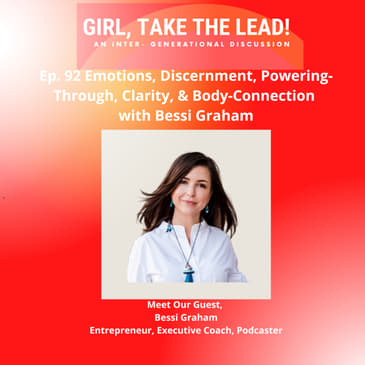
Bessi Graham (Millennial) joins Yo to talk about leadership by examining emotions, and cultivating discernment and clarity. They also take a look at “powering-through” and its connection to burning out. One area of particular interest in the discussion was how the body plays in a role and keeps score!
Bessi Graham is an award-winning entrepreneur with over 20 years of experience working with business owners, governments, and large funding bodies to bring doing good and making money back together.
3 Episode Takeaways:
1. Learning to sit with our emotions, having 2 sides that thing that can be a strength can also be a weakness, is probably one of the most important lessons as a leader.
2. There is a massive shift around work - life expectations for younger generations who are choosing to interact differently – they are weary to give their pound of flesh.
3. The pressure of powering-through can be addressed with discernment which can be about observing emotions that can show up, reading our own body & energy.
As Mentioned in the Episode:
Bessi’s Podcast: Both Success and Integrity with Bessi Graham www.bessigraham.com
More about Bessi:
Bessi works with established business leaders who want to build on their success and align their company with their values but are concerned about the impact of these changes on their bottom line. Showing them that they can do good and make money. In fact, doing good is the competitive edge their business has been missing.
Ways to reach Bessi:
eMail:
Website:
LinkedIn: Bessi Graham http://www.linkedin.com/in/bessi-graham-48a31323
Instagram: Bessi Graham https://www.instagram.com/bessigraham/
Ways to reach Yo:
yo@yocanny.com (Yo)
FB group: "Girl, Take the Lead!"
https://www.facebook.com/groups/272025931481748/?ref=share
IG:
yocanny (Yo)
LinkedIn: https://www.linkedin.com/in/yocanny/
00:00:07
Welcome to episode 92 of Girl Take the Lead for Each week we
00:00:11
explore womanhood and leadership.
00:00:13
And I'm your host, Joe Kenny. Today we are joined by our guest
00:00:19
Bessie Graham, a millennial, to talk about leadership by
00:00:23
examining emotions and cultivating discernment and
00:00:27
clarity. We'll also discuss Powering
00:00:31
through and its connection to burning out.
00:00:35
One area of particular interest in a discussion was how the body
00:00:40
plays a role and keeps score. Here's a bit more about Bessie.
00:00:47
She is an awardwinning entrepreneur with over 20 years
00:00:51
of experience working with business owners, governments and
00:00:55
large funding bodies. Bessie works with established
00:01:00
business leaders who want to build on their success and align
00:01:04
their company with their values, but are concerned about the
00:01:08
impact of these changes on their bottom line, showing them that
00:01:14
they can do good and make money. In fact, doing good is the
00:01:19
competitive edge their business has been missing.
00:01:23
Hope you'll enjoy the listen. Here you go.
00:01:30
Hello, Bessie. Welcome to Girl Take the Lead.
00:01:33
And we are so glad you're here. Thank you.
00:01:36
It's lovely to have this conversation with you, right?
00:01:40
And why don't we start by first telling our audience welcome
00:01:43
about yourself? Sure.
00:01:45
So I am in Melbourne, Australia, so other side of the world and I
00:01:51
was born and and raised in Sydney, so a different part of
00:01:55
Australia, but lived here in Melbourne for 20 years.
00:01:57
And in terms of setting a little bit of context around my
00:02:03
background and the things that I'm passionate about relating to
00:02:08
our conversation today, I really am someone who has.
00:02:13
Lots of different things that I love, but have worked in my
00:02:17
career to find spaces where I could bring different things
00:02:21
together and have a common purpose, if you like, around
00:02:28
trying to help people build businesses that could actually
00:02:31
have more of an impact in the world.
00:02:33
So I combine some of the aspects of my study around leadership
00:02:38
and how do we actually? Really set a vision and lead
00:02:42
people well and connect that in with then business leaders and
00:02:48
working with them to figure out how do we actually from that
00:02:52
point of view of being able to show up as a whole person in our
00:02:55
work. How do we build an organization
00:02:58
that reflects our values, that reflects what we want to be part
00:03:00
of contributing to in the world? And not find ourselves in a
00:03:03
position where we feel like we're one person at home and
00:03:07
then we're a different person at work.
00:03:09
So it's really about bringing those pieces all together and
00:03:12
letting people step more fully into that fullness of who they
00:03:16
are and feel both a sense of fulfillment but also be able to
00:03:21
do great work using their skills and talent in the world.
00:03:25
Well, what what do you think? What emotions do you think get
00:03:28
it kind of in the way of leadership?
00:03:33
Oh my goodness, so many, in many respects.
00:03:38
You know, I think it's probably a matter of depends on the
00:03:43
season of life you're in, the context or role you're in,
00:03:47
expectations. There's all different pieces
00:03:50
that are external to us that I think really significantly
00:03:55
impact which emotions we're experiencing the most of in any
00:03:59
given situation. And so I think one of the
00:04:03
pieces, if leaders were honest with themselves about, you know,
00:04:07
how they're they're feeling, is that when we're in a good place
00:04:11
and we're in flow, then being the person that everyone relies
00:04:15
on is actually energizing. Having to make lots of decisions
00:04:18
is energizing. But if we find ourselves in a
00:04:21
place where we're a bit exhausted or run down or
00:04:24
starting to feel taken advantage of or resentful, any of those
00:04:27
feelings? Then the very pieces that were
00:04:31
seen as our strengths and that we found energizing suddenly
00:04:36
flip and it becomes a demand and expectation and a pressure.
00:04:42
And so if I go back to those pieces that are deeply in how I
00:04:47
operate in the world, I love for people to start to get more
00:04:52
comfortable and honest with themselves about.
00:04:54
The fact that two things can be equally true, and I think with
00:04:57
emotions, with strengths, with leadership, that is even more
00:05:02
apparent than in other areas, because there can be a sense of
00:05:07
confusion if you don't learn to sit with that paradox.
00:05:11
Because you'll say, hang on a minute, I love making decisions
00:05:14
or I like being the person who's in the position of authority.
00:05:17
Why is it that I just? Was really rude and defensive
00:05:22
with that person when they asked me to make a decision like so.
00:05:25
I think that piece of learning to sit with our emotions, having
00:05:30
two sides and the thing that can be a strength can also be a
00:05:33
weakness, is probably one of the most important lessons as a
00:05:37
leader connected to tuning into those different emotions we
00:05:40
experience. Yeah, And I think sometimes it's
00:05:44
just being a human being, right? Absolutely.
00:05:48
Sometimes you can use a title like later and then it kind of
00:05:51
becomes, oh, but I'm not the boss and it's like, no, no, it
00:05:54
doesn't need to be that right? Right.
00:05:56
And I also think admitting your humanity to your team makes it
00:06:07
even more authentic. They feel closer to you.
00:06:10
They trust you more. Yeah, I think that's an
00:06:14
interesting one. I.
00:06:15
I've had a few conversations with people lately around that
00:06:19
idea. One of the things that I think
00:06:21
we need to be aware of with that, there's a lot of research
00:06:26
and different pieces out there or books that talk about that
00:06:30
very piece of you know, the role of vulnerability and humility
00:06:34
and being honest with a team or your family or those around you
00:06:38
when you don't have it all together or you don't know the
00:06:41
answer. And I think one of the pieces
00:06:43
that we have to be careful with is with anything in life.
00:06:48
Something can be true in one context, but there is nuance to
00:06:53
that. And I don't know about you, and
00:06:55
maybe this is an interesting kind of thing to explore.
00:06:58
But I have found that there are situations where unless you
00:07:03
first come into that situation and have built some kind of
00:07:07
credibility with people jumping straight to, I don't know what
00:07:11
I'm doing or I need help. He's actually not a wise, I
00:07:17
think that's very. I can see what you're saying
00:07:19
there, yeah. And so there is a piece of
00:07:22
having to, and that comes with some experience and wisdom.
00:07:26
But I also think we need to be a bit more gracious and aware of
00:07:32
our own privilege or position or authority in some situations
00:07:36
when we demand of others that they need to be vulnerable or
00:07:39
they need to say when they need help or put your hand up, like
00:07:42
don't be embarrassed, Not everyone steps into a room and
00:07:47
is treated as if the starting position is you are competent.
00:07:52
You know what you're doing and you can be trusted.
00:07:55
That is not everyone's experience.
00:07:57
And so I think when we talk about some of those quite
00:08:02
vulnerable aspects of putting yourself out there, we have to
00:08:06
also be conscious of who we're talking to and whether for them
00:08:10
that is going to be more difficult than say for example,
00:08:13
a lot of the books on leadership and in the business world in
00:08:17
particular that talk about these great examples of a leader
00:08:19
coming in and. Saying that they didn't have
00:08:22
expertise in this area and they needed their team.
00:08:25
Often they are written by men and the reality is that a a man
00:08:31
can walk into a room and the starting point is you're
00:08:34
capable, you know what you're doing and and so I think we just
00:08:37
do need to tune into that a little bit.
00:08:39
That's a very, very good point. Almost like reading the room and
00:08:43
where the power exists and who's saying what and who's leading
00:08:47
what. Yeah, because I had this image
00:08:50
when you were talking of someone walking into a room without the
00:08:52
context of being established as a leader and they start saying
00:08:59
that they don't know what to do, that would totally freak me out.
00:09:03
Like, wait a minute, you're getting the big bucks.
00:09:06
You're supposed to know these. Things.
00:09:08
And that's a good point too, because I think we can sometimes
00:09:12
use that as a cop out. Often I've had those
00:09:15
conversations with leaders. Where you can see their
00:09:19
discomfort around making a decision and it actually being
00:09:23
on them. And so there's actually the
00:09:25
continued attempt to push that off and avoid.
00:09:30
And there are times when, regardless of whether you
00:09:35
actually do know what to do or have all of the information, if
00:09:38
you are in, if you find yourself in that position where there is
00:09:43
authority or position, or as you said, you're being paid to do
00:09:45
that, it is your job. Then it's actually not all right
00:09:49
to push the risk and decision making on to other people who
00:09:52
are even less equipped to do that and it is not their
00:09:55
responsibility. So with any of that, you know it
00:09:58
all comes back to one of my favorite words which is
00:10:00
discernment, which is about we do regardless of where we find
00:10:03
ourselves. For any of us in life you need
00:10:07
to be able to do that piece of reading.
00:10:10
The room, time and place is important and what works in one
00:10:13
context won't necessarily in a different.
00:10:17
Do you think there's any generational differences there
00:10:19
like Dori, Gen. Z or millennial?
00:10:24
Young leaders look at this and go they have a different take on
00:10:29
it. I think so.
00:10:31
I mean, I think there's personality differences.
00:10:33
I think there's differences around.
00:10:37
Gender, there's differences depending on where you grew up
00:10:41
and what you're used to interacting with.
00:10:43
But at the level of generationally, yes, I do think
00:10:46
there are some of those. Come back to parts of the
00:10:49
conversation we've already had around either power dynamics or
00:10:53
your level of experience and whether we like it or not.
00:10:56
In most organizations there is still a sense of hierarchy.
00:10:59
And so something could be framed as a generational piece, but it
00:11:03
might actually just be that we need to.
00:11:06
Allow for or create a different platform for someone simply
00:11:09
because they are more junior or have less experience.
00:11:12
So sometimes I think we label it as generational and it may just
00:11:17
be that they're in a junior position.
00:11:20
And so those pieces we talked about are different because they
00:11:23
can't come into a room and interact in the same way someone
00:11:26
can who's got 25 years of experience and is a subject
00:11:29
matter expert, for example. So that piece.
00:11:31
Has generational consequences. I do think one of the bits
00:11:35
that's quite interesting when we think about some of these
00:11:38
conversations around emotions and being our whole self,
00:11:43
particularly in sale work context, generationally there is
00:11:47
a massive shift around well. I actually don't want to work in
00:11:54
a place where I can't be myself or where there is just an
00:11:58
expectation that I will not have a social life or that I'll give
00:12:03
everything to this organization with no actual security, that
00:12:07
they will look after me when times are tough.
00:12:09
So I think there are shifts that as younger generations have
00:12:15
watched, society and changes occur.
00:12:20
That they are choosing, quite intentionally, how to interact
00:12:23
in a work context that is informed by different experience
00:12:28
and that has different expectations to older
00:12:31
generations who probably came into their work life with a
00:12:36
sense of okay. You do a good job, you will be
00:12:39
taken care of. You will work your way up that
00:12:43
ladder and. That piece I don't think is the
00:12:46
same either expectation or experience of younger
00:12:49
generations. And so therefore, there's a
00:12:51
weariness to give that pound of flesh or go above and beyond in
00:12:56
a context where the relationship is different.
00:12:59
Sometimes it's hard to read what's going on for a younger
00:13:03
generation because I I've had this experience where I walked
00:13:07
into classroom at San Jose State to teach.
00:13:10
They were all mute. It's like pulling teeth, you
00:13:15
know, because and you could make the mistake and think there's
00:13:21
nothing going on on the other side.
00:13:23
But it is far from that. And once you crack kind of the
00:13:29
shell, you know, being approachable and being authentic
00:13:33
and that you are, you care about what's going on.
00:13:38
Did that went in that setting? Do you think was some of that
00:13:42
about being used to consuming information and it not
00:13:45
necessarily being a two way conversation or like that they
00:13:49
were taking it in? But yeah, I would be curious.
00:13:53
The word I think you used was leery.
00:13:56
They are very skeptical of trusting social media.
00:14:01
You know, like they're the first ones to tell you to say, oh
00:14:04
professor, you should never be on TikTok, whatever they're
00:14:07
telling you, it's a lie. You know, it's like they they
00:14:10
have a skepticism that perhaps other generations don't have.
00:14:16
But once you crack it, and once you're in it with them and
00:14:21
you're you're teamed up, my God, the resource, the unbelievable,
00:14:27
wonderful ideas, the creativity, the problem solving.
00:14:31
Yeah. And I wonder, I mean that is,
00:14:34
it's an interesting thing because again, when we think
00:14:36
about how much information people have now been exposed to
00:14:41
that no one even had seen in their lifetime, if it went to
00:14:45
our grandparents or, you know, people beforehand, some of that
00:14:49
skepticism is absolutely warranted.
00:14:53
But I think when we go into these conversations around
00:14:55
things like. Integrity.
00:14:58
Or being able to get to a place where you know and understand
00:15:01
yourself really well and then are able to show up in that way,
00:15:06
those shifts around, a pause to wait and actually observe
00:15:13
someone and see is there some alignment between what they're
00:15:17
saying and how they actually treat me or what they do that
00:15:21
piece? I think is across the board
00:15:23
something that has shifted and that we need to be aware of
00:15:26
whether that's in a business context or in relationships in
00:15:29
general, that the pieces that you could get away with before
00:15:33
of sort of stating something was a core value or stating that you
00:15:37
cared about this topic and then not actually living that out in
00:15:41
your life. I think connected to those very
00:15:44
pieces you just described, you can no longer get away with that
00:15:48
because of all the social media and things where it's like.
00:15:51
You can talk all you like, but there's a video over here that
00:15:53
shows your company doing the exact opposite thing.
00:15:55
So I don't now believe anything you say.
00:15:58
You can't get away with it anymore, which is good, I don't
00:16:00
think we. I don't think it's healthy when
00:16:02
people can get away with that complete false presentation like
00:16:07
this facade of this is who we are as either a person or an
00:16:11
organization and then we behave completely differently.
00:16:14
So I think that's good that we get called out on that and it
00:16:16
sounds like it's a global phenomenon, Ben, just.
00:16:20
Absolutely. Yeah.
00:16:22
Yeah. And and what about this notion
00:16:25
in the States? I think we have a powering
00:16:28
through things, you know, like just keep going, just go, go,
00:16:33
go, go. Do you, do you have that also in
00:16:37
Australia? Yeah.
00:16:38
Look, I think it's probably there's different levels of it,
00:16:42
but I think that is pretty much a in in most settings you will
00:16:50
find the pressure for that, particularly when you then
00:16:54
narrow down the group that you're talking to into people
00:16:58
who are. Achievers, ambitious, driven,
00:17:02
you know, types of personalities or in certain roles.
00:17:07
That piece, I'm going to go right back to what we kind of
00:17:11
talked about before around discernment, because whenever I
00:17:16
see whether it is on social media or it's in a book or
00:17:20
something, people who are pushing that sort of angle of
00:17:26
even if you don't feel like it, push through.
00:17:29
But I also think that it it is this piece of understanding you
00:17:33
need to be able to have some filters to make those decisions
00:17:37
in any situation. Because very often when we go to
00:17:40
the piece of right back to your aspect around what are some of
00:17:43
the emotions that that tend to come up for, for leaders or
00:17:47
people in positions where they're sort of being expected
00:17:50
to to show up at a high level all of those.
00:17:54
Aspects are going to require you in order to sustain it over time
00:17:59
to be able to read your own body and your own energy and say in
00:18:03
this moment. So six months ago I may have
00:18:06
been able to push through and that was the right decision.
00:18:08
But in this moment, is that the right decision for me or
00:18:12
actually would I be better off taking the weekend off and going
00:18:16
really slow and we will get to this on Monday.
00:18:18
Those pieces, I think, are why it is so critical.
00:18:23
To be someone who is more reflective and tuned in and gets
00:18:27
to some of those aspects of clarity and self knowledge
00:18:31
because that can then inform your decision of whether you
00:18:34
should push through because sometimes you do need to or
00:18:37
whether in fact that would be the the worst thing you could
00:18:41
possibly do. Yeah, I love what you're saying
00:18:43
about knowing yourself in the moment.
00:18:48
Yeah. And that because that changes,
00:18:50
that gives us so much. Space that allows us to be more
00:18:53
human to your piece before of actually giving yourself and
00:18:58
others the the recognition that your answer doesn't have to be
00:19:03
the same today. Simply because that's what you
00:19:06
said yesterday so many times I think we go on automatic pilot
00:19:12
to we don't we don't know in the moment that we're people
00:19:16
pleasing in the moment we might just okay I'll you know I'll do
00:19:21
it and there's a bit of resignation.
00:19:24
There's probably some resentment.
00:19:25
There's other things going on I know for myself that I need to
00:19:31
like take a moment maybe write what's going on for me just so I
00:19:36
can be in touch with that and go okay.
00:19:40
There's that whatever emotion is coming up, and it almost has to
00:19:45
be, like you said, a reflective moment like where I am.
00:19:49
And I also am very interested in what you were saying about
00:19:52
tuning into your body, because it's going to show up there
00:19:56
first, right? Yeah.
00:19:58
And I think we get so used to, certainly, and I'm my experience
00:20:03
would suggest it's the same in the US but when we live in such
00:20:06
a fastpaced world and we are doing so many things and
00:20:11
juggling things and jumping between this responsibility and
00:20:14
that. We become over time so used to
00:20:19
just pushing down any sensations or feelings in our body because
00:20:25
well, I don't have time to listen to the fact that my back
00:20:27
sore or my shoulders are really tight or.
00:20:30
And so we we have become practiced at ignoring that.
00:20:36
And we it's not that it's gone away.
00:20:39
There's a great book. The body keeps score.
00:20:41
And you know, I think some of those aspects, at different
00:20:46
points in your life, your body may yell quite loudly at you
00:20:50
until you listen because you have been sort of pushing it
00:20:54
down. But if we can do that in a
00:20:56
gentler way, where we don't wait till it's a disaster and our
00:21:00
body falls apart and we have to be in bed for two weeks because
00:21:03
we're so sick. If we can preemptively be going,
00:21:07
ah, I'm just going to start to tune in.
00:21:09
Even if it's just a little bit and it's a little tightness in
00:21:11
your chest or you go, oh, that's interesting.
00:21:15
Like I only just walked up the stairs and I didn't do it fast,
00:21:18
but I'm a bit breathless, like what's happening?
00:21:20
Am I really breathing in a shallow way?
00:21:22
Why is that? So the curiosity to tune in and
00:21:27
not see that as either weakness or a waste of time, but it is
00:21:32
just a practice that will filter into your effectiveness in a
00:21:37
whole bunch of different areas. That's interesting too, because
00:21:40
when you talk about something like that, where we're trying to
00:21:45
shift gears quite significantly from how we might operate in the
00:21:48
rest of our our life, it can be tricky because your brain is
00:21:53
going, oh, this is it, I'm trying to learn a new skill.
00:21:55
Or like, what are we doing here? Am I doing it right?
00:21:57
Is this the right pose? You know, so they can be a whole
00:22:01
bunch of things going on in our minds that are actually playing
00:22:05
into part of why we can't feel or experience our body.
00:22:11
Definitely I can. When you're in the the flow, you
00:22:16
don't hear the thoughts like I I can.
00:22:19
I know that I've had those moments when I'm in the flow,
00:22:23
I'll be, I'll like, oh that was great.
00:22:25
I didn't think about anything in that moment, You know, then the
00:22:28
thought comes and then it. But whatever.
00:22:30
It's. I appreciate what you're saying
00:22:32
because I really would like to do probably some episodes about
00:22:36
body awareness because I do think as a leader.
00:22:40
You you do tend to stuff things down and but that's your
00:22:46
biggest. You can have a clue.
00:22:49
That's your clue there of what's going on.
00:22:52
It's interesting too, because I think you're right.
00:22:53
So we've we've stuffed things down.
00:22:56
Partly that has been a tool that we've needed to have because we
00:23:02
tend to be the people who everyone relies on in a crisis,
00:23:05
so everyone else can fall apart and we are stable, you know,
00:23:09
we're solid. The aspect that I think is
00:23:12
interesting when you kind of start to pull that apart is that
00:23:17
even if let's say it's we're talking in a work context, even
00:23:20
if your team are not conscious of it.
00:23:24
So even if they're not people who are tuned tuned into energy
00:23:27
or body language or anything like that, they don't have to be
00:23:31
conscious of it to be subconsciously picking up
00:23:34
tension in your body. Or the aspect that you might be
00:23:38
saying one thing but your facial expression is saying, I am angry
00:23:41
and resentful and you have done a terrible job here, but your
00:23:45
words might be saying the opposite.
00:23:47
So what I think is interesting from that perspective of
00:23:50
actually being effective as a leader is to be honest with
00:23:54
yourself and say actually my physicality, whether that is
00:24:00
body language, facial expressions or even deeper than
00:24:04
that, the kind of energy I'm radiating in a room is having an
00:24:08
impact whether I want to admit it or not.
00:24:11
And this is actually just as important as that conversation
00:24:15
we had around the words we're saying and whether there's a
00:24:17
disconnect between what you are telling your team and then how
00:24:21
you're behaving. The same goes here.
00:24:23
There is a problem if what you are saying and how you are
00:24:28
delivering that are at odds with each other.
00:24:31
Because even a person who doesn't tune into their
00:24:34
discomfort is going to feel this cautiousness around you now
00:24:38
because they're like you're saying this, but I can't put my
00:24:42
finger on it. But I don't think that's what
00:24:44
you meant. The the aspects again around our
00:24:47
bodies and and learning to become reembodied and not do
00:24:51
that. Dissociation is actually
00:24:54
important for your effectiveness in your role.
00:24:57
It's not just about the beautiful aspects of what it
00:25:01
will do for your own health and wellbeing and releasing tension
00:25:03
and things, which is really important in and of itself.
00:25:06
But I think if you're someone who struggles to go into that
00:25:10
space because you think you know I'm too busy, the selfcare thing
00:25:14
or looking after myself, I'll get to that.
00:25:16
You know I'll have a bath on the weekend or something like okay.
00:25:19
Well, that's not what we're talking about.
00:25:21
So if you can't convince yourself to prioritize some of
00:25:25
these things around the benefits to your own well-being, then I
00:25:30
would suggest you think about it from that perspective of this is
00:25:33
actually interfering with your effectiveness.
00:25:37
And so maybe come at it from that angle.
00:25:40
You talk a little bit about clarity.
00:25:43
Yeah. So I think you know lots of the
00:25:45
pieces that we've already talked about, just like you were saying
00:25:48
we can take aspects around leadership and then think Oh
00:25:53
well, I'm not in a in a position of leadership at the moment.
00:25:55
So these conversations irrelevant.
00:25:57
I think the same piece goes to as we start to have a
00:25:59
conversation around how do you actually make a difference or
00:26:03
what does that look like. I would want to make sure we
00:26:06
start that conversation by saying different that is
00:26:09
relevant for all of us because it will look different for each
00:26:12
person. What we care about or are trying
00:26:14
to contribute to will be different.
00:26:15
So it may not be it ticks these boxes for other people when they
00:26:20
were looking at your life, but you will have things that are
00:26:23
important to you. And so I think the reason why,
00:26:27
from the sense of a meaningful life or a purposeful life, this
00:26:31
is an important conversation to actually start with clarity, is
00:26:35
that for any of us, if we don't begin in that place, my
00:26:40
experience is that we then fall into the trap of whatever the
00:26:45
loudest voices are or the biggest influences on our life
00:26:48
or what other people say we should care about or how we
00:26:51
should behave or what our values should be or our goals should
00:26:54
be, we take those things on board.
00:26:57
So clarity to me is important as a foundational step because it
00:27:01
is the practice to do that tuning in and understanding
00:27:05
okay, what do I actually want here And not to fall straight
00:27:10
into the okay, jump to action, get busy, make a decision and
00:27:17
move. But to really use the, the
00:27:22
clarity exercise to make an intentional decision about where
00:27:28
do you even want to go because then that provides for you the
00:27:34
filter that we were talking about before.
00:27:35
If you don't have the clarity, then you can have as many
00:27:39
conversations as you like around.
00:27:41
I want to feel aligned and I want to be able to be my
00:27:44
authentic self. Well, how do we know what to be
00:27:48
aligned to? How do we know if we're actually
00:27:51
trending in the direction of those goals if we haven't
00:27:54
actually been quite specific of what they are.
00:27:56
So again, clarity is important because of what it provides you.
00:28:04
When you then are in the positions of having to make
00:28:07
decisions, you now have a filter.
00:28:08
You now have a way to assess. Is this something that is
00:28:12
actually a good use of my time? But I could talk to you forever,
00:28:16
but I think we're at time. So is there anything that you
00:28:21
want to say that we didn't cover that?
00:28:25
I know that there's a ton of things that, oh, lots of things
00:28:28
apart. I think if there was one piece,
00:28:32
an aspect that I'm highlighting with the leaders that I work
00:28:37
with a lot at the moment is to say that what I really encourage
00:28:43
people to do is to stop thinking that there's a bunch of things
00:28:47
that they'll do one day. So you know, whether it's some
00:28:51
of these pieces we've talked about today around getting to
00:28:54
clarity on certain things or starting to tune into your body
00:28:58
or understand what it is that you actually value and want to
00:29:03
be putting your effort towards in the world or contributing to
00:29:07
the. The last thing I would love to
00:29:09
just leave people with is you can actually be starting that
00:29:14
now. You can be finding what does it
00:29:17
look like for you. What is your unique version of
00:29:20
bringing together some of those ideas of a more fulfilling life
00:29:25
that's still unapologetically is?
00:29:29
Again, depends on you, but maybe ambitious and have really big
00:29:32
goals, but it's not at the cost of other people or the cost of
00:29:36
your relationships or the cost of your health and your body and
00:29:39
energy levels. So I think it would just be that
00:29:42
piece to say you can actually begin that now and be more
00:29:46
intentional and find ways to take some of these reflective
00:29:51
exercises that we have traditionally thought were, you
00:29:56
know, for different other people who were going on a retreat, not
00:30:01
for achievers. You can actually take some of
00:30:04
this and see it as a way to both deepen and strengthen your work,
00:30:09
but also to give you longevity. You're going to need energy.
00:30:12
This is a marathon, not a Sprint.
00:30:13
So I would say start now and do not wait till it gets to a
00:30:18
breaking point and you're so exhausted that we're then
00:30:21
rebuilding from the ground up. That's lovely.
00:30:25
That's lovely. Definitely.
00:30:27
I guess we'll have in the show notes how to reach you, but is
00:30:30
there ways that our listeners can follow you?
00:30:33
Now? Best place to go is just to my
00:30:36
website because from there it will funnel you everywhere.
00:30:38
So Bessie graham.com. You'll be able to find the
00:30:41
podcast, some blogs and different articles and my social
00:30:45
media links in terms of LinkedIn and Instagram.
00:30:48
But the website is 1 easy spot to head to just to think about
00:30:54
some of these ideas more. So Bessie, you're you're
00:30:56
terrific and I'm so glad that you were with us today and so
00:31:01
many of the topics you covered have been on my mind and
00:31:05
hopefully being integrated into my podcast.
00:31:08
So you were absolutely perfect. I hope this is helpful for
00:31:12
people I. I think, I think really it was.
00:31:15
Thank you again for being here. My pleasure.
00:31:18
Thank you so much. Bye everybody.
00:31:25
Thank you for listening today and we sure hope you enjoyed
00:31:27
this episode. If you did, please leave a
00:31:29
comment wherever you listen to your podcasts.
00:31:32
Join our public Facebook group, Girl Take the Lead or visit our
00:31:36
website girltaketheleadpod.com. We also have a YouTube channel
00:31:40
where your subscription would be appreciated.
00:31:43
Once you're on YouTube, search at Girl, take the lead.
00:31:49
Here are the three takeaways from this episode #1.
00:31:54
Listening to sit with our emotions and knowing that we
00:31:58
have two sides that can be a strength as well as a weakness
00:32:03
is probably one of the most important lessons we can have as
00:32:08
a leader. Two, there is a massive shift
00:32:13
around work life expectations for younger generations who are
00:32:18
choosing to interact differently.
00:32:21
They are very weary. To give their pound of flesh. 3
00:32:28
the pressure of powering through can be addressed with
00:32:32
discernment, which can be about observing emotions that can show
00:32:36
up and reading our own body and energy.
00:32:42
On Thursday, we'll have a sound bite and continue this
00:32:45
conversation with Bessie to explore the question how we can
00:32:50
get along with someone. With differing values than us I
00:32:55
see had so many great things to say.
00:32:57
I wanted to give you the benefit of this part of our
00:33:00
conversation. I know many of you are working
00:33:04
with or for someone who can be very difficult and different
00:33:08
than you and perhaps Bessie's thoughts on this can help you.
00:33:16
Thanks for being here and talk to you soon.
00:33:19
Bye.