
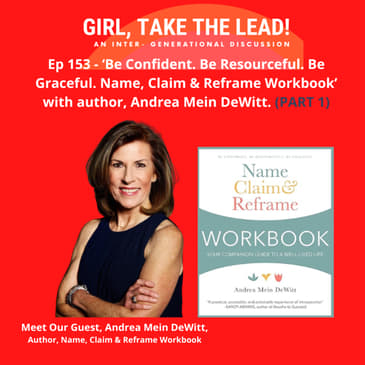
Andrea DeWitt returns to “Girl, Take the Lead!” Podcast to discuss her new workbook, Name Claim & Reframe Workbook, Your Companion Guide to A Well-Lived Life. Yay!!
This is Part 1 of a 2-Part Series.
I had the opportunity to receive an advance copy and wrote the following book jacket endorsement:
“Andrea provides a gentle path to examining the origin of our core wound beliefs and limited thinking on a deeper level so we can let go of people pleasing and quiet even the loudest inner critic. Her step-by-step process is a masterful blend of transformative insights and practical exercised designed to awaken an inner power that is both empowering and impactful. Can I get an Amen to that?!”
Here are 3 Episode Takeaways:
1. The 9 Core Wound Beliefs can help us outline our negative core beliefs and the personality we develop to compensate for those.
2. The people pleasing inner critic is rooted in fear and is focused on earning love.
3. We should remember what Andrea’s mom had to say about accepting a complement: “When someone is giving you a compliment, NEVER interrupt.”
As mentioned in the episode:
Andrea’s Workbook, Name Claim & Reframe Workbook
Andrea’s Book: Name, Claim, & Reframe
Ep. 72, Andrea Mein DeWitt, Name Claim & Reframe (NCR) author, returns and relates her book Name Claim Reframe to female bullying
Ep. 48, A Discussion with Andrea DeWitt about her book, ‘Name, Claim, & Reframe’
You can get a free copy of the masculine and feminine trait grid mentioned in the episode here: Website: www.andreadewittadvisors.com – just sign up for the free tool kit. If you have the book, check out page 24.
Event Coming Up:
Andrea has an upcoming NCR Salon on THURSDAY, MAY 16TH
Using Name, Claim and Reframe to Heal Past Conflict
Zoom 2:00pm Eastern (11:00pm Pacific)
$97.00
Program description:
What if you could heal past relationships with refreshed vision?
Use to use NCR tools to understand past conflicts so you can REFRAME a negative experience with new perspectives and a refreshed vision for the person you are becoming. You’ll learn tools so proactively processing a regret within the structure of Name, Claim and Reframe® and harvesting learning, insights and maybe even some intentional strategy for the future you hope to create.
Link to Fall 2024 NCR Theme Programs-Starting September 5
More about Andrea:
Andreas holds a M.Ed. in Reading Leadership from UC Berkeley and is a Certified Professional Coach through the International Coaching Federation and the Co-Active Training Institute. She lives in the San Francisco Bay Area.
Ways to reach Andrea:
Andrea Mein DeWitt, M.Ed., CPCC, ACC
Life and Leadership Coaching | DeWitt Advisors
www.andreadewittadvisors.com
andrea@dewittadvisors.com
Learn more about her BOOK
Watch her WEBINAR
Read her BLOG
Follow her on Instagram
Ways to reach Yo:
Website: https://www.girltaketheleadpod.com
Public FB group: Girl, Take the Lead! https://www.facebook.com/groups/272025931481748/?ref=share
IG: https://www.instagram.com/yocanny
YouTube: @girltakethelead
LinkedIn: https://www.linkedin.com/in/yocanny/
[00:00:00] Welcome to episode 153 of Girl, Take the Lead, where each week we explore
[00:00:11] womanhood and leadership.
[00:00:13] And I'm your host, Yolanda Canny.
[00:00:16] Andrea Main Dewitt returns.
[00:00:20] To discuss her new workbook, Name, Claim, and Reframe workbook, your companion guide
[00:00:28] to a well-lived life, which you can pre-order from Amazon and will launch April 30th.
[00:00:35] I had the opportunity to receive an advanced copy and wrote the following book jacket endorsement.
[00:00:43] Andrea provides a gentle path to examining the origin of our core wound beliefs and limited
[00:00:49] thinking on a deeper level so we can let go of people pleasing and quiet even the loudest
[00:00:56] inner critic.
[00:00:57] Her step-by-step process is a masterful blend of transformative insights and practical exercises
[00:01:05] designed to awaken the inner power that is both empowering and impactful.
[00:01:11] And can we get an amen for that?
[00:01:15] Andrea and I got chatting, and we covered so many yummy things.
[00:01:20] I've made this into two part series.
[00:01:24] This is part one, and in it we'll cover a basic background of name, claim, and reframe in case
[00:01:31] you missed our previous episode.
[00:01:33] But not to worry, I'll have the links in the show notes in case you'd like to hear
[00:01:37] more about that episode.
[00:01:39] We'll also talk about core wound beliefs, energy imbalance, people pleasing the inner
[00:01:46] critic, and boundaries.
[00:01:50] And part two, we'll continue the conversation, which will include getting feedback, accepting
[00:01:56] compliments, which can be very difficult for us to do.
[00:02:00] And we'll even talk about flying helicopters and Hawaiian healing words.
[00:02:05] All good stuff.
[00:02:07] Enjoy the listen.
[00:02:08] Here you go.
[00:02:13] You know I love it when a friend comes on the show.
[00:02:18] Thank you.
[00:02:19] Thank you for coming on the show again, Andrea.
[00:02:22] We just love you.
[00:02:23] We love your book.
[00:02:24] We love your workbook.
[00:02:25] I can't wait to tell my listeners more about this.
[00:02:29] So thank you for coming today.
[00:02:30] Oh yeah, I was so excited.
[00:02:33] This is my first press for the workbook.
[00:02:37] So of course I was just delighted that you and I were going to get to open the
[00:02:43] press tour.
[00:02:44] Yay!
[00:02:45] I'm the launch.
[00:02:46] I'm the opening act for the launch.
[00:02:48] Yay!
[00:02:49] Well, why don't we start?
[00:02:51] Because some of our listeners may not have heard our previous episodes on name,
[00:02:56] claim and reframe.
[00:02:57] But I will put that in the show notes for everyone to refer to.
[00:03:01] But if you could introduce yourself and tell them about your book and you know
[00:03:07] that would be great.
[00:03:08] Great place to start.
[00:03:09] I'm Andrea Mindy Witt and I am a leadership coach and author.
[00:03:16] And I wrote a book that came out in December of 2022 called Name, Claim and
[00:03:22] Reframe Your Path to Well-Lived Life.
[00:03:24] And it was a surprise kind of best seller in that it made the today's show as
[00:03:31] the number one motivational read for 2023.
[00:03:34] And we were excited because what it does is it really takes a simple three-part
[00:03:39] structure and helps people to use life coaching tools in a very practical way
[00:03:47] to respond to life's challenges instead of reacting to them.
[00:03:52] And so that's really what it's about.
[00:03:54] And that's what I do, speak, teach classes and just have a well-lived life.
[00:04:03] So might be good to give some foundation for name, claim and reframe for the
[00:04:09] listeners who haven't heard the previous episodes we've done.
[00:04:14] So maybe that's a good place to start today.
[00:04:16] That is a great place to start.
[00:04:19] Name, claim and reframe is, has three parts.
[00:04:23] The first part is name the source of your emotional trigger.
[00:04:27] Why am I reacting to that challenge instead of responding to it?
[00:04:33] Claim resonant actions that match up with your core values.
[00:04:38] When you understand what your core beliefs are, it's easier to understand why you can't,
[00:04:44] why you're upset about something and it's easier to bring yourself back in integrity
[00:04:48] by choosing actions that really align with your core beliefs.
[00:04:54] And then once you've named and claimed, you can reframe.
[00:04:57] And think about what is, what actions and what mindset is going to serve my goals for the future.
[00:05:06] Oftentimes if we can separate our ego, we can really look at the big picture
[00:05:12] and shift our perspective and harvest learning.
[00:05:14] And so it's really an optimistic way to go about even the trickiest things that happen in our lives.
[00:05:22] Right.
[00:05:23] Well, and I think you make the point too that we can't give it a name unless we see it.
[00:05:31] Like we have to observe it and then the awareness of that, it kind of diffuses the power that it has.
[00:05:40] Exactly. I mean, this is really Yolanda about conscious awareness.
[00:05:46] When we're conscious about where we are in any given moment,
[00:05:51] then we have the power to choose again.
[00:05:55] You know, if you're talking on the phone to the two contrasts, which is oftentimes triggering.
[00:06:02] And I've been in situations where I think, OK, I'm getting triggered.
[00:06:06] I'm starting to get angry.
[00:06:08] I'm reacting and then I can choose again.
[00:06:11] I'm sorry, this is really frustrating.
[00:06:13] Let me ask again.
[00:06:15] I'm going to choose again to ask in a different way and then I can choose again to ask.
[00:06:21] So I'm claiming a different action.
[00:06:23] And I think that when you think about even just at work or with your spouse or somebody cuts you off in traffic,
[00:06:33] you can choose to be reactive and that gets your cortisol levels up or you can choose to be responsive.
[00:06:40] OK, maybe that person's having a hard day.
[00:06:44] I'm just going to let them go in front of me. It's fine.
[00:06:46] Yeah.
[00:06:47] Right there, you've chosen yourself.
[00:06:49] You know, why raise your cortisol levels?
[00:06:52] Right.
[00:06:52] Regardless of how I mean, somebody else might have have reactive behavior,
[00:06:57] but you don't need to take that energy on.
[00:07:00] And this is really about just being aware.
[00:07:03] It doesn't mean you're not going to that you're not going to be triggered.
[00:07:06] You will be triggered for sure you will.
[00:07:08] But being aware of where am I and what do I need to feel better?
[00:07:14] So the workbook is your is kind of I when I read it, it was like a guide for me to really look at.
[00:07:30] All the different aspects of each of those elements.
[00:07:35] And you just sort of do just a marvelous, marvelous job of giving us the questions
[00:07:43] and giving us what we need to really look at with those triggers and those things that are happening.
[00:07:53] You know, what did you realize in the first when you wrote the book that
[00:07:58] oh, this needs to be a workbook too or how did that come about?
[00:08:01] No, it's all accidental.
[00:08:03] I mean, it is all accidental.
[00:08:05] But what happened with this with the book was that we found that people,
[00:08:11] this concept of name claiming refrain just hit like wildfire.
[00:08:17] And so we decided we really needed to take the concepts in the book and put prompts
[00:08:26] and exercises back into the hands of the reader.
[00:08:29] And I think that they're again, I'm a teacher, you know, first and foremost.
[00:08:34] And there are different kinds of learners.
[00:08:37] Not everybody wants to read a self help book.
[00:08:40] Some of people just don't want to read a self help book, but people could take this workbook
[00:08:45] and they don't have to even go, you know, from the beginning to the end,
[00:08:49] they can go right in the middle saying, hey, I'm having an interpersonal conflict right now.
[00:08:55] Oh, there's prompts here that I can use to help navigate that or gosh,
[00:09:00] somebody really tromped on one of my core beliefs.
[00:09:03] What can I do about that?
[00:09:05] And it was so interesting.
[00:09:08] Yo, I when I was doing I did some beta programs.
[00:09:14] I did some theme salons and I did some programs where I took people through the
[00:09:18] workbook to sort of as a to get more information.
[00:09:22] And I said to my publisher, I really want to do this before we publish
[00:09:25] because I want to make sure we've looked at every angle.
[00:09:28] And there were so many areas that I got new perspectives from my readers.
[00:09:34] And it was so exciting.
[00:09:36] So I'm hopeful that we were able to expand the exploration
[00:09:43] and in ways that that will really help people to use name and claim
[00:09:47] and reframing in their lives again and again and again.
[00:09:51] That's my hope.
[00:09:53] Well, you integrate the the book so well, your original book.
[00:09:58] You integrate inspirational quotes that I loved.
[00:10:03] And we'll talk about a few of them as we go through this episode.
[00:10:08] But it does seem like you've.
[00:10:12] Thought it all, you know, all the aspects and pulled it all through.
[00:10:15] And it sounds like your readers and the people that have
[00:10:20] attended your workshops, etc.
[00:10:22] were great resources for you to put this workbook together.
[00:10:26] Well, you know what I think?
[00:10:28] And this is a reframe we talk about separating your ego.
[00:10:31] Once you write something, you don't own it anymore.
[00:10:34] And so when you put something out into the world,
[00:10:37] it's always incredible.
[00:10:39] Talk about feedback, understanding how things are landing.
[00:10:43] And I learned things, things that maybe didn't land well
[00:10:47] or maybe I didn't do as well as I could have.
[00:10:49] And so it was an opportunity for me to to go at it again and think about, OK,
[00:10:53] well, maybe I didn't make that accessible.
[00:10:55] Maybe this this will help people to see themselves in this work.
[00:11:00] And so it's really about helping people to be more strategic
[00:11:07] and resourceful and graceful in their own lives.
[00:11:11] And you know, that right there, if we can learn to respond
[00:11:17] and be in integrity, our lives are just calmer and we feel more grounded.
[00:11:23] And man, I want one of that.
[00:11:25] Don't you?
[00:11:26] Sounds delicious.
[00:11:28] Definitely.
[00:11:29] Well, it definitely comes through that you this is a book.
[00:11:35] About I mean, it just seems like it's not about you so much as about
[00:11:41] the people that are going to actually do the work in the workbook,
[00:11:44] like a shift, like sometimes we put content out from us.
[00:11:50] And you don't know quite where it's going to land.
[00:11:52] But your workbook is definitely got the voice of somebody
[00:11:58] who's actually going to walk through this, who's actually going to do it.
[00:12:03] And you've taken such care to help.
[00:12:06] Thank you. We did.
[00:12:08] I think we did.
[00:12:09] I think the first book, the book that I wrote,
[00:12:14] you know, I had to show people examples of, you know, this is
[00:12:18] this is what happened to me or this is what happened to a client
[00:12:21] and this is how we worked it.
[00:12:23] And I think you have to show people would say, oh,
[00:12:27] I saw myself in that story or I see that.
[00:12:30] And so the this workbook is really about being able to take those stories
[00:12:36] because everybody's got something like that.
[00:12:39] And this overlay in your life.
[00:12:41] I do make references to the book number one, although it's not required.
[00:12:47] It sometimes gives you a great context and then you get all fired up
[00:12:49] and you go, OK, now I'm going to go do that section.
[00:12:53] So good because you put like chapter and pages and things.
[00:12:57] So that's very, I think a good.
[00:12:59] I have to say my editor, I've taken my editor credit for that
[00:13:02] because he was he goes, you gotta show people where they are.
[00:13:06] And I think that it's very user friendly.
[00:13:09] Yeah, oh, totally, totally user friendly.
[00:13:13] What? You know, and I just had to go, whoa,
[00:13:17] when you kind of spelled out the nine core wounded beliefs.
[00:13:25] That was so amazing.
[00:13:27] I thought you nailed there like in the list.
[00:13:30] I said, oh, that's I think that's my mom.
[00:13:33] And then went, oh, this one is me.
[00:13:38] But I mean, can you talk a little bit about that?
[00:13:42] Maybe share some of those aspects
[00:13:45] so our listeners get a sense of what that's about.
[00:13:47] Absolutely. And I want to preface it by saying,
[00:13:52] you know, that I am a I'm a certified life coach.
[00:13:55] I am not a therapist.
[00:13:57] And so I really stayed in the workbook.
[00:14:00] These are these are just, you know,
[00:14:04] a collection of of core wounds.
[00:14:08] And I the list is by no means complete,
[00:14:12] but it's a place to start.
[00:14:14] And my my hope for doing it and it was in the name step,
[00:14:18] name your triggers, your limiting beliefs in your poor wounds.
[00:14:21] We all have poor wounds.
[00:14:23] And so to go in and sort of receive yourself with grace and compassion.
[00:14:27] That was my my hope that you could just read them and think, OK,
[00:14:32] this is this is the limiting belief.
[00:14:34] And this is how I show up because of that limiting belief.
[00:14:38] Yeah. So having that context when you go into the workbook
[00:14:43] and do the shadow work of what is your inner critic say?
[00:14:47] It's really great. It's a great context.
[00:14:50] I also really I provide other references
[00:14:54] that if you want to do more work and read more, please do.
[00:14:59] I am not a therapist.
[00:15:00] I'm to say it again because I'm not.
[00:15:03] But I just want people to have a context
[00:15:07] to really do the exploration and do the interesting.
[00:15:10] Well, and to see the correlation between this is what happens,
[00:15:15] what might happen in the belief that you have.
[00:15:18] Exactly. And I think we had talked
[00:15:22] before we went on, you said that number seven, I think.
[00:15:26] Yeah, number seven.
[00:15:28] The limiting belief is I am I am incomplete.
[00:15:33] Yeah. And the so it's, you know,
[00:15:36] there must be something missing from me.
[00:15:38] I'm not enough.
[00:15:39] And I think so many of us feel that way.
[00:15:42] I'm not especially when we compare and we watch somebody do something.
[00:15:46] We think, oh, I'm not doing that or I should do that.
[00:15:49] And, you know, it's it's really that, you know, I can't.
[00:15:55] That's not true.
[00:15:56] All of us at some point feel that way.
[00:15:59] So we can get under me.
[00:16:01] You know, why I'm feeling that way and maybe wear it.
[00:16:04] You know, maybe somebody maybe somebody said that to me.
[00:16:08] Maybe a teacher said that to me or a parent said that to me.
[00:16:12] And how can I now as a more
[00:16:17] conscious adult nurture that child inside me and release that limiting belief
[00:16:24] and curate a new one?
[00:16:27] Yeah, work for me better.
[00:16:30] I agree.
[00:16:31] And I think we almost have to keep reminding ourselves of it.
[00:16:35] Like it isn't like there you're cured.
[00:16:40] You're not now.
[00:16:42] It's like, you know, that that's in there.
[00:16:45] And it pops up and then you kind of, oh, that's where that.
[00:16:50] Yeah, I see it now.
[00:16:52] I had a client that came to me.
[00:16:55] And we were we were doing this work.
[00:16:59] And I just stopped and I said, stop.
[00:17:02] You are not broken.
[00:17:06] You are magnificent.
[00:17:09] And my, you know, let's go find let's go find that magnificent spirit
[00:17:14] because she's in there.
[00:17:15] You just she's in there.
[00:17:17] Let's go find her.
[00:17:18] I mean, and it was just like at the end of our time together,
[00:17:23] she was so sparkly.
[00:17:24] And it was, you know, as her coach, it was just so much fun to witness
[00:17:29] her find that magnificent spirit because that magnificent spirit
[00:17:35] lives in all of you, all of us.
[00:17:37] It's there.
[00:17:38] We just have to pull it out and find it.
[00:17:41] Yeah.
[00:17:42] Love it.
[00:17:43] Your light.
[00:17:44] And those things that get in the way, that's that.
[00:17:47] So it takes the light away and that's what we have to use.
[00:17:50] Name.
[00:17:51] And it's our responsibility.
[00:17:54] It's our responsibility to hold our own light and stand in our light.
[00:18:00] Yeah.
[00:18:00] It's nobody's fault.
[00:18:02] You know, somebody maybe didn't have, you know, whatever your
[00:18:05] parent said or whatever that teacher said, well, that that's their stuff.
[00:18:10] Exactly.
[00:18:10] You don't have to take it on.
[00:18:12] You get to choose again.
[00:18:14] Well, and sometimes I think we do take those things on, right?
[00:18:19] And we, we don't realize that it's there.
[00:18:22] Something else will pop up.
[00:18:24] And then we really do have to do the work to get to what is
[00:18:29] underneath that and what's motivating that.
[00:18:32] And I think that's the difference with sometimes with self-help is,
[00:18:38] oh, you're supposed to have this, you know, a spiritual awakening.
[00:18:43] And meanwhile you're down and you're below the line kind of energy
[00:18:50] and you're, you don't realize that you can work through that.
[00:18:55] You don't have to stay below the line.
[00:18:57] You can actually move yourself.
[00:19:00] The first step is to see it.
[00:19:02] Exactly.
[00:19:02] To see that the limiting belief is there.
[00:19:05] Yeah.
[00:19:05] I mean, and that's the, that's the hardest part.
[00:19:08] Yeah.
[00:19:09] You know, because I mean, loving all, all of all of you, I mean, we all have
[00:19:14] fierce bits and rough bits and bits we don't want anybody to see.
[00:19:19] Everybody has bits, but if we can really say, well, actually that bit
[00:19:25] of me that's a little fierce, well, you know, that's my warrior or that's
[00:19:30] my, you know, that's my defensive child.
[00:19:32] Well, you know, what is that defensive child trying to protect me against?
[00:19:36] Well, I don't know.
[00:19:38] So it's just looking at those things.
[00:19:39] I mean, it's, I'm not going to say that it, it doesn't happen in one reflection.
[00:19:45] It's, it's work.
[00:19:46] It's work just to look at it.
[00:19:48] The first step is really just noticing it's there.
[00:19:51] Yeah.
[00:19:52] And then massaging it and playing with it.
[00:19:55] Yeah.
[00:19:56] Loving yourself.
[00:19:57] All of you.
[00:19:59] I think one of the, for, I think we've done about three or four episodes
[00:20:05] on energy because I loved the idea and we went to, you know, Dr.
[00:20:12] Dispenza looked at what he had to say about energy and, and you have
[00:20:17] things to say about energy and balance.
[00:20:20] And, and you mentioned before that inner critic that can pop up
[00:20:26] and kind of go, Oh yeah, CEO.
[00:20:29] You don't got to figure it out, girl.
[00:20:31] You know, should, you know, listen to that second grade teacher who told you
[00:20:36] you were the ringleader and you were taking people in the wrong direction,
[00:20:40] whatever it was, you know, but I'd love to know what you have to say
[00:20:47] about energy boundaries, you know, and the different aspects of this
[00:20:54] that you bring up in your book.
[00:20:56] Well, I mean, when we talk about energy, this is where I think people
[00:20:59] get, people go, that sounds kind of whoa, what do you mean when you say energy?
[00:21:05] I mean, we all have energy.
[00:21:07] When I'd like to say about energy is that it's, it's, you know, what,
[00:21:11] what are you putting out into the world?
[00:21:13] Whatever you put out into the world is the energy that you,
[00:21:16] that people are reading, whether it's enthusiastic or it's,
[00:21:22] you know, depressed or it's, you know, aggravated.
[00:21:27] I mean, we all can have all different kinds of energy at all different times.
[00:21:32] And when you go into a room, you bring energy and other people in that room
[00:21:38] have energy.
[00:21:40] And so some people's energy, we love, we want to be around it.
[00:21:44] It feels good to be around that energy and other people's energy
[00:21:47] maybe doesn't match with our energy.
[00:21:50] And so I always say, you know, again, we're conscious awareness about,
[00:21:54] ooh, that energy is not working for me right now.
[00:21:59] And there are incredible ways I talk about energy vampires,
[00:22:04] you know, people like they sort of feed off your energy.
[00:22:08] And then I always notice that because I'm really sensitive to energy.
[00:22:11] I just I just am.
[00:22:13] It's kind of a superpower.
[00:22:14] And I think, ooh, this isn't feeling good.
[00:22:17] And I can still be nice to this person, but I got to get it.
[00:22:19] I got to get away.
[00:22:21] It's like, oh, it's so lovely to see you.
[00:22:25] Great to see you.
[00:22:26] But I need to I need to go or always see my husband over there.
[00:22:30] I need to go over there or oh, gosh, I'm late.
[00:22:34] I mean, there are ways to be kind, but to say no, thank you.
[00:22:37] This isn't working for me.
[00:22:39] Or to say, you know, if somebody is trying to getting in,
[00:22:42] you're getting into an altercation with someone, you could say, you know what?
[00:22:46] I don't think this conversation is productive right now.
[00:22:51] And so I'm going to end it.
[00:22:53] I wish you all the best.
[00:22:55] And that's a boundary that you're putting as a boundary.
[00:22:59] I think it's OK.
[00:23:03] And, you know, we one of the things I think that gets in the way of of us,
[00:23:09] you know, when we get energy depleted is I always talk about that
[00:23:13] that people pleasing inner critic.
[00:23:16] And mine, because I was raised Catholic, is a little
[00:23:20] Sister Marie Francis, this little nun that comes in and she's always
[00:23:24] sure that I'm not being nice enough and that I need to give all my resources
[00:23:28] away and all of this stuff.
[00:23:30] And I notice now when she shows up because people pleasing is rooted
[00:23:34] in fear and is focused on earning love.
[00:23:37] I mean, so why am I thinking that I need to give all my power away to this?
[00:23:42] I mean, really, I don't.
[00:23:44] It's OK to say, let me think about that.
[00:23:49] And, you know, checking in with Sister Marie Francis to say, you know,
[00:23:53] why are you think I need to do this right now?
[00:23:55] Because I'm tired. Yeah.
[00:23:57] Well, I remember that first book, wasn't it a crabby roommate?
[00:24:00] Didn't you give? Oh, yeah, well, that the crabby was she's not nice.
[00:24:03] I mean, she's just I mean, you have so many different critics.
[00:24:09] I mean, you know, there's all different kinds.
[00:24:11] I mean, there's some that are mean that tell you you're
[00:24:14] you're not smart enough like the core wound of you're not good enough.
[00:24:20] There are some that are people pleasing.
[00:24:23] There can be all different kinds. Yeah.
[00:24:26] And so it's just noticing. Yeah.
[00:24:29] You know, and what are they saying?
[00:24:32] When do they show up?
[00:24:34] And they never have current information ever.
[00:24:39] They always, you know, they might have the information that you had
[00:24:42] when you were 12 years old.
[00:24:43] Sounds right.
[00:24:45] And then say, you know, thanks so much for your your fears,
[00:24:48] because it intercritic, their voice is always motivated by fear.
[00:24:52] Thanks so much for your concerns about this, but I got it covered.
[00:24:55] You need to leave now.
[00:24:58] Don't worry, we got it covered.
[00:25:01] Yeah. Thank you for listening today.
[00:25:03] And we sure hope you enjoyed this episode.
[00:25:06] If you did, please leave a comment wherever you listen to your podcast.
[00:25:10] Tell a friend about us.
[00:25:12] Join our public Facebook group, Girl, Take the Lead or visit our website.
[00:25:17] Girl, Take the Lead pod dot com.
[00:25:20] We also have a YouTube channel where your subscription would be appreciated
[00:25:24] once you're on YouTube search at girl, take the lead.
[00:25:27] And we recently extended into YouTube music
[00:25:31] where you can find a video of this episode.
[00:25:36] So here's the three takeaways from this series.
[00:25:39] One, the nine core wound beliefs
[00:25:44] can help us outline our negative core beliefs
[00:25:47] and the personality we develop to compensate for those.
[00:25:52] Two, the people pleasing intercritic is rooted in fear
[00:25:58] and is focused on earning love.
[00:26:02] Three, we should remember
[00:26:05] what Andrea's mom had to say about accepting a compliment.
[00:26:09] Quote, when someone is giving you a compliment, never interrupt.
[00:26:21] On Thursday, I'll be posting part two of this conversation with Andrea.
[00:26:27] Please join us again.
[00:26:29] Take care now.
[00:26:30] Thanks for being here and talk to you soon.
[00:26:33] Bye.