Welcome back to Girl, Take the Lead! — the podcast where we explore leadership, healing, identity, and the stories that help us reclaim our voice and lead with intention.
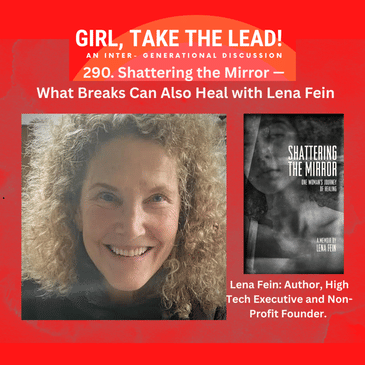
In this deeply moving episode, Yo welcomes author Lena Fein to talk about her memoir, Shattering the Mirror, and the healing journey that unfolded after a lifetime of living behind distorted beliefs formed through childhood trauma.
Lena shares how achievement, perfectionism, and high performance became her armor — and how, later in life, she began peeling back the layers to rediscover her true self, her voice, and her heart.
Together, Yo and Lena explore:
✨ Healing in layers over time
✨ Moving from survival to wholeness
✨ Reclaiming the parts of ourselves we left behind
✨ Releasing shame and self-rejection
✨ Finding courage to tell our stories
✨ Learning to surrender instead of holding on so tightly
✨ The connection between voice, breath, heart, and healing
✨ Why healing and authentic self-expression are possible at any age
Lena also shares one of the original songs that became part of her healing journey and reclaiming of her voice.
💡 In this episode:
- The metaphor behind Shattering the Mirror
- How trauma shaped Lena’s self-worth and identity
- Why achievement became survival
- The role of somatics, singing, dancing, and writing in healing
- Recording her audiobook and reclaiming her voice
- Seeing both the loving and painful sides of her parents
- Why mature women are resonating deeply with her memoir
- What Lena would tell her 20-something self today
- “Blessing the moment instead of cursing the moment”
🎧 Timestamps:
00:00 Welcome & introduction
01:30 What “Shattering the Mirror” means
03:00 Lena’s hope for readers and healing later in life
04:20 Achievement and perfectionism as protection
10:00 Reading her audiobook aloud and reclaiming her voice
15:30 The complicated relationship with her parents
20:00 The healing journey beyond writing
23:50 Singing, breath, and reclaiming her voice
27:00 Surrender and self-forgiveness
31:20 Why writing your story matters
35:30 What Lena would tell her 20-something self
37:45 “Blessing the moment instead of cursing the moment”
39:00 Lena’s butterfly card choice and brave wings metaphor
🦋 About Lena Fein:
Lena Fein lives in San Francisco and is a retired high-tech executive, nonprofit founder, artist, singer, dancer, and writer. Her memoir, Shattering the Mirror, explores her journey through childhood trauma toward freedom, clarity, authentic self-expression, and love.
🔗 Connect with Lena:
Website: https://shatteringthemirror.com
Book: https://www.amazon.com/Shattering-Mirror-Memoir-Lena-Fein/dp/B0FDX5R89C
Instagram: @lenafein.author
Facebook: Lena Fein
Contact: author.Lena.Fein@gmail.com
💌 Connect with Yo & Girl, Take the Lead!
Website & Shop: https://girltaketheleadpod.com
Facebook Group: https://www.facebook.com/groups/272025931481748
YouTube: https://www.youtube.com/@girltakethelead
Instagram: https://www.instagram.com/girltakethelead
LinkedIn: https://www.linkedin.com/in/yocanny/
🎧 Listen on YouTube Music, Spotify, Apple Podcasts, or wherever you listen or view your podcasts.
If this episode resonated with you, share it with someone who may need this conversation today.
[00:00:06] Welcome back to Girl, Take the Lead, the podcast where we explore leadership, healing, identity, and the stories that help us reclaim our voice and lead with intention. I'm your host, Yolanda Canny.
[00:00:20] You know, one of the things I continue to discover through this podcast is that healing rarely happens all at once. It happens in layers, sometimes quickly, sometimes painfully, sometimes through moments we don't fully understand until years later.
[00:00:41] And often, what we thought made us strong was actually what helped us survive. Today's guest, Lena Fein, shares a deeply personal and courageous story about childhood trauma, achievement as armor, reclaiming her voice, and ultimately learning how to see herself clearly after years of living behind distorted beliefs.
[00:01:09] Her memoir, Shattering the Mirror, is both heartbreaking and hopeful. It's a reminder that healing is possible at any age and that what breaks in us can also become part of what heals us.
[00:01:26] I'm going to tell you, a lot of her story is my story too. So this conversation really touched me personally because so much of it reflects what many women experience silently, the need for approval, the pressure to achieve, the disconnect from our own voice, and the long journey back to ourselves. And yet, what Lena ultimately discovers is something profoundly beautiful.
[00:01:54] That wholeness doesn't come from perfection. It comes from truth, surrender, compassion, and allowing ourselves to fully live with an open heart. There's also a moment in this episode where Lena sings a song she wrote during her healing journey. And honestly, it's one of those moments that stays with you.
[00:02:18] So settle in for this very special conversation with Lena Fein. Here you go. So Lena, welcome to Girl, Take the Lead!. So excited to have you with us and to talk about this amazing book. Thanks for being here. Let's get started by introducing yourself to our audience. Okay. I'm Lena Fine.
[00:03:09] Uh, it's about really not realizing that I was living behind a distorted mirror with distorted beliefs. I was living kind of with a film or fog over my heart, you know, based on trauma. And I was so used to living that way. You know, I was an achiever. So I did well at work. I did well at school.
[00:03:35] And that's how I measured myself by, um, and, um, the whole was shattering the mirrors about when I looked into my, when my mother was dying, I was age 51 and I was looked into her eyes. And it was the first time in my life. And it was the first time in my life. I actually saw depth in her eyes. And that was the beginning of realizing that possible, that something was covering my true self.
[00:04:04] And that was the very beginning of realizing that I had something to shatter. And it started a 10, 15 year journey of reclaiming the parts that I had left behind or that I had distorted. And I've shattered that mirror. It feels really, really good. And so what's your hope then for any readers of your book?
[00:04:28] My hope is that, you know, I'm in my late sixties. I feel from taking that journey to find my true self with clear eyes and to really feel my heart space. I mean, we always hear about that, but I truly feel that it's open and it doesn't have this protective film over it anymore.
[00:04:53] And my hope is that especially mature women readers around my age group, that we lived during a different time. And we had parents that maybe were crazier, teachers that were abusive. It was a different time. And I'm hoping that reading my story, a woman will have an aha moment, aha, into their own mirror.
[00:05:20] And that will be a step into reclaiming maybe something that was lost along the way that they didn't really recognize was lost. So that's my goal. I was so terrified to face my story, to write my story, let alone have someone read my story.
[00:05:39] And now I feel very brave and I'm hoping that that bravery will encourage anyone that needs it to step into their own true self with courage. So in your prologue, you offer us some great questions. And one of them was about yourself, right? Like what about you was in the shadows?
[00:06:05] But then you also considered your mother in a question about her. What do you see there? Because I thought that was rather a good sign of healing when you can see the other person's perspective. Yeah. You know, when you're born, I think you don't really know. And I remember the feeling state of when I was little.
[00:06:33] I was just so excited to be alive. Yeah. And oh, isn't that exciting? And isn't that exciting? And I love my mom and love my dad. And everything felt like a happy skipping, jumping fairy tale. I had a photographic memory that was more than just seeing.
[00:06:55] I actually remember the feeling states I was in, my physical feelings in my body, not just what was in my memory. And that photographic memory, at some point, all that happy feelings ended when I was maybe five or six, first grade, kindergarten. And I began to see the world as a frightful place. And so I developed.
[00:07:24] It was scary. My mother was scary. She was yelling a lot and not available a lot. And I went from being everything's happy fairy tale to, ouch, this hurts. And I didn't like that hurt. So my shield to protect my most vulnerable self was to, oh, I'm smart with that photographic memory. I could do really well in school. And I memorized all the words.
[00:07:52] So I really relied on my intellect. And I developed my self-worth measured by my achievements or getting those A's in schools. And I really left my true heart behind. And so that's why it happened at such a young age that I really didn't know that I left it behind.
[00:08:17] And until I got that glimpse, a different glimpse of my mother as she was dying, I think my mother was having her own awakening on her deathbed. A lot of her vitriol came from her voice. She was diagnosed with lung cancer and died within a week and a half of her diagnosis. In the last couple of days of her life, she was intubated so she couldn't speak. All she could do was stare with her eyes.
[00:08:43] And in those eyes, I saw for the first time in my life, light in her eyes, which created this, oh, this opening, not huge opening, but it was just enough to see that I was living behind a film that I didn't even really know was there. Mm-hmm.
[00:09:05] So then you were able to leverage a lot of those insights and that photographic memory into your book. Yes. The photographic memory was a great tool because I really, I would, as an adult now, I could, oh, that's what that was when I went back. So I think, and the journey wasn't just, I had this opening and everything was fine.
[00:09:32] It was like, you know, 10, 15 year journey of being embodied, dancing, singing, learning how to love, having different relationships with men, making all sorts of messes as I went to try and find my full heart and voice. And so that's really what the book is about. It took a lot of courage to put some of those things on the page. It's like, ah, you know, but here I am.
[00:10:02] It was messy. And I could honestly say that it was worth the journey to find my true heart because I feel so much better right here. Yeah. You always hear about that, but truly feel like I may be older and I may be losing some of my marbles and my, I forget my words and I'm not as coordinated. But I can tell you that my heart is brighter than it's ever been.
[00:10:32] Do you think it takes the time to kind of peel back those layers? Definitely. For me, it did. Yeah. And definitely seemed like, it seems like to me and in my own healing that I peel back a layer and then I go, oh, there's the next one. It's almost like I need to do them, do the one before so that I can get to the next one. Exactly.
[00:11:01] It's like realizing, oh, I don't have a voice. Okay. Oh, I can't sing. Doing, trying singing and being off key, whatever the modality it was. Um, I think it takes time and there's no rushing it. I thought after, you know, I was terrified. Okay. I'm going to write the book, but I'll never publish it. And then when I published it, I was terrified. I was going to be shamed. Well, I wasn't shamed. Actually, the target reader, mature woman were like me too.
[00:11:31] Wow. Thank you for writing that. And I thought I was done, but it wasn't until I actually read my story out loud because I made an audio book. I didn't think I would do that, but I did. And the guy in the sound booth was in his 30 somethings. It was a guy that I'm reading this very personal woman's story to. And I was terrified. I thought I kept flubbing.
[00:11:59] You know, it wasn't easy. He, he was the most amazing quote unquote mother, whatever you want to call it. He never shamed me once that reading my story, like in my voice, reading out out loud with feeling and having somebody, my son's age, who my son, by the way, hasn't read my book.
[00:12:25] Having him be, wow, that's amazing. Amazing was profound. And it opened. I'll never say it's the last layer, but I feel like that was like the final polish of the heart was from having a young man listen to my story and not be shaming at all. Oh boy. That must've been quite the awakening. It was amazing. Yeah. We gave you two. They're a big hug at the end. Great. Please.
[00:12:58] So, so many of us put our moms on a pedestal, right? And we try like heck to think of them as, you know, doing no wrong. Um, but I know that, that she sent a lot of shame and guilt your way and wonder if that is what made that protective armor that you, Oh yeah. That you had.
[00:13:28] Because I loved fairy tales when I was little, my dad at night would read, you know, I have three sisters, four girls would read fairy tales. And I love that whole fantasy. And then you always hear about the wicked witch, you know?
[00:13:45] So, and those fairy tales were shattered and maybe they needed to be shattered because my mom in my fairy tale mind very early on, like by the time I was in first grade, became the wicked witch with vitriol and violence coming out of her mouth, hitting.
[00:14:08] But mostly it was her, especially, I thought it was just me in the family of four girls. I thought I was the bad one, the worst one. And I didn't realize until our mother died when my sisters and I were comparing notes that each of us were abused, but it would only happen when we were one-on-one with our mother.
[00:14:36] And I don't know what was wrong with my mother, what abuse she had. She never talked about it. She was the only child, grew up in the depression. Something happened. And that anger just came out. And I feel sorry for the man you married. Get rid of that curly hair. You know, you should be ashamed. You know, you're such a slob.
[00:14:59] Whatever it was, it was just attacking who I was as a woman, like with the beauty. And, you know, I feel sorry for the man you married. It was like a curse. She didn't attack me for my grades at school. So I hung on to that thinking, well, that's going to be my self-force. Because deep down, I shut down those parts that I guess were bad or what felt shame for.
[00:15:26] And it was just like a knee-jerk reaction to hold on to those good grades or be a star student because I didn't feel like I deserved a star, really. No. I mean, look at this hair, you know. It's gorgeous. It's just a mess.
[00:15:47] So, I mean, one of the things that I could identify with in the book with you was seeking validation from her and approval and thinking that our high achievement and our good grades and all of that was going to save us from something. And it sure didn't. It didn't. But it was our way of surviving. It was our way of surviving. And I did. And it's okay.
[00:16:17] And then the door got opened as my mother was dying because as she was dying, I think she had the beginning of her awakening on her deathbed. Where she got her own aha moment and maybe felt that peace of love. And that's what I think. And so I don't harbor. I have more. I wonder what it was that happened with my mother.
[00:16:44] But that feeling of, you know, hate, I guess, if you will, is gone. It's just, oh, I hope, you know, she's on the other side and is getting lots of love. Yeah. And we, I also thought the role of your dad in your story was a bit complicated. Yeah. Like a lot of us.
[00:17:15] It's like this, but there were so many aspects to your dad. Yes. And I, when I look back on it, I had to adore my dad. My mom was, my dad was traveling a lot of the time to survive. I feel like part of that protection was adoring my dad. So I did that. It wasn't until after my mother died that I saw my dad.
[00:17:44] And first of all, all that abuse that was happening, he never, as far as I know, talked to her about it. And if my mother would just keep going and going and going with her vitriol until when I was older, I finally just would say, F you, you know. And she knew if I said a swear word that as soon as my father came home from his travel, that she'd say, you know, your daughter swore at me again.
[00:18:12] He goes, no matter what your mother does, you can't swear your grounder for two weeks. That was just the cycle. And I always tried so hard. I'm not going to swear. I'm not going to swear. But my mother kept going. Okay. So I realized now that my father did not protect his children and he could have. He didn't.
[00:18:37] After my mother died, I saw, and he was a traveling salesman, I saw a side of my dad that was charming and very flirtatious. And I saw very quickly how after being married, since he was 20 years old, for however many years he was married to my mom, 40, 50 something plus, that he got out there in that dating world right away. And I used to have events in my house with women over and he'd be flirting away.
[00:19:07] And I like, wow. Okay. He had this sexualized energy that I had to get right with my dad through conversations. And I eventually got brave enough to talk with my father and say, you know, you were traveling, but it was awful what was happening with mom. And he goes, well, I didn't know it was that bad, that kind of thing. But I called him on it.
[00:19:36] I was so brave. And so that was also part of my feelings. So yes, my relationship with my dad was complicated. It's certainly, I made him a hero. He looked like a hero compared to what my mother was doing. But, you know. Yeah. He had some inappropriate boundaries and didn't protect his children.
[00:19:57] So I think it's part of maybe our reconciliation that happens that we see our parents as people. Yeah. And we see the good and the bad parts. You know, the parts that were loving and the parts that they didn't know what to do with. Yeah. Yeah. Just, they just absolutely did their best.
[00:20:26] But it was pretty rocky. Yeah. Yeah. I can appreciate that. Well, I will say, and it's in the book that I had. I finally was brave enough to say how I felt with my dad. And he took it in and heard it. Mm-hmm. So I would say that towards the end of the last 10 years, you know, he died at 88. So he lived about 10 years after my mom died.
[00:20:56] But I really felt I said everything I needed to say. And he heard it. He didn't generate an FU out of me. Yeah. He was really took it in and actually apologized. And took it in. And I'm really glad I did that because when he was on his deathbed, it was beautiful. You know, all his daughters were there and we connected and he was, you know, ready to go.
[00:21:25] And it felt very spiritual and profound. Just like when my mom was on her deathbed, I had sort of a second awakening when my dad. There's a lot of forgiveness. One of the things I'm sure that was part of your healing was writing your book. Were there other things that came to you other as part of your process? A ton.
[00:21:54] Like, let me count the ways. Really? It wasn't just mother and father. I think a core thing that happened to me, which starts out very early in the book, is that I was a happy little kid. And my older sister was only 14 months older than me. And I always, I let her drag me around the house. I always did whatever she said. And on this particular day, I think I was about two and a half.
[00:22:21] On this day, I wouldn't give her the block that she wanted. And I'd always given her that. I think I was being age appropriate. But anyways, I didn't give her the block. And she was so mad. And I was so determined not to give her the block that she ended up being mad and pretty much hurled me out a window. Okay. And I, I have photographic memory of that accident.
[00:22:45] I remember the actual, the absolute terror of feeling, falling and never have had that terror before. And I, at the last second, my last kind of memory was grabbing at drapes, which then the next thing I remember was sitting on the floor. And my mom coming up to me with a rag. I didn't know. I don't. Photographic memory.
[00:23:13] My body's protective system doesn't recall blood, doesn't recall a broken window. I had no idea that when my mom put the towel on my face and told me not to let go, that I was holding onto my own nose that had been severed. Here's a, you know, no 911, no cell phones. She has three kids. She has a three-year-old, a two-year-old and a little baby.
[00:23:40] And I remember her getting us into that car and me holding my nose. My nose was reattached. But I think that terror of falling was another thing that really terrified of falling, allowing myself to fall in like this, in this terror that I was so happened at such a young age.
[00:24:04] That that was another thing I had to work through with allowing myself to do more somatics dancing. It turns out the fall in the window wasn't just the nose. And when I had a brain injury that no one talked about then, that put me, I was very, I didn't find out until years later, really in my 50s, that I was in the ninth percentile for eye-hand coordination. I used to get teased a lot for being a klutz. The ball would come and, you know, I'd be able to catch it late or not catch it at all.
[00:24:34] So that accident set up another part of that shattering of the mirror, that glass was shattered. But I also, I don't want to fall. Just that idea of surrender, like letting go of those drapes. Can I, you know, holding on too tight? That wasn't from my mother or my father. That was from an accident.
[00:24:58] And it took me a while and a lot of somatics breathing, you know, to come back into my body, especially when the world feels like it's moving too fast, like driving, things like that. So that was another layer to trauma for me. Yeah. Well, I know song had a big element of your recovery and I'm hoping that you would read us or sing if you wanted. The one.
[00:25:28] Yeah. My mother used to tease me a lot how I couldn't sing. And, you know, I feel that when you're blocked, it's easy to shut down. If there's too much screaming in the house, I probably shut down my ears. There was a lot of screaming, shut down those ears. So. I worked with a woman that was just a magnificent, almost like a counselor.
[00:25:57] Of the heart through the singing voice, because my voice, my full voice really wasn't connected fully to my breath. Again, it could have been an accident. It could have been a lot of things. And it took me, you know, many years of working with her and her being so patient to finally just, you know, I started writing songs and she played guitar. And I wrote a song and I could read it or sing it.
[00:26:25] I guess it would be hard to sing because there's no guitar, but I'm going to try. So this is a song that I sang with a group of got to sing in front of an audience. We gave a concert. It's called The Temple of Song. Hello, hello. I finally come home. My soul is yearning to sing its song.
[00:26:53] I've been silent for far too long. All together now, there is no wrong. Come alive, come alive in the temple of song. Breath, heart, voice, ears, weaving together my joy and my tears.
[00:27:22] For my mother, my father, my sister and my brother. For my son and my daughter, my friends and my lover. All together now, there is no wrong. Come alive, come alive in the temple of song. So good.
[00:27:50] I did it. You did it and it's beautiful. Thank you. Oh my gosh. I. And my dad was in that audience. Oh, wow. Yeah. So he really got to hear. Yeah. He really got to see a new, new me. Yeah, definitely. And, um, boy, that really touches the heart, doesn't it?
[00:28:14] There's another one though, in your book that I loved also, um, another song, but a passage that you're just talking about surrender. Yeah. Yeah. Um, yeah, that was so good. This is, I'm going to read part of it. I don't need to go into the history of who I was with at the time, but was this truly what I feared most to be alone with myself?
[00:28:43] If this wasn't true, how could I expect Stefan? That was my lover at the time to choose me when I had clearly not chosen myself. It came to me in a rush of truth, cutting into my face like the shattered glass of so many years ago. Over and over, I had rejected myself, giving up dance just because a teacher had offered
[00:29:10] a correction, giving up writing because my wicked mother had read my diary, giving up my love of nature because she had thrown my plants away, giving up meditation because she had splattered my face with milk, abandoning trust because my sister had tried to steal my block, hiding myself to escape the fear of abandonment and failure.
[00:29:36] Repeatedly, I had cast myself as a victim, blaming others for self-rejection. Trauma had played in my mind all my life in an endless loop. I was perpetually falling into an abyss, grabbing at drapes to blunt my fall, but in the end hurting only myself. I had spent all my life running as fast as I could to escape hurt.
[00:30:02] At my worst, I had betrayed others before they could betray me. My photographic memory wound again and again, slowing down to a crawl as I watched myself falling toward the window and grabbing at those drapes with both hands. My memory doesn't recall it, but in grabbing the curtains to blunt my fall, I must have let go of the block I'd clung to.
[00:30:29] Although my nose had been severed, I had avoided more injury or perhaps even death by letting go. Surrender. My mother putting a towel to my face and telling me not to let go. My singing the words, don't let go, as I worked hard to hold the towel, even though I hadn't realized my nose was severed. My body's preservation system hadn't allowed me to feel pain, see a broken window, or recall blood.
[00:30:59] I had tried to keep life neat and tidy just as my mother had relentlessly cleaned our home. Now in surrender, I realized life was messy. In my mind's eye, I let go of everything I'd so desperately clung on to. I just let go. I took a deep breath and allowed myself to fall into my own arms, to allow love to support me, to trust the universe.
[00:31:29] Surrender. Lying in bed with cool air on my breasts, I finally surrendered to my full complicity in the pain of my own life. I shattered the mirror and witnessed the infinite facets of my own heart with all its wondrous maddening nooks and crannies. Delight. Terror. Pain. Self-loathing. Kindness. Ecstasy. Sadness. Betrayal. Joy. Shame. Shame. All of it.
[00:32:00] Wow. I read that and I went, oh my gosh. There's so much in here. There's so much forgiveness. Self-forgiveness, really. You called it complicity. You called it complicity. You know, and now I look at my own complicity on things when I was young and I'll go, you
[00:32:29] know, you were just trying to do your best girlfriend. Yeah. Survive difficult situations. Yeah. Yeah. Yeah. Yeah. So I related to the story and I think a lot in our audience are going to relate to the story. So thank you for being so brave to, to write your story. It did take bravery.
[00:32:57] And I'm so thankful that I don't, I don't even know, maybe there's one or two men readers, but in general, the woman readers tend to be in the age demographic of sort of 50 and up. I don't know why that is, but maybe we had some generational sharing. I am just so thankful for the, some people I don't know.
[00:33:24] And some are people that I do know of, of women like yourself that I said, I relate to that. And thanks for sharing that because I think there's a lot of opportunity in different places for aha moments. I mean, God, my picker for men was really not very good. I'm just, you know, all the messes I made in the journey to find my own wholeness. And I don't feel shame anymore for that journey.
[00:33:53] It's just like, that's, I needed to make that mess to find the grace. So I really appreciate really all the woman readers that have resonated with this story. And I hear, I was so terrified of being shamed and, you know, almost not just, I'm just going to do this to get my story down. I really didn't think I'd ever publish. And I'm really glad I did. Yeah. I'm glad you did too. It needed to happen because it's like me standing for my voice. Yes. And my story.
[00:34:22] And I think one takeaway I have from it is that you would probably encourage all of us to write our story. Yeah. Yeah. And, you know, even if it doesn't get published and it's really important also to that trusted friend to read it out loud. I, you know, I'm keeping it a secret. Like I kept so many things a secret and I think stopping our voice is another way of, you know,
[00:34:48] stopping our full heart so that finding my voice, it was hard. I mean, I was really good in the engineering tech field and marketing because it didn't have anything to do with personal. Like it was robot robots and things like that. Yeah. And I feel like me claiming my voice, even if it didn't happen until my late fifties and the fact that I could actually stand up and sing a song and that I could actually sing it right now in front of you without a guitar in the background.
[00:35:17] Um, yeah, go, go, go. That's one of the reasons why I started this podcast. I came out of corporate and I could not tell you like where, where was yo? Yeah. I could tell you about brands. I could tell you about businesses, but it took me and it continues to take me time to find my voice about certain items.
[00:35:44] And, and I've gotten so much braver to like some of my clips, some of my reflections, some of my, um, shattering of myths. Um, I have really tried to just push not, not in a mean way, but in a way that just says, you know, you're ready, girl, go ahead. You can, you can do that. And, um, you go, yo. Yeah, exactly. Well, we've covered so much.
[00:36:13] I, I'm sure a lot of people are going to get your book. I've got to read this one. It's an audible Kindle and paperback. Great. And no, I really appreciate the time and, um, I'm appreciating my, you know, I'm scared, but how relaxed I actually feel. Um, and you create that space for that. And I appreciate that a lot. Thank you so much. And before we let you go, you have to tell us what you would tell your 20 something self
[00:36:42] today, because you had quite the twenties. Yeah. My 20 something self. Yeah. I would say, yo, you go girl. No, I would say, um, oh, you're so precious. You don't need to hold on so tight. Yeah. You're intelligent and you can do that in math and do that in engineering and you can make
[00:37:12] a good sale in the corporate world. Cause you got A's in schools, but you know, the heart's where it's at. And I'd really like to see you like stay in the moment longer instead of trying to race ahead of it and really take your time. Like when you're ordering coffee or ice cream, take your time to look in someone's eyes, really truly see them. And maybe they're having a bad day or maybe you're having a good day, or maybe the ice cream was really good.
[00:37:41] You can say, oh my gosh, it was the best ice cream ever. Yeah. Yeah. That, that place I find myself being in my late sixties and feeling like a little kid scream. That feeling is so present in me. And I tell that 20 something, you go find that feeling of yo, yay. Yeah. We got this. And you're going to make mistakes. And sometimes you're going to lick that ice cream and it's going to fall on the, the street.
[00:38:10] And it's all good because when you bring your sparkle and your true heart. Yeah. Situations. That's what matters. Oh, that's really what matters. Heart, breath, having our breath, breath, voice, having our voice, heart. And there was one more breath, voice, heart, ears, listen, really opening those ears and hearing what people say instead of if somebody's shouting, shutting them or keep the ears open,
[00:38:39] keep the heart open, keep the voice open, keep the breath open. Yay. I guess also too, you would probably tell somebody who perhaps is uncovering their layers of trauma that don't, don't worry. You'll, you'll get there. You'll get to see that things change. I feel what I, one of the things I feel really good about, especially since writing the book
[00:39:07] and being in this open hearted space and having my voice is I've gotten so much better and having my breath at being it. I call it blessing the moment instead of cursing the moment, no matter what moment I'm in, I might be talking to my daughter, talking to a friend, talking to a stranger. How can I be in this moment and really be present with what is happening here? And is how can I bless this moment?
[00:39:38] You know, sometimes it's saving a life, which has happened to me in the moment. Sometimes it's holding a little kid's hand or looking, noticing the one that shy at a party and talking to them that radar in my heart. Like I said, even though I may not always remember all my words and I may not be able to walk or bend and touch my toes.
[00:40:02] I am so much better with the sort of one-on-one being really truly in my heart with what's needed in any situation and blessing it. Even if the world is up in flames, there's always a blessing there. That's my attitude. Well, I know that you went to the store and you picked the butterfly card and with brave wings, she flies.
[00:40:31] And I thought, oh yeah, that's so perfect for you because you definitely are that butterfly. Yeah. And it was like my wings were clipped as a young child and I didn't know it. And now I feel, I feel that, that metaphor when I went through all the cards, that was the one that was like the metaphor of coming out of the cocoon and here I am and flying into this next phase.
[00:41:01] And it's profound. I bought, bought more than just one because I have some other friends. I have wonderful women friends. Thank you so much for supporting this. I just think that's just such a pretty card too. It was, you know, it's a, it's a pretty one to make. And I always feel when I'm making them that I'm, I'm making something pretty. Yeah. So that's always good. You make, you made those cards. Yeah. Amazing. Oh, extraordinary.
[00:41:31] I love art. Yay. Well, thank you again, Lena. And, um, thank you. I think, um, I'll have in the show notes, how everyone could get the book and be in contact with you. So thank you again for coming on the show and being with us. Thank you so much for joining me for this conversation with Lena. I think what stands out with me most was this idea that healing doesn't always arrive dramatically.
[00:41:57] Sometimes it's simply the willingness to look honestly at our lives, to reclaim the parts of ourselves we abandoned in order to survive and to realize that even later in life, we still have the capacity to become more whole. And I love Lena's reminder, bless the moment instead of curse the moment. There's so much wisdom in that.
[00:42:28] Here are three takeaways I'm holding onto from this conversation. One would help us survive may not be, but helps us live fully achievement, perfectionism, people pleasing, staying quiet. Many of these patterns began as protection, but healing often begins when we gently ask ourselves, who am I underneath all of that?
[00:42:57] Two, healing happens in layers. There's no finish line, no perfect timetable. As Lena shared, each layer we peel back often reveals another one underneath and that's not failure. That's growth. And three, it's never too late to reclaim your voice.
[00:43:19] Whether through writing, singing, creating, speaking, or finally telling the truth about our experiences, our voice matters. And maybe aging isn't about becoming less of ourselves. Maybe it's about finally becoming more fully who we are. Next week, we'll shift into another powerful conversation.
[00:43:48] This time around women's leadership, entrepreneurship, AI, and building smarter, more sustainable systems. My guest will be Dawn Andrews, founder and CEO of Free Range Thinking, executive leadership coach, strategist, speaker, and host of She's That Founder podcast. Dawn brings a refreshing, no BS approach to helping women lead with clarity, confidence, and conviction
[00:44:18] without sacrificing themselves in the process. So until next time, keep finding your voice. Keep leading with intention. And keep taking the lead. Bye. Bye.