What if the most important question in your life isn’t what should I do next… but: “What do I truly want?”
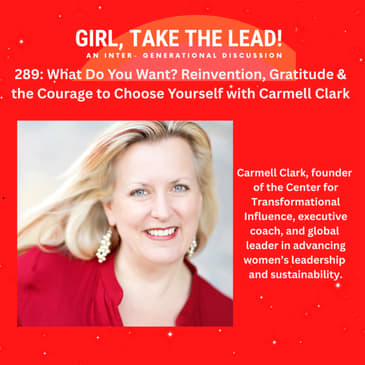
In this powerful and deeply reflective conversation, I’m joined by Carmell Clark, founder of the Center for Transformational Influence, executive coach, and global leader in advancing women’s leadership and sustainability.
Together, we explore what it really means to reinvent ourselves across life’s thresholds — from grief and loss to growth, purpose, and expansion.
This episode is a conversation about gratitude, conflict, identity, self-trust, and the courage it takes to choose yourself again and again through every stage of life.
🌿 What you’ll walk away with from this episode:
• A deeper understanding of why reinvention often begins with loss or change
• Insight into the emotional patterns that may be keeping you stuck
• A new perspective on conflict and why many women avoid it
• Encouragement to reconnect with your own desires, needs, and voice
• A reminder that healing, growth, and self-discovery are possible at every age and stage of life
💡 In this episode:
• Why reinvention is a path — not a quick answer
• How gratitude can become a healing force during difficult seasons
• The powerful question: “What do I want?”
• Why women often avoid conflict — and how to begin changing that
• Understanding emotional patterns: fear, obligation, guilt, and shame (FOGS)
• The difference between internal vs. external conflict
• How to carry your own sense of safety
• Why aging invites us to either expand or contract
• Letting go of external validation and reclaiming your voice
• The role of courage in becoming a pioneer in your own life
🌿 A few moments that stayed with me:
“Gratitude heals a broken heart.”
“Reinvention is a path.”
“I am the decider of my day.”
“We don’t have to sacrifice our lives to the expectations of others.”
👤 About Carmell Clark
Carmell Clark is the founder of the Center for Transformational Influence (CTI), a global organization focused on advancing leadership, sustainability, and gender equity across sectors.
With over 25 years of experience, Carmell has coached executives and professionals, launched women entrepreneurs, helped female-led businesses scale, and developed transformative leadership trainings for women across industries.
Through CTI, Carmell works globally with companies and entrepreneurs to create meaningful and sustainable change. She leads flagship programs, takes influencers on international adventures, and works directly with executives and entrepreneurs navigating pivotal life and leadership transitions.
Currently based in Salt Lake City, Carmell lives a life of exploration — rock climbing, running RAGNAR races, traveling internationally, and creating large-scale abstract oil paintings.
🔗 Connect with Carmell
🌐 www.carmellclark.com
💼 LinkedIn: https://www.linkedin.com/in/carmellclark/
📧 carmell@carmellclark.com
💬 Let’s keep the conversation going
What resonated most with you?
👉 Join our Facebook Group and share your thoughts:
https://www.facebook.com/groups/272025931481748
🎧 Listen wherever you catch your podcasts.
💬 What resonated most with you from this conversation?
Share in the comments below — we’d love to hear your thoughts.
🔗 Connect with Girl, Take the Lead!:
🌐 Website: https://girltaketheleadpod.com
💜 Facebook Group: https://www.facebook.com/groups/272025931481748
🛍️ Heartfelt Cards & Gifts: https://girltaketheleadpod.com/shop
[00:00:06] Welcome back to Girl, Take the Lead!, the podcast where we explore leadership, life transitions, healing purpose, and the conversations that help us grow into who we're becoming. I'm your host, Yolanda Canny. Today's conversation feels especially timely because we're talking about something I think many of us experience, but don't always have language for, reinvention.
[00:00:33] Not reinvention as a quick makeover or a checklist, but reinvention as a threshold. The kind that happens after grief, after loss, after change, after we realize we can't keep living from everyone else's expectations.
[00:00:54] My guest today is Carmel Clark, founder of the Center for Transformational Influence, executive coach, leadership trainer, and someone who deeply understands what it means to help women navigate change with courage and intention.
[00:01:15] Together we explore gratitude as a healing force, conflict avoidance, emotional patterns, self-trust, and one of the most intimate questions we can ask ourselves. What do I want? And I'll tell you, there are several moments in this conversation where I found myself stopping internally and thinking, Wow, that's so true. It's so great the way she said that.
[00:01:44] Especially when we talk about how women often move through life trying to create harmony for everyone else while quietly abandoning themselves in the process. This is one of those episodes that may stay with you long after you listen. To settle in and enjoy my conversation with Carmel. Here you go. Carmel, welcome to Girl Take the Lead. Hi, Yolanda.
[00:02:13] Thanks so much for having me on. I'm so excited. It's great to be here with you. Yeah, I think we're going to have good energy between the two of us. It's going to be great. So let's start if you would to, if you'd introduce yourself to the listeners and viewers, that would be awesome. Yeah, absolutely. I'm Carmel Clark. I have been an executive coach for the last 25 years. I've worked with women a lot primarily in so many different sectors. I am a business coach.
[00:02:43] I also work with corporate leaders. And I bring women's leadership trainings into companies all over the world. And I am passionate about advancing and accelerating women in all different areas of their lives. So that's kind of the big overview. Right now I'm working on an ebook, women, how to successfully engage conflict.
[00:03:06] Because as women, we are constantly finding ourselves in situations where culturally we're taught to take care of everything emotionally for everybody else. We're taught to avoid conflict at all costs. Yeah. And we tend to be uncomfortable with it. And so what I want to do is actually help us as women be ourselves and learn how we can engage conflict really effectively for the benefit of ourselves and everybody else involved.
[00:03:34] Such a needed topic for us, especially to get comfortable with. I don't think we get very comfortable with conflict. Kind of got started into gratitude, which is one of my all time fave topics to talk about. Tell us a little bit about your journey though, and on how you got to embrace that.
[00:04:04] Well, you know, I grew up with a mother who was very principle driven and in gratitude was a big part of the way that she taught us to view life. Right. That it was more powerful for us instead of complaining to find our way into being grateful. What could we be grateful for? And of course, when you're a kid, you push against it all the time, complain a lot.
[00:04:26] And, you know, my mother's job was definitely uphill like it is for every mother to help their kids learn the principles that are going to help them in life. But that is one that is incredibly powerful. And I just thank her for it so much. And what I what I remember being kind of a pivotal point for me with gratitude was when I went through particularly probably one of the hardest things in my life where my beautiful 20 year marriage ended.
[00:04:53] And I remember there was still so much love and so much respect, you know, on both sides, and it was just heartbreaking. But I didn't know how to move forward in that moment in my life. I was stuck with the grief. And I had this beautiful inspiration come unexpectedly. And that inspiration was Carmel gratitude heals a broken heart.
[00:05:17] And from that moment, I touched into the superpower that we have as human beings in a very real way, that superpower being gratitude.
[00:05:30] There is always a way for us to authentically and genuinely find gratitude inside ourselves in each moment that we are in, even in those moments of great loss, or where we can, you know, find ourselves overcome by anger or resentment. Underneath those other emotions, and they can be very honest emotions underneath them.
[00:05:54] There is this place in our hearts for gratitude, and we can find it, we can tap into that. And it is a superpower. What are your thoughts on that? You know, I when you and I spoke, I mentioned that I was, I read, was reading Francis Weller's book on grief.
[00:06:09] And one of the points that he makes in that book is that you don't get to experience joy, beauty, and the gratitude of things, unless you also experience grief and loss. And that was really kind of opening to me.
[00:06:37] I mean, you know, I kind of saw it as, as, you know, gratitude was, it certainly is a practice and I can work through things and, but I wasn't grateful for gratitude, I don't think, until I realized how important it is so that I can really experience all the other great things.
[00:07:03] Yes, I think that, I love that you brought that up because a lot of times, when we are in such a dire situation inside ourselves or in our lives, we're reaching in those moments and then gratitude becomes this lifeline for us when we can find it right. And it is most certainly a lifeline. And yet, I think it's harder for us when things are going fairly well, it's maybe harder for us to tap that deepest level of gratitude inside.
[00:07:33] That is that same lifeline, how do we cultivate that level of realness in our gratitude that we tend to be able to touch so much more easily when things are hard, when they're difficult, right? Yeah, no, it's a good point. Because I think sometimes when things are going well, and we're in the flow, we just want that. We want anything else. More of that, please.
[00:08:02] Don't ruin my transparency here. I'm doing just fine. But I think the ups and the downs and the things that we're speaking about, yeah, you don't get one without the other. And if you're just coasting and controlling and hanging on to the side rails, you know, you're missing out on the ups and downs of things. It's really a good point. Yeah.
[00:08:30] Well, and I think it takes, it's a lens to that we can cultivate in our lives. And I think that's part of what I think you were asking me about my journey of gratitude was recognizing that in any given moment, I can choose to come into awareness of my gratitude, my being grateful. Yeah, yeah. All the time. Like right, right now I have, you know, the last farmer's market of the season, I picked up all of these tomatoes, some were mostly ripe, some were not ripe yet.
[00:08:58] And I wanted to have the opportunity because I love, you know, really good, healthy produce. I wanted to have the red ripe tomatoes a little bit longer. Right. Yeah. And so just, you know, there's so many different things we can focus toward and look at and instead of saying, oh, well, I hope that they ripen soon. I can say, oh, I'm so grateful to have all those tomatoes on my windowsill that are ripening in the sun. Right. So grateful for the sunlight or I can.
[00:09:25] And this was one thing that I found to be really important for me waking up every day and the moment that I wake up and I'm still lying in bed. We have the ability to choose a thought. What is the thought that we choose in that moment? Is it the list of everything that needs to be done? I mean, that tends to be what most of us do, especially women, probably men too, I would assume. But what if that first thought was just gratitude? What would you be grateful for?
[00:09:54] I'm grateful for my life. Yeah. I had this come up with a client recently as this litmus test for where she is in her healing process. She said, I can't say I love my life right now. And I remember a time in my life with so much grief where I couldn't touch it either. And I said, but it becomes the thing that can lead us forward because I love my life is a gratitude statement. It is.
[00:10:22] So what is if I decide that that's the path I'm on? I want to get to that point of being able to say, I love my life and to feel it all the way through. How does that lead me forward right now? Where does it lead me to today? How do I begin my day? How do I look at every moment of my day and my decisions and the people around me, the work I'm doing?
[00:10:47] How do I get myself to that place of connecting to that gratitude of I love my life? I saw a post just recently. It reminded me of it, that it said, we can all have bad moments, but we choose when we have a bad day. Oh, isn't that good? That's so great. Yes. It's like what you were saying, like our choice. Yeah.
[00:11:16] Our choice is to either say, okay, it's a bad moment. You know, guy cut me off over here or there. Right. But I don't have to look at it. Like this is going to ruin my day. Exactly. I am the decider of my day. Right. I'm the CEO of my own emotions. I love that. Yes. The CEO of my own spirit. That's great. That's a really good reference point. I'm really glad you said that out loud for all of us. Yeah.
[00:11:47] Now you also talked to me a little bit about relationships and the cost to be a pioneer when it comes to relationship. I think you need to share a little bit about what you see there. Well, I mean, you're a pioneer, first of all. So I think that has to be said. Your listeners have probably had so many experiences of you speaking from that path and that position of being a pioneer.
[00:12:15] And I think that's part of why the people who resonate with us do resonate with us is it takes a lot of courage to be a pioneer. That step out. And what does it mean for me? I'll just speak to myself. But what it means for me to be a pioneer, first of all, is that I have to trust the path that's leading out from inside me.
[00:12:41] Even when I was a small child, I would venture out and have my own, you know, my own adventures, my own exploration into the world in so many ways. In fact, my mother was rather frantic about it a lot when I was really little. And I insisted to her before my first day of kindergarten, I insisted the whole summer that I was going to walk to school by myself the first day, which meant crossing two busy streets, right?
[00:13:06] And when I think about it as an adult, I'm like, yeah, but then I think about an actual five-year-old crossing two busy streets alone by themselves. And I think, oh, no, that's bad. That's a bad choice. Anyway, I really threw down with her the whole summer. And she finally just stopped arguing with me. And I thought I'd won. And that first morning of kindergarten, I got up. I got ready. I was so excited. I knew exactly how to get there. And I headed out the door by myself.
[00:13:35] And I thought I walked by myself to school alone that first day, right? 25 years later, I'm telling the story at a family reunion. And my mother pipes up and she says, oh, that's right. You were so insistent. And I couldn't get you to agree to anything else. So I followed you the whole way to school, hiding behind bushes and cars.
[00:13:58] I think that being a pioneer means really being connected to a deep trust in ourselves. And there's also a mandate inside. Because not everybody is a pioneer. We all have pioneering ways that we take on in our lives. But not everybody has that whole scale as a way that they engage their lives. But if you are somebody who does, where you recognize that you want to take the best information and learn from others,
[00:14:27] you are also always making your own way. You are a path maker, a way maker. You look at what you're doing as being able to forge a path so that others can have an easier time. Or you know that this is the right way, even though everybody around you doesn't agree. Or they see a different way forward. And you know what yours is. Those are examples of what it looks like and what it really feels like to be a pioneer. It can be very lonely at times.
[00:14:57] And I will say again, it doesn't mean that we don't take in other information. Because the smartest people, as my second mentor Stan said, the smartest people aren't interested in their own ideas. They're interested in the best ideas. So we do always want to be gathering better ideas. And if you are a pioneer, then you know you're not following somebody else.
[00:15:22] You're taking in information because you are making your own path in your world. Did you have a sense of yourself after kindergarten that you were a pioneer? That you were just a little bit different than the other kids? Um, there's some there was some writing on the wall for that for sure. I mean, I was the oldest of all the kids in my family.
[00:15:49] So I think there's kind of disappears a bit in that old being the oldest situation, because you're just expected to be a leader. But I look around in the world now and I see that my being a pioneer was always like I didn't feel a belonging to things. I felt an independence of myself, whereas, you know, other oldest kids will feel the belonging and the need to be responsible for everybody else.
[00:16:18] I didn't feel that I felt that I need to be responsible for themselves. And I had my own path that I was going to go. It would be a great big sister and be like, okay, they're on your own. You're on your own and you can do it. Then you can do it. That's so great. I, the reason I asked that question is because sometimes I think we don't see sometimes the
[00:16:44] elements of ourselves being the leader or being the pioneer, sticking our neck out, being more courageous. And it takes usually a teacher or a mentor of some kind to kind of help us see that capability in us. Yeah. And, um, and trust it, as you said, you know, trust that you can, you can lead and take risk. Yeah. That's a really good point. I did.
[00:17:12] I have had some teachers and some mentors along the way who really, I felt really saw me. Um, a couple of my aunts, one of my father's side, one of my mom's side who looked at me and, and saw something different. Right. And affected with me from that place who put me into opportunities. Yeah. These different people put me into opportunities with that recognition for me to step out and
[00:17:40] explore that path-making and that independence as a leader. And I'm incredibly grateful, right? Yeah, definitely. I am, was blessed that way too. And kindergarten girl, I was on a bus to kindergarten that was almost, um, an hour and 15 minutes away from our home. Oh, wow. Yeah. And I started that as a kindergartner. Wow. Until eighth grade.
[00:18:11] Yeah. Um, our 15 as a year old, that's a long way. It was borderline trauma. Pioneering started quite early. No kidding. Develop the chops. Wow. So we talked a little bit about, you know, reinventing ourselves and seeing ourselves in a new way
[00:18:40] and having the mentors see us too. What do you see with your clients when it comes to reinvention and reframing and looking at themselves maybe a little bit differently than they thought? Yeah. I think that's a really good question for me. First of all, I'm going to give credit to this amazing, these amazing women that I had
[00:19:06] the opportunity to meet and interact with in their seventies, eighties and nineties. Whoa. Right. And these women, each one of them had had multiple lives at this point, multiple careers, multiple marriages. One woman, the 90 year old, she was on her fourth marriage, but she had lost each of her husbands. They had passed away.
[00:19:31] One, the first one after, of course, so many decades of marriage and, you know, and I just, I guess this is really the opportunity and also the challenge in front of us as women in our biology is written in these big transitions in life. We come into adolescence, right? And we have our teenage years, but then we actually move from that into the time where,
[00:20:00] you know, we're coming into career. We may choose to have a family have, you know, in, in those different ways, or we choose that period of our life. We're not having children doing things differently, but our biology automatically means, you know, when we come into perimenopause and menopause and post-menopause that all throughout our lives, we have these invisible, but biological thresholds that change the rules of the game for us. They really do. Right.
[00:20:29] And our society isn't really good at marking that in distinct ways for us to find our way as we walk across those thresholds. I mean, some, you know, teenage years into, you know, into our twenties and all of that. But I find that for us as women, uh, we have to be more conscious and aware that we're in front of a threshold, one of these thresholds of change that is asking for us to reinvent.
[00:20:58] Now that threshold could happen at any point when we have, uh, a death of, of, you know, someone close in our lives. It could happen, uh, with the loss of a relationship through divorce. Um, I have had a number of clients who've had children who have decided to cut them out of their lives. And that is heartbreaking threshold to find oneself in how do we reinvent in these unexpected
[00:21:25] places, as well as the ones that are expected, like, you know, coming into a place where we change careers or we want to change the whole vocation that we've produced. We've pursued our whole lives. Um, somebody who wants to change from corporate to owning their own business or wants to change from being an entrepreneur into, um, founding a nonprofit or stepping into a corporate career. There's so many different versions of these changes.
[00:21:51] And I, I speak them out loud because I think we don't see them as women. I think we're just used to getting the thing done. We're used to figuring out what needs to happen next and getting after it. But what really we're doing in that is a process of reinvention. And if we can be more mindful about it, if we can be more eyes open and intentional about seeing those reinvention thresholds for what they really are, then I want us to be able to step back and say, then what do I want?
[00:22:21] Not just what needs to happen or not just this is the natural evolution, I think. Right. But what do I want? It's a question that as women, we maybe do it and exercise a lot, but we don't live it into its full capacity as much. And that's why we have all these books out there that speak to us as women. What do you want? Like go for the big, look at, look at whatever that is.
[00:22:49] Um, and I, I guess I just want to say, um, the question of what do I want is probably one of the most intimate personal questions we'll ever ask as women. It is the question for spawning the reinvention. I'm going to be really vulnerable and honest right now to say that I am right now in another reinvention of what do I want? Because my mother very unexpectedly passed away this summer.
[00:23:12] And as a result of that, it's called so much into question, like almost everything into question because she is such a massive universe in my universe. And we have these moments happen in our lives. They're going to come one way or another in that. What do I want there? At this point, there aren't immediate easy answers. You're really going into a reinvention. We have to know that there probably aren't going to be immediate, easy answers.
[00:23:42] There's a path. That's what I think reinvention really is, is a path. I'm not asking the question, what do I want from, you know, what could I do? I mean, that list is infinite and endless. What could I do? What would I want to do? That list is infinite and endless, but what is the right next invention of Carmel at that point in time? That's a deep, intimate question to ask with a path, not an answer. Oh, that's so good.
[00:24:10] I think that question of, I just remember becoming very aware of how much I was dependent on what other people thought. And so I was going through, I was probably early forties or something. And I said to a friend, I said, what do you think of my hair? Do you think I should go long? Should I go short? Should I go like a bob? Or, and she said, what do you want? Yes.
[00:24:39] Took me like forever to decide that, but it was a real indication to me of how I wanted other people's validation and how I was externally driven. And, you know, when I started my own transformational work when I was about 28 or so, and I moved from LA to New York and I made big changes.
[00:25:07] And when you talk about reinvention and I think those big changes make an opportunity, have an opportunity for us, right? Right. Very much. Very much. To redo it. Yeah. So you made this change. First of all, I just have to acknowledge, cause if this is audio podcast, right. Your, your listeners don't know that you have fabulous purple streaks. It's so great. It looks so good.
[00:25:37] I've got the gray that's coming in and yeah, I just have the purple to accent it. But yeah, this is definitely my choice. Um, although I do get comments occasionally walking down the street, you know, someone will say, Oh, I really liked the purple. It's like, you really rocked that. Um, agreed. Thank you. It is. Well, and I think, again, I'll say it takes courage to go in, you know, go into reinvention
[00:26:06] and they can, those, those thresholds come up at many different points of our lives. Obviously when, you know, you made that choice at 28th to move from LA to New York city, you, whatever your life was at that point, there were things that you had to consciously choose to let go of. Right. Yeah. And you had to choose to engage with the absolute unknown and the uncertainty moving into something new.
[00:26:35] Something happens in our brain. It's, it's really, it's been studied that when we practice continually entering into the new in whatever form in our lives, we develop a certain degree of resilience. We also engage our brain in different ways that make us more curious, more open, more, um, more willing to entertain the unknown as we move forward in our lives.
[00:27:03] And one of the things that happens as we get older is as human beings, we either start to try and close in and protect more as we get older, because death is coming closer or choose to expand and open up because we time is, you know, not unlimited and there's less of it in one form or another. There's less of it. And we want to experience and to engage with as much as we can. So which are we going to be really?
[00:27:31] That is with every reinvention in our lives. That's the question underlying that we're engaging with is as I get closer and closer toward the eventual end of my life, do I meet that from a path of constantly reinventing to open things up? Or do I meet that from a path of wanting to shut things down? Now that said, choosing to set different boundaries in our lives is not shutting things down. That is opening up more opportunities. If that's what we want, right?
[00:28:01] When I say, I can't spend my time trying to be friends with everybody. I have to spend my time allowing those deepest connections that resonate and just move and go to be more of what I put my time toward. Like that's an example, or I choose to cut a certain significant chunk of my time for just myself now, instead of giving that time to others, that time belongs to me and it's sacred, right?
[00:28:25] Those are boundaries that create the next stages of our lives as we reinvent, right? And they're big, they're important. And also I agree with you. How do we recognize the homage we have paid to what other people think or what other people expect? That's a big one for me when I work with women is I have them write out an obligation map.
[00:28:52] I have them map out all the obligations that they have in their lives or that they perceive that they have. And then I have them go through that and really sit with, is this what I want? Is this worth putting into it to me? Right? Not to them, not to the other situation, but to me as a form of calling and clarifying what
[00:29:17] I choose to keep in my life and what I'm ready and willing to let go of because we can't do it all, all the time. Like, and nor should we have to sacrifice our lives to the expectations of others, you know? And even, I guess I want to add to that too. We have relationships that may have needed us a lot at certain points, right? Like you have children, but eventually like those relationships have to shift, um, into
[00:29:46] supporting our own independence of self in new ways. That is something that I see as women, as we hit into perimenopause and menopause and postmenopause, our desire and need for our time for ourself increases. And if we're not paying attention to that and not allowing and engaging that reinvention to give ourselves the time that we require, then we find that it goes against our health. Our health suffers as a result of that.
[00:30:15] The relationships we do have suffer as a result of that. Our happiness factor, our quotient of happiness goes down in our life. We become less happy and fulfilled because we're not paying attention to the cycle and rhythm of our own reinvention that wants to happen. That's asking for us to follow it and trust it. Wow. Well, that is so good. All the listeners should really just like go back and listen to that whole section again,
[00:30:43] because that was just amazing how you were able to just put it all together for us and help us understand that, you know, it's up to us. Yes. You know, our happiness is ours. It's not somebody else's and we can't make other people happy. So, well, I wonder, I'm just a little intrigued on the conflict thing you've been working on.
[00:31:12] And I think it could be a whole episode, but tell us a little bit more about, because I think part of that resistance that perhaps we're not accepting ourselves or we're not choosing ourselves first comes a bit from that avoiding conflict. You nailed it. You nailed it. You nailed that. You know, you really did.
[00:31:41] And when we are not being really honest with ourselves, we will find ourselves trying to make space for things that don't fit us or things that are, you know, at our expense. That's probably the best way to say that. We all have a conflict avoid pattern in one way or another.
[00:32:05] And so I think one of the things that, you know, that I break down in the e-book that's really important is for us to go through and do an assessment of ourselves to find out what is my conflict avoid pattern? What, where is it coming up for me? Do I conflict avoid with, you know, people disagreeing with me or do I not have any problem with people disagreeing with me?
[00:32:26] And I can engage that, but I conflict avoid when I have family members who, who want things a certain way. And I don't want there to be any waves. I want to, I want to make sure that everybody's happy. Everybody feels good about the situation. Um, another, let's see, conflict avoid patterns can come up with, um, well, with stepping into leadership in certain moments, right?
[00:32:55] Uh, oh, I, I would rather somebody else take the lead on this. And yet we're the ones that are there and we find ourselves in the position. Or as a leader, we find that we're being too controlling or heavy handed and we need to learn how to, um, not create the conflict, right. That we could create in that sense and step back and open up the, the dialogue for more input. Yeah. Conflict avoid patterns.
[00:33:25] Um, I guess maybe part of what I would want to, um, to talk about with that is how we engage with emotional blackmail. So emotional blackmail, when I talk about it and teach about it is a really easy acronym to remember. FOGS, F O G S. And, um, Susan forward wrote the first book about emotional blackmail. So I want to definitely acknowledge her, um, but she didn't talk about the fourth one, which I call shame.
[00:33:54] And she only looked at emotional blackmail in that book from the perspective of how other people might be blackmailing us. And what I talk about when we're looking at conflict and how to move forward as women is, um, we can blackmail ourselves with emotional blackmail. We can blackmail others, or they can leverage it against us. And those are the three different areas, but fear, obligation, guilt, and shame are the four types of emotional blackmail.
[00:34:21] And when we find ourselves in conflict and we are avoiding conflict, it tends to be around a lot of the time. It tends to be around one or more of those four areas, fear, obligation, guilt, and shame. Um, so when I teach about how women can learn to see and recognize conflict, first of all, and we have to start to be able to recognize, oh, I feel conflict here, or I'm avoiding conflict here.
[00:34:49] That tends to be kind of the first level of working through successfully engaging conflict. Am I actually avoiding it? Can I see myself avoiding it? Um, so I've always kind of thought that an avoidance was a fear, but I think what you're proposing to us that actually could be other emotions as well. Yes. Yes. Yeah.
[00:35:16] Because, um, my daughter and I were having a conversation just recently about, she felt that she went for a service and the person who was actually offering the service made said to her, well, can you hurry up?
[00:35:35] And so my daughter went into a bit of embarrassment and shame about it, that she wasn't fast enough or anything. Right. So she was talking to me about it to try and unpack it. And really I said to her, do you think you weren't being respected as a client?
[00:36:02] That you were the client and as a result of being a client, you expect to be treated a certain way and you weren't being treated that way. And the shame showed up because you didn't want to obviously say, Hey, can you treat me better here? You know, like, because that could be conflict. Right.
[00:36:30] Do you think that we kind of shut off? Don't go through the emotions, like stuff them down because we are not sure of how it would turn out. Yes. Oh, well, that uncertainty is a big reason that human beings will try to fill something up or not engage conflict because of the uncertainty factor. Right. What's going to happen if I actually engage the conflict.
[00:36:59] But there are ways that we can engage conflict that are actually positive and can help us come to a conclusion, whatever it is. Because I want to just, you know, kind of mention since you brought it up, here's just a kind of a short list of reasons for us as women, like the emotional blackmail, fear, obligation, guilt, or shame. Like you talked about with your daughter, this coming up. And I want to come back to what you're saying. But also when we're not internally aligned with our own responsibility to ourselves, right? Like that will create a conflict.
[00:37:28] Or when we tell a story in ways that disadvantage us, we create a conflict within ourselves. Or we tell it in a ways that disadvantage others. That's another one. When we're emotionally liable is another form. Or we advocate personal responsibility to create external harmony and resolution. Like these are ways that conflict will come up with us. Or we have competing stakes in something and we can't agree. Or differences in opinion in a decision.
[00:37:57] So there are different ways that conflict arises for us. One of the first things that we have to do though is recognize that there's a conflict happening. Is it internal or is it external? Is the next question. We have to carry our own safety. It's not enough just to know some tools of how to engage conflict. If you still walk away not feeling safe inside yourself, there's the path of growth right in front of you. Right?
[00:38:23] Like that's, we as women have the power to diffuse the conflict around us. By meeting it. Yeah. Not by avoiding it. Right? That's so good. That is so good. We have to get beyond the fear. Yeah. And we have to get beyond the self-consciousness. And we have to get beyond this idea that everybody else is right except us. That's a big one. Girlfriend, I think our listeners and our viewers are going to want to find you and follow you.
[00:38:52] Oh, definitely find me on LinkedIn. That's a great way to connect with me. You can email me directly at Carmel at CarmelClark.com. My website, CarmelClark.com is also another way to reach out and connect with me. I just, I really am excited to be able to, you know, I have conversations all the time. Even if we don't end up working together right now, that there's always that opportunity to
[00:39:20] help support somebody in their next steps. Right? What's the next thing that's happening? And I always love to at least connect. And if there's more there, I would love to have that conversation. I work with women, you know, individually, and I work with groups as well. And really I'm focused on if you're at a crossroads right now in your life and you're wanting to be able to navigate that to your greatest benefit and your greatest success.
[00:39:48] That's really, that's one of the main areas that I focus on because we can have these big questions that we don't know how to answer, or we don't even know what the questions are. And we need to get clear about that. So I want to add to that really quickly, if I could. But the way that I work with my clients though, is very much focused on what is the bigger picture or helping them to get clear about what their bigger picture is. We're not, I don't just do piecemeal, like that kind of thing.
[00:40:15] Like there has to be a specific, you're going to, this is your, the success that you're wanting to see, whatever that is. And we're working toward it together. So, so the last question I ask all my guests is what would you tell your 20 something self today? I think that the first thing that I would want to say to my 20 something self is this. Thank you. I would want to tell her, thank you.
[00:40:43] Thank you for at that age, taking two very huge, big steps that set the course of our life in what it is now today. That was completely contradictory to what had been laid out for us growing up. So first of all, I want to say thank you because it took some serious guts and courage to do that. I want to give her full credit for that.
[00:41:06] The second thing that I would say that I would want to probably ask her, I would want, I would want to have her give me access. I would want to ask her say in your terms, Carmel, 20 year old Carmel, what you are looking at for our life.
[00:41:31] Oh, give me your take on our life from that point. I want access to that freshness again. I want access to that, the being a beginner, fully being a beginner instead of being encumbered by all of the experience. Take me inside that so that I can, I can tap it again at this point. Another reinvention. That's it. It's kind of like that, the wonder, right? Thank you.
[00:41:59] And big thank you for joining us and just sharing so much of what you're doing. And I feel like we're so like-minded. I do too. When you mentioned the Francis Weller book in our pre, in our pre-show, it was like, oh, we are kindred spirits. Just like right there. Right. So great to talk to you. You as well. Thank you so much. I'm sending all of the success to you, this show, and to all of your listeners for sure.
[00:42:29] Thank you. Well, I feel like this was one of those conversations where we covered so much of what it means to be human. Gratitude, conflict, grief, reinvention, self-trust, and courage. And the courage it takes to keep becoming ourselves through every stage of life.
[00:42:51] One of the things I'll keep thinking about from this conversation is Carmel's reminder that reinvention is not an answer. It's a path. And maybe that's the invitation for all of us, not to have everything figured out, but to stay open enough to keep growing. I loved her question. What do I want?
[00:43:20] Such a simple question. And yet for many of us, it may be one of the hardest questions to answer honestly. My hope is that today's conversation helped you recognize something in yourself. Maybe a pattern you've outgrown, a conflict you've been avoiding, or a reminder that your own happiness, safety, and fulfillment matter too.
[00:43:44] A big thank you to Carmel for joining us today and sharing so much wisdom and heart with us. You can find all her links in our show notes. And next week, I'll be joined by Lena Fine, author of the memoir, Shattering the Mirror. Lena's story is a powerful reminder that healing is possible at any age.
[00:44:07] In our conversation, we talk about trauma, self-discovery, authenticity, and what it means to finally live with greater freedom, clarity, and love after a lifetime of searching for wholeness. It's a beautiful and deeply honest conversation that I know will resonate with many of you.
[00:44:28] Until then, keep taking the lead in your own life with courage, with curiosity, and with heart. Thanks for being here. Take care. Bye.