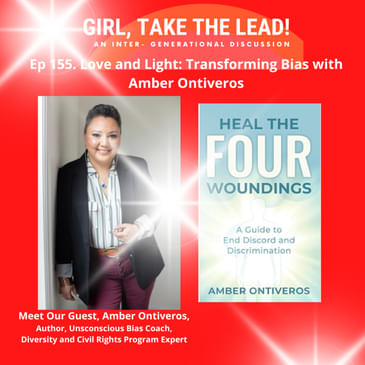
Amber Ontiveros, Gen X, joins us to discuss her book ‘Heal The Four Woundings, A Guide to End Discord and Discrimination’. After a life-altering near-death experience, Amber recognized the limitations of traditional racial equity conversations and was inspired to innovate. Amber is an Unconscious Bias coach and has crafted tools grounded in the neuroscience of unconscious bias to heal herself from beliefs that result in discord, discrimination and oppression. Here are the topics we covered in the episode: 2:28 Ambers amazing background
15:11 Different kinds of biases and what happens in our brain
19:18 Dr. Martin Luther King’s quote about love/light
23:03 The four wounds
24:20 Mindfulness listening
28:29 Loved Awakening Grace
Here are the three takeaways:
1. "Everything is not accidental".
2. The only way to combat darkness is with light.
3. The secret is self-love…you can’t give what you don’t have.
As Mentioned:
Her book: Heal The Four Woundings, A Guide to End Discord and Discrimination
Ep. 115 PART 1: Inside Out: Unveiling the Layers of
Internal Family Systems (IFS) with Uri Talmor
Ep, 116 PART 2: Inside Out: Unveiling the Layers of
Internal Family Systems (IFS) with Uri Talmor
More About Amber:
Amber Ontiveros, a longtime civil rights advocate, served in advisory roles at the US Department of Transportation for the Bush and Obama Administrations, and now runs Ontiveros and Associates specializing in change management, policy development, executive and spiritual coaching.
How to Reach Amber:
https://healthefourwoundings.com/
How to Reach Yo Canny:
Our website:
You can send a message or voicemail there. We’d love to hear from you!
email:
yo@yocanny.com (Yo)
FB group: Girl, Take the Lead
https://www.facebook.com/groups/272025931481748/?ref=share
IG:
yocanny (Yo)
LinkedIn:
[00:00:00] Welcome to Episode 155 of Girl, Take the Lead for each week we explore womanhood and
[00:00:19] leadership. And I'm your host, Yol Canny. Amber Antiveros-Genex joins us to discuss her book,
[00:00:29] Heal the Four Woundings, a guide to end discord and discrimination. After a life altering near
[00:00:37] death experience, Amber recognized the limitations of traditional racial equity conversations
[00:00:45] and was inspired to innovate. She is an unconscious bias coach and has crafted tools
[00:00:52] grounded in the neuroscience of unconscious bias to heal herself from beliefs that result
[00:00:59] in discord, discrimination and oppression. Amber is also a long time civil rights activist
[00:01:09] and served in advisory roles in the U.S. Department of Transportation for both the Bush
[00:01:14] and Obama administrations and now runs Antiveros Associates, specializing in change management,
[00:01:23] policy development, executive and spiritual coaching. She has an amazing story to tell,
[00:01:31] especially about the light and love she lives in today and helps her clients listen mindfully
[00:01:38] and awaken grace. Part of her story though includes being raped so around 9 minutes 30
[00:01:46] seconds. You might want to skip those few seconds if that topic is a trigger for you.
[00:01:52] Enjoy the listen. Here you go. Amber, oh my friend, I really feel like a closeness to you.
[00:02:03] Feel like we're sisters. Me too. And I'm so glad you're here and going to share your story
[00:02:10] with everybody. And maybe let's start by just you introducing yourself to the listeners
[00:02:20] and telling them a little bit about your background because it is friggin amazing.
[00:02:27] Yeah, so let's see where to start. Obviously I'm Amber. I'm Latina. I was born in
[00:02:38] Arizona in Phoenix. I grew up poor on a farm in Arizona. I was very blessed,
[00:02:50] very blessed and I grew up poor and I was lucky in that I worked really hard and I kind of
[00:02:59] followed my passion and I accidentally ended up here in Portland, Oregon. And I met a Black woman
[00:03:10] who was a senator and you know everything is not accidental. And she saw something in me that I
[00:03:23] didn't see in me. And I know that it was my mother who had passed, who had put her in my life.
[00:03:31] And so I ended up working for a Black senator for many years. I became a lobbyist and then
[00:03:38] I ended up working for the head of TriMet which is a transit agency here in Portland.
[00:03:43] And ultimately I was recruited to work for the Bush administration and the Obama administration
[00:03:48] and I'm an expert in several federal civil rights laws that I wrote and I've investigated
[00:03:56] agencies for discrimination and compliance with the federal law that I wrote all across the
[00:04:01] country for many years. And so the thing that we're going to talk about which is the
[00:04:09] discrimination and oppression that lives within me
[00:04:13] is not, does not go unnoticed about the irony and the hilarity for which the infinite creator has.
[00:04:30] Yeah I get that. I think our listeners will get that too. What about the book?
[00:04:36] Could you tell them a little bit about the book? Yeah so I left the Obama administration in 2014.
[00:04:45] They kicked my butt because we did everything. And then I started my business and
[00:04:51] was helping agencies implement some of the things that I had learned all over the country.
[00:04:58] I learned about what not to do and through learning what not to do I could help agencies
[00:05:03] figure out what to do. But you know I have a rare disease and I talk about this in the book that
[00:05:12] one day I was in my bed and the next minute Yolanda I was floating through the ceiling.
[00:05:22] And I was floating through this ceiling and I was in pure blackness and I can feel it.
[00:05:32] I can feel it right now. And that pure blackness felt so good. And one minute I was there and the
[00:05:44] next minute there was like a tiny pinprick of light on the other side of what was like infinity.
[00:05:52] And it called me. It called me. And it sucked me into it like
[00:05:59] like a vacuum. And the next minute I was in an expansion of light.
[00:06:08] And the reason why I call the being of light that was there the infinite creator
[00:06:15] is because it was infinite expansion of light and I knew there was nothing beyond its creation.
[00:06:25] And it's very hard to explain and try and process and describe but it felt like
[00:06:34] one it was a being of light. And I remembered everything because when you're not in the body
[00:06:45] you are everything because you're a spark of that which is you're a spark of the consciousness
[00:06:53] of God. That's who we really are. That is what lives within us is a spark of the consciousness
[00:07:00] of God. And so in that moment I remembered everything because I am everything and so are
[00:07:08] you. And so you both remember everything and you feel what you really are which is you are the
[00:07:17] you are the harmonic of love. It had a harmonic. I could talk for hours about that even though it
[00:07:26] only was minutes it felt like an eternity and I went through essentially a life review of every
[00:07:35] experience I had ever had. It came back into my essence and I felt all of the good things
[00:07:43] that I had done in my lifetime and all of the ways that I had hurt people.
[00:07:51] And I experienced it from a higher perspective from that perspective of the infinite creator.
[00:07:59] And so when I came back it shocked me. It cracked my consciousness. It woke me up.
[00:08:06] I realized I had to die so that I could live.
[00:08:11] And that I was not seeing what was real. I was not seeing what was real and so I studied
[00:08:20] I became completely overnight obsessed with consciousness and quantum mechanics and the
[00:08:25] neuroscience of unconscious bias and these really bizarre things and somehow I knew all
[00:08:31] of these things about quantum mechanics and consciousness and unconscious bias because
[00:08:37] when you go over there you are a part of it and it somehow encodes into you.
[00:08:43] And why did I write this book? I wrote this book because the infinite creator helped me see
[00:08:55] Oh no baby you are angry with the white man who is angry over black lives matter
[00:09:06] but those very oppressive thoughts live within you.
[00:09:11] Right clarity on these things right? I mean this it just sounds like you got
[00:09:17] completely clear to see your sight of things too.
[00:09:22] It lives within me yes. And so as a result of that and studying these things I realized that
[00:09:33] that darkness lived within me and if I'm really going to be a change management expert and
[00:09:38] going to be a leader in discrimination and going to be a woman a person of color and
[00:09:44] a bi woman and if I'm really going to be a leader in these things I have to stand up
[00:09:50] and announce to the world how do you actually change it? And the infinite creator gave me the
[00:09:58] tools to change myself. And the book both identifies the problem and the solution that
[00:10:09] lives within me and that lives within you because like I said I am a policy advisor.
[00:10:15] We identify the problem and the potential solutions regardless of where it takes us.
[00:10:26] And in this case the reason why we act the way that we do
[00:10:34] and we are oppressive or we're triggered or we're jealous or whatever it's all the same thing.
[00:10:42] So I ended up calling the book The Four Woundings because what's really happening
[00:10:49] is the brain is holding you hostage
[00:10:58] to only allowing you to experience through your sense perceptions
[00:11:06] what you believe about yourself. Right, right. And so there's this part of the brain called
[00:11:15] the reticular activation system and whatever you believe about yourself if you think you're
[00:11:22] awesome in my case I suck because I had been raped. I had gone through a lot of trauma. I
[00:11:28] had been discriminated against a lot. All of those things color yourself and create
[00:11:37] traumas and woundings that unless you have healed from them your brain automatically applies
[00:11:48] those filters to new experiences because it's quickly categorizing experiences
[00:11:55] because it's like it's thinking oh that's a lion. I need to quickly analyze that experience
[00:12:01] so that I don't get eaten by the lion. So it's doing that constantly and applying your filters
[00:12:08] which are your expectations namely experiences that affirm my bias.
[00:12:16] And so the four woundings are I am not enough. I am not enough is the belief that I have to
[00:12:28] compare myself to you my beautiful white sisters that are listening and because I believe that
[00:12:39] and I believe the white aesthetic that I no longer do now I believe that I'm not worthy
[00:12:44] because you are the standard of beauty. And because we've been told what we've been told
[00:12:55] I then think I have to compete with you the beautiful white woman and that in order for me
[00:13:02] to compete with you I have to win which means I'm going to deny you a resource or I'm going
[00:13:10] to do something ugly to oppress you because in the past I had somehow been denied a resource
[00:13:19] so that's how it's playing out. Those are the four woundings.
[00:13:23] I am not worthy. I am not enough. I have to win and I don't have enough. Those are
[00:13:29] the four woundings and they play out in work, in oppression, they play out in
[00:13:36] discrimination, they play out with girlfriends, they play out with partners.
[00:13:43] Yeah definitely I can see that when we've been when there's a trauma
[00:13:50] that's happened how we can go to that neural pathway that's so you know just trying to
[00:13:59] protect us and how these things can and it's I had a beautiful weekend with some
[00:14:07] friends some college friends and when there's no comparison and when there's no competition
[00:14:13] and there's only love for each other oh my god is that just not the deepest connection
[00:14:19] you could have with somebody this just fills you up and but I think your the book lays out
[00:14:29] so many wonderful things from the neuroscience point of view and then showing us how we see
[00:14:37] the world differently each of us so that discrimination and the discord comes from
[00:14:46] us seeing the world differently that's right and then maybe talk a little bit too about
[00:14:54] the different biases because you spend some time talking about the ones that are self-serving
[00:15:03] and also those that are unconscious and I think you know it's all because that's happening in
[00:15:10] our brain right like you were saying before so how are they different well okay so
[00:15:17] there are so many there you know the neuroscience has studied all these different types of biases
[00:15:26] right there's you know bias against women etc but when I read when I read all all these
[00:15:34] different biases the reason why I included I included two but I'll really talk about the
[00:15:41] two in the book and then the third so the two in the book that I talk about is one is called
[00:15:48] the self-serving bias and I'm going to talk about these three because all of the rest of
[00:15:55] them really boil down to these three so the self-serving bias is it's a self-protected
[00:16:04] self-esteem protective mechanism it's an evolutionary mechanism so
[00:16:12] the way it works is if good things happen to me I attribute it to myself of course if bad
[00:16:19] things happen to me I attribute it to things outside of myself so I apply for a job I try
[00:16:26] and get the job I don't get the job I don't get the job because I blame it on all these
[00:16:31] other factors and it helps me with the challenge to get the job so that I can eat
[00:16:41] that's why it's that's why it's important the mini me bias which is also a bias it's you
[00:16:51] basically pick people that are like you in hiring now why is that also evolutionary
[00:16:59] because back in the caveman days if if the other tribes weren't like us they would likely steal
[00:17:07] our food in our women and our and our children so we would pick tribe we wouldn't let other
[00:17:14] tribes be in our tribe unless they looked like us or were like us so again it's evolutionary
[00:17:21] now this third bias your brain has a negative bias so in the book and everyone that knows me
[00:17:32] knows I only talk about positive things and there are two reasons why well actually three
[00:17:42] one is because your brain has a negative bias if you if you see five things it will look at
[00:17:48] all those five things negatively it's biased to the negative always okay now but if you know that
[00:17:57] and you understand what the reticular activation system is doing you have to when you have a
[00:18:02] negative experience you have to reframe that experience always in the positive even if it
[00:18:08] was negative because you're retraining your r.i.s filter to then only see positive things
[00:18:16] because then it will change the way the brain see you see and experience things to only
[00:18:23] experience positive things and I want to see I want to have my life awesome right right the
[00:18:30] other reason why I do that and this is this is probably for me the most important which is
[00:18:38] from that near-death experience I was shown that
[00:18:46] the kingdom of heaven that is within you is the consciousness of the infinite creator in which case
[00:18:54] all that power that you have is within you in which case you want to create have
[00:19:04] positive power come back to you not negative one love that in the book you talk oh you have
[00:19:15] some wonderful passages and one of my favorite was dr kings and I'm just gonna say it I'm
[00:19:22] just gonna read it real quick darkness cannot drive out darkness only light can do that
[00:19:29] hate cannot drive out heat only love can do that I think that was just like what you
[00:19:39] were talking about right there yeah it is it is the key because um when when you really
[00:19:50] start practicing this Yolanda the darkness that is within me is the same darkness that
[00:20:00] is within the white man that is angry over black lives matter and and then once you
[00:20:09] fill that darkness up with love you only have compassion for the man that is angry
[00:20:18] and jealous over me and then you realize you can't combat darkness with darkness because
[00:20:29] then you're only feeding it the only way that we can combat darkness is with light
[00:20:40] if you think of it this way if this pen was a flashlight and this is the ground
[00:20:50] it's not like darkness can shine on a light and it it it removes the light it doesn't work
[00:20:58] that way that is the power of love love and and light are a metaphor for the same thing
[00:21:11] let's set that sink in for a second because I think that's so powerful and I mean and I
[00:21:17] guess I'll say one other thing Yolanda and this this will be deep the beings of light
[00:21:28] to me this darkness is simply the absence of light is simply the absence of love
[00:21:40] when in the face of the absence of love you give it more love because it doesn't have any
[00:22:07] and so I know people I need people are are confused by me when they're when they
[00:22:14] when I say I only have compassion for the racist and they're shocked by me and and I'm not saying
[00:22:23] I accept it I'm not saying that I completely that I accept the racist that is not what I'm
[00:22:30] saying what I'm saying is how am I going to show up when it is in front of me
[00:22:39] and it shows up I am going to love the racist because that's what they need
[00:22:51] and that's what's going to heal us exactly maybe we can talk a little bit more about the wounds
[00:23:06] because I think we almost have them I know that I'll have them no one gets through
[00:23:14] life without trauma yes so I know for me belonging and fitting in and assimilating and
[00:23:29] all came with the feeling of not being worthy
[00:23:33] yep and you know knowing that I was different and that
[00:23:42] the last name was Chavez and it wasn't like everybody else's and my family didn't look
[00:23:48] like anybody else's right it's just so how how can others maybe find those wounds like how
[00:24:00] how did you come to that how did you come to those four and for yourself and say this is
[00:24:08] what I think this is about so the way that I came to them is the beings of light had given
[00:24:18] me a tool called mindful listening and mindful listening is a tool that I use I use with
[00:24:25] myself and I teach my clients how to use it and so let's imagine you're in a situation where
[00:24:33] your is very traumatizing you're really triggered so what you do is you focus on the tip of your
[00:24:40] nose and as you breathe breathe in think in and as you breathe out think out and this
[00:24:47] helps you regulate your emotions it helps you
[00:24:53] compose yourself so that you can assess the situation because if you're triggered likely
[00:24:59] you're not you're not going to be able to analyze the situation accurately so you compose
[00:25:05] yourself in the and then the other thing you're doing is you're asking yourself these
[00:25:09] questions you ask yourself why am I getting angry why am I feeling the way that I'm feeling
[00:25:16] and then why what kind of beliefs would I have if I was angry and then the other two questions
[00:25:25] are you ask questions about the person that's behaving in whatever way that they're behaving
[00:25:32] why would they behave that way and what kind of beliefs would a person like that have to
[00:25:39] behave that way now why you're asking yourself these questions is because you're trying to
[00:25:47] understand you and in other words what is what are the core beliefs that are resulting
[00:25:54] you having an emotional response right and you're also trying to understand the other person
[00:26:01] about why are they behaving in the way that they are behaving and and that will help you
[00:26:06] understand their core beliefs that are resulting in their behavior because again for the listener
[00:26:14] your beliefs in your unconscious mind that you don't know exist create your thoughts
[00:26:19] that create your emotions that create your behavior and if you've ever had a behavior
[00:26:23] you have no idea where it came from it's in your brain somewhere with some kind of belief
[00:26:28] I love that I love well the whole work around beliefs it's work you know it's like you're
[00:26:35] saying you've got to work through and see what's at that core yes and I love that you bring that
[00:26:42] up because that to me is also the heart of things those beliefs and you can shake those
[00:26:50] up though because you can question them and you can say well is that really true or do I still
[00:26:58] need that anymore like that's right right maybe I had that as you know a five-year-old and that
[00:27:05] was really important for survival but I don't need it now and I can let it go yes but it's
[00:27:13] it's it just doesn't happen I think what you're showing us is that
[00:27:20] you have tools you can work with them you can find people who can help you identify these
[00:27:27] things and you can get to the core so that you can heal yes those wounds because if we're all
[00:27:34] walking around being wounded like we are right now yeah yes you know we need leaders like you
[00:27:44] to help us say hey this isn't the way this the way to we've got to look at this has come
[00:27:51] from love that's right passion for ourselves first I think we have to do that work on
[00:27:58] ourselves first yes so we can give it to other people yes I think another tool that you talked
[00:28:08] about in your book was awakening grace yes can you talk a little bit about that because
[00:28:16] that was very cool so in the near-death experience the beings of light gave me a
[00:28:23] tool that I didn't know what it was it was they called it awakening grace and awakening grace
[00:28:32] awakening stands for to to turn to go within to witness and see false dark self-loathing
[00:28:47] oppressive beliefs it's basically turning within to see yourself that's the awakened part
[00:28:57] grace is then extending kindness love and compassion and grace so in other words awakening
[00:29:07] turning within to see yourself and grace to extend compassion loving kindness
[00:29:14] and through awakening your grace you then do what Yolanda just said which is you can then
[00:29:22] extend the hand of love to another once you awaken your grace you can then extend the
[00:29:28] hand of love to another so the awakening grace tools that I now use with other executives are
[00:29:39] so many like mindful listening I do an exercise called breaking the habit of being small
[00:29:48] and that ties with the visualization exercise because this is all based on neuroplasticity
[00:29:57] so your brain doesn't understand the difference between an imaginary versus a real experience
[00:30:04] so when you do these visualization experiences and techniques that I use
[00:30:11] right before you go to bed it locks that in and it builds your confidence because
[00:30:18] your brain doesn't understand the difference between a fake and a real one so awakening
[00:30:24] grace is all about turning within to see the quote darkness that is simply the absence
[00:30:35] of light and love and so you find those things and you compassionately love those parts of
[00:30:42] yourself and then you can become the best version of whoever you want to be yeah
[00:30:48] yeah we did an episode about a book called no bad parts
[00:31:01] and it I just really loved the idea that we can be all of these things we can be our experiences
[00:31:12] and we can embrace all of them and I used to think well I need to get rid of that one so
[00:31:18] that I could be this better person but maybe it's more about the awakening part of accepting
[00:31:27] yes that that's me and that was there for a reason yeah yeah and and the way I would say
[00:31:37] and I'm going to say this because this is this is the way the creator talks to me
[00:31:44] I would say this to you my sister Yolanda you were always perfect you just were programmed
[00:31:52] to believe that you weren't and those things that were quote your imperfections or your
[00:32:01] darkness you had to experience to be the Yolanda that you are today okay another episode where I am
[00:32:12] the tears are coming because you touched my heart so deeply that's that's that's how he speaks
[00:32:19] that's the real that is the real thing he's talking to me right now so cool okay another
[00:32:31] episode this little girl is like oh my god we're crying again oh but I think
[00:32:40] how can that not be so beautiful I mean that is just so beautiful and it's so touching and
[00:32:46] you know to have that light and that love come in you know it's almost like a beam that just
[00:32:53] goes right to the hurt yes you know and just goes boom it's like we're gonna we're gonna
[00:33:01] flip that well you know we've covered our questions that we had outlined when we talked
[00:33:10] before and is there anything else that you would like to pass along I mean you've given us love
[00:33:18] and understanding and compassion is there anything left I mean you did such a great job
[00:33:30] let's see what I don't know what else do you think I should talk about Yolanda
[00:33:34] I think my takeaway because you talk a lot about this in the book is self-love yeah
[00:33:47] okay I'll I will I'll talk about that so um we have it wrong
[00:34:00] we have it wrong Yolanda we first must love ourself
[00:34:08] we must love ourself first because when you go back to what I said at the beginning
[00:34:19] for those of you that can see I have my hand up and in the middle think of your heart
[00:34:26] think of your heart as the spark of consciousness within you you have to love yourself
[00:34:35] love yourself unconditionally love yourself and when you then love yourself in the way that you
[00:34:45] are loved that comes to you because that is what's within you that you are calling
[00:34:54] forth do you get it it's manifestation so if you are if you are consciousness if there is a
[00:35:01] consciousness within you that is that powerful and you do not love you that is what you are
[00:35:08] calling forth so you have to love you including when you make a mistake when you make a mistake
[00:35:17] it is here's why this is also a love story it's a love story because when you made a
[00:35:25] mistake you were unconscious you were unconscious you made the mistake from your past it wasn't
[00:35:36] real you were innocent that's what I learned in my NDE and I realized that I was like oh
[00:35:44] my gosh but I'd hurt all these people and so therefore I wanted I had to come back
[00:35:50] so that I could learn all these things so that I could teach people you don't have to live this
[00:35:56] way and also you can't live this way because you're a spark of God it's not who you really are
[00:36:13] you are amazing you are so amazing and your book is so amazing I hope it helps people
[00:36:24] I want everyone to listen to this episode
[00:36:30] everyone needs to listen to it but oh my gosh thank you thank you Yolanda and I just
[00:36:40] want to say one last thing to everybody that's listening you don't understand the true nature
[00:36:48] and true power that's within you but when you're ready and you're ready to tap into it
[00:36:52] and you then harness it you can literally be anything that you want that's real thank you
[00:37:07] again I love you take care of yourself you're so special thank you for listening today and
[00:37:18] we sure hope you enjoyed this episode and if you did please leave us a comment wherever
[00:37:23] you listen to your podcasts tell a friend about us join our public Facebook group Girl
[00:37:30] Take the Lead or visit our website girltaketheledepod.com we also have a YouTube channel where your
[00:37:37] subscription would be appreciated once you're on YouTube search at Girl Take the Lead and
[00:37:44] we've recently expanded to YouTube music where you can find a video of this episode
[00:37:51] here are the three takeaways from this episode one everything is not
[00:38:00] accidental two the only way to combat darkness is with light and three the secret is self-love
[00:38:15] you can't give what you don't have our next episode we'll explore a bit more about the
[00:38:25] spiritual awakenings after a dear nath experience I have questions after listening to Amber's
[00:38:31] story that got me going then maybe you tip like how common are near-death experiences
[00:38:39] and are other experiences like Amber's so I found a study that Dr. Bruce Grayson who has
[00:38:48] been studying the field since the mid-1970s as professor of psychiatry and director of the
[00:38:55] Division of Perceptual Studies at the University of Virginia Health System
[00:39:01] and he's credited with the term near-death experience and then I found this book titled
[00:39:08] after a doctor explores what near-death experiences reveal about life and beyond
[00:39:14] I was in and hope you will be too so join us again thanks for being here and I'll talk to you soon bye