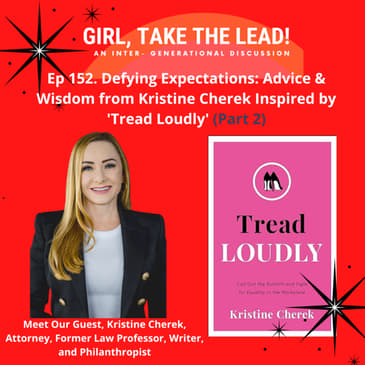
Today we continue our conversation with Kristine Cherek to discuss her book Tread Loudly. In addition to being an author, Kristine is an attorney, executive, professor and philanthropist. This is Part 2 of 2 and we will continue 'going for it like Elle Woods" by discussing key data & research findings, and Kristine offers advice for younger generations, plus what she’d tell her 20 something self. Be sure to listen to both parts of our interview.
Here are the topics we covered in the series: Work friends and their importance· Having it all (not!) and Perfectionism. Beliefs. Elle Woods. Data (The real issue: normalized gender bias). Quitting is not failure.
Here are the three takeaways:
1. We can’t have it all and trying to be perfect robs us of our happiness. Others that we think ‘have it
all’ really don’t.
2. We can begin to change our lives by changing a few beliefs within ourselves. Be determined. Be
ambitious. Believe in yourself and take chances, just like Elle Woods did!
3. Quitting is not failure but can be the only way to achieve success in the long term.
As Mentioned:
Her book: Tread Loudly: Call Out the Bullsh*t and Fight for Equality in the Workplace
More About Kristine:
Kristine earned her B.A. from Marquette University, and her J.D. from the University of Wisconsin Law School. She resides with her husband and their two senior rescue cats.
Events:
Kristine is currently doing book signings and events at various locations around the country. Follow her on Instagram for the latest updates!
How to Reach Kristine:
Facebook: https://www.facebook.com/tread.loudly.2023
IG: treadloudly, kcherek
TikTok: treadloudly
How to Reach Yo Canny:
Our website:
You can send a message or voicemail there. We’d love to hear from you!
email:
yo@yocanny.com (Yo)
FB group: Girl, Take the Lead
https://www.facebook.com/groups/272025931481748/?ref=share
IG:
yocanny (Yo)
LinkedIn:
[00:00:00] Welcome to Episode 152 of Girl, Take the Lead where each week we explore womanhood
[00:00:12] and leadership. And I'm your host, Yolani Canny. Today we continue our conversation
[00:00:18] with Christine Cherick to discuss her book Tread Loudly. And you may remember in addition
[00:00:25] to being an author, Christine is an attorney, executive professor and philanthropist. This
[00:00:32] is part two of two. And in it we'll continue our conversation about going for it like Elle
[00:00:40] Woods and we'll get some key data and research findings. And Christine offers her 20 something
[00:00:47] self advice as well as younger generations. Be sure to listen to both parts of our interview.
[00:00:55] Enjoy the listen and here you go.
[00:00:59] I think a good example of somebody going for it was Elle Woods, right?
[00:01:05] Absolutely. Absolutely. And you bring her up in your book in a couple of places. And
[00:01:12] for our listeners who may not know who Elle Woods was, in the movie Legally Blonde,
[00:01:20] she had, I think a 4.0 and super high LSAT score, which is the entry exam to go to law school.
[00:01:28] Right? Like, what was it like 380 out of 400 or something?
[00:01:33] Yeah. So she's in like the 98th or 99th percentile of LSAT scores. Right.
[00:01:39] That's what it was. 179 over out of 180. And you bring her up as an example
[00:01:49] of someone who can lead and you don't expect it.
[00:01:55] Absolutely. And I love that. Yeah.
[00:02:01] Yes. And she's smart and it's such a great movie. If you haven't seen it,
[00:02:06] listeners, that's your homework for the week. Cue up your Netflix, watch Elle,
[00:02:11] watch Legally Blonde. It's such a great movie because it works on so many levels.
[00:02:19] Some people see it as this, oh, it's a fluffy fun movie about this pretty sorority girl who
[00:02:25] surprised herself and was successful. But I think of it as such a deeper meaning.
[00:02:32] This was a, it's Reese Witherspoon, if you don't know the movie. This is Reese Witherspoon
[00:02:38] 20-ish years ago. Beautiful young girl who everybody just assumed was not smart.
[00:02:46] Everybody just assumed because of the way she looked and the way she acted and the clothes she
[00:02:51] wore that she couldn't possibly be an attorney. She couldn't possibly get into law school,
[00:02:57] let alone Harvard. And she decides to take on that challenge because she's chafing a boy.
[00:03:05] That's beside the point. It got her there. And she finds out that yes, she's different.
[00:03:13] Yes, she doesn't have what it typically takes to be a great student at Harvard. She doesn't have
[00:03:22] the knowledge or the experience or the background or the four generations of attorneys before her.
[00:03:30] But she's got all these other qualities. She's smart and she's tenacious and she's
[00:03:37] strong and she has knowledge that they don't know anything about. And so she finds this
[00:03:42] kind of power in herself. There's a turning point in the movie where she wants to give up,
[00:03:48] where she says all these people are doubting her and things aren't going right.
[00:03:54] And she's going to pack up and go back to California and give up on Harvard.
[00:04:01] And something in her clicks and she says with some inspiration from a female professor,
[00:04:08] you know, I'm not giving up. In fact, I'm going to win this battle and surprises everybody.
[00:04:15] And I think that's such a great role model that for us all to think about.
[00:04:23] So in the book I say, be like Elwoods, be like El the day that Warner, the boyfriend,
[00:04:30] told her she wasn't smart enough for law school. Live to prove him wrong.
[00:04:36] Live to stand on the stage and say, I did this. I got this. And not only did I do this,
[00:04:43] I did this better than you did. She doesn't have to say that in the movie.
[00:04:46] She's just standing on the stage giving the speech at graduation.
[00:04:51] Well, and you had your own Elwoods moment with your own law professor
[00:04:57] who threw up a major comment to you that I did.
[00:05:04] I wish I had been around because I would have probably taken him out.
[00:05:08] But I did. Tell me about that story.
[00:05:12] That was so good.
[00:05:14] Thank you. This was, so I went to law school straight from,
[00:05:19] I graduated from college in four years. So I was 22 at the time.
[00:05:23] And what a fact that not a lot of people know is that most law students are a little bit
[00:05:29] older. Average age is 26 or 27 at most schools. So I was young and I felt very
[00:05:39] intimidated and under qualified. And I had an older professor who at the time,
[00:05:45] I thought he must have been in his eighties. But now as I get older,
[00:05:48] I realized maybe he wasn't that old. But an older professor
[00:05:52] I think is a good example of how you can grow me for lack of a better word one day.
[00:05:58] The way law school works is it is a bit like you see in the movies
[00:06:03] in order to teach you how to think on your feet and how to argue and reason and react
[00:06:07] and be able to field questions thrown at you. What the professors will do is they'll pick
[00:06:12] somebody that day or that 10 minutes or whatever it is, and just start asking question after
[00:06:18] question after question. And you don't know it's coming and you don't know your day is today,
[00:06:22] so you better be prepared. And the professor was asking me all these questions. I don't even
[00:06:29] remember what the topic was, but it was a contracts law class. And he kept saying,
[00:06:33] but why? But why? But why do you think you're right? Why do you think this side wins? Why do
[00:06:37] you think this argument is the right one? And at some point I said, because it's just not fair.
[00:06:44] Like the way the court decided something just wasn't fair. And he said to me,
[00:06:50] the words that I can still hear ringing in my head, he said, you know, my dear,
[00:06:54] whoever told you life was fair? And I could feel like my face turning red.
[00:07:00] And I said, but it isn't that, I don't know, I fumbled through some kind of answer about
[00:07:06] this is the law and justice and fairness and what are we all here for?
[00:07:11] And he told me something along the lines of that I was far too young and naive to be in law school.
[00:07:18] And in the moment, I didn't, I don't think I said anything in response. I think I just froze
[00:07:25] and just bought back the tears as hard as I possibly could. And I think graciously,
[00:07:31] he moved on to the next person because he didn't want me to break down in tears
[00:07:35] in the middle of class. I don't know, I somehow fought that either rage or sadness or anger
[00:07:41] or whatever it was. And in that moment, I just wanted to shrink into my seat and disappear.
[00:07:50] And I let that really affect me. I didn't realize it at the time, but I thought,
[00:07:55] well, maybe I can't do this. And I remember crying to my friend, crying to my mom saying,
[00:08:01] this is what happened. And maybe he's right, maybe I can't do this. And letting that fear
[00:08:10] kind of shatter my confidence for a bit. But at some point, I don't know what triggered it,
[00:08:16] but I thought, you know what? This guy doesn't even know me. He doesn't know anything about
[00:08:21] me really. He doesn't know my history. He doesn't know what I've been through in life.
[00:08:27] He judged me in that minute and I let that affect me. And I let that make me lose confidence in
[00:08:34] myself. So I decided this was actually before the Legally Blonde movie came out, I think now
[00:08:40] had the timetable been reversed, I could have looked at that situation and thought,
[00:08:46] this is really parallel to what happens in the movie where she wants to give up.
[00:08:51] And instead of giving up, she turns around and thinks, no, this is what I'm going to use
[00:08:57] every time I want to close the book or close the chapter or leave the place or just stop.
[00:09:05] I want to instead say, no, I am going to prove this person wrong. I am going to use that
[00:09:12] doubt as the thing that motivates me instead of the thing that deflates me. So that was my
[00:09:22] Elwood's moment. But was there any more data that you wanted to cover with us today?
[00:09:30] Oh, absolutely. So when I tell people that I wrote a book about gender inequality in the
[00:09:37] workplace, sometimes I get this look like, tell me more, tell me more because I feel it too.
[00:09:43] I've been there. Sometimes I get sort of a nice, oh, good for you. And sometimes I get,
[00:09:50] yeah, sometimes I get some skepticism. Skepticism usually comes from guys,
[00:09:57] usually comes from older guys. And depending who it is, they'll sort of nicely say,
[00:10:05] are we still talking about this? Do we really need this? Is this still really a problem?
[00:10:10] I have a really good friend whose opinion I value greatly, who challenged me in a very nice
[00:10:17] but intellectual way and said, you know, at my company, we have so many programs for women,
[00:10:25] for people of color, for people who identify as LGBTQIA+, for anybody who isn't a white dude,
[00:10:33] basically is what he said. He said, to me being a 50 year old white guy, I'm the low
[00:10:38] person on the totem pole. So he said, how do you combat that? Or how do you think about
[00:10:45] that? Or what's, prove me wrong. Tell me I'm wrong. And so what I realized in writing the book and
[00:10:53] kind of going over ideas and things with my husband was the way to prove my point
[00:10:59] was to use numbers. Because if I say, you know, it's hard for women in the workplace,
[00:11:05] it's hard for women to become CEOs of companies. It's hard for women to become
[00:11:10] engineers and attorneys and doctors and whatever profession you speak of. Yes, it is. But you get
[00:11:21] a lot of, well, you just have to work hard and dig in and try more. But when you look at the
[00:11:26] data, it's really irrefutable. So there's, if you're not familiar with the consulting world
[00:11:33] listeners, there's a company called McKinsey and Company, which is one of the largest
[00:11:38] and probably most prestigious consulting firms in the world, offices all over the world.
[00:11:44] And every year McKinsey and Company does a comprehensive study of women in the workplace.
[00:11:51] And this is done in partnership with leanin.org, which is a wonderful nonprofit that works to
[00:11:57] advance women and girls. There's now a lean in girls movement as well, to help propel us
[00:12:06] forward in career and life. And also Stanford University. So we have McKinsey and Company,
[00:12:13] incredibly large, incredibly prestigious consulting firm, leanin, which is led by
[00:12:18] Sheryl Sandberg, who's the former chief operating officer of Metta, which formerly
[00:12:23] Facebook and Stanford University. So these three powerhouses get together every year
[00:12:29] and study corporate America, for lack of a better word, from coast to coast. Looks like my lights
[00:12:37] just turned off. Coast to coast, from industries of all kinds. And from engineers to consulting
[00:12:47] firms to healthcare to utilities to you name it, that profession is in there from marketing
[00:12:53] professionals to everything obscure like oil and gas companies to accounting firms, to law firms,
[00:13:01] to manufacturing, to you name it, retail, hospitality, hotels. You get the idea.
[00:13:09] And looking at the data of women at different levels of seniority across all of those
[00:13:14] companies, whether the company has 500 people or is a Fortune 50 company largest in the country.
[00:13:23] And what they found is that we see a drop off of women at each level on this proverbial corporate
[00:13:32] ladder. So at the entry level, women make up roughly 50% of the workforce. And that makes
[00:13:41] sense. Women are 50% of the population, roughly 50 or more percent of college grads. So we're
[00:13:48] good there. We're good at that entry level position, but just one level up or one category up.
[00:13:55] At the manager level, we see that the percentage of women drops from 50 to 40.
[00:14:02] So already early in career at a manager level, we start to see this massive difference.
[00:14:12] So we go from 50-50 to 60-40 immediately, fairly early in the career. One level up from there,
[00:14:20] it drops to 36%. Go up from there to a vice president level, it's now only about 32% women.
[00:14:30] So one out of three or less across the country, across the company, across industry,
[00:14:37] and it gets worse and worse from there. At the senior vice president level, it's only about
[00:14:44] 28% women. And at the C-suite, which we talked about earlier, only about one in four C-suite
[00:14:53] executives are female. And they're not just talking about the CEO, we're talking about
[00:14:59] the chief marketing officer, we're talking about the CFO, the head of human resources,
[00:15:05] legal technology, all of those positions. If you take all of them together, only one in four
[00:15:12] is held by a woman, regardless of industry or location or company size. And I think once we
[00:15:19] look at that, we can't deny the fact that there is a problem with women being able to
[00:15:29] ascend into senior level positions. That's the bad news. The good news is when you have the data
[00:15:37] and you know what the numbers are, you know where the disparity is, and you know where the
[00:15:43] greatest drop-off is, you can do something about it. Companies can do something about it,
[00:15:50] industries, leaders can say, what are our numbers? Are we better or worse than average?
[00:15:57] And why are we losing women? So that's the data. It's a long explanation, but I think it's really
[00:16:04] important to know where that's coming from and what those numbers are. Well, I think to post
[00:16:10] COVID, we've gone through a period of women leaving. Now, a lot of them are becoming
[00:16:15] entrepreneurs and doing their life differently. And it does seem like balance comes to be
[00:16:23] more of an issue. When I was starting, you work 60 hours, like 40 hour a week.
[00:16:34] Right. Same. Absolutely same. You just took it on. You just worked really, really hard. And now
[00:16:43] we know that working hard doesn't really get you anything except you've worked hard.
[00:16:51] You can say you worked hard. You worked long hours. And it'll be interesting to see how this all
[00:16:58] nets out because I do think that women are finding their way through this differently.
[00:17:07] And it may not look like the way that we got through it, but in corporate,
[00:17:16] it's going to have to adjust and change. Exactly. Can't just be the same old thing.
[00:17:27] Right. And I do feel like we are at kind of a tipping point. And I think COVID, for all of
[00:17:33] the awfulness that it was, it had the effect of really highlighting some issues in the workplace
[00:17:44] and in our lives and teaching us all how to sort of refocus on what's really important.
[00:17:53] But I completely agree. That's one of the things that I love most about the younger generations.
[00:17:58] So Millennials and Gen Z, I talk about this all the time with my husband, with my friends.
[00:18:05] I look at my nieces, and not only do they take less crap than I did, they're just not
[00:18:12] willing to do what you and I did. They're not willing to... I think about my 20s,
[00:18:19] I worked. I worked a lot. And then I worked some more. And one of my nieces,
[00:18:26] I remember when she was a little kid and we were going on vacation and I brought my laptop
[00:18:32] and I brought a whole suitcase full of work binders and all this kind of stuff.
[00:18:38] And I remember her saying, Auntie Christine, your job sucks. I'm never going to do that.
[00:18:43] And they just view the world differently. I think their perspective, they're so much
[00:18:49] more entrepreneurial. They're so much more self-reliant. They see possibilities where
[00:18:56] we didn't and they value their time. I mean, if 20 years ago I would have gone into my boss
[00:19:05] and said, I need more time off. I value my free time. Or I want to... On a Thursday night,
[00:19:15] I can't be here that late because I've got tickets to the symphony or whatever.
[00:19:19] I never would have done that. But now I see young people every day not only doing that,
[00:19:27] but saying, not only can't I be there Thursday night, but I'm not doing that. I'm not going
[00:19:34] to be there till 8, 10 o'clock really any night unless it's an absolute must do kind of thing.
[00:19:40] They're really prioritizing themselves, their lives, their interests, their whole selves
[00:19:45] more than I did. And I find that really inspiring. And I think companies are going
[00:19:50] to have to listen. I think some industries have got the message loud and clear and made
[00:19:56] some real changes. Yeah. Well, and you brought this up in the book about
[00:20:02] can't be what you can't see. But perhaps the way that we'll see this, the way that these
[00:20:11] generations will see it, it might be one of the more positive things happening too
[00:20:17] from social media is it won't necessarily be in the walls of the company, but they'll
[00:20:24] get messages from other sources that we didn't have. I didn't have social media. I didn't know
[00:20:32] that there were other ways of doing things. And so maybe that could be one of the positive
[00:20:38] things that does happen, that they'll get messages and support differently than the way
[00:20:44] that we did. I think this goes along with the perfectionism that we talked about earlier
[00:20:52] that we work hard, we do a good job, we have pride in what we do. We want to be great at our
[00:21:02] careers or our life, whether it's sport or academics or profession, we try and we
[00:21:11] want to be great at it. And we're chasing that perfectionism. And at least for me,
[00:21:18] I saw quitting as something wrong with me. I've stayed in a couple of positions longer than I
[00:21:26] should have. I thought if I just worked harder, tried harder, learned more skills or in school,
[00:21:35] studied harder, studied differently, studied longer, found more help, whatever it was,
[00:21:41] if I just rounded out more, that then I would succeed. And what I've come to learn over 20 some
[00:21:50] years of professional career so far is that sometimes you just have to walk away. Not every
[00:21:59] situation is for you. Not every company is for you. If you are in a culture where it doesn't
[00:22:06] align with the way you work, your work style, what you want out of life, what's important to you,
[00:22:14] leave. If you can and not everybody can. But if you have the ability to find a different job.
[00:22:21] For me personally, I got caught up in the competitiveness of, well this is the job
[00:22:29] everybody wants. Everybody's chasing this thing. So therefore that's the thing that I must want to.
[00:22:38] And I felt like, and I wasn't happy there. It was more hours, not the right environment.
[00:22:45] It's a great place. I still have friends there. Still have some very good close friends there.
[00:22:50] But it wasn't the right place for me. I would have been much happier in a company that was
[00:22:56] less competitive, more supportive, less of a swim atmosphere, more mentoring, more training.
[00:23:06] Kind of just kinder, gentler place. But I thought if I left that I was failing
[00:23:13] and I was hell bent on making sure I didn't fail. And now what I realize is by staying
[00:23:19] and staying and staying, I was blocking out any other opportunities where I could have been much
[00:23:26] happier. So sometimes you have to quit to get to the place where you can succeed and be happy.
[00:23:35] I think of the story you told about MBA. If you had doubled down and said, nope,
[00:23:42] to be successful I have to be the person at the top of the class in accounting or finance.
[00:23:48] You might not have found that you're really, really good at marketing. And so I think that's a
[00:23:54] perfect example of you have to quit. Well there you have to take the required course, but to
[00:24:00] pursue that as your career would not have been the right thing to do. You found something else
[00:24:07] by walking away from that and saying, I know I don't want to be in that field. You're able
[00:24:11] to find the thing you're really good at and where you can really succeed. And I think that
[00:24:16] that's such a good message, particularly for younger people to know you don't have to chase
[00:24:25] the investment banking jobs or whatever the thing is in your chosen field.
[00:24:32] It might be the best definition of success to close that door and go somewhere else.
[00:24:39] Well, I also- Giving you permission to quit.
[00:24:43] Yeah. And it's definitely so many times it's like dating, like guy looks terrific on paper.
[00:24:53] He's charming. He's all these great things. And then once you start dating for a while,
[00:24:59] not for me. And everybody else might look at it and say, are you crazy?
[00:25:04] I know. And that's okay.
[00:25:09] And then all of the pink cloud wears off and you're doing the job day to day,
[00:25:18] and you really find out what it's like. But it's almost like the romance of it and getting
[00:25:25] into the job and, oh, we're giving you more money. And then I kind of look back on,
[00:25:31] I think I had like 14 different jobs in my career and none of them are perfect.
[00:25:41] Especially, you get to that point where you go, okay, now I'm going to find the things in it
[00:25:46] that I really like. And that's what's going to fuel me and bring my creativity in and
[00:25:54] not these other things, which I know at this point I don't like. I mean, because you do,
[00:26:00] you learn about yourself in the process. So anyway, good stuff. And I guess that's probably
[00:26:07] wisdom you would pass along to the Gen Zers and millennials. Absolutely. Anything else?
[00:26:12] Absolutely. That we could share with them? Absolutely. Oh, you have your whole life
[00:26:18] ahead of you. Millennials and Gen Z, remember that any particular job,
[00:26:24] any particular relationships, everything I've said today doesn't just apply to career,
[00:26:32] especially the example you just brought up about dating. This is just good life stuff.
[00:26:38] If a situation isn't serving you, if it isn't the right fit for you, if it isn't
[00:26:44] where you want to be, then it's okay to walk away. There was a great quote, so I'm a Graze
[00:26:53] Anatomy fan. There's a great quote for listeners who either aren't familiar with Graze Anatomy
[00:27:00] or if you are in a place where it doesn't broadcast or didn't broadcast, show about
[00:27:07] the lead character being a young female doctor rising up through the ranks.
[00:27:13] And there's a great quote where Meredith Gray talks about, are you where you thought you would be?
[00:27:21] If you look back at yourself five years ago, 10 years ago, wherever it is,
[00:27:26] are you where you thought you would be at this point or do you dream of something bigger?
[00:27:30] And that was another quote that really stuck with me and I always sort of used to check
[00:27:35] myself. Is this where I thought I would be? Is this where I want to be or do I dream of
[00:27:42] something bigger? You know, I wrote a book. I am not an author. I was an attorney. I
[00:27:49] practiced corporate law. I taught. I did a lot of writing, but they were contracts.
[00:27:57] They were articles and certainly not a book. But are you doing something that really fills
[00:28:04] your spirit that you love, that you're passionate about, that you are you?
[00:28:09] Is there something out there that you really want to try to do to go for if you can,
[00:28:15] if you have the means to do it, if you have the ability to be able to jump to a
[00:28:21] different position, a different career, try something new. Even if it's a new hobby,
[00:28:25] you always wanted to, I don't know, climb a mountain or go water skiing or whatever it is.
[00:28:30] Are you going to look back someday and think, I wish I would have tried?
[00:28:35] And if so, just do it now. Why not? Why not? My mom, I'll have to close,
[00:28:43] share one last piece of advice that my mom gave me. No one in my family is an attorney. No
[00:28:49] one had ever gone to law school. My sister, my older sister was actually the first person on
[00:28:55] either side of our family to go to college and I was the second. And I remember when I
[00:29:01] was in high school telling my mom, I had this dream about going to law school,
[00:29:06] but I was really scared because it's a long road. It's four years of undergraduate degree
[00:29:13] or five or however many years that undergrad degree takes one than three years after that.
[00:29:20] And I remember saying to my mom, worst case or best case scenario, the fastest I could do
[00:29:26] this, I wouldn't graduate until I was 25 years old. And that's if everything lined up,
[00:29:34] if I finished my undergrad in four years, if I got into a law school,
[00:29:38] if I finished that in three, I'd be 25 years old. And she said to me,
[00:29:44] someday you're going to be 25 anyway. Do you want to be 25 years old with a law degree
[00:29:50] or 25 years old without one? And that was just like this light bulb moment for me.
[00:29:57] You know, yeah, someday you're going to be 50 anyway. Do you want to be 50 and say,
[00:30:02] I jumped out of an airplane or not? And if you think, yeah, I wish I would have done that,
[00:30:08] then do it. I think that is my take, my best advice. There are so many things I was afraid
[00:30:13] to do in life that now I'm just, what the heck, I'm going to write a book, see if I can
[00:30:20] do it. So I hope that inspires people. Well, I'm so glad you wrote the book. I mean,
[00:30:25] I get to meet you and hear about you. And it was just wonderful. So one last question though,
[00:30:32] girlfriend, what would you tell your 20 something today? Oh gosh. I would tell my 20 something
[00:30:42] all that stuff I just said, but I would also say, you know, it's whatever you're going to
[00:30:47] do in life, it will surprise you. You can have life will surprise you. You can have the best laid
[00:30:55] plans and the universe will laugh in your face and throw something at you. And that's okay.
[00:31:02] You're going to be okay. You know, if someone would have told me that I would end up moving
[00:31:08] from where my husband and I both grew up from our, we grew up in Wisconsin,
[00:31:14] didn't know each other until after college, that we would end up moving across the country.
[00:31:19] And I would drop my corporate law career and start teaching at a university. I would have said,
[00:31:24] you're crazy. If four years ago, someone would have said, you're going to write a book. I
[00:31:30] would say, no, I'm not. That's not my thing. You can have a plan and life is just going to
[00:31:37] happen and roll with it. And that's, that's what's really fun. Frankly, that's what's really
[00:31:45] exciting. Go with it. Take on the experiences. Maybe make that move across the country. Maybe
[00:31:55] take that job. Maybe go on that date that you thought you were going to turn down.
[00:32:01] Life can take you in some really interesting, fun places and experiences and you can plan it,
[00:32:09] but it's just not going to go the way you planned. And that's, that's not only okay.
[00:32:14] That's great. How boring it would be if everything went the way we wanted it to go.
[00:32:22] Yeah, definitely. We don't get to control this stuff. We think we can.
[00:32:29] We just don't. We try, but we just really can't. Absolutely not. So Christine, I think we've,
[00:32:37] I've exhausted you. I know I've kept you. This is going to be too. I haven't exhausted you.
[00:32:43] This is going to be too episodes because it's just such good stuff. Why don't we end with
[00:32:49] reminding our listeners of the book and where they can get it and how they can follow you?
[00:32:55] Absolutely. The book is called Tread Loudly and I'll show it so you can see the bright pink
[00:33:02] for to symbolize not only femininity, but power and empowerment and strength.
[00:33:09] It's available on Amazon. It's also available. There's a great website called bookshop.org.
[00:33:16] If you haven't ever been there, it's a great one to check out. They source all that. You
[00:33:21] can order just like you would on Amazon and it's sourced through local indie bookstores.
[00:33:27] So you can designate your favorite indie bookstore and they'll ship it directly from that bookstore.
[00:33:34] It's on Barnes and Noble dot com, pretty much anywhere you buy books. It's available
[00:33:40] and I am on Instagram under both Tread Loudly, the name of the book or my name,
[00:33:46] Kay Cherick. It's chair like a chair. You can find me on Instagram. You can find me on LinkedIn
[00:33:52] under my regular name. I do Facebook too, although not as active and maybe to the
[00:34:01] embarrassment of my millennial and Gen Z nieces, I do have a TikTok under Tread Loudly.
[00:34:07] So I probably most active on Instagram. So Tread Loudly or Kay Cherick, send me your
[00:34:13] questions. I love hearing from people. I'm happy to share whatever bits of
[00:34:21] wisdom or don't do this, don't do what I did kind of advice that I have.
[00:34:27] LESLIE KENDRICK Perfect. Well, thank you again for joining us,
[00:34:31] Chris. It was so much fun. Appreciate it very much.
[00:34:34] CHRISTINE Thank you. It's such a pleasure. It's such a pleasure. I really appreciate it.
[00:34:37] LESLIE KENDRICK Thank you for listening today and we sure hope you enjoyed this episode.
[00:34:41] If you did, please leave a comment wherever you listen to your podcasts. Tell a friend about us,
[00:34:49] join our public Facebook group, Girl Take the Lead or visit our website, girltaketheliedpod.com.
[00:34:57] We also have a YouTube channel where your subscription would be appreciated
[00:35:01] once you're on YouTube search at Girl Take the Lead. And we've recently expanded to
[00:35:07] YouTube Music where you can find a video of this episode.
[00:35:13] So here are the three takeaways from this two-part series.
[00:35:17] One, we can't have it all and trying to be perfect robs us of our happiness.
[00:35:25] Others that we think have it all really don't.
[00:35:29] Two, we can begin to change our lives by changing a few beliefs within ourselves.
[00:35:36] Be determined. Be ambitious. Believe in yourself and take chances, just like Al Woods did.
[00:35:45] Three, quitting is not failure and can be the only way sometimes to achieve success
[00:35:52] in the long term. Next week we'll have another two-parter with our friend
[00:36:00] Andrea Main Dewitt who returns to our show.
[00:36:04] Andrea has been a true friend and she's just launched a workbook
[00:36:09] to go with her book, Name, Claim and Reframe.
[00:36:13] I had the honor of receiving an advanced release
[00:36:17] and writing a book jacket endorsement for the Name, Claim and Reframe workbook.
[00:36:24] Here's what I said. Andrea provides a gentle path to examining the origin of our core wound beliefs
[00:36:33] and limited thinking on a deeper level so we can let go of people pleasing and quiet,
[00:36:39] even the loudest inner critic. Her step-by-step process is a masterful blend of
[00:36:45] transformative insights and practical exercises designed to awaken an inner power that is both
[00:36:53] empowering and impactful. And can I get an amen to that?
[00:37:00] Thanks for being here and talk to you soon. Bye.