
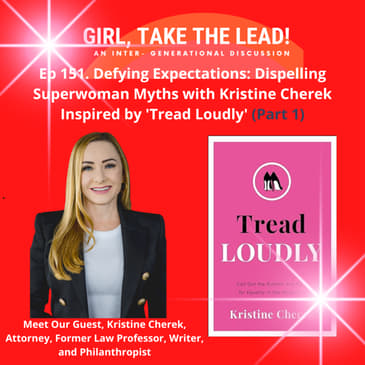
Kristine Cherek, GenX, joins Yo to discuss her book, Tread Loudly: Call Out the Bullsh*t and Fight for Equality in the Workplace. Kristine Cherek is an attorney, former law professor, writer, and philanthropist.
Kristine began her career practicing commercial real estate law at an international law firm. By the age of 33, she was the general counsel of the nation's largest developer of healthcare facilities. After she left the practice of law, she taught for eight years at a law school in Florida. She now focuses on writing, speaking, and advocating for gender equality in the workplace. Her philanthropic work centers on equity and access in higher education, arts education, food security, and animal welfare. This is Part 1 of a 2-Part series. Here are the topics we covered in the series:
- Work friends and their importance.
- Having it all (not!) and Perfectionism.
- Beliefs.
- Elle Woods.
- Data (The real issue: normalized gender bias).
- Quitting is not failure.
Here are the three takeaways:
1. We can’t have it all and trying to be perfect robs us of our happiness. Others that we think ‘have it all’ really don’t.
2. We can begin to change our lives by changing a few beliefs within ourselves. Be determined. Be ambitious. Believe in yourself and take chances, just like Elle Woods did!
3. Quitting is not failure but can be the only way to achieve success in the long term.
As Mentioned:
Her book: Tread Loudly: Call Out the Bullsh*t and Fight for Equality in the Workplace
More About Kristine:
Kristine earned her B.A. from Marquette University, and her J.D. from the University of Wisconsin Law School. She resides with her husband and their two senior rescue cats.
Events:
Kristine is currently doing book signings and events at various locations around the country. Follow her on Instagram for the latest updates!
How to Reach Kristine:
Facebook: https://www.facebook.com/tread.loudly.2023
IG: treadloudly, kcherek
TikTok: treadloudly
How to Reach Yo Canny:
Our website:
You can send a message or voicemail there. We’d love to hear from you!
email: yo@yocanny.com
FB group: Girl, Take the Lead
https://www.facebook.com/groups/272025931481748/?ref=share
IG: yocanny (Yo)
LinkedIn:
https://www.linkedin.com/in/yocanny/
[00:00:00] .
[00:00:02] Welcome to Episode 151 of Girl, Take the Lead, where each week we explore
[00:00:12] womanhood and leadership.
[00:00:14] I'm your host, Yolanda Canny.
[00:00:16] Today we are joined by Christine Cherick to discuss her book, Tread Loudly.
[00:00:24] In addition to being an author, Christine is an attorney, executive, professor and philanthropist.
[00:00:32] We got to talking.
[00:00:34] And it was a lot so I've broken the conversation into two parts so you wouldn't miss anything.
[00:00:41] This first part covers strategies, perfectionism, and just going for it.
[00:00:48] Our second part covers more about just going for it like Elle Woods and we cover some data.
[00:00:55] And Christine offers advice for younger generations.
[00:00:59] Plus she'll tell us what she'd tell her 20-something self today.
[00:01:04] So be sure to listen to both parts.
[00:01:07] Enjoy the listen.
[00:01:09] Here you go.
[00:01:15] Christine, welcome to Girl, Take the Lead.
[00:01:17] We are so happy to have you with us.
[00:01:20] Thank you so much.
[00:01:21] I'm so happy to be here.
[00:01:23] And I was your book was just so fun.
[00:01:27] There were so many things I could relate to in it.
[00:01:30] And I think so many things our listeners are going to really enjoy hearing about.
[00:01:34] Why don't we start first by you just introducing yourself and telling them about your book?
[00:01:39] Sure.
[00:01:40] First, I'm so pleased to be here to meet with you today, and to share the message with all of your listeners.
[00:01:47] My name is Christine Cherick.
[00:01:49] I buy education.
[00:01:50] I'm an attorney.
[00:01:51] I spent about 20 years of my career in corporate law firms and then big companies,
[00:01:59] all of which were very male dominated not only by numbers but also kind of culture and feel and the way things worked.
[00:02:07] And I finished my career teaching through a long series of events.
[00:02:13] My husband and I ended up moving from Wisconsin to Florida for his career.
[00:02:18] And I made the jump from corporate America to teaching and taught at a law school here in Florida for about eight years.
[00:02:26] And at the time my students were coming back after their first internships,
[00:02:32] their first jobs and telling me about their experiences.
[00:02:35] And it really sounded too similar to things that I remembered from 20 years prior when I was in their shoes.
[00:02:44] So I wrote a book about my experiences, my advice, some things I wish I had done differently.
[00:02:53] Hopefully some things and tips to inspire not only my generation, but your daughter's generations, the millennials and Gen Z to help them navigate the workforce to find that power and strength within and to hopefully leave the world a little bit better place for all of us.
[00:03:15] And to really inspire and empower women to speak up and take charge of their lives and their careers.
[00:03:24] So the book is called tread loudly, and it's a kind of a play onwards.
[00:03:30] Well, I think when you and I spoke, I said that when I went through my career, it was about being silent and passing and not making a fuss.
[00:03:44] And not, you know, being out there. And I think your book gives us total permission to be ourselves and to be out there. So thank you for that.
[00:03:59] Thank you. And I thought it's exactly right. You know, I'm, I'm Jen X.
[00:04:03] So I entered the workforce in the late 1990s. And, you know, at that time there, there weren't a lot of women in positions of power and unfortunately it hasn't changed that much.
[00:04:16] But at that time the work culture was such that we couldn't, we couldn't loudly say this isn't fair. You're not treating me equally.
[00:04:26] This system is skewed or wrong or not serving all people. I think had we done that, and I'm guessing you're, you share this opinion, then had we done that we would have been labeled a trouble maker of a mouth or something.
[00:04:41] And no one would have listened.
[00:04:44] So we had to tread very lightly and make what change we could little by little, and without, you know, making too many waves without disrupting the norm too much, but fighting for every little bit of progress that we had.
[00:05:00] And I think I hope and I believe that the world is now at a kind of tipping point where we don't have to tip toe around these issues anymore.
[00:05:09] And that's for all the, for all the bad mouth that social media gets, I think that's one thing that's been really good is it gives women the platform and the ability to find their community and to know that you are not alone.
[00:05:24] And I've really seen with the younger generations, they just don't take as much crap as I did. And I love that. I love that about them. And I want to continue to empower them and hope that they then carry the torch forward.
[00:05:40] Right.
[00:05:41] Right. Well, I think that there's more opportunity for them to have different options like for me back in the 80s, the way that I saw things happening since I couldn't progress upward.
[00:06:00] I had to change jobs, move to a different company, you know, interview at a slightly higher level because I wasn't getting promoted within.
[00:06:12] And that was how I handled it. And I think and you did the best you could right? Absolutely.
[00:06:20] With what you had available at the time. Exactly. And but, you know, you'd get a call from the headhunter to tell you about this other job and then they would go, Oh, you've moved around so much and, you know, I look at it.
[00:06:33] Well, I have to in order to continue to progress. Absolutely. Exactly. That was that was kind of what happened for me.
[00:06:42] Sometimes there were women who were able to move up, but not quite into the C suite.
[00:06:50] You know, you could move to like higher middle management, but not quite the executive level. And I know for me it was like I had to change jobs and I had to change industries in order to kind of get that C suite, which I did eventually.
[00:07:10] But it was not easy. And I'm sure it's not easy for anybody right now. So it isn't and I think I think you're right though that there are more opportunities. There's certainly more attention paid to it.
[00:07:24] We've seen in recent years a lot of attention paid to the suite in particular lack of women and CEO CFO chief marketing officer, chief people officer, general counsel, chief risk, all of those.
[00:07:39] And I mean by C suite. Yeah, we've seen more attention paid particularly at the Fortune 500 at the biggest companies and they, they took some heat from media and other activist groups.
[00:07:54] And there are definitely more opportunities, not as many as we would get like, and it isn't I'm sure the path isn't easy for anyone. But certainly from the 80s or 90s it, I hope I pray that it's at least a bit easier.
[00:08:12] I get the sense that it, I mean there's still tons of frustration and but I hope so. I hope I hope with you too, you know and maybe your voice and my voice and other people's voices will help that.
[00:08:29] And that is that is why we're doing what we're doing.
[00:08:34] One of the things that we've talked about a few in a few places in the podcast has been work friends. And I know, boy they were so important for me to survive and what do you see there like why are why are work friends so important especially for women.
[00:08:52] Yeah, I think that's a great question. When I entered the workforce. I was very lucky to have an incredibly close friend of mine from school, who was my roommate, who was the maid of honor at my wedding also go to the same company as I did now we were in
[00:09:10] very different places in the company very different departments. She was four floors away from me in a tall office building, but I at least had this sort of built in person who I started my first day with.
[00:09:22] And I think that made my transition to work dramatically easier, but I didn't work with her see her on a daily basis.
[00:09:31] But she was at least someone who I could message and say, can you meet me in the lobby. I need to vent or I need a coffee or I need a break or something like that.
[00:09:39] Mine was always I just need. I need to breathe.
[00:09:43] But from my perspective throughout my career, we're friends have been incredibly important because you need that person. And hopefully you can find that person and even if it isn't in your own company maybe there's someone in a trade group or some association that you belong to networking
[00:10:02] group, someone who is going through the same kind of thing as you at that time or maybe a little ahead or behind you in seniority, who understands the pressure who understands what you're dealing with in your industry or your business or company.
[00:10:20] And for me it was really a sounding board. It was someone who I could be honest with like truly honest and say, I have no idea what I'm doing on this project or I, I'm terrified I'm not going to meet this deadline.
[00:10:35] You know, those are things that I wouldn't have shared with. Yeah, even work acquaintances. But to have that person who you know understands and who you know isn't judging you for me was truly a lifesaver.
[00:10:53] And I think you say go for quality, not quantity.
[00:10:58] Absolutely, absolutely. Like I said when I went through law school, I saw other people take a very different approach and they were doing all those social events and clubs and happy hours and things and they had from the outside what looked like a lot of friends.
[00:11:15] And I had Marty, that's her name. It was just the two of us. And for me, it was so much more helpful to have this for me one person or small number of people who I knew had my back who I knew I could be absolutely honest with, rather than the quantity of I'm surrounded
[00:11:36] by eight people all the time and I have all these friends but are any of those people truly the person who at midnight you can call and scream or cry if you need to.
[00:11:49] Mine was usually crying.
[00:11:51] Mine too.
[00:11:53] Mine too.
[00:11:55] Yeah, we've also covered the topic of happiness.
[00:12:00] And one of the things you bring up in the book is, you know how perfectionism is not happiness.
[00:12:10] And that was so good. That was so good. Thank you.
[00:12:15] And I think that's something that was, it took me a lot of years to understand and so what I'm hoping is you and I are here telling all the younger women don't keep chasing that perfect state.
[00:12:30] Don't think you have to be perfect because it's frankly impossible.
[00:12:38] Particularly people who have done well in school, you know you go through elementary school and middle school and high school, and you've done well and you excelled.
[00:12:48] And maybe you go to college or not, maybe you choose a career where that's not a prerequisite, and you continue to do well and you think I've got to keep, you know, checking the boxes I thought of my whole life was just chasing
[00:13:02] the path that I took and then that step. And it was trying to get into a great college, trying to get into a great law school, trying to get that great first job. And I have to be perfect.
[00:13:12] And once I get there, it will make me happy.
[00:13:16] And what I've learned, I'm here to tell everybody that that's just not going to happen. You're never going to get to that place where you think, okay, I'm here, I'm done and everything is okay now.
[00:13:30] It's just not something we see.
[00:13:33] For me it was seeing women, seeing women who were older and more senior than me the few that there were who had what looked like really perfect lives.
[00:13:43] And I thought that's what I want if I can just get there, then everything is going to somehow magically be okay.
[00:13:51] And I'm not going to have all these struggles and doubts and I'm not going to feel like I don't know what I'm doing and I'm not going to doubt myself.
[00:13:58] And what I found through my life and my good couple of very close girlfriends lives is that
[00:14:05] it's just not an attainable state.
[00:14:07] It's not an end goal.
[00:14:09] You have to enjoy every day and happiness in finding the good in every stage of life
[00:14:17] and every week and every year.
[00:14:20] One of the things that, you know, I read your book and then we had our planning call.
[00:14:26] But one of the things that have really stuck with me from your book and has come up a few times for me
[00:14:33] is the point you make like we think other women are perfect and they have it all together.
[00:14:41] And we just don't.
[00:14:42] We're the loser.
[00:14:44] And that comparison is a killer.
[00:14:49] And it is.
[00:14:50] And you make the point nobody has it all together.
[00:14:56] That is exactly right.
[00:14:57] And I got permission here's we'll have to tell a few stories.
[00:15:01] I got permission from my couple of close girlfriends to share some stories in the book, because I think it is.
[00:15:07] It is so important for us to realize that everybody has things that they're going through.
[00:15:16] Everybody struggles.
[00:15:17] We're all just trying to get through the day, the week, the month.
[00:15:22] And certainly there are people who have a much harder time in life than I had.
[00:15:27] There are people who didn't have access to the things that I had access to.
[00:15:32] So this isn't a pity party, but just to understand, particularly for younger women or women earlier in their career,
[00:15:40] that what you see out there, what you see in social media, obviously, is not the whole picture.
[00:15:47] We all know we've all been in that place where you take 15 pictures to find the perfect one or have them forbid you take 300 pictures to find the perfect one.
[00:15:55] That is really an analogy for life.
[00:15:59] We see, I'll tell a story, a very good friend of mine who was a few years behind me and fairly early in our careers,
[00:16:10] who she looked up and thought I had it all figured out.
[00:16:15] She thought it was a late night conference room somewhere on a high rise in Chicago and she had, she was maybe six months out of school.
[00:16:25] So very early in her career, the first big, big, big project of her career.
[00:16:33] And we were working on it together.
[00:16:35] And one day, even late night in this conference room, I kind of saw that look on her face.
[00:16:41] And I see, you know, like her lips start to quiver and her, she's batting your eyelashes.
[00:16:45] And I said, come here.
[00:16:46] And I kind of pulled her aside and I said, are you OK?
[00:16:50] What's going on?
[00:16:51] And she just started unloading.
[00:16:54] You know, I can't do this. The hours are too much. This is too much.
[00:16:58] You know, I look at you, Christine, and I see your your clothes are pressed and your, you know, your hair has died and your nails are done or whatever it was.
[00:17:07] You don't seem rattled.
[00:17:08] You know what you're doing?
[00:17:10] You know, how, how are you doing this?
[00:17:12] How are you keeping this all together?
[00:17:14] And it was, I think, incredibly vulnerable for her to to do all of that.
[00:17:20] I think she was kind of at that breaking point, to be honest.
[00:17:23] Like it didn't care anymore.
[00:17:24] It didn't care anymore.
[00:17:25] Like I'm just going to say the truth and whatever it is it is.
[00:17:30] And she said, you know, none of this.
[00:17:32] I'm running out of clean clothes and I don't have any food to eat for dinner because this project was just sort of all consuming.
[00:17:41] And she said, you know, I look at you and you've got this all together.
[00:17:45] And I just smiled and I said, I am so far from together.
[00:17:50] And I let her in on my at that time.
[00:17:53] My big secret was my mom.
[00:17:56] I was probably 30 years old, late 20s or late 20s.
[00:18:03] And my mom, my mom cleaned my house.
[00:18:06] My mom did my laundry.
[00:18:08] I should take the clothes out of a hamper, wash them.
[00:18:11] I was so incredibly lucky and blessed that first I lived near her.
[00:18:17] Second, she had the time.
[00:18:19] Third, she was happy to do it.
[00:18:22] She would pick up my dry cleaning.
[00:18:24] She would do whatever I needed and but for her, there's no way I could have kept all those balls in the air.
[00:18:30] No.
[00:18:31] And I saw you know, I saw this sort of look of relief go over my girlfriend's face.
[00:18:36] And she said, do you think your mom would do that for me too?
[00:18:42] And you know, her family wasn't nearby.
[00:18:44] And I said, I don't know, but I'll ask.
[00:18:46] And that's how my mom got to be sort of a second mom to not only her, but to one other of our colleagues.
[00:18:53] So sweet.
[00:18:55] It's so supportive.
[00:18:57] Oh, my gosh.
[00:18:57] So supportive, so supportive.
[00:18:59] And you know, the irony is now that friend is a very senior person at her company.
[00:19:08] She has a really big important job where she has incredible responsibilities.
[00:19:13] You know, I see things she's working on in the press.
[00:19:17] And you know, she has three boys and she always looks great and never seems frazzled to the public.
[00:19:29] But you know, in those moments where she and I grab lunch, if she she'll let her guard down and say, oh, my gosh,
[00:19:37] I've got it.
[00:19:37] I've got to text this person and do this and make sure the carpool picks up that kid.
[00:19:41] And I've got to get this kid to travel baseball.
[00:19:42] And she is constantly juggling.
[00:19:46] But to the world, all they see is in the book I call our carry.
[00:19:51] All they see is carry living this incredible life with this great career and these three boys who are doing great things.
[00:20:00] And they have no idea what it takes every day for her to keep all of that together.
[00:20:06] So I tell that story and a few others in the book.
[00:20:09] There's some funny stories about when Carrie's kids were little.
[00:20:13] And all of the mishaps of just trying to keep it all together as a parent and a worker and a friend and a sister and a mom and a daughter.
[00:20:25] And trying to keep all those balls in the air.
[00:20:28] It is not easy for anybody, even people whose lives look pretty perfect.
[00:20:34] They struggle to, I promise.
[00:20:37] That was so good to read, though.
[00:20:38] You know, when I was reading that, I went, oh boy, this is so good.
[00:20:43] Because we do when we were social beings, we compare, we look, you know, we're always thinking this or that.
[00:20:49] And you talk a little bit too about beliefs and probably that's a good one, right?
[00:20:55] That we could shift about that we need to have it all together.
[00:21:01] Very true.
[00:21:02] Are there other beliefs in there that you think we have to, you know, would be very helpful to shift?
[00:21:08] So we could have that more of the balance.
[00:21:12] Absolutely.
[00:21:13] And of course, I'm using words throughout this podcast of men, women, boys, girls and that I realized that's very binary.
[00:21:23] I realize that's not the way all people see themselves or view themselves or want to be referred to.
[00:21:32] I use those words because the data, the data on the studies use those categories of people, but certainly gender is a spectrum.
[00:21:41] And I appreciate and honor all of that.
[00:21:44] But in general, women, what the research and the data on the studies tell us is that women of a different set of beliefs about themselves and their abilities, we tend to doubt ourselves more.
[00:22:01] We tend to be less confident.
[00:22:04] We tend to speak in asks rather than statements.
[00:22:11] We tend to not dream as big as men do.
[00:22:15] We tend to not go for things, not have that sort of I got this kind of attitude.
[00:22:23] And it runs in huge ways and tiny ways.
[00:22:28] And I'll give you just one tiny little example.
[00:22:30] My husband recently said to me, we were at a restaurant and the waiter stepped away from taking our order.
[00:22:38] And my husband said to me in the course of this book, he's been extremely helpful.
[00:22:43] He said, do you realize how you order food at a restaurant?
[00:22:46] And at first I thought, what are you talking about?
[00:22:48] That's a weird thing to say.
[00:22:49] And he said, every time you order, you say, can I have the steak?
[00:22:56] And he said, the stakes on the menu.
[00:22:58] Of course, you can have the steak, whereas he would say, I would like the steak.
[00:23:04] And in little ways, every day, I so in little ways, I catch myself doing that.
[00:23:10] I'll be writing an email to someone and I'll do the just checking in to see if you've had a chance.
[00:23:19] Minimize language.
[00:23:20] Yeah, just yes.
[00:23:21] And just I'm sorry to be a bother.
[00:23:23] I'm sorry to ask, even though you owe this to me and I was expecting it.
[00:23:27] And this is the deadline, whereas my husband would just say, hey, I haven't
[00:23:32] gotten your report yet on X.
[00:23:35] When can I expect it?
[00:23:36] I would backpedal and be nice about it and soft about it.
[00:23:40] Doing all those little ways.
[00:23:42] What I'm the aggregate the data tells us is that women tend to, you know, we
[00:23:47] tend to minimize our, our demands.
[00:23:50] We tend to ask permission.
[00:23:52] We tend to not go for things and we tend to not have that kind of confidence
[00:23:59] or belief in ourselves that men do.
[00:24:03] Well, I just saw something happen just this past week to me where I
[00:24:10] are Gardner because I think there's a cult there for me too.
[00:24:15] There's a cultural thing here too because I'm Latina and our Gardner is also
[00:24:22] Latino and he was going to get some ground cover.
[00:24:27] And he said, you know, I think we could put some ground cover down here.
[00:24:30] And I said, Oh, okay.
[00:24:33] And I went in the house and then he showed up with three guys and put
[00:24:39] the ground I never asked for an estimate.
[00:24:44] I was people pleasing the whole way, trying to be very charming.
[00:24:49] And I talked to my husband about it and I said, you know, when I was in
[00:24:54] my job as a VP of marketing, I was very demanding.
[00:25:00] I wanted estimates.
[00:25:02] I wanted it.
[00:25:02] I want the whole thing.
[00:25:05] But then I fell, I fell apart.
[00:25:07] It was like, what happened to that woman?
[00:25:10] And she becomes this very accommodating, nice person to be around.
[00:25:19] And I think that's so common.
[00:25:21] Absolutely.
[00:25:22] Oh, I mean, I saw it definitely in myself and how I lost a bit of that
[00:25:30] request, you know, like a sharp request or, you know, what to expect here.
[00:25:35] And I want everybody to like me.
[00:25:37] And I'm thinking, Oh my God, I'm reverting to this mushy woman.
[00:25:42] Like, come on.
[00:25:44] You know, and I think that's exactly it.
[00:25:46] Yeah, it's exactly what you want.
[00:25:48] We have this tendency to be people pleasers, to want people to like you.
[00:25:54] And I think a lot of that comes from culture, from society, from the way
[00:26:02] we are raised, you know, we're taught to be polite and smile and pretty.
[00:26:08] And boys are taught to be strong and bold, you know, a little boy runs around
[00:26:13] and breaks things or, you know, swinging sticks around the yard
[00:26:18] and dirty faced and all of that.
[00:26:20] And we say, Oh, they're such boys or they talk firmly or they're aggressive.
[00:26:26] And we just attributed that to some maleness in them.
[00:26:32] But women, we, you know, little girls, we expect them to be more gentle and
[00:26:36] soft and we buy them baby dolls and Barbie dolls and teach them to brush
[00:26:40] hair and all of those kinds of things.
[00:26:41] I think a lot of that is just inherently subconsciously in us that
[00:26:48] we're not supposed to be loud.
[00:26:50] I could tell you how many times when I was a little kid that teachers
[00:26:54] would tell my mom that I was bossy.
[00:26:58] You know, Christine's, you know, she's a great student, but she's
[00:27:00] really bossy or she's, you know, she's loud.
[00:27:05] And to my mom, that was kind of a compliment.
[00:27:08] She would say, good, I'm glad she's, I'm glad she's stating her mind.
[00:27:13] But in the teacher's mind, that's not how girls act.
[00:27:17] You know, girls shouldn't take charge.
[00:27:20] And I think it's really hard for us to shed all of those beliefs.
[00:27:22] There are plenty of social scientists from incredible universities
[00:27:28] around the world who study these things.
[00:27:30] Like, what is it about gender that makes a difference in how people,
[00:27:37] whether it's problem solving or leadership roles or one that stands out
[00:27:43] in my mind so brightly is applying for a job.
[00:27:48] So there's a now pretty famous study that was first done by HP,
[00:27:53] Fortune 500 Company, and they wanted to find out where
[00:27:59] where they were losing women.
[00:28:00] Why don't we have more women in senior roles?
[00:28:04] So one of the things that they did, which became sort of a phenomenon
[00:28:08] in the social science literature was they they did a deep dive
[00:28:13] into their into the applications for jobs and looked across
[00:28:21] all different kinds of departments, different geographies,
[00:28:23] different levels from low level positions to very high level positions
[00:28:27] and dice the data and study.
[00:28:30] What is it different?
[00:28:31] What's different about the way men approach a line for a job and women?
[00:28:38] And what they found was that based on a job's backer
[00:28:43] specification or criteria, if a position said we're looking
[00:28:46] for someone with five years of experience who has a bachelor's
[00:28:51] degree in marketing, who has done these kind of projects before
[00:28:56] that when they when they looked at the data, women would only apply
[00:29:00] for that position if they met every single one of the stated criteria.
[00:29:06] Which I know I certainly did.
[00:29:08] If if if something said five years of experience and I only had two,
[00:29:12] I would have thought, oh, well, that's that I'm not qualified.
[00:29:14] I can't submit my resume for that.
[00:29:17] But when they looked at that same job and looked at the male applicants,
[00:29:21] the men applied for that job when they met only about 60 percent of the criteria.
[00:29:29] So there's something going on there.
[00:29:32] It's women, women, we won't go for it unless we're
[00:29:37] completely qualified or over qualified as in again, broad categorization.
[00:29:42] There are certainly some women who don't act this way at all.
[00:29:45] But this data among thousands of job application shows us
[00:29:49] that we don't go for it unless we are completely qualified or over qualified.
[00:29:55] They found a pretty large segment of women who had seven or nine years
[00:29:59] of experience versus guys applying with one or two.
[00:30:04] And that men just don't view it that way.
[00:30:07] They take those risks.
[00:30:08] They have this I can do this kind of belief in themselves
[00:30:13] that just wasn't present in the data set for the women.
[00:30:15] And I think about that every single time there's something
[00:30:19] that I think is scary or frightening or out of reach or that I'm not qualified for.
[00:30:24] Think, how would a guy do this?
[00:30:26] A guy would think I can do that and they would go for it.
[00:30:32] So I hope that I hope that that story will resonate
[00:30:35] and will recur in people's minds the next time your listeners are
[00:30:40] looking at a promotion that they want to say,
[00:30:43] I think I should be considered for that promotion or looking at a job posting
[00:30:47] or looking at getting into college or graduate school or med school or whatever it is.
[00:30:54] Just to go in with that kind of confidence, a little better than halfway qualified.
[00:30:59] So I'm going to try.
[00:31:00] Yeah, building the confidence muscle.
[00:31:03] I mean, confidence.
[00:31:04] The confidence doesn't mean to have 100 percent.
[00:31:08] You can have 60 percent.
[00:31:11] Yeah, and there's a difference between confidence and arrogance, of course.
[00:31:15] But just to have that, let's go for it.
[00:31:18] Let's let's try.
[00:31:21] I have a niece who right now is a junior in college.
[00:31:25] I've got seven nieces ranging from 18 to 33.
[00:31:30] And she is really interested in being a veterinarian.
[00:31:35] This is what she's wanted to do since she was a little kid
[00:31:39] and started volunteering at the Humane Society.
[00:31:42] Vet schools are incredibly difficult to get into.
[00:31:47] I didn't realize until I started talking with people
[00:31:52] a few years ago when she continued to express this interest.
[00:31:56] It's harder to get in statistically harder to get into vet school than medical school.
[00:32:00] Well, a lot harder than getting into law school.
[00:32:03] There are only about 40 vet schools in the country.
[00:32:07] And so she was talking with me.
[00:32:11] I really want to do this.
[00:32:12] I don't think for X, Y or Z school, I might not meet their criteria.
[00:32:16] And I said, you've got to try.
[00:32:18] You apply to every single one that you're interested in.
[00:32:22] What is the worst that can happen?
[00:32:25] The worst that can happen is you get a no.
[00:32:29] Well, then you're in the same place you are if you didn't even try.
[00:32:31] Yeah. So if you do apply, maybe you'll get in.
[00:32:36] Maybe you'll get waitlisted.
[00:32:38] But I promise you, if you don't submit your application, you've got zero chance.
[00:32:43] So give yourself better than zero chance and go for it.
[00:32:47] So I'm fingers crossed and hoping and praying that she gets into the school
[00:32:50] of her dreams. But if she didn't go for it and didn't say,
[00:32:57] I'm just going to give this a shot, even though it's harder than being a doctor.
[00:33:02] It would never happen.
[00:33:03] Yeah. So I want people to kind of embrace that.
[00:33:06] So we'll end today's episode here, but there's more to come with Christine in our next episode.
[00:33:14] Thank you for listening today.
[00:33:15] And we sure hope you enjoyed this episode.
[00:33:18] If you did, please leave a comment wherever you listen to your podcasts,
[00:33:23] tell a friend about us, join her public Facebook group, Girl, Take the Lead,
[00:33:28] or visit our website, girltaketheleadpod.com.
[00:33:34] We also have a YouTube channel where your subscription would be appreciated.
[00:33:38] Once you're on YouTube, search at Girl, Take the Lead.
[00:33:41] And we've recently expanded to YouTube music
[00:33:45] where you can find a video of this episode.
[00:33:50] So there's three takeaways from the series.
[00:33:53] One, we can't have it all in trying to be perfect.
[00:33:59] Robbs us of our own happiness.
[00:34:02] Others that we think have it all really don't.
[00:34:06] Two, we can begin to change our lives by changing a few beliefs within ourselves.
[00:34:14] Be determined, be ambitious, believe in yourself and take chances
[00:34:20] just like Elle Woods did.
[00:34:23] And three, quitting is not failure,
[00:34:27] but can be the only way to achieve success in the long term.
[00:34:32] Thanks again for being here and talk to you soon.
[00:34:36] Bye.