
This is a shorter episode with Yo Canny building on our previous episode where we explored Amber Ontiveros’ near-death experience. I had so many questions after hearing her story, I knew I wanted to know more so here are some of the ones we explored:
- What are common near-death experiences based on research? BTW you’ll hear me refer to near-death experiences as NDEs.
- What happens in the brain during a NDE?
- What can we learn from experiencers of NDEs?
The expert we’ll cover is Bruce Greyson, MD – professor emeritus of psychiatry and neuro-behavioral sciences at Univ of Virginal School of Medicine. He was the co-founder and president of the International Association for Near-Death Studies and editor of the Journal of Near-Death Studies. A Distinguished Life Fellow of the American Psychiatric Association, he has received national awards for his medical research.
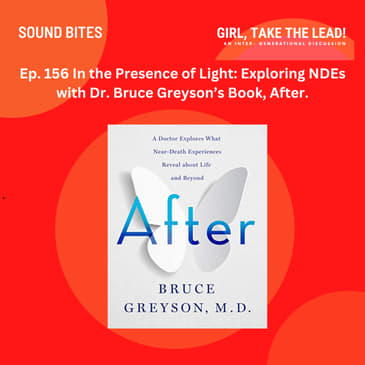
And he’s written a book which we’ll use to ground us titled: After, A Doctor Explores What Near-Death Experiences Reveal about Life and Beyond, copyright 2021.
As Mentioned:
Ep. 155, Love and Light: Transforming Bias with Amber Ontiveros
https://spotifyanchor-web.app.link/e/TxWcOJdZfJb
Bruce Greyson, MD’s book
Article: Distressing Near-Death Experiences: The Basics
https://www.ncbi.nlm.nih.gov/pmc/articles/PMC6173534/
How to Reach Yo Canny:
Our website:
You can send a message or voicemail there. We’d love to hear from you!
email:
yo@yocanny.com (Yo)
FB group: Girl, Take the Lead
https://www.facebook.com/groups/272025931481748/?ref=share
IG:
yocanny (Yo)
LinkedIn:
https://www.linkedin.com/in/yocanny/
[00:00:00] Welcome to Episode 156, which is a Girl, Take the Lead soundbite.
[00:00:10] And a soundbite is a shorter episode that builds on some previous content like our episode today,
[00:00:16] or it's a quick inspiration.
[00:00:19] And I'm your host, Yolanda Canny.
[00:00:21] In our last episode 155, Amber Ante Veros talked to us about her life-altering near-death experience.
[00:00:30] I just had to learn more.
[00:00:33] Some questions we'll explore in this episode are,
[00:00:37] What are common near-death experiences based on and what's the research?
[00:00:43] And by the way, you'll hear me refer to near-death experiences as NDEs.
[00:00:50] And then also like what happens in the brain during an NDE?
[00:00:55] And what can we learn from the experiences of NDEs?
[00:00:59] To help us look at these I found an expert.
[00:01:02] Bruce Grayson M.D., Professor Emeritus of Psychiatry and Neurobehavioral Sciences at the University of Virginia School of Medicine.
[00:01:13] He was the co-founder and president of the International Association for Near-Death Studies,
[00:01:19] an editor of the Journal of Near-Death Studies.
[00:01:23] A distinguished life fellow of the American Psychiatric Association,
[00:01:27] he has received many numerous awards for his medical research.
[00:01:32] And he's written a book which we'll use to ground us titled After.
[00:01:38] A doctor explores what near-death experiences reveal about life and beyond.
[00:01:44] And it was written in 2021 so it's really recent.
[00:01:48] So let's get to it and I hope you enjoy the listen.
[00:01:51] There you go.
[00:01:55] Grayson offers us an evidence-based approach to NDEs and is not promoting any one theory or belief system.
[00:02:06] He wrote this in the introduction,
[00:02:09] Following the scientific evidence that has accumulated over the past several decades and not promoting any one theory or belief system,
[00:02:18] I know I will disappoint many of my friends who may favor one or another particular view.
[00:02:25] I know that some of my spiritual friends may object that I take seriously the possibility that NDEs may be brought on by physical changes in the brain.
[00:02:37] And I know that some of my materialistic friends may be dismayed when I take seriously the possibility that the mind may be able to function independent of the brain.
[00:02:49] And I know that some in both camps may complain that by not taking sides, I am taking the easy way out.
[00:02:57] But in fact, intellectual honesty demands that I avoid taking sides in this debate.
[00:03:04] I think there is enough evidence to take seriously both a psychological mechanism for NDEs and continued functioning of the mind independent of the brain.
[00:03:16] The belief that NDEs are due to an unidentified physiological process is plausible and consistent with the philosophical view that the real world is purely physical.
[00:03:30] On the other hand, the belief that NDEs are a spiritual gift is also plausible and consistent with the philosophical view that there is a non physical aspect to who we are.
[00:03:44] But neither of these ideas, while plausible is a scientific premise, because there's no evidence that could ever disprove either of them.
[00:03:56] And they are instead articles of belief.
[00:04:01] And what he hopes to show in his book is that there's no reason NDEs can't be both spiritual gifts and enabled by specific psychological events.
[00:04:16] And he wants us to think to show a scientific perspective to help us understand what NDEs tell us about life and death, and about what may come after.
[00:04:29] He's actually a scientist sharing what he thinks the data suggests.
[00:04:34] He goes on to say this.
[00:04:37] The decades of research have convinced me that NDEs are quite real and quite profound in their impact, and are in fact important sources of spiritual growth and insights, whatever their source.
[00:04:52] I know that they matter critically to the experiencers themselves in the way they transform their lives.
[00:05:00] And they also matter to the scientists in what they hold are the vital clues to understanding of the brain and the mind.
[00:05:09] It matters to all of us about what they say about death and dying and more important about living.
[00:05:18] In addition to telling you about the authors of books I cover, and I do that so you know some of the biases that authors might have as they write this book.
[00:05:29] And I also like to look at the methodology of their research.
[00:05:34] After 42 years of looking at market research is important to know the depth and the origin of the research on author has done.
[00:05:43] So, as I examine Grayson, he makes the point that he skips over the method logical and statistical details but offers those details in the back of the book.
[00:05:54] And he has done many findings which you'll hear about today. He has done decades of research and was a 45 year journey, and he uncovered records of NDEs that go back centuries, and encircles the globe.
[00:06:09] I'll have some of that in the show notes so that you can link to some of those articles, if you find them interesting.
[00:06:16] So, I had to the bottom of NDEs this journey took him hospital to hospital university to university and state to state.
[00:06:24] He carried out research with almost 1600 hospitalized patients who had come close to death through cardiac arrest illness accidents suicide attempts combat and complications during surgery or childbirth.
[00:06:39] And those patients had lost their heartbeat blood pressure or breath, or had been pronounced dead. He's published more than 100 articles and peer reviewed medical journals.
[00:06:50] He's also gathered a sample of more than 1000 experiences which had contacted him with accounts of their NDE.
[00:06:58] And he saw the commonalities with hospitalized patients and found patterns, which he covers in this book.
[00:07:06] Here are some findings from his research.
[00:07:10] Among all the experiences he's interviewed have described their thinking during the NDE as clearer than usual, and almost as many described it as faster than usual.
[00:07:25] So, he was able to see images pastor his mind at high speed, and the mind understanding at the same high speed. He thought, ah, so this is it.
[00:07:37] Everything is so perfectly clear and simple in so many ways. I had simply never thought about it from this point of view.
[00:07:47] The feature associated with rapid thinking is a sense of time slowing down which gives time to think through the situation.
[00:07:56] A more extreme version of the slowing of time is the experience of complex timelessness, and this featured in the NDE's.
[00:08:06] It's a state of timelessness where there's nothing progressing from one point to another, where it all is there and you're totally immersed in it.
[00:08:17] Time not only slows down but it disappears entirely. It's like time still exists but the NDE seems to be outside the flow of time.
[00:08:27] Based on his research, 3Fourth reported a change in their sense of time and more than half said that they had a sense of timelessness in their NDE.
[00:08:37] Experiencers also reported that their senses like vision and hearing were more vivid than usual.
[00:08:44] Two thirds of the experiencers in Grayson's research reported extraordinary vivid sensations in their NDE's.
[00:08:53] First off, it involved exceptionally bright vision and unique colors or exceptionally clear hearing and unique sounds.
[00:09:01] On rare occasions, experienced reported unusual odors or tastes.
[00:09:09] Another feature of NDE's is the life review in which scenes from the experiencers past come flooding back like we heard with Amber.
[00:09:20] She saw things about her life when she had heard others.
[00:09:24] Among Grayson's research, a quarter reported a live review.
[00:09:28] A vast majority described this live review as more vivid than ordinary memories.
[00:09:34] Some experiencers told him that they were shown images from their past as like a movie screen or on pages in a book.
[00:09:42] Some reported that they re-experienced these past events as if they were still happening with the original sensations and feelings.
[00:09:51] Three fourths of those who had a live review said that it changed their ideas of what things are important in life, just like Amber.
[00:10:01] Half of those who had a live review experienced a sense of judgment.
[00:10:06] Most often judging themselves about the rightness or wrongness of their actions, just like Amber.
[00:10:14] And more than half experienced these past events not only through their eyes but through the viewpoints of others, feeling those other people's emotions as well as their own, just like Amber.
[00:10:29] Some of the questions guiding Dr. Grayson were, so why might this be happening especially while the brain is impaired and what we know about the brain?
[00:10:41] How do we make sense of live reviews given that they've been reported for centuries?
[00:10:48] Do they challenge our idea of how the mind and brain work?
[00:10:53] Are they due to common psychological mechanisms that help us gain some closure before we die?
[00:11:00] Are they caused by brain malfunctions as we start to approach death?
[00:11:06] One thing Dr. Grayson found interesting was that among all the experiencers he studied, 71% said that their memories of their NDE's were clearer and more vivid than other memories of their events.
[00:11:21] While only 3% said that they were less clear or less vivid.
[00:11:26] So it appears that scientific investigation of memories of NDE's confirms that they are consistent over time, that they are not dependent on familiar models of what's supposed to happen at death.
[00:11:41] And that they look like memories of events that really happened.
[00:11:45] They also said that what happens to us in the afterlife is at least partly dependent on how we lived before death.
[00:11:54] And that we will also reap benefits for our good deeds and actions in this life.
[00:12:01] Almost have said that in the afterlife we will still be able to watch loved ones who are still alive and may be able to communicate and interact with them.
[00:12:13] They also said that we still have physical like sensations in the afterlife comparable to seeing and hearing, and that we still have emotions.
[00:12:25] Two thirds said in the afterlife we meet loved ones who had died earlier and that in fact they did see or sense the presence of a deceased loved one in their NDE.
[00:12:40] And in the book Dr. Grayson provides numerous accounts from experiencers.
[00:12:46] 90% reported they encountered some kind of divine or godlike being or the God of their understanding.
[00:12:56] As we saw with Amber's account, many experiencers have changes in attitudes after their NDE's.
[00:13:05] She had a deeper understanding and compassion for the racist.
[00:13:10] She understood it was about love not hate.
[00:13:14] Dr. Grayson reports that experiencers report a deeper and more intimate awareness of meaning and purpose in life, and the sense of connection with something greater.
[00:13:28] He states that the most impressive after effects were not the changes in attitude, but the dramatic changes in lifestyles that often followed NDE's.
[00:13:41] And things are not always easy for experiencers and even researchers he said, immersing oneself into NDE's is a push to grow and change views of the mind and the brain.
[00:13:55] And of who we really are as human beings.
[00:14:01] And there's growing evidence that spreading awareness of NDE's and their implications can not only influence other people for the better, but is doing so.
[00:14:14] I'd like to end this episode with Dr. Grayson's hope that after reading this book, if you get it or just listening to this episode, that his words not end but continue to live on in our thoughts and feelings about life, death, and beyond.
[00:14:33] And I would add, live on in our questions.
[00:14:37] Here's a passage from the chapter Life Before Death at the end of the book.
[00:14:42] He writes, NDE seem to give people who have them the spark to reevaluate their lives and make changes in how they spend their time and how they relate to other people.
[00:14:55] They tell us that death is more about peace and light than about fear and suffering.
[00:15:01] They tell us that life is more about meaning and compassion than about wealth and control.
[00:15:08] And that appreciating both the physical and the non physical aspects of life gives us a much fuller understanding.
[00:15:17] And the evidence shows that near death experiences transform the lives not only of people who have them, and their loved ones, or the researchers who study them.
[00:15:28] NDE's can also transform those who read about them and can ultimately, I believe, even help us change the way we see and treat one another.
[00:15:42] It is my hope that learning about near death experiences will also give you the spark to reevaluate your life and reconnect with the things that fill your life with ever greater meaning and joy.
[00:15:58] And on that note, dear friends, we'll end today's episode.
[00:16:09] Thank you for listening today and we sure hope you enjoyed this episode.
[00:16:13] If you did, please leave a comment wherever you listen to your podcasts, tell a friend about us, join our public Facebook group, Girl Take the Lead, or visit our website, girltaketheleadpod.com.
[00:16:27] We also have a YouTube channel where your subscription would be appreciated.
[00:16:31] Once you're on YouTube, search at girltakethelead.com.
[00:16:35] And we've recently expanded to YouTube music where you can find a video of this episode.
[00:16:40] Can you tell I really like this book?
[00:16:43] It's full of experiences, stories and accounts.
[00:16:46] Great questions.
[00:16:49] On the book jacket, it's called a medical detective story that will grab your heart.
[00:16:57] I couldn't agree more. I thought that was a terrific way to describe this book.
[00:17:01] If you get it, let me know. I'd love to hear what you think.
[00:17:05] Our next episode will welcome back Dominica Turcan to talk about one of my favorite organizations, Women's Day Movement.
[00:17:13] We'll be joined by Julianne Savarti Kosansa, co-founder and executive director of the African Education Program, the 2024 beneficiary of Women's Day Movement.
[00:17:28] So please join us again. These organizations are showing us examples of inspiring and loving leadership as they tackle very important issues.
[00:17:38] So thanks for being here. Talk to you soon. Bye.