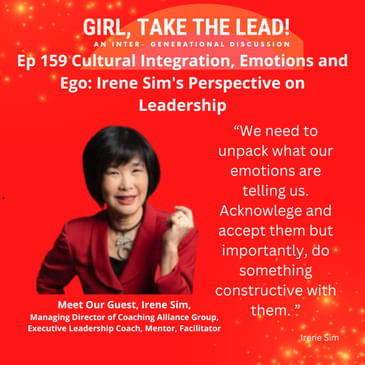
Irene Sim joins us to discuss some topics I think you’ll find interesting like the power of emotions, new thinking habits, systemic bias and racism, and emotions and ego. Such good stuff!
Irene is the Managing Director of Coaching Alliance Group, an accredited Executive Leadership Coach, Mentor and Facilitator. Her career is amazing. She was the inaugural Chief of Staff at APEC and first Asian woman to be promoted to the Senior Executive Service of the Australian Treasury and the Australian Taxation Office. AND she was the first Asian woman that the Australian Treasury posted overseas diplomatically as the Minister-Counsellor to China, Hong Kong and Taiwan.
Here are the topics we covered in the episode:
3:12 Power of emotions & leadership 7:33 New thinking habits 11:52 Bringing cultures together by removing systemic bias/racism 21:44 The effect of emotions and ego
Here are the three takeaways:
1. Let's look at emotions look at comfortable or uncomfortable not good or bad. They can be our “north
star” guiding us to act in alignment with our deepest values and to be more resilient. Accept them, allow them and then do something constructive with
them.
2. Having an inclusive mindset is about being curious and move away from the assumption that the way I see the world is the only way to see the world.
3. One habit to break up the “all about me” and the disconnection from the other. We can look at an issue together, rather than making it personal by blaming judging or defending against the other. This allows alignment.
More About Irene:
Irene coaches women at all stages of their journey to break free from societal biases to set their own terms and to thrive as powerful and authentic leaders on their own terms. Irene also coaches entire organizations on how to provide allyship support to one another, to remove systemic biases.
How to Reach Irene:
www.coachingalliance group.com
www.linkedin.com/in/irene-sim-acc-1491a774
Emerging Women Leaders Program (https://coachingalliancegroup.com/women-leaders-coaching/)
How to Reach Yo Canny:
Our website:
You can send a message or voicemail there. We’d love to hear from you!
email:
FB group: Girl, Take the Lead
https://www.facebook.com/groups/272025931481748/?ref=share
IG:
yocanny (Yo)
LinkedIn:
https://www.linkedin.com/in/yocanny/
[00:00:00] Episode 159 of Girl, Take the Lead where each week we explore womanhood and leadership.
[00:00:12] And I'm your host, Yolanda Canny. Irene Sim joins us to discuss some topics I think you'll
[00:00:19] find interesting like the power of emotions, new thinking habits, systemic bias and racism
[00:00:27] emotions and ego. Such good, good stuff. Irene is the managing director of Coaching Alliance Group,
[00:00:37] an accredited executive leadership coach, mentor and facilitator. Her career is amazing.
[00:00:45] She was the inaugural chief of staff at APAC and first Asian woman to be promoted to the senior
[00:00:52] executive service of the Australian Treasury and the Australian Taxation Office.
[00:00:59] And she was the first Asian woman that the Australian Treasury posted overseas diplomatically
[00:01:07] as the minister counselor to China, Hong Kong and Taiwan. Enjoy the listen. Here you go.
[00:01:17] So welcome Irene to Girl, Take the Lead. We are so excited to have you with us. And you've
[00:01:23] come so far to join us. So thank you for being here. And thank you for having me.
[00:01:33] And I am excited to be here loving this technology that allows us to connect from,
[00:01:39] you know, so far as you say. Yeah, because you're coming into us from Australia, everybody.
[00:01:45] And we've had a few guests come from Australia. And I think the hardest and most
[00:01:50] challenging thing is just getting our time zones right. But with us changing time,
[00:01:55] you changing time. It's just like, where are we again? But why don't we start if you would
[00:02:02] please introduce yourself to the listeners so that they learn about you. Hello listeners.
[00:02:08] I am Irene Sim, an Australian living in Canberra, Australia. Where is that? That's
[00:02:14] the capital of Australia. But it's a very small town, really. And it's called the bush capital.
[00:02:21] I'm an immigrant to Australia originally from another small town, this time in Ipoh,
[00:02:30] a town called Ipoh in Malaysia. I'm the eldest daughter of a single mother in Malaysia.
[00:02:37] And I grew up as that. And you can imagine the challenges that I faced and my family
[00:02:45] faced at that time, because single mothers were not a thing. So you can imagine there were,
[00:02:52] yeah, anyway, lots of opportunities to learn from my perspective. Ethnically Chinese,
[00:02:59] a member of a minority race in Malaysia where I grew up and in Australia where I am.
[00:03:06] What else? I'm a wife. I'm a mother. I have two-
[00:03:10] And coach, right? You've been coaching.
[00:03:12] And coach. I have two daughters. Yes. Yeah. So I'm introducing the background to this
[00:03:19] because it is central to the fact that I've had this amazing career. I'll leave people
[00:03:27] to have a look at my LinkedIn profile if you want to find out more of the career that
[00:03:31] has exceeded my expectations. And today I'm a coach at one point where I look back and
[00:03:39] thought that I have a lot more to give and I have a particular story to share. And so
[00:03:48] to give back really in what you call it, to honor the people who have supported me
[00:04:01] along the way. Yeah. Well, definitely you have so much to offer your expertise and your
[00:04:08] just who you're being. And I know we share a common passion around emotions
[00:04:14] and our listeners love learning about emotions. I know you had some interesting things to say
[00:04:21] about that. What are your thoughts about how emotions play a role in our leadership?
[00:04:27] Emotions play a central role in our leadership. The fundamental point about emotions, I think
[00:04:35] your listeners, you've been talking to your listeners about emotions. I mean, the fundamental
[00:04:41] point is that emotions are neither good nor bad. You know how we talk about emotions as
[00:04:45] positive or negative implication being that negative is bad, positive is good. On the
[00:04:52] contrary, I look at emotions as being comfortable or uncomfortable, but whether they are comfortable
[00:04:58] or uncomfortable, they are important signals from us to ourselves to guide us to our North Star,
[00:05:09] to guide us to our values and the kind of leader we want to be.
[00:05:14] Mm-hmm. So it's kind of input, input that we can see about ourselves, right?
[00:05:20] Yes. Yeah. So the tendency to avoid acknowledging our emotions means we are operating without
[00:05:30] that important intelligence. Yeah. Right. And I guess that helps us be more resilient
[00:05:36] when we're able to look at those emotions, accept them and then keep moving on from them. Like
[00:05:45] almost let them pass, understand them more. I would take it further. I would say accept them
[00:05:56] and allow them, but then do something with them.
[00:06:03] So, and the role and when we that process of accepting is important because we have a tendency,
[00:06:13] myself included, to be annoyed at ourselves for being upset or to
[00:06:23] be uncomfortable or to, I'll use the word scold myself for feeling this way, telling myself I
[00:06:32] shouldn't feel like that and telling myself to suppress those things. When I say instead of
[00:06:40] doing that, leaning into that and just accept and honor that that's what our
[00:06:47] intelligence system is telling us. But instead of just letting them pass,
[00:06:53] look at what it is that our emotions are saying to us about usually when our emotions are
[00:06:59] uncomfortable, they're trying to convey to us about something that is important to us,
[00:07:07] something that we need that our needs are not being met. Right. Yeah. So we can lean into that,
[00:07:14] interpret those emotions and then make conscious choices about what we need to do
[00:07:21] to get our needs met say or to act in accordance with our deepest values, for example.
[00:07:29] Right. So if we pull, if we kind of pull a thread at some of those emotions and we start looking at
[00:07:36] thoughts that might be underneath that, right? And beliefs, what are some of the,
[00:07:44] when you're coaching, what are some of the ways you help your clients shift those?
[00:07:50] So that's connected to having uncomfortable emotions and the first step is to acknowledge
[00:07:59] the emotions, right? And then to unpack that and see what are the thoughts that I'm holding
[00:08:07] that are underpinning the emotions. Right. So that's the first step.
[00:08:13] And then to acknowledge the emotions and then to unpack that and see what are the thoughts
[00:08:16] that I'm holding that are underpinning these emotions. So for example,
[00:08:25] something like someone gives me feedback on a piece of work that I've put so much effort into
[00:08:33] and they give me critical feedback about it. The habitual, and these are patterns by the way,
[00:08:42] so the habitual thought might be to be defensive about it and say,
[00:08:47] do you even know what you're talking about? Oh God, are you criticizing me? You know,
[00:08:51] aversion to some of those thoughts. And why are you picking on me? Don't you know
[00:08:55] I worked hard on this? I've had those thoughts a few times.
[00:09:03] Of course that those thoughts are in sync with our feelings of upset, embarrassment,
[00:09:10] shame, you know, defensiveness, discomfort. Yeah. Right. And so the first step to being
[00:09:23] adept at tapping into your emotions for the intel is to acknowledge all these things and
[00:09:28] to unearth all these things. What's making me uncomfortable? What are the thoughts? What
[00:09:32] are the assumptions I am making about either myself or the other person?
[00:09:38] Or by the way, I probably also add into that the thought that, oh my God, I'm not good enough.
[00:09:48] You know, I've worked so hard and it's still not good enough. So maybe I'm not good enough.
[00:09:53] Right. That's that personal taking it very personally.
[00:09:58] Yeah. So I then coach my clients to acknowledge all that and then to reframe,
[00:10:08] to reframe those thoughts. And so a reframe in that example might be number one,
[00:10:18] this is not about me. Definitely not about my worthiness because my worthiness is never
[00:10:26] in question. Point number one, always in any reframe in a situation like that.
[00:10:33] And then another reframe might be what is the issue that the other person is referring to?
[00:10:42] What is the issue? So separate the person that is me from the issue. What is the issue?
[00:10:51] What is the person, what needs to be improved? What are they seeing that I am not?
[00:10:59] No. Or I would also add, what are you seeing that they are not?
[00:11:06] And then what am I seeing that they are not?
[00:11:09] Right. Right.
[00:11:11] But you notice the tone of these reframe thoughts. They are not about,
[00:11:17] I should be ashamed. I'm not good enough or they are being picky. They are being mean or
[00:11:24] all sorts of, you know. So it's not about personalizing it to them or to me.
[00:11:31] It's about focusing on the issue. What needs to be better? I'm seeing X.
[00:11:35] What are you seeing? Yeah.
[00:11:36] You know why? Tell me about the why.
[00:11:41] Yeah. Because I think sometimes we can miss the bigger picture when we're just focused on
[00:11:49] one big part, one part of it and miss that, you know, like I used to tell my daughter when she was
[00:11:55] a goalkeeper for the soccer team. Listen, the ball got beyond all these other people before
[00:12:02] it came to you as the goalie, you know? And that sometimes is how we see it, that it's our
[00:12:09] fault. But we don't realize, well, there was all of these other people on the field,
[00:12:15] on the team that also had a part in whatever is going on. Anyway, I think that's really great
[00:12:23] advice. Yeah. So again, in that example with your daughter, it just reflects and I say the
[00:12:32] inclination and it's something to do with women and you know how we were socialized when it's
[00:12:40] always about, it's our fault because we bear this responsibility to take care of everyone
[00:12:47] and to be the person to fix all the problems. Right? We forget that there's a scene.
[00:12:56] Oh boy. Well, I know another one of your big passions is especially given your diverse
[00:13:04] background is bringing cultures together. And I think that you have perhaps a particular lens
[00:13:13] on cultural bias and how we might work with that more and make it less of an issue because
[00:13:26] it's a big issue for many cultures beyond, you know, Australia and the U.S. I mean,
[00:13:32] we're talking about the world. Yeah. So my work is supporting women, but on top of that, I also
[00:13:44] coach organizations and to learn how to connect across different cultures. Right? And
[00:13:54] fundamentally, the reason we are even talking about this is because of the human condition.
[00:14:01] Which is, I'll make a general statement, which is that you and I, I'll assume that and you
[00:14:08] tell me whether you're right or whether I'm right or wrong. We typically, we are typically
[00:14:14] conditioned to see the world through our own lens. And speaking for myself, my lens is a
[00:14:24] gender lens. And of course, my lens incorporates my culture. You know, I talked, you know,
[00:14:31] the way I introduce myself, right? My Chinese-ness and my state as an immigrant
[00:14:39] is central to my lens. Right? And we look at the world through our own lens and we assume
[00:14:48] that others either share that lens or if they don't, they ought to. They ought to share that lens.
[00:15:02] I guess so. I definitely, I think it's,
[00:15:06] we are not attuned to our lens too much. You know, we think maybe because you're all
[00:15:14] Australians or we're all Americans or that we have some kind of shared background. And to
[00:15:22] some extent, we probably do, but there's a heck of a lot of diversity in that lens that
[00:15:31] we cannot see. And it's almost like it's invisible to us. And unless, like you're saying,
[00:15:40] we become intentional about it, it's just so invisible though, how sometimes we can
[00:15:47] relate to each other. So do you help people like observe it more? Is that kind of what you try
[00:15:52] and do? Yes. Yes. So we have a lot of diversity in, as you say, and I've come to
[00:16:03] experience more and more that the people who bring a lot of richness of their lives,
[00:16:08] no matter what it is, whether it's race or gender or anything else, right? If they are free to bring
[00:16:15] that richness of their experience to the workplace or to teams that they work with
[00:16:20] or any project, then that enriches the project because then we get really the power of diverse
[00:16:31] ways of thinking and perspectives into solving problems. The reality is that talking about
[00:16:41] Australia, but not just in Australia, in the Asia Pacific, so I've worked in different parts of there
[00:16:47] as well, every dominant culture thinks that that's the way to think about the world.
[00:16:53] And so what I work with people to do is to become more, to educate themselves about their
[00:17:03] own culture and looking out for differences in other people's culture for the sake of building
[00:17:14] a bridge. I love it. And is it sometimes through their
[00:17:24] DEI efforts, the diversity equity and inclusion efforts or is it kind of a separate thing
[00:17:30] sometimes? So organizations here, I work a lot with the Australian public service
[00:17:38] and so each organization tends to have its own diversity and inclusion initiatives.
[00:17:48] But I work with leaders really instead of through the diversity and inclusion.
[00:17:57] I think it's really important that diversity and inclusion or having an inclusive mindset,
[00:18:04] for example, is the job of everyone, the leader to set the tone and for everyone
[00:18:13] to also start to engage in inclusive ways. And so to adopt an inclusive mindset
[00:18:24] and an inclusive mindset I mean something like being curious. So number one, moving away from
[00:18:32] the assumption that the way I see the world is the only way to see the world, right? To pause
[00:18:40] that because it's a bit of a you know we're conditioned so that conditioning is a long,
[00:18:46] you know we've been conditioned for a long time to think like that. So to pause and say
[00:18:53] tell me more what do you mean? You know so the curiosity to inculcate habits of curiosity
[00:19:02] and also to be non-judgmental. Yeah well that creates the safe space right? I mean if
[00:19:10] it begins from the top down then everybody knows it's sincere and it's authentic and
[00:19:16] I think it's great that you're doing that work with the leaders to help them create that
[00:19:21] space so people can be in it and know that yeah it's okay when you know I think I mentioned
[00:19:28] to you that when I was coming through the ranks it wasn't okay to say that you were Mexican
[00:19:32] you know and you had to try and assimilate but now they don't need to assimilate.
[00:19:39] I think it's just so much better like you're saying we get the creativity,
[00:19:43] we get the best from the people performing in their teams.
[00:19:50] But this bridge building is important. So actually talking about assimilation and
[00:19:58] you were saying about your experience in my experience as well coming through the ranks
[00:20:03] I didn't used to say I'm an immigrant. I did not used to say I'm from Malaysia and
[00:20:11] you know and all of that that was like in a separate compartment that not to be talked about.
[00:20:16] Right. I've come to talk about it more and more because I've come to realize that actually
[00:20:24] as I was journeying through many people were looking to me because I was the first woman you
[00:20:30] know to be promoted to the executive in my organization and to get a diplomatic posting
[00:20:35] etc etc and I didn't realize it then but that my appointment gave people from other
[00:20:46] marginalized groups or you know minority groups hope
[00:20:52] and I've only come to know that more and more as I've done this work coaching
[00:20:58] coaching the younger leaders right so there are many people who say to me oh yeah I remember
[00:21:05] you, you were the first blah blah blah and I'm thinking you know I didn't even think about it
[00:21:12] like that then right not too much in you know I was busy you know trying to maybe there was
[00:21:21] a point in my career was when I was busy trying to assimilate. Yeah I think it was part of the
[00:21:28] time I mean really it wasn't good to be different the way it is now where you know
[00:21:36] you've got efforts you know that give you a safe space to talk together and to talk about common
[00:21:44] issues that could be you're having that someone else is having and looking at
[00:21:50] establishing mentors and people to help you through the organization.
[00:21:56] Right.
[00:21:58] Yes and from an organizational point of view actually as a leader your job is to bring up
[00:22:06] the best in everyone right so you to get the best if we talk about it in economic terms
[00:22:13] the best value for money from all all your team members not just the ones that are like
[00:22:21] you. Right right that bias oh I really like that person I wonder why oh they're so much like me
[00:22:33] yes yes so that's our conditioning yeah yeah yeah it takes deliberate effort as you say
[00:22:42] and I guess you know when we look at
[00:22:44] that understanding I think we talked a little bit about our emotions and our ego
[00:22:53] and you know getting better habits you like I think that's your you are laying a lot
[00:23:00] you know the better habits and so we can get better habits at diversity and inclusion and
[00:23:08] better habits because I would think those emotions come up as a result of some space
[00:23:14] and environment that we're in and if we're safe or if we're not safe and if we're fearful or not
[00:23:26] so there's a particular emotion well we can call it an emotional habit there's a
[00:23:33] or rather there's a particular there are particular habitual thoughts
[00:23:37] that bring about the uncomfortable emotions right that that I think we need to put a spotlight on
[00:23:44] whether you are part of a dominant group a majority group you know like you know like
[00:23:50] the powers that be highly assimilated it applies to that person it also applies
[00:23:56] to the person who doesn't fit in right the habitual thought that says anything the thing
[00:24:03] that's happening around me is about me you know so if they don't like what I've done in my example
[00:24:10] if they don't like what I've done it's because they are taking on me giving me a hard time
[00:24:17] being unfair being biased right or the other way around if you are the one who is privileged
[00:24:28] you know you belong to the majority group or you have other privileges the tendency to say well
[00:24:35] you are different miss you you are strange you you need to go learn more or something
[00:24:42] you know making it about the person yes yes you're wrong you're you are the problem
[00:24:48] you are yeah and I'd like well the most important thing I think we can do
[00:24:56] is to get away from the habit of personalizing it and I'm not saying that everybody is really good
[00:25:04] and nobody is being biased and all that I am not saying that at all what I am saying is that
[00:25:09] your bias is not my problem right so I'm not going to take the emotional load of your
[00:25:17] whatever it is or personalizing it to me and everything to become all upset and defensive and
[00:25:24] sad and embarrassed and ashamed and all that sort of thing right so I think the habit to make it
[00:25:31] about ourselves or the other person that's something to practice reframing yeah to
[00:25:40] then instead say what is the issue what needs to be better how can I serve better what is
[00:25:48] after what's the long-term goal here what's the bigger picture yeah so make it about the issue
[00:25:57] so that's a habit that if I were to choose one habit it would be that habit yeah so the one
[00:26:05] habit would be to break up that it's all about me yep it's all about people it's all about me
[00:26:13] all of them and the and the disconnection because the minute we make it them and us
[00:26:21] we're disconnected from each other yes yes I love the way you put that absolutely
[00:26:28] so when we don't make it about us or them uh you and I we are looking at an issue connected
[00:26:36] together yeah you know we're standing on the same side if you like same side of together
[00:26:42] looking at the issue not blaming each other judging each other defending against each other
[00:26:50] and all that yeah that's very cool very cool I like that a lot I think that
[00:26:58] that allows for you know you to align with another person to to um almost well be as you
[00:27:07] said curious together about how to find new solutions or look at this a different way
[00:27:17] yeah and address a breakdown yes or even if in in the end we conclude that there is no
[00:27:26] different way it's either what you're suggesting or what I'm suggesting let's say but by giving it
[00:27:34] the uh making the effort to look at the issue in a connected way like that then both of us
[00:27:42] will move away from that regardless of the outcome feeling heard feeling respected
[00:27:51] well I Irene I think that's even good for any kind of relationship yes yes marriages could be
[00:27:57] a lot better if that was happening all right that's another story
[00:28:03] yeah all human relations I mean I'm looking at the world at the moment and you know feeling
[00:28:10] quite a bit of despair about all sorts of things but it's this tendency right that worries
[00:28:16] me about bling and othering looking for differences rather than looking for commonalities
[00:28:25] and then um yeah and again personalizing it you know so that we are in defense attack mode
[00:28:31] yeah really would like you know as I said the one habit to break is the habit to make it about
[00:28:38] ourselves or the other yeah well that's pretty good advice but do you have any other advice for
[00:28:48] young millennials and Gen Zers as they're moving along in their lives
[00:28:54] yeah I do um I thought about this by uh reflecting on what I wish I knew a lot earlier
[00:29:06] in my life you know I come to you with all this I talked about challenges and everything
[00:29:12] um and uh I wish I knew that setbacks and failures are guaranteed
[00:29:20] um your goal is to make a positive difference in the world
[00:29:25] I came into you know into into my career uh wanting to make a positive difference in
[00:29:33] in the world right I wish I knew though that these are like like learning how to ride a bike
[00:29:39] you've got to fall you've got to fail and then most importantly you've got to get up
[00:29:47] get up try again and learn from that and do tweak what you're doing to to actually get the
[00:29:55] bike you know to actually be successful in your bike riding yeah so that's what I wish I knew
[00:30:02] because I I I reckon I you know I went through a lot of angst angst because because
[00:30:10] I didn't know that earlier um and also I would like to say to my younger self or the
[00:30:18] millennials of today that um to own to own the fact that you don't know everything
[00:30:27] because you don't and guess what you're unlikely to and nobody does
[00:30:34] so that's true though it's so much of us no and and and that and and I'll also take it further
[00:30:43] and say if you if you think you know everything that's downright dangerous
[00:30:52] because if I if I look at that mentality in the context of leadership or in the context
[00:30:59] in the context of growing up or in the context of just getting better
[00:31:05] thinking that you know everything or have to know everything just makes you fearful and insecure
[00:31:11] you're constantly worrying about being toppled from your pedestal in your mind
[00:31:16] and you imagine you know can you imagine being led by someone like that
[00:31:21] well I think you're always pretending too like that's the other thing like
[00:31:25] you know that you're pretending to know it all and it's so much better to say I don't know
[00:31:33] yes and the power the power comes in saying oh yeah I don't know everything
[00:31:40] but I want to learn yes so that is the x factor you know being prepared to lean in to learn
[00:31:48] and back to that curiosity mindset I talked about yes yeah that is spring yeah that's pure
[00:31:56] strength yep and inclusion and all of those things well I'm feeling very hopeful right now
[00:32:06] me too yo is there anything else that you'd like to tell our listeners before we end our episode
[00:32:13] yeah so my big passion in as a leadership coach is to coach women and others who
[00:32:23] feel that they're not able to bring their whole selves to work to talk to me because my
[00:32:31] focus is on helping people to be leaders on their own terms right so connect with me
[00:32:39] I'm on LinkedIn Irene Sim executive leadership coach yeah connect with me tell me your story
[00:32:47] and if I can support you that's great if not I'll cheer you on
[00:32:53] this conversation has been energizing to me I love hearing from others who have found ways
[00:33:00] to also be their own their own best champions yeah oh it's so good Irene and we'll have all
[00:33:10] of that in the show notes for our listeners in case they want to follow you and get in touch
[00:33:15] and you know just get to know you more I just so appreciate your energy and your light
[00:33:22] I mean it's like for those of you that aren't watching the video right now I wish you could
[00:33:26] see her she's just so lit and you can just tell she's just full of positive energy for all of us
[00:33:33] so thank you Irene for joining us today thank you yo and you've inspired me today too so when
[00:33:40] I talk to someone like you it gives me optimism you know I am optimistic about the world
[00:33:46] let's get more people like us
[00:33:48] all right thank you again all right thanks thank you for listening today we sure hope you enjoyed
[00:34:00] this episode if you did please leave us a comment wherever you listen to your podcast
[00:34:05] tell a friend about us join our public Facebook group girl take the lead or visit our website
[00:34:11] girl take the lead pod.com we also have a YouTube channel where your subscription would be
[00:34:18] appreciated once you're on YouTube search at girl take the lead and we've recently expanded into
[00:34:25] YouTube music where you can find a video of this episode. Here are the three takeaways from this
[00:34:32] episode one let's look at emotions as being comfortable or uncomfortable not good or bad
[00:34:41] they can be our north star guiding us to act in alignment with our deepest values
[00:34:47] and to be more resilient accept them allow them and then do something constructive with them
[00:34:56] two having an inclusive mindset is about being curious and moving away from the assumption
[00:35:04] of the way we see the world is the only way to see the world three one habit is to break
[00:35:13] up the all about me and the disconnection from the other we can look at an issue together rather
[00:35:21] than making it personal by blaming judging or defending against the other this allows alignment
[00:35:30] our next episode will be a sound bite building on this topic of emotions and ego
[00:35:36] the psychology undergrad was way too interested in the topic and I found some great resources
[00:35:43] that I think you'll find interesting too please join us again and thanks for being here talk to
[00:35:51] you soon bye