
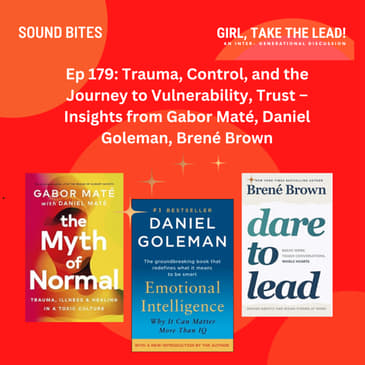
Have you ever found yourself working for or know a "control freak" – we tend to think they’re someone who engages in a series of behaviors that frustrate others and cause resentment. In this Sound Bite episode, which is a shorter episode about a topic we’ve previously covered, we’ll ask ourselves:
What if there was more to understand about control?
Topics Covered:
Gabor Maté definition of trauma
Daniel Goleman insights about control
Brené Brown’s thoughts about vulnerability and trust when it comes to leadership
Healing strategies to find balance
Here are 3 takeaways:
1. Controlling behaviors could be resulting from an underlying trauma. It’s good to take the time to learn more about that possibility and strive for balance.
2. Vulnerability is a super power – a way to build trust and authenticity.
3. Healing
strategies include self-compassion and self-love.
Mentioned in the Episode:
Gabor Maté’s Book: The Myth of Normal
Daniel Goleman’s Book: Emotional Intelligence
Brené Brown’s Book: Dare to Lead
Ep. 176 Mind Your Own Karma: Melissa Brunetti on Somatic Mindful Guided Imagery and Healing
https://spotifyanchor-web.app.link/e/o6yy7342uLb
Ep. 177 Worthy: Self Confidence, Self-Worth and Insights from Jamie Kern Lima’s Book.
https://spotifyanchor-web.app.link/e/qiDwQ342uLb
Ep. 39 Be A Terri Cole boundary Boss in Training, Too!
https://spotifyanchor-web.app.link/e/5OIP0C02uLb
Ep. 76 “Don’t Take It So Personally!” & Emotional Intelligence
https://spotifyanchor-web.app.link/e/xlad6DmWuLb
Ep. 77 AI & EI What Daniel Goleman Has To Say
https://spotifyanchor-web.app.link/e/TQbkQDmWuLb
https://www.worthwisdomwellness.com/blog/let-go-of-control/
Next Episode Topic
Toxic Positivity
How to reach Yo Canny:
Our website:
You can send a message or voicemail there. We’d love to hear from you!
email:
FB group: Girl, Take the Lead
https://www.facebook.com/groups/272025931481748/?ref=share
IG: yocanny (Yo)
LinkedIn:
https://www.linkedin.com/in/yocanny/
[00:00:05] Welcome to episode 179, which is a Girl, Take the Lead soundbite. And that's a shorter episode, which may be a bit more about a topic we've covered like our episode today, or quick inspiration. And I'm your host, Yolanda Canny.
[00:00:20] Have you ever found yourself working for someone you'd call a control freak, which is someone who engages in a series of behaviors that frustrate everyone and causes resentment? Maybe it could even be us. Individuals who operate this way do so because they believe they need to have the order to meet their needs and accomplish their goals.
[00:00:45] But what if there was more to understand about control? In our previous episodes this month, we've explored self-care and the powerful connection between trauma and the need for control that can result.
[00:01:00] But what if the control freaks are actually experiencing a trauma response? That might help us understand more about ourselves and them.
[00:01:10] According to the substance abuse and mental health administration, 61% of men and 51% of women report at least one traumatic event in their lifetimes.
[00:01:22] This could put that kind of response at the top of the list.
[00:01:28] Around 70% of people globally also have experienced some traumatic event during their life.
[00:01:35] Chances are we have experienced trauma ourselves, know someone who has, or even work with someone who has.
[00:01:42] So it's good for us to explore this.
[00:01:45] Gabor Mate is a celebrated speaker and best-selling author and is an expert on the subject of addiction, stress, and childhood development.
[00:01:56] In his book, The Myth of Normal, he defines trauma and its lasting impact on individuals.
[00:02:04] He makes the point that trauma is a foundational layer of experience in modern life, but one largely ignored or misappreended.
[00:02:15] He states that the common sense about trauma is that it's something catastrophic, abnormal, unusual, the exceptional.
[00:02:24] Here's a passage from the book.
[00:02:27] Trauma pervades our culture from personal functioning through social relationships, parenting, education, pop culture, economics, and politics.
[00:02:38] In fact, someone without the marks of trauma would be an outlier of our society.
[00:02:43] He uses the word trauma as an inner injury, a lasting rupture or split within the self due to difficult or hurtful events.
[00:02:54] It primarily happens when someone has a result of the difficult or hurtful events that befall them.
[00:03:02] It's not the events themselves.
[00:03:06] Trauma is not what happens to you, but what happens inside you.
[00:03:11] Trauma is a psychic injury logged in our nervous system, mind, and body, lasting long past the originating incident.
[00:03:23] Triggerable at any moment.
[00:03:26] It is a constellation of hardships composed of the wound itself and the residual burdens that our woundedness imposes on our bodies and souls.
[00:03:39] The unresolved emotions.
[00:03:42] The unresolved emotions they visit upon us and the coping dynamics they dictate like developing compulsive behaviors and control mechanisms.
[00:03:53] So good.
[00:03:55] In previous episodes, we explored Daniel Goleman's book, Emotional Intelligence.
[00:04:01] I thought that book might be a good resource to learn a little bit more about control too.
[00:04:07] In his book, Goleman discusses control primarily in the context of self-regulation, which is one of the key components of emotional intelligence.
[00:04:17] He explains how self-regulation helps individuals maintain control over their emotions, allowing them to stay calm and think clearly in stressful situations.
[00:04:32] I think what Goleman is pointing to is a need for balance.
[00:04:38] There's a site I found, the Worth, Wisdom, and Wellness Center, and they make these points.
[00:04:47] Finding balance includes first accepting that there's only so much one can do in all situations.
[00:04:56] There will come a point where things are out of control.
[00:05:00] Instead of allowing that to have a negative impact on us emotionally and how we feel about ourselves, recognize that this is normal.
[00:05:10] The more you continue to fight against this, the harder it will be to move through it.
[00:05:17] They also say this.
[00:05:19] After acceptance, keep in mind that the future is coming whether you're prepared for it or not.
[00:05:25] With it being the future, that means you will have no idea what's to come.
[00:05:32] Trust that you'll be able to handle whatever comes your way because you've done it before.
[00:05:41] What impresses me most about this is the opposite of control is trust.
[00:05:49] Let's take a moment to let that in.
[00:05:52] The opposite of control is trust.
[00:05:58] It could also be that maintaining control is a form of avoiding vulnerability and messy situations.
[00:06:06] Now, why would that be?
[00:06:09] Vulnerability and controlling behavior can be related in a few ways.
[00:06:15] For example, controlling people may associate vulnerability with powerlessness, which can make them wary of appearing weak.
[00:06:25] People who are insecure may crave intimacy but fear rejection, which can lead to unhealthy behaviors like controlling behaviors.
[00:06:35] Can reference our episode 177 worthy, where we explored that topic.
[00:06:41] And numbing vulnerability can also numb other emotions, including those that people crave, like love, happiness, and connection.
[00:06:52] This can lead to over-controlling behavior, which can be a death sentence to creativity and team trust.
[00:07:03] Renee Brown advises to see vulnerability as a sign of strength.
[00:07:07] And can foster not only trust, but resilience and self-confidence in relationships.
[00:07:14] It can also help people work through their emotions and build better emotional and mental health.
[00:07:22] And if you or someone you know suspects there are more underlying issues like trauma, here's some healing strategies you can offer.
[00:07:32] One, understand, become aware, and accept the roots of trauma and how it manifests in controlling behaviors.
[00:07:43] Two, understand more about the mind-body connection through mindful meditation or SMGI.
[00:07:52] And in episode 176, we talked to Melissa all about SMGI.
[00:07:57] So be sure to check that out to learn more.
[00:07:59] Four, therapy and counseling and learning can be used to set boundaries.
[00:08:06] And Terry Cole does a great job helping us all to understand how we can become a boundary boss.
[00:08:14] And four, have self-compassion and exercise self-kindness.
[00:08:21] And five, practice being more open about your truths and stories.
[00:08:27] So vulnerability and authenticity can flourish.
[00:08:32] This takes courage.
[00:08:34] But can lead and guide others.
[00:08:38] Yeah, it takes work.
[00:08:40] But it's so worth it.
[00:08:43] To close this episode, I'll leave you with this excerpt from Dare to Lead and our beloved Renee Brown.
[00:08:51] Self-Foreverness and self-love matter.
[00:08:56] Who we are is how we lead.
[00:08:59] So often we think of courage as an inherent trait.
[00:09:04] However, it is less about who people are and more about how they behave and show up in difficult situations.
[00:09:13] Fear is the emotion at the center of the list of problematic behaviors and cultural issues.
[00:09:21] It's precisely what you'd expect to find as an underlying barrier to courage.
[00:09:29] And on that note, we'll end today's episode, friends.
[00:09:38] Thank you for listening today.
[00:09:40] I wish or hope you enjoyed this episode.
[00:09:42] And if you did, please leave a comment wherever you listen to your podcasts.
[00:09:45] Tell a friend about us.
[00:09:47] Join our public Facebook group, Girl Take the Lead, or visit our website,
[00:09:53] girltaketheleadpod.com.
[00:09:54] We also have a YouTube channel where your subscription would be appreciated.
[00:09:58] Once you're on YouTube, search at Girl Take the Lead.
[00:10:02] And we're on YouTube Music where you can see a video of this episode.
[00:10:08] Here are three takeaways.
[00:10:10] One, controlling behavior could be resulting from an underlying trauma.
[00:10:16] It's good to take the time to learn more about that possibility and strive for balance.
[00:10:24] Two, vulnerability is a superpower.
[00:10:28] A way to build trust and authenticity.
[00:10:32] And three, healing strategies include self-compassion and self-love.
[00:10:42] Our next episode will close out our July theme of self-care
[00:10:46] with the topic that I mentioned in our worthy episode, toxic positivity.
[00:10:54] I thought we'd explore that a bit more together and understand what that's all about.
[00:11:01] So please join us again.
[00:11:04] Thanks for being here.
[00:11:05] Talk to you soon.
[00:11:07] Bye.
[00:11:08] Bye.
[00:11:08] Bye.
[00:11:09] Bye.