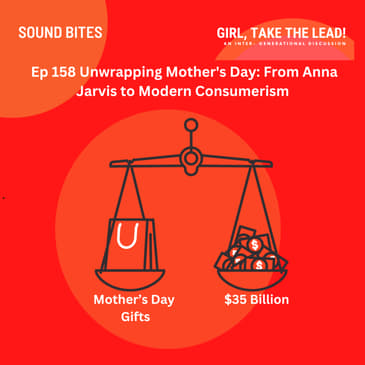
In our previous Episode 157 we heard about Mothers’ Day Movement and the African Education Program and I was struck with the fact that $35B is spent on Mother’s Day gifts. How could that be? And what’s the history of the holiday? And where’s the motivation coming from? So I dug into some articles and searched for insights I thought you might find interesting.
https://www.history.com/topics/holidays/mothers-day Mother’s Day 2024
https://time.com/4771354/mothers-day-history-origins/
The Surprisingly Sad Origins of Mother’s Day, by Olivia Waxman, 2018
https://www.dailysabah.com/life/history/mothers-day-origins-more-than-a-commercial-holiday
Mother's Day origins: More than a
commercial holiday, by Buse Keskin, 2022
Brene Brown, Atlas of the Heart
Katherine Lane Antolini’s Book: Memorializing Motherhood: Anna Jarvis and the Struggle for the Control of Mother’s Day.
5 Languages of Love: https://5lovelanguages.com/
https://www.popneuro.com/neuromarketing-blog/consumer-psychology-mothersday-guiltConsumer Psychology And Mother’s Day Guilt
Samsung’s Texts From Mom Campaign: https://www.youtube.com/watch?v=LEVsiKYnSBs
Ep. 42, Receiving Feedback & Resentment, Shame, Anxiety, Fear, and Curiosity – With Help from the Masters (Brené Brown, Parker Palmer, & Cory Muscara)
Ep. 157, Mothers’ Day Movement 2024: Supporting African Education Program
Ep. 68 Mothers’ Day Movement 2023: Addressing Global Maternal Mortality
Ep. 14 Mothers’ Day Movement 2022
Mothers’ Day 2024 AEP campaign: https://www.africaneducationprogram.org/mothersdaymovement
Donation Link Mothers’ Day Movement
How to reach Yo Canny:
Our website:
You can send a message or voicemail there. We’d love to hear from you!
email:
yo@yocanny.com (Yo)
FB group: Girl, Take the Lead
https://www.facebook.com/groups/272025931481748/?ref=share
IG:
yocanny (Yo)
LinkedIn:
https://www.linkedin.com/in/yocanny/
[00:00:00] Welcome to episode 158, which is a Girl Take the Lead soundbite. And a soundbite is a shorter episode that builds on a previous one like our episode today, or it's a quick inspiration.
[00:00:18] And I'm your host, Yolani.
[00:00:21] In our previous episode we learned about Mother's Day movement and the African education program. And I was struck with the fact that $35 billion is spent on Mother's Day gifts.
[00:00:33] How could that be right? And what's the history of the holiday? And where's the motivation coming from, from a marketing perspective?
[00:00:41] So I dug in and searched for insights I thought you might find interesting. And I'll have all the links to the articles that I sourced found in the show notes.
[00:00:52] Mother's Day began in the 1900s by Anna Jarvis, daughter of Anne Reeves Jarvis following her mother's death in 1905. And the intention was to have a way of honoring the sacrifices mothers made for their children.
[00:01:09] After gaining financial backing from a Philadelphia department store owner named John Wanamaker, on May 10, 1908, she organized the first official Mother's Day celebration at a Methodist church in Grafton, West Virginia, by sending 500 white carnations.
[00:01:29] That same day also saw thousands of people attend the Mother's Day event at one of Wanamaker's retail stores in Philadelphia in honor of her late mother, Anne.
[00:01:41] Following the success of her first Mother's Day, Jarvis, who remained unmarried and childless her whole life, resolved to see her holiday added to the national calendar.
[00:01:53] Arguing that American holidays were biased toward male achievements, she started a massive letter writing campaign to newspapers and prominent politicians urging the adoption of a special day honoring motherhood.
[00:02:08] Clearly, a woman taking the lead right? Oh yeah.
[00:02:13] It's interesting to note that Anna Jarvis was a copywriter with an advertising background.
[00:02:21] By 1912 she had quit her job in the industry and started Mother's Day International Association partnerships with florists and a successful letter writing campaign to state governors helped the holiday get recognized at the state, and eventually federal level.
[00:02:40] By 1912 many states, towns and churches had adopted Mother's Day as an annual holiday.
[00:02:47] And her persistence paid off.
[00:02:50] On May 9 1914, President Woodrow Wilson signed a measure officially establishing the second Sunday in May as Mother's Day.
[00:03:02] What's interesting though is that Anna wasn't the first to come up with the idea.
[00:03:08] Jarvis's own mother, Anne, had come up with such an idea in the mid 19th century.
[00:03:16] Her vision for Mother's Day however, looked very different from the gift centric holiday of modern times.
[00:03:25] But what the elder Jarvis had probably had in mind was very different than what her daughter eventually brought into reality.
[00:03:36] Evidence suggests that the original idea was for a Mother's Day, a day for mothers, plural, not a day for one's own mother.
[00:03:49] Sounds like Mother's Day movement right?
[00:03:52] And that day was going to be a day when mothers could get together for a day of service to help out other mothers who were less fortunate than they were.
[00:04:01] And this was all according to Katherine Lane Antinoli, an assistant professor of history and gender studies at West Virginia Wesleyan College and author of Memorializing Motherhood, Anna Jarvis and the struggle for control of Mother's Day.
[00:04:20] Why would the elder Jarvis have focused her idea for a commemoration of motherhood on the idea of community service?
[00:04:29] The reason is pretty tragic.
[00:04:32] Her experience of motherhood had been infused with much sadness.
[00:04:37] Of the 13 children that she bore, only four lived to adulthood.
[00:04:43] Her story was not uncommon. An estimated 15 to 30 percent of infants in the Appalachian region died before their first birthday throughout the 19th and 20th century, largely due to epidemics that were spread by poor sanitary conditions, according to Antinoli's book.
[00:05:04] In 1858, while she was pregnant for the sixth time, Jarvis enlisted the help of her brother, Dr. James Reeves, who was involved in treating victims of the typhoid fever epidemic to try to improve the situation.
[00:05:20] They organized events at which doctors were invited to lead discussions with local mothers on the latest hygiene practices that could keep their children healthy.
[00:05:31] The event was called the events Mother's Day Work Clubs.
[00:05:37] But when it came time for Jarvis to lead the charge for the National Day for Mothers, she left behind the idea of educating mothers.
[00:05:45] Perhaps it was because she was not a mother herself, Antinoli suggests, and thus, she couldn't be a leader for a holiday that encourages mothers to be socially active.
[00:05:56] As she mentioned, she may have thought a more uplifting tone would be easier to market broadly.
[00:06:03] She didn't want it to turn into a baker's day, says Antinoli. She thought even poor mothers were rich if they had their kids left.
[00:06:13] What were some of the efforts leading up to this?
[00:06:17] Just before the Civil War, Anne Reeves Jarvis of West Virginia helped start Mother's Day Work Clubs, as we mentioned.
[00:06:24] And that was to really help women to keep their children properly cared for so they didn't die prematurely like hers had.
[00:06:33] These clubs later became a unifying force in a region of the country still divided over the Civil War.
[00:06:40] In 1868, Jarvis organized Mother's Friendship Day, at which mothers gathered with former Union and Confederate soldiers to promote reconciliation.
[00:06:53] Another precursor to Mother's Day came from the abolitionist and suffragette Julia Ward Howe.
[00:07:01] In 1870, Howe wrote the Mother's Day Proclamation, a call to action that asked mothers to unite in promoting world peace.
[00:07:11] In 1873, Howe campaigned for a Mother's Peace Day to be celebrated every June 2nd.
[00:07:20] And maybe the stars were just aligned.
[00:07:23] And city leaders of Henderson, Kentucky argued that Mary Tell Sassine should be credited for starting the day to honor mothers all the way back in 1887, at which point Sassine was a 24-year-old school principal.
[00:07:41] She would even curate a book of songs, poems and readings for schools that wanted to organize tributes to mothers.
[00:07:49] And if you ask the Fraternal Order of Eagles, the organization would say Mother's Day started in 1904 with its member Frank Herring, a football coach and Notre Dame faculty member who required students to write a note to their mothers once a month.
[00:08:09] Antonelli suggests that some historians also point out the paradoxical timing of Jarvis's version of Mother's Day taking hold at the beginning of the 20th century.
[00:08:21] People had been talking about the idea for decades, but the holiday got national attention just at a time when more women were beginning to get jobs outside the home.
[00:08:33] And some experts see the embrace of a celebration of motherhood as a backlash against that change.
[00:08:43] But how far back does honoring motherhood go?
[00:08:47] Celebrations of mothers and motherhood can be traced back to the ancient Greeks and Romans who held festivals in honor of their mother goddesses Rhea and Sibili.
[00:08:59] But the clearest modern-day precedent for Mother's Day is the early Christian festival known as Mothering Sunday.
[00:09:09] Once a major tradition in the United Kingdom and parts of Europe, the celebration fell on the fourth Sunday in Lent and was originally seen as a time when the faithful would return to their mother church, the main church in the vicinity of their home for a special service.
[00:09:30] Over time, the Mothering Sunday tradition shifted into a more secular holiday and children would present their mothers with flowers and other tokens of appreciation.
[00:09:41] This custom eventually faded in popularity before merging with the American Mother's Day in the 1930s and 1940s.
[00:09:54] Anna Jarvis had originally conceived of Mother's Day as a day of personal celebration between mothers and families.
[00:10:04] And we've already seen that her mother's vision was different as well.
[00:10:09] Anna's version of the day involved wearing a white carnation as a badge and visiting one's mother or attending church services.
[00:10:17] But once Mother's Day became a national holiday, it was not long before florists, card companies and other merchants capitalized on its popularity.
[00:10:28] And when you think about it, I think that Anna Jarvis had a little something to do with the whole thing with her original marketing idea and strategy.
[00:10:38] While Jarvis had initially worked with the floral industry to raise Mother's Day profile, by 1920 she had become disgusted with how the holiday had been commercialized.
[00:10:52] She outwardly denounced the transformation and urged people to stop buying Mother's Day flowers, cards and candies.
[00:11:01] And in the 1960s, Jarvis eventually resorted to an open campaign against Mother's Day profiteers speaking out against confectioners, florists and even charities.
[00:11:13] She also launched countless lawsuits against groups that use the name Mother's Day, eventually spending most of her personal wealth and legal fees and by the time of her death in 1948.
[00:11:26] She disowned the holiday altogether and even actively lobbied the government to see it removed from the American holiday.
[00:11:35] So how does this history of Mother's Day impact our consumer psychology?
[00:11:43] One word, guilt.
[00:11:46] Due to the constant association between Mother's Day flowers and gift cards, the aspect of gift giving has been directly associated with honoring our mothers.
[00:11:58] The five love languages outlined by Dr. Gary Chapman, who is a marriage counselor and director of marriage seminars, argues that everyone shows and receives love differently.
[00:12:11] In one of the five languages, only one of them is receiving gifts.
[00:12:16] Mothers who prefer to show and receive love through quality time, physical touch, affirmations and so forth would be perfectly fine not receiving a gift on Mother's Day.
[00:12:27] And in my case, having my daughters make a contribution to Mother's Day movement so we take care of all mothers globally.
[00:12:35] And as Miley Cyrus sings, I can buy my own flowers or I could even pick them from my backyard.
[00:12:44] So how do we as consumers fall victim to the tactics of all these companies?
[00:12:50] Why is it we rush to buy the most colorful bouquet of flowers, scroll hours through Amazon to find the perfect gift or go through numerous gift cards to find the one that matches exactly how we feel?
[00:13:03] And this is called the consumer psychology of guilt.
[00:13:07] And it might be good to remind ourselves about the difference between guilt and shame.
[00:13:12] And it was time to go to our BFF, Brene Brown, who we adore.
[00:13:17] And she says that shame is a focus on self.
[00:13:22] Guilt is a focus on behavior.
[00:13:26] Shame is I am bad.
[00:13:28] Guilt is I did something bad.
[00:13:32] Marketers are highly aware of the guilt that they can elicit through their Mother's Day campaigns by simply mentioning our mother's efforts, which are often taken for granted.
[00:13:44] They target us with messaging to take an action, a behavior like buying the flowers.
[00:13:51] Samsung's famous text for mom campaign does precisely this, featuring typically irritating stereotypical mom texts such as how do I hashtag your brother?
[00:14:03] Or I gave my new podiatrist your phone number. Very handsome.
[00:14:08] It ends with a woman clicking on the call button, guilting viewers into calling their mothers.
[00:14:16] The motivational aspect relies on the fact that one feels guilty and one feels the urge to make good.
[00:14:23] So a typical viewer of the text from mom campaign would think to themselves, when was it last time I called mom?
[00:14:31] What can I do to make this up to her?
[00:14:34] As they fall into the cycle of guilt that the ad aimed for in the first place.
[00:14:41] The solution that most of us arrive at is spoiling our mothers one day a year.
[00:14:47] Consumer guilt is a feeling that arises from our awareness of having failed to achieve personal or social moral standards.
[00:14:57] As you probably already know, the sense of guilt is not an enjoyable emotion.
[00:15:04] And we attempt to avoid it if we can.
[00:15:09] And there's social pressure.
[00:15:12] Mother's Day is celebrated by everyone around you, which elicits pressure to comply with these social standards.
[00:15:20] Our Instagram feeds burst with photos of friends' moms being smothered with gifts and ads that naturally push us into a loop of guilt
[00:15:31] and leads to do the one thing that would make it all go away.
[00:15:36] Buy those flowers or make the phone call.
[00:15:42] Did you know more phone calls are made on Mother's Day than any other day of the year?
[00:15:51] These holiday chats with mom often cause phone traffic to spike as much as 37%.
[00:16:01] We all want to be great children and our abstinence from the holiday would go against who we think we are.
[00:16:09] And I think that's where shame kicks in, like I'm not a good person, a good daughter or a good son.
[00:16:17] Our compliance to this holiday by buying those flowers, the sweet perfume and witty gift cards, restores our self-esteem as a child,
[00:16:28] and we regain our self-identity without shame or guilt.
[00:16:34] So maybe at the end of the day, it is all about us and how we can feel better about ourselves.
[00:16:43] Whoa.
[00:16:45] This article ended by challenging ourselves to really ask why we're doing or overdoing with Mother's Day gifts.
[00:16:55] Could it be obligations, competition or comparison?
[00:17:02] And what a great opportunity Mother's Day gives us to check in with ourselves and those we love to talk about what really matters to each other.
[00:17:15] That could be the greatest gift of all.
[00:17:19] And on that note, we'll end our episode today.
[00:17:24] Thanks for listening.
[00:17:28] Thank you for listening today, and we sure hope you enjoyed this episode.
[00:17:35] If you did, please leave a comment wherever you listen to your podcast.
[00:17:39] Tell a friend about us.
[00:17:41] Join our public Facebook group, Girl Take the Lead, or visit our website, girltakedeleadpod.com.
[00:17:49] We also have a YouTube channel where your subscription would be appreciated once you're on YouTube search at Girl Take the Lead.
[00:17:56] And we've recently expanded to YouTube Music, where you can find a video of this episode.
[00:18:03] Our next episode will feature our guest, Irene Sim, managing director of the Coaching Alliance Group and executive leadership coach.
[00:18:14] She was the first Asian woman that the Australian Treasury posted overseas diplomatically as the minister counselor to China, Hong Kong, and Taiwan.
[00:18:27] She has held the role as the secretary to the Australian Treasury's executive board.
[00:18:33] And we had the best time talking about the power of emotions, new thinking habits, systemic bias and racism, and emotions and ego.
[00:18:46] Wow, it was good stuff and lots of fun.
[00:18:50] Please join us again.
[00:18:52] And thanks for being here and talk to you soon.
[00:18:55] Bye.