In our previous Ep 159 we spoke with Irene Sim about ego and the role it played in leadership. But I wanted to dig in a bit more about this and had what may be a basic question: what is the ego and what are current thought leaders in the field saying? So I did some research and found some insights I thought you might find interesting.
Episode sources:
Consumer Behavior, Babin + Harris, 2022
Brené Brown’s book: Rising Strong
Explore Psychology Website:
Ep. 76 ‘Don’t Take It So Personally!” & Emotional Intelligence
https://spotifyanchor-web.app.link/e/BgbyNEPKCJb
How to Reach Yo Canny:
Our website:
You can send a message or voicemail there. We’d love to hear from you!
email:
yo@yocanny.com (Yo)
FB group: Girl, Take the Lead
https://www.facebook.com/groups/272025931481748/?ref=share
IG: yocanny
LinkedIn:
https://www.linkedin.com/in/yocanny/
[00:00:04] Welcome to episode 160, which is a Girl, Take the Lead soundbite. And a soundbite is a shorter
[00:00:10] episode, which may build on a topic we've covered before like our episode today or quick inspiration.
[00:00:17] And I'm your host, Yol Canny. In our previous episode 159, we spoke with Irene Sim about the
[00:00:24] ego and the role it played in leadership. But I wanted to dig in a bit more and had what
[00:00:31] maybe a basic question. What is the ego and what are the current thought leaders in the field saying?
[00:00:39] So I did some research and found some insights I thought you might find interesting,
[00:00:43] and I'll have the links for all of the sources I used in the show notes.
[00:00:48] Freud often considered the father of psychoanalysis delves deeply into human psyche,
[00:00:55] including the study of emotions and the ego. His concepts such as id, ego, and superego,
[00:01:02] as well as his theories on defense mechanisms greatly influenced psychology and our understanding
[00:01:09] of emotions. I'm going to reference the textbook I used in my consumer behavior marketing class
[00:01:15] at San Jose State University because it has some classic definitions that I think could be
[00:01:20] helpful. Id is the component of psychoanalytic theory that focuses on pleasure seeking motives
[00:01:29] and immediate gratification. The focus is to minimize pain. Superego works against the id
[00:01:38] by motivating behavior that matches the expectations and norms of society.
[00:01:44] And the ego attempts to balance the struggle between the id and the superego.
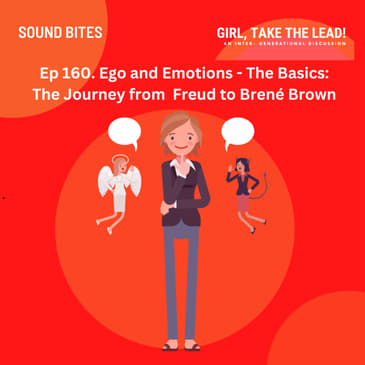
[00:01:49] That's why we often see images of the id represented as the devil, the superego as
[00:01:55] the angel and you in between trying to decide which to follow and trying to find balance.
[00:02:03] I found a great article called id, ego, and superego understanding Freud's theory
[00:02:10] on the explore psychology website. And it offered us the following understanding
[00:02:16] understanding of the impact of the id, ego, and superego on therapy. It said the concept of the
[00:02:24] id, ego, and superego is still relevant in modern psychology and therapy. Although it has
[00:02:31] been expanded and modified over time, today many therapists use psychodynamic approaches that draw
[00:02:38] on Freudian concepts including the id, ego, and superego to help individuals better understand
[00:02:45] their thoughts, feelings, and behaviors. One way that the id, ego, and superego concept is
[00:02:53] applied in modern therapy is by exploring unconscious conflicts and unresolved emotions
[00:03:00] and contribute to psychological distress. For example, a therapist may help a client
[00:03:06] uncover and process past traumas impacting their current behavior and emotions. By
[00:03:13] understanding these conflicts, therapists can work with to develop more effective coping strategies.
[00:03:21] Another way in which the concept is applied is by helping individuals develop a stronger sense
[00:03:27] of self-awareness and self-reflection. By examining their own thoughts and behaviors,
[00:03:33] individuals can learn to understand better the motivations and desires that are driving them.
[00:03:41] In doing so, they can develop a more balanced and integrated sense of self. The article also
[00:03:48] had this to say about what happens when the id, ego, and superego conflict. It can lead to
[00:03:56] psychological distress and maladaptive behavior. For example, if the id is dominant and the ego
[00:04:04] and superego are weak, an individual may engage in impulsive and self-destructive behavior
[00:04:10] without considering the consequences of the impact on others. This can lead to problems such
[00:04:16] as addiction, reckless behavior, and criminal activity. On the other hand, if the superego
[00:04:23] is dominant and the id is weak, an individual may be overly rigid and self-controlled.
[00:04:31] This can result in suppressing natural desires and impulses in favor of strict adherence to
[00:04:37] moral and ethical values. When this happens, people may experience problems such as anxiety,
[00:04:45] depression, and a lack of spontaneity and enjoyment in life. So when the ego is unable
[00:04:53] to balance the demands of the id and the superego effectively, it can lead us to feelings
[00:04:59] of guilt, anxiety, and confusion. This can manifest in symptoms such as compulsive behavior,
[00:05:07] obsessions, and phobias. Maybe overeating like it was in my life.
[00:05:15] This gets us to the question of how ego and emotions relate and who is better to talk to
[00:05:22] about that than Brene Brown. Here's what she had to say in her book, Rising Strong,
[00:05:28] The Reckoning, The Rumble, The Revolution. It's just such a great title. Quote, bouncing hurt,
[00:05:37] our ego is the part of us that cares about our status and what people think, about always being
[00:05:44] better than and always being right. I think of my ego as my inner hustler. It's always telling
[00:05:52] me to compare, prove, please, perfect, outperform, and compete. Our inner hustlers
[00:06:01] have very little tolerance for discomfort or self-reflection. The ego doesn't own stories
[00:06:08] or want to write new endings. It denies emotion and hates curiosity. Instead,
[00:06:17] the ego uses stories as armor and alibis. The ego has a shame based fear of being ordinary,
[00:06:25] which is how I define narcissism. The ego says, quote, feelings are for losers and weaklings.
[00:06:34] Avoiding truth and vulnerability are critical parts of the hustle. Like all good hustlers,
[00:06:41] our egos employ crews of ruffians in case we don't comply with their demands.
[00:06:47] Anger, blame, and avoidance are the ego's bouncers. When we get too close to recognizing
[00:06:54] and experience as an emotional one, these three spring into action. It's much easier to say,
[00:07:01] I don't give a damn than it is to say, I'm hurt. The ego likes blaming, finding fault,
[00:07:07] making excuses, inflicting payback, and lashing out, all of which are ultimate forms of self
[00:07:13] protection. The ego is also a fan of avoidance, assuring the offender that we're fine,
[00:07:21] pretending that it doesn't matter. And we're imperious. We adopt a pose of indifference
[00:07:28] or stoicism, or we deflect with humor and cynicism, like whatever, who cares?
[00:07:37] We did an episode a while ago on the book, Emotional Intelligence, Why It Can Matter More
[00:07:43] Than IQ by Daniel Goldman, where we explored that emotional intelligence was understanding
[00:07:50] and managing one's own emotions as well as recognizing and responding to the emotions of
[00:07:55] others. Goldman stated that self-awareness, a key component of emotional intelligence,
[00:08:02] involves recognizing our own emotional patterns and how they influence our thoughts and
[00:08:07] feelings. I find that in addition to talking to someone about them, writing is often the
[00:08:14] best course of action that I can take so I can put a name to the emotion.
[00:08:19] Recently, I had to write about what I was feeling about something and then I could see it.
[00:08:25] Jealousy popped up big time. And it was almost a relief to see it because I could
[00:08:31] question it and then ask myself, is it really true? We also discussed in that episode the
[00:08:38] importance of empathy and interpersonal skills in developing emotional intelligence,
[00:08:43] which can involve setting aside one's own ego and being attuned to the experiences
[00:08:49] and the emotions of others. Oh, so good. Oh yeah. The last thing, perhaps the good news,
[00:08:57] when it comes to our ego and superego, they can be developed or changed over time through
[00:09:03] various experiences and life's events. For example, as we age and gain more life experience,
[00:09:12] greater self-control and ability to delay gratification, we can be more effective in
[00:09:17] regulating our id's impulses. But it also goes that traumatic experiences or a major life
[00:09:24] event can disrupt that balance anytime. So on that note, we'll end our episode today.
[00:09:33] Hopefully it helped connect some of the dots for you and help you see that becoming aware
[00:09:39] of our emotions, we can better understand ourselves and what might be out of balance.
[00:09:46] Thanks. Thank you for listening today. And we sure hope you enjoyed this episode.
[00:09:55] If you did, please leave a comment wherever you listen to your podcast,
[00:09:59] tell a friend about us or join our public Facebook group, Girl Take the Lead or visit
[00:10:04] our website, girltaketheleadpod.com. We also have a YouTube channel where your
[00:10:09] subscription would be appreciated. Once you're on YouTube search at Girl Take the Lead.
[00:10:14] And we've recently expanded into YouTube music where you can see video of this episode.
[00:10:20] Our next episode will feature our Gen Z guest, Hannah McDonald Danaker.
[00:10:27] I just love it when the Gen Z energy is in the house. Hannah is an author,
[00:10:34] sought after public speaker and partner in sales and marketing manager at the
[00:10:39] Better Together group of companies. She also has a podcast, Workish. We had a great time
[00:10:47] talking about her book, staffing trends and career advice for all of us.
[00:10:52] Please join us again. Thanks for being here and talk to you soon. Bye.