
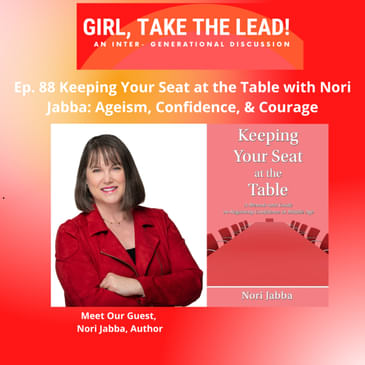
Nori Jabba joins Yo to discuss her book Keeping Your Seat at the Table, A memoir and guide on Regaining Confidence in Middle Age. Together they explore ageism, strategic partnerships and hero lists. Nori explains the many aspects of The Table as a theme throughout her book. There were so many cleaver table uses like “Flip The Table”, “Don’t Table Yourself”, “Don’t Get Pulled Under the Table” discussed in the episode. Nori’s story is sure to be inspirational no matter your age!
Here are the 3 Episode Takeaways:
1. Ageism is real so don’t “table” yourself: take your seat at the head of your own table and surround yourself with your peeps (aka strategic partners).
2. The worry about money is real: factor this into your career planning as early as you can.
3. Be courageous: put your graduation years on your resume!
We hope you’ll enjoy this episode!
As mentioned in the episode:
Nori’s book, Keeping Your Seat at the Table
More about Nori:
Nori Jabba grew up in the San Francisco Bay Area. She has had a career spanning more than 30 years in corporate real estate and community development. Her book, KEEPING YOUR SEAT AT THE TABLE, is a memoir and guide on regaining confidence in middle age. She wrote the book when she could not land a job, abandoned her job search, and embarked on a quest to find out what was really going on and whether ageism was real. She landed the job she was looking for while writing the book. She is passionate about mentoring women, including her three grown daughters, and writes to empower and inspire others. She lives in the San Francisco Bay Area.
Ways you can contact Nori:
Website
Tik Tok: @norijabba; Instagram: @bnjabba
Upcoming Events:
Nori will do book signings, readings, and workshops upon request. I have one scheduled for Dress for Success San Jose on September 28.
Ways to reach Yo:
eMail yo@yocanny.com
Public FB group: Girl, Take the Lead!
https://www.facebook.com/groups/272025931481748/?ref=share
IG:
https://www.instagram.com/yocanny
LinkedIn:
00:00:10
Hi there. Welcome to episode 88 of Girl
00:00:12
Take the Lead, where each week we explore womanhood and
00:00:15
leadership. And I'm your host, Yo Kenny.
00:00:19
Today, Nori Jabba joins us to discuss her book Keeping Your
00:00:24
Seat at the Table, a Memoir and Guide on regaining confidence in
00:00:29
middle age. Together we explore ageism,
00:00:32
strategic partnerships, and hero lists, and Nori explains the
00:00:37
many aspects of the table used as a theme throughout her book.
00:00:42
There were so many clever uses like flip the table, don't table
00:00:46
yourself, and don't get pulled under the table.
00:00:50
And she discusses all of these in this episode.
00:00:53
Nori's story is sure to be inspirational no matter your
00:00:56
age. Here's a bit more about Nori's
00:00:59
background. Nori is a baby boomer.
00:01:01
She's had a career spanning more than 30 years in corporate real
00:01:05
estate and community development.
00:01:07
She wrote this book when she could not lend a job, abandoned
00:01:12
her job search, and embarked on a quest to find out what was
00:01:16
really going on and whether ageism was real.
00:01:19
She is passionate about mentoring women and rights to
00:01:23
empower and inspire others. And I think you'll be inspired
00:01:27
by this episode and I hope you'll enjoy it.
00:01:30
Here you go. Hi, Nori, welcome to Girl Take
00:01:39
the Lead. We are very excited to have you
00:01:41
with us and I know our listeners are going to really enjoy this
00:01:44
conversation. So thanks for being here.
00:01:47
And thank you. I'm really excited to be here,
00:01:50
right? So let's let's start by just
00:01:53
letting our listeners know a little bit more about you and
00:01:57
your journey to this point and about your book, which is just a
00:02:02
perfect title. Keeping your seat at the table.
00:02:06
How great is that title? I wrote this book because I felt
00:02:10
like I lost my seat at the table and I had to scramble to get it
00:02:15
back and. It was really a hard thing to
00:02:21
accept at the time and I was job hunting.
00:02:25
I couldn't find a job, nobody would hire me and I just decided
00:02:30
I'm going to stop this. It is not good for my mental
00:02:33
health. I was depleting my self esteem
00:02:36
and so I took a step back and wanted to research.
00:02:40
What was really going on? Is ageism real?
00:02:43
And what can I do about it? And if nobody's gonna hire me,
00:02:47
then I'm gonna start my own company and write a book about
00:02:50
it. It all started.
00:02:54
And it took on a life of its own As I went through the journey.
00:02:59
I didn't end up starting the company because I realized it
00:03:02
didn't need to do that to get my seat at the table.
00:03:06
And I was much more interested in writing, and found that
00:03:09
writing was kind of my passion and my purpose, and that having
00:03:14
that seat at the table was so different than what I thought it
00:03:17
was. So it might help just to give
00:03:20
some context for our listener. At what age you felt you were?
00:03:25
You lost your seat at the table. So I I really think ageism
00:03:30
starts at different times in different industries.
00:03:34
And I I took six years off to be a stay at home mom and I got
00:03:38
lucky. When my youngest was in
00:03:41
kindergarten, I was offered a job that I wasn't looking for.
00:03:45
And it kind of fell in my lap. And it was a great job and I did
00:03:48
it for six years. It was really hard, but I did
00:03:50
that for six years, so I felt like I had my seat at the table.
00:03:54
Then I was in my 40s when I went back to work, and then my
00:03:57
company at the project I was working on was put on hold.
00:04:01
They hired me back as a consultant.
00:04:03
I decided to be a consultant and felt like I had my seat at the
00:04:08
table then too. So it was a few years ago when I
00:04:11
was in my 50s. That I had lost one of my
00:04:14
biggest clients and I talked about why in the book.
00:04:18
I got pulled under the table and I lost my biggest client and I
00:04:22
couldn't replace that client. I was having trouble and I
00:04:26
decided, you know, it was time to go back to employed work and
00:04:31
I wanted benefits and wanted to be on a team again.
00:04:35
And that's when I started job hunting and in my 50s.
00:04:38
And no, that was not going to happen.
00:04:40
But I think it ages and really ages and starts in your 40s for
00:04:47
a lot of women. And it can even start in your
00:04:50
30s in certain industries, You know, in the music industry.
00:04:54
My daughter's in the music industry.
00:04:56
If you're in your 30s, you are old.
00:04:59
And probably irrelevant if you're over 35 side.
00:05:05
And so in the tech industry, I hear that in your late 30s is
00:05:11
when you start feeling old in the tech industry too.
00:05:15
So it really depends on on your industry.
00:05:17
But for me, I lost my seat at the table in my 50s.
00:05:22
So well, we'll back up just a second about because at the
00:05:26
title of your book is so precious.
00:05:29
And when you and I spoke before, I know you had a lot of reason
00:05:34
behind the title and using the table kind of as a metaphor.
00:05:42
And that would be. I think my listeners would enjoy
00:05:44
hearing about that. So I I named it keeping your
00:05:48
seat because I thought it was so important to share my journey
00:05:53
with others and. I'd lost my seat and the
00:05:57
journey's really about me getting it back.
00:06:00
But it's about how to keep it forever and never let it go
00:06:03
again. And the idea is to share it with
00:06:07
others. But the table, you know, we all
00:06:10
think about your seat at the table at this corporate table
00:06:14
where you're finally made it and you're invited to be there.
00:06:18
And what I realized in my journey is that is not how it
00:06:22
works. And.
00:06:24
I say enough of that. It's time to build your own
00:06:28
table. Take your rightful plagues at
00:06:31
the head of the table and you invite others to be there to
00:06:36
support you. Strategic partnerships for your
00:06:39
meeting, your goals and your purpose.
00:06:42
And it's reciprocal. You know you.
00:06:45
You help others as well. But the table itself is just so
00:06:50
much more than the corporate table.
00:06:52
I mean, if you think about the table and how we use it, it's in
00:06:57
every single culture in the world.
00:07:00
Every single one. It's essential for the human
00:07:03
existence. It's where we love.
00:07:05
It's where we learn. The kids do homework at the
00:07:08
table. We eat, we nourish ourselves.
00:07:10
We fall in love at the table. We have tough conversations and
00:07:13
make big decisions and socialize and work.
00:07:18
And so I started thinking of it in a much broader sense than
00:07:22
just this corporate success model.
00:07:27
Well, congratulations on that. Yeah, the words.
00:07:28
I thought that worked throughout the book.
00:07:31
There was just someone, oh, here's another good one.
00:07:33
You know, it's it was really. And you did a good job with
00:07:38
that. So I know you offer so many
00:07:43
great ideas around ageism, and I know some of my listeners are
00:07:47
beating their head against the ball trying to get hired, you
00:07:51
know, in their 50s and even in their 60s.
00:07:55
I know I was 60 when I got hired at the hospital system to do
00:08:02
their marketing and I I took it to motion.
00:08:09
You know, like I I didn't go in at a high director level at all.
00:08:14
I went in as a as a manager, having been in senior management
00:08:18
positions, and it just seemed to me that that was okay.
00:08:25
And that's that's a big part of my journey is really redefining
00:08:30
what success is. So as part of my journey I
00:08:33
decided I want to be a writer and yet that's not my job.
00:08:38
I work in affordable housing and and community development and I
00:08:44
too, the job that I have now which is just a fabulous I am
00:08:48
loving, is a demotion and it's a strategic demotion.
00:08:53
I actually. My last job where I was in
00:08:57
charge of an entire portfolio of 500 apartment units and a team
00:09:03
of 17 people, and I took a job that is a couple of levels below
00:09:09
that and. I don't have anybody reporting
00:09:12
to me. My boss is much younger than I
00:09:14
am and I feel like I'm adding so much value.
00:09:17
I'm learning. I'm doing something I always
00:09:20
wanted to do. I always wanted to work for a
00:09:22
city in the planning team and went to grad school in urban
00:09:25
planning and I kind of went on this different path and and
00:09:28
never did that. So it's kind of a bucket list
00:09:31
job because it's so much fun and because I have so much
00:09:35
experience under my belt. I have a lot of confidence with
00:09:39
my job. I know my stuff and so and yet
00:09:42
there's still a lot to learn. But looking at the career path
00:09:49
that I thought I was going to be on, I wanted to be C-Suite.
00:09:52
I thought that's what I am meant to be.
00:09:54
I have that in me. I still have it in, but I have
00:09:58
strategically chosen not to go that path.
00:10:02
Because there is so much more to life and there is so much more
00:10:05
to being happy and fulfilled in your career, and there's so many
00:10:11
ways to add value. But I had to make peace with
00:10:14
those squiggly lines, as I call them, on my career path.
00:10:17
And doing that, making peace with that, really helped me get
00:10:22
my seat back at the table because I don't care so much
00:10:26
about my title. I don't care so much about.
00:10:29
How many people report to me? I care about the value that I'm
00:10:33
adding and the value that the job gives me.
00:10:36
You know this equilibrium. You mentioned some research that
00:10:40
you did and you uncovered into what ageism is about and what
00:10:44
the concerns are when it comes to ageism.
00:10:48
And I know one of them was being able to learn.
00:10:52
What I learned is that we can never stop learning.
00:10:55
And as we age, there's there's just more and more and more to
00:11:00
learn it. The world has changed so much
00:11:02
with technology. You know that there are
00:11:04
1 apps out there or more and which ones do we need to
00:11:08
know and which programs do we need to know And we're keeping
00:11:13
on top of it. All is it's hard, you know it's
00:11:17
hard and we're tired and how do you choose?
00:11:21
So you need to look at your industry that you're in.
00:11:25
Assess what skills you're missing and really have an
00:11:28
honest conversation with yourself about that.
00:11:31
What do you need and get that knowledge.
00:11:35
Get those skills and reach out to younger people, mentors.
00:11:41
You can go to a place like Nova Works, which is an assess.
00:11:44
It's a job placement center and and workforce training center
00:11:49
and they have one in every metropolitan area.
00:11:53
They're free and they'll help you write your resume.
00:11:55
They'll help assess your skills. They'll give you all kinds of
00:11:59
tests and quizzes to help you, and they'll find those skills
00:12:02
for you and they'll give you the resources that you need to learn
00:12:05
them. And I did a lot of research on
00:12:08
other programs that you can do. You know LinkedIn Learning I
00:12:11
didn't even know existed before I started this journey.
00:12:14
There is so much on that you can learn in these training courses
00:12:19
and they're reasonably priced and other online resources, but.
00:12:23
But the key is to really make a strategic, purposeful effort on
00:12:30
staying on top of things and set aside, set aside time on a
00:12:34
regular basis to just do your own professional development,
00:12:39
not for the job that you have, just for you, and to make sure
00:12:44
that you're staying on top of everything.
00:12:46
That is a key thing because a lot of older people and you've
00:12:51
all heard it. Your listeners are probably
00:12:54
going to laugh because they've been in a meeting where somebody
00:12:56
will say I'm too old for that or I am, so somebody will say I am
00:13:01
so old I can't learn that and just never be that person.
00:13:08
That's my group. Never be intimidated by it,
00:13:11
Never think you're too old for it.
00:13:13
Always learn because boy, if you don't, you will be left behind.
00:13:17
And I look at my mother who's in her 80s and seniors now, if they
00:13:22
don't have technology, they're not able to use a smartphone.
00:13:26
They are out of luck and try ordering a a soda on an airplane
00:13:32
now and not having your app. You have to have it to travel.
00:13:38
And so you will be left behind. So making sure that you just
00:13:42
stay on top of everything all the time and set aside, set
00:13:47
aside time for this key. I know you said mentioned it a
00:13:51
little bit, but some of your points in the book about the
00:13:54
concern of working with somebody who was younger or reporting to
00:13:58
somebody who was younger than you, that would be a concern as
00:14:02
someone might have as a hiring manager.
00:14:04
So the job that I have now, my boss is decades younger and I
00:14:08
would not have been able to do that before being on this
00:14:12
journey and going through it. You know, I would have thought
00:14:15
of it as maybe a little humiliating and I'm a failure or
00:14:20
just I hadn't made it in my life.
00:14:23
But now I have completely changed my 2:00 and I looked at
00:14:28
younger workers as just. Full of valuable information and
00:14:34
insights and perspectives that are just so important for me to
00:14:38
keep my seat at the table just to understand the other
00:14:41
perspectives. So we often talk about being a
00:14:44
mentor to younger people. And I say yes, that's good, but
00:14:48
flip it on his head, be a mentee.
00:14:51
Have a mentor who is decades younger than you.
00:14:54
You know, really make a conscious effort to learn from
00:14:58
these younger people and and have them in your network.
00:15:01
And reach out to them and understand them because they
00:15:05
have so much value to add and they do look at things
00:15:08
differently and you will learn and grow from them.
00:15:11
I don't think we're aware sometimes of what the when
00:15:15
people meet us or what their concerns are.
00:15:17
And you did such a good job of pointing them out on your
00:15:20
research. You know, like, Oh well, they're
00:15:22
going to be concerned about your ability to learn.
00:15:24
They're going to, and all you need to do, you know, for
00:15:27
yourself is to take some, except that some of these things are
00:15:32
are there. That may not be very fair, but
00:15:36
there you go. People have perceptions.
00:15:38
Right, It isn't that hard. You know, just when you go into
00:15:41
a job interview and you're you're in your 50s or late 40s
00:15:45
and you have decades under your belt and lots of experience and
00:15:49
you want to show them everything you know, but you forget to show
00:15:53
them that. And you love learning and you
00:15:57
are not intimidated by new technology and learning from
00:16:01
younger worker. You know you have to, you have
00:16:05
to state that because otherwise you might come across as you're
00:16:09
not gonna listen to other people, you're just gonna add
00:16:13
your value that you think is important.
00:16:15
And companies, you know, they say that.
00:16:18
Fit is the number one thing when you're job hunting.
00:16:22
That's what it all comes down to, is being a good fit.
00:16:25
So understanding that corporate culture and understanding what
00:16:30
works for you and what is a good fit for you, and being able to
00:16:35
showcase how your personal fit aligns with the corporate
00:16:40
culture and their fit and what they're looking for is the G and
00:16:46
I. You had an interesting take on
00:16:48
resumes. Yeah, and so hold on listener,
00:16:53
this is going to blow your mind so.
00:16:56
Many times have we been told tell put your year graduation
00:17:01
on. Don't quit the years.
00:17:03
Don't let them know how old you are.
00:17:04
Hide it well. What do you do if you see a
00:17:07
resume without the year of graduation on it?
00:17:09
You automatically assume that they're old because they're
00:17:13
trying to hide it. I do.
00:17:16
So, and I am so annoyed that we can't celebrate our wisdom to
00:17:21
age and experience. I I say call BS on that and I
00:17:25
say you own it. And I have a whole chapter in
00:17:28
the book about owning your age, but also balancing it with
00:17:32
humbleness. And it goes back to being able
00:17:35
to grow and also to add value. With that wisdom, and it's all
00:17:41
about that and making sure that that comes through on your
00:17:44
resume also, it's not just a laundry list of everything
00:17:48
you've done that's great over the last 30 years.
00:17:51
It's how you can add value to. So yeah, I I put my years of
00:17:57
graduation proudly on that resume.
00:18:00
So I started. Doing that, I didn't get any
00:18:03
jobs. Well, I did that too when I
00:18:07
think I started in my 60s. You know, cuz I went what the
00:18:12
heck, you can't hide it anymore. You can't.
00:18:16
It's like, it is what it is anyway, So I thought that was
00:18:19
very interesting. I'm sure that some of my
00:18:22
listeners are blowing their minds right now, going, Oh my
00:18:24
God. This is not what we're told to
00:18:26
do, but anyway, I think it's. Good time to turn that on its
00:18:29
head. Yeah, we celebrate companies
00:18:33
that are old, the older the company is.
00:18:36
The more revered and respected it is.
00:18:38
And yet the people that work there that are older, it's the
00:18:43
opposite. You want them to hide their
00:18:45
wisdom and experience and age and what they bring to the
00:18:48
table. So no, I say celebrate it.
00:18:52
So great. One of the things that's really
00:18:54
unique about your book is that you talk about money and the
00:18:59
concerns that people have about money.
00:19:02
Especially women as we age, you know, Wow.
00:19:05
I thought that was. A lot of anxiety over that.
00:19:08
I thought that was pretty courageous.
00:19:10
Hard to take on that topic to talk a little bit about what you
00:19:14
saw there and why you decided to include that.
00:19:17
Well, because it makes me anxious and you know a lot of
00:19:22
what hold me under the table. And by that I mean just hold me
00:19:27
away from my ability to achieve my purpose.
00:19:31
Was dealing with my aging parents and also anxiety over
00:19:37
the future and making sure I have enough money when I retire
00:19:41
and really looking at what I want that next chapter to to be
00:19:46
about and look like and how much money I'll need to get there.
00:19:50
And women, we're we're notorious for not addressing that head on.
00:19:56
And it is sometimes uncomfortable and there, you
00:19:59
know, Susie Orman was great example.
00:20:02
She's a wonderful resource with that and there are so many other
00:20:06
books and and podcasts on this topic.
00:20:09
But just facing your fears and anxieties head on is key and.
00:20:16
Really figuring out how much money do I need and what do I
00:20:20
have to do to get there? And the truth is, it's usually
00:20:24
always more than you think you're going to take it, right?
00:20:27
There's often never enough. And it totally depends on where
00:20:31
you live and what your lifestyle is.
00:20:33
But we live in. I live in the San Francisco Bay
00:20:36
Area, and it's one of the most expensive places in the world.
00:20:40
So just addressing the fear of having enough money as a senior
00:20:45
is just really important. And just knowing little things
00:20:48
like when you have to apply for Social Security, I didn't know
00:20:52
the age that it was. There's this cutoff period or
00:20:56
it'll cost you a whole lot of money if you don't need that
00:20:59
deadline. Well, I even see in Gen.
00:21:02
Zers and Millennials real concern about money and being
00:21:08
able to afford. You know where they're living or
00:21:11
the lifestyle that they want to have and whether, you know, so
00:21:15
many are postponing having children because of the cost
00:21:19
involved with that. And the I think what you're
00:21:23
pointing to is that underneath that concern is you know how you
00:21:30
relate to money. And then that's going to affect
00:21:35
how you relate to interviewing, looking for another job.
00:21:40
I mean, I can always remember being super anxious, you know,
00:21:44
and holding on to that interview I just had like, oh, please, oh,
00:21:48
please, oh, please, you know, And when it didn't go my way and
00:21:54
they hired somebody else, you know, it was, it took me time to
00:21:58
recover. It would be like.
00:22:01
It it, it just hit, would hit me like a ton of bricks.
00:22:06
But I think a lot of it, it was driven by this panic about
00:22:11
money. And I didn't use that word
00:22:13
panic, but there is this underlying sensor panel because
00:22:19
we're at that age where it starts getting real, You start
00:22:23
really thinking about your future and wow, I only have XY.
00:22:28
There's even more years to save for my retirement and I better
00:22:32
get on it. So it is, it does create kind of
00:22:37
this underlying panic and these things that eat away at us.
00:22:40
And I talked about, you know, my mom, I had to move her.
00:22:45
And it was like a volcano ready to erupt.
00:22:48
And I knew it was going to erupt.
00:22:50
And I did nothing to prepare myself for it because it was too
00:22:54
overwhelming to even think about this woman out of state.
00:22:59
And I would have to move her, downsize her, find her a new
00:23:04
place to live. And what was I going to do?
00:23:08
And where my sisters and brothers going to help?
00:23:10
Or was it all on me? And you know it.
00:23:14
These things never happen when you want them to.
00:23:17
Ever. And I did no preparation.
00:23:20
None of us did. And it fell on me.
00:23:22
And I lost my biggest client because I couldn't be there for
00:23:26
them. I had to fly to Colorado every
00:23:29
week or two and spend multiple days there.
00:23:33
Missed meetings, miss all kinds of things that I needed to do,
00:23:37
and I had no choice. I had to be there for my mom,
00:23:41
and thank goodness that I was consulting at the time, because
00:23:45
I could just stop. Whereas with the job I would
00:23:49
have lost all the benefits or needed to take Family leave Act,
00:23:53
which I learned about too, and it it can really overwhelm you.
00:23:58
But what I share in the book is my plan for getting through it.
00:24:03
The lessons I learned that I could have done better and the
00:24:06
need to kind of think about it, at least some of it in advance,
00:24:11
so that when it happens you don't get sucked under the table
00:24:16
in this, in this whirlwind and into an abyss and have so much
00:24:21
trouble climbing out, you know, because it is all consuming.
00:24:25
You you talk about a couple of other things too.
00:24:29
How to use age as a benefit. We did talk about it on our.
00:24:32
Reflecting on resumes, but I think there are a lot of other
00:24:35
things too. You mentioned that we could use
00:24:38
age as our benefit. Well, so we've been through a
00:24:42
lot when we get to a certain age.
00:24:44
I don't care what your story is or what you've been through.
00:24:47
We've all been through hard times and good times.
00:24:52
And when you're at work and you're working with young people
00:24:57
and you're faced with a crisis, older workers are really helpful
00:25:03
for getting through a crisis because you can have a sense of
00:25:07
calmness. You might have even been through
00:25:10
a similar or very similar crisis in the past, or a crisis that
00:25:16
has enabled you to develop skills on how to address it.
00:25:19
And that that wisdom that knowing you were gonna get
00:25:23
through this and it's all gonna be okay and have a real calming
00:25:27
effect on your team and help everybody through it.
00:25:30
And so making sure that people know that and being able to
00:25:35
demonstrate that is really, really helpful.
00:25:38
And I think it's the greatest benefit of aging in the
00:25:42
workplace because we've been through it and we're just not
00:25:46
going to panic and feel like the world is closing in on us when
00:25:50
something really bad happens and we know you can get through it.
00:25:53
Can talk about your hero list, which I thought was amazing.
00:25:57
I think everybody should have a hero list.
00:25:59
And when you read my book, you'll laugh at some of the
00:26:02
heroes that I put in there. And I do that on purpose because
00:26:06
they don't have to be what you think of as a traditional hero.
00:26:09
You know, Rob Lowe is one of my heroes and had a little crush on
00:26:13
him. But the reason I have a crush on
00:26:17
Rob Lowe is because he loves his way so much and he is a
00:26:23
fantastic dad and he's such a humble guy.
00:26:27
I mean, he owns his mistakes and resurrected himself and he's a
00:26:32
happy, happy guy and so he's my happiness hero that just you
00:26:37
know, life is short, enjoy it. Just have fun and and love your
00:26:43
wife. Really does love his wife.
00:26:47
But I have a long list of heroes.
00:26:49
You know, Valerie Bertinelli is one of my heroes because in the
00:26:52
book that she wrote recently and she just said enough already and
00:26:58
that's the name of the book. And we are so hard on ourselves
00:27:01
with our bodies and trying to be a certain weight and look a
00:27:06
certain way. And Valerie was in the public
00:27:08
eye so much and the pressure was on and she eventually just said
00:27:13
enough already, I have to accept myself as I am and love Italian
00:27:17
food and eating. And she had her cooking show.
00:27:20
And I'm, I'm just so proud of her for doing that and basing
00:27:25
that and just owning it. So she's one of my heroes.
00:27:29
Arianna Huffington is a hero of mine.
00:27:31
She's my sleep hero because she wrote The Sleep Revolution, and
00:27:36
that book changed my life. You know, I grew up and I lived
00:27:40
my life along the lines of sleep equals laziness, and the less
00:27:46
sleep you get, the more productive you can be.
00:27:49
And she turned the tables on that.
00:27:50
I love using that word table for everything.
00:27:54
And she made me realize just how important it is.
00:27:58
And so now I cherish going to bed early and getting enough
00:28:03
sleep. I do not feel lazy when I sleep
00:28:06
in. I feel like it's a healthy thing
00:28:08
to do. I'm nourishing and taking care
00:28:10
of myself, so she's my sleep here.
00:28:13
Like, having a long list of these heroes for each purpose I
00:28:17
think is really, really important.
00:28:20
And I talked to you about having strategic partnerships, and
00:28:25
those are the people that sit at your table.
00:28:27
So the heroes, the heroes are there, but you know, they're not
00:28:31
active in my life. They don't know why I exist.
00:28:35
Although we'll see about that, right?
00:28:38
Hope to meet Ralph Lowe and have.
00:28:40
You never know. You never know.
00:28:42
And his wife someday. And Richard Branson.
00:28:44
Yeah, I feel like very good friends.
00:28:46
And Valerie, yeah, Valerie's already a friend.
00:28:50
She just doesn't know it. But having these people at your
00:28:53
table and one for each chapter in the book, so you know there's
00:28:58
a chapter about strength and reinforcing your table.
00:29:02
Having one of these people and you can think of the most
00:29:04
mentors as coachers, as they can be a friend, they can be a
00:29:09
husband, they can be a colleague or a worker.
00:29:12
But somebody that you can reach out to that actually can really
00:29:16
support you in your journey for that specific purpose.
00:29:20
And you know, having a learning coach, you know somebody who
00:29:24
pushes you to learn more, maybe that's a younger person that you
00:29:29
can call on at any time to say how do I do this?
00:29:32
Is this a stupid question please help me.
00:29:35
And they without judgment or they love helping you have a
00:29:38
couple of that in my life. So having these strategic
00:29:42
partnerships to help propelled you towards your purpose is, is
00:29:47
what it's all about and then having those heroes to give you
00:29:51
that strength. But you're my hero.
00:29:57
I think writing your book, putting it out there and
00:30:00
tackling some topics that, I don't know, it took courage to
00:30:05
tackle. And you know, there's one hero I
00:30:08
haven't mentioned yet and she's really, really important.
00:30:11
And that's Renee Brown. Oh my God, yes, that she's so
00:30:15
many people's heroes. But Renee is so important in
00:30:19
this journey and for this book because sharing and being
00:30:24
vulnerable is where when growth happens is when you're
00:30:29
vulnerable. And I love how she turned upside
00:30:34
down, this definition of vulnerability because we used to
00:30:39
think of being vulnerable as being weak.
00:30:41
And with Renee, being vulnerable is being strong and being
00:30:47
courageous and taking risks and opening yourself up to failure
00:30:53
and opening yourself up to grow. So that's what it's all about.
00:30:57
And yeah, it was hard to share some of these personal stories
00:31:00
and but I just felt like they were so important.
00:31:04
And I know, you know, I'm I was a successful career woman.
00:31:08
I had. I want business Woman of the
00:31:11
year. I have a long list of important
00:31:14
people that I can call my friends and mentors.
00:31:18
And yet here I was and I just felt like such a loser because I
00:31:23
couldn't get a job. And I know so many women are
00:31:28
going through this right now. And I learned so much, and I
00:31:32
wanted to share my story with them.
00:31:34
And I'm going to write a second book.
00:31:36
Actually, I'm not going to write it.
00:31:38
You're going to write it because I want to compile other people's
00:31:42
stories about getting their seats back at the table or
00:31:45
keeping their seat and sharing with me.
00:31:48
So that's the next book. So cool.
00:31:53
Well, I think we've covered our topic today.
00:31:56
Is there anything you'd like to that I might have missed that we
00:31:59
didn't cover? Well, I would like to invite
00:32:02
people to purchase the book. It's on Amazon.
00:32:05
It's keeping your seat at the table.
00:32:07
I also have a website calledkeepingyourseat.com and I
00:32:11
am available to come and speak to your book club, your group,
00:32:16
your corporate leadership day, anything like that.
00:32:20
I'm really excited to do that and I hope to hear from some of
00:32:24
your listeners. And I want to keep listening to
00:32:27
your podcast because I'm learning so much from you.
00:32:29
Thanks. Sorry.
00:32:31
I love it. All right.
00:32:33
Well, thank you for being with us today.
00:32:34
We sure appreciate you being here.
00:32:36
It's wonderful. Yeah.
00:32:38
Bye. Thank you for listening today.
00:32:47
And we sure hope you enjoyed this episode.
00:32:49
And if you did, please leave a comment wherever you listen to
00:32:52
your podcasts. Join our public Facebook group
00:32:55
Girl Take the Lead, or visit our website girltaketheleadpod.com.
00:33:01
We also have a YouTube channel where your subscription would be
00:33:04
appreciated. Once you're on YouTube, search
00:33:07
at Girl Take the lead. Here are the three episode
00:33:13
Takeaways 1. Ageism is real, so don't table
00:33:18
yourself. Take your seat at the head of
00:33:21
your own table and surround yourself with your peeps, AKA
00:33:26
strategic partners. 2 The worry about money is real.
00:33:31
Factor this into your career planning as early as you can.
00:33:37
Three, be courageous. Put your graduation years on
00:33:41
your resume. Oh, I'm so there.
00:33:48
We have lots of exciting guests lined up for August, including
00:33:51
Andrea Canny, who will return, and she's my beloved
00:33:55
sisterinlaw. And she'll talk a little bit
00:33:57
more about ageism with us. And we also have Courtney Lee,
00:34:01
founder OYT Cosmetics, Bessie Graham, awardwinning
00:34:06
entrepreneur, and Maria Moruchian, an expert in
00:34:10
diversity, equality and inclusion.
00:34:14
And we hope you'll join us for all these great episodes coming
00:34:16
up. Thanks for being here and talk
00:34:18
to you soon. Bye.