
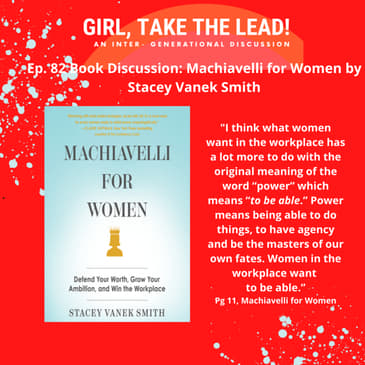
When you hear the name Machiavelli, what do you think? Historical figure? His work “The Prince” which offered pragmatic and often controversial advice to rules on how to gain and maintain power? Maybe an Amoral Realist who believed the end justifies the means and that rules should be ready to employ deceit and cruelty to achieve their goals? And if someone uses the adjective “Machiavellian” it’s done so to describe cunning and manipulative behavior? Maybe not a good thing, right?
I know I thought some of those things myself but after reading Stacey Vanek Smith’s book Machiavelli for Women I learned a lot more about Machiavelli and came to appreciate the lessons he can offer all of us about leadership and power. And our hope after listening to this podcast, you will too!
So I ask you to suspend any prior beliefs you may have about Machiavelli and let’s open yourself ourselves up to hearing about this man’s writing done during the Renaissance period and their application to us today as proposed by the author!
3 Episode Takeaways
1. No, you’re not crazy. The no-win situation is real but we can navigate all kinds of ways and Machiavelli offers us insights into doing just that.
2. The Cinderella Syndrome and the Hotbox can be a disadvantage but by being aware of them can open up new possibilities by changing the story.
3. Facing the bias monster will mean embracing the hardship and struggle.
Mentioned in the Episode:
Machiavelli For Women by Stacey Vanek Smith
Ep 72, Andrea Mein DeWitt talks about masculine/feminine traits
Ways to reach Yo: eMail
Public FB group: Girl, Take the Lead!
https://www.facebook.com/groups/272025931481748/?ref=share
Linktr.ee/yocanny
IG:
https://www.instagram.com/yocanny
LinkedIn:
00:00:09
Welcome to episode 86. A Girl Take the Lead for Each
00:00:12
week we explore womanhood and leadership.
00:00:15
And I'm your host, yo Canny. So let me ask you, when you hear
00:00:20
the name Machiavelli, what do you think?
00:00:25
Maybe a historical figure. Maybe you've heard of his work
00:00:30
The Prince, which offered pragmatic and often
00:00:34
controversial advice to rules on how to gain and maintain power.
00:00:41
Maybe you see him as an amoral realist who believed the end
00:00:47
justified the means, and that rules should be ready to employ
00:00:52
deceit and cruelty to achieve their goals.
00:00:56
And if someone uses the adjective Machiavellian, it's
00:01:01
done so to describe cunning and manipulative behavior.
00:01:08
Maybe not a good thing, right? I know I thought some of these
00:01:12
things too myself. So when my local bookstore
00:01:16
recommended Stacey Vanek Smith's book Machiavelli for Women, I
00:01:21
went what? Stacey Vanek Smith is a long
00:01:25
time public radio reporter and host.
00:01:28
She currently cohost NPR The Indicator from Planet Money, a
00:01:33
daily podcast. She is also served as a
00:01:37
correspondent for NPR's Planet Money and Marketplace.
00:01:41
So she's no slouch when it comes to research, and this book is
00:01:46
full of it. After reading Stacy's book, I
00:01:49
learned a lot more about Machiavelli and came to
00:01:53
appreciate the lessons he can offer all of us about leadership
00:01:57
and power. And my hope after listening to
00:02:00
this podcast, you will too. So I ask you to suspend any
00:02:05
prior beliefs you may have about Machiavelli, and let's open
00:02:10
ourselves to hearing about this man's writing done during the
00:02:15
Renaissance period and their application to us today as
00:02:20
proposed by the author. I hope you'll enjoy the listen.
00:02:24
Here you go. Stacy presents the issue facing
00:02:32
women today. Early in the book she says that
00:02:35
while women are making real and substantial progress, hard won
00:02:40
by generations of pioneering women, things are still a bit
00:02:44
distressing. 80% of CE O's are men and within the Fortune 500
00:02:51
more than 90%. Corporate boards are more than
00:02:55
80%. Male women make about $0.80 for
00:03:00
every male dollar. 2/3 of federal judges are male. 75% of
00:03:07
elected representatives are men. Women start 40% of the
00:03:13
businesses in the country, but 98% of venture capital goes to
00:03:19
men. And she asks, why would this be?
00:03:25
She states that popular explanations include women shy
00:03:28
away from leadership positions. Women want more flexibility with
00:03:33
their time, so they avoid the most demanding jobs.
00:03:37
Women are more nurturing and collaborative.
00:03:40
In other words, they lack the killer instinct you need in a
00:03:45
leader or decision maker. And she states all of these
00:03:49
explanations have seeds of truth in them.
00:03:52
But she believes the real reason for the frustratingly slow
00:03:57
progress of women in the workplace is something
00:04:00
Machiavelli summed up quite well about 500 years ago.
00:04:05
And here's the quote. Let it be noted that there is no
00:04:11
more delicate matter to take in hand, nor more dangerous to
00:04:15
conduct, nor more doubtful in its success, than to set up as a
00:04:22
leader in the introduction of changes.
00:04:26
For he who initiates will have for his enemies all those who
00:04:31
were well off under the existing order of things, and only
00:04:37
lukewarm supporters in those who might be better off under the
00:04:41
new okay. So what did that quote mean, and
00:04:47
what does it mean in today's English?
00:04:50
Stacy says Changing the system is really hard, and you will
00:04:54
probably fail. The old guard will freak out
00:04:57
because they have so much to lose, and the people who would
00:05:02
benefit from the change will waffle because they're scared
00:05:06
and skeptical of how much they would really benefit even if
00:05:13
they did manage to pull off this crazy hat trick.
00:05:16
So for me personally, as I reflected on this, I wondered at
00:05:20
my own career ambition and why didn't I go for being a CEO?
00:05:25
I had friends who did, but why didn't I?
00:05:29
I did become a Senior Vice President of Global Marketing
00:05:32
and then again a Senior VP of Marketing and Sales.
00:05:36
And being completely honest with you though, I think it was
00:05:40
because I was fearful. I didn't think I was smart
00:05:44
enough to break through the boys clubs.
00:05:47
I could remember interviewing once with PepsiCo for a Pepsi
00:05:51
brand management position and being asked in my interview what
00:05:56
competitive sports I played like.
00:06:00
None. I didn't get the job.
00:06:03
No surprise there, right? But I did learn something about
00:06:07
the game I was ill equipped to play.
00:06:11
I wasn't competitive enough. Or could it have been something
00:06:16
like I didn't know how to present myself in a competitive
00:06:21
way? Interesting.
00:06:25
And as I progressed in my career, I saw what CEO's did and
00:06:29
thought, gosh, how did they learn about partnerships,
00:06:33
mergers, investments in finance? And did I want to learn them?
00:06:39
By the time I could have gone in that direction, I started my
00:06:42
family and frankly, being a CEO didn't sound very interesting
00:06:47
and I could see the cost. And honestly, I was passionate
00:06:52
about marketing and that became my lane.
00:06:56
I thought I could handle that and balance my family.
00:07:00
So I did hit the glass ceiling, didn't shatter it, but did get a
00:07:05
little close to it and had a place at the table.
00:07:10
So I guess I would say to you that just because there's a
00:07:14
shortage of women representation at these senior levels, go for
00:07:19
them if that's what you want and works for you, but it's okay if
00:07:24
you don't. I started this podcast so we
00:07:28
could all find our voices, breakthrough things that held us
00:07:33
back, and become aware of ourselves.
00:07:36
Someone else's success could be someone else's misery.
00:07:42
So build your own version. What is success to you?
00:07:46
Not everyone needs to be a CEO on a corporate board, be an
00:07:51
elected official or federal judge.
00:07:55
You just do you, No matter what. Our path, the principles and
00:08:00
lessons Stacey Vanek Smith offers us in her book might be
00:08:04
helpful to all of us along our journey.
00:08:08
I pulled just a few of the many gems for you.
00:08:11
The first is something she calls the Power Principle, and she
00:08:15
says this quote. Power doesn't exactly have the
00:08:20
best reputation. Say the word, and it conjures up
00:08:24
images of men and expensive suits behind giant desks.
00:08:29
End Quote. And she goes on to offer an
00:08:32
alternative way to think about it, since most of us do have
00:08:36
negative beliefs around power and the misuse of it.
00:08:40
She says this, which is a more empowering way to look at power.
00:08:45
Quote I think what women want in the workplace has a lot more to
00:08:50
do with the original meaning of the word power, which means to
00:08:55
be able. Power means being able to do
00:09:00
things, to have agency and be the masters of our own fates.
00:09:06
Women in the workplace want to be able End Quote, So what is
00:09:13
standing between us and power? Stacy asks.
00:09:16
And I love when she wrote this. Leaders are by definition high
00:09:21
status. So when women are in leadership
00:09:25
position, it often does not sit well with people, and it all
00:09:33
comes down to stories, which can be formidable because they are
00:09:37
woven into our identities. We use stories to make sense of
00:09:43
things, and letting go of them can make the world seem
00:09:46
frightening and chaotic. But the good news is we can
00:09:50
change the stories throughout the book.
00:09:54
Stacy includes lots of research. One example is Joan C Williams,
00:10:00
who is a gender researcher and coauthor who is quoted to have
00:10:05
said women can totally crush it at work so long as they're about
00:10:11
twice as politically savvy as men.
00:10:15
And Stacy adds to this, and I couldn't agree more that that's
00:10:20
a lot of savvy. On top of a day job and a family
00:10:24
and gas bills and getting in your 10 steps, I think we
00:10:28
can all relay, no? Oh yeah, Stacy goes on to ask us
00:10:32
to face the monster, a story that is big and insidious and
00:10:37
ugly and entrenched and powerful and destructive and annoyingly
00:10:41
hard to kill. So what could this monster be
00:10:44
and how do we slay it? She starts this with an
00:10:47
explanation of the Cinderella syndrome.
00:10:50
We all know how the story goes. The stepmom tells Cinderella she
00:10:53
can't go to the ball, only after she cleans the entryway.
00:10:57
Mop the floors, Polish the silver, iron the napkins and the
00:11:00
list goes on and on. Stacy says the stepmother is
00:11:04
holding out the illusion of possibility to Cinderella, and
00:11:07
Cinderella believes her. She states that women in the
00:11:10
workplace get put in this position too all the time.
00:11:14
Whereas men are typically promoted based on what they
00:11:16
perceive their potential to be, women are typically promoted
00:11:20
based on actual work they've done, usually again and again
00:11:24
and again. This slows women down
00:11:26
substantially in early and mid career.
00:11:29
Women are told they can get that promotion or raise if they just
00:11:33
do this one more thing. Meanwhile, Randy and Jerry
00:11:37
saunter on into the ball without having so much as washed a dish.
00:11:44
I thought that was really great, how she put that together, Stacy
00:11:48
says. The perceived notions about what
00:11:51
makes a good leader include qualities like being aggressive,
00:11:54
assertive, logical, self confident, ambitious, visionary,
00:11:59
brave, and demanding, and that these are 100% masculine traits.
00:12:06
Now, she says that qualities people associate with an ideal
00:12:09
woman are someone who is affectionate, helpful,
00:12:13
sympathetic, sensitive, gentle, soft spoken, modest, and puts
00:12:18
others 1st. And if a woman displays the
00:12:22
masculine traits, others feel very uncomfortable because it
00:12:25
goes against their stories or biases about what they think
00:12:30
leadership is. And there's something else, you
00:12:32
guys. She calls it the hot box and it
00:12:36
often happens to women in mid career when they start getting
00:12:41
close to leadership positions or positions of power.
00:12:44
It's being caught between two seats of expectations, feminine
00:12:48
or leader. And it's a no win situation.
00:12:52
And why people are likely to think of women as difficult,
00:12:56
abrasive, and hard to get along with when leading.
00:12:59
Or someone kind, generous, modest, advocate for others,
00:13:03
smiling and supported behind the scenes, chronically underpaid
00:13:08
and loaded down with work. Oh, in our episodes with Andrea
00:13:12
Main DeWitt, we've come to see that we can mix our traits, and
00:13:16
all of us are a combination of masculine and feminine traits,
00:13:21
I'd add understanding that might help us navigate better.
00:13:26
And what does Machiavelli have to say about this?
00:13:29
He says the Prince cannot avoid giving offense to his new
00:13:33
subjects, and however, it is essential that in entering a new
00:13:38
province, you should have the goodwill of its inhabitants.
00:13:43
Stacy offers us this translation.
00:13:46
To win your new Kingdom, you have to do things that makes the
00:13:50
locals hate you. To keep your new Kingdom, you
00:13:54
need to get the logos to like you.
00:13:58
To me that says mixing up our masculine and feminine traits
00:14:03
and it can be your secret weapon you guys going into battle.
00:14:07
Also throughout the book Stacy offers Machiavelli's lessons.
00:14:12
The 1st is embrace the struggle. Your hardships are setting you
00:14:17
up for success, not only to get what you want, but to keep it,
00:14:24
Machiavelli wrote. Princess become great by
00:14:28
vanishing difficulties and opposition.
00:14:32
But before we all go Game of Thrones on this, which is where
00:14:36
I went, let's take them all out, Stacy says.
00:14:40
There's a Zen moment in The Prince where Machiavelli felt so
00:14:43
strongly about the value of hardship, where he said
00:14:46
something along the line of things happen for me, not to me.
00:14:54
And the quote goes like this fortune Machiavelli wrote,
00:14:59
especially when she desires to make a new Prince great causes
00:15:04
enemies to arise and form designs against him in order
00:15:08
that he may have the opportunity of overcoming them.
00:15:12
His conclusion? Great leaders become great
00:15:16
because of hardship and struggle.
00:15:19
As we reflect on Machiavelli's conclusion, I'd like to weigh in
00:15:23
and say yes. Overcoming hardships can make us
00:15:27
more resilient, more empathetic and courageous, all great
00:15:32
characteristics we'd love to have in our leaders.
00:15:36
But it can go the other way too, and lead us to burn out, feel
00:15:40
helpless, and a victim. Let's all do what we can to take
00:15:45
a different path, a path that is right for us and works for us
00:15:50
and doesn't burn us out. Stacy's hope with this book is
00:15:55
that we all use these difficult circumstances to create a new
00:16:00
kind of workplace. A workplace where everyone can
00:16:03
experience the joys, challenges, rewards, and growth that come
00:16:09
from doing the work you love. A workplace where everyone can
00:16:13
grow into their very best personal and professional
00:16:18
selves. A workplace where everyone can
00:16:22
be able, and on that note, will end today's episode.
00:16:28
Thank you for being here. Thank you for listening today
00:16:33
and wish your hope you enjoyed this episode.
00:16:36
If you did, please leave us a comment wherever you listen to
00:16:40
your podcasts or join our public Facebook group Girl Take the
00:16:44
Lead. And I'd like to welcome our
00:16:46
newest members to the Facebook group Teresa and Rebecca.
00:16:50
Thank you for joining us. You can also visit our website
00:16:54
girltaketheleadpod.com and we have a YouTube channel where
00:16:58
your subscription would be appreciated.
00:17:00
Once you're on YouTube, search a girl, take the lead.
00:17:05
So the three takeaways from this episode were one.
00:17:09
No, you're not crazy. The Know when situation is real,
00:17:13
but we can navigate all kinds of ways, and Machiavelli offers us
00:17:17
insights into doing just that. 2.
00:17:21
The Cinderella Syndrome and the Hot Box can be a disadvantage,
00:17:26
but by being aware of them, we can open up new possibilities
00:17:29
for changing the story. And three, facing the Bias
00:17:34
monster will mean embracing our hardships and struggles.
00:17:40
This episode, believe it or not, only covered chapter one, so I'm
00:17:45
planning to do a sound bite on Thursday about some more gems
00:17:49
from the book. I hope that you'll join us again
00:17:52
to hear a bit more about Machiavelli for women.
00:17:55
Thank you Stacey Vanek Smith for such a great book.
00:17:57
Plus, we have lots of exciting guests lined up for August,
00:18:00
including Nori Java, author of Keeping Your Seat at the Table,
00:18:04
a return visit by Andrea Canny to talk about her insights about
00:18:10
ageism. Courtney Lee, Founder, OYT
00:18:13
Cosmetics, Bessie Graham, Awardwinning Entrepreneur and
00:18:18
Maria Maruchian, an expert in diversity, equality and
00:18:22
inclusion. Stay tuned to listen to these
00:18:25
amazing women leaders and what they have to say about
00:18:28
leadership. Thanks for being here.
00:18:31
Talk to you soon. Bye.