
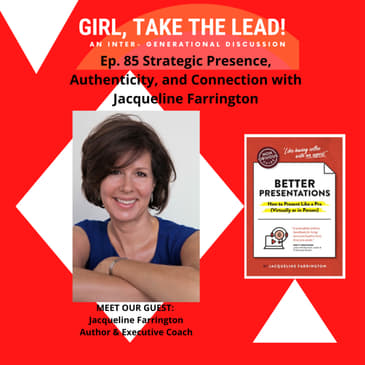
Jacqueline Farrington joins Yo to discuss Strategic Presence, Authenticity, and Connection based on her new book: The Non-Obvious Guide to Better Presentations: How to Present Like a Pro (Virtually or in Person).
There are so many gems that Jacqueline offers us about tuning into our audiences and connecting with what they want. Here’s one of her quotes: “Communication is all about intent. We need to ask ourselves: What is my intention to help support my audience? How do I want them to feel?”
Here are the 3 Takeaways:
1. Strategic Presence is about adapting to how you show up in the room – we need to be flexible and agile.
2. Finding your voice is about getting into the arena and it can be uncomfortable but there are ways to prepare for that.
3. Listening and curiosity gets the attention off ourselves and questions are a low risk way to contributing to a meeting.
We hope you’ll enjoy this episode!
As mentioned in the episode:
Jacqueline’s book, The Non-Obvious Guide to Better Presentations
More about Jacqueline:
Jacqueline Farrington has over 20 years’ experience as a change maker, empowering leaders and their teams to spark transformation and innovation through communications. Known for her direct yet supportive and science-backed approach, Jacqueline works with senior and board-level leaders at multinationals such as Amazon and Microsoft. She blends her experience in the performing arts, vocal pedagogy, communications, psychology, and organizational and executive coaching to help her clients find unique communication solutions. Jacqueline’s new book, The Non-Obvious Guide to Better Presentations: How to Present Like a Pro (Virtually or in Person), provides actionable, practical concepts, tips, and tools to improve any speech or presentation.
Ways you can contact Jacqueline:
Email:
Website:
https://farringtonpartners.com/
Twitter: @farringtonic
Ways to reach Yo:
Public FB group: Girl, Take the Lead!
https://www.facebook.com/groups/272025931481748/?ref=share
IG:
https://www.instagram.com/yocanny
LinkedIn:
00:00:07
Welcome to episode 85 of Girl Take the Lead for Each week we
00:00:11
explore womanhood and leadership.
00:00:13
And I'm your host, Yo Canny. Today we are joined by our guest
00:00:18
Jacqueline Farrington to discuss strategic presence, authenticity
00:00:22
and connection based on her new book The Non Obvious Guy, to
00:00:27
better presentations or how to present Like a Pro Virtually or
00:00:32
in person. You may remember our very first
00:00:36
episode about voice titled Wait I Can Sound Wimpy.
00:00:42
This conversation with Jacqueline takes that episode a
00:00:45
bit further. We had a lot of fun discussing
00:00:48
some very important communication issues.
00:00:51
I really liked when we talked about treating a phone like a
00:00:54
teleprompter and how to connect with audiences when doing so.
00:00:59
Plus, she's given some thought to working with a bully in a
00:01:03
meeting trying to shut you down. Here's a bit about Jacqueline's
00:01:07
background. She has over 20 years experience
00:01:11
as a change maker, empowering leaders and their teams to spark
00:01:16
transformation and innovation through communications.
00:01:21
Known for her direct yet supportive and science backed
00:01:24
approach, Jacqueline works with senior and board level leaders
00:01:28
at multinationals such as Amazon and Microsoft.
00:01:33
She blends her experience in the performing arts, communications,
00:01:37
psychology and organizational and executive coaching to help
00:01:42
her clients find unique communication solutions, and
00:01:46
she's offered us some in this episode.
00:01:49
We hope you'll enjoy the listen. Here you go, Jacqueline.
00:01:56
Welcome to Girl Take The Lead. We are so darn excited to have
00:01:59
you with us. And I can't wait to talk to you
00:02:02
about voice and leadership and strategic presence.
00:02:08
Oh, it's going to be a juicy one.
00:02:09
So thank you for being here. Thank you so much for having me.
00:02:13
It's great to be here. Yeah.
00:02:15
So why don't we start with you just introducing yourself to the
00:02:19
listeners so that they know a little bit about your
00:02:21
background? Sure, I'm a coach and
00:02:24
consultant. Who works at the intersection of
00:02:27
leadership, communications, change.
00:02:30
And what that means is that I I support leaders in delivering
00:02:36
transformative change so that that has a deep impact on on
00:02:40
their teams and their organizations and and the world.
00:02:45
That sounds great and I think a lot of your your background too
00:02:49
has been about helping people present better and have a
00:02:54
stronger presence. Is that right?
00:02:56
Yes, because the when I say the intersection of communications,
00:03:00
leadership and change, you really you can't be a good
00:03:03
leader if you're not a good communicator and you leaders are
00:03:06
so often asked to deliver change.
00:03:09
But you can't deliver change unless you can communicate that
00:03:13
and communicate it in a way that helps people feel motivated to
00:03:19
adopt the change. Yeah, now you do have your book,
00:03:23
and we'll have a link to that in the show notes.
00:03:27
And why don't you tell our listeners a little bit about
00:03:29
your book? Cuz I know it helps.
00:03:30
As you said, coach others and work with your clients.
00:03:35
Well, the book I it's funny, it's a little surprising with
00:03:38
the book I I started to write it for kind of a banal reason,
00:03:42
which was it was the pandemic and everyone was scrambling to
00:03:46
translate from in person communications to virtual.
00:03:52
And so I started to write it and then realized it was a a great
00:03:56
tool and guide for my executive coaching clients.
00:04:01
As they think about communications, it's called the
00:04:04
Non Obvious Guide to Better Presentations.
00:04:07
But I think you'll find as you read through it that it it just
00:04:11
has a ton of tips in it for communicating in general that
00:04:15
that you could use in it in a team meeting or even one-on-one
00:04:18
community. And and I love the title, The
00:04:21
Non Obvious Guide. That means that there's a lot of
00:04:25
hidden gems in there and things that we can pull from it.
00:04:29
I imagine. Is that is that kind of what you
00:04:31
were thinking when you named it? So the non obvious guides are
00:04:36
it's a series of of books and the the gentleman who started
00:04:41
them he was a bit frustrated with with the How to books out
00:04:45
on the market. He felt like the Harvard
00:04:48
Business Review books were a little too cerebral, and he felt
00:04:52
like the Dummies series. Condescended to their audiences.
00:04:57
They were too dumb and he wanted something in between.
00:05:02
And so he markets them as a something that is written for
00:05:07
intelligent people who already have some knowledge of of the
00:05:11
topic, but they also appreciate slightly irreverent approach and
00:05:17
irreverent humor and yeah, so, So that's the, the frame of the
00:05:22
book. Yeah, that seems like, well, it
00:05:26
should all be fun and entertaining to to grab
00:05:28
attention. And I think that's terrific that
00:05:31
you kind of went down that path. And we started our episode
00:05:34
talking a little bit about strategic presence.
00:05:37
And I'd love to hear your thoughts about what that is and
00:05:40
how leaders can use that. Yeah, I think of strategic
00:05:45
presence as adapting how you show up in the room, changing
00:05:49
your presence in the room in order to help that audience hear
00:05:54
your message. So always start with the
00:05:57
question, who is my audience and what message do I need them to
00:06:01
hear? And in order for this particular
00:06:04
audience to hear this particular message, how do I need to show
00:06:08
up in the room? And so it sounds a little bit
00:06:11
like authenticity plays a role, being able to adapt to the
00:06:17
situation, like having flexibility.
00:06:21
It isn't like I I think sometimes we can get stuck in
00:06:25
our own style. Like I'm supposed to be this
00:06:29
particular kind of leader. So I'm not going to change it.
00:06:33
But it sounds like you're really saying that we need to be
00:06:37
flexible. Yeah, especially in in this
00:06:40
world where we have so much changing, rapid change, volatile
00:06:45
change, We've got to be flexible and and agile in our approach.
00:06:52
That's a great word. And you know, one of the things
00:06:57
that we've worked a lot with on our podcast, and one of the key
00:07:00
reasons I did this podcast was to help other women find their
00:07:04
voice. And I wonder if you have
00:07:09
anything to say about that in, in helping all of us, you know,
00:07:16
deliver. It's just like we get caught up
00:07:18
in the emotion of what am I going to say, how am I going to
00:07:22
say it, am I going to be accepted, all of that?
00:07:24
What are things that you can help us with when it comes to
00:07:27
that? Finding your voice means getting
00:07:30
into the arena, and getting into the arena is not comfortable
00:07:35
because you're in it, you're in the arena.
00:07:39
And the way that you can successfully engage in the arena
00:07:43
is to give yourself opportunities to to slowly put
00:07:47
put your toe in first, then then put maybe half of your foot,
00:07:51
then then your full foot in there.
00:07:54
I also think it's important to prepare for being in the arena
00:07:58
before you get in there. So for example, thinking about
00:08:03
how do I? If I if I think that the arena
00:08:07
is going to be high challenge high stakes kind of scary how do
00:08:11
I prepare for that in in advance.
00:08:13
And one of the ways you can do that is to simulate that stress
00:08:18
before you go in to simulate maybe even failure.
00:08:22
Putting yourself into a situation where you you might
00:08:24
fail. I I had this client once.
00:08:27
Who she decided she She was terrified of public speaking,
00:08:31
and she decided one of the way she was going to overcome this
00:08:35
is that every time she ordered coffee at Starbucks, she was
00:08:38
going to give some weird name to to the what?
00:08:43
What's the barista? The barista thank you to the
00:08:47
barista and literally worked her way through the Bible with names
00:08:51
that even pronounce. And at first it was really scary
00:08:57
to her to do that. She was an off the charts
00:08:59
introvert, really scary. But then she started having fun
00:09:04
doing it, and that's just a low risk way of putting your big toe
00:09:09
in the water. Yeah.
00:09:11
Well, I can see how anticipating an important meeting or
00:09:17
something that you've been invited to and trying to think
00:09:21
of what are aspects that are important to you about that
00:09:25
meeting and what's important to the leadership in that meeting
00:09:30
and helping the goals get keep moving ahead, like being able to
00:09:36
provide insights that maybe nobody else can see in the
00:09:41
moment, right. And being able to talk about
00:09:44
them. I also think it's a good idea to
00:09:47
go last in the room because it allows you to have heard
00:09:53
everyone else is concerned, so that's a good idea.
00:09:56
I'm a bit of a research nerd and there's research on that, that
00:10:00
if you're nervous, go first or go as close to the beginning as
00:10:07
possible, because otherwise you'll sit there and feel, yeah.
00:10:13
That said, what I think what you're what you've landed on is
00:10:17
this idea of listening and curiosity.
00:10:23
Which gets our attention off of ourselves.
00:10:26
I often see younger leaders when when they're in a meeting and
00:10:29
they're thinking, I've got to speak up, I've got to find my
00:10:32
voice and I've got to speak up. And I need to add something
00:10:35
that's really insightful, that adds value.
00:10:38
Well, where is their attention when they're thinking that it's
00:10:41
all on themselves and they become hyper critical of what
00:10:47
they're doing, how they're coming across, whereas if they
00:10:50
if they switch that frame. And they think about how do I
00:10:56
listen to what's going on to the room, How am I curious about
00:11:00
what I'm hearing? And then to your point, what's a
00:11:04
question that I can ask. So you think about starting
00:11:07
small questions are a small way of contributing our voices to
00:11:12
meetings that are a little lower risk.
00:11:15
And in fact, what I what I tell my younger clients is think
00:11:20
about asking. A question about the mundane or
00:11:25
the obvious. And I'm thinking it probably
00:11:47
gives your voice a chance to, you know, sometimes when those
00:11:54
nerves are in your throat and your voice sounds like you're
00:11:58
about to cry in like a second, you know, just because you're
00:12:01
not used to it. Can you say a little bit about
00:11:28
where you got those numbers? Then once you get the answer,
00:11:33
you can drill down into the answer.
00:11:35
And that's possibly going to start getting you out of
00:11:39
thinking about yourself, but also thinking about asking more
00:11:44
astute questions. And I I see this in in younger
00:12:05
leaders as well. You know that it's it's not
00:12:09
comfortable, it's all the nerves are there.
00:12:12
But I think by beginning with a little something and then you
00:12:17
know, like a question or you know where did you know, how can
00:12:22
we support that, what it, you know, what would be good for the
00:12:26
team to to deliver If this is the issue we're addressing, that
00:12:30
might be a good way just to get the air, the breath back into
00:12:36
your body, right? Yes, getting your attention off
00:12:41
of yourself, onto other people, onto the content, onto the room
00:12:46
around you, and also one of my favorite.
00:12:50
Tools to use is is called affect labeling or also known as name
00:12:54
it to tame it. And that's where all all you do
00:12:58
is name how you're feeling. I'm feeling nervous, I'm feeling
00:13:02
frightened, I'm feeling intimidated, I'm feeling angry,
00:13:06
frustrated, whatever the emotion is, but naming it.
00:13:10
And we know that when we name it, you can do it silently to
00:13:13
yourself. It activates the brain's control
00:13:16
systems, the impulse control part of the of the brain.
00:13:20
Which it's counterintuitive, but it dampens the emotion.
00:13:24
Which doesn't seem like it would if we would say, oh, I'm feeling
00:13:27
angry, I'm feeling frustrated, but it dampens the emotion and
00:13:31
then allows us to speak from a a calmer place or to make
00:13:36
decisions from better focus and greater calm.
00:13:40
Oh, that makes a lot of sense. One topic that we've addressed
00:13:45
quite a bit, because I know that a lot of my listeners have to
00:13:48
deal with this one, is like bullies in the room.
00:13:53
And then also like almost having a surprise attack, like somebody
00:13:59
says something that they know will put you on the defense.
00:14:07
And I know we are in charge of our own emotions and our
00:14:11
decision to react defensively or listen however we listen is is
00:14:16
something. But there are people in meetings
00:14:20
who kind of play this role of I've got the power you don't and
00:14:27
how we deal with that. You know, I've, I've called it a
00:14:31
surprise attack. What we do in those moments to
00:14:35
find our voice and to stand our ground.
00:14:39
I I don't know, Jacqueline, if there's an answer we can give
00:14:42
our our listeners, but I know that a lot of them have that
00:14:45
issue, how to deal with these difficult situations.
00:14:50
Yeah, it's tough you're you're in the arena and it's tough that
00:14:55
people can throw surprise punches, life can throw surprise
00:15:00
punches. And again, I think we prepare
00:15:03
for being in in the arena before we ever go in there.
00:15:07
If you look at a tool like Name its Tainment that that can
00:15:11
really help you in those surprise punch moments.
00:15:15
To because it helps you calm down and it helps you think more
00:15:17
rationally rather than the emotion hijacking our brains.
00:15:22
So even if that boom, if if a bully comes at you or a horrible
00:15:26
comment comes at you being able to 1st, just say okay I'm I'm
00:15:31
feeling woo knocked off my center there.
00:15:35
It doesn't have to be specific. It's interesting.
00:15:37
Often we think when when we are knocked off our center, we're
00:15:41
we're nervous, afraid or angry that we should take a breath.
00:15:45
You'll you'll hear that. Just take a deep breath.
00:15:48
But in fact if we can think about letting go of some breath,
00:15:53
blowing out some breath, that triggers the body's need for
00:15:59
breath. Because the next thing that the
00:16:01
body then knows is. You just blew out on my breath,
00:16:07
right? The breath is part of the
00:16:09
autonomic nervous system. It knows how to to breathe.
00:16:12
Our bodies know how to breathe without us trying to do it.
00:16:14
So blow out a little breath. It will kick in that autonomic
00:16:18
nervous system and will remember to breathe, which in turn sends
00:16:22
a message to your brain. I'm not in a threat state here.
00:16:27
I'm not. So it's okay.
00:16:28
I can manage this. I can deal with this.
00:16:30
And then? We can think about, well, how do
00:16:35
I want to deal with this in the moment?
00:16:36
Do I want to deal with it in the moment?
00:16:38
Or do I want to take a step back and maybe follow up with the
00:16:41
person afterwards when I'm a little calmer and give them some
00:16:45
feedback? How do I want to deal with this?
00:16:47
Yeah, I like the idea of practicing as well because I
00:16:53
know one listener I have who I've spoken with and has
00:16:58
somebody who's at the same level as she is.
00:17:03
They're both executives and and leadership positions.
00:17:08
And he's often taking her ideas and promoting them as his and
00:17:15
not hers. And so we've talked about
00:17:18
different strategies. You know, have other women in
00:17:20
the room speak up and oh, that sounded just like what this
00:17:24
person said. How is that different?
00:17:26
But the idea of practicing and knowing that this person is
00:17:29
probably going to do that again. Are there some scripts that you
00:17:33
can come up with right? You know, to establish your own
00:17:37
presence? Maybe.
00:17:40
Yeah, and practice before going into the meeting.
00:17:44
Like what might? We will never anticipate what
00:17:47
will happen Now in, in this person's case, she probably can.
00:17:50
And yeah, and so I think it's what she's doing.
00:17:54
What I hear she's doing is is coming up with a strategy for
00:17:57
how she wants to address that, which is.
00:18:01
Great, It gives her. I'm hearing that she's using
00:18:04
some allies. She's thinking about what she
00:18:07
wants to say in the room. We can't always do that.
00:18:11
One of the another tool I like to use is called implementation
00:18:15
intentions. And implementation intentions
00:18:19
sound like this. When X happens then I will do Y
00:18:26
when my manager says. Reappropriates my idea and
00:18:32
starts to just feed back to me my idea.
00:18:36
Then I'm going to turn and look at my my ally and she's going to
00:18:39
speak up and say, hey, that was Jacqueline's idea.
00:18:43
Or when my manager takes my idea, then I'm going to blow out
00:18:47
some breath and calmly say yes, I mentioned that 10 minutes ago.
00:18:54
Whatever the strategy is now, what we know about
00:18:57
implementation intentions is that it primes the brain to deal
00:19:01
with curveballs. So again, we, we can't ever
00:19:04
anticipate everything that's going to happen, but because
00:19:08
we've done some scenario planning and implementations are
00:19:11
just another way of thinking about scenario planning because
00:19:14
we've done some scenario planning.
00:19:17
We can then better manage that one unexpected thing that we
00:19:21
never thought would happen. We can better manage it when it
00:19:25
when it happens. That's really great.
00:19:29
I think that could help some of my listeners.
00:19:34
You talk in your book about tips to connect, scan, switch and
00:19:39
speak. I think how, how does that work?
00:19:44
We can definitely, especially for our Gen.
00:19:47
Zers and how they are, you know, such a different kind of
00:19:53
generation that is definitely becoming young, that are
00:19:57
becoming young leaders. Well, Scan, Scan switch and
00:20:02
speak is a tool that I use with my speakers when they're on
00:20:05
stage and they have to work with a teleprompter and.
00:20:09
Why that eats into connection is is because a lot of times when
00:20:14
people are early days working with a teleprompter, they speak
00:20:17
to the teleprompter and their eyes are down on the
00:20:20
teleprompters. So.
00:20:21
So what I say to them is start to get used to this idea of
00:20:25
scanning the teleprompter, reading ahead for where you need
00:20:29
to go, then switching your eye contact, getting your eye
00:20:32
contact out to the audience, and then speaking so that your eye
00:20:35
contact and your speaking is out to the audience, not down at the
00:20:39
floor, which is normally where teleprompters are.
00:20:41
They tend to be down at the bottom of the stage.
00:20:45
But it speaks to this broader idea of of connection and the
00:20:51
the there are loads of of tools around how to connect with
00:20:55
others, how to connect with your audience.
00:20:57
What I'd say is always start small.
00:21:00
Think about those baby steps. Starting small.
00:21:03
And the way that you start small with connection is thinking
00:21:06
first about your audience. What's meaningful to my
00:21:10
audience? If I know their communication
00:21:12
preferences, how can I adapt my presence and be more strategic
00:21:17
in my presence to meet them halfway in their their
00:21:20
communication preferences? And that's just a very easy
00:21:25
beginning way to start to think about connecting with others.
00:21:28
Well, I, you know, I'm, I think I might have mentioned to you
00:21:31
that I'm an adjunct lecturer at San Jose State University.
00:21:35
And so many of the students, when they get up to present,
00:21:41
they're on their phones and they're reading from their
00:21:45
phones. And I thought, OK, well, the
00:21:49
next class, I'm just going to be really hard on them and take the
00:21:52
phones away and stuff. But I think you're giving me
00:21:54
some thought. Maybe I coach him a little bit
00:21:57
about. Connecting.
00:21:59
Even if they're using their phone for their presentation
00:22:04
instead of reading, making sure that they they scan and then
00:22:09
they are able to really connect because that their audience or
00:22:14
other students and they're all going to be on their phones too
00:22:16
or their their tablets, you know, because that's just like
00:22:20
it. They are digital natives and and
00:22:24
you see, you see younger folks sitting on park benches having
00:22:30
conversations with each other like this.
00:22:33
Yes, yes. And so I'm curious too though
00:22:37
about intent, because communication is all about
00:22:41
intent, clarity of intent. And how are they trying to make
00:22:46
their audience feel as as they're speaking?
00:22:48
What is their intention? Yeah, well, I think it's they.
00:22:56
I I looked at it as I remember my first class and they got up
00:23:01
to present and I went, oh boy do they need help in this area
00:23:09
because they are used to being with their device, they are used
00:23:13
to looking down and they're not used to connecting.
00:23:17
So I think there's. Rather than I I'm always at the
00:23:21
philosophy. Rather than change what they're
00:23:24
doing to be something that is so awkward to them, maybe there's a
00:23:29
way to incorporate what they're doing and help them make the
00:23:35
connection. Yeah, yeah.
00:23:38
Because if you think about the intent there, holding my phone,
00:23:42
speaking to my phone, my intent is I I think I'd be curious to
00:23:46
know what their intent is. But the assumption I make is
00:23:49
that their intent is to not screw up.
00:23:52
Right. Do it right.
00:23:53
Their intent is I'm fearful I need to do this right.
00:23:56
I don't want to screw up and and so if they can use something
00:24:00
like scan switch, speak, they still have that crutch there
00:24:04
initially to help support them in taking some risks.
00:24:10
But then they start to use a tool to learn to get the eye
00:24:14
contact up and then think about how am I trying to make my
00:24:18
audience feel. Yeah, yeah, that was great.
00:24:23
Well, I think we could keep going all afternoon, but is
00:24:29
there anything we didn't cover that you would like to cover for
00:24:34
our audience because they're, I think they're so committed to
00:24:40
learning about how to be you know have that presence of
00:24:44
leadership and. And be with their audience, We,
00:24:52
we didn't really talk about this idea of strategic presence and
00:24:55
authenticity. And I think strategic presence
00:24:59
helps you be more authentic. You hit on it a little bit when
00:25:03
you said sometimes leaders feel like I have to be one kind of
00:25:07
leader and that's it. And yes, we often get those
00:25:11
messages. That idea of executive presence
00:25:14
is frequently set by the the dominant culture of the people
00:25:18
who are the leaders at the top. And it's not a very restrictive,
00:25:22
limited way of thinking about presence.
00:25:25
Whereas this idea of strategic presence is more authentic
00:25:30
because none of us are only one thing.
00:25:34
We go through our day and we are many different people,
00:25:38
identities, roles. I I wouldn't dream of talking to
00:25:43
you the way I talk to my dog. I would not dream of it.
00:25:47
Yeah, I adjust my presence based on who my audience is.
00:25:53
And I think probably there must have been somewhere along the
00:25:59
line that some assessment was made that if you change
00:26:06
yourself. To your audience, you're being
00:26:09
inauthentic, right? And what you're proposing and
00:26:13
challenging us to look at is the exact opposite, yes.
00:26:19
And to draw on our values, the different identities that we own
00:26:24
in in life. And asking ourselves, what part
00:26:27
of myself do I need to amplify in this situation in order to be
00:26:32
a more successful communicator? I was.
00:26:34
Thinking about my dad. And we were on a vacation as a
00:26:41
family. My dad is first generation
00:26:43
Mexican, born here in the States.
00:26:46
We were up in Canada and he had driven like, I don't know, all
00:26:51
day or whatever to get to this town and we go in.
00:26:54
He and I went in to get a hotel room and the man said we don't
00:26:59
give rooms to Mexicans here. And my dad turned and said, oh.
00:27:07
We all have our idiosyncrasies. And walked out and I was behind
00:27:12
him and I'll never forget it because of course he responded
00:27:19
in a way that was just amazing. And the guy probably had to go
00:27:24
look the word up in the dictionary.
00:27:29
But I think, I think what you're getting at is, you know, you
00:27:34
adapt. To whatever is needed in the
00:27:37
moment, right? Absolutely.
00:27:41
And this world, this current world, requires us to do that.
00:27:48
Yeah, not be just one thing right?
00:27:53
And it in fact it's more authentic, but because this idea
00:27:56
that there's one person in our brain controlling everything,
00:28:00
our brains aren't, aren't hardwired that way.
00:28:02
Our brains are hardwired to help us perform multiple functions,
00:28:10
multiple functions, and each of those functions has a different
00:28:14
sense of self. So that's all we're doing is
00:28:17
embracing our whole selves, our our our unique thinking style,
00:28:23
our unique decision making style, but also understanding
00:28:28
that maybe we need to flex those styles sometimes and expand and
00:28:33
our repertoire. Yeah, I know some people right
00:28:37
off the top of my head who I know will like that very much.
00:28:39
So great. Is there anything else we you
00:28:43
know well, Jacqueline, what a great conversation.
00:28:47
I am so glad that you joined us and thank you so much for being
00:28:51
here. Thank you Yolanda for having.
00:28:54
OK, everyone, talk to you soon. Bye.
00:29:01
Thank you for listening today and we sure hope you enjoyed
00:29:03
this episode. And if you did, please leave a
00:29:05
comment wherever you listen to your podcasts.
00:29:08
Join our public Facebook group, Girl Take the Lead, or visit our
00:29:12
website girltaketheleadpod.com. We also have a YouTube channel
00:29:17
where your subscription would be appreciated.
00:29:20
Once you're on YouTube, search at Girl take the lead.
00:29:25
So the three takeaways from this episode were one.
00:29:28
Strategic presence is about adapting to how you show up in
00:29:32
the room. We need to be flexible and
00:29:35
agile. 2 Finding your voice is about getting into the arena,
00:29:41
and it can be uncomfortable, but there are ways to prepare for
00:29:45
that. Three, listening and curiosity
00:29:49
gets the attention off ourselves and questions are a low risk way
00:29:55
to contributing to a meeting. We have lots of exciting guests
00:29:59
lined up for August, including Nori Java, author of Keeping
00:30:03
Your Seat at the Table, Courtney Lee, founder OYT Cosmetics,
00:30:09
Bessie Graham, awardwinning entrepreneur and Maria More UK
00:30:14
and an expert in diversity, equality and inclusion.
00:30:19
We hope you'll join us for these episodes and listen to these
00:30:22
amazing women leaders. Thanks for being here.
00:30:26
Talk to you soon. Bye.