
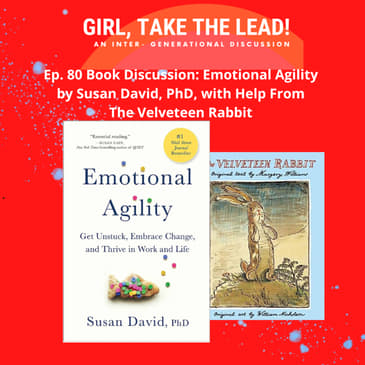
In this episode Yo digs into the book Emotional Agility by Susan David, PhD, to explore the science-based approach to navigate life’s twists and turns. It’s about getting unstuck, embrace change, and thrive in work and life. She states that how we deal with our thoughts, feelings, and self-talk ultimately determine how successful we’ll be.
David has a special chapter on Becoming Real and she works in the book, The Velveteen Rabbit by Marjorie Williams. Yo discovered this book in college and treasures her own copy. You’ll hear a bit more from the book than what David offered because it’s so close to her heart.
Enjoy the listen.
Here are the episode take-aways:
1. Emotional agility is the absence of pretense and performance which gives our actions greater power because they come from our own core values (not someone elses).
2. It takes courage to appoint ourselves as our agent for our own life – it involves embracing a new identify and releasing narratives that no longer serve us.
3. We reach that level of being REAL, that level of emotional agility, not through magic, but through a series of steps in everyday moments over the course of a lifetime.
As mentioned in the episode:
Emotional Agility by Susan David, PhD.
The Velveteen Rabbit by Marjorie Williams
Susan Cain, Bittersweet, Episodes: 23, 24
Daniel Goleman, Emotional Intelligence, Episode: 76, 77
Susan David Newsletter & Website
Ways to reach Yo:
Public FB group: Girl, Take the Lead!
https://www.facebook.com/groups/272025931481748/?ref=share
Linktr.ee/yocanny
IG:
https://www.instagram.com/yocanny
LinkedIn:
https://www.linkedin.com/in/yocanny/
00:00:09
Welcome to episode 80 of Girl Take the Lead for each week we
00:00:12
explore womanhood and leadership.
00:00:15
And I'm your host yo Canny. When Susan Kane, author of
00:00:19
Bittersweet and Quiet, which we featured in episodes 23 through
00:00:24
25 and 35 through 37, says that the book.
00:00:30
Emotional Agility, Get Unstuck, Embrace Change and Thrive and
00:00:33
Work Life by Susan David, PhD is, quote, essential reading.
00:00:41
I knew I needed to check it out. And when Daniel Goldman, author
00:00:45
of Emotional Intelligence, featured in our episodes 76 and
00:00:49
77, says quote, helpful to anyone, that's all I needed.
00:00:54
I'm ready. Let's go.
00:00:57
Susan David is a psychologist on the faculty of Harvard Medical
00:01:01
School, cofounder and Co director of the Institute of
00:01:05
Coaching at McLean Hospital, CEO of Evidence Based Psychology, a
00:01:10
boutique business consultancy. She's worked with senior
00:01:14
leadership in hundreds of major organizations, including the
00:01:17
United Nations, and published in Harvard Business Review Time.
00:01:22
Fast Company and Wall Street Journal.
00:01:24
I'll have in the show notes where you can sign up for her
00:01:27
free newsletter and learn more about her.
00:01:31
Remember to listen to the very end.
00:01:32
It's where I capture the three takeaways and what's coming up
00:01:36
next. Enjoy the listen.
00:01:38
I really enjoyed this book. Let's start by looking at how
00:01:48
Susan David defines emotional agility.
00:01:51
She first looks at the emotional part of emotional agility, which
00:01:56
is about becoming more aware of our emotions, learning to accept
00:02:01
them and make peace with them. The agility part addresses our
00:02:06
thinking and behavior as well those habits of mind and body
00:02:10
that can also prevent us from flourishing.
00:02:13
And she states that research shows that emotional rigidity,
00:02:17
which is getting hooked by thoughts, feelings, and
00:02:20
behaviors that don't service, is associated with a large range of
00:02:26
ills. Meanwhile, emotional agility is
00:02:30
about being flexible with our thoughts and feelings.
00:02:34
So that we can respond optimally to everyday situations and is
00:02:39
key to our well-being and success and allows us to be in
00:02:43
the moment, changing or maintaining our behaviors, to
00:02:48
live in a way that's aligned with our intentions and values.
00:02:54
Yay, we like that. It's all about loosening up,
00:02:59
calming down. And living with more intention.
00:03:02
And as she says, between stimulus and response, there is
00:03:07
space. In that space, it's our power to
00:03:12
choose a response. In our response lies our growth
00:03:17
and our freedom by opening up that space between how we feel
00:03:24
and what we do with those feelings emotional agility has.
00:03:30
Been shown to help people with any number of troubles.
00:03:34
I especially loved when she said.
00:03:36
Quote Meanwhile, our consumer culture promotes the idea that
00:03:42
we can control and fix most of the things bothering us, and
00:03:48
that we should toss or replace the things we can't unhappy in a
00:03:53
relationship. Find another not productive
00:03:57
enough? There's an app for that.
00:03:59
When we don't like what's going on in our inner world, we apply
00:04:04
the same mindset. We go shopping.
00:04:08
We go get a new therapist or result to fix our one
00:04:13
unhappiness and dissatisfaction and simply think positive.
00:04:20
End Quote. For me, if I had emotions I
00:04:24
didn't like, like sadness or shame, I'd eat something sweet.
00:04:29
And if I was in overwhelmed or angry, I'd eat something deep
00:04:33
fried. I know, Go figure it was how I
00:04:38
kept going, though, trying to make everyone happy.
00:04:42
I think I'm not supposed to have these emotions.
00:04:47
Why can't I think more positively?
00:04:49
David says that trying to impose happy thoughts is extremely
00:04:53
difficult, if not impossible. Because few people can turn off
00:04:58
negative thoughts and replace them with more pleasant ones.
00:05:01
And there's something interesting, she offers an
00:05:04
essential truth. Our so-called negative emotions
00:05:08
are often actually working in our favor.
00:05:12
And in fact, negativity is normal, a fundamental fact that
00:05:18
we're wired to feel negative at times.
00:05:21
It's simply part of the human condition.
00:05:26
Whoa, so good to know. David unfolds emotional agility
00:05:31
in four essential movements, 1 showing up, two stepping out,
00:05:40
three walking our why, and four moving on.
00:05:46
So let's look at #1 showing up, I was reminded while reading
00:05:51
this section of the book. The episode we did with Andrea
00:05:56
Main DeWitt, I name, claim and reframe, which was episode 48.
00:06:02
Because David also says that decades of research shows that
00:06:05
our life satisfaction in the face of inevitable worries,
00:06:10
regrets, and sad experience depends not so much on how many
00:06:15
of these things we experience or even their intensity, but on the
00:06:22
way we deal with them. When we show up fully with
00:06:26
awareness and acceptance, even the worst demons usually back
00:06:31
down. Simply by facing up to the scary
00:06:35
things and giving them a name, we often strip them of their
00:06:40
power. We end the tug of war by
00:06:43
dropping the rope. Isn't that a great image?
00:06:47
I loved it. She also offers us this.
00:06:53
When we show up to these emotions compassionately with
00:06:58
curiosity and with acceptance, no failures, regrets, or bad
00:07:04
hairstyles turned away. So this is where self compassion
00:07:09
works. In recognizing we had to play,
00:07:13
the hand we were dealt is often the first step toward showing
00:07:18
yourself more warmth, kindness, and forgiveness.
00:07:23
We all did the best we could and it couldn't have been any
00:07:27
different. Another thing she said here
00:07:29
about compassion was that compassion gives us the freedom
00:07:33
to redefine ourselves as well as the all important freedom to
00:07:39
fail which contains within it the freedom to take the risks
00:07:45
that allow us to be truly creative.
00:07:49
And who wouldn't love that? Let's look at #2.
00:07:54
Stepping out the next step in gaining agility she provides.
00:08:00
A way to do this is through writing, which can improve
00:08:04
physical and mental wellbeing, she says.
00:08:08
In the process of writing, we are able to create the distance
00:08:12
between the thinker and the thought, the feeler and the
00:08:17
feeling. And that allows us to gain a new
00:08:21
perspective, get unhooked and move forward.
00:08:26
And I can see how that would be. I love getting something out of
00:08:31
my head, and on paper it allows me to be a new observer rather
00:08:37
than just spinning something in my head.
00:08:40
I can see things from a different perspective, which is
00:08:43
stepping out, creating a gap between the stimulus and
00:08:47
response. Plus, we recover a bit of our
00:08:51
humanity. It's this space that allows us
00:08:55
to be sensitive to the context, to shift our actions to what
00:09:00
will work in the here and now, rather than being driven by
00:09:04
mindless impulses. Oh boy, we should probably
00:09:11
highlight that one. I'm going to say it one more
00:09:15
time. It's this space.
00:09:19
That allows us to be sensitive to the context, to shift our
00:09:24
actions to what will work in the here and now, rather than being
00:09:29
driven by mindless impulses. Oh gosh, you're speaking to the
00:09:34
choir about mindless impulses. I can jump to something so
00:09:38
quickly and take something on and really writing, breathing,
00:09:44
doing a little meditation. Definitely is needed.
00:09:48
So she offers 6 techniques for stepping out.
00:09:52
One, think process. So if you have absolute states
00:09:58
like I'm fat, it draws us into old stories and they're just
00:10:04
stories, not our destiny. Two get contradictory like
00:10:11
loving and loathing our bodies at the same time.
00:10:15
This improves our tolerance for uncertainty 3.
00:10:20
Have a laugh. Often I find myself so funny
00:10:24
trying to get different results by doing the same thing over and
00:10:27
over. I can hear myself saying, oh
00:10:31
Yolanda, how about you are are you the funniest person
00:10:36
sometimes in the room 4. Change our point of view or our
00:10:42
perspective 5. Call out the thought and emotion
00:10:48
for what it is. Anytime you get hooked, an
00:10:52
emotion, as my husband Steve will say, they pass six.
00:11:01
Talk to yourself in the third person, like LeBron James, who's
00:11:05
excellent at this when he went to the Miami Heat from the
00:11:10
Cleveland Cavaliers, he said. Quote One thing I didn't want to
00:11:15
do was make an emotional decision.
00:11:18
I wanted to do what's best for LeBron James and to do what
00:11:23
makes LeBron James happy. I'm cool with that, LeBron, Good
00:11:27
for you. Now the big #3 walking your Y.
00:11:33
And that's WHY. Which she says is the art of
00:11:38
living by your own personal set of values.
00:11:43
The beliefs and behaviors that we hold dear and that give us
00:11:48
meaning and satisfaction, identifying and acting on the
00:11:53
values that truly are ours, not those imposed on us by others.
00:12:00
Not what we think we should care about, but what we genuinely do
00:12:06
care about is the crucial next step of fostering emotional
00:12:11
agility. So my thought here is that this
00:12:14
is not always easy to do and involves a lot of detangling and
00:12:20
a lot of writing and asking ourselves.
00:12:25
So where did that come from? Are those people even living?
00:12:30
Here's what she says. I see values not as rules that
00:12:36
are supposed to govern us, but as qualities of purposeful
00:12:41
action. That we can bring to many
00:12:44
aspects of life. Values aren't universal.
00:12:49
What's right for one person may well not be right for someone
00:12:53
else. But identifying what matters to
00:12:57
us, whether that's a career success, creativity, closer
00:13:02
relationships, honesty, altruism, there is an almost
00:13:08
infinite list to choose from. And these give us a priceless
00:13:14
source of continuity. Values serve as a psychological
00:13:19
keel to keep us steady. Ooh, and listen to this, she
00:13:25
says, when we make choices based on what we know to be true for
00:13:30
ourselves, rather than being led by others telling us what is
00:13:35
right or wrong, important or cool.
00:13:39
We have the power to face almost any circumstance in a
00:13:44
constructive way. Rather than being caught up in
00:13:48
pretending or social comparison, we can stride forward with
00:13:53
confidence. Oh yeah, she goes on to say.
00:13:57
Determining what we truly care about is only half the process
00:14:03
of walking your why we need to take courageous action.
00:14:09
And she says there's bound to be complex.
00:14:12
An example she gives is creating work life balance.
00:14:17
It can be a constant tug between working and spending time with
00:14:21
our families. So here's some examples.
00:14:26
If we say I value being a loving parent, I will bring that love
00:14:33
to my interactions with my kids. And I value being a productive
00:14:39
worker. I will bring that productivity
00:14:43
to my desk every day. That is very different, she says
00:14:48
from saying I value being a loving parent, so I will leave
00:14:54
the office at 5:00 every day regardless.
00:14:58
This brings an expansion of what is possible in our life because
00:15:03
we haven't separated the two. I think that makes a lot of
00:15:07
sense. Now for #4, the last essential
00:15:10
movement, which is moving on. Here she talks about tweaking
00:15:16
our motivations by engaging our autonomy, The power of wanting
00:15:21
to do something rather than having to Like I need to lose
00:15:27
£10 rather than I want to lose £10.
00:15:33
Want two goals? Reflects A person's genuine
00:15:37
interest and values. There why they call forward our
00:15:44
personal enjoyment. You can imagine what have two
00:15:48
goals call forward and if you can't call forward a want to,
00:15:56
then they could be a sign that we need to change something.
00:16:02
I thought this was pretty important.
00:16:04
She says a mind that is open to growth and change is a hub from
00:16:10
which values and goals can be brought to life and realized.
00:16:15
There is tremendous empowerment in appointing ourselves the
00:16:20
agent of our life, in taking ownership of our own
00:16:25
development, career, creative spirit, work and connections.
00:16:31
And she adds this. Emotional agility is about
00:16:36
getting on with life. It involves moving toward
00:16:42
clarity, challenging yet achievable goals that you pursue
00:16:49
not because you think you have to or because you've been told
00:16:53
to, but because you want to because they're important to
00:16:57
you, I think in her book. And outlining the four essential
00:17:04
aspects of emotional agility. Susan David is teaching us to be
00:17:09
real. So I'd like to share with you an
00:17:13
excerpt from the book, because I love this book.
00:17:19
I really love it, and it means a lot for me to share it with you.
00:17:24
So I hope you'll like it. Here it goes.
00:17:27
When the story opens, the rabbit is having a hard time fitting in
00:17:30
with his owner's other toys. The little boy to who the rabbit
00:17:36
belongs lost interest in him shortly after receiving him and
00:17:41
the other toys. Many of them have modern
00:17:44
mechanical parts that make them seem and act real, intimidate
00:17:48
the rabbit. After all, he is made of cloth
00:17:53
and sawdust. And hardly looks like a real
00:17:56
Bunny at all. The rabbit eventually finds a
00:18:01
friend in the wise old Skin Horse who has lived in the
00:18:06
nursery for longer than any of the other toys.
00:18:11
What is real? The rabbit asked the Skin Horse
00:18:15
one day. Does it mean having things that
00:18:18
buzz inside you and a stick out handle?
00:18:22
Real isn't how you are made, says the Skin Horse.
00:18:27
It's a thing that happens to you when a child loves you for a
00:18:31
long, long time, not just to play with, but really loves you.
00:18:38
Then you become real. Does it hurt?
00:18:42
The rabbit asks sometimes, said the Skin Horse, for he was
00:18:48
always truthful when you are real.
00:18:52
You don't mind being hurt. Does it happen all at once, like
00:18:57
being wound up? He asked.
00:19:00
Or bit by bit, It doesn't happen all at once, said the Skin
00:19:05
Horse. You become, it takes a long
00:19:09
time. That's why it doesn't happen
00:19:12
often to people who break easily or have sharp edges, or who have
00:19:18
to be carefully kept. Generally, by the time you are
00:19:23
real, most of your hair has been loved off and your eyes drop out
00:19:30
and you get loose in the joints and very shabby.
00:19:35
But these things don't matter at all because once you are real,
00:19:39
you can't be ugly except to people who don't understand the
00:19:46
skin. Horse goes on to tell his story
00:19:48
about the boy's uncle. Making him real a great many
00:19:51
years ago. And the rabbit side, he thought
00:19:57
it would be a long time before this magic called real happened
00:20:02
to him. He longed to become real, to
00:20:07
know what it felt like. And yet the idea of growing
00:20:11
shabby and losing his eyes and whiskers was rather sad.
00:20:17
He wished that he could become it.
00:20:20
Without these uncomfortable things happening to him one
00:20:24
night, the little boy can't find his favorite China dog to sleep
00:20:28
with, so his nanny grabs the velveteen rabbit out of the toy
00:20:32
cupboard and tucks him in with the master.
00:20:36
After that, the boy becomes inseparably attached to the
00:20:40
rabbit, hugging him tightly in bed, covering the rabbit's pink
00:20:45
nose with kisses and taking him everywhere.
00:20:49
The boy even brings him to play in the garden, and once
00:20:53
accidentally leaves him outside all night.
00:20:56
Through it all, the rabbit becomes increasingly grimy and
00:21:01
threadbare. Eventually the pink begins to
00:21:05
rub off his nose. At one point the nanny tries to
00:21:10
take the now filthy toy away, but the boy protests that the
00:21:14
rabbit has to stay, insisting that he's real.
00:21:18
Which is, of course, music to the rabbit's satiny but now
00:21:23
shopworn ears. Eventually, the velveteen Rabbit
00:21:27
meets the nursery fairy who asks him Little Rabbit, Don't you
00:21:33
know who I am? I am the nursery magic fairy,
00:21:38
she said. I take care of all the
00:21:41
playthings that the children have loved.
00:21:45
When they are old and worn out and the children don't need them
00:21:48
anymore, then I come and take them away with me and turn them
00:21:54
into real. Wasn't I real before?
00:21:58
Asked the little rabbit. You were real to the boy, the
00:22:03
fairy said, Because he loved you.
00:22:07
Now you shall be real to everyone and on that note.
00:22:15
Will end today's episode. Thank you for listening.
00:22:36
Thank you for listening today, and we sure hope you enjoyed
00:22:38
this episode. And if you did, please leave a
00:22:41
comment wherever you listen to your podcasts.
00:22:44
Join our public Facebook group Girl Take the Lead or visit our
00:22:47
website, girltaketheleadpod.com. We also have a YouTube channel
00:22:52
where your subscription would be appreciated.
00:22:55
Once you're on YouTube, search at Girl.
00:22:57
Take the lead. Here are the three takeaways
00:23:01
from the episode. One emotional agility is the
00:23:05
absence of pretense and performance.
00:23:08
Which gives our actions greater power because they come from our
00:23:13
own core values, not someone else's. 2 It takes courage to
00:23:19
appoint ourselves as our agent for our own life.
00:23:25
It involves embracing a new identity and releasing
00:23:28
narratives that no longer serve us Three.
00:23:33
We reach that level of being real, like the Valvatine Rabbit.
00:23:39
That level of emotional agility, not through magic, but through a
00:23:44
series of steps in everyday moments over the course of a
00:23:48
lifetime. By the way, I thought you'd like
00:23:51
to know a few facts about the book.
00:23:53
The Velveteen Rabbit. Marjorie Williams, the author,
00:23:57
was an English American author born on July 22nd, 1881 in
00:24:03
London, England. And is best known for The
00:24:06
Velveteen Rabbit, which she published in 1922, and she
00:24:12
continued to write throughout her life, exploring all kinds of
00:24:16
genres and themes. And she passed away on September
00:24:20
4th, 1944 in New York City at the age of 63.
00:24:26
Her legacy lives on through The Velveteen Rabbit, which has
00:24:31
remained A cherished classic. In children's literature for
00:24:36
over a century. Gosh, and it's still one I love
00:24:39
very much. Susan David has so many more
00:24:43
amazing things to say about emotional agility, and one theme
00:24:48
is emotional agility at work that I'll cover as a sound bite.
00:24:54
Stay tuned where to come on that.
00:24:57
I'm also looking forward to sharing Melody Wilding's book.
00:25:01
Trust yourself. Stop over thinking and channel
00:25:04
your emotions for success at work.
00:25:07
Talk to you soon. Bye.