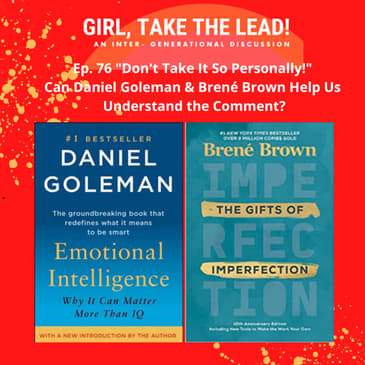
Yo was super intrigued about the comment she would receive: “Don’t Take It So Personally!” Her go-to response was defensiveness. Perhaps you can relate? She went to the experts when it comes to emotional intelligence and emotions: Daniel Goleman author of the book, Emotional Intelligence, and Brené Brown, author of the book, The Gifts of Imperfection. Perhaps with their help we can all handle comments like this or others like it?
Here are the 3 Takeaways:
Instead of immediately becoming defensive or reactive, when someone says “Don’t take it So Personally”, let’s take a moment to pause, take a breath, and reflect on the situation.
Play your Empathy Card: consider the intentions and context of the other once our emotions are managed. No matter what, understand that a comment or criticism does not define our entire identity or worth. As Mentioned In The Episode:
Daniel Goleman, Emotional Intelligence
Brené Brown, The
Gifts of Imperfection.
Episodes About Bullying:
Ways to reach Yo:
Public FB group: Girl, Take the Lead!
https://www.facebook.com/groups/272025931481748/?ref=share
IG:
https://www.instagram.com/yocanny
\
LinkedIn:
https://www.linkedin.com/in/yocanny/
00:00:06
Fucking fantastic leader. Each week we explore Womanhood
00:00:11
and Leadership and I'm your host.
00:00:13
Yo, Kenny, has anyone ever told you don't take it?
00:00:19
So personally, I have. And as I thought about it, I
00:00:26
wanted to understand more about that comment.
00:00:29
And the first thing I realized was that I was taking it rather
00:00:33
personally which was a very interesting Discovery when I
00:00:38
thought about the comment don't take it.
00:00:40
So personally, I saw it one way alert time to be defensive.
00:00:49
The person making the comment is trying to attack or belittle you
00:00:53
by telling you not to be so emotional.
00:00:59
How about you did you feel the same way when you heard it in
00:01:04
episode 72, I mentioned this concept of taking things
00:01:08
personally and Andrea main DeWitt.
00:01:10
Our guests had an interesting take on it, she said it had
00:01:15
something to do with emotional intelligence.
00:01:19
So let's start there. I dug into the book, emotional
00:01:23
intelligence. Why it can matter more than IQ
00:01:27
by Daniel goleman? He First wrote, the book in 1995
00:01:31
and then recently updated it in 2020.
00:01:35
He is considered the go-to guy because he is credited with
00:01:39
bringing the concept of emotional intelligence to the
00:01:42
mainstream. He did pioneering research by
00:01:45
drawing upon the works of psychologists who initially
00:01:48
introduced the concept of emotional intelligence in an
00:01:51
article in 1990 Gomen, expanded upon research that had been done
00:01:56
and synthesized it into a cohesive framework and he
00:02:00
integrated scientific findings from psychology neuroscience.
00:02:05
And other disciplines to support his arguments and provide
00:02:08
practical applications of emotional intelligence.
00:02:11
So his approach, I found very well grounded, I'll also
00:02:15
reference burn a Brown's book, the gifts of imperfection can't
00:02:20
do an episode about emotions without including her.
00:02:23
And just a reminder, I'll have all the links mentioned in the
00:02:26
episode in the show notes and the three takeaways Plus what's
00:02:30
coming next or always at the end of the recording this week where
00:02:35
Also announcing at the end of this episode a new product.
00:02:38
You might want to check out later this week so here you go.
00:02:42
Enjoy the listen. So Daniel goleman's book offers
00:02:49
us a three-level model for emotional intelligence.
00:02:53
Those three levels, our brain chemistry, domains that emerge
00:02:59
from, those circuits activities, and competencies that Depend on
00:03:05
each domain he explains it like this first.
00:03:10
There are the neural circuits at play.
00:03:12
Particularly the dynamic between the prefrontal cortex, which is
00:03:18
the brains Executive Center and the emotional circuitry,
00:03:23
especially the amygdala, which triggers are upsets.
00:03:27
On the one hand and gets us motivated on the other.
00:03:31
The self awareness and self management, domains of E.
00:03:35
I depend on this brain activity. Then separately, there are a
00:03:40
suite of circuits in the forebrain that serve social
00:03:44
functions like empathy and Attunement.
00:03:47
That result from four domains self-awareness self-management
00:03:53
social awareness and relationship management.
00:03:57
And competencies like empathy and social skills largely emerge
00:04:02
from activities of these social brain circuits.
00:04:06
He states, there are 12 Chi Mei competencies that depend on one
00:04:12
or another of these domains. So between the domains and the
00:04:18
competencies, I think we'll get some understanding of the
00:04:21
phrase. Don't take it.
00:04:22
So personally 0 because we are all hardwired with brains that
00:04:28
are emotional. Our emotions have been shaped by
00:04:33
the course of evolution for over a million years.
00:04:35
As Goldman says, quote, for Better, or For Worse, our
00:04:41
appraisal of, every personal encounter, and our response to
00:04:46
Do it, our shape not just by our rational judgments or our
00:04:51
personal history but also by our distant ancestors passed each
00:04:58
emotion. We have prepares the body for a
00:05:01
different kind of response and quote.
00:05:04
He also States, the emotional areas are intertwined connecting
00:05:09
circuits to all parts of the neocortex, which is the thinking
00:05:13
part of the brain. This gives the emotional centers
00:05:17
immense power to influence the functioning of the rest of the
00:05:20
brain including its centers for thought.
00:05:24
And that's where we can see emotional, hijacking, remember
00:05:29
Will Smith at the Academy Awards while we don't know exactly what
00:05:32
happened for him. One could say, he certainly took
00:05:36
the comments, very personally, and his actions were an example
00:05:40
of emotional, hijacking. And those moments a center.
00:05:44
In the limbic, brain proclaimed, an emergency recruiting the rest
00:05:49
of the brain to it's urgent agenda.
00:05:52
The hijacking occurs in an instant triggering this response
00:05:57
before the neocortex. The thinking brand again, as had
00:06:01
a chance to Glimpse fully what is happening.
00:06:05
Let alone decide if it's a good idea.
00:06:08
The Hallmark of such a hijack is that once the moment passes,
00:06:13
Those possessed have the sense of not knowing what came over
00:06:17
them. Perhaps Will Smith experienced
00:06:20
some emotionally-charged memories that had the power to
00:06:23
trigger this crisis response, which could have been outdated
00:06:27
as a way to respond. Goldman says, quote one reason
00:06:33
we can be so baffled by our emotional outbursts, then is
00:06:38
that they can often date from a time early in our lives.
00:06:41
When things were bewildering and we did not yet have the words
00:06:45
for comprehending events. We may have the chaotic feelings
00:06:51
but not the words for the memories that formed them and
00:06:55
quote. So our brains can be very fast
00:06:58
and sloppy. Because in a sense, we have two
00:07:01
brains and two minds, the two different kinds of intelligence
00:07:07
rational and emotional. And how we do life is determined
00:07:11
by both. And Goldman says that to do
00:07:15
well, in our lives means, we must first understand more
00:07:19
exactly what it means to use emotion intelligently.
00:07:26
So, here's some good news for those of us who wear our
00:07:29
emotions on our sleeves, much evidence.
00:07:33
Testifies, that people who are emotionally Adept, who know, and
00:07:37
manage their own feelings and to read and deal, effectively,
00:07:42
Other people's feelings are at an advantage in any domain of
00:07:49
life, whether romance, and intimate relationships, or
00:07:52
picking up the unspoken rules, that govern success in
00:07:56
organizational politics. People with well-developed
00:08:00
emotional skills are also more likely to be content and
00:08:04
effective in their lives. Mastering the habits of mind and
00:08:09
fostering their own productivity.
00:08:12
People who cannot Marshal some control over their emotional
00:08:16
life by Tanner battles. That sabotage, their ability for
00:08:21
focused work and clear thought. The book shares that in recent
00:08:26
years, a growing number of psychologists have come to agree
00:08:30
with Goldman that IQ Concepts revolving around a narrow band
00:08:36
of linguistic and math skills are outdated. and they are
00:08:41
taking a wider view of intelligence that leads back to
00:08:45
an appreciation of just how crucial personal or emotional
00:08:51
intelligence is Here's a bit more about the domains he
00:08:57
outlines. The first one is self-awareness
00:09:01
which is knowing one's emotions recognized a feeling as it
00:09:06
happens. And it's the Keystone of
00:09:09
emotional intelligence people with greater certainty about
00:09:14
their feelings are better Pilots of Their Lives.
00:09:18
Having a surer sense of how they really feel about emotional
00:09:22
decisions from who to marry or what job to take, brene Brown.
00:09:29
In in her book, the gifts of imperfection offers us this.
00:09:33
Sometimes our intuition or our gut tells us what we need to
00:09:38
know other times. It actually steers us toward
00:09:42
fact-finding and reasoning. As it turns out intuition may be
00:09:48
the quiet Voice Within, but that boys is not limited to one
00:09:53
message. sometimes our intuition Whispers, follow your instincts,
00:09:59
Or other times it shouts. You need to check this out.
00:10:04
We don't have enough information.
00:10:08
She also says, quote, in my research, I have found that what
00:10:13
silences are intuitive voice is our need, for certainty.
00:10:19
Most of us are not very good at not.
00:10:22
Knowing we like, sure things and guarantees so much that we don't
00:10:28
pay attention to the outcomes of our brains matching process.
00:10:34
For example, rather than respecting a strong internal
00:10:38
Instinct, we become fearful and look for assurances from others.
00:10:44
Like what do you think? Should I do it?
00:10:48
Do you think it's a good idea or you think I'll regret it?
00:10:53
What do you do? We start polling people because
00:10:57
we don't trust our own knowing that's and quote.
00:11:02
And here are some of the other domains from Goldman number to
00:11:08
managing emotions, handling feelings.
00:11:12
So they are appropriate in an ability that builds on
00:11:16
self-awareness. These may include the capacity
00:11:20
to soothe oneself to share, off-ramp it, anxiety, Gloom, or
00:11:25
irritability. When someone tells you not to
00:11:29
take something, personally, it might be an invitation to
00:11:33
regulate our own emotions and avoid reacting, impulsively, or
00:11:37
defensively. It could encourage us to
00:11:41
consider the intention behind the comment or situation and to
00:11:46
respond with greater emotional, resilience and self-control.
00:11:52
Over three motivating oneself, which is marshalling emotions.
00:11:57
In the service of a goal is essential for paying attention
00:12:01
and for creativity, emotional self control, delaying
00:12:06
gratification and stifling impulsiveness, underlies,
00:12:10
accomplishment of, every sort, and being able to get into the
00:12:15
Flow State and Mabel's outstanding performance of all
00:12:20
kinds. Number for, recognizing
00:12:24
emotions, in others. Empathy is a fundamental skill,
00:12:30
people who are more, empathetic are more attuned, to the subtle,
00:12:34
social signals that indicate what others need or want and
00:12:40
five handling relationships. He states that the art of
00:12:45
relationships is in large part, skill in managing emotions in
00:12:51
others. And he States, these are
00:12:54
abilities. That underpin popularity,
00:12:57
leadership and interpersonal. Effectiveness.
00:13:02
So I say, yay. Let's celebrate our emotions.
00:13:08
So the next time someone says don't take it so personally you
00:13:12
might say something like thank you for complimenting me on my
00:13:16
emotions. A highly developed part of my
00:13:19
brain that sometimes. Yes, overrides my thinking part,
00:13:24
I work at recognizing my emotions and your comment
00:13:27
brought up some fear on my part but I can manage that by seeing
00:13:32
it and being aware of how I feel.
00:13:36
I want to take in all you have to say, so let me have a moment
00:13:41
to breathe, so I can listen with an open heart and mind.
00:13:47
I wish I had known that script that I could have said many
00:13:52
times in my life by taking a moment to breathe we can become
00:13:58
more self-aware, allowing us to step back and objectively assess
00:14:02
what the situation truly warrants.
00:14:05
And if it warrants a personal reaction or if it is influenced
00:14:10
by other factors. So what could be those other
00:14:15
factors Perhaps, it's not about us, but about the other person's
00:14:21
mood, personal issues miscommunication, or differing
00:14:25
opinions, perhaps the other person, lacks empathy, which can
00:14:30
happen when someone feels hurt offended or upset by something
00:14:36
someone else said or did. And they are making a personal
00:14:40
attack. They are intentionally insulting
00:14:44
or belittling you. Using your character or
00:14:48
undermining your abilities. It's natural to feel hurt and
00:14:53
take it personally. Such comments are intended to be
00:14:58
personal and it's reasonable to have an emotional response.
00:15:04
And that's where your script can maybe pop in.
00:15:08
Perhaps the person lacks genuine understanding of all the
00:15:11
circumstances that did involve you kind of like your side of
00:15:15
the story. Perhaps the comment is a form of
00:15:19
gaslighting, which someone seeks to make you their victim and you
00:15:24
question your own reality insanity.
00:15:29
We are blamed for the way. Another person feels rather than
00:15:33
owning their own feelings and emotions.
00:15:37
And if you think it's a repeated pattern as in, you are
00:15:42
constantly receiving negative feedback or criticism about a
00:15:45
specific aspect of your personality or worth tune, into
00:15:50
our episode 63 64 66, and 70 to about bullying.
00:15:57
So if it's a repeated pattern, I say that continuous criticism
00:16:02
can a road self-confidence create self-doubt and Trigger
00:16:06
personalization of the feedback. There are options, others,
00:16:11
offered in those episodes that might be helpful and burn a
00:16:16
brown offers this about self-doubt and supposed to quote
00:16:23
to overcome self-doubt, and supposed to, we have to start
00:16:28
owning the messages about fitting in perfectionism,
00:16:32
people-pleasing, improving ourselves.
00:16:35
And look at questions, like What makes us afraid and what's on
00:16:41
our supposed to do list who says that and why.
00:16:47
Is the person making the comment too close relationship when
00:16:52
comments or actions come from loved ones or individuals with
00:16:55
whom we have a deep. Emotional connection is common
00:16:59
to take things more personally. the opinions of those close to
00:17:04
us, can have a significant impact on our emotions and
00:17:07
self-perception And the topic could be sensitive.
00:17:12
The person wants to discuss. Comments about sensitive topics,
00:17:17
such as appearance insecurities past traumas or deeply held
00:17:21
beliefs can easily be taken. Personally, these subjects are
00:17:25
often tied to our sense of identity self-worth and can
00:17:29
evoke strong emotional reactions.
00:17:33
It's always good to take a moment to become aware of what's
00:17:36
happening when someone says don't take it personally.
00:17:41
Byron Katie judge-your-neighbor worksheet could be handy and
00:17:45
doing the turnaround, for yourself to see three other
00:17:47
situations when you've not taken something personally, and write
00:17:53
them down to remind yourself so you can manage those emotions.
00:17:58
It's also worth considering that sometimes people may mistakenly
00:18:02
take something personally, when it was not intended that way,
00:18:07
communication can be complex and misunderstandings can occur.
00:18:13
In such cases clarifying, the intention behind the comment or
00:18:19
seeking open dialogue. Can help alleviate the
00:18:22
personalization for me, gotta say, getting feedback, for
00:18:27
example was personal, it's about me.
00:18:33
So here's what I like to do, I like to buy myself some time to
00:18:38
breathe. And bright so I can identify my
00:18:41
feelings. Maybe do that
00:18:44
judge-your-neighbor worksheet. So I work through the fear under
00:18:48
the defensiveness. And when I'm in a good place, I
00:18:53
can seek to understand and actively listen with questions.
00:18:56
Like can you tell me more about what you just said?
00:19:01
How do you feel about this situation?
00:19:04
Can you clarify what you mean by that?
00:19:07
Can you give me an example? What is the best way to approach
00:19:12
this issue? How important is the issue to
00:19:16
you? It also helps me assess the
00:19:20
other person's motives and listened to my gut ultimately
00:19:25
understanding. When to take something
00:19:26
personally, requires self-awareness empathy, and the
00:19:30
ability to differentiate between constructive feedback or
00:19:34
disagreement and comments that genuinely attack our character
00:19:39
or worth It's essential to find a balance between considering
00:19:43
feedback for growth and resilience and not internalizing
00:19:48
everything as a personal reflection.
00:19:52
And brene brown offers us this. If you look at the research,
00:19:58
there are five of the most common elements of resilient
00:20:01
people. One, they are resourceful and
00:20:05
have good problem-solving skills.
00:20:07
To they are more likely to seek help three.
00:20:11
They hold the belief that they can do something that will help
00:20:15
them manage their feelings and to cope, and for they have
00:20:20
social support available to them.
00:20:23
Five, they are connected with others, such as family or
00:20:27
friends. Think this is a good place to
00:20:31
end our episode today. And I hope your netting out
00:20:35
where I am, which is son apologize for our emotions.
00:20:40
We have them And most of us probably use them very
00:20:44
intelligently and that serves us very well.
00:20:48
So let's embrace them and honor where they came from.
00:20:53
Love it. Thank you again for being here.
00:20:57
Bye, thank you for listening today and we sure hope you
00:21:05
enjoyed this episode. If you did, please leave a
00:21:08
comment wherever you listen to your podcast.
00:21:11
Join our public Facebook group, girl, take the lead or visit our
00:21:14
website girl, Take the Lead pod.com.
00:21:17
We also have a YouTube channel where your subscription would be
00:21:20
appreciated once you're on YouTube.
00:21:22
Search at girl, take the lead. And here are the three takeaways
00:21:26
from today's episode 1 instead of immediately becoming
00:21:30
defensive or reactive. Like I always did when someone
00:21:35
says don't take it. So personally let's take a
00:21:38
moment to pause, take a breath and reflect on the situation
00:21:42
rather than feeling the surprise attack or threat.
00:21:45
We can try to approach the comment with an open mind and a
00:21:48
willingness to understand the other person's perspective.
00:21:52
Let's buy time If we need to to play the empathy card, consider
00:21:59
the intentions and context of the other.
00:22:02
Once our emotions are managed, recognized that the comment or
00:22:05
criticism may not have been intended to Target us.
00:22:09
Personally consider the context in which it was made, and the
00:22:13
person's intentions. Sometimes, people Express their
00:22:16
opinions or concerns without intending to cause harm or
00:22:20
offend. But if Our gut says this is
00:22:25
clearly an attack. Let's look at different options
00:22:28
and strategies to address the attack and three no matter what
00:22:34
understand that a Commodore criticism does not define our
00:22:39
entire Identity or worth recognize that our value as a
00:22:42
person extends, Beyond any particular comment, or situation
00:22:47
and love ourselves. And all our emotions that we
00:22:50
have, let's encompass, Them integrate them and find our
00:22:55
peace with them. Thank you Melissa for helping me
00:22:58
find those magnificent words because his book was recently
00:23:01
updated Goldman offers us some key insights into AI crying and
00:23:08
group or team emotional intelligence.
00:23:12
And I'll cover those in sound bites, a new series from girl,
00:23:17
Take the Lead, which will launch later this week, sound bites
00:23:21
will be very short episodes like under five minutes related to
00:23:26
topics recovering and will still keep the longer format as well.
00:23:32
Sound bites might also be moments of inspiration.
00:23:35
We can all use at times, so stay tuned.
00:23:41
Next week will continue to dig into emotions by exploring.
00:23:45
The book emotional agility. Get unstuck Embrace change and
00:23:50
thrive in work and Life by Susan, David PhD.
00:23:55
One of the things she references in her book is the book, The
00:23:59
Velveteen Rabbit by margarine Williams, which is one of my
00:24:05
absolute all-time favorites, maybe you remember it to, to
00:24:10
remember, it goes, Thing. Like, what is real asked the
00:24:15
rabbit one day when they were lying side by side near the
00:24:19
nursery Fender before gnana came to tidy.
00:24:22
The room, does it mean having things that buzz inside you and
00:24:26
a stick out handle You'll need to listen in to hear what the
00:24:31
skin horses back to The Velveteen Rabbit.
00:24:36
Thanks for being here and talk to you soon.
00:24:39
Bye.