
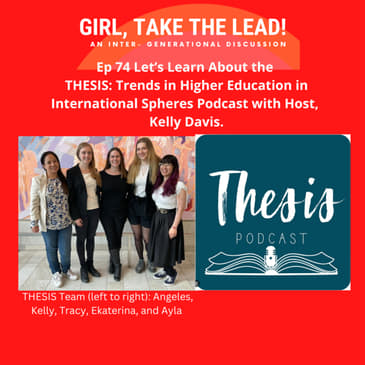
Kelly Davis joins Yo to discuss THESIS, an independent podcast, created by a group of international students who are currently in a Masters Program in Higher Education at the University of Oslo in Norway (the podcast is not affiliated with the University of Oslo). The theme for their first season, which just recently ended, was to discuss geo politics and the use of higher education as a form of soft power in autocratic regimes. Their second season which began June 7 and will focus on first generation students and higher education on a global level.
Kelly is also a special guest because she was in Girl Scout Troup 2136 which Yo led.
During the episode Kelly and Yo explored higher education trends and how it’s changing.
Here are the 3 Takeaways:
1. We can expect a drop in enrollment in the years to come due to a declining birthrate.
2. The reasons for not going to college cannot be easily defined and we can question if the motivation and role of higher education leads to more social mobility.
3. Our views on higher education are U.S. centric and outside the U.S. it’s a different story - if we think higher education has no value we should look outside the U.S.
We hope you’ll enjoy this inspiring episode!
As mentioned in the episode – Direct links to podcast:
Ways you contact the THESIS team:
Ekaterina Kurinskaia
Podcast Website: https://thesispodcast.com/
LinkedIn Page: https://www.linkedin.com/company/thesis-podcast-trends-in-higher-education-systems-international-spheres/
Twitter (@THESISpodcast): https://twitter.com/THESISpodcast
Ways to reach Yo:
Public FB group: Girl, Take the Lead!
https://www.facebook.com/groups/272025931481748/?ref=share
IG:
https://www.instagram.com/yocanny
LinkedIn:
00:00:06
Welcome to episode 74 of girl. Take the leader each week we
00:00:09
explore Womanhood and Leadership and I'm your host.
00:00:12
Yo Kenny Kelly Davis. Joins us today to discuss the
00:00:15
podcast thesis Trends in higher education in the international
00:00:20
spheres and I'm thrilled, she's here, these us' an independent
00:00:26
podcast created by a group of international students who are
00:00:30
currently in the master's program in higher education at
00:00:34
the University of Oslo. So in Norway, by the way, the
00:00:39
podcast is not affiliated with the University of özlem Kelly is
00:00:43
also a special guest because she was in my girl scout troop 21:36
00:00:49
and I love her and the work she's doing with her podcast.
00:00:53
I just had to share with you. In this episode, we'll explore
00:00:57
Trends in higher education topics, we will cover include
00:01:02
dropping enrollment changing reason.
00:01:06
About students going to college the impact.
00:01:09
Alternative ways of learning could have on higher education
00:01:13
and the importance of broadening.
00:01:15
Our view about education beyond the United States.
00:01:18
Enjoy the listen. Here you go.
00:01:22
Kelly Davis, I have so excited to have you today.
00:01:26
I am. I can feel my like body is
00:01:29
excited. I'm just so thrilled for my
00:01:31
listeners to hear from you. We go back.
00:01:35
Like I don't know how many years like how many years since we
00:01:39
were in Girl Scouts? Oh gosh.
00:01:43
I don't know. I know it's been sometimes.
00:01:47
I forget my age. So it's hard to pinpoint it when
00:01:51
I think about you guys turning twenty nine twenty, you know,
00:01:56
getting closer to 30 and hearing about the remarkable things
00:02:00
you're doing. I'm just so thrilled and honored
00:02:04
to hear and did Hopefully, pass along to our listeners, some of
00:02:08
the great things you're doing. So thank you for being here.
00:02:12
Well, thank you so much. Yo, I mean, I remember those
00:02:15
days, very, very fondly. And I remember when you came out
00:02:18
with this podcast, it was, I thought, yes, this is exactly
00:02:21
what you should be doing. You have always been so
00:02:23
supportive of not just your daughters, but all of the people
00:02:28
who all of the young women who have kind of fallen into that
00:02:31
Circle. So, I'm so excited to be here.
00:02:34
Thank you for inviting me too. And I'm excited for
00:02:37
conversation. Why don't you tell our listeners
00:02:39
what you're up to? And if you could introduce
00:02:41
yourself a little bit that I think that will provide some
00:02:43
foundation for our discussion? Yeah, absolutely.
00:02:47
So I mean I'm sure it's going to be said, but my name is Kelly
00:02:50
Davis. I am currently getting a
00:02:53
master's degree in higher education at the University of
00:02:56
Oslo. In Norway, when I say Masters in
00:02:59
higher education, people don't always know what that means and
00:03:02
so you can think of it as a masters in higher education
00:03:05
studies. I like to say that I study
00:03:07
higher education systems and your fellow students in are your
00:03:12
colleagues I guess I should say in your program got together and
00:03:16
put this podcast together. Yes.
00:03:19
So we started the program in August of 2021 and I think it
00:03:24
was a month and a half in where this idea kind of started to
00:03:28
form that we all got kind of busy because we had our first
00:03:32
exams and that was a bit stressful.
00:03:35
So we Circled back to the idea in March or April of 2022.
00:03:40
And that's when we really started to focus on it and so
00:03:44
there's five of us who are involved and I'll definitely say
00:03:48
their names here. My co-producer is our ala
00:03:51
Rubenstein Ekaterina kerensky Maria on the list.
00:03:54
They'll go and Tracy Waldman, so it's the five of us right now.
00:03:58
Open to growth, open to growth. So the podcast is called basis,
00:04:03
which is an acronym for Trends, in higher education.
00:04:06
Systems in international spheres.
00:04:08
And what we are doing is we're taking a global approach to
00:04:12
higher education. So we're trying to look at
00:04:14
different topics within higher education, kind of from
00:04:17
different angles around around the globe.
00:04:20
And when I say higher education, I actually mean post-secondary
00:04:23
education. So any education that occurs
00:04:26
after secondary school at this point in time?
00:04:29
We are, we have just really looked primarily at your typical
00:04:34
kind of universities. So bachelor's and Master's and
00:04:39
PhD awarding institutions, and the systems that kind of are
00:04:45
encircled around those types of Institutions.
00:04:48
But we are you know, we are just getting started.
00:04:52
We have so many different topics that we want to tackle.
00:04:55
That we it's totally possible that we'll be diving more into
00:04:58
say the vocational side of things or other elements of what
00:05:02
might be deemed post-secondary, education in the future.
00:05:06
Sure. So just to kind of give an
00:05:08
example of what it means. Our first season looked at
00:05:11
higher education, the role of higher education and foreign and
00:05:14
domestic politics. And through that season which
00:05:18
was eleven episodes we included somewhere between 10 and 12
00:05:22
different countries into the conversation which was just
00:05:26
really cool. It's very fun.
00:05:28
I love this. This is what I'm this is why I
00:05:30
do it and your passion started in high school or did was it
00:05:34
basically in In college because I know you worked at the Menlo
00:05:38
College for a while, right and stuff.
00:05:41
How did how did you find your lane to go in like about this?
00:05:46
It's that's a longer story but I in when I was getting my
00:05:51
Bachelor's, you know, there were kind of signs poking at me that
00:05:55
maybe this was something I should focus in.
00:05:57
I actually got a Bachelor's in European studies.
00:06:01
The I took a class when I was studying abroad in Berlin, that
00:06:04
was about Theology of globalization of higher
00:06:07
education or something like that.
00:06:09
And I found that really fascinating went to New York
00:06:11
University. I think I said, and they have
00:06:13
kind of these global satellite campuses in Into their full
00:06:19
institutions into other countries.
00:06:22
So it was a really, really interesting class to take
00:06:26
because we had students from NYU Abu Dhabi which is a whole other
00:06:28
institution. Anyway, it was really
00:06:30
fascinating. It still didn't click at that
00:06:33
point but it was maybe a year and a half later and I think
00:06:38
what really? So there was a movement.
00:06:40
I think they're still around but the there was a lot of movement
00:06:43
around student debt and at NYU at In oh gosh was 2015 2016.
00:06:50
I was really you know engaged with a lot of the activists
00:06:54
around that and then or are you know they were a lot of them
00:06:57
were my friends and so there was this conversation about student
00:07:00
debt and I knew that in Germany, you did not have the same issue.
00:07:05
There are students who end up with debt, but it's not
00:07:08
anywhere. I mean, there's nowhere that's
00:07:10
as close to the amount of debt that we see in the United States
00:07:14
and I thought, well, Jeremy Just there's different systems out
00:07:18
there and so I actually ended up doing adding on a fifth year to
00:07:23
that degree. And I got a master's.
00:07:25
My first Masters is in European politics and policy and I
00:07:28
focused on looking at Ireland, and Germany, and my Master's
00:07:32
thesis and did a lot of other, like all my classes classes
00:07:36
focused somehow on higher education, in different parts of
00:07:39
Europe. So that was kind of my first
00:07:41
foray and then I ended up working at Menlo College, which
00:07:45
was fantastic. Hands-on experience for three
00:07:48
years. I was, it's a really, really
00:07:50
small college. So I wasn't just an advisor, but
00:07:54
I kind of tell people, I was a career services and study abroad
00:07:57
advisor and that was perfect place for me to kind of get this
00:08:01
experience and be further exposed to higher education
00:08:05
learned within what I was doing and not side of it.
00:08:08
Through articles podcast books, Etc.
00:08:11
I mean, it's like very interesting to be obsessed with
00:08:14
something like higher education. You would Think, thank you so
00:08:18
fascinating but it is. No, I gotta tell you what having
00:08:22
been inside with San Jose State as an adjunct lecturer.
00:08:27
I found it extremely interesting because the students, the
00:08:31
students are terrific and you love working with the students
00:08:35
but then there's this whole Administration and what they're
00:08:40
after what their concerns are and the marketing of the
00:08:45
institution and what they They stand for and then there's all
00:08:49
of the faculty and what they do it's complicated it's like its
00:08:53
own little ecosystem so I can totally get when you say it's
00:08:58
fascinating it is it totally is because we tend to think oh well
00:09:01
it's only about the kids but it isn't exactly tell the listeners
00:09:07
a little bit about some of your episodes because I want them to
00:09:10
check it out and kind of see the theme that you had for your
00:09:14
season 1 and congratulations. Congratulations on season one,
00:09:19
that was terrific. Thank you.
00:09:22
Like I said, there's about 11 episodes.
00:09:25
I'm thinking back. Yes, 11, it's really hard to
00:09:29
kind of pick a favorite because that doesn't seem fair.
00:09:32
But I will say that one of my favorites is one that I can't
00:09:35
actually talk about. And if you go listen to it,
00:09:37
you'll learn why. So, curious to know what that
00:09:40
is, go take a look and it's the only episode that doesn't have a
00:09:45
country or region. In in the title at the.
00:09:48
But another one, that I will highlight that I really, really
00:09:52
enjoyed one of our final episodes of the, of the season,
00:09:56
was with someone named who died with Zen, and he is originally
00:10:00
from Syria. He's now getting his Ph.D
00:10:04
actually at Cambridge, and he was just talking about, he was
00:10:10
talking about the Syrian higher education system leading up to
00:10:13
actually so on the crisis in Syria began and then also about
00:10:21
kind of how higher education has I guess been affected by what's
00:10:28
going on and he oh, he was just so on it and I was really,
00:10:32
really impressed by him and you know, II feel so naive and
00:10:35
saying this because it kind of makes sense, but I think
00:10:38
sometimes be, especially because these things go in and out of
00:10:42
media and the way that they do, we think we remember Were when
00:10:47
when kind of Crisis started and we remember that, we remember,
00:10:51
people like posting things that internet asking for help, and
00:10:54
then we just know that things haven't really been right since.
00:10:58
And so, to really kind of do the research for this and learn
00:11:02
about what's been going on with the higher education systems.
00:11:06
And you know how the students have been impacted the choices
00:11:10
that they are making to stay into higher education, so that
00:11:13
they won't end up in the Army, hang it, as a way out.
00:11:16
Way to delay when you asked me about takeaways from this
00:11:20
season, this is going to be difficult to articulate.
00:11:22
I think I'm still kind of processing but there was
00:11:26
something and sort of talking about all these of all these
00:11:29
elements of the role of higher education in politics.
00:11:33
Essentially in terms of how higher education institutions
00:11:37
can play a mediating role if they are allowed that the
00:11:42
choices that higher education's higher education institutions
00:11:45
can make that Their individual actors can make.
00:11:48
If they are allowed that. And that is something else that
00:11:51
gets touched on. In some of the episodes.
00:11:53
I came away from some of these things.
00:11:55
Some of these conversations thinking about how lucky we are
00:12:00
in the United States, in some respects to have the kind of
00:12:03
University autonomy. So the freedom to decide what
00:12:06
you do with your institution and rules to have that so that
00:12:10
they're separate from the government and the United
00:12:12
States, we kind of have, I don't think it's altogether unique,
00:12:15
but many other countries will have Like a National University
00:12:18
or a National University system and we do not have that the
00:12:20
federal government plays, not very strong role in higher
00:12:23
education in the United States. Even when it comes to funding,
00:12:28
it can be a blessing and a curse.
00:12:30
And we I think a lot of the conversation right now is that
00:12:33
we want more of that government support.
00:12:36
I don't know if we want the government control but
00:12:37
oftentimes there's going to come a stick-up, strings attached and
00:12:43
you know I would say on the whole I am fully on board.
00:12:46
Board who has higher education in the United States being a lot
00:12:49
cheaper than it is, but it was just really interesting to have
00:12:52
some of these conversations and think.
00:12:54
Yeah. Like where we might want more of
00:12:57
kind of, in some cases. Not everybody wants this, but
00:13:01
maybe a little bit more of the government to have a bit more of
00:13:04
a role to play. But we have to find balance.
00:13:06
Sometimes, I catch this obscure showing us that how the scales
00:13:11
can tip in different countries and how we look at education.
00:13:16
As kind of a freedom almost like a right to have and in other
00:13:22
countries it's not. What are some of the trends
00:13:24
going on that? You can see I know one thing you
00:13:27
and I talked a little bit about before was this drop in
00:13:31
enrollment and what that's about and you had some great insights
00:13:35
into that. Yeah.
00:13:36
Well you also just alluded to kind of You know, the role of I
00:13:41
think academic freedom as well on campuses and also students
00:13:45
rights to protesting. And, and I would to just kind of
00:13:49
touch drawl think they're, I think that University autonomy,
00:13:53
it can be so important because it can actually provide some
00:13:56
protection of students and some cases if they choose to act on
00:14:00
it, of course, that can also be a blessing and a curse because
00:14:04
we often times put a lot of parental role on higher
00:14:08
education. Ian's.
00:14:09
That's something. We also have to Grapple with and
00:14:11
the university has to really decide, you know, at what point
00:14:14
are we still responsible for these students, is it when
00:14:18
they're on our campus, where they physically things of that
00:14:20
nature and academic freedom is also an interesting one,
00:14:24
especially when it comes to just kind of what two words are used.
00:14:29
And what we talked about in the school setting or in the
00:14:32
classroom setting, I should say. And I don't think that those are
00:14:36
totally, you know, separately linked from Things that happen
00:14:40
when students when students protest.
00:14:43
So, I think there's a, there's so much going on there and it's
00:14:46
kind of a reflection of a lot of the tensions that are in the
00:14:50
United States. In general.
00:14:51
I think that it's kind of a really amazing thing that
00:14:54
students at universities exercise that right to only
00:14:59
right, that they have, they have the right to do it and it's,
00:15:02
yeah. And they're safe.
00:15:03
Yeah, retribution. I think you pointed in some of
00:15:06
your episodes about. That's not the case.
00:15:09
Case in the world. But so some of that may be
00:15:11
lighter trends like this, the enrollment Cliff.
00:15:15
I also have afraid to go too far down, because I'm not a
00:15:18
political scientist animation. Thank you.
00:15:22
Thanks a, reminder, but I think it's important to think about.
00:15:25
But in terms of the enrollment Cliff, this is something that's
00:15:29
been talked about within higher education for several years.
00:15:32
So it's kind of been this looming thing, over institutions
00:15:35
that the population of people, All in the United States, who
00:15:40
will be College age in 2025 2026 is going to drop and I was just
00:15:46
reading that it has something to do with the 2008 recession.
00:15:50
So all the sudden people were less inclined to have children.
00:15:54
So you kind of have a people just didn't have as many babies.
00:15:57
What that means for higher education institutions is that
00:16:02
there's just going to be full fewer people to draw from and
00:16:05
then they're typically used to at least in that age group
00:16:07
people were talking about Us before covid.
00:16:10
And now that covid has kind of made things really walkie, so
00:16:13
difficult to tell. I mean there's so many different
00:16:15
kind of elements that play. Now people are really starting
00:16:20
to question what kind of what the value of a higher education
00:16:24
degree is. So they might be looking to
00:16:26
other options. I'm not sure what the stats are.
00:16:29
Don't think that's necessarily like there's a this Mass Exodus
00:16:32
from going to a university or a college, and getting a degree
00:16:35
and instead going and learning how to be.
00:16:39
A computer programmer. So I think that there's still a
00:16:43
lot of people are seeing a lot of value in higher education
00:16:46
degree. And you see this kind of like
00:16:48
thought leader /. I don't know General did
00:16:51
technological CEO later, kind of debate where you've got CEOs,
00:16:55
who are saying, oh you don't need to get a college degree and
00:16:59
it other people are pointing out.
00:17:01
Well you horses from Harvard? So okay, in Norway, it's very
00:17:05
different. We have been mask free for over
00:17:08
a year. So it's kind of a different
00:17:10
context but that first, let's say phase of covid pre vaccines
00:17:15
or maybe a bit after was when I remember Google saying that
00:17:21
there are they at least had certain roles open where you
00:17:24
didn't have to have a degree or something along those lines.
00:17:27
I think you had to learn through their programs be qualified for
00:17:32
some of these roles it depended. I mean, there were all sorts of
00:17:35
different I suppose policies that were being suggested
00:17:39
proposed. One thing that I think we were
00:17:42
both interested in was the aspect of first generation
00:17:47
students. If you look at the drop in
00:17:50
enrollment, it's got to be offset by the growth of first
00:17:54
generation students, who are either recently migrated to the
00:17:59
United States, or whatever it is that?
00:18:02
Because in my class, I think I mentioned to you out of the 90
00:18:05
students Most I would say, at least eighty percent were first
00:18:10
generation and a lot of the students, you know, because it's
00:18:13
a commuter School, San Jose State, and it's also a lot of
00:18:18
transfer students. So, you know, they could get
00:18:21
started at a community college obviously, and then move in.
00:18:25
But I think I think it's still holds like when I was growing
00:18:30
up, it was for my dad. He had to he eventually got his
00:18:35
Ph.D And for him, it was the way out of poverty.
00:18:40
Like, that was the way you did it and when I was growing up, it
00:18:45
was you need to make a living. You need to have a good
00:18:48
education to make a good living. And when the girls came along,
00:18:53
it was you need to have an education to be competitive.
00:18:58
Because the person next to you is probably going to have a
00:19:01
master's degree and you need to have higher education of that.
00:19:06
To be competitive. I don't know what the rallying
00:19:10
cry is anymore. You know?
00:19:12
Because the reasons people go to school aren't as easily defined.
00:19:17
It makes it hard for the marketer.
00:19:19
I'm going to. I was looking at that marketing
00:19:21
perspective going. Well, what do put out there, you
00:19:25
know, but I guess you, I mean, I could get into a whole marketing
00:19:30
of it. But, do you think it's changing
00:19:32
that? It's shifting why.
00:19:33
Now you're, you're, I think it. What you said you have a
00:19:37
curiosity about the world and about what's going on.
00:19:41
That's fueled that, you know, it's like your purpose is being
00:19:44
fulfilled in what you're doing. I wonder if there are reasons
00:19:50
that kids go to school. Go to college is now better
00:19:53
different. I think that's a really good
00:19:56
question. I don't know the answer off the
00:20:00
top of my head. There's and I feel like there
00:20:04
are so many people who Really, no kind of admissions our
00:20:09
enrollment and call it and and they would have a much better
00:20:13
grasp on kind of that what's pulling students into college in
00:20:18
general. I think that to, you know, while
00:20:21
the, the idea that higher education is your ticket to kind
00:20:26
of upward social Mobility, that's kind of an idea.
00:20:29
It's becoming a myth that, you know, people are questioning it.
00:20:32
Yeah. Yeah but I think that it still
00:20:35
holds true True to some people's at least ideas, about higher
00:20:40
education. And I think that some people
00:20:43
would point to studies, maybe not studies but kind of
00:20:47
different data to say, well, you are still much more likely to
00:20:52
get that social Mobility Mobility.
00:20:55
If you do get a higher education degree, as you said, it makes
00:20:57
you more competitive and I guess is for whatever the for sake of
00:21:03
is here because sometimes like the forsake of And I went was so
00:21:08
you could help make a living like you could have money.
00:21:11
That was that was a bit of the success.
00:21:14
You know, that it was about money.
00:21:16
And now I think there's more options to go and be fulfilled
00:21:21
in what you do. You know, I think of you and
00:21:25
you're following your path and your learning.
00:21:28
I mean, I love my podcast because I get a chance to learn
00:21:32
about so many different things like listening to you.
00:21:35
I'm getting connected to the world differently than I ever
00:21:39
would have just by what I was doing before.
00:21:41
It's an opportunity to learn. Yeah, and I think that one of
00:21:45
the things that kind of made my mind very much open to this
00:21:50
idea. There are other ways to learn.
00:21:52
I was doing a little bit of traveling after my first Masters
00:21:57
and I met several people who did not have higher education
00:22:00
degrees. They either were in the middle
00:22:03
of it and you know, took a leave of absence or Were in their mid
00:22:07
to late 20s and it was not something they were going to do.
00:22:11
I think there was someone I met who did a vocational.
00:22:14
So now I'm kind of separating between University, Research,
00:22:17
academic track versus vocational but somebody who did some sort
00:22:22
of vocational learning, and New Zealand or Australia, and
00:22:26
somebody else who just started and was like, this is not for
00:22:29
me, and they went their own way and but, you know, you but
00:22:33
people learn through different methods and these people were
00:22:36
Learning through actually, you they're traveling.
00:22:39
So they, you know, saved up money in different ways.
00:22:41
And and they were really engaging and how they were going
00:22:46
about and physically seeing the world, which was really
00:22:49
incredible. And yeah, there's just there
00:22:52
are, you're completely right there.
00:22:53
So many different ways to learn and I think that's what people
00:22:55
are. Figuring out that, you know,
00:22:58
it'll take a while though. The issue is that, we still kind
00:23:01
of have an institutionalization of you, need to have a college
00:23:05
degree for. For this particular job.
00:23:09
And so that is really something I think that needs to change or
00:23:13
people can really feel that freedom to go a different track
00:23:18
how that happens. I'm not entirely sure.
00:23:21
Right. But I think everybody is kind of
00:23:23
wrestling with that question, right?
00:23:25
Like like what? What is it mean to learn?
00:23:29
Now with so many different options and something else I
00:23:34
wanted to say about trends that I think emit, I don't think it's
00:23:38
being talked about as much outside of the higher education.
00:23:41
Specific conversation is actually staff moving away from
00:23:45
higher education or out of higher education.
00:23:48
It started happening with the pandemic and I mean, I could be
00:23:52
wrong with us, but I first saw it happening in The kind of
00:23:57
International Education space, especially study abroad because
00:24:02
people were getting laid off, Etc.
00:24:04
So they would there, a lots of different especially kind of
00:24:07
tech related. Adjacent, rolls opening up
00:24:10
there's been articles about, especially actually admission
00:24:12
staff, leaving, people are just, it's becoming really hard.
00:24:16
So that's something that we need to be aware of because it was
00:24:19
really difficult in this kind of competitive environment.
00:24:22
So if I can speak out for a moment, there's this kind of
00:24:27
Channel scholar who described this triangle, where it's kind
00:24:31
of a who has power over higher education.
00:24:35
One corner is the state. So we have kind of government
00:24:39
but really exercising that power and then the other might be the
00:24:42
academic oligarchy so to speak. So really coming from the
00:24:45
faculty and their faculty senates and what not making
00:24:48
those decisions. And then the other one is the
00:24:51
market and the u.s. leans very much towards the market side and
00:24:56
I think that's something that That we have to recognize.
00:24:59
I mean, there's people really want a lot of different things
00:25:01
from higher education in the United States, like a lot of
00:25:04
different things. We want it to educate, people
00:25:07
kind of on a theoretical basis. How about, you know a
00:25:10
theoretical grounding knowledge some kind of knowledge.
00:25:13
Right knowledge. Now we also want the what we've
00:25:16
wanted for a little bit of the Practical piece.
00:25:18
So in addition try to integrating some of these
00:25:21
courses that you might frighten to udemy Etc, to really kind of
00:25:25
give those kind of Skills. We also want higher education to
00:25:30
be the parent ever children. There's just there's and there's
00:25:32
so many other things higher education institutions run
00:25:36
research which is like the Bedrock of our technological and
00:25:39
economic advancement and we want to do it and we want higher
00:25:43
education to do it in this market set up where the public
00:25:47
systems typically don't get a lot of funding and then we want
00:25:51
them to behave like the most altruistic kind of institutions.
00:25:56
So we want them to be a public good, but then, we're not
00:26:01
sending them up in a system where they can be a public good,
00:26:04
right? And it makes it very difficult.
00:26:06
So, when you have and I think, people don't, you know, people
00:26:10
get caught up in this idea that University presidents make so
00:26:13
much money, many institutions. And so do some of the higher
00:26:17
administrative staff people get caught up on the rock walls and
00:26:21
the lazy Rivers, which not that many institutions have lazy
00:26:25
Rivers. When you think about 4,
00:26:27
higher education institutions in the United States.
00:26:30
You can take those things away. Fine.
00:26:32
But you're still going to have a money problem and it's because
00:26:36
the other thing, one thing we want from higher education is to
00:26:39
make up for what we lack in our pre higher education systems.
00:26:44
Uh-huh. So students come in and they're
00:26:47
not on an even Level Playing Field so you need support
00:26:51
systems, right? I'm sure you saw plenty of that,
00:26:55
San Jose State and what is that? Typically take it's not
00:26:58
necessarily something that could be the optimized, it takes
00:27:00
personnel. And that is your most expensive.
00:27:03
Maybe not but I mean I'm not a financial person over here in
00:27:07
the higher education space but that is a very expensive piece
00:27:10
of your costs. Yeah.
00:27:11
And you need increasingly more educated Personnel to complete
00:27:15
those tasks as well. And so people are talking about
00:27:19
how can we scale this? How can we deliver this for less
00:27:22
money? It's going to be really hard and
00:27:24
it's because we want higher education.
00:27:26
Of her so many different things. And so you get staff under so
00:27:31
much pressure fancy Under Pressure adjuncts, that but also
00:27:34
people who you might consider Administration who aren't as
00:27:38
high, who aren't like the, you know, top ranking people.
00:27:42
Yeah, there's it can be depending on the institution,
00:27:46
some places, they're totally fine.
00:27:48
But in other places it's a lot of work and you got all these
00:27:51
different things coming at you. Yeah and it's not easy if you're
00:27:56
an Ins you're working with students or you're in another
00:27:59
student facing rule. There's like a very big,
00:28:01
emotional toll. So, also faculty to have to work
00:28:04
with that as well, and it's really expensive.
00:28:07
And so we are kind of at this dichotomy of we want higher
00:28:10
education to be cheap. We want it to be free, which
00:28:14
free is awesome. It is a huge expense though.
00:28:18
And so I think that we look at other institutions.
00:28:21
And I can tell you, I have really enjoyed my experience,
00:28:24
the University of Oslo but there's definitely The service
00:28:28
quality that is unbelie--, it's not not the same and so you're
00:28:35
really kind of on your own which can be totally fine.
00:28:38
But when we talk about students who are first in their family to
00:28:42
go to college, maybe they're coming back or maybe they just
00:28:46
they've got a lot of other stuff going on in their life and they
00:28:48
need more kind of mental support.
00:28:50
Sorry, you know, those kind types of services.
00:28:53
Yeah, it just sometimes it needs you need more guidance.
00:28:56
To see their success. And so I think that's something
00:28:59
that we really need to be thinking about as well, which is
00:29:04
a monumentous task, tell the whole United States among the,
00:29:07
the kind of media surge that we get around higher education,
00:29:10
which is primarily around very top tier institutions.
00:29:14
So we're all a little I don't want to say informed, we're not
00:29:18
ill-informed but we're we're thinking about higher education
00:29:22
as if every institution is Harvard or something.
00:29:26
Like that. And this is an accurate, I think
00:29:30
also to what you've done for us and I so appreciate you sharing
00:29:34
your insights about this because it's would like to question the
00:29:37
status quo, right? And the status quo is, okay,
00:29:41
you've got to go to one of these top 20 schools.
00:29:44
In order to be successful, you mentioned to me once about Game
00:29:48
of applications and the big schools are not going to back
00:29:51
off from wanting more and more applications from students
00:29:55
because that adds to their Prestige, right.
00:29:57
Is that what you guys told me and yet those schools aren't
00:30:01
going to take but a small percent of those people that
00:30:04
apply ah it's such a painful. It seems students are set up for
00:30:09
suffering around this too when they don't get that for sure
00:30:13
when they don't get that school, it's I think so interesting.
00:30:16
But I just so appreciate you coming today and helping us
00:30:20
understand it a little bit more from a Global Perspective this
00:30:25
way. Is that what was so great about
00:30:28
it? If I can kind of just to add to
00:30:31
that Global Perspective just recently quickly because the
00:30:34
question is you know how is higher education changing and I
00:30:38
just want to say that in the US and this was something I felt
00:30:42
kind of frustrated with working in the u.s. it's extremely
00:30:45
eccentric and so we think this is the direction that higher
00:30:48
education is going. If you look outside of the US,
00:30:51
the it's a different story which is fine, but I think that that's
00:30:56
important. To consider if you're really
00:30:58
thinking like a higher education has no value oh just look
00:31:01
anywhere else and and you'll see that the story is extremely
00:31:05
different. That's what else will makes it a
00:31:06
fascinating space to be in is that it's changing in different
00:31:09
ways all over the place and in some places you know there's
00:31:13
there's different certain trends that are very similar it's
00:31:16
important to kind of look outside and remember oh yeah
00:31:19
okay we're in this very specific context yeah and as if the u.s.
00:31:25
is a country cannot Lose interest in kind of higher
00:31:28
education. I mean, you certainly we don't
00:31:30
want to over, we don't want to have, there is a balance, not
00:31:33
everybody needs to have a college or university degree,
00:31:38
but but we do you know that can't just follow the Wayside.
00:31:41
It's not going to be replaced by just kind of new to me and I'm
00:31:48
like, you know, Coursera whatever.
00:31:50
No, because you still need that research component, right?
00:31:53
So search, that's a big like you're saying that's it.
00:31:56
A very big contribution that the university and colleges bring to
00:32:02
us. I mean, I don't think we realize
00:32:03
how much goes on. Like, I now that I had been on
00:32:07
the inside a little bit and hearing some of the projects
00:32:11
that the faculty were doing things in Ai and machine
00:32:15
learning. And I'm like, wow, I had no idea
00:32:20
and you're in Silicon Valley. I mean, the reason why Silicon
00:32:23
Valley is so successful is from the beginning.
00:32:26
And then a land grant University Berkeley, that is important.
00:32:30
And then, you know, the state colleges are trying to keep that
00:32:34
going and that momentum going and they're certainly adding to
00:32:38
it 100%. Yeah, this was so stimulated
00:32:42
earlier. He liked it, you know, like how
00:32:46
you say, you have a certain episodes that you really like
00:32:49
and I know this will be one of my really liked the episode.
00:32:52
So thank you for being here Kelly and I'm just wondering, is
00:32:56
there a Anything about the thesis project that we didn't
00:32:59
cover that you want to tell all our listeners about.
00:33:02
I will just say we could have touched on it earlier but our
00:33:06
next season is going to be about first generation or first and
00:33:09
family students. So we use first generation in
00:33:13
the u.s. context and first and family is more of a UK
00:33:17
Australian terms and then adopted by some other countries
00:33:21
as well. We're hoping to launch that at
00:33:23
the end of May, I'm really excited.
00:33:25
We've got a number. We are We've actually got two
00:33:28
episodes that will focus on the US.
00:33:29
And this one, I kind of let it slide because one of them is
00:33:32
about a specific term or topic that I think is just very
00:33:35
important and then love it. Yeah.
00:33:37
So it's going to be great. The intro is with my former
00:33:39
colleague, she's absolutely amazing.
00:33:42
That's going to be a really great season with countries
00:33:46
from. I think we'll have every
00:33:48
continent represented in this one.
00:33:50
You guys we have to create these really have such a follow you.
00:33:54
You're on all the podcast platform Eames are on at least
00:33:58
six or seven but main ones, first big ones are there.
00:34:01
You want to do is you want to type out thesis all capitalized,
00:34:04
so th e SI s: Trends in higher education systems.
00:34:09
That will definitely get you there.
00:34:12
Links are definitely the best way you can find us on LinkedIn.
00:34:15
We have a website. Yeah.
00:34:16
So those are good places and I'll put all the links in the
00:34:20
show notes for this nurse so that they can get there easily.
00:34:23
Thank you for this opportunity. This has been just as much of a
00:34:26
joy for me. Me to have this discussion with
00:34:28
you. Oh great.
00:34:30
Alright, everybody. Well, thanks for listening and
00:34:32
talk to you soon. Bye.
00:34:36
Thank you for listening today and we sure hope you enjoyed
00:34:39
this episode. If you did, please leave a
00:34:41
comment wherever you listen to your podcast.
00:34:44
Join our public Facebook group, girl, take the lead or visit our
00:34:48
website girl, Take the Lead pod.com.
00:34:51
We also have a YouTube channel where your subscription would be
00:34:55
appreciated once you're on YouTube search.
00:34:58
Girl, Take the Lead. So here are the three takeaways
00:35:01
from today's episode 1, we can expect a drop in enrollment.
00:35:05
Moment in the years to come due to declining birth rates and
00:35:08
that will affect higher education in a big way.
00:35:12
To the reasons. We could be seen less students,
00:35:17
going to college cannot be easily defined but we can
00:35:20
question the motivation students traditionally had when going to
00:35:24
college like achieving more social Mobility three, our views
00:35:31
on higher education are very u.s.
00:35:33
Centric and The u.s. it's a different story if we think
00:35:38
higher education has no value. We really need to look outside
00:35:43
the US next week. The girls are back on the
00:35:45
podcast and the three of us are planning an episode about the
00:35:49
book, The influencer Industry, it'll be yummy and after that
00:35:53
we've got an episode about Susan, David's book, emotional
00:35:57
agility, you may remember in episode 72, with Andrea main
00:36:00
DeWitt. I said, I really wanted to
00:36:03
tackle the comment that That maybe you've heard to from other
00:36:06
people, don't take it. So personally, and I'm thinking,
00:36:11
Susan, David can help us with. So, thanks for being here.
00:36:14
Talk to you soon. Bye.
00:36:05
That maybe you've heard to from other people, don't take it.
00:36:09
So personally, and I'm thinking, Susan, David can help us with.
00:36:13
So, thanks for being here. Talk to you soon.
00:36:15
Bye.