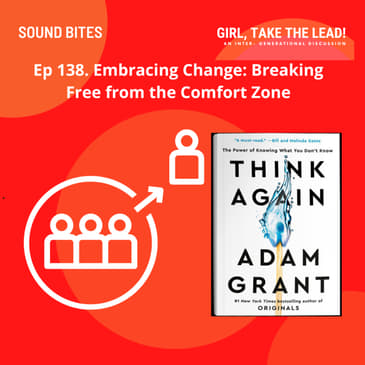
This is a “Girl, Take the Lead!” Sound Bite which builds off our previous episode with Lata Hamilton, Change Management Expert. Lata inspired us to adapt to the future which will be filled with tons of change. In this episode we’ll explore the question: “How can we help ourselves keep open to learning” with the help of Adam Grant’s book, Think Again. Adam Grant is an organizational psychologist and professor at The Wharton School, his books have sold millions of copies and he has two podcasts, ReThinking and WorkLife, a link to his podcasts is below.
As Mentioned:
Adam Grant’s Book: Think Again
Adam Grant’s Podcasts: ReThinking, Work Life https://adamgrant.net/podcasts/
Ep 39, Byron Katie
Ep 41, Imposter Syndrome
Ep. 77, AI and EI
How to Reach Yo Canny:
Our website:
You can send a message or voicemail there. We’d love to hear from you!
email:
yo@yocanny.com (Yo)
FB group: Girl, Take the Lead
https://www.facebook.com/groups/272025931481748/?ref=share
IG: yocanny (Yo)
LinkedIn:
https://www.linkedin.com/in/yocanny/
[00:00:00] Welcome to Episode 138, which is a Girl, Take the Lead Soundbite. The Soundbite is a short episode, which may be a bit more about a topic we've covered like our episode today or Quick Inspiration. And I'm your host, Yolanda Canny.
[00:00:20] In our previous episode, we explored leading change with Lata Hamilton. And she inspired us to adapt to the future, which will be filled with tons of change. I wanted to dig into learning to change. And I found the perfect book to help us explore the question,
[00:00:38] how can we help ourselves keep open to learning? And the perfect book is Think Again by Adam Grant, written in 2021. And if you don't know Adam Grant, he's an organizational psychologist and professor at the Wharton School, and he has sold millions of copies
[00:00:58] of his books. And he has a couple podcasts, which I'll link to in the show notes. One of the things we heard from Lata was how dramatic the work world will change in the near future, especially with the advent of AI.
[00:01:14] It can prompt fear in some of us and hold an opportunity for others. We all may need to adapt and develop new skills to thrive in this evolving AI environment. And one way workers may need to change to effectively integrate AI in the workplace is with continuous learning.
[00:01:35] This involves staying updated on the latest AI developments, understanding how AI is applied in your industry and acquiring new skills to work alongside AI systems. And I would just say, just strap on your nikes and be prepared to learn applications very fast. So how do we do that?
[00:01:58] Adam Grant says there's value in rethinking and there's power in knowing what we don't know. He says that rethinking is a skill set and a mindset. Quote, we already have many of the mental tools we need.
[00:02:14] We just need to remember to get them out of the shed and remove the rest. Our sense of self might include things we know, assumptions we make or opinions we hold. So we cling to those assumptions, instincts and habits
[00:02:31] and they can get in the way of having an open mind. As he studied the process of rethinking, he found that it often unfolds in a cycle. It starts with intellectual humility, knowing what we don't know.
[00:02:47] He offers us a list of things he didn't know like art, fashion, chemistry and the list went on. It was a great question, right? What don't I know? What would your list look like? Mine would include remodeling a house, writing code, changing oil,
[00:03:04] teaching yoga and my list would go on and on too. He says that recognizing our shortcomings opens the door to doubt and makes us question our current understanding and we become curious about what information we're missing. That search can open us up to being more creative
[00:03:22] and being a mood of discovery. He says that if knowledge is power, knowing what we don't know is wisdom. Sounds so good, right? Oh, yeah. The curse of knowledge is that it opens our minds to what we don't know.
[00:03:42] Good judgment depends on having the skill and the will to open our minds. I just love that. So this leads us to the question. What is confidence then if we can trust that it's not what we think we know?
[00:03:58] Turns out research shows we're very bad judges of our own competence and all of us at some time are overconfident, like that armchair quarterback who thinks he knows how to do the game better than the coach. He says the confidence sweet spot is having faith in our capability
[00:04:17] while appreciating that we may not have the right solution or even be addressing the right problems. That gives us enough doubt to reexamine our old knowledge and enough confidence to pursue new insights. He provides us the term confident humility, which we can all learn.
[00:04:39] Research showed that when students wrote about what they didn't know rather than being certain about what they did, their odds of seeking extra help in an area of weakness spiked from 65 to 85 percent. They were also more likely to explore views to learn from the others.
[00:05:00] Research also suggests that identifying even a single reason why we might be wrong about our thinking can be enough to curb overconfidence. Kind of like doing a Byron Katie turn around that helps us question our beliefs. And boy, that's the quickest way to question, I think.
[00:05:20] And I'll have that in the show notes if you want to follow up a little bit more about Byron Katie. Psychologists have also found that admitting we were wrong doesn't make us look less confident. It's a display of honesty and a willingness to learn.
[00:05:35] One of the reasons I wanted to learn about podcasting was because there was this whole area in marketing that my career had been in for over 40 years that I didn't know about. And it was called personal branding. I had done branding for companies and organizations and products
[00:05:52] and didn't know what personal branding was. So I took a class on podcasting, thinking I was there to observe and learn about it and never thinking I'd get on the playing field. But here I am over two years later and loving what I'm doing.
[00:06:07] In the past, we've done an episode on imposter syndrome and Grant has something to say about that. He says the evidence is new and we are still learning a lot about the imposter syndrome, but it could be beneficial versus when it's detrimental.
[00:06:23] And the challenges this is that the common sense of this is something that we tend to ignore and give ourselves benefit of the doubt when we're thinking about imposter syndrome. But we might be better off embracing the fears because they give us three benefits of the doubt.
[00:06:40] It can be motivation to work harder, work smarter and keep us all better learners. I'm not sure about working harder. My sense is that we all work pretty hard. But maybe what we could say is that whenever fear comes up
[00:06:53] like the imposter syndrome, it's input that can help us see something to learn perhaps about ourselves or skill we need to develop. We can look to see when it shows up and that self doubt is a way of telling ourselves
[00:07:07] something we could be blind to and don't consciously know about yet. And we can slow down enough to breathe, be mindful and discover what it's about. There's a great Kelvin and Hobbes cartoon in Grant's book where Calvin says, I thrive on change.
[00:07:26] And Hobbes says, you threw a fit this morning because your mom put less jelly on your toast than yesterday. And Calvin says, I thrive on making other people change. God is say, honestly, I'm with you, Calvin, on that one.
[00:07:44] I don't love having to change, but I do love learning. I love doing research, reading and then synthesizing a book like this so that we learn something new or see something differently. I think this is a great place to end our episode today.
[00:08:02] Adam Grant's book is filled with so much more and he has tons of stuff to say about conflict. And so I'll be bringing that back in future episodes. It's kind of juicy stuff to come next week. We'll have Brandi Mabra as a guest.
[00:08:20] She is the CEO and founder of Savvy, Clover, Coaching and Consulting. And we talked all about leadership energy. Whoa, that was so good. She covers some of the basics, which I hope you'll find super interesting. So please join us again.
[00:08:38] Thanks for being here and talk to you soon. Bye.