
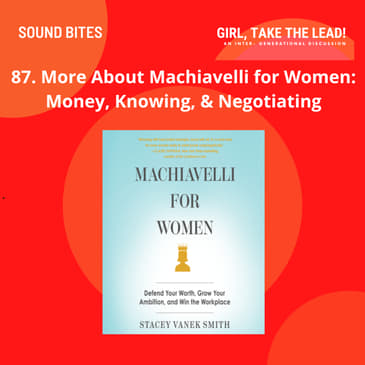
You may remember from Ep 86 where we discussed Machiavelli for Women by Stacey Vanek Smith. In today’s episode we got a bit deeper into that book where she wrote one of the main ways power is reflected in the workplace is pay. Oh Yeah!
She states that after closing the pay gap between 1980 and 2000, the gap stopped shrinking. More and more women got degrees and entered the workforce, but the pay gap didn’t really budge.
In this episode we’ll explore why that could be the case.
Enjoy the listen!!
Mentioned in the Episode:
Machiavelli For Women by Stacey Vanek Smith
Ep 86 Machiavelli Book Discussion
Ways to reach Yo:
eMail: yo@yocanny.com
Public FB group: Girl, Take the Lead!
https://www.facebook.com/groups/272025931481748/?ref=share
Linktr.ee/yocanny
IG: https://www.instagram.com/yocanny
LinkedIn: https://www.linkedin.com/in/yocanny/
00:00:03
Welcome to episode 87 of Girl Take the Lead, and this is a
00:00:07
sound bite. A sound bite is a short episode
00:00:10
which may be a bit more about a topic we've covered, like our
00:00:13
episode today or a quick inspiration.
00:00:16
And today's episode builds on episode 86, where we began the
00:00:20
exploration of Stacey Vanek Smith's book Machiavelli for
00:00:25
Women. You may remember from episode
00:00:27
86. Stacy Vanek Smith is a longtime
00:00:30
reporter and currently cohost NPR's Planet Money, a daily
00:00:35
podcast, so she knows a thing or two about money.
00:00:40
In her book Machiavelli for Women, Stacy writes that one of
00:00:43
the main ways power is reflected in the workplace is pay.
00:00:49
Oh yeah, After closing the pay gap between 1980 and 2000, she
00:00:56
wrote that the gap stopped shrinking.
00:00:58
More and more women got degrees and entered the workplace, but
00:01:03
the pay gap didn't really budget.
00:01:06
So let's first look at what money is, and I'd say that it's
00:01:13
an exchange conversation that we all use to express the value of
00:01:17
something. That's why Stacy says it's an
00:01:20
emotional subject. If women are paid less, does it
00:01:26
mean that women's efforts are worth less?
00:01:30
What? Or is it we just accept lower
00:01:33
pay? Or is it that we just don't ask?
00:01:38
A study in 2002 found that nearly 7% of women negotiated
00:01:43
their starting salaries, while 57% of men did, and one in five
00:01:49
reported that they never negotiated their pay at all.
00:01:53
Ever. Oh boy, this is truth time,
00:01:58
guys. I fall into that four women who
00:02:02
never negotiated their pay at all.
00:02:04
Why didn't I? I think it had something to do
00:02:06
with not knowing how to ask, or that I could ask.
00:02:12
I was pretty happy to have the job, and I kept advancing my
00:02:15
position, and pay increases just came along with that.
00:02:20
The Machiavellian woman sees a situation where the downside is
00:02:25
certain and the upside is iffy, so she doesn't ask.
00:02:33
Yeah, I can definitely see how that might be the case.
00:02:37
Stacy identified 5 obstacles women encounter around salary
00:02:42
and salary negotiation. One women are happy with less.
00:02:49
So, like in my story, I was too grateful, she says.
00:02:53
Women focus more on what they need instead of what our work is
00:02:59
worth. Very likely could be.
00:03:04
I'd also add that sharing salaries or asking about
00:03:08
salaries was very impolite because it was handled so
00:03:13
secretively. I know good girl here not
00:03:18
wanting to be impolite, so I never found stuff out.
00:03:23
Two negotiation is painful. At its heart, negotiation is a
00:03:29
kind of conflict, and women are raised to avoid conflict, she
00:03:34
says. And if you were raised with lots
00:03:37
of trauma around conflict, like I was, it is definitely
00:03:42
something to avoid. And three, safety in lower
00:03:48
numbers think. Some of us think sometimes that
00:03:51
making less money will make us less a target if there's a
00:03:55
reduction in force. Sadly not true.
00:04:01
Four. It hurts to ask.
00:04:04
Yes, I can see this one. What if I ask and I'm seen as
00:04:09
pushy or conceited? And Stacy includes that in her
00:04:13
book too. And five is complicated.
00:04:17
Women are taught, money is not their realm. 75% of economists
00:04:23
are men and Stacy states. Stats in banking and finance are
00:04:29
not much better, gotta tell you. Even with my MBA, I did not
00:04:36
think of myself as capable in the area of negotiating.
00:04:40
I lacked a lot of confidence. There were a couple times,
00:04:45
however, I got to the point of quiet quitting and even once
00:04:50
said I was going to apply for an internal job at a higher level
00:04:54
than I knew I deserved. I was willing to leave and take
00:04:59
whatever the consequences were the outcome.
00:05:03
I got the promotion in place without having to leave the
00:05:06
department I was in. I don't know if that works for
00:05:10
everybody, but I sure got to the end of my rope on that one and
00:05:14
was quite willing to walk. Stacy offers us 3 pillars of
00:05:19
negotiating while female one arm yourself.
00:05:24
So this is about information being our weapon, which means
00:05:29
we've got to do our homework and thank God there are better
00:05:33
options to find out salary ranges today and you don't have
00:05:37
to Snoop around like I did. OK, try not to be too judgey
00:05:42
about that too. She says It's not just about the
00:05:49
money. OK, so for me that meant good to
00:05:53
think of other things you might want if the company can't come
00:05:57
up with the moolah. So could it be a particular
00:06:01
project or maybe more vacation time?
00:06:04
But it seems the trend now is we're all offered unlimited
00:06:08
vacation time, which no one ever takes, am I right?
00:06:13
And what about a bonus? I liked those.
00:06:16
I got a couple signing bonuses once or more days from home.
00:06:22
Now that you're back in the office.
00:06:25
One I just thought of was education stipend or travel to
00:06:30
conferences to keep learning more and developing yourself and
00:06:35
your own network. And the third one, she says, is
00:06:40
Smile like You mean it. So this could mean an attitude
00:06:47
of gratitude is helpful and a good tool to use to take on one
00:06:54
of your greatest skills. Figuring out what people want
00:06:58
and how they see others to help the hiring team get what they
00:07:03
want. It's all about the we Stacy
00:07:07
said. So the question can be, what's
00:07:10
going to make your employer want you to earn more?
00:07:17
So our disadvantage in negotiating becomes a kind of
00:07:20
superpower where everyone benefits.
00:07:26
And by not settling for less and feeling like there's no choice,
00:07:31
negotiating and advocating for yourself can make you feel like
00:07:37
you can stand up and speak for yourself.
00:07:42
Stacy reminds us to remember it's a process that takes time,
00:07:47
effort, courage, and homework. But realizing your worth and
00:07:51
fighting for it is one of the most powerful and impactful
00:07:55
things you can do for your career and for yourself.
00:08:00
And I'd add this perhaps the vulnerability we all risk by
00:08:05
sticking our neck out and going for it can be hard and painful,
00:08:08
Stacy says make a plan. And I say invest in yourself,
00:08:13
your own learning, your own advancement. 42 years later, you
00:08:18
can feel content and satisfied with your life's achievements.
00:08:22
And in that note will end today's episode.
00:08:26
Thank you for being here. Please join us at our girl Take
00:08:29
the Lead Facebook group, visit our girl Take the Lead pod.com
00:08:34
website, or check out our New Girl Take the Lead YouTube sound
00:08:38
bite videos. On Tuesday, we will be posting A
00:08:42
Girl Take the lead interview with Nori Java, author of
00:08:46
Keeping Your Seat at the Table. And that conversation is a juicy
00:08:50
about ages. I hope you'll join us for that
00:08:53
and talk to you soon. Bye.