
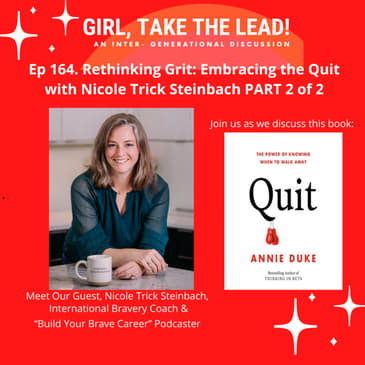
Nicole Trick Steinbach (Millennial) returns to discuss the book, Quit, The Power of Knowing When to Walk Away, by Annie Duke. Annie Duke is a former professional poker player and earned more than $4 million in tournament poker before retiring in 2021.
Nicole and I had so much fun talking and I wanted to save every minute of our conversation, I decided to break the episode up into two parts.
This is Part 2 of 2. Below are the different topics we covered by part.
Part 1:
Grit vs Quit
Intersectional Identity & Staying Too Long
Nicole’s “Time to Leave” Scale
Risk & Expected Value
Whispers, Missals, & Bricks
The “At the Moment Manager”
Part 2:
Goals & Expected Outcomes
Stressing Less & “Sunday Scary”
A “Quit Coach” & 4 Steps to Quit Conversations
Kill Criteria & Cut Your Loss
Attachment to our Self Identity & “In Love with my own Self-Importance”
Battles Worth Having
The “Ant Story”
Mentioned in the Series:
Book: Quit, The Power of Knowing When to Walk Away
Ep. 6, Can’t We Ditch Performance Appraisals?
Ep. 115 Inside Out: Unveiling the Layers of the Internal Family System (IFS) with Uri Talmor
Related Episode:
Ep 113, Dare to be Brave: Conquer Failure & Learn Bravery as a Skill!
Yo’s Feb 12, 2024 appearance on Nicole’s Podcast:
Here are three takeaways from the series:
1. In our culture we see grit as a virtue and quit as a vice. Per Annie Duke: “Success does not lie in
sticking to things. It lies in picking the right thing to stick to and quitting the rest.”
2. Any decision is made under some degree of uncertainty – we don’t have crystal balls and new
information will always reveal itself.
3. External validation increases the escalation of commitment. Fear of how others will view us if we quit are usually overblown.
Nicole’s Free Offer:
www.TrickSteinbach.com // freebie: https://tricksteinbach.com/work-less/
Sign up for access to a powerful video and workbook combo designed to cut between one and three hours of work each week.
More About Nicole:
Nicole Trick Steinbach is the international bravery coach. She is a former executive in technology, has worked in over 25 countries, and is at home in both the US and Germany. Nicole is a lot of things but naturally brave is not one of them. That’s why she teaches and coaches other women all over the world to build their own brave career so that they stress, work less and then begin to earn more. Her podcast is “Build Your Brave Career with Nicole Trick Steinbach”.
How to reach Nicole:
Linkedin: https://www.linkedin.com/in/nicoletricksteinbach/
Build Your Brave Career with Nicole Trick Steinbach Podcast: https://podcasts.apple.com/es/podcast/celebrate-brave-with-nicole-trick-steinbach/id1563427212?l=en
How to reach Yo Canny:
Our website:
You can send a message or voicemail there. We’d love to hear from you!
email:
yo@yocanny.com (Yo)
FB group: Girl, Take the Lead
https://www.facebook.com/groups/272025931481748/?ref=share
IG:
yocanny (Yo)
LinkedIn:
https://www.linkedin.com/in/yocanny/
[00:00:07] Welcome to episode 164 of Girl, Take the Lead, where each week we explore womanhood and leadership. And I'm your host, Yolanda Canny. In our previous Part 1 episode with Nicole Trick Steinbach, we explored the book Quit by Annie Duke. And Nicole offered us great advice about how to approach
[00:00:28] our decision-making process to quit or stay. And what happens when you get two podcasters together to do an episode? There's a lot of talking and they have a lot to say. So this is Part 2 of a two-part series where we'll finish our conversation by covering the following
[00:00:52] goals and expected outcomes, stressing less and the Sunday scary. A quit coach and four steps to quit conversations with them. Kill criteria to cut your losses, attachment to our own self-identity. And when we're in love with our own self-importance, battle's worth having
[00:01:22] and the famous aunt story. Enjoy the listen. Here you go. I would actually love to hear your perspective because one of the things that you've generously done on this podcast is have cross-generational conversations with your daughters. So now
[00:01:41] having read this book and reflected on so much of it and then your own experiences, has it changed how you talk with your daughters about their decisions either in career or relationship
[00:01:54] or buying a house or car or travel? And then how? I talked a little bit about this with Emma yesterday. She came over for a quick visit and it kind of comes up in the book too that
[00:02:08] when we put, when we have a strategy, the one that kind of blew me the most was what she says about goals. That goals can lock us in to some kind of expected outcome. Oh yeah. Right? And I, in talking
[00:02:32] with Emma, we were talking about being more flexible, being able to look at things differently. And when I was designing my career, I took a lane that was sort of independent of a company taking
[00:02:50] care of me. I mean, I was like not interested in staying anywhere really long because I learned that I needed one, a lot of stimulation and I needed to be creative. And so what I did was
[00:03:07] I went down this lane of new products and becoming an expert in how to launch new products in the United States especially on a national level. And it didn't matter. I mean,
[00:03:20] for me it was like, okay, yeah, they don't have anything new for me to do. I'm going to go over here. I knew I could continue to progress if I made the change. And it was interesting because
[00:03:32] Annie Duke says something about, sometimes what holds us back is that we don't think we're going to progress if we make the change. That's right. But in my head, that was the only way to progress.
[00:03:47] Like I got more money, I got a better title and I got new products to work on that I was, you know, that were just terrific. The girls seem to have less tolerance for,
[00:04:02] they watch more of what's happening at the upper level to see how things are happening. They tune into the kind of layoffs that happen and who's affected and why is that. And they're much more attuned, I think than I was to things like that. And I think
[00:04:28] Annie Duke says to us in this book that when we look at these decisions that we make, the more that we can understand what we see as failure, what we see as success,
[00:04:52] the better off we're going to be. And I have, oh man, like my second or third podcast episode was about can't we ditch performance evaluations because they just, they give you feedback, but they're giving you like some kind of structured feedback that isn't really useful.
[00:05:18] Yeah, they're very seldom well done. That's very true. But I think what she tells us too is we kind of need to have somebody who's not in it. And we, you know, and we were, and something called a quitting coach, which sounds like a great
[00:05:34] thing. And I think Nicole, like we said, you're a quitting coach. You help people with this. Yeah. I mean being brave, right? Includes pushing back the indoctrination and the status quo for a woman's specific situation. So I adore supporting women in tech
[00:06:01] and communities and organizations and one-on-one. I just adore it. Tech industry made so much possible for me. And learning to quit or I use the way I've been talking about it is learning to find the joy of the failure, learning to embrace, you know,
[00:06:23] Nelson Mandela said, I never lose. I either learn or I win embracing that. That's one of the things that I think, not I think research shows the agile methodology has allowed individuals and then groups of individuals to make decisions and then remake the decision. You get new information,
[00:06:42] new experience, you remake it, right? And so for quite a lot of my clients who come to me, my promise is you will stress less. I check with my clients every single year and not just
[00:06:59] the clients who are currently working with me, but the clients of the last two years. Because coaching should be just like anything, right? If you're doing a certification, if you are learning a skill, if you're learning how to knit, there's a long-term return on investment,
[00:07:15] right? It should be longer term what you're learning. So, you know, there should be impact well after you've invested in those first few knitting stitches, right? And 100% of them say, yeah, I stress less now. To stress less, you got to quit some stuff. You got to quit working
[00:07:36] at 9pm on a Friday. You got to stop that, right? You got to stop stepping into the Sunday Scaries and pretending that that's normal. And for everyone who like myself was not familiar with the term Sunday Scaries because you were living in a box for about 10 years, Sunday
[00:07:52] Scaries are when you wake up on Sunday and you are already feeling like crap because Monday is in less than 24 hours. Yeah. Like, you got to quit that. You got to quit chasing quote-unquote self care by overspending. You got to create reasonable financial habits for what is available
[00:08:11] for you, right? You got to quit pretending that what works for tech bros is going to work for you. It's not if you attempt to be a tech bro as a white woman, I would just offer to you,
[00:08:26] check out Sheryl Sandberg's career. It works and then it really doesn't work with a lot of respect and appreciation for what Sheryl Sandberg has created for tech. So there are four steps
[00:08:39] because right now your homework, dear listener that we go and I did not agree upon at all. So I'm being very brave and bold and older sister here. Here she goes. As you're gonna,
[00:08:49] you're gonna get yourself a quick coach. It's gonna be a friend of yours. It's gonna be a mentor. It's gonna be an actual coach. It's gonna maybe be your therapist, right? Step one,
[00:09:00] say to them, please, I want to talk to you and I want you to tell me what you think I should consider quitting. Please note this is a nuanced, mature conversation not what they're telling you to quit, but what they're suggesting you should consider quitting. There are certain
[00:09:19] things in my life like the coffee that you're watching me drink excessively. This is my fifth cup of coffee as we're recording it's 1049 my time. Should I probably quit that? Sure. Am I going to consider it? Thanks for the insight. No. Okay. Step two, allow yourself
[00:09:38] and agree with them that you get to push back. You get to creatively co-create your quick plan and sometimes that means you're gonna pull back, maybe lick your wounds, right? But they're going
[00:09:52] to be open. That door is going to be there for you when you're ready to talk about them. Again, right? This is a very generous thing for someone to do for you. Then number three,
[00:10:06] if you and with your quick coach are going to set very clear definitions, this is on page 195 around what success is going to look like in the near future. And we haven't talked about this yet.
[00:10:20] Your kill criteria. Yeah. Oh, that's a good one. Right? What is your line? You can call it a red line. You can call it a red rope. You can call it a hail no. Yep. And then step four,
[00:10:33] which is the last step, you're going to agree to revisit the conversation. You're going to look at how you feel, how you are with your definition of success. Right? And consider the serious discussions about quitting.
[00:10:53] And if you don't quit things, if you keep whining and complaining and dragging yourself through the mud, it's okay for your quick coach to quit. They're a quick coach. Yeah. You know that I think it's worthwhile to just talk a minute about that kill criteria.
[00:11:20] And that sort of shows up like if by X date, for example, I am not promoted, for example. Yeah. To level of X, then I will leave. Yes. And again, like you said, you can revisit that,
[00:11:39] but it's good to have... Like I, with this little business of my card making, there are just some designs that just will not come together. I'll just go, oh my God,
[00:11:52] this has such potential, but it is just not happening. Yeah. And now I can just go cut it, it's almost like she talks about cutting your loss at that point. It's like, okay, I've invested this much. It's not happening. It's time, and hopefully they don't get the brick
[00:12:15] in the back of that. The whispers have been there for a while and you have not. But I think that's a nice way to work with the coach too, like you said. Yes. Say, if by this, this doesn't happen, we'll do that. Yes. Yeah. The strongest example
[00:12:39] for where I think a lot of these things really came together, and I actually read this one of the times I read it was with a client. We were going through chapter by chapter
[00:12:50] together and discussing it. This client works in tech sales, global tech sales at the time. You know, global tech sales makes a lot of money. And so the first thing was, okay, I've invested so much in this for me to be able to transition to another major player.
[00:13:09] I need a specific title. And so she set that as her kill criteria. So she kept working crazy hours, kept dealing with truly inept people, messing up deals that she was continuously having to save,
[00:13:26] but she needed that promotion. Well, on her way there, two of the inept people did the same thing they were doing to her, but to another white woman who was related to someone very high up in this tech organization. So they both got fired.
[00:13:43] They end up to people. And then she was like, oh, okay, my kill criteria is still this. Okay, I'm going to get to this promotion level. But then my next goal is going to be to have
[00:13:56] this level of income. I think it was like 500,000 a year or something like that, plus commissions. Yeah, tech sales pretty fantastic. If you like to talk to people, figure out sales. Okay, anyways. Right? But then I'm going to not work on my holidays, not even going to take
[00:14:14] my materials with me, my tablet or whatever. And then I'm not going to work Sundays. And my kill criteria is going to be if I try to do this for three months, and I'm still getting negative feedback or demands to complete sales deal documentation,
[00:14:34] et cetera, on Sundays or on my holidays, then I know it's time for me to go. And like as we were moving that that's so specific, that's so specific. Yeah. And she got to about 80, 20 success with that kill criteria. But she still felt awful
[00:14:56] because she knew she was surrounded by people who maybe weren't as demanding, but they were just pulling back support. Yeah, all in her difficult, complete, complicated. She started to see the wins that some of those big, big clients who are
[00:15:14] going to be coming in would be siphoned to qualified colleagues, but in a distribution that didn't make sense. And so she coming back to the taking the consequence, she decided that she got the title. She had done the work, but now her kill criteria
[00:15:36] was shifting and bringing the title along, but working for a company of values. A company where the CEO and the executive line are known and committed and role model. Wow. That's some sort of integration of life. And she's probably very happy. Oh my gosh. But
[00:15:55] you know, she took a $200,000 pay decrease. Never been happier spending time. She has four children spending time with them. Yeah. Wondering why she held on for so long. Cause one of the things that any joke says in here is quitting on time will feel like
[00:16:12] quitting early. Yeah. So kill criteria is going to help you be specific. And for me right now, I'm also dealing with major life changes and I have some kill criteria where I'm not going to
[00:16:24] like the consequence, but I'm also not going to like who I am, who I become. If I keep doing the same stuff I've been doing without making significant changes. So good. So good. Yeah. I, you bring up too a little bit there. You know, quitting coach is
[00:16:50] so different than thinking, well, because I love the neutrality of that person versus we go to one, you know, when we go to get validation from friends or wonder what our family is going to think if we quit. And, and, you know, I always, I had was,
[00:17:16] loved my husband and we always would talk these things out with each other and, you know, figure out what was happening. And, you know, we wanted each other's well being and mental health overall. But I can see that sometimes you can worry, you think what other people think.
[00:17:37] And she brings up the point that we probably overestimate what other people think. Oh yes. Oh yes. And that, you know, being able, I think to put those other people aside and move them out
[00:17:55] so that you can hear yourself better and truly listen to what you're trying to tell yourself. Yeah. And whether this is good for you or not good for you. And it does take process. I think that's one of the things I took away from the book was that,
[00:18:17] you know, we're tied to our identities and who we think we are in a big way. Yes. And the process of undoing that identity and being okay with inventing a new one
[00:18:33] in a new situation, it takes time. Yeah. Yeah. Yeah. Yeah. I held on. Oh, this is very vulnerable. I held on to the I'm scrappy. I do it myself. I don't have enough money for a very long time.
[00:19:03] Well past the point that that made any sense at all. And there is this time, I don't remember why, but it was in Germany and there was something maybe when the children were coming and we needed to do
[00:19:22] not just like a tax statement, not just whatever, but like a whole financial viewpoint on myself, on the Roth in the United States, on, you know, the properties that are owned, on the German pension, like all this stuff, all the stocks that I got from my employer.
[00:19:39] And I looked at the number and I'm just going to be very vulnerable and tell you that it was over two million euros. And I was so upset because it reflected an identity that I didn't have
[00:19:55] that I walked into the bathroom of my house and I vomited all the way all the way. Because I held on to the I am scrappy. I get it done. I don't have enough. So I work harder. Right? I don't belong here. So I do more. Yeah.
[00:20:21] That I really, now obviously she hadn't written the book because the book came out in 2022 and this was in 2010 or 11. Yeah. Oh yeah, it was because Patrick was about to be born my son.
[00:20:36] But knowing what I know now and what so many of, you know, the Gen Alpha, Gen Z, etc., are talking about with like identity and pronouns and identification with clauses and personalization and all of these things, right? I think I would not have been such a painful experience
[00:20:59] because yes, my body revolted in an extremely strong way in that moment. But I will tell you that even now I have a wonderfully rich life to quote Rami Sartey. I have such a rich life and I still will be like, oh another pair of running shoes.
[00:21:18] I mean, my hip doesn't hurt that much. It's like we hang onto our identities with pride. You know, like for me being the warrior, Latina woman strong, you know, it served me for a while.
[00:21:34] I, one of the episodes I did on no bad parts helps me understand that, oh, that got developed for a reason and it's okay. And now today though, I don't, Warrior Princess
[00:21:49] is just smiles and goes, yeah, you know, someone else can pick up the fight and go for it. And my mother-in-law is such, she is such a joy. And she said to me one time she said,
[00:21:59] you know, you can't dance on every dance floor at the same time. Right? Like you have to pick your battles. Yes. And, but I still feel that I have been formally and officially with Golden Bossed Seals invited to
[00:22:16] every single battle. Right? And there are a few where I will, I will fight that until the very end. Not with all like not with all of my heartblooders like for example, almost every single week,
[00:22:30] I with persistence and with grit write a letter to whoever is my representative and whoever is my senator saying gun control now. Yeah. Reasonable gun control right now. Yeah. And I could look at statistics and say, I'm wasting my time, but who do I want to be?
[00:22:48] And what does success mean? And I will tell you success for me means there's the out of my control success, which she also talks about in this, right? Like the Everest, you don't control
[00:23:00] the weather. Right? You got to control your decision making is that my children, your children, all of our children become adults. And the one that is in control is that I can say to my
[00:23:15] children with the best ability that I had balancing all of the other things, the joy, the work, the connection with you, the crazy audacious idea that I should have a hobby and sleep in the same week. What? Right? I still took action. I did my part.
[00:23:40] Oh, that's so lovely. That's a wonderful place for us to kind of bring this to an end. But is there anything that you want to that we didn't cover in the book that we should?
[00:23:55] There's the one part that's talked about most on Google or in podcasts that we didn't talk about at all, which I find super fascinating. And that is the study of the ants. So in the book, she shares,
[00:24:10] so we all know if ants, if we're all lucky enough to know ants, right? They have these hunters, these seekers who go out. And as soon as they find a food source,
[00:24:25] they bring that back and with their feet are laying down the scent, which is why PS, if you're cleaning up after ants, you got to use vinegar so they can't smell themselves moving on.
[00:24:35] It was way too old when I learned that. And then they bring all their buddies and they walk single file until that food source is complete. Now, when I grew up and what she talks about
[00:24:46] in the book is there would always be these very confused ants who even though the food source, and there was a very clear line going one by one, right? There'd be these confused ants who were
[00:24:59] like kind of moving around in circles and going left and going right and going the upper. What is happening, right? And it turns out that that is super important for the longevity and the law
[00:25:10] and the health of that ant hill. Those ants are not confused. Those ants are the innovators because you don't know when that food source will be removed brick in the back of the head,
[00:25:23] right? So good when it'll be poisoned, when it'll fall out, be done, be complete. Right. So you have to have, you have to know when you're going to be quit or quit and you got to have
[00:25:39] these exploration innovative sort of ants going around. And for me, she does not mention this in the book, but I find it fascinating. Two things are fascinating to me. Number one, this is what's talked about the most when she's a guest on podcasts and on Google,
[00:25:58] the ant example. I find it fascinating. And secondly, oh shoot, I lost it. Oh, secondly, this now comes to the side hustle idea. There's so much strong feelings about a side hustle.
[00:26:15] Right? I'm not going to tell you to do a side hustle. I'm not going to tell you to not do a side hustle. It's intriguing to consider where are your innovation ants because I will tell you
[00:26:26] one of the most significant life mistakes that I made, not just career life was tagging my identity to a corporate identity for 13 years. The further away I am, the more I realize what a major mistake
[00:26:43] that was. Now notice I did not say stay at the same company for 13 years. I don't think that was a mistake. I tied my identity to that corporate identity. I did not have any ants out there exploring,
[00:26:57] or as I like to think about it, octopus arms. I had zero octopus arms experiencing different water temperature, different culture, like none of it. That is so good because she does talk about having a backup plan and then also exploring even when no matter what.
[00:27:21] So I think thank you for that because those are important. I never did that. I was so into like you were talking about work hard, do what they, one of the things we're going to be talking about, the girls and I are going to,
[00:27:45] we've read a book called Cultish. Oh, that's such a good book. Oh, I know. And we're going to cover it because I think a lot of organizations can have a lot of cultish kind of. And you've kind of referred
[00:27:59] to it a little bit by one of your clients who was talking about that she changed herself a bit and was taking her Sundays off and and she was being kind of pushed out a little bit. You know,
[00:28:13] you could tell that, you know, like there was a certain kind of cult order in that probably organization and she wasn't doing it any longer. That's right. So we're going to talk about that.
[00:28:23] But I think when we begin to look at where are we really like, what is this place about? What do they value? What is this? And like, you know, I just love that because we can get tied up with,
[00:28:42] oh, I work at such and such company and everybody goes, Oh, that's great. You get this validation of importance. Oh man, I was so in love with my own importance when I could tell you about the
[00:28:56] products I launched and, you know, and then when I didn't have that importance anymore, it was like this major, major change in me. It was like, Oh my God, I just fell off a cliff. Yeah. You know,
[00:29:12] but then you know, you recover, you come back and I find it funny now when I look back after all of this time and go, Oh yeah. Like that was such an identity you had. Yo, you just thought that was the
[00:29:34] best thing ever and it was not. I am writing down and I'm sure many listeners are in love with my own self importance because yep. Yep. Definitely. All right, my darling. Well,
[00:29:53] I think we beat this book to death, but I just love absolutely not get this book read it five times. Make sure you put your flags in there. This book is going to make you think it definitely makes you
[00:30:07] think it definitely does no matter what you're doing and no matter where you are in life because all right, my darling. Well, thank you so much for coming on the show. And usually I end the
[00:30:18] show with something like, you know, what would you tell your 20 something self? But I think you already answered that question. And also the advice you have for younger generations, I think you also answered the question. Thank you. So thank you for doing that.
[00:30:35] I love you and I just am so appreciate that our podcasts can compliment each other and support each other. So thank you for coming. And thanks for creating this for all of us.
[00:30:46] I appreciate it so much. Thank you for listening today and we sure hope you enjoyed this episode. If you did, please leave a comment wherever you listen to your podcasts, tell a friend about us, join our public Facebook group, girl, take the lead or visit our website girl,
[00:31:03] take the lead pod.com. We also have a YouTube channel where your subscription would be appreciated. Once you're on YouTube, search at girl, take the lead. And we've recently expanded to YouTube music where you can find a video of this episode. Here are three takeaways from the series.
[00:31:27] One in our culture, we seek grit as a virtue and quit as a vice per Annie Duke. Success does not lie in sticking to things. It lies in picking the right things to stick to
[00:31:42] and quitting the rest. Two, any decision we make is under some degree of uncertainty. We don't have a crystal ball and new information will always reveal itself. Three, external validation increases the escalation of commitment and fear of how others will view us
[00:32:06] if we quit is usually overblown. Our next episode will feature our guest Claire Lechence, president and CEO of Research International. Did you know that five billion people do not have access to safe, timely and affordable surgical care worldwide? And every two seconds,
[00:32:33] someone dies from a surgically preventable disease. Research provides free reconstructive surgical care and strengthens surgical teams in low income countries to give people with treatable conditions a chance to lead fuller, healthier lives. Now I've been a supporter and
[00:32:57] involved with research for over five years. Love their mission, their capacity for building programs and funding for direct patient care, giving surgeons in low income regions the tools they need. Claire will share with us more detail about their programs and the positive impact they're making
[00:33:21] in global communities with life transforming care. Please join us again and thanks for being here and talk to you soon. Bye.