
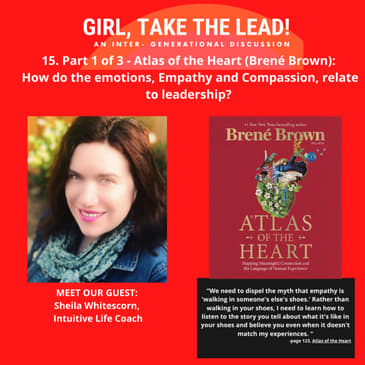
Sheila Whitescorn, Intuitive Life Coach, joins Yo to discuss Brené Brown’s book Atlas of the Heart and how the emotions of Empathy and Compassion can make us better leaders. This is the first of a 3-part series where we’ll discuss other emotions in parts 2 and 3.
During this episode we explore the following questions around emotions and dig a little deeper into Empathy and Compassion:
- Why emotions are important?
- What role does language play in emotions?
- What is the difference between Empathy and Compassion?
- Can we really walk in someone’s shoes?
- What are some Empathy misses?
- Can we really read emotions in other people?
Here's a quote from Brené Brown we include in the episode:
"...today if you ask me to identify the biggest barriers to developing brave leaders or cultivating courage in our families or bringing justice to communities, I'd go right back to what I believed was true about people when I was a kid:
- People will do almost anything to not feel pain, including causing pain and abusing power;
- Very few people can handle being held accountable without rationalizing, blaming or shutting down; and
- Without understanding how our feelings, thoughts, and behaviors work together, it's almost impossible to find our way back to ourselves and each other. When we don't understand how our emotions shape our thoughts and decisions, we become disembodied from our own experiences and disconnected from each other.
We are grateful to Brené Brown for sharing her fabulous research with us!
We hope you’ll enjoy this episode and will tune in to hear the rest of the series! Here’s the line up by episode:
- Episode #15, Part 1: Empathy and Compassion
- Episode #16, Part 2: Stress, Overwhelm, Comparison (Envy, Jealousy, Resentment)
- Episode #17, Part 3: Fitting In and Belonging
More about Sheila:
Following a successful 20-year career as a Marketing Communications expert with Fortune 500 companies, Sheila became a certified Intuitive Life Coach. She became certified by successfully completing a 12-month program with Atmana Coaching Academy which provided her with a dual credential in both Intuitive and Life coaching.
Sheila lights up when she is able to help her clients turn their stresses into resilience and assist them with their transformation into the life they desire. They learn how to recognize and tap into their intuition to align with their true purpose. As a result, they live a more fulfilling, authentic, soul-led life.
On a personal note, Sheila lives in the Bay Area with her husband and collie, Rowan. She also holds a degree in Social Work.
Ways you can contact Sheila:
Link Tree:
IG:
https://www.instagram.com/SheilaWhitescorn
Ways to reach Yo:
Public FB group: Girl, Take the Lead!
https://www.facebook.com/groups/272025931481748/?ref=share
IG:
https://www.instagram.com/yocanny
LinkedIn:
00:00:02
Welcome to episode 15, a girl Take the Lead where each week we
00:00:06
explore Womanhood and Leadership.
00:00:09
Before we get started today, I wanted to give a shout out to
00:00:12
two of our listeners, Mary gotten Borg and Mary.
00:00:15
McEvoy, thank you, Mary's, for your support and listening to
00:00:19
our podcast. Also, in episode 14, I said I'd
00:00:23
mention give a shout out to anyone who donates to the
00:00:26
Mother's Day movement or is a mom or an incredible woman.
00:00:30
Woman. So I would also like to give a
00:00:32
shout out to Katharine mean, Rachel Blair Whitney Baker,
00:00:37
Misha, McKittrick, Rachel broom Burger, Melissa.
00:00:41
Brunetti and mccanney, kiki-annie DDC on Co and Linda
00:00:47
Crandall. Thank you, ladies for being
00:00:49
incredible inspirations Today, Sheila White scorn, another
00:00:56
incredible woman, and intuitive life coach joins me for this
00:01:00
episode, where we'll take a closer look at Bernie Brown's
00:01:03
book, Atlas of the heart, and how certain emotions she
00:01:07
researched relate to leadership. We're going to do this as a
00:01:11
three part series. And this first part is about the
00:01:14
emotions of empathy and compassion.
00:01:17
We sure hope you'll enjoy it. So welcome, Sheila wife scorned,
00:01:24
you know that I love you to the moon and back and I'm just so
00:01:27
excited that we're going to take this series, this journey
00:01:32
together on emotions and it's going to allow us to dig in a
00:01:36
little bit and relate it to our experiences especially around
00:01:42
leadership. And so we're we're going to have
00:01:44
some fun with that. And for our listeners you can
00:01:48
want introduce yourself. Sheila.
00:01:49
So that they know who you are. Sure, William, so delighted to
00:01:53
be with you. Yolanda, my name is Sheila,
00:01:57
White scorn, and I'm an intuitive life coach.
00:02:00
I live in the Bay area and I'm I recently did a career pivot
00:02:07
about a year ago and decided to leave corporate life behind and
00:02:12
start my own coaching business and for the listeners, Sheila,
00:02:18
and I work together for about eight years because we started
00:02:23
in this same organization I think within months of each
00:02:27
other and there was an instant camaraderie, we shared a cube
00:02:33
wall and saw life. Very similarly, and the universe
00:02:39
is really good to us by bringing us to each other.
00:02:42
So, listeners, what we're doing is, you know, brene, Brown is so
00:02:48
magical. And this book, This latest book
00:02:51
for her, atlas of the heart, was one that Sheila and I looked at,
00:02:57
and we went, this is so good, and we need to look at it and
00:03:04
relate it to, to leadership. And, because the obvious thing
00:03:09
for us was that some of these emotions, just lend themselves
00:03:13
more to leadership. So, our first episode here, and
00:03:18
we're going to probably have a three part series He's is about
00:03:21
empathy and compassion. and one of the things that she that
00:03:27
brene Brown says, is that if you identified, the biggest barriers
00:03:32
to developing Brave leaders or cultivating courage, in our
00:03:36
families are bringing Justice to community, I'd go right back to
00:03:41
what I believed was true. When I was a kid.
00:03:44
People will do almost anything to not feel pain, including
00:03:49
causing pain and abusing power. Very few.
00:03:53
People can handle being accountable without
00:03:56
rationalizing blaming or shutting down and without
00:04:00
understanding how our feelings thoughts and behaviors work
00:04:04
together. It's almost impossible to find
00:04:07
our way back to ourselves and each other.
00:04:11
When we don't understand how our emotions shape, our thoughts and
00:04:16
decisions, we become almost almost disembodied from our own
00:04:21
experiences and disconnect from each other.
00:04:26
So when when I saw that, I went boy, how much more powerful you
00:04:33
could be, as a leader, right, if you can connect.
00:04:37
Absolutely. you know, compassionate leadership for
00:04:41
example, How do we connect? How do we guide leaders who are
00:04:46
in that situation? Now, what's it look like?
00:04:51
And I know that, you know, Sheila has always said to me,
00:04:55
you know, we have to understand who we are. one of the things
00:05:03
that we can look at is, you know, when we talk about our
00:05:13
emotions You know, why they're so important like?
00:05:20
Connection. Like what does that mean to us
00:05:24
and what what could it mean to leaders?
00:05:26
So she defines in the book connection to be the energy that
00:05:32
exists between people when they feel seen heard and valued when
00:05:39
they can give and receive without judgment and when they
00:05:43
derive sustenance and strength from the relationship, And those
00:05:51
of you that might have the book. So it's 250 but I think I don't
00:06:00
think that's included in training manuals or anything,
00:06:03
right? She let me wait.
00:06:05
Look about how we've been trained in organizations. yeah,
00:06:10
I mean I think at the end of the day, that's what everybody wants
00:06:14
and sometimes l are in positions where, you know, they have a lot
00:06:20
on their plate, there's not a lot of free time to be
00:06:23
interacting with their team's necessarily and you know, Their
00:06:30
team members, you know, maybe needing things from them that
00:06:35
they're not able to provide. And so, the more self-aware that
00:06:40
one is, they can, you know, take the time to check in and make
00:06:45
sure that they're showing up and being present and and helping
00:06:49
their team members feel seen heard, right?
00:06:53
I think also to there's brene Brown says, you know, the Basic
00:06:59
premise is that. She I think she used the quote
00:07:03
from damacio. We think we're thinking
00:07:07
machines, we don't pay attention to emotions and we're taught
00:07:11
that they get in the way we process.
00:07:14
Emotional pain, the same. But the thing she points to is
00:07:18
that, we process, emotional pain the way, same way as we do
00:07:21
physical pain. So, If that's happening just in
00:07:27
general and then you're put in a leadership position.
00:07:30
The last thing you're going to want to do is, you know, you
00:07:34
don't have the time for anything to get in the way.
00:07:40
It also is interesting to her research, right?
00:07:43
That when she talked to 7 people, that three came up.
00:07:49
Happy sad and pissed off. That was interesting.
00:07:55
Yeah and I think she said her research yielded 75, emotions,
00:08:01
and experiences. So you know, she covers a lot of
00:08:06
those in the book and she had her HBO Max special recently.
00:08:11
If anybody wants to check that out, I think she covers 30 in
00:08:15
that one. You know, she makes the point
00:08:18
that human emotions and experiences are layers of
00:08:22
biology biography behavior and backstory.
00:08:27
And that probably because of that.
00:08:30
Each of us has our own way of habit of processing emotions,
00:08:38
getting emotions. And I just love that she made
00:08:42
this huge point that we cannot read emotions in other people.
00:08:50
so, so if you're a leader of a team, And you're noticing the
00:08:56
biology of somebody is Turner is totally shutting down.
00:09:01
Hmm? Or they're not talking or You
00:09:07
can't assume, you know what's going on for that person.
00:09:13
You have to ask questions and take the time to work with them
00:09:19
to see what could be going on. I don't think I've, I probably
00:09:27
have had a few leaders that have done that with me.
00:09:32
But they're the exception. Yeah, I mean I would say that
00:09:36
depending on the culture of the organization, some leaders, you
00:09:42
know, they avoid that position. They don't really want to get
00:09:46
involved because of all of the other priorities that are taking
00:09:53
place. Recently, Sheila found this
00:09:58
quote from Susan, David PhD. And she says, emotional agility
00:10:05
is the new currency for leading successfully.
00:10:10
And so I wonder I wonder what emotional agility might mean?
00:10:17
Do you have some thoughts on that?
00:10:18
Sheila like What she might be. Meaning by emotional agility to
00:10:24
me. I, it seems like it's similar to
00:10:27
compassionate leadership some of the same criteria.
00:10:34
I really think that, you know, being able to, for a leader to
00:10:40
be self-aware and to know the difference between, you know,
00:10:46
sympathy and empathy and compassion.
00:10:51
And to really be able to effectively communicate their
00:10:56
feelings or their thoughts with their team members and to be
00:11:02
willing to be vulnerable with them, in order to get to the
00:11:06
root of whatever it is, that's going on, you know, in the work
00:11:10
setting. If we look at Compassion brene,
00:11:14
Brown made the point that compassion is fueled by
00:11:17
understanding and accepting that we're all made of strength and
00:11:22
Struggle. No one is immune to pain or
00:11:25
suffering compassion is not a practice of better than or I can
00:11:31
fix you. It's a practice based in the
00:11:35
beauty and pain of shared Humanity.
00:11:39
Just love her words. She does that so well and
00:11:43
empathy she says is the most powerful tool of compassion.
00:11:48
It's an emotional skill set that allows us to understand what
00:11:53
someone is experiencing and to reflect back that understanding
00:12:01
So, compassion is a daily practice and empathy is a skill
00:12:05
set. He is, it's like building a
00:12:09
muscle in one of the posts. I think you sent me from Susan,
00:12:13
David, it was a simple to use sympathy as well as an example.
00:12:20
I'm sorry, you're in pain where empathy is, I can imagine what
00:12:25
this pain feels like for you. And then compassion, you are
00:12:30
suffering and I will do what I can to help.
00:12:33
So that's how she made the distinctions one being sympathy,
00:12:38
being a distant thing. Hmm, empathy being a shared
00:12:44
thing. And then compassion, being a
00:12:48
connection and something with regard to action, Yeah, I like
00:12:53
that one thing that I wanted to share that.
00:12:56
I that really resonated with me was that quote that Bernie talks
00:13:02
about language and emotions. And she says, language is our
00:13:07
portal to meaning-making connection, healing learning and
00:13:12
self-awareness without accurate language.
00:13:15
We struggle to get the help. We need, we don't always
00:13:18
regulate or manage our emotions and experiences in a way that
00:13:22
Allows us to move through them productively.
00:13:25
And our self-awareness is diminished language, shows us
00:13:29
that naming and experience doesn't give the experience more
00:13:34
power. It gives the power of
00:13:36
understanding and meaning You know, I hadn't really realized
00:13:43
before reading the book, I hadn't really given emotions
00:13:46
much thought. You know, I knew I, I kind of
00:13:49
wear my heart on my sleeve and I'm a pretty emotional person
00:13:53
and but I found By using language, more precisely.
00:14:04
I could begin to see how different. action was you know,
00:14:13
or what different actions, I could take things that I didn't
00:14:20
realize about myself, you know, like you think you're being
00:14:25
compassionate and you're actually being sympathetic,
00:14:29
you're not being, you're not connecting your actually
00:14:32
distancing yourself from the person and you think that you're
00:14:34
actually doing the opposite, that was that was pretty my
00:14:40
opening. That's what I also felt that the
00:14:44
docu series on HBO Max was another way.
00:14:48
Like even if you've read the book, it really complimented the
00:14:53
book, it was like, It's nice to see some of the role-playing
00:14:57
that was taking place during the docu-series so that even though
00:15:03
the book itself is written in a different style, it's, you know,
00:15:08
obviously backed by research but the book take has a lot of
00:15:13
Storytelling aspects to it, which I really liked.
00:15:18
But the docu-series if anyone hasn't seen it yet, it is.
00:15:24
Definitely worth watching. Yeah, and she brings in so much
00:15:28
visual context, you know, with with movies.
00:15:32
And the way she likes to teach and You feel what?
00:15:37
It's not just hearing the words or reading the words in a book
00:15:42
that's actually being able to see something.
00:15:44
Visual that you go. Oh yes.
00:15:47
I understand what that means now as you see it so well, portrayed
00:15:53
in a movie. Yeah, I thought that was really
00:15:56
interesting too, because knowing that she's written a lot of
00:16:00
other books that are really heavy, you know, heavily based
00:16:04
on Research, Even though the content in her other books is
00:16:09
really interesting, you know, some could find it somewhat dry
00:16:14
to read and what I felt was so refreshing about the way she
00:16:18
wrote Atlas of the heart was it was written in more of a
00:16:22
storytelling format and that way, it really can kind of sink
00:16:27
in and be more engaging and people can really relate to it
00:16:31
better. It kind of breaks.
00:16:35
Down the barriers that people might have.
00:16:40
I think also too. In Atlas.
00:16:44
I mean, she always does right from her own perspective and her
00:16:48
own story but some of the stories in Atlas were great,
00:16:53
right? Her swimming, you know, when she
00:16:56
gets competitive with the person in the lane next to her know,
00:16:59
regardless of age, I mean there was just so much you could
00:17:04
relate to. I mean, come on.
00:17:06
Competition is certainly something down the road we'll
00:17:10
talk about but It was uncovering so much of her own Humanity.
00:17:16
Mmm. Yeah.
00:17:18
And she used I think the quote from the American Buddhist nun.
00:17:27
Pema, chodron. You know, and, you know that and
00:17:33
it ends kind of like compassion becomes real when we recognize
00:17:36
our shared humanity. And I think the book and the
00:17:41
special actually remind us, you know, we're all in this
00:17:47
together, we're all discovering, sometimes leaders think that
00:17:51
they're supposed to know how to do all of this, right?
00:17:53
That you get into the job and you're, you know, you're given
00:17:58
some training and, okay, you're done now, go to it.
00:18:03
And, you know, it's if you look at it as self-discovery and who
00:18:08
you are, and that's what you're bringing to the team and to the
00:18:14
humanity of your team. You know, lightens everything
00:18:18
up, you don't have to be the expert.
00:18:25
I love this part because you see quotes everywhere about walking
00:18:30
in someone else's shoes and she, she said, we need to dispel the
00:18:35
myth that empathy is walked quote, walking in someone else's
00:18:39
shoes, rather than walking in your shoes.
00:18:43
I need to learn how to listen to the story.
00:18:47
You tell about what it's like in your shoes and believe you.
00:18:55
Even when it doesn't match my experiences.
00:18:59
Wow, that is really. That's so important.
00:19:05
Yeah, because she wrote when we don't believe it means That it's
00:19:13
too much of what you believe in threatens what I believe in.
00:19:19
And how many times in our own lives?
00:19:20
Have we heard somebody tell us something?
00:19:25
And we don't believe it. that's, that's really amazing to to
00:19:36
suspend our own belief. And accept that what someone
00:19:40
else has said is true for them. You know, it's like so, so one
00:19:48
of the things and you talked about it just a moment ago are
00:19:54
an area where she talks about mrs.
00:19:58
Right? Like where we're looking at
00:20:02
sympathy versus empathy and and different areas and I thought
00:20:09
You are so good because she's got such a good way of putting
00:20:15
this out there. So Like shit.
00:20:19
Here's the Miss on sympathy versus empathy.
00:20:24
Oh, you poor thing. I'm bless your heart.
00:20:28
You know, I feel so sorry for you. it's really good one to
00:20:34
write how many people, you know, just And you think you're being
00:20:45
compassionate, mmm. But you're actually creating
00:20:50
distance. Also to, I guess she talks.
00:20:57
And then another example of You know she especially in the HBO
00:21:04
Max where they're real plane and someone comes to her and says
00:21:09
you know I just had a talk with my boss about XYZ and it didn't
00:21:14
go well and her response back was something like what were you
00:21:22
thinking? So you know that that's got the
00:21:28
blame in there, it's making somebody feel terrible about
00:21:34
what they did. There's the blame how many times
00:21:40
do we do sometimes with our I can you know especially with my
00:21:44
small kids you know think coming back at it like oh my God you
00:21:49
made. I didn't realize that.
00:21:51
I was saying these things because I didn't want to.
00:21:54
I feel bad, you know, I was feeling terrible.
00:21:58
So I was like, you are you have done something that is made me
00:22:03
look bad. You know, what were you thinking
00:22:08
when you did that? Or the comparing and competing
00:22:14
one. Mhm.
00:22:17
So imagine listeners that you have done something and you're
00:22:23
sharing it with your best friend about some action, you took.
00:22:26
And and they say to you, that's nothing.
00:22:32
Listen to what happened to me when I try to do that.
00:22:36
Yeah and I think sometimes too as In my parenting, I thought,
00:22:46
when the kids would come to me with a problem that by not, I
00:22:53
didn't want to fix their problem or tell them what to do.
00:22:58
So I would always tell them about something that I did that
00:23:03
was similar and how I fixed it and I'm not sure, I mean, I
00:23:08
should have checked in now you and a lot of years but whether
00:23:14
that actually help the situation, you know, like
00:23:18
sometimes you think you're doing something that will, but your
00:23:25
you could be Almost not believing what they're saying by
00:23:30
turning it around, or trying to, to fix it.
00:23:35
Right. Yeah, I mean I can think of some
00:23:38
occasions in my own life with my mom and how she handled
00:23:42
situations where and, you know, I definitely think that there's
00:23:50
an opportunity to to learn from from these.
00:23:57
Especially, I was just thinking about the speaking truth to
00:24:02
power. I can't believe you said that to
00:24:04
your boss. I can't believe that you went
00:24:06
there that kind of thing versus that must have been.
00:24:11
That must have been hard. You were really Brave.
00:24:15
It's hard to stand up for what you believe in.
00:24:17
Thank, That is that really one that one resonates with me a
00:24:22
lot. I like that.
00:24:23
Well, it must be to as a coach as an intuitive coach that you.
00:24:30
You are listening that way for people.
00:24:34
You know, you're validating, how they're feeling you're helping
00:24:38
them. Reflecting back feelings.
00:24:42
Yeah, there's definitely a lot of unconditional positive
00:24:48
regard. You have to be able to set your
00:24:52
own feelings and down and be completely in the in the zone
00:24:56
with your client. And that comes easily for most
00:25:00
coaches. At the end of the day, we're all
00:25:04
building our emotional intelligence and I think, you
00:25:09
know, when you think about the work, they're doing some people
00:25:13
have are highly developed in that area and other other
00:25:19
leaders are not. So there's just an opportunity
00:25:23
for everyone to learn from this docu-series that people.
00:25:26
Are we talking about? Did someone win?
00:25:30
I think the these examples, you know, the mrs.
00:25:35
Almost give us more insight into the complexity of things because
00:25:42
in our heads were thinking we're doing the right thing.
00:25:44
Yes. Right.
00:25:45
Like if it's giving advice, you know or problem solving or
00:25:53
especially as my girls have gotten older.
00:26:01
It's, it's hard not to give advice and it's really hard to
00:26:05
not try to fix things. You know, you had patterns, that
00:26:10
were established, as children. And, and now as adults, I'm I'm
00:26:17
really have to be aware to change my role that I'm not, I'm
00:26:23
not the mom that needs to protect them.
00:26:28
Right. Right.
00:26:29
I understand, you know, that's a big part about being a life.
00:26:32
Coach is, you know, we don't give advice, we're asking
00:26:37
questions. You know, the whole idea is that
00:26:41
you're supporting your client and asking them a number of
00:26:45
questions and having them experience the Insight or the
00:26:49
aha moment. And, you know, that is something
00:26:53
that I'm sure that's hard for me, but that was easy.
00:26:58
For me to do to be able to do, I think that, you know, other
00:27:03
other consensus that I trained with.
00:27:05
I think they, you know, some of them that was a challenge, you
00:27:08
know, take some getting used to, like I said earlier that these
00:27:13
are all skills that are, it's like building a muscle.
00:27:17
You have to kind of practice doing it, and being aware, and
00:27:22
paying attention to what's going on and reading in between the
00:27:26
lines. I think another part that is
00:27:30
important is about language, you know, going back to the how we
00:27:37
don't have enough language to describe how we're feeling.
00:27:40
And I think that was one of the main points that she was making,
00:27:43
how Brené Brown says, language shapes the effect and emotion
00:27:48
we're feeling when we miss label it.
00:27:50
It changes our experience of them and it makes me think about
00:27:55
so often. How people Use different types
00:28:01
of emotions interchangeably when they actually have different
00:28:05
meanings. For example, happiness and joy
00:28:09
are used interchangeably all the time but yet they're actually
00:28:13
different stress stress and overwhelm.
00:28:17
Yes. Yes.
00:28:20
So there were there were many times where I was thinking this
00:28:25
book. This You series is so timely
00:28:29
right now. Yeah I agree I think well
00:28:36
everything comes at the right time when it's supposed to write
00:28:39
and definitely could feel that that there's such a ground swell
00:28:51
of support and listening for this.
00:28:57
Especially after having gone through.
00:28:59
And I think we're sensitive creatures right now, where we're
00:29:03
gone through a pandemic and we're unsure, and we have all of
00:29:07
this, these things going on for us and they're complex emotions.
00:29:11
One of the things that I saw, when I tried to take a closer
00:29:17
look at emotions was that, they just, they like it just didn't
00:29:22
come in one. Flavor.
00:29:27
I found myself kind of down in the dumps and I was trying to
00:29:30
figure out what was going on and finally after took me a couple
00:29:35
days, okay? Not fast but I realized I was
00:29:40
experiencing grief. I sadness, and one more thing
00:29:50
like it must have been like Some kind of stress, but what was
00:29:57
sprinkled on top was something like shame.
00:30:03
They and when I started to see the complexity of it, I went oh
00:30:09
I see the emotions. We have aren't just one flavor.
00:30:16
They can be mixed up. Absolutely.
00:30:19
Hmm. And that makes them sometimes
00:30:21
difficult to talk about or to identify or to know to language.
00:30:27
Because they come. Now now she makes the point that
00:30:32
if you don't recognize these things that they begin to evolve
00:30:36
and shaped differently if you miss miss call something so it
00:30:40
could have been that. Oh, I know it was envied that
00:30:44
was the third thing I was trying to remember that if I had
00:30:47
identified early on that, I had I was envious That maybe I went
00:30:52
to it went to morphed into, you know, grief and shame and
00:30:58
everything else but I don't know.
00:31:01
I mean that's just that's just what happened for me.
00:31:03
That I could go. Oh my gosh, that's what that's
00:31:07
not what I called it. The cocktail, the emotional
00:31:09
cocktail and moment and I'm sure our listeners can identify
00:31:14
emotional cocktails at they've all had, but that was one that I
00:31:19
remember just Having this emotional response of, I had no
00:31:24
idea. I had no idea, I would have,
00:31:27
probably just tried to call it. Something like, you know,
00:31:33
jealousy or probably would have called it jealousy.
00:31:36
But, you know, she makes the distinction of jealousy versus
00:31:40
and be. And I'm like, okay.
00:31:45
All right, so it didn't involve another person.
00:31:48
It was something that somebody had that had to be.
00:31:51
Okay. So we call that Envy so I can
00:31:54
see how where we could take these things.
00:31:56
Things and and apply them. You know, in our lives by
00:32:02
practicing. Definitely, and that's why I
00:32:08
think like for example, I keep going back to the docu-series
00:32:12
but watching the video clips that she picked out, you know,
00:32:18
strategically to demonstrate the various emotions was such a
00:32:23
brilliant idea. Right?
00:32:27
Because when you think about, you know, how movies have, you
00:32:32
know, brought so much joy and happiness to so many people and
00:32:38
have move them, even if it, you know, with some of those sad
00:32:43
movies, we're still moved by it. Yeah.
00:32:46
We just don't, we don't even we don't even realize what the what
00:32:51
the language is that describes how we feel sometimes.
00:32:56
And yet having this book and the docu-series, and the terms, and
00:33:01
the language really helps with that.
00:33:05
Yeah. One of the ones that I remember
00:33:08
specifically she'll about that was the one on vulnerability.
00:33:13
Hmm. There were just such great clips
00:33:16
of people saying they loved somebody and then not getting it
00:33:22
back. you know, I was really powerful and I think sometimes
00:33:28
in corporate life, or any kind of teamwork where When you're
00:33:35
leaving, you're so vulnerable. Like you're you're you're
00:33:41
putting your ideas out. Whoever you are, whether you're
00:33:44
you got the title or not. You know, you're hoping that
00:33:48
people are going to accept your idea and jump on it and go, oh
00:33:52
my God, that's so great. We got to do that.
00:33:55
But a lot of times the room just goes silent.
00:33:58
Hmm. And there's no response and you
00:34:03
just are dying inside. That's vulnerability.
00:34:07
Yeah. And that that's the thing that I
00:34:12
think we opened the our session web which is we like to avoid
00:34:17
that we don't want to experience that we don't want to have that
00:34:21
happen to us and I Remember when I, I was, it was 22 years ago,
00:34:31
when I started my 12-step program for my food addiction
00:34:36
and because I had never experienced emotions, right?
00:34:40
I would always eat and not experience it or push it down.
00:34:44
And, you know, got me to about 225 pounds.
00:34:49
And as I was coming down in my weight and I was having these
00:34:52
experiences I remember talking to Steve my husband and going.
00:34:58
What do you do when you get these emotions?
00:35:00
If I'm not going to eat, what am I going to do with it?
00:35:03
And he looked at me, he goes, honey, they pass through you.
00:35:07
Just let them pass. it was like a novel idea or a thought of
00:35:13
like you mean you can just have vulnerability and just Not hold
00:35:20
a resentment, not do something. I get angry that you were
00:35:24
vulnerable. You can just experienced it and
00:35:28
let it go. I have, that was pretty amazing
00:35:32
and it's something of course I've never forgotten because I
00:35:34
can share it with everybody, but when we, when we can take some
00:35:40
of those experiences like that vulnerability and not turn it
00:35:44
into Anger or resentment. Or in my case, stuffing it down
00:35:52
and eating it that are trying to medicate.
00:35:55
It make it go away. We can get through it faster.
00:36:01
I think also, this is where compassionate leadership comes
00:36:06
into play with leaders who are have the ability to put
00:36:13
themselves in other people's shoes and really Being able to
00:36:21
effectively communicate and have courage to stand by what they
00:36:27
believe. And when they have that
00:36:29
confidence, they're able to be in a space where they would
00:36:34
never allow ideally. They would never allow someone
00:36:38
to be in a room and you know who has put themselves out there and
00:36:44
receive silence. And I think that is, that's
00:36:51
where we're going, you know, that's where we're evolving to
00:36:54
that place. And so it's very inspiring to be
00:36:59
reading about all of this content right now because the
00:37:02
fact that we're all that we're having this discussion right now
00:37:06
is wonderful. You know, we just started
00:37:09
watching Ted laughs. Oh, I'm totally pulled in and, I
00:37:15
mean, people totally pulled in because His leadership.
00:37:19
Hmm. His empathy compassion how he,
00:37:25
he moves with the team and, you know, I'm still where we've just
00:37:31
about four episodes in, but we're totally hooked people who
00:37:34
enjoy watching it together Steven, and I love that.
00:37:38
It's a wonderful show. Yeah, so I think that's
00:37:41
definitely one listeners. If you're not, you can probably
00:37:45
all relate to him. Yeah, I also liked that. hbr
00:37:54
article that you will try and, and link to, which said that
00:37:58
compassion is the quality of having people, rather having
00:38:03
positive intentions and real concern for others compassion
00:38:08
and Leadership creates stronger connections between people It
00:38:13
improves collaboration. Raises levels of trust and
00:38:20
enhances loyalty. In addition, studies find that
00:38:25
compassionate leaders are perceived as stronger and more
00:38:29
competent. Yeah, I think that's so good.
00:38:34
I mean the idea of collaboration and trust with people you work
00:38:38
with and loyalty. It smells like a dream to me.
00:38:48
Yeah. Oh well it's something to get to
00:38:53
work towards but I bet you there are teams like that listeners.
00:38:58
If you have a team like that, let us know you want to know
00:39:03
about it. Definitely, you know, one thing
00:39:06
that always gets me is when somebody is begging for, Food or
00:39:14
money on the, you know, on the street I, uh, I think it's good.
00:39:20
You know, for us to kind of look at what comes up for us.
00:39:24
Is it compassion? Is it sympathy?
00:39:28
You know what? What is that about?
00:39:31
That could be a rich kind of way to look at it.
00:39:35
A lot of times I'd leave guilty because I haven't given
00:39:38
anything. or I had a woman once tell me how he's feeling very
00:39:43
generous and it was like she was looking for money and so I put a
00:39:48
five dollar bill in her and she said, That's not enough.
00:39:58
What can I can't even buy shampoo for $5?
00:40:02
Yeah, I mean, I think my philosophy is if I decide that
00:40:06
I'm going to help someone like that, I have to just let go of
00:40:09
the expectations. Yeah, I can remember many years
00:40:12
ago when I worked in the city. I remember I was helping this
00:40:16
woman who whenever I came up in the morning on from the BART.
00:40:21
Terminal. I would walk up the steps up to
00:40:24
the street and she would be standing there.
00:40:27
And so I was helping her periodically in different ways
00:40:30
like giving her, you know, little money and and then one
00:40:34
time she she was she it was very cold out.
00:40:39
So I ended up bringing her a hat.
00:40:42
Well, I asked her, what do you need?
00:40:44
You know, and she said I'm really cold and so the next day
00:40:48
I bring hat and I gave it to her and she was very Very grateful.
00:40:52
And then the very next day. I came up the steps and she's
00:40:57
wearing a different hat. She had I gave her and I it
00:41:01
just, I just had a moment where I was like, what am I doing?
00:41:05
You know. And I Sheila, you just have to
00:41:07
let it go. And who knows what she did?
00:41:09
She probably traded the hat for a pack of cigarettes.
00:41:12
Who knows? She traded your head for this
00:41:15
other hat and I'm thinking I just have to let it go.
00:41:22
I think sometimes these these these situations just help us
00:41:29
see more about ourselves, you know, where we get fearful.
00:41:33
What? Where were courageous way we're
00:41:36
cynical. It's just an insight into who we
00:41:40
are, which is what we want to do, right?
00:41:42
This is what this is all about that.
00:41:44
The more that we know ourselves, the more that we take the time
00:41:48
to really explore. Our emotional set, the better
00:41:53
we're going to be as leaders and is people and better listeners
00:41:58
for other people and that's really what we want.
00:42:02
So these times have been uncomfortable in these
00:42:06
situations are ones where I think, you know, we're just
00:42:10
being brought to see something about ourselves and to, as you
00:42:16
said, you know, let it go and Maybe give it a, you know, a
00:42:23
smile or however, it it gets unfit.
00:42:27
However, it unfolds, it's not our control.
00:42:30
I think that's one of the big takeaways to of, not controlling
00:42:36
the emotion, like let it just be, let them come up, let them,
00:42:41
and it's our humanness, it's our Humanity, right?
00:42:45
Well, is there anything more for this episode Miss feeling?
00:42:48
You would like to add? No.
00:42:51
Alright, so thank you for listening to this and we look
00:42:54
forward to our next episode about atlas of the heart.
00:42:58
We hope you'll join us by, thank you for listening to this
00:43:06
episode and we hope you'll join us again for part two, where
00:43:11
we'll explore the emotions stress overwhelm.
00:43:15
Comparison, envy and jealousy. With a little resentment on top.
00:43:22
Please let us know what you thought of today's episode by
00:43:25
leaving a rating or a comment and join us at our public
00:43:29
Facebook group, girl, Take the Lead.
00:43:32
We'd love to have you there. Talk to you later.