
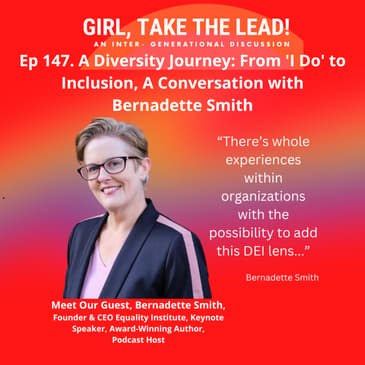
Bernadette Smith, Gen X, joins Yo to talk about her
book, 'Inclusive 360: Proven Solutions for an Equitable Organization' and provides rich insights into Diversity, Equity, and Inclusion (DEI). In addition to being an award-winning author of four books and diversity expert, Bernadette is founder and CEO of Equality Institute. The Equality Institute’s mission is to help organizations fulfill the promise of diversity by embedding equity and inclusion into organizational systems and culture, enhancing outcomes for everyone. Their vision is for a world where every human feels safe to express their authentic selves.
Equality Institute is a certified woman and LGBTQ+-owned business. Here are the topics we covered: Celebrating Good DEI Vibes ARC (Ask, Respect, Connect) Unconscious Bias Equality & Equity Power & Privilege Influence
Here are three takeaways from today’s episode:
1. DEI should not just live in Human Resources – it needs to live across all functions of an organization.
2. We can have a genuine feeling of hope about DEI efforts and not be overwhelmed or be fearful – we’re
all going to make mistakes and we can learn the most from things that are not working.
3. It is up to all of us to use our own power, influence, and privilege to lift and help others!
As Mentioned:
Her book: Inclusive 360
Her podcast: 5 Things In 15 Minutes The Podcast: Bringing Good Vibes to DEI
Her Newsletter:
https://www.theequalityinstitute.com/5-things
ARC (Free cheat sheet)
https://www.theequalityinstitute.com/arc-method
Equality & Equity Image:
https://interactioninstitute.org/illustrating-equality-vs-equity/
Wheel of Power & Privilege Image:
https://kb.wisc.edu/instructional-resources/page.php?id=119380
Other GTTL Episodes About DEI:
Ep. 19: A Model for diversity, belonging, equity, and justice leadership!
https://spotifyanchor-web.app.link/e/DDTc1bWNjIb
Ep. 65, The Power of Latino Leadership, Our Culture, Inclusion & Contribution
https://spotifyanchor-web.app.link/e/rAmtSxYNjIb
Ep. 73, Discussing Access Denied, Addressing Workplace Disparities and Discrimination with Author, Brenda Harrington
https://spotifyanchor-web.app.link/e/vTfMyVZNjIb
Ep. 88, Keeping Your Seat At the Table with Nori Jabbi: Ageism, Confidence & Courage
https://spotifyanchor-web.app.link/e/JjFoE41NjIb
Ep. 94, Courtnei Lee Joins Us to Discuss OYT Cosmetics, Plus Authenticity & Beauty
https://spotifyanchor-web.app.link/e/9iiFg31NjIb
Ep 103, Balancing Belonging and Uniqueness: The Heart of DEI Leadership
https://spotifyanchor-web.app.link/e/ZNNwIKJ1SHb
Ep. 104, DEI in Focus: Examples of Navigating Complexity
https://spotifyanchor-web.app.link/e/1cgLtKJ1SHb
More About Bernadette:
Bernadette has presented to enthusiastic audiences of CEOs, associations, entrepreneurs, leadership teams, sales professionals, account executives, marketing executives, human resource managers and more. Her expertise has been sought after by the New York Times, Forbes, the Washington Post, and Fast Company, among many others, and she’s appeared on the Today Show, the BBC, National Public Radio, and CNN.
Bernadette has been named one of Chicago’s Notable LGBTQ Executives by Crain’s Chicago Business and hosts the weekly podcast 5 Things in 15 Minutes: Bringing Good Vibes to DEI. When she’s not busy speaking, you can probably find her on a local pickleball court!
How to Reach Bernadette:
https://www.theequalityinstitute.com
How to Reach Yo Canny:
Our website:
email: yo@yocanny.com
FB group: Girl, Take the Lead https://www.facebook.com/groups/272025931481748/?ref=share
IG: yocanny
LinkedIn:
https://www.linkedin.com/in/yocanny/
[00:00:02] Bernadette, welcome to Girl Take the Lead. You know, we've had a few episodes about DEI, but to have you with us as an expert in this field, we are so excited to have you. So thank you for joining us. Yeah.
[00:00:16] Thank you. I'm really excited to be here. I love talking about this stuff. Great. Maybe we can start with, would you mind introducing yourself to our listeners so that they find out about your background?
[00:00:29] Because it was kind of interesting to hear how you went from wedding planner to diversity expert.
[00:00:36] Yeah, so my name again is Bernadette Smith. My pronouns are she and her. I'm a keynote speaker and an author and I'm CEO of a small diversity equity and inclusion consulting firm called Equality Institute.
[00:00:50] That's sort of where I am now and kind of like a little bit about what I'm doing. But years ago, back in 2004, I actually started my first business when I was living in Boston as a wedding planner specializing in LGBTQ weddings.
[00:01:06] And my goal was to be an activist wedding planner to help these couples navigate a very traditional industry.
[00:01:14] And so I did that and, you know, it was a really rewarding experience but I also knew that I could have a much bigger impact beyond the couples by educating the industry at large.
[00:01:25] So I started writing these books and doing inclusion training on LGBTQ plus inclusion and weddings hospitality travel, and all that and so that's sort of how my consulting work took form in that industry on that topic.
[00:01:43] You know, I got divorced and I was like, I'm tired of weddings. I ended up being in this place where I was planning very high end weddings and my activist wedding planner herself was not feeling a sense of purpose anymore.
[00:01:58] And my marriage was suffering and, you know, essentially I rebuilt my life. And part of that has been my career evolution and, you know, it's great. It's great being on the other side of all of that. And I have some stories. Let me tell you.
[00:02:20] Well, you have a terrific podcast and you have a book. Why don't you talk a little bit about those because I think our listeners would like to know about them.
[00:02:28] Sure, like, so I talk my whole thing is diversity equity inclusion but one of the approaches that I think kind of makes me a little bit different is that I like to focus on good vibes in DEI specifically celebrating what's working,
[00:02:45] and there are so many negative headlines. There's so much negative data, and it is very easy to get discouraged and feel like all we're doing is backsliding.
[00:02:55] But there are actually a lot of really cool amazing inclusive things happening in the world. And so what I do as a weekly exercise is I find five stories of what's going right and they're all sort of current news headlines things that you might not see
[00:03:14] in the news. And I find the stories, and I put together a newsletter called five things, and I send it out and it's celebrating good vibes and DEI. And then on the following Monday, a guest and I talk about those five stories on a podcast and on a LinkedIn live
[00:03:31] so it's like a way for us to, again, sort of celebrate what's going right build positive momentum, be inspired by what's working. And I love talking about this keeps me energized.
[00:03:45] Yeah. And your book, your book was filled with positive stories that companies were doing, you know, what you talk a little bit about your book.
[00:03:56] So my book is called inclusive 360 proven solutions for an equitable organization. And so the thesis behind the book is that DEI should not just live in human resources we need to look at it across all of the functions of an organization so it has best practices and really cool
[00:04:17] anecdotes along the lines of all of the HR functions, you know, so anything from hiring to interviews to talent development, all of that, but also stories about procurement stories about product development representation and marketing amazing training and listening
[00:04:37] to the organizations like so the whole experience within an organization. There are, there's possibilities to add this DEI lens. And so the book is about identifying how we're looking at DEI through an entire organization, because everyone has a role to play.
[00:04:57] It's not just sort of the role of HR. Well, I think you talk so much through the book about influence like using your influence. And I think probably right now we're a good example of influence.
[00:05:11] You know that you're here and you're going to share about your experience in your book and your podcast and, and I'm here providing a platform for you, you know to get the word out to perhaps an audience you haven't reached yet.
[00:05:25] So, I was really, as I listened to your book obviously on audible. I was hopeful. I would and I think that's what you want right you want us all to, to be hopeful and not feel like it's such an enormous task that so overwhelming.
[00:05:48] That's right. That's exactly right and I'm really glad that you've left with a feeling of hope because that is my brand, to be honest it really is. And I hope that comes across and everything that I put out into the world. And honestly, that's how I feel.
[00:06:09] I really do have that sense of genuine hope because I talk to people all the time who have really good intentions and who are really looking to do the right thing as it goes as it relates to D.
[00:06:23] But they just get overwhelmed. They don't know where to start. There's this sense of if I get it wrong, I'm going to be canceled. What if I say the wrong thing. There's so many reasons that folks get overwhelmed and that sort of continues the status quo.
[00:06:42] And one of my goals within the book was really to simplify it and to say you know it doesn't have to be rocket science. And in fact there are so many excuses that we can come up with for not doing this work.
[00:06:57] Well I wrote this book to get rid of the excuses because you want some solutions, you want to know how to do it like here.
[00:07:05] This is very, very practical. Your book was definitely I think you know we've had a few guests on that I've talked about DEI and it's hard to get started, but I think your book kind of gives everyone this is, you can start anywhere.
[00:07:24] You know there's no right way to do it. You can just dig in and start something.
[00:07:33] It makes me so happy to hear that you get it and that the book resonates with you and that it's effective. You know, I wrote it a few years ago and I'm still very proud of it so thank you.
[00:07:47] Yeah and your podcast is as your platform to keep it updated. Yeah, you can bet there's going to be a second edition.
[00:07:57] It was so good to hear some of the positive stories, especially in some of the big companies because they seem to be less nimble and flexible but you gave us a lot of examples there.
[00:08:11] You know one of the things we taught you and I spoke about was a backlash, a DEI backlash. Can you explain that a little bit more to our listeners.
[00:08:23] Yeah, I mean essentially it's a, I don't know how to talk about it without being political to be perfectly honest because it's really a right wing backlash to DEI that's essentially putting DEI under attack through legislation, anti LGBTQ legislation,
[00:08:48] legislation banning race discussion in schools, LGBTQ discussion in schools. So there's that kind of backlash and of course the overturning of affirmative action by the US Supreme Court, you know is a form of backlash as well.
[00:09:08] And so there's kind of a lot of negativity out there like there are a lot of reasons that one could be discouraged.
[00:09:17] And you know and then there are DEI layoffs, employees being laid off so there's that piece as well. So, you know there are some folks who are saying that DEI is over. And I will tell you that it is here to stay.
[00:09:38] I hope so, I can't imagine I had the opportunity, you know, before I retired a couple years ago to see within my own organization at the time how it was okay to be who you were. You know, I had 42 years of being silent. Assimilating.
[00:10:08] Try not to be different at all, even though the last name was Chavez, it was pretty obvious I was different.
[00:10:16] You know, try and be under the radar don't, you know, cause any waves. And what I saw happening just before leaving was no, like make some waves like, yeah, have an interest group have, you know, let all the Latinas get together and talk,
[00:10:36] you know about common issues and that made me feel good. That made me feel hopeful. I'm glad that must have been really heartening.
[00:10:46] It was, I mean because I could see how, you know, I've had somebody on who who helped me deal a little bit with the assimilation strategy and say, hey you know a lot of this didn't come into law until recently and, you know, that was how we survived, you know we just,
[00:11:08] we were one of a kind, you know we were the ones who were kind of sitting in the front row and your graduate school in business and with the Samsonite briefcase and totally being in fear.
[00:11:23] You know just rigid fear, whatever, because we just didn't know we didn't know how to how to navigate that. In some cases, our families couldn't teach us.
[00:11:34] Right. They won't mind certainly could because this is totally new for them to the theme. You know what a lot of my listeners love emotions. They love to hear about them. So I was talking about like my own fear.
[00:11:52] But do you think what role do you think fear is playing in this backlash and in other elements when it comes to DEI. I hear two kinds of fear. You know, I think that on an every human basis I hear kind of the fear of getting it wrong.
[00:12:13] The fear of saying the wrong thing, which ultimately means the fear of being canceled or you know at our core or the feeling of being unloved or rejected, you know so that fear.
[00:12:26] I think that the media has really perpetuated that fear. I just think that people are canceled and I don't think cancel culture helps anyone because this work of the guy is messy, and we're all going to make mistakes
[00:12:48] and normalize making mistakes and trying again anyway because the bigger picture matters. Yeah.
[00:13:00] Then we're going to be stuck, you know, and so it really does matters and the other fear is about loss of power in loss of control which is all, you know, sort of a white supremacy culture kind of thing.
[00:13:15] There were two things in your book that you talked about. One, one was a tool that we can use arc and I'd love for you to talk a little bit about that.
[00:13:30] And also, I think, looking at ourselves and our own privilege, our own where we're personally coming from our bias. So I know that those are three big topics, but we could take one at a time.
[00:13:48] So how about arc let's start with the tool that you gave us because I thought that was really interesting because that's not just for that I mean we can use that for anything.
[00:13:59] Yeah, so the arc method is a tool I created which really does have a lot of versatility and essentially the the thesis behind the arc method is if you don't know what to do.
[00:14:12] So I'm going to follow the arc. So the first thing to do is ask a question. So, ask exploratory questions to kind of figure out what the current state is. And so whether that's one on one with an individual.
[00:14:26] Ask open ended questions like hey can you tell me more about your experience with blank, you know so if you have a team member who's struggling. Maybe you have, you know, you will ask an open ended question would like that.
[00:14:40] So if you do that, if you are sort of having as a one on one conversation. Maybe you share a little bit of your own experience first maybe you talk about a time that you struggled or maybe you talk about a mistake you made.
[00:14:55] So we can open up a little bit first and then ask that question so that's the a the ask, and then we move on to the R, which is respect. And here we just want to make sure that we're not getting defensive that we're not interrupting that we're
[00:15:12] not interrupting what we hear that we're actually respecting the answers written if it's a one on one conversation that we're respecting the person who's sharing with us whatever they have to say. So we're not interrupting we're not dismissing we're just respecting.
[00:15:28] I always want to follow up with the C, which is connect. Now in a situation with, you know, kind of a broader situation connect is just going to mean like you're sort of summarizing the information you're connecting it back to the question you're kind of getting into action mode.
[00:15:44] One on one with an individual connecting is about kind of paraphrasing and summarizing what you heard maybe you say something like, Okay, so you, you're saying this.
[00:15:56] Wow, that must have been really hard, you know thanks for letting me know. So it's kind of a way to kind of tie it all together. So ask respect connect the arc method. I mean that was like a very brief summary. There's a lot more.
[00:16:12] So helpful though I mean because I think, you know we they. Renee Brown tells us you know that empathy and sympathy. You know, a lot of times we're thinking we're being empathetic, and we're actually being sympathetic. We're not connecting and actually creating space and distance from somebody.
[00:16:38] So I think your approach and your tool there is certainly helpful, at least getting things started right and you got it you got to give it a shot.
[00:16:50] That's right and because people can get so in their head, right likes overthink things way over complicate things right because it's our brains way of you know keeping us safe and avoiding the problem or avoid the situation.
[00:17:06] The I have arc method conversation starters so you can have some ways to start these conversations ways to wrap them up. So you can get the arc method cheat sheet on my website.
[00:17:18] It's definitely all in the book inclusive 360 so just so you have so you have those points of reference that you can use so it actually becomes practical. Great idea and we'll have that in the show notes for everybody too so that they can get that.
[00:17:33] Okay now, this unconscious bias thing because that is hot everybody's talking about it. And we all have it.
[00:17:44] We all have it. And I thought, you know your book just kind of brought that out a lot more for us to take a look at it and your example of being your own, you know, seeing your own bias was so great it was very.
[00:18:02] I know that there was a lot of vulnerability probably when you were writing that but it was so good. Thank you. Thank you. Yeah, I think it's this sort of goes back to talking about mistakes.
[00:18:15] I think as a leader and I think as a speaker and a writer. People are going to learn the most from me. If I take folks along on my own journey. And if I talk about the mistakes that I made.
[00:18:29] And the times that I've messed up and the biases that I am still working through. I want to tell those stories so that I can be more relatable.
[00:18:40] At the end of the day, it's my mission to reach as many people as possible and to bring as many folks along on this journey as possible.
[00:18:50] And that means that I'm making fun of myself and telling a talking about my mistakes because I know it's going to affect people then then yeah let's do it.
[00:19:01] You know, the reality is that biases are a form of assumptions, and we all go around making assumptions about other people.
[00:19:12] We all go around essentially stereotyping, but they're shortcuts right and so I talk about, you know, mistaken assumptions like broken gaydar, you know how I asked a woman out to a straight kind of thing.
[00:19:30] I don't know about that because that's essentially you know I stereotyped her right and stereotypes are kind of a form of bias so, you know we all do these mistaken assumptions every single one of us.
[00:19:43] And they also, the mistaken assumptions also sort of cause us to subconsciously assume that people who look like us, who checks similar demographic boxes to us are safe. Right, because we subconsciously believe that people who are like us they're more familiar they're more comfortable they're more safe.
[00:20:08] And that's how it plays out in leadership roles. That's how people who look like people the people who came before continue to rise in leadership roles and so it's all related. Yeah. Well I can remember hiring people and the question would be, are they a good fit.
[00:20:31] Yeah, right. I think we should probably get rid of that. Yeah.
[00:20:39] And say, is this person actually going to lead us forward, create a little mischief for us so that we're so she doesn't fit in, you know, like, like a cult thing like she's actually her own person and can, you know, move things and change things on her own.
[00:21:00] I think that's what we should hire for. Yeah, you know that there is some schools of thought that say the question should be a culture ad not a culture fit. So I think that sort of speaks to what you're saying yeah. Yeah. Yeah. I agree. What one other.
[00:21:20] Another thing that stood out for me in your book was when you were talking about equality versus equity. And I think our listeners would be interested in that. Can you talk a little bit about that? Sure, so, you know, equality is this sort of optimal state.
[00:21:43] Right. It's sort of like wow we should all have this sense of equality. But the reality is that we are very far from equality like it is way up here like it is the pinnacle right how wonderful would that be.
[00:21:57] Well, how do we actually get to a quality. We get to that with equity and equity that means the sense of giving more to those who need it, keeping in mind that different people have different circumstances they have different needs.
[00:22:14] And so equity is sort of acknowledging those different needs those harder circumstances perhaps and giving folks equal access to opportunity. So that's it's about equal access.
[00:22:30] Can you give the example that you did in the book about the tall versus, and then there's like a little bench or something that kind of that was.
[00:22:41] So here's a graphic you can probably Google it Google image search it but it's a graphic in which there are three kids trying to watch a baseball game.
[00:22:52] And so equality means that all three kids who are three different heights so there's a tall kid, a medium height kid and a short kid equality means that all three of those kids get the same height box because that's equal, except with the same height
[00:23:08] and the same height, the same height, the same height, the same height. And so that's actually not equal right it doesn't actually work out for everyone, but equity means that the shorter kid is getting the taller box.
[00:23:21] So that the shorter kid can actually see over over the fence just like the other two kids. So equity is giving more for those who need it. And so that's in this case the shorter kid.
[00:23:32] I thought that was so good because when I, I mean, oh that's brilliant how you describe that and I get the illustration.
[00:23:39] Yeah, because I think right now with our population becoming more and more diverse that there are so many new students who are going into business who have like I was had no background to our first generation going in.
[00:23:59] They just don't have. It's just not an equal playing field for them so I love what you're saying and, and I think one of the things you talk about to and probably believe strongly in is having mentors having people that can help them along.
[00:24:17] Are there other things too.
[00:24:19] Absolutely I think it's just so key to not only look for mentors but look for opportunities to be mentors and to be aware of one's own privilege. You know I think that that privilege is something we need, we need to keep talking about to be perfectly honest.
[00:24:37] And so in the book there's something called the wheel of power and privilege which you can also Google image search, neither of those graphics are, are my own original ideas.
[00:24:47] But the wheel of power and privilege lists marginalized identities illustrates marginalized identities on the outside the perimeter of the wheel with identities that have more power towards the center of the wheel.
[00:25:01] And so what I'm doing a keynote, I talked through where I fit on the wheel. And so the reality is, I am white so I'm in the center. You know I am a native English speaker, I own my own house, I have a master's degree, I do not have any disabilities like I have so much privilege.
[00:25:25] And yes, I'm a lesbian and yes I'm a woman. But so what honestly, you know, because I have so much power and privilege. And so the question then becomes, how can we use that to pay it forward. How can we use that to lift others up.
[00:25:46] Because a lot of those identities are a lot of those elements of our privilege we didn't earn. You know, at least I know I didn't. And so I really feel a strong sense of responsibility as it comes to that and I think that part of how we learn how to use that power and privileges to reflect on who's given us a
[00:26:06] shot, thinking about the past who's taken a chance on us and how can we do that for others.
[00:26:14] Well, I know that I was privileged to have affirmative action happen right then when I got my MBA and you know I was moved in and that was like 1978. So it's late 70s.
[00:26:30] And I know that that helped me enormously. And, you know, and it's, it really is my honor, and to give it back to, you know, say come on, you know, let's, you can do this, you know.
[00:26:46] And it's such a joy, actually brings a lot of joy to my life to do that so I imagine it does to yours as well. Absolutely. Yeah.
[00:26:56] Well, we kind of have covered a lot of what we plan to talk about but I'm wondering if there's any advice that you would give to our Gen Z and Millennial generation up and coming leaders. I'm going to guess it has to do with influence but.
[00:27:15] You know, my advice is to stay the course and keep the pressure on because without accountability. DEI initiatives are not going to continue to get done they're not going to stick right so hold your leaders accountable.
[00:27:32] And if they aren't doing anything, ask for it. Like you have a lot of power, you have a lot of influence and this stuff is not fast. No one ever said that it's easy, but stay the course and use your power.
[00:27:50] And so, Bernadette what would you tell your 20 something self today. Well my 20 something self was a wedding planner struggling with imposter syndrome not knowing how to ask for help, really over her over her head.
[00:28:11] So I would say to my 20 something self the first thing I would say is learn how to sell because sales skills are the most important business skill you need so expedite that. Interesting.
[00:28:28] Yep. Yes, I guess I was in marketing for so many years 42 years and sales was like the enemy. Oh and all kinds of judgments about you know the sales people versus the marketing people organization.
[00:28:47] I was pretty good at marketing, but I didn't know how to be comfortable in my own skin. You know, I look I totally agree with you I think for me now. I appreciate that skill.
[00:29:04] And, you know, developing it and being able to, to at least, you know make requests and, you know, to have the energy and, you know, to have that kind of inclusion, I think sales people are very inclusive people so.
[00:29:22] Is there anything else before we kind of close our episode like that you would like to share with our listeners. Yeah, you know I would really encourage you all sort of get in the line of saying the course to subscribe to my newsletter because of the good vibes piece,
[00:29:38] because it will keep you filled up, because it will help you stay the course so check out my newsletter five thing you can subscribe at five things di.com.
[00:29:49] But I just think that we need that positivity right I just think that we do. It's an election year gosh I mean there's so much garbage. So much garbage we've got to find the good vibes. And on that good vibe.
[00:30:08] episode today so thank you for listening and thank you for being with us from the debt. My pleasure, thank you.