
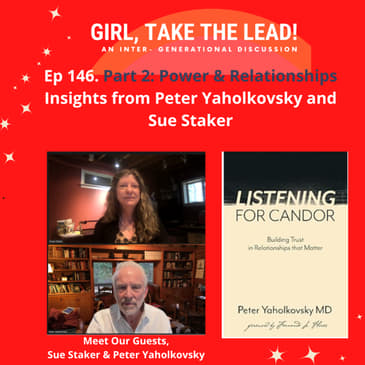
This is Part 2 of a 2-Part Series:
Peter Yaholkovsky and his partner in life, Sue Staker, Boomers, join Yo to discuss Peter’s book, Listening for Candor: Building Trust in Relationships that Matter, which illuminates a path for trust conversations by starting with a shared sense of what matters. Peter has an extensive background in the linguistic foundations of trust and communication, having studied and worked with Dr. Fernando Flores since the 1980's and being certified by the Strozzi Institute as a Master Somatic Coach.
Over the past three decades, Peter has coached families and executive teams in building and restoring trust. In addition to being life partners for 25 years, Peter and Sue worked together as part of the Williams Group team to bring trust building skills to wealthy families.
Here are the topics we covered in this 2-part series: What is candor and how can it build trust with others?
What is the role that emotionality and intention play in relationships? How does trust differ in personal and professional settings? What does power have to do with listening with candor? What elements need to be present to “save” a relationship and when to let it go?
Here are the three takeaways from the series:
1. The “truth” of Candor is sincerity
about one’s intention and care—about ‘what matters’—a departure from speaking “honestly” or being “right” about the past.
2. Sincere engagement is to want to understand another more fully.
3. Vulnerability to a power differential can wreak havoc in conversations when “what matters” is protecting
oneself from the risks of engagement.
As Mentioned:
Peter’s book:
Listening for Candor: Building Trust in Relationships that Matter
The Williams Group:
https://www.thewilliamsgroup.org/
Dr. Fernando Flores: https://conversationsforaction.com/fernando-flores Strozzi Institute: https://strozziinstitute.com/
More About Peter & Sue:
Prior to his consulting career, Peter practiced Internal Medicine as a Board Certified Internist after graduating from Stanford University and UC Davis Medical School. Sue has done executive coaching for some 20 years.
How to Reach Peter & Sue:
The contact link at peter-yaholkovsky.com (Website)
How to Reach Yo Canny:
Our website:
You can send a message or voicemail there. We’d love to hear from you!
email:
yo@yocanny.com (Yo)
FB group: Girl, Take the Lead
https://www.facebook.com/groups/272025931481748/?ref=share
IG: yocanny (Yo)
LinkedIn:
[00:00:00] Welcome to episode 146, which is part 2 of a two-part series of Girl, Take the Lead, where each weekly explore womanhood and leadership. And I'm your host, Yolanda Canny. In this episode, Peter Yaholkovsky and his partner in life, Sue Staker, join us to continue the discussion
[00:00:26] about Peter's book, Listening for Candor, Building Trust in Relationships that Matter. In addition to the career backgrounds presented in part 1 for Peter and Sue, you might like to know that Peter practiced internal medicine as a board-certified internist after graduating
[00:00:45] from Stanford University and UC Davis Medical School before he started consulting. And Sue has been an executive coach for over 20 years. In addition to being life partners, Peter and Sue also worked together as part of the Williams Group team to bring trust-building
[00:01:05] skills to wealthy families. Please listen to part 1 because it lays the foundation for what we'll cover today. Today, we'll go deeper into the power differential and what it has to do with listening with Candor. Plus, we'll look at the notion of pretense
[00:01:25] and have some tips to prepare for discovery conversations like taking the bunny hill first. Plus, you'll want to hear the heartfelt expression of love at the end of the episode. And heads up. Might want to have a hanky nearby. Enjoy the lesson. There you go.
[00:01:50] One element that I think can add to the drama of the relationship is the notion of power. Oh, yes! You bring up in the book. Yes. That is... And I'd like to hear Sue talk a little bit about that because I think from
[00:02:12] a female male point of view, there can be dynamics of power happening there too. From a gender perspective as well as an authoritative perspective. But anyway, this could be so cool. So please jump into that.
[00:02:30] Gosh, there's a whole world there. Yeah, well, in the book, we talk about a power dynamic because it, again, because it matters. And it often also kind of exists in the background. Everybody knows it's there, but nobody talks about it. So on an executive team, you know,
[00:02:52] it can be, you know, we all matter. We're up to what's important. We care about each other. And I never for a moment am going to forget that the guy I'm talking to is
[00:03:06] the one that gets to fire me, that gets to decide what my bonus is, that gets to decide how much money I make or don't make next year. Like, that's... You know, we bring that sense.
[00:03:19] Often, the person with the power is oblivious to it, like blind. So we often find in that example of an executive team that the guy who has all the role power or authoritative power
[00:03:39] in the business is the one who goes, oh no, I'm just Jeff. Everybody knows, you know, like I'm just Jeff. And meanwhile, I can look around the table and go, nobody else thinks
[00:03:52] you're just Jeff. Like they all know. So it's waking people up to where that power is. And just not being blind to it, not being silly about it, just being... It's like, oh, I need to take
[00:04:09] that on. I need to own that. Yeah. Because in the examples with families, it's like we can have a disagreement about this. You know, at the end of the day, we're still a family. Nobody in the
[00:04:24] family or let me put it a different way that the children in the family, even if they're 62 years old, they don't forget who is going to decide what's in the will. Yeah. Where the money's
[00:04:44] going, where it's not going. And yet the person who gets to decide that goes, oh, no, no, that's okay. Nobody even thinks about that. Yeah, we do because we're human and we have a sense of self
[00:04:59] preservation, right? We protect ourselves. Yeah. Maybe you probably have something to add. Yeah. So what Sue's talking about is how familiarity with being advantaged in the power differential can produce blindness. You just get so used to it,
[00:05:21] you don't even notice. We see this with chief executives who are owners of big companies, they come home and they're still being the boss and they don't even realize it. They're family members. Yes, they're family members.
[00:05:42] And so what they get in response is pretense. People who are basically protecting themselves from this power that could cause them problems. So they're being careful. And like Sue said, quite often we talk to senior executives and they go, oh no, I've got an open door. People
[00:06:03] can come to me with anything, anytime. And you talk to the people and they go, yeah, right. They know exactly what are the topics they have to be careful about. Now, against all that or
[00:06:16] including all that is this notion of what matters. So if you're listening for what matters and you are careful and diligent about getting aligned on what matters, that's how you get
[00:06:32] the power of the other, the power of you to be lined up in the same direction so that you're no longer at risk. So that's why you notice that you can see often an executive assistant
[00:06:50] some real severe powerful guy, often as guys. And they can see quite freely and openly with the guy. Why? Because they know that the guy is going to treat them well. Yes. It's not going to be
[00:07:07] offended by it because they know that the guy is counting on them to be fully aligned. So a line about what matters is a way to mitigate the potential detrimental effects of a power
[00:07:25] differential. That's kind of a technical way to say it. But yeah, and that's why it's so important to listen for what really matters. Otherwise you're dancing around this power business.
[00:07:37] And I mean, I've seen say in a family where the big guy finds that his kids or maybe one of them either are like acquiescent but distant. Or maybe you have one who's hiding out in the
[00:08:03] background and every now and then will jump out an ambush him with a potential small mistake and then jump back in. No, you're wrong about that. We actually did that in December, not in
[00:08:18] November, like some totally meet just to be right and then to hide again. Why? Because the power differential is just dominating the whole scene. And yet I've also had patriarchs who say,
[00:08:37] but it seems to me that they have all the power. Yeah, you know what? The power they have is the power to not let you connect emotionally. They with old emotional connection. And that is often the motivation as these older guys start to hear the waterfall.
[00:08:59] They realize, I'm going to mix metaphors, that they have a limited runway and they suddenly realize they don't have the relationship with their kids that they want. And they find that they cannot order their kids to be open and connected. And then I tell them, hey, look, yes,
[00:09:20] your power here. They go, what my power? And until you sort that out, they get honest and straight about it and then line up to be going for the same thing in the same direction because
[00:09:36] that's what matters to us. Then the power differential starts to be less of a problem. But until you have that conversation, it ain't going to work. And unfortunately, that might be an aspect you learned of that in a more traditional way women
[00:09:56] are familiar with is that often, and I am going back dating myself so to speak, but withdrawing care and affection is a way that women, one of the only ways that women could bring power into the game. So I might not be the primary bread earner,
[00:10:18] I might not be the one who gets to hire and fire, but I can withdraw emotionally. I can go away. And that is another kind of power. And it was pointing out whether it's often been with the patriarch, but we've also, we have also had this experience with
[00:10:40] a powerful matriarch that's realized that her children are not available for her or with her in a way that they used to be or in a way that she wants. Oh, that's so interesting. Yeah, power differential show up not just in who controls the money,
[00:11:00] but also in the emotional dynamic of the space. There's one more thing I know you talked about certainty like being right, can sabotage a relation, you know, getting into relationship with somebody. But you also mentioned pretense, like, I thought that was good. Oh, yeah.
[00:11:31] And if you could just talk a little bit because sometimes I think we pretend. Yeah, so this pretense thing is it has two motivations either. It's either basically fear taking care of myself because I think that I could get hurt with you. Something valuable to me
[00:11:57] is potentially at risk, this feeling of real vulnerability or like risk, that kind of vulnerability, not the kind of vulnerability like being open and sharing, but that if I openly share, I'm at risk in some way. That's one kind of motivation for being careful and not showing
[00:12:23] all my cards and not really listening to you other than whatever matters to you. I have to be careful and learn how to dodge. Okay, kind of like the way you are when you're driving a little
[00:12:37] faster than speed limit and you see the blue and red lights behind you and your policeman comes up and you are going to be careful. So that's just the overpower differential. There's another
[00:12:53] kind of pretense, which is where you have the greater power. And this is the one you see quite often where the one with greater power has already made up their mind, but they're putting on a show
[00:13:07] of listening for input from the others. And then the others go, yeah, right. And they give you the kind of fake input and then everybody shows up at the water cooler and it's the big cordial
[00:13:25] hypocrisy conversation. So it can go both ways where the one with less power is protecting themself or the one with more power doesn't want to waste their time. And it's all pretense, it's all a charade and people think that's relationship and you wonder why
[00:13:51] working in some businesses is so draining emotionally. It just can't be fulfilling there because you don't have real relationship. You just have doing things. Yeah. And pretending about some of the things you're doing. I think that pretense is such a
[00:14:09] perfect description, but it's not worth dying on that hill. So I'm not even going to go there. I'm just going to light noises and go, uh-huh, uh-huh, uh-huh. Yeah, sure. I don't mean it at all, but I don't want that fight because I can't win that fight. Yeah.
[00:14:29] And I saw one company where the culture was nobody ever declines a request. So what you got is fake promises. We're very careful to clarify promises so that when somebody says, hey, did you get it done? They say, oh, you mean this Tuesday.
[00:15:03] I call that intentional ambiguity and until we could open up the clear validity of a decline in counteroffer, there was no hope of getting an authentic promise. Now that was pure operational space of a company. Well, I can remember being that manager and passing
[00:15:28] along assignments. Yeah. And I had somebody tell me once, oh, no, I have quite enough to do already. I can't take that on. And I was shocked, you know, like, well, wait a minute,
[00:15:45] here in the United States, we just came to it, you know, and you stay all night if you need to get it done or whatever it is. But that was very mind blowing to me that someone could manage
[00:16:00] themselves and their work in a way that they could say, no, that's too much for me to do. We talked about a move we call a commit to commit. So you're asking me for a promise and what I'm
[00:16:16] not going to accept or decline, I'm going to say, you know what, Yolanda, let me go back and check what's actually on my schedule for this week and how much I've already promised to other people
[00:16:26] and I'll let you know by the end of the day if I can do that or not. Yeah. And it's good, if you have that kind of relationship with somebody, you know, like in my case where he could just be
[00:16:37] totally honest and say, no, I can't do that. It's fantastic. But I get the reaction is a great example of how rarely we actually get to be at risk with each other. Yeah. And talk about the workload.
[00:16:57] I think our younger generations are doing a better job than I did, you know, in that regard. They've learned from us in that respect. And I've thought about this with our kids that,
[00:17:11] you know, we've given them a certain example where they go, yeah, I don't want to work like that. Thank you. But no. That's good for them. Go for it. Make a better life, definitely. Well, one of the things that I thought was also very good was
[00:17:34] like, you know, typical yo here on this end is, oh, let's I want to go have a discovery conversation with somebody. Like, yeah, and you know, but but I think you are put it so well in the book, like you just don't jump into this.
[00:17:50] Mm hmm. You know that there's preparation to do. And, you know, I thought that was so good. Can you talk a little bit more about some of those thoughts? Yeah, there's there's preparation in two ways. One is to recognize that
[00:18:11] that even though we can outline a path for how a conversation might go, the forest that can never be fully anticipated needs to be navigated. You're going to go out there and have a conversation.
[00:18:26] In that conversation, you are for sure going to have stuff happen that will produce emotions in you, your emotions. It doesn't do it, but you respond to it with emotion. Right? Now,
[00:18:45] so that means I have to be in one way somewhat knowledgeable about myself so I know what kind of stuff I might come up with. And I need to recognize that whatever it is, it's mine.
[00:19:00] Now, there's a number of different ways to kind of familiarize myself with my emotional kind of structure and to get more skilled at not being derailed when it happens. And it can range from certain meditative practices, mindfulness practices. There's
[00:19:24] certain kinds of biofeedback that are really good for that, like heart math and things like that. But in the end, the best thing I found is just having real conversations that are relatively
[00:19:43] low stakes. So as opposed to the one about should we stay married? It's a high stakes conversation. I'm trying to exaggerate there. But actually listening to, you know, we were talking about going out for dinner. What's important for you about this?
[00:20:06] Is it that we go to a place where we can do karaoke or is it we have a place where it's quiet and we can have a nice dinner? What is it? What matters to you? And how can I get
[00:20:19] aligned with that? That tiny little that I consider an easy one, right? You want Italian or sushi is a relatively easy one. And you can get used to engaging yourself with other people's
[00:20:39] life. That is the big deal. The further you go, the better you get at that. The more you can do that. It gets so that, yeah, you can handle big stuff, surprising stuff. But you need to because
[00:20:53] guess what? You're going to have big stuff coming in. Life is like that. You've got kids. You're going to have weird stuff happen with your kids for sure. Yeah. You know how that is. So
[00:21:05] I'm reminding you, Peter, actually of something that might be important to make sure we talk about briefly is what's being brought forward in the book or in the work we do is it's about
[00:21:17] learning that we are actually learning a new confidence. And it would be lovely if I could pick up a book and read the book and go, well, I've learned all about it now. I'll behave differently tomorrow. Well, no, actually I won't. And if tomorrow unfolds
[00:21:34] the way it probably will, I'll have forgotten everything I read in the book 10 minutes into the day. So learning is happens over time and it happens through practice. I need to repeatedly practice new skills so they become embodied so that they actually, I have them
[00:21:54] to hand. So if I want to, you know, for example, learn to be more a good example, I want to learn to be more aware of the moods I'm bringing into conversations. Well, yeah, let's start with some bunny hills. It's like, okay, Peter, I really want to make
[00:22:16] sure that I'm showing up as really present and patient with you. So I'm going to be working on that and one now I've said it out loud. He's aware of it. I can actually check back later. So
[00:22:29] Peter, did it even show up that I was trying to be really present with you, that I was looking in your eyes, that I was taking a breath, being more patient and not being abrupt? Oh,
[00:22:41] not so much, huh? Okay. Please tell me how it did show up to you. So yeah, practice, patience, perseverance is what needs to happen for us to learn new confidences. Yeah, I like the bunny hill. The bunny hill imagery is really cute and I can really get that,
[00:23:03] like take it a little at a time. Yeah, we've used that whether executives are with, you know, with the families, we've, you know, you don't start out on the double diamond run with locals. You start out on the bunny hill. Yeah, I love it.
[00:23:22] Well, you guys, what do you have? We missed anything. I know we kind of went through a lot of distinctions there, which I think were very helpful and yeah, the one is so we talked a
[00:23:36] little bit about, I mean, I look at the course of how the chapters are laid out. Yeah. Since I had to deal with that for years, is this first this notion that candor is really willing to be revealing about what matters and listening for candor
[00:24:04] is listening for that, but in a way that you're willing to be receptive to the others revelation so there's revelation and receptivity. I'm willing to reveal what's important to me, what matters and you're willing to be receptive and allow yourself to align with that and reciprocate.
[00:24:29] So you got revelation, receptivity and reciprocity. I love it because you get they all start with are, you know, but that is so so so crucial and my sense is that happens everywhere. Even if you
[00:24:46] practice with the person doing the checkout at the grocery store really being open to the moment of this is a live human being in a moment of their life in your life together. That kind of practice is what she's calling bunny hill, but it's worth it.
[00:25:08] As opposed to simply regarding them as an object. Like you know that they could be replaced by a mechanical robot that said thank you very much. And so I think the whole thing about being this way with people
[00:25:27] and then I got to deal with there's gender differences, there's culture differences, there's regional differences. There's people who don't speak English. Guess what? Not everybody in the world speaks English, you know, and so then the whole relationship space is potentially available
[00:25:46] to us and I'll throw one more thing in there. We don't just relate to people. We relate to moments of life, including animals. Absolutely. I'm not saying they're equal to people. I didn't say that, but I'm saying that that's an aspect of
[00:26:08] relationship also and communication happens in there. It's a different kind of communication. But we're, I think, so oriented around the material world that when we start to take a break and look
[00:26:26] in the other direction and shift our attention to the relationship world, we have a lot to learn there. Well, I think just thinking what a beautiful word and world it would be if we actually all had
[00:26:40] the experience of just that, that simplicity that you're a human being and I'm a human being and we're absurd when we matter and we have feelings and people just see each other for a moment and be with each other. What a delight to be with you both.
[00:27:04] It's been wonderful. I love your question. And we're right on time, you are. Oh, yes. Yolanda has to get together. And this has been fun even more. Oh, thanks you guys and thanks for being here today and sharing your terrific book.
[00:27:21] And it's an act of love eight years in making but thank you for doing it. Thank you. It's going to help so many people understand the complexities of things. So thank you. And some of this. And I'm just going to close with Peter.
[00:27:43] I'm going to trust you do know how incredibly proud I am of what you've accomplished here and the contribution you're making to others. Thank you. Thank you. It matters. Oh, it totally matters. Another emotional ending for me. So I'll be in touch with you by email for now
[00:28:06] and we'll go on for there. Take care. And we'll have in the show notes, everybody, where you can get this book and how you can follow up with Peter. Okay. Okay. Take care. Bye. Bye.
[00:28:21] Thank you for listening today and we sure hope you enjoyed this episode. If you did, please leave a comment wherever you listen to your podcast, tell a friend about us, join our public Facebook group girl take the lead or visit our website girl take the lead pod.com.
[00:28:39] We also have a YouTube channel where your subscription would be appreciated. Once you're on YouTube search at girl take the lead. And we've recently expanded into YouTube music where you can find a video of this episode. Here are the three takeaways from this
[00:28:57] series one, the truth of candor is sincerity about one's intention and care about what matters a departure from speaking honestly or being right about the past to sincere engagement is to want to understand another more fully and three vulnerability to a power differential
[00:29:24] can wreak havoc in conversations when what matters is about protecting oneself from the risks of engagement. Wasn't this a great series I hope you've listened to part two you also listen to part one and that you enjoyed it and we'll check out Peter's book. It's an important read.
[00:29:45] Oh yeah. Next week we'll have another guest Bernadette Smith diversity equity inclusion and belonging speaker and author of the book Inclusive 360 she's also host to the podcast five things in 15 minutes the podcast bringing good vibes to DEI where she puts the spotlight on positive
[00:30:10] things going on in the field. Please join us again. Thanks for being here and talk to you soon. Bye