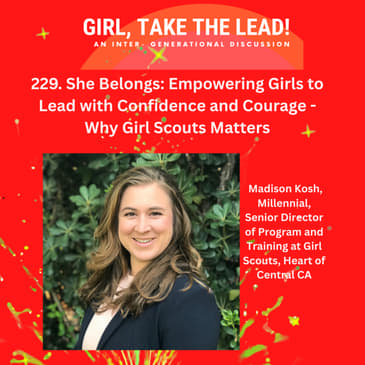
Madison Kosh, Millennial, is the Senior Director of Program and Training at Girl Scouts, Heart of Central California. A dedicated mom of two, she is passionate about championing girls’ ambition and creating meaningful group experiences.
With over a decade of outdoor leadership experience and seven years of leadership within Girl Scouts, Madison is committed to equipping girls with the skills and confidence to navigate the world, find their voice, and create lasting change in their communities. Her deep love of the outdoors has shaped her journey—from Girl Scout to wilderness guide, outdoor retail expert, camp director, and now Senior Director of Program and Training—fueling her mission to empower the next generation of leaders.
What You’ll Learn in This Episode:
0:00 Introduction
1:05 Madison’s Leadership Start
5:43 Girl Scout Journey
9:00 Why for Girl Scouts
11:51 Parent’s Leadership Thoughts
14:53 Biggest Challenges
16:37 GenZ Impact
20:31 Gen Alpha Impact
24:26 Programs
29:08 How to Support Girl Scouts
31:16 20-Something Self Advice
Quotable Moments:
“Nothing challenges you more as a leader than taking a group of people out into the wilderness where you’re in survival mode.”
“We need to teach young girls how to be confident and have the skills needed to live in this world.”
“Who do you think runs this whole camp?”
“All the things that parents are looking for their child to have are within Girl Scouts.”
“GenZ is craving that connection but they are so busy!”
"There’s a trend in Gen Alpha research that shows that persistent sadness and hopelessness in teenage girls increased from 36% in 2011 to 57% in 2021. (CDC)"
“In prior years the #1 response was mom as a child’s key role model.”
“We are trying to create a space for every girl or everyone who associates as a girl or associates with the Girl Scout experience.”
“We’re really creating a space where girls can come and be themselves as nurture that and give them the skills to be resilient, be confident when they walk into any room, and she knows that she belongs and can succeed. Having personal growth and a strong sense of self that can keep her emotionally anchored through both good and tough times.”
“Also girls get a bigger understanding of the world – a global element.”
“Buy Girl Scout cookies!”
“Happy Birthday, Madison!”
Three Episode Takeaways:
1. It’s important for girls to have interaction with women in strong leadership positions.
2. Parenting is challenging. The encroachment of technology and the belief that the world is unsafe and increasingly divided can lead to parental fear and isolation. The focus is on family and want their kids to develop skills, and new styles of leadership. Most important is having the child be their authentic self. Mental wellness is a primary concern.
3. Research indicates that people know what Girl Scouts is but they don’t know what Girl Scouts do outside cookies. We have a lot to learn from GenZ. The data indicates: strong entrepreneurship, high anxiety, skepticism, and high agency (“I can do this”). They crave downtime and the ability to do nothing and want to build relationships/friendships.
Gen Alpha is all in on technology as a way to learn. They aspire to be influencers, do not see mom as a role model and are looking.
Episode Resource:
Ep. 7, Girl Scouts: More than just cookies?”
https://spotifycreators-web.app.link/e/zY0gryNR9Sb
How to reach Madison & Support Girl Scouts:
madison.kosh@girlscoutshcc.org
https://www.girlscoutshcc.org/
https://girlscouts.org
(find your local Council)
FB & Insta https://www.facebook.com/GSHCC1/
LinkedIn: company/girlscoutshcc
How to reach Yo:
Our website:
www.girltaketheleadpod.com
You can send a message or voicemail there. We’d love to hear from you!
email:
yo@yocanny.com
FB group: Girl, Take the Lead
https://www.facebook.com/groups/272025931481748/?ref=share
IG:
yocanny
YouTube
LinkedIn:
https://www.linkedin.com/in/yocanny/
[00:00:07] Welcome to episode 229 of Girl, Take the Lead, where each week we explore womanhood and leadership. And I'm your host, Yolanda Canny. Madison Kosh, millennial, is the senior director of program and training at Girl Scouts, heart of Central California. A dedicated mom of two, she is passionate about being a champion for girls' ambition and creating meaningful group experiences.
[00:00:35] With over a decade of outdoor leadership experiences and seven years of leadership within Girl Scouts, Madison is committed to equipping girls with the skills and confidence to navigate the world, find their voice, and create lasting change in their communities. Her deep love for the outdoors has shaped her journey and what you'll hear about.
[00:01:00] From Girl Scouts to Wilderness Guide, outdoor retail expert, camp director, and now senior director of program and training, all fueled her mission to empower the next generation of leaders. I would also add that Madison is very generous. She shared her birthday with us when recording the episode. So please join me in wishing her a happy birthday.
[00:01:28] Here are some things you'll learn in this episode, particularly about why girls benefit from Girl Scouts and some challenges facing girls today, particularly for Gen Z and their ages 13 to 28 and Gen Alpha, those girls that are younger than 13. Plus Madison shares some of the programs Girl Scouts have to offer these girls.
[00:01:57] You know that I have a passion for Girl Scouts. I have to confess, I'm a member of the Girl Scout Northern California San Mateo County Giving Circle, where about 30 of us pull our contributions together to help create programs and support programs for Girl Scouts. More than that, and our other episodes about Girl Scouts will be in the show notes for you. Enjoy the episode. Here you go.
[00:02:27] So Madison, welcome to Girl Take the Lead. We love it when Girl Scouts are here. I'm glad to hear that. Thank you. Thank you for inviting me. I'm excited to be here. Sure. Yeah. So why don't we start, if you would please introduce yourself to our listeners and our viewers so they know a little bit about you. Sure. Yeah. My name is Madison Kosh. I am a millennial. I was born in 1987.
[00:02:54] I live in the Sacramento area where my husband and I are raising our two daughters, ages four and two. And then a little bit about me and how I see the world. I am a learner by nature. I am particularly intrigued by learning about people and what makes them unique. And I am that big picture idea person.
[00:03:21] Hmm. So how did you find your way to Girl Scouts and tell us about you being on staff there and what your role is and have a great. Yeah, I can give you a little bit about my leadership journey. And for me, that goes way back. I would say, you know, growing up, I had a big family, had a mom and a dad and a little brother, but my extended family was rather large. My mom was one of six kids. My dad was one of five.
[00:03:52] There's 14 cousins on my mom's side and 11 on my dad's and being the oldest girl on my mom's side. I did a lot of babysitting. And so within that, you know, there's a lot of leadership that starts there. And then when I was seven, I became a Girl Scout and I was a Girl Scout from the age of seven until I graduated high school.
[00:04:17] And we can talk. We'll talk more about what that experience looks like a little bit later on. And then it was through Girl Scouts that I got a taste of the outdoors and my family liked to camp and stuff like that. So when I went off to college, it was a natural fit to get involved with the outdoor adventure program on my college campus.
[00:04:42] And part of that was a ropes course. So I became a ropes course facilitator. We had a ropes course on campus. And for those that don't know or haven't had the experience of a ropes course, it's really where groups of people come and there's some climbing elements, but there's also some low ground games and initiatives that really help with team building and connection.
[00:05:10] And that was a really cool experience. I got to work with a variety of groups anywhere from, you know, corporate, corporate groups to community groups where sports teams or, you know, Girl Scouts would be in that category as well as college classes and college students would come out. And so I got to see a lot of different groups and work with that and help them through their challenges.
[00:05:38] And I learned a lot and I had a lot of really great role models in that space. And you know, I was a wonderful woman who I just wanted to be when I grew up. So, um, you do give us that don't they? I mean, when we, I can remember going to camp and just following the counselors around and just wanting to be just like them. And, you know, but I wanted to be like the camp director. Yes.
[00:06:03] You know, like she was so amazing and she, she just looks so beautiful to me. Yeah. That's awesome. They put, they did, they do teach us early about leadership. And so that kind of got you started there to go. Yeah. Yeah. And then it continued. I just, I fell in love with the outdoors. I had done your basic like camping and things with Girl Scouts, but it wasn't until I started, um, yeah, the ropes course experience. And then they also did wilderness trips.
[00:06:33] So I had learned how to backpack and rock climb and mountain bike and do all of these more extreme outdoor activities. And I'll tell you, nothing, uh, challenges you more as a leader than taking a group of people out into the wilderness where you're in like survival mode or, um, you know, you're taking a group down. And I became a whitewater raft guide and that, like that's the ultimate, uh, leadership exercise.
[00:07:01] You know, you you're steering and you're relying on your team to paddle when you say paddle and. Yeah. And working out lots. And they're filled with all kinds of emotions like fear. Yes. And you're, you're trying to hold the space for them to work through that so that they can begin to see, ah, okay. So it's on me. I've got to work through this. It's a good blend of technical skill and that emotional intelligence for sure. Yeah.
[00:07:30] So I really grew in that leadership. And is that kind of how you got to Girl Scouts? Yeah. So, uh, that's part of the journey continues because after college, I, um, I graduated in the middle of a recession with an accounting degree. And so no accounting firm wanted to hire me with no experience. They all wanted five to 10 years experience at that time. So, um, I ended up working for an outdoor retailer.
[00:07:57] Um, and this is where the journey to Girl Scouts kind of started because it was the first time I experienced being treated differently for being a woman. Mm. And at this retailer, I worked in the, uh, department that sold skis and kayaks and bikes. And the majority of the, the customers were men, not all.
[00:08:24] And there were multiple times where I've got a couple stories of like, anytime I was standing, you know, ready to serve a customer. And I was standing next to a male coworker. They would autumn customers would come up to us and they would always address my male coworker, like look him in the eye and ask them the question. And I started to pick up on that.
[00:08:49] And then there were other times where I'd be helping a gentleman, um, you know, buy a bike or something like that. And they were asking questions and I was, uh, answering their questions. And then, uh, one of my male coworkers, or usually it was like a bike shop, um, employee who had, you know, an apron on and, uh, and I had one customer say, does she like mid sentence, like just interrupted me. He's like, does she know what she's doing?
[00:09:18] And I'd be like, what is going on here? Yeah. And of course, you know, we had, um, wonderful coworkers. So they're like, oh yeah, you know, she trained me. She's wonderful. She knows everything. Um, and so that really started to be like, wow, this is, this is out there in the world. And what can I do about it? So it started that thought process.
[00:09:42] And, um, on, on that journey, I was asked to be a part of the women in leadership initiative that the organization. And so, um, I paired up with two other women in California. Um, and we, uh, sort of went around to give presentations and try to, to work with not just the women in the organization, but how to be an ally for the men that vision too.
[00:10:09] And it was through that experience that I really just started to see, you know, working with women and their, their confidence level. And, um, that we really need to start this earlier. Like I was like, no, we need to teach young girls how to, um, be competent and, um, just have the skills needed to, to live in this world. So that's really what led me to Girl Scouts.
[00:10:37] So then I, I, there was a posting for a camp director, which is, you mentioned camp director before. And so, um, of course my background in outdoors and my passion, I was like, oh my gosh. And my experience as a girl. So I was like, this position was made for me. So I, of course applied for it and got it. And, uh, that was my dream job. That was amazing.
[00:11:02] I got to spend the whole summer up in the woods, hanging out with, uh, brilliant young minds who just are full of hope and see the world, uh, beautifully. So, um, uh, there I was, I have another story to share during that summer that just sort of solidified everything for me and gave me my why at Girl Scouts.
[00:11:29] And that was, it was lunchtime and I was sitting in the dining hall at a table with one other staff member and a couple of campers who were probably, you know, anywhere from seven to 10 years old. And they were asking a bunch of questions about camp. And they had asked my, um, coworker, you know, what do you do at camp? And, you know, she answered and then they asked me like, oh, what do you do?
[00:11:57] And my staff member was like, well, who do you think runs this whole camp? And the girl said, uncle Buck. Now backstory at camp, we all have camp names. So nobody knows your real name. So uncle Buck is a camp name. Um, and uncle Buck is the property director. So, you know, he's around camp, he's visible, he's, you know, fixing things and building things.
[00:12:24] And I just said, that's interesting. Like, he's not like a campfire or not in a dining hall or not like in any sort of leadership capacity. And I said, why do you think uncle Buck runs the camp? And she said, because he's a boy. Oh my gosh. And I was like, oh my gosh. Like, I would have never even put that together, but kids are so observant.
[00:12:50] And you could just see how the world had led that particular girl to think that, oh, boys are in charge. Um, and so that really lit the fire. And I was like, okay, this is such a need. And it's important that these girls are interacting with, you know, strong female leaders and are seeing women in places of leadership.
[00:13:17] So, uh, that was sort of my leadership journey and got me to where I am. Oh God. Oh God. But what did you end up telling her? Well, my staff member stepped in. Cause I think I was just like, wow. I was having a moment of like realization. And she's like, no, she runs the whole camp. Um, and, and I think the girl was like, you do all that. That's so cool.
[00:13:43] Like, I want to be like you, you know, hearing you talk about, uh, camp directors, man, they, they are just so, I'll never forget mine ever. She was just amazing. It's a very rewarding job for sure. So what do you hear from parents? What, what do you think are things that they don't seem to understand about leadership and girl leadership?
[00:14:10] I, I interact with a lot of parents, both within Girl Scouts and now, um, you know, being a young parent myself, I've opened my circles to, to parents. So I feel like my observations are one parenting is challenging. There are so many difficult parts about that. So, um, I want to say that first and foremost.
[00:14:34] Um, but what I observe in conversations is, uh, a couple of things. There is this increasing encroachment of technology. And you couple that with this increasing belief that the world is unsafe and increasingly divided. So what does that do for parents? It's, there's some fear, there's some isolation happening.
[00:15:03] Um, the focus is really on what is best for the family and rejecting external pressures. So people are like, I'm doing what's best for me. I'm not going to do, you know, what society tells me to do. Um, which means that family time, you know, is mandatory. They've, people have weathered. A lot loss of loved ones, um, unrelenting news cycles, changing jobs, moving.
[00:15:30] Um, and so they're really focused on family. I would say that, uh, parents, um, are very confident in their parent parenting capabilities. I think capacity is one that, um, they're a little worried about is most, you know, if they're, both parents are working, um, and they're really focused on wanting their children to develop skills and they feel a sense of ownership of that.
[00:15:59] And they feel a little bit of pressure with how much time they have to do that. So, uh, in addition, there's this melding of old time parenting styles of like how we were raised, um, with also this new gentle parenting is, is what it's called. But, you know, how do you say, no, stop crying. Don't, why are you crying? Instead? It's like, yes, cry. Is that how you're feeling?
[00:16:29] You know, what are you feeling? Tell me, talk to me about emotions. And that's really cool. Um, but it's also hard to break myself. I'm like, find myself saying things that was said to me as a kid. I'm like, oh wait, no, we're, we need to acknowledge, acknowledge the feelings and that's hard. So there's this, um, this new, uh, style and good is no longer, you know, listening to being quiet and, um, you know, doing what you're told.
[00:16:58] It's really about letting the child be that they're on thunding itself. Mm-hmm. And that's really important. Um, the other thing I would say is that, um, we're seeing a spike in emotional outbursts, but particularly in schools, there's a lack of focus. Um, there's an inner, uh, inability to interact socially, um, which it, you know, mental health,
[00:17:26] sorry, mental wellness is a primary concern for both parents and teachers and, and, um, not just for the kids, but the parents themselves are experiencing this. So I think the, uh, lack of understanding or, um, what parents don't know is that they're, I think of Girl Scouts, like all of these things that they're looking for, for their child is within Girl Scouts.
[00:17:55] And, um, Girl Scouts recently did a, uh, partnered with Shine Scout, um, who is an organization that does research around future trends and insights. And it was, people know what Girl Scouts is. They, you know, see them out in the community. They're portrayed in media. Um, we sell cookies. That's usually the first thing people say when they find out I work for Girl Scouts.
[00:18:25] They're like, oh, cookies. Um, but people really don't know, unless you're in the movement, they really don't know what Girl Scouts do outside of, uh, cookies. So I think that's the part that just needs, uh, a little bit more understanding. Yeah, definitely. Um, how about from the girl's perspective, you kind of approached it from the parents' perspective, from our Gen Alpha and Gen Zers.
[00:18:55] You know, what, what do they think are some of the challenges they need to, to learn to manage? Yeah. I'll sort of break it out by Gen Z and Alpha. Um, first off the Gen Z, I am just so inspired by this generation. Uh, they have a knowledge and a skill set that's needed and the other generations have a lot to learn from Gen Z.
[00:19:22] Uh, I get the privilege to interact. Um, I have Gen Z on my staff and then the majority of camp staff are, if not all, are, uh, within that generation. And, uh, I learn from them so much. Um, so I just want to say that, uh, the data, if you look at the data, there are four
[00:19:46] characteristics that, um, Gen Z have, and that is a strong entrepreneurship. Um, they see things differently and they are, you know, wanting to take things in their own hand and be innovative and create. Um, number two is high anxiety.
[00:20:08] So again, you look at, uh, technology and how Gen Z had cell phones or tablets at a young age. And so they, they literally had information, you know, they could look up anything. Um, and you look at movies became more graphic. And, and so they're just exposed to a lot of things and you can get anything that happened
[00:20:37] in the world at the snap of your, your fingers. And so that creates this high anxiety. Um, number three is this skepticism of, uh, leadership or authority and like systems. They're really good at that. Yes. If you think about like what they've seen and the systemic, um, issues that have, uh, arisen, that makes sense. Yeah.
[00:21:06] Um, and then they also have this high agency, which is really where I feel inspired is they just feel like, I can do this. Um, they going back to the authority thing too, like they don't, they don't see titles. They're just like, you know, you're a person I want to connect with you and here's what I can, can bring.
[00:21:28] So, um, I really love that when I, I can remember we did a forum group. I led a, a group of girls who were middle school, high school, and I was just kind of talking to them about, you know, their day to day or what they're experiencing in their lives. And all of them, the conversation turned to all of the extracurriculars that they do.
[00:21:55] And these girls had like 10 things, dance band leadership at school, you know, like, yes. Um, so many things, sports girl scouts. And I was just like, Oh my gosh. So a lot of them were just like, I crave. Downtime. And I just, you know, we were talking about like, what do you want to see in girl scout programming? And they're like, I just want to hang out with my friends and do nothing.
[00:22:24] Um, and, and that was powerful. Uh, cause someone who, for me, someone who's like planning programs, um, that seems really simple and easy to do. Right. But they're just, they're craving that connection because they just are so busy. So this is a group of people that really just want to build relationships and friendships. So, so that's, um, Gen Z.
[00:22:51] And then if you look at Gen Alpha, I mentioned that research that we did with, uh, Shine Scout. Um, and there were some really good tidbits that, uh, I pulled out from that. Um, one, you know, they're dealing with the mental health crisis. Um, we've seen a significant increase.
[00:23:15] Um, I looked up the CDC report, uh, and there was a trend that shows, uh, persistent sadness and hopelessness in teenage girls increased from 36% in 2011 to 57% in 2021. Um, so that's a real issue.
[00:23:37] Um, there is, you think about COVID and, and what that did to families really became insular and there was some trust lost and there was some community loss. And, uh, that just loss of support, loss of community equals loss of support.
[00:24:01] Um, one of the things that I really took away was how girls are spending their time. So the, the alpha girls are all in on technology. They are, you know, watching YouTube and TikTok and, um, they love learning dance moves and, uh, they really are into hair, makeup, skin regime tutorials. Um, I love it.
[00:24:32] Yes. And, um, so part of the Shine Scout research, it was, uh, uh, across the, the U S and there was a combination of surveys that were done, but there were also, uh, uh, group, uh, forums. So this researcher, uh, and Casey would go around, um, and meet with girls in their homes.
[00:24:59] And the majority of them had YouTube channels. They had the, the light, um, mirror, whatever it is like lighting and all the accessories for YouTube channels. And their, um, YouTube vein is like a real goal. So like they don't fully understand like the whole likes and followers. They just know that they want more and that they need to build more.
[00:25:26] Um, and one of the things that really hit me was there was a question that she would ask around role models, like who are, who is your role model? And the answers risk, um, varied from, uh, sports athletes to, uh, singers and rappers to actors, to influencers.
[00:25:56] Um, and historically the researcher made a note in prior, uh, years. The number one response was mom, right? Like my, the role model is mom. Um, and she said, not once was mom mentioned, not once. Oh my God.
[00:26:21] And so what does that tell you that these young girls ages, you know, zero to 14 are looking externally for role models? Yeah. Kind of terrifying. Yeah. Oh my gosh. Well, it makes mom's job incredibly complex, complicated and difficult.
[00:26:49] You know, what are some of the programs then that Girl Scouts are putting together to address some of these things? Yeah. Um, it's, it's, it's always hard to, I'm going to do my best, but there's so much that Girl Scouts offered. It's always hard to kind of put it into a nice little box. Um, but that's really what it's about is we're trying to create a space for every girl,
[00:27:19] um, or everyone who associates as a girl or associates with the Girl Scout experience. And so there's a structure behind it, as far as, you know, we have researched back programming, as far as we've got the badges that range, we sort of categorize them into four pillars. So it's, uh, outdoors, STEM, entrepreneurship, and life skills.
[00:27:50] And there's a, you can go on the Girl Scout website and see all the different badges, but we're really creating a space where girls can come and be themselves and really nurture that and give them the skills to be resilient, to be confident when they walk into any room and know that she belongs and can succeed.
[00:28:14] Um, having, you know, personal growth and a strong sense of self that can keep her emotionally anchored through both good times and through tough times, um, a sense of belonging. So that community that, um, she might not have anywhere else in her life, a love of teamwork. You know, you're working within, um, a troop, which can be anywhere from, um, two to 20, I would say on average is about 12 to 15 girls.
[00:28:44] And, uh, most of the time it's within their same age group, but we are seeing an increase in just like multi-level troops, but, um, really being able to learn and work alongside other, other girls is important. Um, uh, a can do attitude that really gets them to try new things, um, tackle challenges, uh, be open to big change.
[00:29:10] Um, you're giving them real life business experience, you know, the program, people see one side of it. They don't see the other side of what the girl is, you know, preparing her sales pitch, setting a goal, um, managing a budget and money and, and all of those things. So, um, and that a deeper understanding of the world. And that's what I love about Girl Scouts is there's a global element to it.
[00:29:38] Um, there's GSUSA, but Girl Scouts is also part of WAGS, uh, which is the world association of girl guides and Girl Scouts. So there's an international component to that. Um, we have Girl Scouts overseas, which helps support girls and military families.
[00:30:01] Um, and so one of the cool things that at our camp we do is we hire international staff. So people from all over the world come. And for a lot of girls, that's the first time they've interacted with someone from, um, with an accent or a different culture. And we try to, um, incorporate that into our programming as well with, uh, we have flags of every country and we fly different flags on different days when we do flag in the morning
[00:30:31] and at night. Um, and we, uh, try to bring in some of the food or some tradition that, um, they bring from their country. So that's that global element that Girl Scouts provides, which I think is really important for girls at a young age. Most of the time they just know, you know, just what's in there. Yeah. What's in their family or their troop or, uh, what's beyond.
[00:30:56] And so, um, that's also this sense of belonging, uh, that she belongs to a sisterhood of girls and women. And it goes back more than a hundred years. Um, and it's this supportive environment where she can go not just to, to, you know, a caregiver or mom and, or an aunt or whoever, but it's this whole other, uh, group that she can go to for guidance, um, and inspiration and support. So, yeah. Yeah.
[00:31:26] So I'm such a big fan, but you know, how can our listeners find out more and support Girl Scouts? Yeah. So, um, there's the Girl Scouts, uh, USA website, which is girlscouts.org. If you're curious, there's a ton of information. There are wonderful articles that continue the conversation about what girls of today face and what we can do about it. Um, but I would also say, uh, that there are many ways you can get involved.
[00:31:56] Um, if you yourself want to get involved, or if you have a girl in your life, uh, that you think would really benefit from this, uh, help connector to that. Um, there are 112 councils across the USA. Right. Wherever you are listeners, you can get it. Yes. So reach out to your local council. Again, you can find that on, from the, um, girlscouts.org website.
[00:32:23] You can find your local council and there's many ways to get involved. Uh, we have a lot of volunteer opportunities. You do not have to be a parent of a girl in Girl Scouts to volunteer. And there are different ways you can, if you've got a skillset or a knowledge, um, that you can come and be a special guest at a troop or a Girl Scout event, or if you want to become a troop helper.
[00:32:51] I did that in college and that was really fun to just kind of come to troop meetings and help the leaders. Um, if you want to become a troop leader. So lots of, lots of, um, ways to get involved with your time. Um, also if you have, uh, if you want to give financially or if you have gear, if you have outdoor gear or craft supplies, um, reach out to your local council and that's always a good way of helping.
[00:33:20] And of course, uh, I wouldn't be, I would be remiss if I didn't mention by Girl Scout cookies, right? That is, I think that's a given. So I'm so curious, Madison, what would you tell your 20 something self now? Oh, um, so many things. Um, I tell my staff, uh, that I am a recovering perfectionist.
[00:33:49] And so it was a lot worse when I was in my twenties. And so if I could go back, I would say, you know, things don't have to be perfect. I felt like it held me back in some spaces that I would hold on to, to projects I was working on, or I wouldn't, I wouldn't participate in things or speak up because I just didn't have all the answers or things weren't in this perfect little package.
[00:34:17] So I would, I would definitely say it doesn't have to be perfect. Oh, that's great. Yeah. And by chance, did you get to the website? Did you check out our, uh, shop to see if there were any cards? Yeah. That's well, yeah. So, um, fun fact today is actually my birthday. Oh, so happy birthday. Thank you. Good for you to be on a podcast. That's right.
[00:34:46] I, I wanted to spend my birthday with you. So of course the birthday cards were speaking to me. So sweet. Oh, it's been such a joy. I mean, I, I get involved listeners with the lead the way, which is a high school program
[00:35:10] and the girls pick the themes and they, you know, they, they organize the whole thing. And I show up as a workshop leader, usually talking about finding your voice and podcasting and, um, they have the best time, you know, like when I walk in, I'll say, well, how many of you want to do a podcast and no hands go up then by the end of the workshop, it's like, okay, who wants to do a podcast?
[00:35:40] There's so much that they have to tell us and have to say. So, and I know you'd get to see that on a daily basis. And I'm so grateful that you are here today. Thank you for sharing your birthday with us and sharing what you've done with your remarkable life. It's inspiring. It really is. And, um, I can't thank you enough. Thank you. Thank you for the opportunity. It's been a joy to spend time with you.
[00:36:09] Thank you for listening today. We sure hope you enjoyed this episode. If you did, please leave a comment wherever you listen to your podcasts. Tell a friend about us, join our public Facebook group, girl, take the lead, or visit our website, girl, take the lead pod.com. We also have a YouTube channel where your subscription would be appreciated. Once you're on YouTube search at girl, take the lead. We're also on YouTube music and Spotify, where you can find the video of this episode.
[00:36:40] Some of my favorite quotes that Madison had to say were nothing challenges you more as a leader than taking a group of people out into the wilderness where you're in survival mode. I could totally relate to that as a former girl scout troop leader. Another one was, who do you think runs this whole camp?
[00:37:04] I also liked all the things that parents are looking for, for their child are within Girl Scouts. And lastly, Gen Z is craving that connection, but they are so busy. Here are three episode takeaways. One, it's important for girls to have interaction with women in strong leadership positions.
[00:37:34] Two, parenting is challenging. The encroachment of technology and the belief that the world is unsafe and increasingly divided can lead to parental fear and isolation. The focus is on family. And Girl Scouts wants those kids to develop skills and new styles of leadership.
[00:38:02] Most important for Girl Scouts is having the child be their authentic self. Mental wellness is a primary concern. Three, research indicates that people know what Girl Scouts is, but they don't know what Girl Scouts do outside cookies. We have a lot to learn from Gen Z.
[00:38:24] The data indicates strong entrepreneurship, high anxiety, skepticism, and high agency. Like, I can do this. They crave downtime and the ability to do nothing and want to build relationships and friendships. Gen Alpha is all about technology as a way to learn. They aspire to be influencers.
[00:38:50] Do not see mom as a role model and are looking for others. Oh my goodness.