
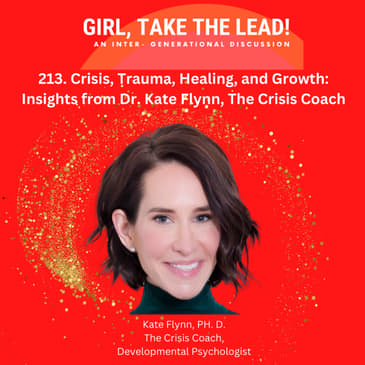
Kate Flynn, Millennial, is The Crisis Coach with a PhD in Developmental Psychology. After navigating her own life-altering crisis, Kate combined her academic expertise, entrepreneurial success, and personal resilience to create a unique coaching practice. She specializes in helping high-achieving leaders turn their most challenging moments into opportunities for growth and transformation.
Topics Covered:
Post Traumatic Growth Defining Crisis and Trauma· The Body Keeps the Score Trauma statistics & symptoms EMDR benefits IFS (Internal Family System) Healing & different options
3 Episode Takeaways
1. Post Traumatic Growth is an individual’s ability to grow and transform following major struggles but continue to grow and transform – “what doesn’t kill you can make you stronger” with a properly set table. Resilience is one’s ability to bounce back to baseline after something challenging happens. 2. Crisis is the external experience and there are two types: with a “C” easily identifiable and requires immediate action, and those with a “c” that are slow burning, less identifiable, and can sometimes trigger bigger feelings. Trauma is our internal experience and lives in our bodies - they can cause crisis situations or over-react to situations. Crisis and trauma can be intertwined. 3. Based on the statistics from the book The Body Keeps The Score there are many of us walking around with unresolved trauma and may not know it. EMDR (eye movement desensitization and reprocessing) is one powerful way to “unearth” what’s going on in our bodies to help identify the triggers to unearth traumas to work through the experiences to get closure.
Kate’s Free Offer:
Free crisis checklist: www.thecrisiscoach.com
Card or Gift Item Kate Liked from Our Store
https://girltaketheleadpod.com/shop You Got This, No Really Do (if you have the right supports in place)
More About Kate:
With a background in starting, scaling, and selling businesses, Kate understands the complexity of high-stakes situations and empowers her clients to navigate crises with clarity and confidence.
Episode Resources:
The Body Keeps The Score, Brain, Mind, and Body in the Healing of Trauma by Bessel van der Kolk, M.D. https://amazon.com
Ep 115, Part 1 – Inside Out: Unveiling the Layers of Internal Family System (IFS) with Uri Talmor
https://spotifycreators-web.app.link/e/r2DBE9snLPb
Help in finding an EMDR trained therapist: https://www.emdria.org/
How to reach Kate:
LinkedIn: https://www.linkedin.com/in/kate-flynn/
Email: kate@thecrisiscoach.com
How to reach Yo Canny:
Our website:
You can send a message or voicemail there. We’d love to hear from you!
email:
FB group: Girl, Take the Lead
https://www.facebook.com/groups/272025931481748/?ref=share
IG:
yocanny
LinkedIn:
https://www.linkedin.com/in/yocanny/
[00:00:06] Welcome to episode 213 of Girl, Take the Lead, where each week we explore womanhood and leadership. And I'm your host, Yolanda Canny. Kate Flynn, Millennial, The Crisis Coach with a PhD in Developmental Psychology, joins us today. Kate has combined her academic expertise, entrepreneurial success, and personal resilience to create a unique coaching practice.
[00:00:32] She specializes in helping high-achieving leaders turn their most challenging moments into opportunities for growth and transformation.
[00:00:42] Some of the topics we covered included post-traumatic growth, defining crisis and trauma, the body keeps the score, trauma statistics and symptoms, EMDR benefits, IFS, the internal family system, and healing with different options.
[00:01:05] As you listen, try to think about the differences between trauma and crisis. Because I think we all have them, and we all have something going on as a result of them. In our last episode, we talked with Amanda about talk types, and it all had to do with our intentions and what we were trying to achieve for 2025.
[00:01:30] And I think sometimes trauma and different crises we face, especially right now for so many of our friends and family in Southern California, that it's good to kind of understand the difference between the two and that the crisis can actually trigger long-standing traumas underneath.
[00:01:53] And so I think you'll enjoy this conversation, and so I think you'll enjoy this conversation, listening to it, and I hope you learn a lot from it about, I know I did, about the differences between trauma and crisis. Enjoy. And here you go. Hi, Kate. Welcome to Girl Take the Lead. And I am so excited for this conversation because just in me exploring it a little bit with you, it's like, it is life-changing.
[00:02:23] It can be very life-changing to see some of the distinctions we're going to talk about. So thank you. Thank you for coming. Well, thank you for having me, Yo. I am so excited to be here talking about something that people don't usually put a positive spin on.
[00:02:44] That would be crisis and trauma, but I think there can be some positivity in it, and that's why I'm so excited to share the message. Terrific. So let's start, if you would, by introducing yourself to our audience so they know a little bit about you. Absolutely. So my name is Kate Flynn, and I am a developmental psychologist by training.
[00:03:10] Most recently, I am a crisis coach, and most people don't know what that is because I kind of made up the term. But essentially what I do is help leaders and kind of high-performing individuals work through massive crises that can be personal. It can be professional.
[00:03:33] I help them navigate those situations, recover from them, and then use those experiences as a springboard for transformation and personal growth.
[00:03:45] And I have also gone through a massive personal and professional crisis that kind of inspired me to build out this model because of the lack of kind of continuity of help and support through that process. That's terrific. Sometimes we hear the term post-traumatic growth.
[00:04:14] Is that what you're talking about when you say there can be some positive or something coming out of crisis and trauma? Yes. Yes, absolutely. So post-traumatic growth is kind of what gets me up in the morning. It's, I think, one of the most exciting psychological phenomenons out there, but, you know, I'm biased.
[00:04:37] So, but basically what it is, is an individual's ability to grow and transform following kind of major struggles that they go through in their lives. So, it's different from resilience.
[00:04:54] We talk about resilience a lot and resilience is a great thing, but just distilling resilience down into its simplest part is one's ability to bounce back after something challenging happens to them, kind of bounce back to baseline.
[00:05:12] What personal or, excuse me, what post-traumatic growth does is allow an individual to actually get back to baseline, but then continue to grow and transform as a direct result of that challenge that they experienced in their life or that crisis, as I call it. Yeah.
[00:05:33] So, it's an opportunity that is given to you in addition to the struggle that you are going to endure. And I always like to bring it back to the quote, what doesn't kill you makes you stronger. And although I don't love little, you know, distilled down quotes because they often leave a lot out, that one is very telling. That is what I truly believe.
[00:06:03] The only thing I would change about that quote is to say, what doesn't kill you can make you stronger because it's not a foregone conclusion that one will achieve post-traumatic growth. The table has to be set correctly. And that's what I help clients with. That's a great way to look at that quote. Yeah. That it can. Sure.
[00:06:29] So, Kate, tell me a little bit about the difference between trauma and crisis. Yeah. So, excellent question. The way I describe it is that a crisis is like the experience that one has that can trigger traumatic feelings, which is more our internal experience of negative circumstances in our lives.
[00:06:59] So, the crisis is more kind of the external experience. And crisis with a capital C is the more obvious crises. That can be divorce. It can be a legal situation. Your business is going under a public relations crisis. Something that is obvious. Something that is obvious.
[00:07:23] Um, but the kind of more, um, or the less obvious crises are the more slow burn crises. And those are kind of smaller things that happen, um, in our lives that create negative experiences, but they're not as, um, high pressure. They're not as immediate. Um, and the consequences aren't as, the stakes aren't as high.
[00:07:52] Or at least they don't appear to be as high because it's not as in your face. Um, but they're just as important to recognize. And they look like, um, you know, especially in high performing individuals that I work with, they can start looking like micromanaging, not trusting people. Um, you know, losing sleep, feeling overwhelmed. It can be, um, in our relationships.
[00:08:21] It can show up as, um, not feeling connected with people, not feeling connected with what you're doing day to day. Um, sometimes some of those like midlife crisis type symptoms, and then also, um, symptoms that we think of with depression or anxiety. Um, and they can actually be kind of pulling up trauma experiences for us.
[00:08:49] Again, that's the more internal experience, uh, of negative situations that happen in our lives. Um, so it's good to be aware of all of those different things, um, and how they interrelate with one another.
[00:09:06] The way I have always thought about it or not always, but I think in the past was that a crisis precipitates, uh, traumatic experiences and the, the internal experience of those negative external situations. Um, but it can actually be the other way around as well.
[00:09:27] Um, where a, the, the trauma that we have in our bodies, um, can actually cause crisis situations or it can cause us to, um, overreact to perceive negative situations in our environment. Um, so yeah, there's a lot of meat there. A lot, but I, I, I kind of get it.
[00:09:53] And, um, where we tend to think of them as separate, they could actually be very, um, intertwined. And reflect on each other. Um, especially if some of that is unresolved and it will pop up on you and you're going, what, what, where did that come from? Yes.
[00:10:19] Well, one of the things that you did for me, when we started talking was, um, you recommended the book. Yes. The body keeps the score.
[00:10:31] So for everybody that can see this book, um, and I, I kind of mentioned to you that I kind of picked up this book a little fearful because I have had, um, things trauma in my life, um, that, you know, I'm like, you've said, you know, they can continue a like, Oh, there it is. Hello. Yep.
[00:10:55] Um, but as I got into the book, it was almost like, I don't know, like a big hug. In some way. Um, so if you know somebody or you yourself just want to understand more about these distinctions, I really encourage you to get this book. And I'm very grateful to Kate for recommending this to me.
[00:11:19] One of the things that hit me, um, right away in the pre-log was when, um, the statistics are mentioned. And I think this book was written a while ago. So I've got to think that, let me just look here. About 10, I think. Yeah, it was, uh, 2015. I'll be right. 2014. Yeah.
[00:11:43] So I'm thinking 10 years later, these statistics are probably even more than what we're going to, I'm going to share with our listeners right now. So, so the book says one in five Americans was sexually molested as a child. One in four was beaten by a parent to the point of a mark being left on the body. One in three couples engages in physical violence.
[00:12:13] 25% grew up with alcoholic relatives. One out of eight witnessed their mother being beaten or hit. And when I saw these, I thought, oh my gosh, I had no idea. I think perhaps as, um, as people who have experienced trauma or a big crisis, like you've talked about,
[00:12:43] you know, we kind of think, well, our brain, right. It goes into action about shutting things down and we don't even remember some of it. Yeah. And that, that was really astonishing to me. Um, as I read the book and if we can't remember some things, do you think people are walking around
[00:13:07] knowing, not knowing that they have some unresolved trauma or crisis that they experienced? So this is such, um, it's such a big question, um, because number one, obviously the, um, statistics that, um, Dr. Vander Kolk talks about are from the ACEs study,
[00:13:34] which is the adverse childhood experience study, really cool study, but, um, just to distill it down. And they took this massive data set, um, with patients at Kaiser Permanente and were able to ask them about their childhood experiences and then do a deep dive into their, um, their health charts. Um, which is pretty awesome.
[00:13:59] Um, obviously it's all signed off on, um, but they were able to really distill down, um, the experiences. Number one, the, so many facets of the study are fascinating. Number one, this, you know, staggering numbers of folks who experienced these very, um, formative experiences, that these things are really a big deal, like a very big deal.
[00:14:28] Um, but then also how that relates to later functioning. Now they weren't able to get into the, um, one's ability to like the day-to-day processing of information and how those early experiences reflect later there. They were only able to get at proxies for that. And that looked like their, um, you know, their physical medical outcomes.
[00:14:57] So individuals who experience, um, these early risk factors have a much higher likelihood. And again, I always have to cut myself off because we could talk about this study for hours. I mean, days really, um, they're sicker. They have, um, you know, less financial stability. Um, uh, they are arrested at higher rates.
[00:15:25] So, and they experience more depression, more anxiety, more of everything. Basically their lives are worse statistically. And we can relate it back to these early experiences because, um, kind of holding all thing, like controlling for all other factors, except these, um, you can make those reasonable assumptions
[00:15:49] that, that there is a very clear link between those early experiences and, and later outcomes. And it's not just in our psyche. It is in our bodies. It is in our, how we function in the world. Um, and basically every facet of someone's life is impacted by these early experiences. Um, how does that show up in the people that we're around or the people that we're working with or our bosses?
[00:16:19] I think it can, it can show up in so many, so many ways. So it's, it's hard to, uh, distill it down. Um, but if I'm gonna, if I'm going to do that in its simplest form is they get triggered easily. Um, so little things become a big deal.
[00:16:41] Um, so when we're looking at other people, um, they get, they get pissed quickly and easily and frequently. Um, or maybe they're not showing it in the form of being angry, but they get anxious. They, they try to manage, they try to, yeah. They're busy. They're overwhelmed.
[00:17:05] They're just kind of a flurry of activity and, um, but not in a productive manner necessarily kind of doing things just are hard for them. Um, yeah. Do you find with your clients that they'll come to you with some kind of symptom like that showing up? And then as you work with them, you're able to get back to almost the crisis.
[00:17:35] So, yes, I will say, so I am the crisis coach and I do think most people come to me when they have a crisis with a big capital C. Um, but I actually, no, I enjoy that work, but I also appreciate the more slow burn crisis, which I think is what you're describing.
[00:17:59] Um, because I think through, um, our work together and I'm not, I am a licensed therapist, but in this respect, I help people get routed to the correct, um, trauma therapies that, um, are available. And there are many different options. Um, and I coach them through that process.
[00:18:27] I'm not doing the actual therapy with them, but once they're able to delve into it, yes, they typically uncover, not typically always uncover some sort of traumatic experience or, uh, that, that they have, that is causing a lot of those symptoms that you're seeing, um, that they're experiencing and the other people in their lives are experiencing.
[00:18:54] A couple of the, um, approaches that I know the book had and, and you have mentioned to me, one was EMDR, which was so interesting. So interesting. And, and the other we've covered in a previous episode, but, um, and that was IFS internal family system, but, um, talk a little bit about MDR because there seemed to be a lot of benefits
[00:19:24] with that. There are so many, and I will say it is a massively interesting, um, therapeutic approach. One that I admittedly in first hearing about was like, that sounds weird. What, what is that? Uh, and so I kind of ignored it for a long time and I feel really, uh, bad about that.
[00:19:47] Um, so anyway, it's, um, eye movement reprocessing and desensitization. And in its, uh, the simplest way to describe it is it kind of, um, there are eight different stages of it. And I, I won't, I won't go into the nitty gritty of it, but what it is trying to do is
[00:20:11] number one, get yourself aware of when you are triggered, um, primarily looking internally at your body, um, not your mind because you can't really stay objective in your own internal experiences. Yeah. So, um, really getting in touch with your body to figure out what are these various triggers throughout my day?
[00:20:40] And your body will tell you, your body tells you when these things happen. It is tightness. It is your stomach, um, doing a flip flop. It is your palms getting sweaty. It is, that is when you are triggered. You are triggered. That is the physical. Those are the physical sensations you have when you are triggered. Um, so being aware of those things and having some techniques to remedy those physical sensations.
[00:21:09] Um, but then the, the whole thing is to kind of unearth these, um, these traumas that we have experienced and that we continue to experience, um, knowingly or unknowingly, um, throughout our days, um, when we are triggered and to then work through those experiences, um, using
[00:21:38] various techniques to kind of get closure on them so that we are not constantly triggered. Yeah. Yeah. Well, and, or, or doing the behaviors that, you know, are kind of unwanted, like my case, you know, it was eating, you know, or having some kind of, for other folks, it's a numbing that they can do. I know that was kind of my alcohol. Yes. Yeah. I know.
[00:22:07] I've gone through that too. It's numbing. You were like trying to numb yourself. Yeah. Trying to protect yourself. And I think one of the good things about this book was that it just offered even yoga as a way of getting in touch with your body. Um, and then it did have quite a bit about, um, IFS, um, for our listeners who heard that
[00:22:31] episode, how would you differentiate in a way for them to, to understand IFS as, uh, possibly treatment? Yeah. So, um, and a lot of therapists use both of these tools very interchangeably. So, um, I've been through EMDR and, um, we used a lot of IFS.
[00:22:56] Um, so IFS just as a refresher, I know you've done a few podcasts about this, but is essentially, um, us realizing that, um, we are made up of many different parts, um, or like sub personalities and, um, internal family systems means that essentially, and this is where I feel like
[00:23:26] I lose people sometimes when I, when I make this connection, but that, but I'm going to do it anyway. Um, that we are within us. We have a family, um, of all of these different parts and how these parts interact with one another can be good, can be not so good. Um, but that we're family and we're in this together. Um, and we all need to kind of balance ourselves out.
[00:23:56] I don't know if you've ever seen the movie inside out or inside out too, that gets at, that at least provides a framework for our parts, our various parts. The one, um, and I think it's an amazing movie, so I'm not, I'm not here to criticize it, but the one thing is that in that movie, everyone has the same parts. It's, they express themselves differently.
[00:24:21] Um, in actual IFS, you know, you describe what your own parts are. You're not just limited to like happy and anxiety and, um, even the more complex, um, emotions that you see in inside out too. But, um, so there's a little bit of a difference there, but that still gives you a really good framework for understanding what IFS is.
[00:24:46] So, um, so perhaps if I had to like say one was for one circumstance and the other was for another would be like EMDR might be for those more obvious, um, capital C crisis situations. Um, and perhaps IFS could be more for those like slow burn crises. Um, but then there are so many other therapies as well.
[00:25:15] So I wouldn't want to just limit it to those, um, those two either. So is that something you'd kind of recommend for somebody if they were kind of wanting to wreck, you know, they've recognized something in themselves. It's to kind of check these things out. Right. Yes. Yes. It seemed like one of the benefits of EMDR was that you didn't have to necessarily be able to articulate it. Yes.
[00:25:43] It could be something that, and you didn't have to have a strong sense of trust with, with the practitioner or the therapist you were working with. Yes. Right. It was wild. Uh, but I could understand it because I went, Oh yeah, I can see that if somebody has these,
[00:26:05] um, deep traumas, um, that they, they don't trust somebody necessarily because it prevents you from forming relationships to some degree. Yes. So, so, um, the MDR might be for somebody, like you said, that perhaps is, um, got that capital C or the capital T that they're trying to work with. Yes.
[00:26:32] And I, I found with IFS that I could recognize different parts, you know, like I have the, the little Yoli, which is my very little girl that will pop up and I'll just need to tell her it's okay. It's safe. Let me give you a hug. It's my manager kind of takes over and says, we're okay. We're going to be all right. And you're, you're going to be just fine.
[00:27:01] But almost just like on my, I could see on someone's journey that they begin to evolve. They begin to heal and different things and different practices might come to them along that journey. Yes. Yeah. Yeah. And the, and the good thing about that book was it didn't seem like it was just one thing. It was like, there are different ways of approaching this.
[00:27:28] Yes, there are so many different ways and, and seeing, there are so many different ways to go about getting, I like to say, getting closure on those, you know, crises that turn into trauma. And I use those term crisis and trauma interchangeably too. So I apologize for that.
[00:27:56] When I say trauma, I mean your experience of the crisis event, but be that as it may. Um, but you also realize in figuring out all the different types of therapies and ways to get closure on your unresolved trauma really is how many areas of your life it impacts.
[00:28:20] It's it to clean it up, to get that closure properly takes effort and it takes strategy. Um, and that's where too, I think to get true closure, that's why it's complicated to distill down these different, um, there's not one path.
[00:28:45] It, there's not, there just isn't, um, to, again, to get true healing. I think it's a blend and it's specific to the individual. However, I don't want to make it sound so complicated that just going to an EMDR therapist, you can still get tremendous relief. So that is still worth exploring. Doing something is better than nothing.
[00:29:14] But the flip side of that is there still has to be some thought or intention behind it because you wouldn't want to do something that isn't helpful. Right. Right. That makes sense. Well, I also feel sometimes that you just, um, need to, to trust your intuition about it. Yeah. Yes.
[00:29:38] Like I remember once speaking to a therapist and I went, I don't really like this person. Yes. Yes. It was so good in the moment to say, you know, I don't think we're a good fit. I'm going to work. And, and I would say for individuals who have experienced trauma, some ways that manifest itself in not having their inner voice, they, they might have that feeling like, I don't like
[00:30:04] this, but they can't quite articulate it or, um, and I think that's really important to have a therapeutic alliance with a, and I don't want to go too much on this tangent, but, um, with kind of top down, um, therapeutic approaches, which is more your cognitive behavior therapy or talk therapy, um, which are important. But like Bessel or Dr.
[00:30:32] Vander Kolk pointed out in his book is that that kind of bottom up, what he found is you actually don't have to have a therapeutic alliance. Um, and I found that to be true too. I actually kind of butted heads with my EMDR therapist and I did, um, intensive EMDR, which I think is a really nice option for a lot of people. It's essentially these larger chunks of time where you're delving into it as opposed to
[00:31:02] hour long sessions. Um, so anyway, but I, I would say, you know, so I have a regular talk therapist and then I did outside of that EMDR therapy in an intensive, uh, manner and that therapist. Yeah. I didn't, I didn't quite mesh well with, but I still experienced some amazing benefits, which is crazy.
[00:31:30] Well, what, how would you suggest that people find, you know, trained professionals? Is it, do you think just, you know, something that, um, you just sort of, as we said, trust our intuition, but you go out there and you, how do you find good people?
[00:31:53] So, um, it, and, and, you know, as a field, we haven't made finding people, good people easy. Um, but there are more resources now than there have been in the past. Um, I would say, um, a few different places to start. One is kind of bouncing back and forth between using psychology today, which has an amazing tool.
[00:32:19] You can search for therapists who are EMD, EMDR certified. And there are kind of three different levels of EMDR certification. Some people are trainers. Um, I can't remember the three different, what trainer is kind of like the highest tier. Anyway, cross-reference. If you find somebody psychology today allows you to search for therapists again by treatment
[00:32:46] modality, but then also insurance location, a lot of different things. So I appreciate their, all of their search features, but then you want to cross-reference that potentially if, if you really want to do your homework, um, with EMDR and EMD, EMDR. EMDR I a.org. EMDRIA.
[00:33:10] Um, and that allows you to, um, search for an EMDR therapist and really look at what their credentials are and definitely make sure their credentials. Um, you're not supposed to say you do EMDR unless you're credentialed through, um, EMDR, but, uh, you just want to double check that.
[00:33:32] Um, but also, like I said, there is a very kind of delicate dance between figuring out what therapies there are, which therapies you need. And if you know what, what the correct path is. So using a coach to help coach you through that process, which I know, like, I even feel like that sounds crazy. Like, why do you need a coach to do that?
[00:34:02] But, but like, I'm a psychologist for instance, and this wasn't the easiest process for me to navigate. Not that I'm so great, but just showing that how complicated this process is. But part of why it's so complicated is because it's such an individualized experience. Trauma, um, is an individualized experience. So, um, so it's hard to make blanket statements about what, you know, what, what can be helpful.
[00:34:32] Um, yeah. So if our, our listeners, um, our viewers want to talk with you and follow you, how can they do that? Yeah. They can go to my website. Um, so it is www.thecrisiscoach.com. And I, um, you can sign up for my, uh, emails with some helpful information there.
[00:34:57] And then I also have, um, an ability to, um, schedule time with me for free, um, to talk through anything that you would like related to, um, crisis you're experiencing potentially, um, trauma you're experiencing internally.
[00:35:17] We've taken a very deep, um, topic and you've provided such a great distinctions and insights into how to, how to, uh, how to identify it, how to observe things, um, and different ways that we can approach it. And I think that's amazing. So I appreciate that you were able to do that, Kate.
[00:35:47] Is there anything else? Just, we'll just take a moment here. Is there anything else that you would like to tell our listeners about that? That we didn't. Yeah. Um, the one thing that I will say, um, is that particularly with IFS, um, internal family
[00:36:16] systems therapy, well, I think a lot of people get hung up on isolating that traumatic experience, um, particularly with the ACEs study. And they think that their experiences and their kind of negative sensations and triggers and
[00:36:39] getting upset and they're not sure why, you know, they minimize those experiences to be like, well, nothing like really bad happened to me. So I'm fine. And I sincerely think, like I said, especially with IFS that anyone who experiences depression,
[00:37:01] anxiety, rage, really any experiences that you don't like, or don't want to continue, you can benefit from IFS, EMDR, all of these things, because you don't have to link it back to this specific, if you, if you can link it back to a specific traumatic event, then you definitely want to like, go get help.
[00:37:27] But even if you experience other things that you can't quite rebound from quickly, still use the tool. They're still available to you and they are very helpful, like life-changingly helpful. Yeah. Oh, that's so good. Yeah. And I think sometimes these things get uncovered when we're ready. Mm-hmm. And that's a great point.
[00:37:53] When we're, you know, at that point and able to, to, to go and reflect on it and understand. And I think forgive a lot of that, forgive ourselves for perhaps how we responded to it. Just, it's a whole process. And so again, Kate, I mean, you've provided us such terrific, um, you, you, you've got us started.
[00:38:21] So it might be that we'll have, you have to have you back because there's so much here. I'd love to come back because there is so much. There's so, so much there. And, uh, yes, definitely is. So, um, one, one question we ask all our guests is what would you tell your 20 something self today? Ah, this is such a, uh, such a tricky question to answer because like what you just said,
[00:38:48] sometimes we have to be ready to receive information. So I kind of kept thinking about this question in terms of what would I have been even ready to hear? Because I'd want to say, listen, do this, do this, do this, stop doing that. But I would have been like, buzz off, old, old you.
[00:39:13] Um, so instead I wanted to focus my message for my 20 something self on you, you are enough, like you're enough to get the help you need to get the, um, or to, to, to make things happen, to do things.
[00:39:38] Whereas when I was in my twenties, walking around with all sorts of unresolved trauma, I was crazy walk, like I was in grad school. I was trying to do all the things, like I was trying to prevent, I was trying to make my way in the world so that things would be easy later. And, um, and, and that I had to add, you know, I had to, I had to do all these things to, to make myself the person that I needed to be.
[00:40:07] And I think if I had just been like, Hey, just calm down a little bit, you're going to be fine. You're enough. Keep going, but just remember that like, you're enough and what you have, the tools you have right now are enough to, to, to get there, to get where you want to go. Spoken from one high achiever to another. Yes. But I probably still wouldn't have listened at this point.
[00:40:36] Yeah, definitely. So I don't know, did you get a chance to go to our, um, gift shop? I did. Anything. Did anything speak to you directly? It did. Um, so the card that you got this, no, you really do. Um, obviously spoke to me. I would love to add another sentence to that is you got this. You really do.
[00:41:05] If you have the right supports in place. Okay. Because the one thing that I will say too, is we do love in our society to like pull yourself up by your bootstraps and keep going. You got this and you can, yes, but you'll get there so much faster and you'll do it so much better with the right supports in place.
[00:41:30] Um, and so also reaching out for those correct supports. Again, there's nothing wrong with you. You're actually much smarter when you do. Um, yeah. I love it. And I just see a new version of this card being developed right now. I love it. I'm sorry. It's a beautiful card as is, but yes. No, that's so good. Oh, thank you again for helping.
[00:41:56] Well, me personally, because, um, as I mentioned, I could relate to some of those statistics and, um, not be afraid to look at, um, parts of our, of, of myself that, that, um, have been wounded and, um, embrace them and just, so, okay, you know, we're all right. We're doing all right. Yes.
[00:42:25] And we can tell the truth about it. I think it, I don't think I was, it took me until I was about 29 almost before I started telling the truth about, you know, my family experience and what happened. And cause I thought everybody had the same kind of family. And it turns out they didn't. Right. Yes. That's another thing about normalizing. Yeah, we do that.
[00:42:51] So, and, and, you know, I appreciate you taking the lead in this area and wanting to share your understanding, your insights and your experience and just being brave and courageous to do it, Kate. So thank you for contacting me and then putting this forward so that we could touch a lot of people out there with this topic.
[00:43:18] And, um, I think it's going to touch a lot of hearts. So thank you. Thank you so much for doing it. Thank you for having me. I appreciate all the good work you're doing as well. So thanks. Yeah. Thank you for listening today. And we sure hope you enjoyed this episode. If you did, please leave a comment wherever you listen to your podcast. Tell a friend about us.
[00:43:44] Join our public Facebook group, girl, take the lead or visit our website. Girl, take the lead pod.com. We also have a YouTube channel where your subscription would be appreciated. Once you're on YouTube search at girl, take the lead. And we've recently expanded to YouTube music where you can see a video of this episode. And you can also see a video on Spotify. Here are three episode takeaways.
[00:44:09] One post-traumatic growth is an individual's ability to grow and transform following major struggles, but continue to grow and transform. It's almost like what doesn't kill you can make you stronger with a properly set table. Resilience is one's ability to bounce back to baseline after something challenges happen.
[00:44:38] Two crisis is the external experience. And there are two types with a big C, which is usually pretty. Easy easy to identify and requires immediate action. And those with the little C that are slow burning, less identifiable, and can sometimes trigger bigger feelings. Trauma is our internal experience and lives in our body.
[00:45:06] They can cause crisis situations or overreaction to situations. Crisis and trauma can be intertwined. Three. Based on the statistics from the book, The Body Keeps the Score, there are many of us walking around with unresolved trauma and may not know it.
[00:45:30] EMDR, which stands for Eye Movement Desensitization and Reprocessing, is one powerful way to unearth what's going on in our bodies to help identify the triggers, to unearth traumas, to work through the experiences, to get closure. We've been asking our guests to go to our card and gift store,
[00:45:55] girltaketheleadpod.com slash shop, to tell us which items spoke to them. And Kate picked, you got this. No, really, you do. And then she added, if you have the right supports in place. So I'm going to be adjusting that card for Kate. So check out her choice and see our newest birthday and Valentine's cards that are there.
[00:46:21] Our next episode will feature our guest, Dima Gavi, who is Middle Eastern in her genes, American in her heart, and a global citizen in her spirit. Her own journey is one of escaping confinement, crossing continents, and transforming her life's purpose.
[00:46:42] I promise you'll be inspired by Dima's story as she discusses her book and offers us her insights about shattering bases we all have. Talk to you soon. Take care. Bye.