Why can it feel so difficult to admit that we don’t know something?
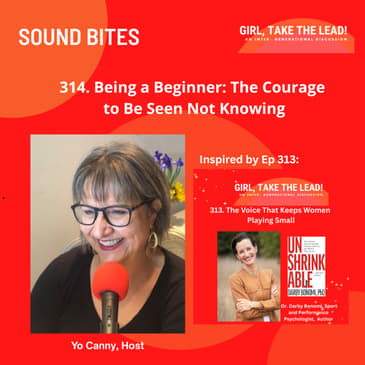
This Sound Bite was inspired by my conversation with sport and performance psychologist Dr. Darby Bonomi, who reminded us that there is no shame in being at the beginning.
But that got me thinking.
Maybe being a beginner isn’t actually the hardest part.
Maybe it’s letting other people see us not knowing.
In this reflection, I explore some of my own history with pretending I knew something when I didn’t—and begin detangling what may have been underneath it.
For me, knowing became connected with achievement, acceptance, and belonging at an early age. Mistakes weren’t always comfortable. Asking for help wasn’t something I remember doing very often. And appearing intelligent could feel like a form of protection.
So what happens when being a beginner requires us to say:
I don’t know.
I don’t understand.
I made a mistake.
Can you help me?
We explore how our fear of judgment, rejection, or appearing “not good enough” can keep us pretending—and how self-acceptance and humility might offer another way.
Because humility doesn’t have to mean making ourselves smaller.
Maybe it means being able to hold two truths at once:
I’m intelligent. And I don’t know this.
I’m accomplished. And I’m a beginner here.
I belong. And I can ask for help.
In This Sound Bite
- Why being seen as a beginner can feel harder than actually being one
- What pretending to know may be protecting
- The connection between knowledge, achievement, belonging, and self-worth
- Why asking for help can feel so vulnerable
- How self-acceptance can make room for not knowing
- Humility as an honest recognition of both our strengths and our limitations
- Why confidence comes through experience
- The stages of skill acquisition—from novice toward expertise
- How asking for help can create connection and community
- Why we can be an expert in one room and a beginner in the next
And perhaps the question underneath all of it is:
Am I secure enough in who I am to let you see me learning?
Because we don’t have to know everything to belong.
We don’t have to pretend when we don’t know.
And we don’t have to use what we know to prove that we’re worthy of being in the room.
Sometimes leadership begins with having the courage to say:
“I don’t know yet. Can you show me?”
Inspired By
Episode 313: The Voice That Keeps Women Playing Small — with Dr. Darby Bonomi
Darby is a sport and performance psychologist and author of Unshrinkable: Why Strong Women Secretly Criticize, Diminish, and Thwart Themselves—and How to Stop.
🌐 https://www.darbybonomi.com/
📖 https://www.unshrinkablebook.com/
Coming Next
In our next episode, I’m joined by Lisa Ketchum Hendrickson, founder of Human Recovery, somatic nurse coach, and a nurse with more than 30 years of experience.
After losing her two oldest sons eight months apart to suicide and addiction, Lisa’s understanding of trauma and recovery became deeply personal.
Our conversation expands the meaning of recovery beyond addiction or loss. We may also be recovering from trauma, grief, old survival patterns, ancestral wounds, transitions, or beliefs and social norms that no longer serve us.
At the center of Lisa’s work is a simple but powerful idea:
We can’t heal what we don’t feel.
Connect with Girl, Take the Lead!
🌐 https://www.girltaketheleadpod.com
🎧 Listen and subscribe wherever you enjoy podcasts.
[00:00:07] Welcome to Soundbite, a reflection inspired by a recent conversation on Girl, Take the Lead. I'm your host, Yolanda Canny. During my conversation with sport and performance psychologist, Dr. Darby Bonomi, she said something that stayed with me. There is no shame in being at the beginning. Sounds pretty straightforward, right? Of course, beginners don't know everything. That's why they're beginners.
[00:00:38] But I've been wondering if being a beginner isn't actually the difficult part. Because I've done the opposite. I've pretended. There was a time in my life it was really important to me to look like I knew what I was doing, even when I didn't. And as I've been thinking about this conversation with Darby, I've gotten curious about where that came from.
[00:01:03] For me, I think some of the roots go pretty far back. Growing up, I often felt caught between two ethnic identities. Education became very important in my family. My father was highly educated and knowing things gave him a kind of power. Looking back, I can see how knowledge may also have been one of the ways of responding to prejudice without violence.
[00:01:30] So as I've been detangling all of this, I've wondered, when did knowing become connected to belonging for me? When did I don't know begin to feel dangerous? Maybe appearing intelligent wasn't simply about wanting to look good. Maybe it was also about protection. Don't give them a reason to think less of you. Don't make a mistake.
[00:01:59] Know the answer. Be pleasant. Fit in. And asking for help? I honestly don't remember doing much of that. I was about 29 when I attended my first transformational workshop. Shout out to ODCers that might be listening. I was introduced to the idea of actually making a request. Think about that.
[00:02:23] I was almost 30 before asking someone directly for something I needed was presented to me as something I could consciously do. So maybe it's not surprising that being a beginner could feel uncomfortable. Because beginners have to say things like, I don't know. I don't understand. I made a mistake. Could you help me?
[00:02:51] And if we've somehow learned that our intelligence, competence, achievement, or even our pleasantness helps secure our place in the room, those sentences can feel surprisingly risky. Darby talked about experiencing some of that herself. She used to hesitate to ask questions because she didn't want to reveal that she didn't know. Then she noticed something.
[00:03:20] Some of the people she considered brilliant were willing to say, I'm not following you. Could you explain that again? They weren't pretending. They were learning. And maybe that's where humility comes in. I used to think humility had something to do with making ourselves smaller. I'm beginning to see it differently.
[00:03:47] Maybe humility is being able to say, I'm good at many things. And I don't know this. Or I've accomplished a lot, but I'm beginner here. I'm intelligent. And I need your help. None of those things cancel each other out, right? That's self-acceptance.
[00:04:11] And maybe self-acceptance is what finally allows us to stop pretending. There's actually a model of skill development that helps put this into perspective. The Dreyfus model of skill acquisition describes five stages.
[00:04:34] Novice, advanced beginner, competent, proficient, and expert. We start by needing instructions and rules, right? As a novice. But the experience would begin recognizing patterns and understand context. And eventually some things that once require tremendous concentration can become much more intuitive. But notice where everyone starts.
[00:05:04] Novice. There is no secret entrance that takes us directly to expert. As Darby said, the only way to get experience is to get experience. So why would we be ashamed of being exactly where learning requires us to be? And maybe asking for help deserves some reframing too.
[00:05:32] What if asking for help isn't proof that we don't belong? What if it's actually an act of connection? When I say, could you show me? I'm acknowledging that you know something I don't. I'm allowing you to contribute. I'm opening myself up to learning. And someday the roles may reverse.
[00:05:59] I'll know something you don't. You can ask me. That's not inadequacy. That's community. And perhaps there's another gift that comes with being a beginner. Curiosity. Talked about compassionate curiosity before. And that's when I don't have to protect an image of knowing.
[00:06:26] I get to wonder and ask questions. I get to experiment. Get to make mistakes. I get to play. I get to learn. And I can be an expert in one room. And walk into the next as a complete beginner. Both can be true. So maybe the question isn't, am I good enough to do this?
[00:06:50] Maybe it's, am I secure enough in who I am to let you see me learning? I've spent a lot of my life knowing things. And I'm grateful for that. I love learning. I value education. I don't want to give any of that up. I don't have to use what I know to prove that I'm worthy though of belonging.
[00:07:19] They don't have to pretend when I don't know. I can simply say, I don't know yet. Can you show me? Maybe that's not weakness. Maybe that's humility. Maybe that's self-acceptance. And maybe that's where learning begins. In our next episode, I'll be joined by Lisa Ketchum Hendrickson, founder of Human Recovery.
[00:07:47] She's also a somatic nurse coach and a nurse with more than 30 years of experience, including over 25 years in level one trauma centers and flight nursing. Five years ago, Lisa's understanding of trauma became deeply personal when she lost her two oldest sons eight months apart to suicide and addiction. Her healing journey changed not only how she understood grief, but how she understood recovery itself.
[00:08:18] And our conversation expanded the idea of recovery in a way I found really meaningful. Because we don't have to be recovering from addiction or the loss of someone we love. We may be recovering from trauma, grief, old survival patterns, ancestral wounds, transitions, or even beliefs and social norms that no longer serve us. At the center of Lisa's work is one simple but powerful idea.
[00:08:47] We can't heal what we don't feel. And I think there's an interesting connection between these two conversations, the one we're having today in the soundbite and the one with her. Maybe growth asks us to become more willing to acknowledge what's true. I don't know. I need help. This hurts. I'm still learning. I'm still healing. I'm still healing.
[00:09:16] We don't have to pretend our way through any of it. I'm Yolanda Canny and thanks for joining me for this soundbite. And I hope you'll join Lisa and me for our next conversation. Bye.