Some of the loudest voices we hear aren't coming from other people—they're the ones inside our own heads.
That inner critic can convince us we're not ready, that everyone else has it figured out, or that asking for help somehow means we've failed. Over time, those thoughts can quietly keep us playing smaller than we're capable of.
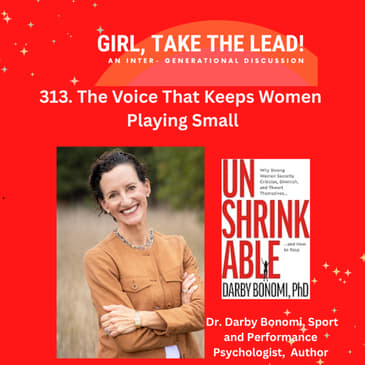
In this episode, I'm joined by Dr. Darby Bonomi, sport and performance psychologist and author of Unshrinkable: Why Strong Women Secretly Criticize, Diminish, and Thwart Themselves—and How to Stop.
Darby has spent decades working with high-achieving individuals, and together we explore why even accomplished women can struggle with self-criticism, comparison, perfectionism, and the pressure to appear as though they have everything under control.
We also talk about something Darby calls the myth of the charmed life—the tendency to look at someone else's polished exterior and assume their path has somehow been easier than ours.
And Darby shares one simple phrase from her equestrian coach that has stayed with her for decades:
"Go ride your horse."
It's a reminder to stop overthinking, trust your preparation, be present, and do the thing that's yours to do.
In This Episode, We Discuss
- Why successful women can believe everyone else has a "charmed life"
- How self-criticism and perfectionism can quietly keep us playing small
- Community versus competition—and why lifting others doesn't diminish our own opportunities
- Why there is no shame in being a beginner
- How "Go ride your horse" became a lifelong reminder for Darby to trust herself and be present
- Why confidence comes through experience
- Envy as information—and even a possible call to action
- Learning from people who are farther along rather than simply comparing ourselves to them
- Why presence, gratitude, and personal growth require practice
- What Darby would tell her 20-something self today
About Dr. Darby Bonomi
Darby Bonomi, PhD, is a sport and performance psychologist who has facilitated transformations in hundreds of high-achieving individuals.
After two decades as a clinical psychologist, psychoanalyst, and faculty member at the San Francisco Psychoanalytic Institute, she shifted her focus to performance coaching in 2016. She works with competitive equestrians, entrepreneurs, and professionals globally—primarily women determined not to shrink under self-criticism or others' expectations.
Dr. Bonomi is an actively competing equestrian herself and has delivered sport psychology clinics nationwide. Her writing has been featured in Practical Horseman, Psychology Today, USHJA In Stride, The Plaid Horse, and The Chronicle of the Horse.
Darby's Book
📘 Unshrinkable: Why Strong Women Secretly Criticize, Diminish, and Thwart Themselves—and How to Stop
Drawing from decades of psychology and performance coaching, Darby explores the patterns that can cause capable women to diminish themselves—and what can happen when we stop playing small.
Connect with Darby
🌐 Website:
https://www.darbybonomi.com/
📖 Unshrinkable Book Website:
https://www.unshrinkablebook.com/
Facebook:
https://www.facebook.com/darbybonomisf/
Instagram:
https://www.instagram.com/drdarbybonomi/
Continue the Conversation
Our conversation about envy reminded me that envy doesn't necessarily have to be something we judge or push away. It may contain information about something we want, admire, or haven't yet given ourselves permission to pursue.
We've explored envy before on Girl, Take the Lead!:
Explore our conversations about Envy:
https://girltaketheleadpod.com/search/envy
And here's a question to take with you after this episode:
What would be possible if you quieted the voice that keeps you playing small... and simply rode your horse?
Connect with Girl, Take the Lead!
🌐 https://www.girltaketheleadpod.com
🎧 Listen and subscribe wherever you enjoy podcasts.
[00:00:06] Welcome back to Girl, Take the Lead, and I'm your host, Yolanda Canny. Have you ever looked at someone else and thought, they got it all figured out? Or hesitated to ask a question because you were afraid someone might discover you didn't know the answer?
[00:00:23] My guest today, Dr. Darby Bonomi, asks how easily self-criticism, perfectionism, and comparison can keep even accomplished women playing small. Darby is a sport and performance psychologist and the author of Unshrinkable, Why Smart Women Secretly Criticize, Diminish, and Thwart Themselves, and How to Stop.
[00:00:48] After two decades as a clinical psychologist, psychoanalyst, and faculty member of the San Francisco Psychoanalytic Institute, she shifted her focus to performance coaching. Today, she works with competitive equestrians, entrepreneurs, and professionals around the world. And Darby is an actively competing equestrian herself, which brings us to one of my favorite ideas from her conversation. Go ride your horse.
[00:01:18] You'll hear the story behind those words and why they became a reminder to stop overthinking, trust yourself, and be present. We also talk about the charm of life, community versus competition, envy, and why there's absolutely no shame in being a beginner. So let's get started. Here you go. So Darby, welcome to Girl, Take the Lead. We're going to have such a great conversation about your book. Thanks for joining us.
[00:01:47] Oh, thanks, Yolanda, so much for having me. I'm thrilled to be here. Let's start, if you would, too, if you'd introduce yourself to our audience and tell them a little bit about yourself. Absolutely. Well, I am Dr. Darby Bonomi. I'm a sport and performance psychologist.
[00:02:04] I work with athletes, entrepreneurs, and businesswomen all over the United States and even over the globe to help them elevate their performance, both in and out of their business or athletic life. I work a lot in the equestrian space. I am an equestrian.
[00:02:26] I work with a lot of highly competitive equestrians and also business owners and entrepreneurs in this space. I started my career. Well, I've been a psychologist for 35 years. And I started my career as a clinical psychologist and psychoanalyst.
[00:02:47] I've taught in lots of Bay Area hospitals and I was a faculty at the San Francisco Psychoanalytic Center for many years. And then about 10 years ago, transitioned to this work in performance psychology and have been doing that since very joyfully. Great. Well, tell us about your book. Yes.
[00:03:13] And I forgot to say, I am also an author of the new book, Unshrinkable, which is the full title is Unshrinkable, Why Strong Women Secretly Criticize, Diminish, and Thwart Themselves and How to Stop. Not that any of us do that. No, of course. Right. This book was in the making for a really long time. You know, I've been writing bits and pieces over many years now.
[00:03:43] And it really emerged out of my years and years of work, mainly with women, ambitious, driven, successful women who get in their own way in so many ways that seem unnecessary and self-defeating.
[00:04:08] And so, and it's interesting because I have had different iterations of my career, right, as a clinical psychologist, a psychoanalyst, also parent. I worked with parents and now in the space that I'm in. But the themes are the same. All here's the themes have been the same. And I also identify with these themes. I am one of these women.
[00:04:33] And so part of my book, I do weave in some of my personal story to connect with my readers, to let them know. I see you in part because not only I've treated you and worked with you, coached you, but I am you. So, so that's the book. I'm really proud to add my words and my thoughts and my experience to this, this space. And I hope everyone will pick up a copy and read it. Yeah.
[00:05:03] One of the things that I truly loved, I mean, there are so many of your topics through the book, which I totally resonated with. It was like, oh yeah. Yeah. One thing was when you talked about the myth of a charmed life and looking at that, I mean, I can just remember myself thinking, oh, they've got it. They have it. I don't, but they do.
[00:05:31] And it's almost like a fantasy or something that I would make up about that person that they were perfect in some way. Okay. And you have a wonderful passage that I think would give our audience an idea of what you saw there. Do you, do you mind reading that for us? Sure. And I just want to say, yo, that this myth of a charmed life.
[00:05:58] I mean, when you and I started out, there was no internet, there was no social media, right? And now in this, in this day and age with, right, there's so much promotion really of, and self-promotion also of a charmed life. So this is probably really a quite, I think it's quite exaggerated now, but we'll get into that in a minute. Let me, I'll read this passage for you.
[00:06:25] So it's on page 11 in my book. The myth of a charmed life. Sometimes people look at someone like me and assume the road I've traveled has been smooth. I still remember a moment years ago when I was in postgraduate training. A friend casually remarked, Darby, you lead such a charmed life. I was startled. A charmed life?
[00:06:54] This was a woman who knew my history, my personal struggles, and those with my family. How could she say that? I felt like she was denying all of the work that I had done so far to lift myself up and propel myself into the profession and life I wanted. 30 years later, her words still sting. What she saw on the outside was not the whole package. Surely she saw the polished version.
[00:07:21] I had enough resources, dressed well, carried myself with confidence, and was doing well. From the outside, it looked like I had it all figured out. And I was working on figuring it all out. But the truth is, nobody leads a charmed life. Every woman has her story and her struggles, her silent battles and her worries. Just because we don't show our bruises doesn't mean we don't have them.
[00:07:50] Women like me and like you often have clawed our way forward while everyone else assumed we were gliding. We've endured heartache, disappointment, rejection, and grief. Navigated impossible decisions and learned how to keep moving when the ground beneath us gave way. Behind every charmed woman, there's a path no one else sees. That is so good.
[00:08:19] That is so good because we get so self-centered about ourselves and our own imperfections that we don't think other people have them. And you must see that as a challenge for us as women to overcome. Absolutely. I mean, one of the things that I do, and I hope the book does, is create community. Because you're right.
[00:08:47] We get in our own silos and we think we're the only ones struggling with us. Right? I mean, that is why I wrote the book. And in my work, I often, I love to connect people. Especially people who are different. You know, maybe one person who's only this much down her path and then another person who's this. Right? Because partly because there's information to be shared. But even more so because I think we create community. Right? That it helps us. Right?
[00:09:17] It helps other women see that, no, other women have struggled. And maybe gone through very similar things. Right? And it's not charmed. Their lives aren't charmed at all. And it was interesting. This was actually a few months ago. I went to this presentation and three senior businesswomen who had all started in here in Marin County where I live. They had all started their own businesses, businesses that you know and you see around.
[00:09:46] And very successful businesses. And these are three older women. I think the youngest was like early 70s. And they talked about the span of their careers and the ups, the big ups and the big downs. And then the ups. I mean, it was so refreshing and honest and real.
[00:10:12] And, you know, it really blew apart any sense that you might have if you just looked at the media and thought, oh, you know, they just created a very successful cosmetics company. Right? I think the reality is what they talked about. It was so refreshing, yo. Because I can see that as women, we do want to be community.
[00:10:38] But then at the same time, we're also on guard competitively. And I think sometimes making peace with both of those aspects in us, you know, that one, like we don't have to give up parts of ourselves. Like it's not an all or nothing kind of situation. It's a total, it's a total package we are.
[00:11:09] Right? Yeah, I really, I know. And in the corporate world, and I've heard, right, the stories of how women have to protect themselves from other women. And I respect that. I mean, I respect their experience. I really try to help people operate in a different way. Right? I mean, I take as one model, psychologists, right? How do we psychologists become psychologists?
[00:11:39] Well, part of it is we're trained by other psychologists. Right? And that's true in the medical profession, of course. Right? Your surgeon has been trained and mentored by other surgeons who have shared their expertise. Right? Who have welcomed them into the field and brought them along. And that creates community. Right? Sure. Those two surgeons are in competition. If I train another psychologist, yes, I'm in competition.
[00:12:09] But this is part of my creating my professional community. And so I'll tell you a little story that when I was starting this practice, my performance psychology practice, I reached out to a number of people who are in this space to ask them about their practices and also get some performance coaching myself.
[00:12:36] And there was one woman who's not a psychologist who is a coach, a life coach. And I reached out to her and within a few minutes of our conversation, she said, and I quote this in the book, you may remember it. She said something like, what? You want me to help you do what I do? And she was kidding me.
[00:13:04] And I was really taken aback. She was. And I said, you know, and I said, yes, that's I'm a psychologist. And part of what we do and part of what I do is mentor others who are coming into the field. Anyway, I didn't I didn't end up working with her. But I think that, you know, her the other thing I might say is that kind of mindset that the pie is fixed is a is a playing small mindset.
[00:13:34] Right. Yeah, I don't choose to operate that way. And I don't encourage people to operate that way. Right. That I I really encourage people to connect, to grow from each other, to learn from each other. If someone else is farther along in the path. Right. Or is better at something than you are. Learn from them. Emulate them. Yeah. That's how we grow.
[00:14:02] And I feel that's just that's how I want to operate and live in the world. And I feel it's much more generative than, you know, trying to put my little piece of the pie. In your example was was super because it showed you did run into the woman who didn't want to share. And you created your own community around that person. You still found your mentors. You still got your help.
[00:14:27] And I think that's what we we we learned to be a little bit more flexible and to, you know, accept what we're seeing. And design something different that works for us. So there you go. Absolutely. Yeah. I really find that when you help lift when I help lift others up, I'm lifted up. Yeah. Right. Right.
[00:14:57] I mean, that's what you do. Right. That's part of this podcast. Your wonderful podcast is right. Helping women lift each other up. That's what you do. No, I got totally with you on that one. I mean, there comes a point where the competition is is there and people have it and it's from their perspective. And you can either choose to jump into the game or not.
[00:15:22] And like you, you know, develop a strategy around it and keep going on your own path. I definitely got to that point, too, in my career where I went. Yeah. It's OK. Yeah. Yeah. Let it be. And I'll just do this other thing. You know, because there's there's so much that's available to us that is interesting that we can learn from. And you talk a lot, which was so great about being a beginner.
[00:15:54] And not being afraid to be a beginner. And before we get there, though, I wanted to I was just thinking about the path and about you being with equestrians. And there was a phrase that you got or you passed along or someone told you something like go ride your horse.
[00:16:21] Tell the story about that, because I think it ties in nicely with what we were just talking about on your own path. Yeah, absolutely. So go ride, go ride the horse is a mantra or just it was something that my horse trainer said to me, Linda Huff, who is a, you know, world renowned hunter rider and her daughter. Lauren is one of our Olympians, our United States Olympians.
[00:16:49] And she was my horse trainer when I was in a late teenage. I was a junior rider. And the story is that I had come from a program that was, you know, more old school, a little bit more negative, you know, spoke to me about the things that I wasn't doing.
[00:17:13] And the competition at which I switched mid competition to working with Linda Huff. And I was warming up for a championship class and I was riding my big horse, which she wanted me to ride my best horse in this. And there's a lot of detail here. And she was watching me warm up. And Linda was and still is, I mean, so graceful, so elegant. I mean, top notch. Right.
[00:17:43] And while other trainers yell and diminish their riders in the warm up ring, Linda would never do that. Right. So but I was just so nervous in the warm up ring and before going into the competition. And after a few warm up jumps, she called me over and she put her hand on my leg. And she said, Darby, you're a good rider. Go ride your horse.
[00:18:14] And I don't think anybody had ever said that to me. I'm a good rider. Go right. Right. She was giving my permission to just ride. She could see that I was being super self-critical and self-doubting and the whole thing. Right. And but just with these words, go ride your horse. And I thought, whoa.
[00:18:35] And I did. I went in and and to this day, I still am a competitive equestrian. I didn't add that to my introduction. My horse trainer now is not Linda anymore. It was a younger woman. We use that phrase when I start to get perfectionistic. Right. And when I start to get perfectionistic or anybody does. Right. We start to nitpick. We start to only see the trees and not the forest.
[00:19:05] We start to kind of just get very kind of cramped up or tense in our performance. And she'll say, Darby, ride the horse. Ride your horse. And that's so freeing. It's like, right. Ride the horse. You know, and I told this story at a book talk that I did a few months ago. And for and there were a number of writers, you know, right. Authors in there.
[00:19:32] And one gentleman said, you know, that really helped me because it's the same when I'm writing. Right. When I'm writing a draft, I get I get so critical and I can't get anything out. And the idea of just right. Right. Just right. Right. And it's a counter to that just suffocating perfectionism and self-doubt and self-diminishment that we can all do. Allowing ourselves to do the thing.
[00:20:02] So so that's my go ride your horse mantra. Um, and I use it to this day, you know, and I use it when I am writing also. I think our audience is going to love that because we could just see it like on there making a little reminder notes to themselves. Just ride your horse. Just ride your horse, you know, and just just be there. Just be present. I think that's what that is telling you is be present.
[00:20:29] Be one with whatever you're doing, you know, and cut the criticism, cut the self-doubt. Just be where you are. And that's so hard. Right. I was thinking about this yesterday or a couple of days ago. And someone said, well, your book is straightforward and the concepts are straightforward. And I thought it is. There's a lot of straightforwardness in it. But but some of these concepts, while we know them.
[00:21:00] Right. I mean, you and I know, you know, it's it is takes work to be present. Yeah. It does. Quiet to mind. In another in another podcast, I heard you and the and the speaker talking about gratitude. Now you would think gratitude would just come right. It would be. But no, I have to have a gratitude practice. Right. I have to be deliberate about it again. And it takes work.
[00:21:30] Yeah. You know, it takes practice. So I think, you know, some of these concepts about like being present. Absolutely. It's a daily practice. Yeah, definitely. What I love to about when you are present and you're in that moment of just riding your horse,
[00:21:48] you are not only suspending everything around you, you're in the flow and it becomes something that you can just fall into and have the grace almost, you know, travel with you as you go through that. But it's it is pretty cool when it happens, when you're in that flow, because you just are suspended. You don't have your mind controlling you.
[00:22:17] You're just going with the flow. Yes. And, you know, you're going to love this, I think, because I also have experienced this as I you know, as my career has developed, I've done more and more public speaking. Right. And that didn't come really naturally to me. Well, I don't know. I mean, I'm pretty decent at it now, but I'm but I but I was so perfectionistic. Right. And why am I saying this?
[00:22:46] Because if I'm giving a talk or if I'm doing a podcast like now and talking to you, if I'm judging everything I'm saying. Right. If I'm standing out outside of the flow, as you were saying, and and thinking to myself, oh, Darby, that wasn't very articulate. Oh, right. I can't even talk. Right.
[00:23:07] And so I learned that go ride your horse is also is very applicable when I give a talk. Right. And what I have to do is actually get present, be in the conversation with you. And then it flows. Yeah, it does. It really does.
[00:23:28] And and but if you're you're in that self self-critical, really perfectionistic state of monitoring every word or or judging. Right. So state of then then you don't get the flow. So it's noisy. Yeah, it's very noisy.
[00:23:48] And anyway, that that's just something for your listeners to think about, because it's been it's been so helpful to me personally as I've developed my career, done more public speaking and thought to myself, you know, you could show up in present time, connect with your audience. And just be let it let ride your horse. Right. Just talk, connect and just talk. Yeah. Yeah. And listen and listen.
[00:24:18] My listening is important. Yeah. One of the things I wonder is and you've brought this up in your book that one of the toughest things for us is to admit that we don't know something or that we're a beginner at something. We don't find a lot of integrity.
[00:24:41] We don't find a lot of integrity sometimes around those things because we're like pretending we're not that, you know, pretending that we know it all or pretending that we've got the answer that we've just been asked. But you did a wonderful job in your book about being a beginner. And I'm wondering if you wouldn't mind reading a little bit of that for us. Yeah. No, this is so important.
[00:25:06] And even before I read that, I'll just say that I learned, you know, as I used to be the person, too, who I wouldn't want to ask a question and reveal what I don't know. Right. And then I observed over years that sometimes the most brilliant people would that people I mean, considered brilliant would would ask maybe the simplest question.
[00:25:36] Or they would say, you know, I'm not following you. Could you could you say that again? And I thought, wow, if that person can say that. Maybe I can, too. Maybe I can say, you know, I didn't follow that. Or could you explain? You know, it was really a good lesson because, of course, I also went around worrying that I was going to reveal ignorance or, you know, you know, anyway.
[00:26:04] So, yes, let me read this part that we talked about, about beginning and the shame that some people experience in beginning. So this is on page 74 of my soft cover. Remember, there is no shame in being at the beginning. Everyone begins somewhere. The point is to start and then keep going. We all start at the beginning.
[00:26:35] As I mentioned earlier, the only way to get experience is to get experience. Funny. As an addendum to that, the only way to gain confidence is to gain experience. You master something by doing it again and again and again. There are no shortcuts to mastery.
[00:27:02] When I discuss these concepts in a client meeting, their reaction is usually to be surprised. It's like no one has ever given them permission to not know. No one's ever said, you're five years in. You're allowed to be learning. Here's what I want every ambitious, self-critical, overwhelmed woman to hear. Being at the beginning doesn't make you less valuable. It makes you brave.
[00:27:31] It means you're investing in mastery and mastery takes time. The only mistake you can make at an early stage is trying to skip it. So good. So good. Did you write that because you could see that in women as something that was pretty prevalent? Absolutely.
[00:28:01] All over the place, right? Whether someone's beginning a new phase of their career, whether they're starting a business. Because again, I work with a lot of people. We might work on the athletic part, but we also might work on their business development, how they're thinking, where they want to go. You know, they're in a certain place in their business, but they want to take it in a different direction, right? So, and some people are at the beginning of starting something, a business.
[00:28:30] And so this shame in not knowing comes up over and over and over again. And so I find myself saying that a lot. And that's true whether, you know, you might have someone who's, you know, 50, but she's starting something new, but somehow she feels ashamed of not, you know? And so, so I try to hit this head on and what I say, right?
[00:28:57] And, and, and, and because I also want these women and men to, to be able to go ask, right? I mean, I, I have three adult kids who are beginning things. And I say that all the time, talk to people, ask them. Yeah. It's no shame in not knowing. How would you possibly know? You know?
[00:29:23] And I, so I see this over and over again, whether it's, you know, an 18 year old who's heading off to college and is so worried that everybody else knows everything and they don't, right? Like, no, I always say, look, nobody knows where the bathroom is. I try to get them to laugh. Like no one knows, right? Like you're, or, or whether that, you know, it's a, you know, a 30 something trying to,
[00:29:49] you know, shift or, or maybe start her own business or whether it's a 50, 50 year old person, you know, again, shifting or starting something new or diving back in. Right. There's no shame. Yeah. I can see too. I thought that was very interesting thought for a moment about when you shift your identity, like, let's say you, you go through a divorce or you go through something like all of a sudden
[00:30:18] you're empty nester, no children to care for. So you're not that mother figure anymore. Don't have that role. You're changing your role. And I think shame does show up a bit around that. And we try and cover it up and, and put out this image of ourselves, like keep the image
[00:30:42] that we had of ourselves while the rest of it underneath is, is shifting and changing. And we're starting over again and we're doing something different. And that change does, I think, as you pointed to gets at shame.
[00:31:05] Like there's, is it the expectation that you think we have that we need to know everything? Like, where does that come from? I think it also, I think it also comes from isolation in some way. Like we tend to silo ourselves. Like what we were talking about at the beginning of our conversation of that feeling that everybody else has got it figured out when now we're always figuring things out.
[00:31:33] So I think, you know, a lot of times those transitions, it's, that's part of where it's important to connect with community, right? To have, to, to, to start to, to understand that everyone starts, right? Everyone starts, we, we start lots of things in our life or we go through hard times, a divorce, right? Like you said, that's a shift in identity or, or the emptiness. All those are, are shifts and beginnings of sorts.
[00:32:04] And, and so I find that, you know, having, you know, creating community around that, again, the book is about mentoring is right. It's about, it's an attempt at creating some more community. I think that, that, that really helps counter that feeling of we're the only one because we're not the only one. Yeah. Whatever it is, you're not the only one. Yeah. Yeah.
[00:32:30] And, and so, you know, trying to get after that, I think that's, it's, it's, it's sort of a natural feeling. I think that we, that we go to that, oh, I'm the only, especially nowadays, you know, that we're all a little bit siloed than we used to be a lot of us anyway. It's definitely me. Meanwhile, you're not the only one going through this. Oh, yeah.
[00:32:57] Well, I know, I know we've been talking about a lot of things and I just cover one more thing though. I have to cover envy. Yeah. You talk about it in your book. I think, you know, I can find envy in me and it kind of comes back to what we were first talking about. I think a little bit of that competition, a little bit of, they have something I don't,
[00:33:27] but, but not embracing right. What I am. Um, I'll just tell you one funny story. I went on chat because I was having a moment of envy about somebody. I went to chat GPT and I said, I'm having this moment. And I'm, I wrote it in there and then it responded by saying, do you really want their life?
[00:33:52] And I went, no, I do not want their life. You know, it's like there's so much pressure, so much stress, so much, they got to travel all the time. I went, no. And that stopped me in the, in the moment from going down that rabbit hole. I think envy can be a rabbit hole.
[00:34:16] We can go down to where you get to that point where you are totally not being generous with yourself, not being graceful, not being loving or kind. You're being really mean to yourself, but I imagine you see a ton of things there. What, what do you see there? Well, I see envy, um, and this might be true for you. I see it.
[00:34:43] I like to use it as a call to action, right? If, if you're envying or when we, cause we all envy, right? When we envy something that someone else has or that someone else is, I think it's, it calls us to reflect on what is it, right? You know, is it something that we want that we need to go after? Right.
[00:35:11] I would, I would read other people's books in a similar space and get all like, I got to write this work. Right. And, and, you know, and I saw it as a call to action or even the work that I'm doing now was the same thing. I was frustrated in this space for reasons I won't go into now searching for a sport and performance psychologist for my son and also for myself. And then, you know, realizing, no, I want to do this.
[00:35:40] I, right. So I use it as a call to action. So that's the most, you know, I always like to see thing. I like to turn things into positives. Like, how am I going to use this as fuel? And so I would encourage, like, you might not want that person's whole life who you were intrigued with, but maybe there's something that she's doing that, that you're not doing that you want to expand. Right. Maybe there is an aspect, as long as it's not unreasonable. I always joke.
[00:36:09] Well, if you want to be six foot two and blonde and, you know, like, yeah. Okay. Maybe that's not going to happen in your lifetime, but, you know, but maybe there's something that she's doing that you, that you do want and you're holding yourself back from for whatever reasons, because you think you don't, you know, you're not good enough or blah, blah, blah. Then that's, that's, use that as a prod or, or a call to action to go after it. I love that. Yeah.
[00:36:37] And because I like to, and again, this touches on what we said earlier, you know, I, I like to, to, to, to encourage people to emulate. Right. If there's someone ahead of you on the path or is doing something quote unquote better than you're doing it. And this comes up in the sport area a lot, right. Emulate them. Don't envy them. Figure what is it they're doing?
[00:37:07] What do you, why, how do you want to, and, and that is much more positive and, um, and keeps us in that space of I'm always learning. Right. I'm always learning. And that's that. I love being in that spot. Like, like, what am I going to learn today from talking to yo? What am I going to learn? Right. What? Cause I feel like I'm always growing. I'm going to grow until the very end, until I'm six feet under. I'm with you. Right.
[00:37:37] There's a couple of things that you and I can, I mean, I just was listening to you going, yep. I'm a connector to boys. We share that. And then you're talking about being a lifelong learner and I'm going, yep, I'm that too. Cause that's like where I can, I thrive in that. You know, it's just like, I think that's why podcasting has been so good for me in that. I, I read your book. I really try and dig into what, you know, is what the authors are trying to tell us.
[00:38:05] And cause I think you're all guiding us down a certain path and a certain road and make, trying to make our life a little easier for us. If we would only listen to some of the things in your books. Oh, well, we could talk forever, but is there anything else on your mind that you want to cover before we? Well, you touched on something that I just want to highlight, right?
[00:38:31] That again, all of this work, all of this personal development, this growth, it does take work. And it doesn't mean you're suffering, but I think that mindset of I'm going to work on it. Just like we said earlier, right? I want to be present. Therefore I do have to work on it. It doesn't just come, or at least that's my experience, right? Even living in a state of gratitude and it, it takes work and practice.
[00:39:01] It takes deliberate choice. Yeah. Do that. Right. And so I want to just highlight that because sometimes I feel not that often in my practice because people self-select, but sometimes I feel that people feel, oh, she just has it. I'm like, no, I guess this is what we were saying earlier. Whoever she's working it. Yeah. Right. And so, and you have to work it. That's, so I just want to put a plug in for that.
[00:39:31] I think that, that that's, that's, that's what we do. And that's a vital, right? That's a vital life. That's so, so well said. Well, Darby, how can our audience find your book, find you and follow you? Well, you can find me at darbybonomi.com. And there's all kinds of information there about my practice.
[00:39:58] My, and my book website is on my professional website. But if you're interested in the book, you can go to unshrinkablebook.com and read the reviews of the book. And also it's available to purchase through Amazon or through independent booksellers or Barnes and Noble, um, all the ways, and there's audio book and Kindle and everything. So it's widely available. And, uh, uh, I hope, uh, everyone will check it out. Yeah.
[00:40:28] And then lastly, I asked my guests all this, the same question. What would you tell your 20 something self today? Oh, I love that question. I wish I could have, I would say to my 20 something self, you're good. You're good. You got it. Right. Yeah. You're good. Right. You're good. Not to say, not to mean you're finished or, but you're good. Stop worrying. Go for it. Right.
[00:40:58] I think that's what I would, that's what I would say to her. And maybe ride your own horse. Ride your horse. Be where you are, right. Be where you are at 20. You're good. That's you. You're where you should be. Right. No less, no more. And it's good. Right. Right. So, uh, you know, that's what I would say to her. Cause she was all, my 20 something self was all worried.
[00:41:26] She wasn't enough, smart enough, beautiful enough, whatever enough. She was all worried about that. And yeah. You know, mine was, I, I was worried that I wouldn't find a husband. And that was, oh my God. And I was doing so much on my own, you know, traveling on my own and going to cool places and vacate, you know, just, just doing my life anyway.
[00:41:53] And, um, but I would tell her, you know, just chill it on that part. Cause there'll be plenty of time for that. Baby girl. Don't worry. Yeah. I know we were all in such a rush. Cause we felt like we had to have, I remember that feeling, right. I had to at 22 graduating from, uh, uh, Berkeley. I felt like I had to have it all figured out. Yo, I thought I was behind in figuring it out.
[00:42:21] Like who I was now that seems really silly, but, um, uh, but I try to counsel both my kids and all the young, young adults I work with. Like, you know, it's, you're good where you are, right. Yeah. There's no way to figure it all out now. And you have no idea where this adventure is going to lead you. You know, That's a perfect place for us to end today. Darby. Thank you again for joining us. What a great conversation we had.
[00:42:51] Oh, this has been so fun. Yo. Thank you so much for having me. Darby. Thank you again for joining us. I love this conversation. As I thought about what I'm taking away from our time together, three things stayed with me. One, no one really has a charmed life. We see what's visible, but we don't see the struggles, disappointments, hard work, and choices that brought someone to where they are.
[00:43:19] Maybe remembering that can help us spend a little less time comparing our insights to someone else's outside. Two, go ride your horse. I love the simplicity of that. When perfectionism and self-criticism get noisy, we can come back to what we know. Trust our preparation. Be present.
[00:43:48] And do what's ours to do. And three, there's no shame in being a beginner. We don't have to pretend we know something we don't. We can ask questions. We can ask for help. We can let ourselves learn. And maybe real confidence isn't convincing everyone that we have the answers. Maybe it's being secure enough to let ourselves be seen what we don't.
[00:44:18] And this last takeaway is one I want to stay with a little longer. In our next episode, I'll be back with a soundbite called Being a Beginner. The Courage to Be Seen Not Knowing. We'll explore why admitting we don't know something can feel so vulnerable. What we are afraid people will think. Will we be judged? Will we belong?
[00:44:46] And why asking for help sometimes feels harder than pretending we don't know? Until then, stay curious. Keep giving yourself permission to learn. And as always, take the lead. Bye.