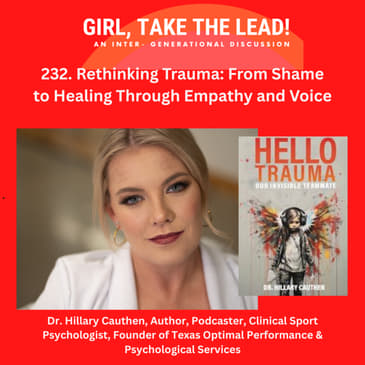
Dr. Hillary Cauthen, Millennial, is a clinical sport psychologist based in Austin TX. Hillary was a division 1 college track athlete, before embarking on a career focusing on the mental health and mental performance dimensions of high performers. Dr. Cauthen is the Founder of Texas Optimal Performance & Psychological Services. Her private practice has steadily grown over the past decade and now includes a dedicated team of six providers delivering comprehensive care to athletes, parents, coaches, and sports organizations throughout the greater Austin, TX area. Dr. Cauthen formerly served as the Director of Organizational Wellness & Performance for Austin FC and the performance psychologist for the San Antonio Spurs, where she developed their mental performance and wellness programs. Her work with high performance is breaking down stigma across communities which is highlighted in her book, "Hello Trauma, Our Invisible Teammate” and continued in her weekly podcast titled Highs & Lows of X’s & O’s
Here are the topics we covered:
0:00 Introduction
2:27 Trauma Statistics
3:50 Trauma Defined
4:55 Empathy vs Sympathy
7:21 The Three Trauma Reactions
10:51 Shame
12:57 Embarrassment
15:50 Anger and Recovery
18:21 Gaslighting and Fear
20:44 Changing the Viewpoint
22:27 Resolving Trauma
25:00 Healing
28:08 20 Something Self
Memorable Quotes
“70% of Americans have reported experiencing trauma.”
“Trauma is any physiological response that exists to you
“Sympathy is saying “I’m sorry” (unintentional pity); Empathy is an emotional connection.”
“Fear is a silencer of people’s voices.”
“Anyone living in the timeframe of 2020-2022ish experienced trauma: COVID. The level of experience and how it impacted us is different.”
“Healing is like learning to walk again,..healing is living…it’s taking tender, honest, active care of our wounds. Healing is forgiving and accepting ourselves without judgment, shame or anger. Healing is getting our voices back so we can speak and listen. But it’s also caring for ourselves out loud publicly and for all to see and hear.” (Excerpt for Hillary’s book)
Here are the 3 Takeaways:
When we experience trauma there are 3 places we can go to and be: the minimizer (dismiss the impact), the enabler (“It must be my fault”), and the moral authority (something really bad did happen). We will go back and forth between these during our healing phase. Until the moral authority kicks in the we really can’t recover.
Shame is not guilt and is an assessment of our character traits. It can create relentless negative self talk and striving for perfectionism. We don’t want to fail because it creates more shame. Before shame, embarrassment, which is a socially prescribed morals and norms, can often come. It’s the fear of the judgement of others that can lead to the feeling of embarrassment. Anger goes to action. It is the most powerful emotion to move differently.
What we’re not doing yet is having the emotional vocabulary for trauma and sitting with people’s emotions. We can all experience trauma and have it impact us but it’s what we do through the next phases, and the meaning we make of it, is how we get back to living healthy. Healing will eventually happen.
As Mentioned:
Her book:
Hello Trauma, Our Invisible Teammate
Available at Amazon, Barnes & Noble or Audible! A signed copy is available at www.txopps.com
Her podcast:
Highs & Lows of X's & O's
Additional Resources:
213. Understanding Crisis, Trauma, Healing, and Growth with Dr. Kate Flynn, The Crisis Coach
Ep. 179. Trauma, Control, and the Journey to Vulnerability, Trust - Insights from Gabor Maté, Daniel Goleman, Brené Brown
Ways to contact with Hillary:
drcauthen@txopps.com
insta: drcmindset
Ways to reach Yo:
yo@yocanny.com
Public FB group: Girl, Take the Lead!
https://www.facebook.com/groups/272025931481748/?ref=share
Linktr.ee/yocanny
https://www.instagram.com/yocanny
https://www.linkedin.com/in/yocanny/
[00:00:06] Welcome to episode 232 of Girl, Take the Lead, where each week we explore womanhood and leadership. And I'm your host, Yolanda Canny. Today, Dr. Hilary Cawthon, a millennial clinical sports psychologist based in Austin, Texas, joins us to talk about trauma, the subject of her book, Hello Trauma, Our Invisible Teammate. Hilary was a division one college track athlete before embarking on a career focusing on the mental
[00:00:36] mental health and mental performance, dimensions of high performers, and her private practice delivers comprehensive care to athletes, parents, coaches, and sports organizations. She was formerly the performance psychologist for the San Antonio Spurs, where she developed their mental performance and wellness programs. She is a fellow podcaster too. Her weekly podcast is High and Lows of Exes
[00:01:06] And I have a link for you in the show notes. In addition to talking about the stigma of trauma, we dug into related areas like empathy versus sympathy, shame, embarrassment, anger, and recovery, all those emotions that come up around trauma. She gives us great insights into resolving trauma and healing. Enjoy the listen. Here you go.
[00:01:35] So, Dr. Cawthon, thank you so much for coming on Girl Take the Lead. And I just know that this conversation is going to be so helpful to our listeners and viewers. So thank you for coming. Yes. Thank you for having me. I'm honored and humbled to be here. I can't wait to dive into what we're going to talk about. Yeah. So let's start if you would introduce yourself and you've got to tell people about your book.
[00:02:04] Yeah. So I am a clinical sports psychologist, a business owner in Austin, Texas. So I have a beautiful team and our whole work is around really work with high performers and athletes and I specialize in mental health. So this continuum of care model really working within the person, within the player kind of aspect.
[00:02:25] Alongside of the applicable work that I do, I have a podcast and I'm an author. So my lovely book is like my little baby. Hello, trauma, our invisible teammate. This really stemmed from a TEDx talk that I did in 2018 about the toxic culture of sport on athletes, mental health. And I really wanted to shed light about the conversations that a lot of us were having behind closed doors, but not publicly talking about.
[00:02:50] And I was like, I love sport. I love sport. I work with athletes. I played sport, but the culture can do so much harm. And I just wanted to fix that. And then it evolved into this beautiful book that I kind of was like set a goal of mine. I was like, I'm going to write a book. And no idea it was going to turn into this book when I, when I created it. And it's been a beautiful thing. And I'm so grateful to have conversations like this and to help people understand that what trauma is in my book and make meaning of it.
[00:03:20] And use sport as this kind of microcosm of society that reinforces trauma to exist and kind of a call to action. Also, it's really complex in a weird, simple way of this book.
[00:03:30] So, um, yeah, but I, I gotta say, you know, the way that you wrote the book just pulls readers in. Um, so, so, so listeners, it's not just for sports people at all. It's for all of us. And I think you even start by telling us the percentage of people that have had trauma and you can talk a little bit about that because, because the book relates to everyone.
[00:03:57] And I, and I love that you get that because I don't want people to think it's just for athletes or high performers. It just uses sport as a relatable topic that we're all fans of sport in general, but it's applicable to every aspect. And especially the first half of the, of the book is really helping people understand and redefine and make meaning of trauma. And to your point, 70% of Americans reported that they've experienced trauma. That's just those that report it.
[00:04:21] So then I'm thinking of all the people that haven't reported it. And then on top of that, I'm like, okay, well, if you're the 30% of lucky humans that don't identify of having any trauma in your life, you will experience someone in your life who has. And I hope this book can help you in like learning how to connect them differently, understand them differently, and just show up to be what I hope in a very like poly in a way, but as a good human, right? Like, can we show up as a good human and connect with care to people?
[00:04:50] Yeah. Well, I, I mentioned this to you and I know a lot of my viewers and listeners are real Brene Brown fans, but I think you have taken certain aspects of emotions and gone deeper into them and relate them more, you know, like fully in this, in this area of trauma.
[00:05:11] Yeah. And maybe we should begin first by kind of defining what you, you meant by trauma when you were writing the book. Yeah. Um, and, and I appreciate that compliment so much. It means so much to me. Um, so for me, I actually wanted to like re de-stigmatize trauma and take out big T little T and help you understand it's any physiological response that exists to you,
[00:05:38] like stubbing your toe or witnessing a car accident or being a victim of sexual assault. It's the B the meaning behind it is what I break down. Right? So physiologically anything that occurs to us, we're going to have a stimulus response in our brain.
[00:05:52] And we're going to like biologically have fight, flight, freeze, fawn kind of actions that occur no matter what the trauma is. My intent is it's the meaning behind that, that reinforces everything else after that and not making your trauma bigger than my trauma or, you know, someone else's trauma bigger.
[00:06:10] Cause we always fall in that trap and helping people as comparable as grief and loss has stages, helping people understand the stages that someone will go through, through a victim of trauma, no matter what it is, you will go through these different phases and, and making meaning of like, Oh, that's why I'm stuck in my own way. Here's how I can get out of it now. Yeah. And I guess before we go too far, I know that you had mentioned this, that we may know somebody who has gone through trauma.
[00:06:38] And I, I loved in your book when you, when you were talking about empathy and sympathy and the difference between the two. And, um, maybe you could just remind us because I, I, I know we could just always use that reminder about the difference between the two and what helps
[00:06:58] a victim, um, um, most. Yeah. I always kind of evolve in this. The simplest answer is think of sympathy, like saying, sorry, you know, you are sorry for someone. You are kind of in a way, unintentionally having pity for them where empathy is an emotional connection. And you can remember the alliteration E and E and S and S, right? So with empathy, can you emotionally connect?
[00:07:23] It's not just walking in someone else's shoes, but can you emotionally understand their feelings and what they are identifying that as, and then help you make meaning of the situation. We often get stuck in our own way. And we assume that we know how someone's going to feel because of our own biases. And so then the quick response is sympathy. I'm sorry that happened to you. It feels like I'm emotionally connecting to you. It feels like the right response,
[00:07:48] but it's our only response, but it's our only response one, because we have a poor emotional vocabulary and we're not socially trained on how to have really proper emotional hygiene and emotional expression. Um, it's also protects us from not having to emotionally engage with someone else's feelings to feel it. Yeah. So we just say, I'm sorry. Like that's thinking of you, you know, thoughts and prayers. Like, and you know, we look at that and that's where people get so angry. It was like, that doesn't do anything.
[00:08:16] Yeah. Doesn't make anyone feel better. Yeah. I think that that empathy almost sometimes doesn't need words. Yes. Beautiful. I love that because you can sit in a space with someone and not have to have any perfect word or say anything and just hold space for them. And then that allows someone else to then either feel calm or go through their own stuff or have the ability to communicate what they need in that space.
[00:08:44] Yeah, definitely. So when we, when you looked at trauma and you broke it down, you had like three different aspects to it, right? The minimizer, enabler and moral authority. Can you walk us through those? Cause they were really good.
[00:09:04] This is like probably like one of the favorite things that I love so much that it connected and hit. Cause when you write it and you're like, I'm going to create these things. You don't know if it's going to hit, but it definitely hits. So, so excited. Um, so this is the best way to cognitively conceptualize where people go to when they experience trauma. And the first one being the minimizer is they are going to often minimize the experience, minimize the impact, the meaning behind it, you know, dismiss it, like totally like remove emotion.
[00:09:34] And, and get stuck in that phase. And the beautiful part about each of these, you will go back and forth depending on how your brain is essentially processing and you're working through your healing phase.
[00:09:46] The enabler is where people get kind of stuck where they're, it must be my fault. They're enabling this thing to exist. So if we go to sexual assault, that's probably the most common to look at the enabler aspect as an example where women who are victims of sexual assault will often feel like, oh, I shouldn't have been out that late.
[00:10:06] I shouldn't have had that extra drink. I shouldn't have dressed this way because society has prescribed these things on top of them. And we enable the excuses for behavior to exist. And so then the victim will be like, it must've been my fault.
[00:10:19] The other confusing part about some of this trauma is when there's convoluted emotions and feelings behind a perpetrator, because oftentimes it's someone you know as well. And then the pleasurable aspect that exists with your body physiologically that you can't turn off where then you're like, did I enjoy this? Did I want to say no?
[00:10:37] And so they kind of work through this process because they don't want to admit that something bad happened. They don't want to admit that this was hurtful or scary or all the other emotions that could come by admitting something bad occurred. So they're trying to make meaning and they'll enable, and then they'll minimize and they'll enable back for it to just kind of make it feel like, oh, well, this is why it happened. It's my fault. You know, it's not that bad.
[00:11:02] And then your brain, and this is not like a quick fix in six months. Like it might take years for you to get to the moral authority. The moral authority is when someone finally in your brain clicks and says, hey, you know what? Something really bad did happen to you. And this is not okay. Like you should stand up for yourself. You should do X, Y, or Z. It's kind of like your superhero rushing in to finally be like, hey, like, do you understand what you went through?
[00:11:28] And I say that when I hope listeners can really resonate. We often judge victims of trauma when they've come out later to speak about what happened to them, whether it's child abuse, sexual assault, war evicted, whatever it might be. We often judge them on, well, why didn't you say something sooner? How could you have allowed it to happen for so long? You know, it couldn't have been that bad if you waited years. What they're not understanding is the person who had to come out of the course. What they're not understanding is the person who's gone through something psychologically hadn't made meaning and come to terms with all the things that existed.
[00:11:57] And so until that moral authority actually comes into play and says, do you see the world that you've lived in? Do you see the experiences and what had occurred to you? Like, it really is not okay. Like, let me help you now.
[00:12:10] Yeah. Gosh, that's good. Let's go back to the part about shame because that one really, I thought you did a great job and listeners, you're going to really enjoy this because I've asked Hillary to read a little bit from her book to help us understand a little bit about shame because I thought she wrote it so well.
[00:12:32] Yeah, thank you. So every chapter entitled, it's a juxtaposition, right? So this chapter is hello, shame. You're welcoming into the emotion of shame. All right. Shame is a very strange thing. It's not guilt, which is a sense that I did something wrong. Shame feels like I am bad. I'm not worth better than this. I am at fault for what's wrong here. It makes us feel like everyone can see into us and they dislike what they see.
[00:12:59] If guilt focuses on behavior, shame is assessment of our character traits. When people experience shame, they feel worthless, exposed, afraid to look stupid, but they're convinced that they already do. It leads us to worry constantly about what other people think about us while disliking and judging ourselves. It can lead to an ancient sense of seeking perfection so we don't fail and expose ourselves to yet more shame. And it creates relentless negative self-talk. Oh.
[00:13:28] That's good. I think a couple of things that you pointed to there, you know, the perfectionism and the negative self-talk. Yeah. Oh, anyway, thanks for writing that because that one just went, whoa. Yeah, there's moments that hit you. Yeah, there's moments where I'll reread it and I'm like, oh, didn't know that was going to hit me today. That one got me.
[00:13:59] Well, I've been playing around a little bit with this distinction between shame and embarrassment. You know, because right now there's a lot of use of the word embarrassment going on, you know, in the media on a national level. Yeah. And I thought to myself, like, what the heck is embarrassment? You know, like, and how, how is that?
[00:14:28] Is that like a social construct that we all have a certain standard that somebody is supposed to be a certain way? And then, then when they're not, we, we feel something and we, and we're embarrassed for them. I don't know. Or, you know, when you would hear don't wear that, that embarrasses, that's embarrassing. Yes. So, yeah, it's like the first tier level before you get to shame. Right. And that's where I think about these emotional hierarchies.
[00:14:56] Like we, we have six universal emotions, but when you expand about them, then like they're deeper levels of that one construct of emotion. Right. So like embarrassment comes into, like, if we think of inside out, right. There's like disgust is like the primary emotion. So it's like, okay, well, like this is in that framework of embarrassment. So it's more of, yes, I love the fact of socially prescribed morals or norms or values of like, this is how you dress. This is how you show up. This is trending.
[00:15:27] You know, this is how you're supposed to act. And those that go outside the social norms and are their most authentic self tend to embarrass, cause embarrassment in other people because they fear the judgment of what other people might say. Because they're not about that person or. Yes. And if you're related to that person. Right. So like, look, I was terrible as a kid. I'm not going to lie. Poor mom. Sorry, mom. I love you. Love you to death. But I would be the kiddie. Like you can't wear that to the grocery store. Like I would be that kid.
[00:15:58] And she didn't care. My mother is the most authentic human. Right. Like still to this day, dyes her hair crazy colors, cuts it however she wants, does whatever. I mean, I think she does have purple hair right now. She's had highlighted green neon pink, like beautiful for her. Right. Um, I, she used to tell me your girls, I have four girls. She'd say, I can't wait till they make mom. You can't wear that to the store. And I tell my girls the story.
[00:16:26] My girls are like, you can wear whatever you want, mom. Do you? Cause I'm raising them to be beautiful, authentic humans. Um, but yeah, I think it's like this, this fear of other people's judgments leads to the feeling of embarrassment. And then the tricky slope could be okay. If I'm like, who I was a little bit embarrassed by that because I think I got that wrong. I think I didn't fit in socially. Um, then it could lead to shame. Then it can lead to other deeper negative emotions that could be problematic. Yeah.
[00:16:57] Well, let's talk a little bit about the moral authority, that anger. Cause one of the things I thought you did brilliantly was to most of us like have anger and we go, Oh, we got to get rid of it. Yes. And we don't listen to it. I think what you were saying in your book was, Hey, this is on the road to recovery. Anger has to show up. Yes. To get there. Whoa.
[00:17:26] I thought that was such a nice way of looking at. And you, and you almost made it seem like that anger is very helpful. It is probably in this specific phase, right. Of experience of trauma and emotion, the most powerful feeling you can have to get to action, right? Anger goes to action. And I've put that in that book in the, in that, in a phrasing around that of when we're sad, when we're scared, when we're frozen, we can't do anything. We can't think clearly.
[00:17:54] We're in a protective hibernative state, but with anger, it's like you're breaking free and you're like, no, wait, I feel something different. I feel energy in my body. It's like momentum. And when you think about anytime you've been angry, it physiologically surges emotion in your body. And it really, if you don't release, it can be pretty problematic, right? Because you're just holding all this tension in there. But when you learn to think through, I'm like, what could I do now? Because I'm now seeing things differently. I'm seeing a different emotional light that gives me movement and momentum to them be like, oh no, I can go fight for myself.
[00:18:23] I can fight for healing. I can fight for working out now. Like you don't necessarily have to have a crusade of activism, right? I don't want to get that message there. Like if you're healing through something and using anger, it's like, maybe you're just now getting off the couch and you're showering and you're working out and you're having conversations that used to be really scary because you didn't trust people, you know, movement into living again. I can see like learning to set boundaries, maybe better for yourself, advocating for yourself more.
[00:18:54] I'm speaking from experience here. Yeah, definitely a child with lots of trauma. So, you know, and I also think sometimes we have, because we've been the enabler for so long and we've got that story in our head, that to question it and to get that bit of
[00:19:19] anger, uh, either towards the person who victimized you or the abuser. Um, and it could be a boss. It could be somebody that you've worked for that just was a bully and, you know, oh my God. So I, I think that was so cool how you talked about that and you talked about fear. Can you, I know, I'm just going to just keep asking you all these questions.
[00:19:46] Can you talk a little bit about, you talked about gaslighting. You have a chapter on gaslighting. These are the phases you go through, right? Any victim has been gaslighted and thought to think they're crazy that the experience of their world, they're the problem. It didn't, it didn't, it didn't happen that way. They're seeing it wrong. Um, you know, I think like fear also like fear is a silencer of people's voices.
[00:20:10] It hijacks their brain to really be stuck and frozen in time and the fear ramification that exists, right. Of how do I work through this? How do I heal from this? Um, the whole world looks different when you go through something, you know, anyway, even if you go through something good, the world looks different. Right. But imagine when you go through something that was traumatic, that shaped the way you see the world and trust people. Right. Well, I think right now we're going, we've had a certain transparency about how we live
[00:20:39] in the United States and how we live in America. And that transparency is totally being erupted. Like it's, it's like we're, we're seeing things very differently. Um, people are experiencing us very differently. Um, it's just, it's pretty amazing, um, to see this. I can imagine. Um, what we're going to, how, how we'll heal from it or how we'll, you know, go forward,
[00:21:09] take action or whatever. But, um, it could be, it could be something that we're all going to be into together. And you talk a little bit about that, that, that the trauma is something that gets silenced. So you don't get the recovery and the help from other people. Right. Which, because we're all being silent about it. Yeah.
[00:21:36] And the difference of being silenced or being silent. Right. And I clarify those two because, um, being silent is an active choice, right? You're choosing to be silent in that, in that framework, in your own process, whatever phase you're working through a fear of trauma. Um, but being silenced is when the world or certain people do not want to hear you. And legally we see that happen a lot, right? We see NDAs. We have legal agreements where you can't say anything. You are silenced. Yeah.
[00:22:07] Ooh. Um, so, so you want us to change the whole viewpoint on trauma. Yeah. Let's talk a little bit about it. It's a bold task. It's a bold task. Yeah, no, it's wonderful. But let's talk a little bit about what you see there and what needs to change in the company. Yeah. I think first and foremost is actually understanding that we all experience that, right? We all, I will, I will confidently a hundred percent say anyone living in the, in the timeframe
[00:22:37] of 2020 until 20, 22 ish had experienced trauma because of COVID. Now the level of experience that you went through is all different, right? Whether that was, you got ill and it changed your health course. It took a family member. It took work that you were doing. Um, it took away the livelihood, like sports, every aspect of living.
[00:23:00] Like there's so many continuum markers that existed to the impact of a pandemic that existed globally. We all experienced the same event and we all will have different experiences of how that impacted us, what we had to work through, how we could heal from that. Other people could tell you a beautiful story about COVID and how the community came together and their family got to spend time together and they restructured their boundaries and their work wasn't impacted. Right. And they got to live their life in certain ways.
[00:23:28] And now it's beautiful five years later for them. Right. And so the whole commonality is we can all experience stuff and have it impact us, but it's what you do through the next phases and make meaning of it. And how can you get back to living healthy? And we also have to have emotional vocabulary and like sit with people's emotions. And that's what we're not doing yet. Yeah.
[00:23:51] You also talk a little bit about resolution and how, you know, resolving, like if, if something like the, the trauma builds on each other, right? So COVID hits and the 70% of us who are all already in trauma, um, that hits on top of the other trauma.
[00:24:14] And then it sounds like they just, you know, because our brains are wired to protect us that we just go into certain patterns. Yeah. You'll go into your natural protective coping mechanisms, right? So if you have an avoidant, you know, style of coping where you don't want to address it and you're going to avoid it and you're going to run away from it. Right. Like you could see yourself isolating, shutting down, avoiding all people because the world becomes too hard now.
[00:24:43] Like all the things are too hard and it's too scary to go try to do things and interact because you don't want to have the emotional connection that could cause pain. And so we just avoid, right. Or we have the anxious attachment style. And it leads back to our attachment styles, really of how we grew up and connected to our caregivers. And so if you have anxious attachment and trauma hits, you might be like super anxious about certain things and clinging on certain things to make them feel real and connected and stable. And it might make you feel like you're needy.
[00:25:11] You're like, I'm not needy or in control and have to be controlling. And you're like, well, my world feels out of order. So I got to do all these things to make sure everything else feels balanced. And so people can pay attention to how do I act when my normal day gets disrupted? You know, what's my natural pattern? Like for me, I'm going to go clean my house crazily and feel like everyone has to be stuck on a schedule. And my, my order comes out, my perfectionism comes out. And it's like, oh, Hillary, you're just anxious right now.
[00:25:38] Like everyone else doesn't have to fit your world of like cleaning and being on time. Um, but it's because I feel out of control. So then I have to control all the surroundings around me. Poor kids, man. They know, they know, they know when mama's on it. Cause I'm like, we're going to be late for school. Get going. You got five minutes. And they're like, what? Like we're fine. Well, I can just tell you, cause I'm at the other end, you know, my, my kids are adults now. And I'm just saying, just put some money aside for their therapy because they definitely will
[00:26:07] get it and need it. Yeah. And it's just like, go to therapy early when you don't have problems. So you build a beautiful connection of what therapy looks like. So then when you really need it, you can be like, oh, no, I really need you. Oh, I think that your kids probably just adore you though. Oh, thank you. I think so. I think they like me. Yeah. That's great. So before we end, I, I loved what you said about healing in the book. Do you, can you read one more? Absolutely. Absolutely.
[00:26:36] Paragraphs for us about healing. You guys, I think that this was, this was so well said. I mean, I'm just gonna let her do it. So please. Healing is like learning to walk again. It's a period of being emotionally tentative with ourselves, like exposing the new scar to sunlight. It takes time to allow our mind to integrate the ground we've covered and to trust that we can be comfortable in our own minds and bodies again. Like everything else, it's a process and it goes slowly.
[00:27:03] We may not realize how much we've grown until we feel our strength come back, but it's happening beneath the surface of our consciousness, which is working around the clock to take care of us. Healing virtually always happens because our brains want us to live. Healing is living. Healing is taking tender, active, honest care of our wounds. Healing is forgiving and accepting ourselves without judgment, shame, or anger. Healing is getting our voices back so we can speak and listen.
[00:27:31] But it's also caring for ourselves out loud, publicly, and for all to see and hear. I think that's such a wonderful place for us to kind of end our episode. But is there anything there that you want to share with our listeners? I tried. I think I dissected your book. Yeah, I think it's, you know, I think it's beautiful. And I, and I hope that that last part can really sit with you on resonate that
[00:27:58] healing will eventually happen without you actively having to try, right? Like some, some people get so frustrated when they're like, I've gone to therapy, I've worked out, I've changed my hair. I've done all the things, you know, like, and I still feel sad. I'm like, of course, of course you still feel sad. You might feel sad for a long time. And it's like, can you just live for a moment? Can you show up for five minutes? And redefining that living aspect, but knowing that your brains are here to help you get back on track.
[00:28:28] And if you can publicly heal out loud and use your community, it might go a little faster for you. Yeah. Oh boy. Well, listeners and viewers, I hope that you pick this book up. If I'm going to tell you, you feel like you have a friend in this book. So, um, and so how can they follow you? Yeah, absolutely. To your podcast, all of that.
[00:28:56] Um, so Dr. C mindset, I'm very active on Instagram. I love to do lots of little educational clips and connections. You can always message me there for direct immediate contact. You can get the book at Amazon Barnes and Noble, or if you'd like to be reading it to you on audible, um, and please leave a review. It's always helpful for us, um, to just kind of keep spreading the message. And then yeah, www.txopps.com is my website that also has a good blog to follow as well. Oh, thanks Hillary so much for joining us.
[00:29:26] And before you go though, what would you tell your 20 something self? Because boy, I think you were through your junior Olympics at that time and gone through. I was a collegiate athlete. Yep. At 20. Um, who my 20 year old self, we had, we would have had some coffee. Um, um, I think I would have just sat down and said, you know what? You can actually go after what you really want.
[00:29:50] Like you can allow yourself to not fear failure or fear evaluation, but be bold enough to go after what you want without hesitation. Oh, and I, I don't know. Did you get a chance to go to our, our gift store and card shop to just see if there was anything? Oh, I did. And I was like, how do I even like look through this? Um, I was like, and I have all of them. So, um, I was like, can you surprise me? Sure.
[00:30:19] I couldn't, I couldn't pick. I tried to have my kids pick too. I was like, which one do we like? I appreciate that very much. And I think, you know, what I might do is I think there you've given me lots of quotes in this episode. I might make you your own. Oh, that would be so good. And then we can share them. Yeah. Well, and what I've, I've been doing is, um, finding that my guests have a lot of great things to say.
[00:30:47] And some of the quotes I get are just made for a card. And there were a few things that you said, and what I'd love to do is just, you know, quote you and then, you know, for sure, you know, put your name there in our episode. So, um, I'll get that to you. Cause I think that would be awesome to do. Yeah. I would love that. That'd be beautiful. Yeah. And you can show it to the girls and go, look, mom has a thing now. Yeah. All right.
[00:31:16] Well, thank you so much again, Hillary, for joining us. I can't wait to do this episode and post it. So thanks. Thank you. Thank you for listening today. And we sure hope you enjoyed this episode. And if you did, please leave a comment wherever you listen to your podcasts, tell a friend about us, join our public Facebook group, girl, take the lead, or visit our website, girl, take the lead pod.com.
[00:31:42] We also have a YouTube channel where your subscription would be appreciated. Once you're on YouTube search girl, take the lead. And we're also on YouTube music and on Spotify, where you can find a video of this episode. Some of my favorite quotes were 70% of Americans have reported experiencing trauma.
[00:32:07] Another was trauma is any physiological response that exists to you. And sympathy is saying, I'm sorry, which can be unintentional pity. Empathy is the emotional connection with someone. And lastly, fear is a silencer of people's voices.
[00:32:38] Here are three takeaways. One, when we experience trauma, there are three places we can go and we can be. One is the minimizer where we dismiss the impact. Can be the enabler. It must be my fault. Or the moral authority, which says something really bad did happen.
[00:33:05] We can go back and forth between these during our healing phase. Until the moral authority kicks in, we really can't recover. Because the trauma is often silenced, we may not get the help from others we need to recover. There is a difference between being silent, which is an active choice, and being silenced, which is when others do not want to hear you.
[00:33:31] Two, shame is not guilt, but is an assessment of our character traits. It can create relentless negative self-talk and our striving for perfectionism. We don't want to fail because it creates more shame. Before shame, embarrassment, which is a socially prescribed moral and norm, can often come.
[00:33:59] It's the fear of the judgment of others that can lead to the feeling of embarrassment. And anger goes to action. It is the most powerful emotion to move differently. Three, what we're not doing now is having the emotional vocabulary for trauma and sitting with people's emotions. We can all experience trauma and have it impact us.
[00:34:30] But it's what we do through the next phases and the meaning we make of it is how we get back to living healthy. Healing will eventually happen. Our brains are here to help us get back on track. And it could go faster if we can publicly care for ourselves with the help of others.
[00:34:53] Our next episode will feature our guest, Lisa Evan, author of the book, What's Your Ripple Effect? and Why It Matters More Than Ever. It's a leader's guide to creating lasting impact and influence. She also has a podcast, Have Good Ripple Effect. We had a great conversation about culture, joy, and presence.
[00:35:21] One quote I loved from her was when she said, Joy is my job. Not a bad job to have, right? It's also the topic of another book she's written. So please join us again and talk to you soon. Bye. Bye.