
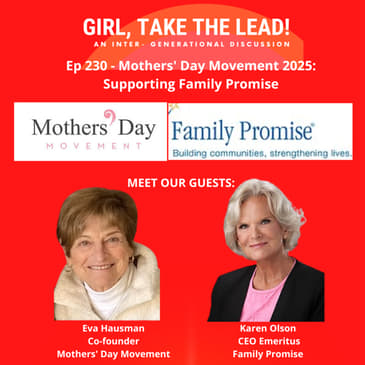
Eva Hausman, Silent co-founder of the Mothers’ Day Movement (MDM) joins to remind us that $35B are spent on Mother’s Day and what if for the cost of a bouquet of flowers we could change a life?
Eva’s interest in starting this organization grew out of a column in The New York Times by Nicholas Kristof, where he made the case for moving the apostrophe in Mother’s Day so it honors not just one mother, but underserved mothers everywhere. It advocates shifting a portion of Mother’s Day gift giving to a carefully selected charity each year in honor of a woman or person they love.
Joining Eva is Karen Olson, founder and CEO emeritus of Family Promise, a national non-profit organization. Karen has dedicated her life to transforming the futures of homeless and low-income families. Family Promise is the 2025 Mothers’ Day Movement beneficiary.
Since 2011, MDM has raised over $1 million, in maternal health, education, hunger, clean water, and human trafficking, and has been featured in The New York Times, Ms. Magazine, and NPR.
Here are the topics we covered:
0:00 Introductions
2:47 MDM Mission
4:57 MDM Impact
6:20 Family Promise Choice
7:33 Family Promise Mission
12:16 Misconceptions about Homelessness
13:29 Homelessness Trends
15:00 MDM Contribution to Beneficiary
16:50 Advice 20-Something Self
Memorable Quotes
“It's time to move the apostrophe so that it becomes not just Mother's Day honoring a single mother but Mothers' Day, an occasion to try and help mothers around the globe as well." Nicholas Kristof, The New York Times
“With cutback in programs, homelessness will increase. When we cut food programs and money for housing, people will end up in the streets.” Karen Olson
“Engage in what you believe in.” U.S. Sen. Elissa Slotkin
Here are the 3 Takeaways:
- For the price of a bouquet of flowers, we can save a life by donating to MDM. Can you believe that $35 Billion was spent in the US on Mother’s Day last year?!
- 100% of your donation to MDM goes towards helping Family Promise achieve their mission and the 2.5 million children in the United States who experience homelessness.
- Founded in 1988, Family Promise is the nation’s leading organization addressing the crisis of homelessness for families with children. With nearly 200 sites across the country, Family Promise leverages local assets, implements real solutions, and advocates for families facing homelessness.
As mentioned in the episode:
Donation Link Mothers’ Day Movement 2025 Family Promise campaign: https://www.mothersdaymovement.org/2025-family-promise
More about Eva:
Born in 1943 in Bridgeport, CT to Jewish refugee parents from Nazi Germany, Eva was privileged to be the only member of my family to be born in the United States a country her parents adored. Her volunteer activities are many and varied but are primarily related to diversity, civil rights and defending against discrimination. She served on the CT board of the Anti-Defamation League for the last 30 years and received multiple awards for her service.
More about Karen:
Karen's journey began in the mid-1980s when she first committed herself to the noble cause of advocacy for the disenfranchised and homeless.
Over the years, Karen's efforts have been recognized including President George H. Bush honoring her with the prestigious Annual Points of Light Award, and the New Jersey Governor's Pride Award recognizing Karen's remarkable social service contributions.
Ways you can contact Mothers’ Day Movement and Family Promise:
info@mothersdaymovement.org
Websites
www.mothersdaymovement.org
https://familypromise.org/
IG:
https://www.instagram.com/mothersdaymovementmdm/
Facebook:
https://www.facebook.com/mothersdaymovementMDM
Ways to reach Yo:
eMail: yo@yocanny.com
Public FB group: Girl, Take the Lead!
https://www.facebook.com/groups/272025931481748/?ref=share
Linktr.ee/yocanny
IG:
https://www.instagram.com/yocanny
LinkedIn:
https://www.linkedin.com/in/yocanny/
[00:00:07] Welcome to episode 230 of Girl, Take the Lead. We're each week, we explore womanhood and leadership. And I'm your host, Yolanda Canny. Eva Hausman, Silent Generation, is the co-founder of the Mother's Day Movement. And she's here to remind us that we spend over $35 billion on Mother's Day.
[00:00:29] And she asks us, what if for the cost of a bouquet of flowers, we could change a life? Eva's interest in starting this organization grew out of a column in the New York Times by Nicholas Kristof, where he made the case for moving the apostrophe in Mother's Day. So it honors not just one mother, but underserved mothers everywhere.
[00:01:00] It advocates shifting a portion of Mother's Day gift giving to a carefully selected charity each year in honor of a woman or person they love. You may remember Mother's Day Movement from previous episodes over the past three years. Every year, they have a new beneficiary with a new story to tell.
[00:01:22] And this year, Eva is joined by Karen Olson, founder and CEO emeritus of Family Promise, a national nonprofit organization. Karen has dedicated her life to transforming the futures of homeless and low income families. Family Promise is the 2025 Mother's Day Movement beneficiary.
[00:01:48] Some of the topics we'll cover includes the missions for both Mother's Day Movement and Family Promise. And you'll learn about some of the misconceptions about homelessness, particularly as it relates to homeless families. I found the conversation very moving. So you may want to have a hanky near boy. Enjoy the episode. Here you go.
[00:02:16] Well, welcome to Girl Take the Lead, Eva and Karen. We're excited to have you here. And this is the fourth episode about Mother's Day Movement. And each time it's so great and interesting to have someone from the organization. So shout out to Dominica, who's come the last three years. And we're excited to have you here. And we're excited to hear some more about you this year. So thanks for being here.
[00:02:42] Eva, would you introduce yourself, please, to our audience so they get to know you a little bit? Yolanda, thank you very much for having me. And as you said, I have large shoes to fill because Dominica is such a wonderful member of our team. I am a first generation American. My parents were Holocaust survivors.
[00:03:07] And I'm the first person in my family born here. And I became an educator. I taught history for social studies, but mainly history for over 30 years. And I guess as I reflect on it, hoping that history would not repeat itself.
[00:03:35] I'm also my husband passed away. We were married for 50 years and I have two daughters, Kim Athen and Lisa Davison, and four grandchildren. And Kim is my co-partner, along with several other people. Karen, tell me a little bit about yourself and how long have you been involved with Family Promise?
[00:04:01] I founded Family Promise back in 1986 as a local program. And it grew into a national program. Before that, I had a corporate career. I worked for the Warner Lambert Company, developing coupons and sweepstakes events for products like Liquor Listerman and Chick. Wow. And I always wanted to help people. And they helped me take a turn.
[00:04:29] And I ended up giving a sandwich to a homeless woman up in front of Grand Central Station. And that paved the way for me to do more. So Eva, would you tell us a little bit more about Mother's Day movement? Maybe refresh it because we've, it's been a year since we talked about it. And we'd love to hear about the mission and why you started it.
[00:04:52] I was deeply moved by the book Half the Sky, written by Nicholas Kristof and Cheryl Wu Dunn. I read that in 2009. And subsequently shared with Nick and Cheryl that I did a small fundraiser on my own for the Fistula Foundation.
[00:05:15] And Nick wrote a little piece in the New York Times and mentioned me and also wrote that then $14 billion was spent on Mother's Day cards, flowers, etc. And that that could educate 60 million girls in the developing world.
[00:05:39] Today, that figure is $35 billion spent on Mother's Day gifts. And our concept is that we want to shift gift giving to women and their families.
[00:05:56] And Nick wrote, and I'm going to quote that in 2010, it's time to move the apostrophe so that it becomes not just Mother's Day honoring a single mother, but Mother's Day, an occasion to try and help mothers around the globe as well. And that was our mission and has remained our mission.
[00:06:23] And we are now on our family promise will be our 16th beneficiary. The concept is that we pick a different 501c3 every year.
[00:06:35] And we have students in the field of education, clean water, sex trafficking, maternal health, and food shortage or malnutrition also. And that is, in short, how we began.
[00:07:01] And what we hope to do every year is support a different 501c3. And what kind of impact has the organization had? In terms of philanthropy, we've raised $1 million since we started. Last year, we achieved the $1 million mark.
[00:07:26] We hope to educate people about the fact that there are significant problems in the developing world, as well as many problems in the United States.
[00:07:39] And each of our charities has, many of our charities have let us know that, you know, the gift that we provide has been very helpful to them in terms of programming or buying a piece of equipment. And really, we've done so many unique charities. When I say equipment, one of them was We Care Solar. We Care Solar.
[00:08:07] And it started by a doctor who has a husband who's an engineer, and she would be doing surgeries in the developing world without light. And her husband designed a solar suitcase so that light could be provided. So the impact has been very, very depending on the charity. And so what made you choose Family Promise?
[00:08:36] Every year, we debate whether we should do an international or domestic charity. We felt this year that we'd done a number of charities in Africa, and that it was time to do another domestic charity.
[00:09:02] We do research, and then we ask the charity to fill out a request proposal. After COVID, I think we became very aware of how many problems there are in the United States.
[00:09:20] And when we learned, for me, when I learned that one, and statistically, one child in every classroom of 20 is homeless in this country. And that's really shocking. It's shocking. Yeah. But I'm going to let Karen tell you more about Family Promise because she's the expert on that. Yeah. So great segue. Karen, can you tell us more about Family Promise and what your mission is? Yes, certainly.
[00:09:50] I'd be happy to. First, I want to thank you, Eva, for your generous support of Family Promise. It will help with sheltering and stabilization, mentoring and all kinds of programs. So thank you so very, very much. All right. So Family Promise started back in 1986, and it's grown to a national program.
[00:10:15] And we serve now a quarter of a million men, women and children each year. And one in 30 children experience homelessness each year. And, you know, when you think of, you say the word homeless, most people think of those who are chronically homeless on the streets, a man lying on a subway grate with his alcohol bottle or woman talking to herself, pushing a shopping cart with all her belongings in it.
[00:10:45] But families are the fastest growing segment of the homeless population and account for 35% of all those who are homeless. And when they become homeless, they have no place to go. They're lucky if they can find a shelter. If not, they live in their cars or double or triple up with friends. And they continue. Many, many are working. About half are working. And but they're the invisible homeless.
[00:11:14] So you go through the drive at say Burger King and a woman who smiles and hands you your burger and says, have a nice day. She may be homeless. And and when her shift is done, she goes to her car to sleep. But all you see is a smiling woman giving you your burger. So the problem is that family homelessness is invisible.
[00:11:38] And when I started the organization, I wanted to focus on families because they were the fastest growing segment of the homeless population. And when I started the program, the number one reason children were taken from their parents and placed in foster care was not abuse or neglect. It was simply homelessness. In other words, they redeemed and fit parents. So I wanted to bring awareness of family homelessness to the community. And I did.
[00:12:07] And our response was, well, we wanted to find a building for shelter. And we couldn't find a building in one church or synagogue could provide shelter full time. So we improvised and came up with a plan where 10, 10 churches that first year came forward in one synagogue and provided shelter in their buildings on rotation with the other 11.
[00:12:34] And so that meant any one congregation would host about once a quarter. And what came out of that was not only the intensive support from case managers, but volunteers who donated a car, repaired a car, helped tutor a child, helped a mom write a resume. And so all kinds of support came out of the program.
[00:12:59] And I'm not pleased to say that 80% now find permanent housing when they leave our shelter program. And that's a high percentage because most shelters just count bed nights, but they don't count families that find housing because the help isn't there.
[00:13:17] I love our comprehensive approach and it includes sheltering, prevention, diversion, stabilization, and then ongoing support once they're housed. So it's very comprehensive. And that's how it should be because homelessness is such a complex issue. And where location-wise are you? Yeah.
[00:13:42] We started out in Union County, New Jersey, as I mentioned, but now we're in 44 states across the country. And so we're in many different locations, but in each location, they have either a static site shelter or the rotational program and plenty of volunteers that want to help.
[00:14:08] Also very cost-effective because we utilize existing community resources, you know, the religious congregations often for shelter and volunteers provide so much support. So yeah, we're really cost-effective and that's one of the things that our donors like and we get results. Yeah. Yeah.
[00:14:28] I know you mentioned that we tend to think of homelessness as the single person in the subway or wherever we're walking and the invisibility of the family. What other myths or misconceptions do you think there are around homelessness? Well, most people think anyone who's homeless is an alcoholic or drug abuser or mentally ill.
[00:14:59] And certainly that's some of the population, but that's estimated to be at 20% of the population. That's really interesting. And so many are working, you know. Yeah. Half of all those who are sheltered are working. And I guess- So the issue is poverty. The issue is poverty. Yeah.
[00:15:20] And as a result of that, you know, they get behind in their rent or because they lost a job or they have an illness and they join the ranks of the homeless, you know. But they were never homeless before. Well, I would imagine that right now with the harsh economic conditions for a lot of people that this is expected to just increase as a problem. Yes. I think it's going to get much worse and worse with the cutbacks in programs.
[00:15:49] It has to. We're going to see a homeless population increase, you know, when we cut food programs and money for housing. It's- People are going to end up in the streets. I have to take a minute to just sort of- I just want to applaud you on what you've done. You have 200 affiliates. Is that correct? Close to 200, yeah.
[00:16:19] And I mean, that's an incredible accomplishment. Mm-hmm. Thank you, Yulia. Well, you know, we found that people want to help all over homelessness. Doesn't have a geographical definition and people everywhere want to help. So it's been, I can't say easy, but for the ground for us to develop new affiliates across the country.
[00:17:00] Mm-hmm. The contributions that people are going to make to the organization, to you. And you then, I think it would be good for our listeners to understand that you turn that money over. We don't touch the money at all. Yeah. The Mother's Day movement, whatever expenses we have, we underwrite ourselves. We have zero. We do not touch donor money. We're really almost like an idea.
[00:17:30] Mm-hmm. Instead of a bouquet of flowers or half a bouquet, give your mom or your friend six flowers. And with the money for the other six flowers, help Family Promise this year. The donation goes directly. We co-brand our web pages. You go to the Mother's Day movement. It says donate.
[00:17:57] It shows that Family Promise is the 2025 beneficiary. The money goes directly to them.
[00:18:06] The beautiful e-card that can be sent in honor of the person you are giving the money in honor of goes directly to your cousin, friend, mother, whoever you are honoring with your gift. Okay. That's very generous. Most foundations do not do something like that.
[00:18:34] Well, we are not a 501c3. We are just the Mother's Day movement. Wonderful. Yeah. Very nice. So maybe is there anything else on your heart or on your mind right now that you would like to tell the audience about? Of course, we would like the audience to go to the website, mothersdaymovement.org.
[00:19:02] And as I said, 100% of the contribution will go to Family Promise. I'd like them to understand that it's... I think you asked what we would tell our 20-something selves. Yeah.
[00:19:28] Today, a friend was listening to Alyssa Slatkin from Michigan, who just became a senator. She was in the house. She's amazing. And she wrote, or said, engage in what you believe in. And Karen clearly did that. She said you saw a homeless person, gave her a sandwich. You know, that changed your life. I read the book.
[00:19:58] It changed my life. So I just feel like a lot of people complain about things, but they don't do a lot about it. And I would tell my 20-something self to try to make a difference, to not just complain about things, but to act. How about you, Karen? What did you tell your 20-something self?
[00:20:29] To hang in there that things will change. Follow your passion, because when you follow your passion, that will open doors. And it will seem not like work, because you're passionate. Before I started Family Promise, I never considered myself a leader. But my passion and my concern for people who were homeless pushed me forward. And I became a leader. And doors opened. And it never, when I was working, it never seemed like work at all.
[00:20:59] Because I was passionate about what I was doing, helping families. And passionate about hiring an amazing team, which Family Promise has. And so I would tell myself, just keep going. And you'll bless many and bless yourself at the same time. Because when you reach out to others, happiness just catches up with you.
[00:21:27] I have to tears my eyes on that one. Thank you very much for that. So I don't know if you've got a chance to go to our online store. I try and tie some cards in for our guests who come on the show, just to see if there's anything there I can send you or that you want to maybe gift onto somebody else. But did either of you get a chance to go?
[00:21:56] I did. And the card that spoke to me was under the inspirational category, grace. Whenever life, wherever life plants you, bloom with grace. If you believe in yourself and you have faith, you will find plenty of things to do wherever you're planted and look and reach beyond yourself. And you'll see that the flowers will grow as you give wherever you are. Many will be blessed.
[00:22:26] That's beautiful. That's beautiful. Wow. Another inspirational. I got tears coming down again. My poor listeners, every time they listen to a podcast, I'm always like moved. Such a crybaby on this end. That's why you do what you do. I guess so. I really do. You make a difference. But anyway, thank you both for coming on the show and for sharing your amazing and such important work. We need you.
[00:22:55] Thank you, Yolanda. And thank you again, Eva, for your generous support. Thank you for all your love. The family promise. Yeah. Really a pleasure to meet you both. Thank you for listening today. And we sure hope you enjoyed this episode. If you did, please leave a comment wherever you listen to your podcasts. Tell a friend about us. Join our public Facebook group, Girl Take the Lead, or visit our website, girltaketheleadpod.com.
[00:23:22] We also have a YouTube channel where your subscription would be appreciated. Once you're on YouTube, search at Girl Take the Lead. And we're also on YouTube Music and Spotify where you can see a video of this episode. Some of my favorite quotable moments were something that definitely Eva said. It's time to move the apostrophe so that it becomes not just Mother's Day honoring a single mother,
[00:23:51] but Mother's Day, an occasion to try and help mothers around the globe as well. And then Karen offered us, with cutbacks in programs, homelessness will increase. When we cut food programs and money for housing, people will end up in the streets. Here are three episode takeaways.
[00:24:21] One, for the price of a bouquet of flowers, we can save a life by donating to Mother's Day Movement. Can you believe that $35 billion are spent in the U.S. on Mother's Day? Oh my God. Two, 100% of your donation to Mother's Day Movement goes towards helping Family Promise achieve their mission
[00:24:47] and the 2.5 million children in the United States who experience homelessness. The trauma of homelessness has far-reaching consequences. Children who experience it are at increased risk of educational setbacks, developmental delays, health issues, emotional distress, and other challenges that significantly affect their future success.
[00:25:15] Three, founded in 1988, Family Promise is the nation's leading organization addressing the crisis of homelessness for families with children. With nearly 200 sites across the country, Family Promise leverages local assets, implements real solutions, and advocates for families facing homelessness.
[00:25:40] They take on the full range of issues that can lead to a housing crisis, offering programs and services that include homelessness prevention, emergency shelter, housing solutions, and stabilization. So grateful for their work.
[00:26:02] Our next episode will feature our guest, Nina Naserdeen, who is an internationally acclaimed thought leader, visionary, and advocate for personal and professional empowerment. As the founder and CEO of Rise Up For You, she is a two-time number one best-selling author and a two-time TEDx motivational speaker.
[00:26:27] Over the past five years, Nina and her team have inspired and transformed the lives of over 100,000 individuals worldwide, equipping leaders and teams with the tools to excel and thrive in dynamic environments. So please join us again and talk to you soon. Bye! Bye!