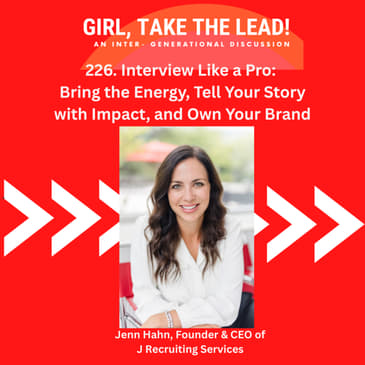
Jenn Hahn, Millennial, joins us and is the Founder & CEO of J Recruiting Services, a niche recruiting firm that partners with leading retail brands across the U.S. to deliver top-tier talent. When she isn't leading her team in recruiting strategy and solutions, she is a wife, mom to three busy kids and anavid yogi.
In 2017, Jenn founded J Recruiting Services to serve the industry she knows and loves—retail. Her team’s mission is clear: deliver exceptional results that encourage both clientsand candidates to expect more from external recruiters. They’re more than just recruiters—they’re true partners.
What You’ll Learn in This Episode:
0:00 Introduction
1:39 Trends in Women in the Workplace Today
4:24 Owning our own motivation, values, whatdrives us
6:43 Yellow stickies
9:48 Employment brand (way you show up ininterviews) and Candidate experience
11:37 Interview tips
12:24 Acing your interview
18:46 Tony Robbins example
20:06 Practice example
25:02 What Jenn would tell her 20-something self
Quotable Moments:
“We fought so hard and it doesn’t feel like fulfillment at the end of the day.”
“The power really comes from owning it yourself.”
“The only way to bring the electricity (energy) is if you’re filled up.”
“The struggle for women is that we want to ace everything and we’re crushing it…we can forget to balance.”
“Sustainable high-achievement” (Hannah Abad) is what we’re all looking for but we need to flip the funnel.”
“You do not need to be the smartest in the room – you need to be resourceful and bring the energy.”
“Fear is a really good motivator but it’s also exhausting.”
“Letting the outside circumstances dictate your brand, when it’s really an internal thing at the top of the funnel (what is your identity), can derail us.”
“We’re all interviewing every day.”
“Interviewing is a skill.”
“Clear is kind.”
Three Episode Takeaways:
1. Key trends include that women are stepping upand there are more women in leadership seats. Another trend Jenn sees is the burnout and exiting (“The Great Breakup”) at record pace. She states havingwomen at the table is important to make good business decisions that represent women in most customer bases.
2. Knowing our personal values and what drives us can fill our cup. Bringing the energy or electricity and knowing what fills us up, allows us to show up as leaders we want to be. Keyis flipping the funnel and starting with our identity and ending with our work at the narrow part of the funnel, instead of making your work 80% of the funnel. Let’shear it for yellow stickies!
3. In addition to bringing on the energy, being able to communicate detail in 3 min or less about what wedo, and stating the financial impact can lead to success in an interview.
Special Offer:
25% off offer for the Ace Your Interview Course
https://courses.jrecruitingservices.com/offers/e79ydjmb/checkout?coupon_code=GTTL25
Use the code GTTL25 when registering.
Episode Resource:
Personal branding free workbooks:
https://girltaketheleadpod.com/time-to-podcast
Ep. 52 Personal Branding: Can’t Leave Home without One – Let’s Craft Yours!
https://spotifycreators-web.app.link/e/r3BBmmTsuSb
How to reach Jenn:
https://www.linkedin.com/company/jrecruitingservices/?viewAsMember=true
(Company page)
https://www.linkedin.com/in/jenn-hahn-5698b66a/
(Jenn’s page)
https://www.facebook.com/JRecruitingServices
How to reach Yo:
Our website:
You can send a messageor voicemail there. We’d love to hear from you!
email:
FB group: Girl, Take theLead
https://www.facebook.com/groups/272025931481748/?ref=share
IG:
yocanny
LinkedIn:
[00:00:07] Welcome to episode 226 of Girl Take the Lead, where each week we explore womanhood and leadership. And I'm your host, Yolanda Canny. Jen Han, Millennial, is the founder and CEO of Jay Recruiting Services, a niche recruiting firm that partners with leading retail brands across the U.S. to deliver top tier talent.
[00:00:29] When she isn't leading her team in recruiting strategy and solutions, she is a wife, mom to three busy kids, and an avid yogi. Jen's professional journey began as a district manager for a top 10 global retailer, where she successfully led operation teams for five years. She later transitioned into sales leadership roles before finding her true calling in recruiting.
[00:00:58] It doesn't take long for Jen to realize she had discovered her zone for genius. In 2017, Jen founded Jay Recruiting Services to serve the industry she knows and loves. And her mission is very clear. Deliver exceptional results that encourage both clients and candidates to expect more from external recruiters.
[00:01:23] So what you'll learn about in this episode are some of the trends in the workplace that Jen sees. She also shares with us why owning our own motivation, our values are what drives us. And she talks a lot about yellow stickies. So get yours ready. She also talks about brands like employment brand, candidate experience.
[00:01:52] So she'll have lots of interviewing tips. So be sure to pass along to anyone, you know, who's in between jobs and interviewing. It's gonna be very helpful. Enjoy the listen. And here you go. Oh, wait. Jen has made a very generous offer. She's offering 25% off the ACE your interview course. You just need to use the code.
[00:02:21] G T T L girl, take the lead 25. When registering and we'll have the link in the show notes. So be sure to check that out. Again, thanks for being here. So Jen, welcome to girl. Take the lead. We are going to have such the best conversation. I can't wait. So thanks for joining us. Absolutely. I'm excited. I'm ready for this. I got good energy. I can.
[00:02:47] Um, so could you begin by introducing yourself to our viewers and listeners? That would be great. Yeah, absolutely. So I will keep it short and you let me know if I need to expand from here. Uh, but I'm Jen Han. So I am a wife. I'm a mom to three cool little kids. Um, actually four right now, because we have a foreign exchange daughter in our house from Brazil. Um, I'm the founder and CEO of J recruiting services where we partner with major retail
[00:03:15] brands across the United States, um, to place top talent. So I think anything in a corporate office, anything in, um, store leadership, distribution leadership, really cross-functional in that way. Um, and organizations anywhere from 500 employees to 80,000 employees. So we really work with many different types of businesses across the nation. Um, and I'm a Michigander. I, I love the Midwest. I I've grown up in the Midwest live here today. And since it's March madness, I will.
[00:03:44] And with a little bit of go green, uh, for my Michigan state Spartans there. Yeah, you are. Well, they have a very good chance to everybody is saying. They do Tom is, Oh, you know, never underestimate that guy in March. Yeah, exactly. So, um, Jen, from your perspective, because you work with so many different kinds of companies and you get, and you can probably see things that are going on. What are some of the trends that you see?
[00:04:15] Um, trends in, well, I know your audiences is mostly women. I believe you said, right? Yeah. So if I'm thinking about trends in women in the workplace today and thinking about sort of corporate America and the clients that we serve in the network that we have, um, a couple of things come to mind. First of all, I want to start with the positive. I think just over the last 10 years, I've seen incredible strides in the amount of women
[00:04:41] that are in those leadership seats, um, that are at the table in those decision-making conversations and they're crushing it. I think, um, that there's no question about that. So I definitely want to start there and then really lean into where I think some of the trends are that we could do better, right? Like what, what maybe your listeners could learn from, or what we have seen as some trends. Um, and really it's that in order to get there, in order to get to that table and either bring
[00:05:11] your own seat or find a seat or ask someone if you can have their seat at that table. It has been a ton of work for women as a collective, right? Not for one specific individual, but just women as a collective over the past many decades to get to this point. Um, and I think all of that work has really created some burnout. And I hate to say the same word that everyone else says, right? I know that's a buzzword. Um, but it's, it's true.
[00:05:38] I see really incredible women in leadership seats that are so successful on the outside, have hit all of their goals that were on, you know, that 30, 60, 90 day tracker that they filled out at the beginning of the year. But there's certainly some burnout going on inside. Um, that wondering of like, wait, why isn't this fulfilling? Or am I truly winning at work and at home? Or am I failing at both?
[00:06:04] I think there's a lot of that sort of, um, tension between who we want to be inside and outside of work and, and not having the right, um, answers there is leading to that burnout and a lot of hustle, right? I know we say hustle culture is over. It's not, we're all hustling, right? Um, there's work to be done, especially in corporate America. And then really, I guess the other trend is there's, there's that burnout. That is leading to women who are incredibly brilliant.
[00:06:33] Um, and they're in these, these important seats in corporate America, but they're not able to show up with all their brilliance. So when there are those opportunities, um, which are every day, uh, to make those big decisions or to make those, take those bold actions, I think. We're seeing women that we're tired. We're like, you know what? Maybe not. Um, maybe not. Right. And in some cases we've heard of, right. They're just leaving.
[00:06:59] So on top of the burnout, sometimes it's, it gets to a point where, um, they've called it the great breakup or the she session. Right. I think McKinsey did a study with maybe lean in.org a few years ago, and women are leaving executive level roles and leadership roles at record pace, which is such a bummer. Right.
[00:07:20] Because like I said, we all worked so hard and we need those women in those seats, not because we're on some initiative to get more women in seats, but because most organizations have women in their customer base. Right. And so we need that representation to make good business choices with women at the table. So, um, I'll stop there because I know you might have additional questions, but I really think those trends I've seen are number one, we're getting there.
[00:07:49] Like I've seen organizations stepping up. I've seen more women in decision-making seats. Number two, that burnout. And number three, when the burnout gets to a certain point, we're just kind of throwing up our hands. Like, you know what? Maybe not. We're just going to take a step back and see what's going on because we've fought so hard and it doesn't feel like fulfillment at the end of the day. Yeah. So what do you think is underneath some of that?
[00:08:13] I mean, do you think that like, if you're inspired and you are doing something where you could see yourself making a difference and that you have a future, it seems like those things can keep us going.
[00:08:34] And we don't, we don't notice that we're, um, like the working hard just sort of happens because you're like inspired by that. But maybe because there's these things called the broken rung, you can't get in even at the manager level, um, that we're not having that electricity to keep, you know, that energy to keep us going.
[00:09:04] What do you think? You know, I really believe it comes down to owning it ourselves as women. Um, I think it's very easy to say like, oh, the organization doesn't have a role that's crafted to support women. And in many cases may be true.
[00:09:21] I do want to say that a lot of the clients we work with are incredibly supportive of some of the flexibility that women might need to be the mom they want to be, or, um, some of the other pieces that really, uh, I think organizations have leaned in on over the last few years. But I think the power comes from the power as a, as a woman really comes from owning it yourself. Like, Hey, what is going on? Like, where did my motivation go? Maybe I'm not the same person.
[00:09:50] I was when I started this job two years ago. I need to figure that out. Like, what are my personal values? Right. What drives me? And am I filling that cup? And it sounds simple and, and a little bit like, yeah, cool. Fill your cup. Right. Um, um, but, but truly, truly, cause I've seen it in my life. I've also seen it in, in corporate executives, um, that are inside of my network.
[00:10:19] We have to bring the energy. You said electricity, right? The only way you're showing up with that electricity is if you're filled up. And some small things could be done. Like you really do have to though, as a woman in a leadership role, you have to stop and say, what fills me up? Like I have yellow things on my calendar, um, and yellow things fill me up. And if I look at a week and I don't see a little bit of yellow, I know I'm probably not going to
[00:10:49] be doing my best work by the end of that week. I'm going to be crabby with my team. I'm going to be like, you know, losing it at the dinner table. When one of the kids drops their chicken on the floor, you know, whatever it might be. Right. But that's on me. That's on me to craft my schedule in a way. And, and I realized, especially in corporate America, not everybody has the flexibility that a business owner does, but there are small things.
[00:11:13] And when you start with your values and you, you intentionally put small things on your calendar that will bring you that energy, you can show up to work with that electricity. Okay. So you've got to tell us what do you put on, what do you have on your little yellow sticky? My yellow things. They do vary. Um, but anything that has to do with my kids is yellow, right? So if, because I, it's really important to me to be a present mom and an incredible business leader, I don't think I have to choose either.
[00:11:42] So anything that has to do with my kids, if I went to, you know, someone's play at noon and they, because I don't know why the school's at noon. Right. But if I have the flexibility to say, Hey, I'm going to pop out, I'm going to go to this play. That's yellow. Um, my yoga is always yellow. So I do hot yoga in the mornings. Sometimes I don't feel like going, but it's almost like a spiritual thing, right? When I leave, I'm always like, okay, I am ready. Anything could be thrown my way because I just got through 60 minutes of hot yoga.
[00:12:11] And that is not for the faint of heart. Um, and then also even my date nights, right? So date nights with my husband, those are not in my work day, but they're in my calendar. Like I blend the two together. Right. And I know that I have date night on Thursday nights with my husband. Um, and that coming out of that date night, I feel fulfilled, or I feel like I gave that attention to another part of my life. I think the struggle for women is we want to ace everything.
[00:12:41] Again, we've been crushing it. We've been working so hard to get there that sometimes we forget to balance. Like, Hey, you have any of that, the goals, the values, the initiatives you're working on at work. You can probably rattle those off in 30 minutes, 30 seconds, I should say. Uh, but if someone says, what are your values outside of work? What are some goals you and your family have, or you and your friends have this year, or you have for your health? Those are hard. Yeah. Those are hard.
[00:13:08] And I think taking the time to focus there is not selfish. It is not lazy. It is not, Oh, I could be doing something. I could be answering another email. It will make you show up to work with that electricity and that energy that that's sustainable. Um, yeah, I think that's great. Yeah, definitely. Yeah. You need some yellow on your calendar. You probably have a lot of yellow on your calendar, right? I have a lot of things that I really enjoy.
[00:13:35] You know, I mean, it's hard for me to, um, but you know, like when you, you gave the examples, I'm going, Oh yeah. Walk with my husband every day at four o'clock. That's our date. Um, working on my cards, you know, and sent, putting them in the mail to people. Um, another thing that lights me up and, and the podcast, you know, like doing research or talking to people like you, it's just like, well, yeah, I get energized from that.
[00:14:02] Well, and I will say just one more thing, because I think I gave examples, you know, from my life that are outside of work, but you mentioned your podcast that is part of work, right? Right. Yes. That's so critical for corporate executives because your role changes often. And again, you might be different than the person you were when you, um, got this job offer two years ago and the role has changed. The business has changed. You have changed. You have to level set, but you have to find those things in your work that do light you up.
[00:14:30] Maybe you don't love that meeting with finance every week or the fact that, you know, you've got to, I don't know, run this report for your team. Maybe those aren't your favorite parts of the job, but taking the time to find those parts that are like, this is why I'm here. This is where I'm showing up. This is what I'm excited about. Make them yellow, you know, as a little reminder to yourself that like, I got to bring the energy here because this is, this is who I am and why I'm lit up by the opportunity to be in this seat.
[00:14:59] I, I found, um, recently I just finished. It's so good not to be in corporate anymore because marketing, you know, I was in a marketing leadership for a lot of years and the marketing plans always needed to be done, you know, just to kick off the new year. So you were always working on them in the fall. And so here I am into 2025 and I have not finished. I had not finished my marketing plans and I'm going, oh my God.
[00:15:28] Yo, come on. Let's get it. And, you know, and I forget how much I enjoy doing them. You know, I do. I look, cause it gives me that time to have perspective. And now I'm doing them on the podcast about the podcast, but I'm also doing that a social media plan for the podcast. And I have the on store online store. So I have a marketing plan for that too. And I'm like, Hey, this is very cool. Yeah. Definitely.
[00:15:56] I could feel the energy, especially when I got them done. It was like, yay. Yeah. But it was so wonderful to have the perspective and to have the time to reflect. And I think that's one of the things that you're pointing to that in order to kind of keep ourselves going, we do have to take a moment. So we don't lose ourselves that we can step back and take a look. And you've mentioned something about sustainability.
[00:16:24] So how do we, how do we keep that kind of leadership and that kind of energy sustainable? What are your thoughts there? Yeah, it's a great question. Um, so this idea of sustainable high achievement is something that was brought to me by, um, an executive coach. Her name is Hannah Abad. Um, and she's a, an executive coach for high achievers, very focused on the neuroscience of it all.
[00:16:52] And I cannot pretend to be Hannah in sort of talking through sustainable high achievement and really how to get there. But I can share that that is, um, what we all are looking for because I think that it's easy for a high achiever to go so hard, get burnout and then step back completely. Nevermind. You know what? Maybe I wasn't supposed to be in that level of a leadership role. Who did I think I was right?
[00:17:18] The imposter syndrome, um, comes in, but that's not the case in, I mean, in most cases that I see, that's not the case. The case is we, we were going after high achievement at the risk of everything else, our health, our mental wellness, our relationships, our passions outside of work, right? Those yellows on our calendar. And I do not believe that is sustainable. At least if you want to feel good at the end of your day.
[00:17:46] Um, and so how do you get there? Um, again, Hannah's going to be the expert and I definitely recommend your listeners check into her and her work that she does. Um, but what I have noticed is really, again, flipping, we call it flipping the funnel in, in any work that I've done with Hannah. Um, you flip the funnel and you really start with your identity and you end with your work and you come up right with what are your values?
[00:18:16] How do those come through? And you, you kind of start with identity and end with your work instead of making your work, you know, 80% of your life, which we spend a lot of time there. And that forms your identity. You flip it. Like you start with your identity and then you, you sort of come down the funnel. If that makes sense. I know this, it totally, your listeners can see my, my beautiful gesture, my funnels, right? She was too better. Yeah. But, you know, we use funnels too in marketing for a great deal.
[00:18:46] And when you're looking at the top of the funnel, your acquisition, you're acquiring, you know, and you're bringing a lot of people in, but then the, the most important customers you have are at the bottom of your funnel. So, so I love the idea of flipping this because it makes me think like, um, personal branding, which is one of the reasons I went into podcasting is, you know, that flip side, that part of
[00:19:15] us that, um, doesn't go away, that anchors us, that actually is the most valuable part of our funnel. You know, I can really understand that. That really makes sense to me. Yeah. And, you know, we talked about energy and the yellows, right. And, and the different ways that, but there are aspects. Um, again, I work mostly with corporate clients.
[00:19:40] I also have some groups of CEOs where I work with women, um, women founders as well, but so much of the energy that you bring gets you to that next level. You know, it is not, you do not have to be the smartest in the room. You need to be resourceful. You need to be energy because whether it's candidates we're interviewing or whether it's, um, corporate leaders we're working with that energy makes such a difference and you can't fake it.
[00:20:10] You cannot fake that energy. So if you are not, if you're not bringing that level of energy because your burnout, because you're, you're operating under this like high achiever, um, fear motivated, right? You're high achiever. How do I get there? How do I get there? Another thing Hannah says is fear is a really good motivator, really good. It will get you to do the things, but absolutely exhausting motivator.
[00:20:38] Um, so she will, she will help people flip that too, which is something that I've learned a lot about. And we've talked to some groups of, of women in corporate Hannah and I together around like how to continue to be that high achiever, but make sure you're not depleting your energy because it's a double negative. You're not getting any higher on that wrong or on the next ladder because you're resentful, you're exhausted.
[00:21:06] Um, you're not bringing your best and also you're not getting any happier at home. You're not getting any happier when you leave. You don't feel that fulfillment because you've let your work define you instead of having an identity and then bringing that to any work that you're doing. Yeah. Oh man. That's so good because there's, there were so many times, um, you know, I kind of had to evolve into what you've just said, you know, like to experience it.
[00:21:36] And have like, when I moved from New York where I had been working with Revlon and a lot of very high end health and beauty and, uh, health and beauty companies that I thought I was important. Like I had a self-importance about me and, you know, I had made it into, you know, upper management and I was important.
[00:22:05] Yes. Then when I took, made a big move from New York to California and I went, I'm nothing. Whoa. I am nothing. And it took me a long time to get myself back centered. You can imagine, you know, like from New York to California, but then also like no job and starting over.
[00:22:30] And what a difference it would have made if I had been in touch with my personal brand through all of that. So that I didn't have these huge swings of self-importance and arrogance and other things that I had to kind of let go of. Yeah.
[00:22:54] Letting the outside circumstances dictate your, your brand, which, which is really an internal thing, right? That's the top of the, what is your identity? Oh gosh. That's so important listeners. I really want you to get that because that is so key. I think that will sustain you. And, um, And I, I think you said you have a mix, right. Of like people in corporate roles, people, um, who are entrepreneurs.
[00:23:21] And I will say, I think it's an ongoing journey, right? I can, I can share my experience and I can talk about the yellow on my calendar, but that doesn't mean that I don't still battle through that. Um, I think we all do, but it takes practice. And the more you practice the better, right? So if I know who I am with or without my business performance, we can have a bad month and I can, I can be centered. Doesn't mean I like what I see in my meeting with my CFO.
[00:23:50] Um, but I can be centered and say like, that doesn't define me. And this is getting really like, I'll call it woo woo, but you know, we're, we're, but it impacts business. It impacts the way I make my next decisions in business. It impacts how bold I can be or how I run and get scared. Oh, we had a bad month or we didn't hit that goal. Or, you know, this client had a change in whatever reason. And then I just go into a hole and say, why would I start this business? Anyway, who do I think I am? Right.
[00:24:20] But if I have my identity rock solid and it is not dependent on these outside factors, it contributes to that sustainability, right? It's sustainable, high achievement, meaning I will still put one foot in front of the other because I know who I am. Right. And you mentioned your marketing plans. I, I do, um, business planning at least twice, twice a year with a business coach. Love that experience. We get women-owned businesses together and it's just very much about who we are and where
[00:24:49] we need the company to go. Um, but also a calendar audit is phenomenal. No matter where you are in your career, what you're doing, if you once or twice a year, take an hour, go to a coffee shop, look through your calendar and just keep tabs. I like to do it by hand. Keep tabs of where are you spending your time? What was worth it? What wasn't? And then you, you just, it's, it's resetting like, wow, well, no wonder we didn't see that
[00:25:19] result or no wonder I feel tired. I've been in 57 meetings about something that is not in my job description. Yeah. I have a new boundary I need to set because these other four meetings I was in, this is where, this is where I belong. And this is where I bring the energy and I don't have, I'm not coming to those with my brilliance and my best self. If I'm over here and all the things I shouldn't be right. So the calendar audit can be just a very practical way to make sure you're achieving in a sustainable
[00:25:49] environment that will keep you coming back with that energy. So you've mentioned the practice and now the calendar audit. Is there any other thoughts you have about how we can get better at this? How we can get better at sustainable high achievements? Yeah. I just think it's a constant curiosity and an awareness. So I would say, get quiet.
[00:26:18] We're not good at getting quiet. At least I struggle with it. And I know many women who do, we have everything going on. They say this often, right? Like our, our brains are spinning. What are we having for dinner? When's the next time we're getting together with our friends? Oh, did I call my mom? It's her birthday. You know, all the things, right? We don't really love the quiet, but I will say yoga is something that taught me to get quiet.
[00:26:45] I didn't get into yoga until it was probably 2017 ish. When I got into yoga and at first I did not like it. I was like, what's the point? Why are we sitting on this mat? Like, let's lift some weights or something until I realized, oh, this is exactly what I need, like this kind of quiet, whether it's yoga or not, but you do have to get quiet and listen and assess, um, who you are today and how you feel at the end of each day.
[00:27:12] Like it can be as simple as a, right before you go to bed each night, like, am I depleted or am, am I feeling good? And then you'll start to recognize those patterns of how to keep yourself in that feeling good space, because we, we do have jobs to do. And like you said, they should be fun. There are going to be hard days. There are going to be meetings. You don't want to be a part of, but if you know your why, and if you are recognizing the patterns and how your energy shows up and, and some of those things that you've done personally
[00:27:42] to get it there that day or not get it there that day, then you'll, you'll come out on the other end. You'll figure it out. I imagine from your perspective to talking to so many, um, companies that you're able to see some tips you might give our listeners and viewers about interviewing, but, but I did want to comment on one thing that you said. You talked about energy. Yeah.
[00:28:10] But you know, companies have energies too. They do. And what I think has been so interesting for me is to watch the interviewing my millennial and Gen Z daughters go through and listening, you know, like, Oh, it comes more from like, and I remember this for myself. Like, what do they want to know? Like, what do they want me to say?
[00:28:36] Like, what's the quote, right answer they're looking for, you know? And I love to shake them up a little bit and say, you listen to them because they are telling you who they are in their process of interviewing. Like, do you get called back nine times to talk to nine different people because they want all that input? Like what's going on that that's happening.
[00:29:05] And why is the CFO involved in making a decision about coming in at a lower level? Things like that, that give off little telltales about the company itself and the energy that they're bringing to the interview. I think is so interesting for me at this point, because I was such a people pleaser. What can I do to please these people and get hired? Yes.
[00:29:35] But I never saw it as a two way street. And I imagine you do now. I mean, you definitely see both sides. We do. There are two things that I would say are corporate language for what you're saying. And one is the employment brand. So there's a whole employment brand. And there are marketing teams that spend time on employment branding. And you can put it out there all you want on social media. But the way people show up in interviews is your employment brand.
[00:30:05] And so that's what you're talking about there. And then the other piece that you're talking about with nine different interviews and who knows what else, right? Because there are horror stories. That's candidate experience, right? So those are two phrases that we use often with our clients. And that's really part of our role, actually, is coming in and helping them with their candidate experience. It's part of our niche. It's part of why we do focus in certain areas.
[00:30:35] Because the recruiter that calls that candidate is the first impression of your brand. And candidates are waking up, right? Candidates are interviewing you just as much as you're interviewing them. We're not talking about Gen X and even millennials, right? We're like, please tell us what to do and we will do it. We're talking about different generations here, right? And they do have questions. And they will be concerned if the recruiter that reaches out and says, hey, can I have
[00:31:04] 30 minutes of your time? And then you get into an interview and they ask that recruiter questions. And the recruiter says, I don't know, actually. You should find out in the next round. It's like, what? Like, how are you? So anyways, there's candidate experience and there's employment brand. And both of which are very important. And you're absolutely right. That is an energy that that organization is putting out there to attract the right talent. So you're speaking my language there.
[00:31:32] And what do you find to be most helpful for those that are interviewing? I think you mentioned their energy. Yes. Yep. And bringing that to the table. Absolutely. So obviously, depending on which role they're interviewing for, there's going to be different advice. But one thing we see that's a very common piece of feedback that I think we could all
[00:31:58] get better at, myself included, if I were interviewing, is the level of detail in explaining your examples and your answers. So let's talk about leadership for a minute, right? Right. The amount of times we have someone that has led large teams, 50, 100 people in the past, sometimes been responsible for 500 different locations and all the teams that report up through those. Right.
[00:32:25] And we ask a basic question around, like, tell me about your leadership style. People can generally talk about their leadership style. Everyone loves to say, I'm a servant leader. Blah, blah, blah, blah, blah. Right. They love to say that. And then you get into an example question and you say, like, tell me about the last time someone was not performing on your team and how did you work through that with them? That's a question we ask in almost every leadership interview, right? And they don't say, I just kicked them to the curb.
[00:32:54] They don't say that. No, they will. They will start to, they can usually say like, oh yeah, it was so-and-so and they weren't doing their job. But we don't care that much, right? About so-and-so, about Bob. Let's pretend, right? That's great. We're glad you identified that's the person that wasn't performing. But people very much struggle with being able to talk through, they told me they were a servant leader, but now can they talk through the example of what did you do? Right.
[00:33:23] What did you do as the leader? What is your style to go in there? And how did you find out Bob wasn't performing? How did you work alongside Bob? Or did you have someone else work alongside Bob? What were the conversations like? How do you get clear about new expectations? How do you follow up when someone isn't performing? Is your goal to develop them? Or is your goal to, like, where is the line between, hey, we can still work with that individual and we think it's time for them to exit the organization. Right.
[00:33:51] Those details are so critical. And I'm telling you the best of the best leaders out there, C-suite levels, VP levels, they're not used to answering questions at that level. And detail of the details. Yeah. And they struggle and they get turned down when they could, their experience is perfect. But when I think about you and in the connection to your podcast, yo, it's like, it really is telling their story.
[00:34:20] Interviewing, this is, we say this all the time, interviewing is a skill. You can be the best director of marketing out there in all the land. If you can't interview well, if you can't tell your story in a way that lands with someone that might not be in your seat too. What do you do? How do you do it? And what is the financial impact of that? Yeah. Then they lose opportunities. So that's, that's my best advice.
[00:34:47] But I will say we identified five key things that are the top reasons we see candidates get turned down from interviews. And it is consistent across all levels, entry level, analyst level, manager level, director, VP, C-suite, and across different sectors. Those five modules. So I don't think we even talked about this, but we do have a course it's called ACE Your Interview. So we can maybe put it in the show notes if anyone's interested because that is one of
[00:35:16] them, but we have worksheets and basics and it's not an expensive course. I think it takes less than 60 minutes to complete it. But the whole reason we put it out there was I was like, someone has to share with these people the level of detail they're missing because these opportunities are perfect for them, but we're not taking the time to prep and share the story in that way. If that makes sense. It totally does.
[00:35:39] Because I think for us to do like the, you know, we practice the elevators, um, two minute, who are we? What do we do? Yeah. But when it comes to what do we really do? What do we really care about? What are, you know, what do we, what's our mission? What are we passionate about? We don't practice those things. No. And that's why I kind of liked doing so much work on the personal brand.
[00:36:09] And I've been doing a lot more coaching of that with high school girls. Yeah. Yeah. And it's been really fun. And I have some of the workbooks in my show, uh, in the, um, website and I'll put that into the show notes in case someone wants to look at them and use them that we don't practice. And I just love that you're talking about that and say, no, that's really important.
[00:36:34] We've got, we've got to practice these things too, because they will really persuade somebody to know who we are. Like, this is who we are, you know, you can't assume, you know, it's very easy at the end of that. So if you're a business owner, you're interviewing too. You're not interviewing for a next role. You're interviewing to work with your potential clients or customers. Right. And so that's an important skill for all of us to have. They're interviewing you to work with you.
[00:37:04] If you're in corporate America and you're interviewing for a new role, that's pretty cut and dry. But what we don't always realize is we're all interviewing every day. Yeah. Right. Especially again, in this corporate world where they might be like, well, where are my opportunities? Like, how come nobody's tapping me for a promotion? Maybe you're not telling your story. Maybe when you're doing these presentations or when you have your, um, annual reviews, you're not showing up with like, Hey, I just wanted to point out.
[00:37:33] These are some things I'm proud of from last year. This was the challenge. This was who I worked with to solve it. This is the team I built and it saved us $3 million. You know, like we have to have that confidence. And especially as women, we have to have that confidence to step up and be confident, uh, in sharing what we've accomplished and not leaving the financials out of it. Because we, we can't just say, I think my team likes it better now. You know, it's like, no, no, no.
[00:38:01] What's the measurable KPI. So I love that you're doing that work with high school girls, because I think starting young is incredibly important. Right. Yeah. And it's a certain kind of, uh, I look at it as a certain kind of anchor, you know, that, that no matter what will come their way or how they talk about it, but I love that you're helping our listeners.
[00:38:26] See like, what is, what they're missing and what they could actually deliver. However, it's not, it's not out of reach. It's pretty reachable. Yeah. I did a, um, I think it was two years ago. I did a Tony Robbins seminar, not the one that you walk on fire. I have not walked on fire. So I don't want to, um, pretend that I will one day, but I did a Tony Robbins seminar and it's some of those simple things that you just need reminders. Right.
[00:38:54] And he said it very clearly more to business owners than to anyone in maybe a more corporate role, but he said, if you don't know why they should buy from you in 30 seconds or less, they don't know. And they won't. And it's the same for our candidates. Sometimes there's a little bit of frustration. Like, oh, that, that interviewer wasn't listening. Maybe, maybe you've got a bad recruiter, right? That happens. But in a lot of cases, you think you said something that you didn't, right?
[00:39:23] Like I told them all these things. Well, no, you didn't. You, it was very fluffy. People like to stay up here, high level when they're sharing their examples. And we need to get in, in the nitty gritty details so that we can picture, you know, Bob, I'll go back to Bob so that we can picture Bob. Oh yeah. Okay. So he's that kind of, he's building spreadsheets. He's doing this. He, he created a dashboard. He can come in here and shift this in my organization. Yeah. But it shouldn't take 20 minutes.
[00:39:51] It should take three minutes or less to give that example and move on. Yeah. Yeah. I always recommend saying it out loud, recording yourself, listening back. And even if you can't hear it, ask someone else to do it. Your brother, your sister, a cousin, a friend. And say like, would you know what I did? If I said this, they might say not a chance because we forget, right? That we're so used to it, that we're, we're not sharing at a level that would land with someone on the other side of that conversation.
[00:40:22] Well, and I think in this episode, in this interview with you, you've almost demonstrated how to check in with somebody about what you thought you said. Like there've been, I don't, I. You'll have to tell me, I wonder if I know I'm doing it. Yeah. Well, I think it's natural for you because you'll say, you know, I'm sure you're looking
[00:40:50] at my face and you're, you're trying to determine, did I, am I getting what you're saying? But it's also that you will ask, did that make, does that make sense? You you'll, you'll, you'll ask it. And I think that's a wonderful way to check in with your listener to find out if they're actually getting what you intended. I think you're a great example of that right now.
[00:41:15] I mean, I'm just watching you going, this woman is masterful at being able to talk to people. That is fantastic. I really appreciate that today. Um, it's nice to hear a compliment, but also, um, I do think I have learned that through leadership even more so than sales or, um, interviewing, right. Cause that's what we're talking about right now. And, and it's called girl, take the lead. I led large teams at a very young age.
[00:41:44] I was 22 and I had a team of probably 40 people and they had, many of them had been there much longer than I had. So I was very fortunate to have mentors and a training program and, and leaders in my life that I could, um, dig in and learn from to know how do I set clear expectations and
[00:42:11] how do I make sure, you know, the worst one-on-ones are when you get in with someone on your team, you do a one-on-one, you leave and you're like, what happened? I don't know. Does anyone need to do anything? Or did she just talk in circles? Like that is my least favorite, right? So that's those checkpoints I'm doing. I think I naturally do that to check for understanding because we have a lean team and we do a lot of work. And so when I'm taking the lead, I like to make sure like clear is kind.
[00:42:37] And so if I am very clear with, um, my advice or suggestion or next steps, then I want to check in and say, does that make sense? Do you feel clear about like what you're looking for next and where you're putting it on your calendar, all the things. Right. Um, but yeah, that's funny that you've noticed that maybe I'm just used to interviewing. It's kind of what we do over here. Yeah, no, you're doing great. I really appreciate it. I was like, oh my gosh, she's terrific at this.
[00:43:05] Um, so I guess we're getting to the end. I mean, we covered a lot of territory, but is there anything more that you want to share? Um, no, I don't think so. I think we've really talked about a lot of the key points, but I think of women in leadership seats, it's making sure you're crafting your life and your calendar and, um, your world
[00:43:30] that you're living in, in a way that gives you energy because energy will take you far. Um, it will get you the sale. It will, um, get you the job. It will keep you coming back after you've fallen down, but you do have to take care of your own energy. So I think we've hit that quite a few times. And, um, some of the things that are going on out there in terms of like practical ways that they can think through how to, how to lead and how to find the next best opportunity. Yeah.
[00:44:00] I think you've given us some great ideas. I'm going to pull out my yellow stickies right after this. Um, so how can you, um, How can our listeners and viewers find you and follow you and work with you? I think that would be a lot of interest. Yeah, absolutely. I would love to hear from them. Um, I would say we're most active on LinkedIn because we're in the recruiting world. So we don't, we're not cool enough for like TikTok, Instagram, those kinds of things,
[00:44:29] but we will one day, um, serving a corporate audience. Honestly, uh, we do most on LinkedIn. So the company is J recruiting services on LinkedIn. And then my personal profile is Jen Han, um, on LinkedIn. We do have a Facebook group, um, or a Facebook page for the company, um, for some of those that really use Facebook instead of websites that they could find us there as well. Okay. So Jen, what would you tell your 20 something self today? Hmm.
[00:44:58] You know, um, I, I think back to my 20 something self and I'm like, wow, what a lifetime ago. And also how did I get this old? You know, like I always think like who put me in charge of these three kids? Like who said I could be the mom? I thought I was still learning. So anyway, just a side note there. Um, I'm not sure if I'm like, wait, I'm not that old. Like I'm still in college. I don't know about who you guys are talking to that you're hoping makes a decision over here.
[00:45:28] Um, no, but I think what I would tell her is just keep showing up. Um, even if you don't have all the answers, show up with the belief that the conversations you're having and the people that you're talking to today, um, you never know who your next business partner might be, who your next bridge 10 years from now might be. So I think I hate to just hit the energy button again, but I just think in my younger years,
[00:45:58] um, I was fortunate to be so excited that I did show up with that level of energy and solution oriented. And I had no idea I would own my own business one day. And some of the people I met when I was 22 years old and worked with are my best clients and connectors today. And it just was nowhere on the vision board. So I think the advice I would give is do put your best into it.
[00:46:25] You know, it doesn't mean you have to spend 80 hours a week on it, but when you show up, show up with your best because you never know how that conversation will lead to where you're headed in the future. Love it. Totally love it. Yeah. So did you get a chance to go to our online store and was there anything there that appealed to you? I did go to your online store and I did check out the cards. I honestly, I gotta be, I gotta be really transparent here. I couldn't pick.
[00:46:54] I was like, do I have someone that has a birthday coming up? Do I have someone? Um, I think there was one that said like, you're doing a good job or something like that, but they're incredible. Do you make those? Yeah. Yeah. I make those, but I'd be happy to pick one for you and send that to you. And you know, sometimes I'll look back at our quotes from the show and I'll be inspired by something that was said.
[00:47:21] So don't be surprised if you get one that's custom made. A custom one. That would be fantastic. Well, I was beautiful. Yeah. I've started to be inspired. Well, the whole objective of the store was to kind of inspire leaders to give things to their teams. That's what I thought I was doing because there would be times in my own leadership that
[00:47:45] I would not find like just the out of person go kind of card. And I thought, well, maybe this'll be, and then it seemed to get some energy from the podcast. And now I'm getting energy from the guests and what they're telling me. And so maybe there's something here, Jen. I'll, I'll dig into our quotes. I trust you to send the one.
[00:48:11] And when it lands, I trust that, you know, all the powers that be, it'll land on a day where I'm like, wow, I really needed that little love from Yolanda. Yeah, that's great. Well, thank you so much for joining us today. We sure appreciate you being here. Absolutely. Thanks for having me. Thank you for listening today. And we sure hope you enjoyed this episode. And if you did, please leave a comment wherever you listen to your podcasts, tell a friend about us, join our public Facebook group, girl, take the lead pod.com.
[00:48:41] We also have a YouTube channel where your subscription would be appreciated. Once you're on YouTube, just search girl, take the lead. And we're on YouTube music where you can see a video of this episode. And also you can see it on Spotify. Some of the quotable comments that I really loved that Jen said were, we fought so hard and it doesn't feel like fulfillment at the end of the day.
[00:49:08] The power really comes from owning it yourself. And then the struggle for women is that we want to ace everything and we're crushing it. And we can forget to balance. Then this one was really good too, which I think is going to be the sentiment for her card that I'm going to make up for her. She said, you do not need to be the smartest in the room.
[00:49:35] You need to be resourceful and bring the energy. Here are three episode takeaways. One key trends included that women are stepping up and there are more women in leadership seats, but there's another trend she pointed out and that's burnout and exiting. She called it the great breakup at record pace.
[00:50:04] One of the reasons she states that it's so important to have women at the table in, because it helps us make good business decisions that represent women in most customer basis. Two, knowing our personal values and what drives us can fill our cup up. Bringing that energy or electricity and knowing what fills us up
[00:50:29] allows us to show up as leaders we want to be. And let's hear it for the yellow stickies. And three, flipping the funnel starts with your identity and ends with your work instead of making your work 80% of the funnel, which can rob our energy. Oh, and don't forget her offer, 25% off her program.
[00:50:58] And you just need the GTTL25 code when you go to register. We'll have that in the show notes for you. Our next episode will feature our guest, Virginia Frischkorn, millennial founder and CEO of partytrick.com. Virginia is an award-winning former event industry professional who has successfully transitioned to a startup founder.
[00:51:25] With over 15 years of experience crafting exceptional events, she is dedicated to transforming and empowering the experience economy. And I'm telling you, it was like going to a party talking with her. So please join us again and talk to you soon. Bye.