
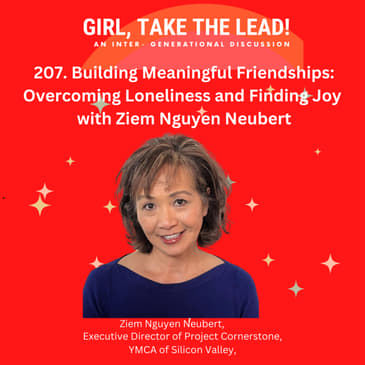
Ziem Nguyen Neubert, Executive Director of Project Cornerstone at the YMCA of Silicon Valley, joins us to discuss the topic of loneliness.
Ziem leads an amazing team, working with school and community partners to support youth social and emotional well-being. Over 20 years of experience in education – serving as a teacher, coordinator, assistant principal, and principal – has been instrumental in supporting her work in building relationships and driving the vision for Project Cornerstone. Ziem is passionate about fostering positive skills, relationships, experiences, and honest conversations to create safe, caring, and equitable communities in Silicon Valley and beyond. Today, Project Cornerstone works with over 180 schools, reaching 62,000 students annually with the help of over 4,000 volunteers.
Topics Covered:
Loneliness defined
Social media connectedness and loneliness
Misconceptions around loneliness
Friendships and different kinds of connections
3 ways we take care of ourselves: assess, plan, act
3 Episode Takeaways
1. We may not want to get rid of loneliness – if we never experience sadness how will we experience joy?
It’s also a way to kick ourselves into gear and take some action when we notice it. It’s chronic loneliness we need to watch for.
2. Social media isn’t all bad but may not be as meaningful to us as a way to connect with others. It’s the choices we make. While the social tools can assist us in connecting and be convenient/fast, we have the choice to connect this way or pick up the phone or make a plan to visit someone.
3. There are a number of misconceptions around loneliness: like quantity matters, to feel lonely isn’t normal, we should feel shameful if we get lonely, loneliness only happens to “old” people, and introverts are lonelier than extroverts (we all need along alone time to recharge). Friendship is a key way to address loneliness but it’s good to assess, plan, and take action when choosing friends.
Ziem’s Resources
The BIG document – report: “Our Epidemic of Loneliness and Isolation – The U.S. Surgeon General’s Advisory on the Healing Effects of Social Connection and Community” https://www.hhs.gov/sites/default/files/surgeon-general-social-connection-advisory.pdf
“US surgeon general Vivek Murthy: ‘Loneliness is like hunger, a signal we’re lacking something for survival’” (January 29, 2024)
“New Surgeon General Advisory Raises Alarm about the Devastating Impact of the Epidemic of Loneliness and Isolation in the United States” (May 3, 2023) https://www.hhs.gov/about/news/2023/05/03/new-surgeon-general-advisory-raises-alarm-about-devastating-impact-epidemic-loneliness-isolation-united-states.html
“Loneliness Among Teens Has Increased Over the Years Violence, depression, and radicalization realities are telling.” (May 30, 2022) https://www.psychologytoday.com/us/blog/cultural-neuroscience/202205/loneliness-among-teens-has-increased-over-the-years
Card or Gift Items Ziem Liked from Our Store
https://girltaketheleadpod.com/shop Lotus Heart with the sentiment: “I carry your heart with me – I carry it in my heart” e.e. cummings.
How to reach Ziem:
LinkedIn account: https://www.linkedin.com/in/ziem-neubert/
eMail: ziem@projectcornerstone.org
Website: www.projectcornerstone.org
You can make a donation there. Click on ‘Community’ for
access to a number of resources.
Facebook: https://www.facebook.com/projectcornerstone
Instagram: https://www.instagram.com/projcornerstone/
How to reach Yo Canny:
Our website:
You can send a message or voicemail there. We’d love to hear from you!
email:
FB group: Girl, Take the Lead
https://www.facebook.com/groups/272025931481748/?ref=share
IG:
yocanny
LinkedIn:
https://www.linkedin.com/in/yocanny/
[00:00:07] Welcome to episode 207 of Girl, Take the Lead, where each week we explore womanhood and leadership. And I'm your host, Yolanda Canny.
[00:00:16] Ziem Neubert, Executive Director of Project Cornerstone at the YMCA of Silicon Valley, joins us to discuss the topic of loneliness.
[00:00:29] Ziem leads an amazing team working with school and community partners to support youth, social and emotional well-being.
[00:00:38] Over 20 years of experience in education, serving as a teacher, coordinator, assistant principal and principal,
[00:00:47] has been instrumental in supporting her work in building relationships and driving the vision for Project Cornerstone.
[00:00:55] Ziem is passionate about fostering positive skills, relationships, experiences and honest conversations
[00:01:05] to create safe, caring and equitable communities in Silicon Valley and beyond.
[00:01:13] Today Project Cornerstone works with over 180 schools,
[00:01:18] reaching 62,000 students annually with the help of over 4,000 volunteers.
[00:01:29] If this topic of loneliness is of interest to you and you'd like more,
[00:01:35] Ziem has offered all the resources she researched in the show notes.
[00:01:41] These are the topics we covered.
[00:01:42] Loneliness defined.
[00:01:46] Loneliness defined.
[00:01:47] Social media connectedness and loneliness.
[00:01:51] Misconceptions around loneliness.
[00:01:55] Friendships and different kinds of connections.
[00:01:59] Letting go of friendships.
[00:02:03] And three ways we take care of ourselves.
[00:02:07] Assess, plan and act.
[00:02:11] Enjoy the lesson.
[00:02:12] Here you go.
[00:02:20] Susan, welcome to Girl Take the Lead.
[00:02:22] I'm so excited to have you here and for us to discuss this topic,
[00:02:27] which could be a little seasonal in nature since we're going to try and post this around the holidays,
[00:02:34] but it's not just a seasonal topic, is it?
[00:02:38] It's all the time that we have to look at loneliness.
[00:02:44] Thank you so much, Yolanda.
[00:02:46] I first of all, I just want to say thank you for having me here.
[00:02:49] It's such an honor.
[00:02:50] I'm really excited.
[00:02:55] I just, yeah, I'm excited to talk about this.
[00:02:58] And like we were just mentioning before, you know, it's kind of strange thinking about that.
[00:03:02] We can actually have a podcast talking about loneliness.
[00:03:04] I'm not sure we would have been able to do that years ago, you know.
[00:03:08] Right.
[00:03:08] I think it is kind of coming out of COVID and one of the silver linings is we are more aware.
[00:03:15] Things existed before COVID, but we are just in this.
[00:03:19] I think the norm is it's okay to talk about things like this and stress and anxiety and being resilient and all old topics, but just taking the stigma away from it.
[00:03:32] Yeah, good.
[00:03:33] So Zim, why don't we start with you telling our listeners and our viewers a little bit about you, because I know I got to know you, but I'd love for them to know you as well.
[00:03:42] I'd be happy to.
[00:03:43] Thank you.
[00:03:45] My name is Zim.
[00:03:46] I'm Vietnamese American, born in Vietnam, but raised and lived most of my life here in the US.
[00:03:53] I'm the executive director of IMCA Project Cornerstone, which is a movement or initiative within the Y with a mission to create caring environments, schools and communities where all kids are going to feel like they have a sense of belonging and they feel valued, respected and known.
[00:04:12] But my background is I've been in education.
[00:04:15] I served in the public school system for about 20 years, having been a teacher and administrator.
[00:04:22] And my last gig was being a principal years ago.
[00:04:27] And it was during when I stepped back and took some time off that I started volunteering for Project Cornerstone.
[00:04:35] And then I never turned back.
[00:04:38] I am a mother of two.
[00:04:41] And when I reflect about all the things I've done, whether it's education or nonprofit, I feel like my true calling really was about fighting for youth and their families and having a lens of equity.
[00:04:59] And just and always learning.
[00:05:01] I'm a lifelong learner.
[00:05:03] I know that's a cliche, but I'm always learning regardless if we're doing parenting workshops or talking with you or just hanging around with my kids.
[00:05:12] I'm always learning.
[00:05:13] I have so much to learn.
[00:05:15] I'm always learning.
[00:05:16] And when I found and discovered Project Cornerstone, it was just a blessing.
[00:05:21] And I'm always trying to be that better parent, which lots of opportunities to fail.
[00:05:30] I'm having two kids who are now, you know, young adult and a teenager.
[00:05:35] And I'm always practicing on them to the point where, you know, they get tired of it, but I know they love it.
[00:05:42] They're not telling me.
[00:05:44] Not yet.
[00:05:44] But they do actually poke me on things.
[00:05:47] And I'm sure someday, you know, they'll be going to therapy because of me.
[00:05:51] But I that's good because I want them to have people to talk to and give them something worth worthwhile to talk about.
[00:05:58] So that's who I am.
[00:06:00] And my kids are biracial, married to a German.
[00:06:04] So there's a lot of that in how I show up.
[00:06:08] I show up in all those ways.
[00:06:09] Mm hmm.
[00:06:10] So wonderful.
[00:06:11] Yeah.
[00:06:12] And you and I work together on the giving circle.
[00:06:16] And so I think Girl Scouts has a partnership with Project Cornerstone as well.
[00:06:24] And that's how we I got to know you, which you guys, I got to tell you, I've seen her in action with with a couple teens.
[00:06:32] And she is such a great example of active listening and really listening.
[00:06:42] It was just so wonderful to see.
[00:06:44] So I was just like, oh, I hope she'll come on the show because it will have such a good talk about this.
[00:06:50] But you really do show and be what you want, you know, in terms of connecting.
[00:06:59] So this is this is just perfect.
[00:07:01] And I'm glad you're here.
[00:07:02] So thank you.
[00:07:03] Thank you.
[00:07:04] Can I share something?
[00:07:07] This morning as I was getting ready and put on my makeup.
[00:07:11] I purposely put on waterproof mascara because I'm like, I'm going to be talking to yo.
[00:07:16] She'll probably get me to be really vulnerable at some point, just in case.
[00:07:20] Let's make sure it's waterproof.
[00:07:22] It's such an honor.
[00:07:23] And, you know, thank you so much.
[00:07:25] And it's, you know, it's to you.
[00:07:29] I'm just blessed to be here.
[00:07:31] Thank you.
[00:07:31] Well, let's start by helping our listeners understand what we think loneliness is.
[00:07:37] And as defined by mental health professionals, it's the gap between the level of connectedness
[00:07:45] that we want and what we have.
[00:07:48] And it's not the same as social isolation, which is the measure of the number of connections.
[00:07:53] I know you have some thoughts on that.
[00:07:56] It's a subjective feeling.
[00:07:58] And because we can have a lot of contacts and still feel very lonely and we can be perfectly
[00:08:09] content if we're by ourselves.
[00:08:11] And one of our faves, Brene Brown says it's the place we go when we're searching for connections.
[00:08:17] And at the heart of it is the absence of meaningful social interaction.
[00:08:22] And that could be an intimate relationship, a friendship, like you brought up family gatherings.
[00:08:29] It could be something in the community or even work connections that we're working for.
[00:08:36] And that our brains and our bodies are set up to be social.
[00:08:41] So, um, one point I know in my previous episodes, I've covered some thoughts about, um, loneliness and some of the statistics that, um, and then the book actually that Dr. Murphy, uh, wrote, but there's some more recent research that I wanted to share with our listeners.
[00:09:04] And this was done by the American psychiatric association.
[00:09:09] And they found the 43% of American adults said their levels of loneliness had not changed since COVID 25% said they were lonelier.
[00:09:23] And 23% said they were less lonely.
[00:09:28] I think that's amazing.
[00:09:30] Don't you, Sam?
[00:09:32] I mean, it's, it's, it's amazing.
[00:09:34] It's very profound.
[00:09:36] Um, but what I grab onto of all that is that definition of loneliness.
[00:09:45] It really, since you and I have, um, started working on this project for giving circle, it's really been prevalent in my mind.
[00:09:53] I mean, I have to tell you almost every day I am assessing my loneliness and, but using this term, I love this definition that is actually the gap.
[00:10:03] Um, because I feel like, um, we, I can really go down the rabbit hole if I want to, right?
[00:10:13] We're so used to being isolated during COVID.
[00:10:16] I'm still, you know, right now I'm zooming from home.
[00:10:19] I have the option to go in the office, but I've been used to, you know, kind of being by myself.
[00:10:25] I love my team and I love getting together with them, but we've trained ourselves to be alone.
[00:10:31] Um, and alone doesn't have to be loneliness.
[00:10:34] And when I think about, um, but I'm blessed, I have choices and I have a good support system.
[00:10:41] Right.
[00:10:41] And I feel like if you were already feeling lonely before COVID, oh my goodness.
[00:10:46] Like what did that isolation do to you?
[00:10:49] And depending on your circumstances after COVID, like, do you have the time, the energy, the resources to reconnect with people?
[00:10:58] You know, we're so blessed and yeah, we can text people.
[00:11:00] I'm, you know, there are people I know who don't use phones or don't have a way of texting or they don't, they're trying to still, you know, bounce back with their job and so forth.
[00:11:10] Do they have enough time and energy to have a support system other than going to work if they have a job?
[00:11:16] Right.
[00:11:17] It's, it's a lot.
[00:11:18] And if you just, you can really, it can be a lot.
[00:11:22] And so I'm really happy that we are going to unpack some of this and give people some strategies on how to, um, overcome and reduce loneliness.
[00:11:31] But one of the things we, I saw in the research that I liked to, I would like to point out is that, um, an amount of loneliness is okay.
[00:11:40] Like we're not trying to get rid of loneliness.
[00:11:43] It reminds me of, um, when we work around stress and stress management, um, we need stress in our lives.
[00:11:50] If we didn't have, um, the stress, then we, if we never experienced it, we would not be able to survive.
[00:11:57] For example, fight, flight or freeze, right?
[00:12:01] It isn't a biological thing that happens in our body.
[00:12:04] So we feel the stress or something coming at us, a train, a car, whatever.
[00:12:08] And we move out of the way or a tiger running at us.
[00:12:11] Right.
[00:12:12] We can't sit there and go, Oh, what is this?
[00:12:14] You know, we need to like move out of the way or figure it out or do something.
[00:12:18] Um, and that is stress.
[00:12:20] And if we didn't have that, we wouldn't be able to survive.
[00:12:23] And it's the amount of stress over time.
[00:12:26] Uh, it's chronic stress that becomes anxiety.
[00:12:29] And if we don't have a way to deal with that, then it can really harm us physically and mentally.
[00:12:34] And same with loneliness.
[00:12:36] I think of it as, um, if we've never experienced sadness, how would we truly understand happiness?
[00:12:44] Right.
[00:12:45] Right.
[00:12:46] And I think alone, when you feel loneliness, um, based on this definition of Dr. Murphy's
[00:12:51] of the, um, the gap of our desire of how much connection we want versus the reality of how much connection we have.
[00:13:02] If our system is saying, Hey, there's something going on here.
[00:13:07] You want this, but you're not getting this.
[00:13:09] I think it's good for us to then feel lonely and go, okay, maybe it'll kick me into gear to do something to pick up that phone to, to reach out to someone or call an old friend that I haven't spoken to for a long time.
[00:13:23] So I think it's okay.
[00:13:25] But I think the chronic loneliness going into depression and not knowing what to do, that
[00:13:30] is what can be harmful.
[00:13:31] Yeah.
[00:13:32] Well, I think you bring up to the paradox that even though we are so connected, right here,
[00:13:39] we are, we're on a podcast.
[00:13:42] We have social media options.
[00:13:43] We've got zoom.
[00:13:45] We've got everything going for us, but it loneliness continues to rise.
[00:13:50] And I love this one finding, um, that I, I saw that, and it was done earlier this year that 54% of those interviewed said they found the, um, like social media connections meaningful, but 46% found them superficial.
[00:14:14] And that to me just sort of went, Oh yeah.
[00:14:18] So it's not all bad, but a lot of people don't find it as meaningful.
[00:14:26] So I thought that was interesting that there's this ability, this way to connect, but yet it's not as meaningful for us.
[00:14:35] Um, that was one thing that stood out for me in the research where there's some other things for you.
[00:14:40] And on that note, um, I think it's the choices we make.
[00:14:44] Um, I see social media and the technology as brilliant and wonderful, but more on the convenient side.
[00:14:53] When I think of loneliness and reaching out to people and connections, I think of, Oh, thank goodness.
[00:14:58] I have a text.
[00:15:00] I can, I can text people.
[00:15:02] And because I don't know if I have enough time in the day to have a long, meaningful conversation with somebody all the time.
[00:15:08] Right.
[00:15:10] Um, but you know, I have this rule, especially with a certain friend of mine, I can think of, or actually at least two of them, where if we're texting each other back and forth and after X number of texts back and forth, I'm like, okay, no.
[00:15:23] Why are we sitting there doing this long text?
[00:15:25] This is when we're like, okay, pick up the phone and call.
[00:15:28] This just happened to me a couple of days ago.
[00:15:30] And my friends like, can we just call, you know, and same with a relative that I had.
[00:15:34] So it's convenient.
[00:15:36] It's fast.
[00:15:37] And at least people let somebody know that I'm thinking of you, but then you can make a choice of like, do you, is that the only way you're going to reach out?
[00:15:45] And same with social media.
[00:15:47] I have Facebook, but I'm really horrible at keeping up with Facebook.
[00:15:52] Um, so every once in a while I will get on and you'll know that, okay, Zim's online right now on Facebook because I will like things that happened three months ago.
[00:16:02] Um, because I don't want to be tied to it, you know, but at the same time, like, thank goodness, if I didn't have Facebook, I would not know at least 20 people in my past.
[00:16:14] I grew up in Iowa, um, friends from the past.
[00:16:18] I, I, there's no way I wouldn't know what they were doing.
[00:16:20] So it's kind of superficial, but not really like I see what they're doing.
[00:16:25] So I'm kind of connected and if I really, you know, and then if there's a reunion of, so of course, you know, then you can, you get to see face to face, but it's good and bad.
[00:16:35] And I think it's about how you choose it when you choose it.
[00:16:38] Um, and when you know that how it serves you.
[00:16:42] Right.
[00:16:43] That's important.
[00:16:44] Well, I also think that there's a lot of misconceptions, right?
[00:16:48] You mentioned one of them that shame comes up, that we should be shameful about being lonely.
[00:16:55] Um, and yet it's part of being human.
[00:17:00] Um, what are some other ones that hit you?
[00:17:04] Um, I was reading an article talking about misconceptions and I think one of the things that stuck out was, um,
[00:17:13] the, well, the connectedness of, you know, loneliness and friendship was the article, how friendship can, can be one of the, um, not fixes that one of the ways to, to overcome loneliness.
[00:17:24] And one of the misconceptions is the more friends you have, the merrier, you won't be lonely if you have more friends, like quantity matters.
[00:17:33] And I don't think it took the article to tell me that, but it was nice to have some, um, some, uh, validation on that.
[00:17:41] So remember that, that definition of loneliness being the gap between your desired level of connectedness versus what your actual level is.
[00:17:50] That's the key.
[00:17:51] So if I am a, um, person with 50 friends, you know, but my desire is actually to have a hundred friends.
[00:18:01] Well, I could still be lonely.
[00:18:03] Right.
[00:18:04] But if my comfort level, the way my personal personality is, or my, you know, my circumstances, if I'm happy with, you know, I just want like five good friends or three even.
[00:18:15] Um, and I have four, well, I've already, you know, like met what I want.
[00:18:21] So I think that's a misconception, the more the merrier.
[00:18:24] And I think that's really good for people who might be comparing themselves to others, especially on social media.
[00:18:30] Like, I don't care that I don't have that many friends on Facebook, you know, but they're the ones, the people I want to connect with.
[00:18:36] Um, and then related to that, one of the other misconceptions is that, um, introverts are generally lonelier than extroverts.
[00:18:44] And you can see where I'm going with that.
[00:18:46] Right.
[00:18:46] It's, it's the same.
[00:18:47] If I'm the, uh, party social person, you know, life of the party.
[00:18:53] Um, it doesn't necessarily mean that I'm not lonely.
[00:18:57] Right.
[00:18:58] And I think it depends on, you know, we all need alone time.
[00:19:02] Introverts and extroverts may be an introvert might need a little bit more time to recharge and get and get grounded.
[00:19:08] Um, but our perception of what the ideal social life looks like depends on many factors.
[00:19:16] Right.
[00:19:16] Including our level of extroversion and, um, maybe it's the size of our family, maybe our birth order, me being the youngest of six.
[00:19:24] Um, but having a huge gap between myself and my, uh, my, uh, my older siblings, I was deaf a lot of time alone because nobody would play with me.
[00:19:36] I had the same thing.
[00:19:38] My sister was seven years older than me.
[00:19:40] Yeah.
[00:19:41] Yeah.
[00:19:41] And my oldest sister's 13 years older than I am.
[00:19:44] You know, so she was like a second mother.
[00:19:46] Yeah.
[00:19:47] Um, so no, I didn't have to go to therapy about being the youngest.
[00:19:52] But you know, it's just, um, it just depends on your circumstance, your situation, your biological makeup.
[00:19:57] And it doesn't mean that if you're an introvert that you, um, necessarily are lonelier than somebody else.
[00:20:03] One of the things that hit me too, was that I had always thought that loneliness was, you know, something that would happen to you as you got old.
[00:20:12] Yes.
[00:20:13] Right.
[00:20:14] And then it only affected somebody over 80.
[00:20:17] But the research and everything says it happens all the time.
[00:20:22] And our teens are especially vulnerable.
[00:20:25] Um, and I went, Oh, this is so different than I thought, you know, I, it broke my heart when I, I read that.
[00:20:36] Yeah.
[00:20:37] Because I have a team, you know, at home and I work with, with teams as well.
[00:20:41] And, um, yeah, I mean, this, I feel like it should be the best time of their lives.
[00:20:46] Well, besides all the teenage puberty and all that stuff, but it's like, it's, it's so sad to hear about the generation, that generation coming up.
[00:20:55] What are they called now?
[00:20:56] They are Jen.
[00:20:58] What are we?
[00:21:00] Well, they're Jen.
[00:21:01] Yeah.
[00:21:01] What are they?
[00:21:02] Jen's ears.
[00:21:03] Jen.
[00:21:03] Yeah.
[00:21:03] Jen's ear.
[00:21:04] I get all the whole names, right?
[00:21:07] Um, just the, all the stuff that they have to deal with.
[00:21:11] Yeah.
[00:21:12] I think it's different, you know, um, instead of our grandparents saying, Oh, you had it so good back in my days.
[00:21:17] I feel like we can't say that anymore.
[00:21:18] I think it's, it's, our world is so different.
[00:21:21] Yeah.
[00:21:22] Um, and I really feel for them and I really, um, you know, I, I have more years to work and I feel I'm one of my mission is just, I, we need to leave.
[00:21:34] I think our world have been a better place for our kids.
[00:21:37] Yeah, definitely.
[00:21:38] I feel like we've destroyed so much and, um, I don't know, sorry for getting off the tangent there, but, um, yeah, I, it is true.
[00:21:46] You feel like a lonely people in nursing homes and whatever.
[00:21:49] Right.
[00:21:50] Right.
[00:21:50] Look at these kids and they're like, they are alone.
[00:21:52] They are so connected, connected, and yet they're so lonely.
[00:21:57] Yeah.
[00:21:57] Yeah.
[00:21:58] So how do you think friendship works to help everyone?
[00:22:04] I mean, I think that you brought it up about the teens, but it's also just about adults and everybody and friendship.
[00:22:13] Well, we are, you know, human, our human beings are social beings.
[00:22:18] Right.
[00:22:19] So, um, regardless of what that desire is, we still need to connect.
[00:22:25] Um, and friendships.
[00:22:28] I don't know.
[00:22:30] I hope I'm answering this, but I, I was thinking that like lessons learned that I've learned about friendships.
[00:22:38] And I feel like there's different kinds of friendship.
[00:22:42] You know, I feel like when you grow up and you might, um, if you think about a romantic relationship, you know, there's this myth about the soulmate, the one person, the one relationship, who are you going to spend the rest of your life with?
[00:22:56] I started thinking about friendships.
[00:22:58] Like we're so lucky about friendships because there isn't one kind of friendship.
[00:23:02] Oh, good point.
[00:23:04] For me, I don't feel like there's an ultimate goal of I'm going to get this friend, you know, kind of like when people, some people, you know, might think like I'm going to end up with this partner.
[00:23:13] And to me, um, there's such richness and hope in when you think about friendship and especially as you get older, we have so many choices of the kinds of friendships that, um, because you know, you have work friends and you have, um, best friends.
[00:23:30] And then you have friends that maybe you do just, you have some things in common, but they're not, you know, maybe not necessarily that every time you have some problem you go to.
[00:23:41] And so there's a spectrum of friendships.
[00:23:43] And I think that's like really exciting.
[00:23:46] Um, and I have to say recently, it's so weird that this is happening.
[00:23:50] I do believe like things happen for a reason.
[00:23:52] The reason why I'm sitting with you here, it has been a journey.
[00:23:56] I would have to say, I can't remember now, six months ago or maybe a year ago.
[00:24:02] Um, I went up and down with not, not necessarily diagnosed depression, but just definitely like, okay, I'm in a slump.
[00:24:09] Um, you know, work might be going really well, but there's a lot of stress and blah, blah, blah.
[00:24:14] And, you know, different kinds of relationship stuff and family and all this thing.
[00:24:18] And kind of starting feeling sorry for myself.
[00:24:21] Like, what am I doing?
[00:24:23] You know, where am I going?
[00:24:24] And this is what I want to be doing.
[00:24:27] Um, and I started going down this rabbit hole about friendship and I literally started thinking, I, I have no friends.
[00:24:36] Mm-hmm .
[00:24:37] And I was like, and I didn't, I didn't think about this definition.
[00:24:40] I would, I hadn't read this yet.
[00:24:41] And I was like, oh my goodness.
[00:24:43] I have a few friends, love them, but what happens if they move away?
[00:24:48] What happens and blah, blah, blah.
[00:24:50] What happens, you know, like what's wrong with me?
[00:24:52] Like, why don't I have, like, why am I not, you know, going out and doing this stuff?
[00:24:56] And I started judging myself and my friendships with other people.
[00:25:00] And I think partly because, you know, I know some people who are really, really social and they're always, always busy.
[00:25:06] Or if I, you know, happen to be on Facebook and I see people posting about this and that.
[00:25:11] And I started measuring myself against their standards.
[00:25:16] And again, I don't, I don't even know they might even be lonely, right?
[00:25:21] But, um, and then I started thinking, well, what am I going to do?
[00:25:24] How am I going to make friends at my age?
[00:25:27] And we feel what I've learned is we assume that our kids, I don't know how many of your readers or listeners have kids at what age.
[00:25:39] But I remember going to events with my kids when they were younger.
[00:25:44] And they were forced to go because they were too young to stay home.
[00:25:48] But they didn't know anybody.
[00:25:50] We, um, but our friends had kids.
[00:25:53] Right.
[00:25:54] Right.
[00:25:54] And as an adult, I was just like, yeah, kids make friends.
[00:25:57] I mean, that's what they do, right?
[00:25:59] Friendships are important.
[00:26:00] So I would take them to these parties and get togethers.
[00:26:03] And I literally would say, go, go be with these kids, right?
[00:26:09] Go make friends.
[00:26:10] And one time my son looked at me at the party and said, mom, stop making me make friends.
[00:26:22] And I was like, what?
[00:26:23] And then he said, I believe he was only, I don't know, nine or something, maybe 10.
[00:26:29] And he said, if I tell you when I, when you go to a party to go over there and make friends with strange adults, how would you feel?
[00:26:41] And, you know, that was not, that was not the first time my son has.
[00:26:44] Yeah.
[00:26:45] I love your kids.
[00:26:46] I totally.
[00:26:47] And I have to say from then on, I stopped.
[00:26:50] Cause I'm like, yeah, like we just assume it's so easy to make friends with your kids.
[00:26:54] And we just assume what you're that age and you're that age and go be together.
[00:26:58] Right.
[00:26:58] Basically because the adults want to be by themselves and not be bothered by their kids.
[00:27:02] And we feel like, okay, as long as they're getting along, it's, it's fine.
[00:27:06] Um, and then fast forward.
[00:27:08] Same thing with, um, I had a situation with my daughter and I did get her permission.
[00:27:15] You know, um, she's younger than her brother.
[00:27:19] And when she was around, I don't know, fifth grade, sixth grade or something like that, that, you know, that kind of awkward, um, age.
[00:27:27] She had, I would say a close friend, maybe almost a best friend at the time.
[00:27:33] You know, there were sleepovers, play dates, shopped, a whole bunch of stuff.
[00:27:37] They had a lot in common.
[00:27:39] Um, and then all of a sudden they became frenemies.
[00:27:44] Right.
[00:27:44] And there was a lot of drama, a lot, so much drama.
[00:27:49] And as a parent, I really had to think, not just twice, think multiple times of how do I set boundaries.
[00:27:57] Mm hmm.
[00:27:58] And boundaries in a different way, boundaries for her to help her set boundaries around this friendship.
[00:28:05] But for me, boundaries for me as a parent, like what kind of parent do I want to be?
[00:28:10] Mm hmm.
[00:28:11] Um, because it broke my heart watching her go through this.
[00:28:15] And as a parent, your natural tendency is like, I'm going to fix it for her.
[00:28:19] I'm going to stop this girl from acting like this as if I have any control.
[00:28:25] Um, so I actually did.
[00:28:28] And my work with Project Corners don't really help because I was doing parenting workshops.
[00:28:31] I'm like, Oh, I gotta like walk the talk now.
[00:28:33] I just can't.
[00:28:35] Don't you hate that?
[00:28:36] I know.
[00:28:37] I hate that.
[00:28:38] So I, um, I decided and I sat down with her and I, I remember thinking the most important
[00:28:44] thing is I want her to feel like she has a voice, voice and choice, because that's what I'm
[00:28:49] training parents all the time.
[00:28:51] So I got to give her a voice and choice.
[00:28:53] So we unpacked it.
[00:28:54] I told her I use I statements.
[00:28:56] I told her how I felt with, I was not projecting stuff.
[00:28:59] And I asked her about how she felt really hard practicing, listening, active listening.
[00:29:04] Um, cause I definitely had opinions about the girl and the family.
[00:29:10] And, um, that we made, we came up with a plan together and I checked in with her.
[00:29:15] Would you be okay with this?
[00:29:16] What do you, you know, how would you like to do this?
[00:29:19] So we decided we met with the, the mom and the daughter at a neutral place.
[00:29:25] And we talked about it and I just helped facilitate, but I was trying not to be her parent.
[00:29:31] I was just trying to be this, you know, caring adult for both of them.
[00:29:36] And, um, I made up my mind beforehand, which was so hard was that if I put this out there
[00:29:43] and ask her to make a choice at the end of the conversation, and she chooses not to be
[00:29:49] friends with this person anymore, would I be okay with it?
[00:29:52] Not that it's my place to be okay, but I needed to start with me first.
[00:29:56] Right.
[00:29:56] And I made up my mind that it's, if I'm going to say it's your decision, I got to live by
[00:30:01] the decision.
[00:30:02] Right.
[00:30:03] But I got to help get some boundaries.
[00:30:05] So we talked about it.
[00:30:07] They were, um, put it on the table.
[00:30:09] This is what she said.
[00:30:10] This is what they, they didn't agree.
[00:30:13] My daughter was still really offended.
[00:30:16] And in the end I did ask, you know, so would you like to still be friends with this person?
[00:30:23] Mm-hmm.
[00:30:24] Yolanda, she looked at her and she said, no.
[00:30:29] Oh God.
[00:30:30] And part of me is like, oh no.
[00:30:32] And then, but part of me is like, yes, like she's this girl who can speak up and in front
[00:30:37] of this other adult, right?
[00:30:39] Not me, the mom saying, no, I don't want to be friends with this person.
[00:30:44] And she said, why?
[00:30:46] And it goes back to some of the research that, um, I think there was an article that, um, we
[00:30:51] read that talked about friendship for girls.
[00:30:54] And some of the, the most, the key points were trust.
[00:30:58] I'm saying it out of order, something like trust, loyalty, um, emotional support, um,
[00:31:07] mutual understanding and having things in common, shared interests.
[00:31:10] Right.
[00:31:10] Right.
[00:31:11] And it was very obvious that the trust was broken.
[00:31:13] And for my daughter, that was on top of her list.
[00:31:16] I could see over the years and she's like, I'm not doing it.
[00:31:20] So then I, the only thing I wrapped it up was well, but you're, you have classes together
[00:31:25] and you have, so can you both agree to just be cordial?
[00:31:30] Like there's no more of this drama and gossip.
[00:31:33] And there's just, you know, when you see each other, you don't have to be best friends.
[00:31:37] And it sounds like he, one of you doesn't even want to be friends at all, but you can
[00:31:41] say hi back or you can, if you ever have to work together for a school project, you're
[00:31:47] going to do that.
[00:31:48] Right.
[00:31:49] So terrific.
[00:31:50] And that was, I don't know if I answered your question about friendship, but, um, that
[00:31:55] yeah.
[00:31:56] And I see, and I see the importance of having friendships, not just to help with loneliness,
[00:32:01] but there's so many skills and lessons learned when you work through friendships, right?
[00:32:06] Good or bad.
[00:32:07] And then back to the choices again, it's like, and even at that young age, I love it.
[00:32:13] I don't know if I was able to do that at her age.
[00:32:15] She was able to make choices.
[00:32:17] Like I don't need to be around this person.
[00:32:19] So, so what I saw in your daughter and what I think a lot of us do is we need to sometimes
[00:32:28] clear out some of those friendships that aren't servicing us.
[00:32:33] And so we create new room for new friends to come in who feel the gap, who we feel connected
[00:32:43] to.
[00:32:44] And I think, um, that's the opportunity.
[00:32:47] And one of the ways in which we address loneliness through friendship is that, yeah, we can let go
[00:32:54] of some of the toxic ones we might have.
[00:32:57] But I also love when you said that there are different kinds of friendships.
[00:33:01] Like we could have friends, like a lot of my, um, sorority sisters and I got together
[00:33:08] after 50 years and I was nervous about going and showing up and will I be judged?
[00:33:14] And am I, am I young enough looking all of that?
[00:33:17] But we were able to pick up like 50 years later.
[00:33:22] And even though we shared the history, it was enough, you know, and doesn't mean we need
[00:33:32] to be best friends going forward, but that we appreciate that about each other.
[00:33:38] And that was a real gift.
[00:33:40] Yeah.
[00:33:42] So, yeah.
[00:33:43] It reminds me of, you know, those high school reunions and we won't share how many, what
[00:33:47] year we're on here.
[00:33:48] No, I just gave mine away.
[00:33:51] Um, but I remember, I think I mentioned this to you casually one time is that, um, you know,
[00:33:59] these reunions, you know, the stereotypical movies about reunions, right?
[00:34:03] Like, like there's the popular, the cheerleader, the blah, blah, blah.
[00:34:06] Where are they now?
[00:34:07] What are they doing?
[00:34:08] I remember joint on Facebook, you know, we have, um, reunions and somebody who was in charge
[00:34:16] of getting all of us together.
[00:34:17] Thank goodness she's doing it.
[00:34:19] I remember the first couple of reunions, actually, probably the first one I really, I went, but
[00:34:25] I don't, I went with a small group of friends.
[00:34:29] I didn't really feel like showing up by myself, call it insecurity or whatever, but I knew
[00:34:34] I wanted to, you know, reconnect, but I also wanted to make sure that there were people that,
[00:34:39] you know, I definitely wanted to hang out with, but I definitely made judgments as I was
[00:34:45] going through the Facebook page and who's showing up and stuff.
[00:34:49] Um, and maybe, maybe it's trauma loosely, but like, oh, there's that person who turned me
[00:34:55] down.
[00:34:56] There's the, you know, on all this and definitely going back to the whole click, you know, the
[00:35:02] world of clicks that back then.
[00:35:04] Um, and then thinking it's so weird.
[00:35:07] I felt, um, I had a negative feeling like these people now are connecting on Facebook.
[00:35:12] And I was really offended at first going, Hey, you, I didn't write this, but like you were
[00:35:19] in this one group that, and you had no time of day for this person over here.
[00:35:24] And probably, you know, it's not bullying, but like, you probably like definitely did not
[00:35:30] include certain people, but now you're all Facebook friends and sharing stuff like your
[00:35:35] friends.
[00:35:37] And then, you know, but then after a while I'm like, you're the only one with the
[00:35:40] problem here.
[00:35:41] Like, maybe these people let go and like, you need to let go of those stereotypes.
[00:35:48] Yeah.
[00:35:49] And hopefully maybe everybody's grown up.
[00:35:52] Maybe you have grown up that like, they definitely were okay with talking to each other
[00:35:57] on Facebook at least, you know?
[00:35:58] Um, but I had this narrow, you know, kind of like tunnel vision there.
[00:36:04] I think you're pointing to that.
[00:36:06] We have to like expand and move beyond and recognize, right.
[00:36:11] That's one of the things, maybe we could talk a little bit about ways in which we take care
[00:36:16] of ourselves, because I know you've got three thoughts on that.
[00:36:20] And I think that that might fall into our first one, right?
[00:36:23] Assess.
[00:36:25] Um, I do want to point out something in research that I, that I, I love, I think it must have
[00:36:30] been Dr. Murphy's article.
[00:36:31] Um, he's so great and something about how he said friendship is really important to combat
[00:36:38] loneliness or maintaining friendships.
[00:36:40] But it's also not just, it's, it's up to the system that we need to reconstruct how our
[00:36:47] society, at least here in the United States, you know, um, view or, or handle connections.
[00:36:53] And he had that, I think an example about in the UK where, what was it called?
[00:36:58] They called it a happy bench or happy, happy to chat.
[00:37:01] And it reminds me of schools when we have buddy benches, right?
[00:37:05] So buddy benches at school are, if you don't have a, somebody to play with, you sit there
[00:37:10] and you, you know, and the whole school you're training the kids to say, Hey, you see somebody
[00:37:14] on the buddy bench.
[00:37:15] And you know, even though they're not in your circle, you go over there and you ask them
[00:37:19] to come play with you.
[00:37:20] So I think it was the UK where they had happy to chat and you, um, and they sit there.
[00:37:26] And I think it said something like sit here.
[00:37:29] If you don't mind people talking to you or something like that, or stopping by to say
[00:37:33] hello.
[00:37:33] And I was like, that is so cool.
[00:37:36] And I know it's taken off in some other countries too, but I think his point was like, we need
[00:37:41] to, um, recreate or redesign our, our cities, our environment.
[00:37:48] So that is more conducive to having, uh, you know, making connections.
[00:37:52] Yeah.
[00:37:52] Love that.
[00:37:53] So I think you were asking about how can we take care of ourselves, right.
[00:37:57] And restructure so that we can, um, I think re reconnect and create these friendships and
[00:38:03] help to reduce loneliness.
[00:38:05] Um, it goes back, I think to three steps of starting with yourself.
[00:38:12] So assess, like I told you, I've been assessing constantly about this.
[00:38:18] And so assess, it could be like, how do you feel?
[00:38:20] Do you feel lonely?
[00:38:22] I'll just say I statements.
[00:38:23] Okay.
[00:38:24] How do I feel?
[00:38:25] Um, what is my level of desired connection connectedness versus my reality?
[00:38:31] If there is a gap and I want to fix that, I have to start with myself, but I need to know
[00:38:37] where I'm at first, right?
[00:38:38] Stop measuring myself against other people.
[00:38:40] Um, and then I, and then a part of that assessment too is, and which I've been doing literally
[00:38:47] I do.
[00:38:48] I'm really good at homework.
[00:38:49] I love going to school.
[00:38:50] So since this project began, I actually wrote down friends of, I mean, names of friends past
[00:38:57] and present.
[00:38:59] And I've actually decided like, who do I want to reconnect with?
[00:39:04] And who am I ready to let go of?
[00:39:06] Mm hmm.
[00:39:08] Right.
[00:39:08] And there's no right or wrong answer.
[00:39:09] I don't share it with anybody.
[00:39:10] It's just for me.
[00:39:11] You know, it could be in a journal, could be whatever.
[00:39:14] Um, and then the second step after assess is plan.
[00:39:18] So what am I going to do about it?
[00:39:19] Mm hmm.
[00:39:20] Right.
[00:39:21] Um, so I'll give you an example.
[00:39:23] I, I, uh, subscribe to the calm app, C A L M, you know, for meditation to help me sleep
[00:39:29] and so forth.
[00:39:29] And there's so many choices on there.
[00:39:32] And one of them is just a quick thing.
[00:39:34] And I watched something, I think it was this morning called, um, be a shark.
[00:39:39] And it talks about how sharks actually cannot stand still.
[00:39:44] I think they will die if I'm not mistaken.
[00:39:46] They need to be always moving, moving forward.
[00:39:49] Right.
[00:39:50] And they were talking about moving forward physically, but also moving forward in your
[00:39:54] life, whatever it is.
[00:39:55] So after that, it was very, I think it's 30 seconds or something.
[00:39:59] And then it, it always allows you, do you want to share?
[00:40:03] So I often, but I haven't done it recently.
[00:40:06] So I chose one of my friends who I know is struggling.
[00:40:10] Mm hmm.
[00:40:11] And I shared it with her through a text.
[00:40:14] It's the app makes it very easy.
[00:40:15] I don't work for calm.
[00:40:17] Um, and I sent it to her, but I wrote a note saying, I'll be a shark with you.
[00:40:22] Oh, that's so sweet.
[00:40:24] And it's just a little thing, right?
[00:40:26] So plan.
[00:40:27] And, and it leads me to the third thing, which is act, you know?
[00:40:31] So assess, plan, act or implement or do something.
[00:40:36] And they can be very small.
[00:40:38] Yeah.
[00:40:38] You know?
[00:40:38] Um, yeah.
[00:40:41] I love that.
[00:40:42] Well, I think, um, it helps us all look at, take responsibility for where we are and then
[00:40:53] take the action.
[00:40:54] So listeners, after listening to this, pull out your phone, contact somebody, do something
[00:41:01] that for somebody that you want to connect with.
[00:41:03] That would be just so great.
[00:41:06] If I may add something to you, right?
[00:41:08] It comes back to us to help us.
[00:41:09] And then if I may add something to, um, for your listeners as well is, it's not part of
[00:41:18] the three steps maybe, but I think with the lens of forgiving yourself, like allowing yourself,
[00:41:24] I feel like I have a lot of expectations.
[00:41:26] I can make a list.
[00:41:27] I can make my list of whatever, how many friends and what I want to do in my action plan,
[00:41:32] um, fails.
[00:41:35] It's okay.
[00:41:36] Like I want to set myself up for success, but I also know that maybe my target is too
[00:41:40] high and my, my amount of work or amount of, or what I choose, you know, number of hours
[00:41:46] of day are not changing.
[00:41:47] Right.
[00:41:47] So it's, it's what I have.
[00:41:49] So I don't want to, um, I want to take small steps, but I also want to reach as well.
[00:41:55] Um, and if it doesn't work out, I'll just try again.
[00:41:59] I think that's really important.
[00:42:00] It's a really important way to model for your kids, whether or not you have a lot of
[00:42:04] kids or, you know, people around you, um, model for my, my other siblings.
[00:42:12] Yeah.
[00:42:13] Um, and so I try to be creative about a little strategic about it, maybe too much, but if
[00:42:21] I only have number of hours in the day and I want to do this and this and this, and this
[00:42:26] is, and I want to connect with these people.
[00:42:28] Um, but research shows that, you know, also to help loneliness, you need to do something
[00:42:34] physical or go outside and do things like that.
[00:42:37] Right.
[00:42:37] Well, I'm not a hiker, but I do like going outside or I like doing, I do.
[00:42:42] I like cooking.
[00:42:43] I like, you know, I like eating a lot.
[00:42:45] Yeah.
[00:42:46] So can I, with one of these friends, depending on the level of relationship or how close they
[00:42:51] are with me, um, physically and, and, you know, relationship wise, can I invite them
[00:42:56] to do something with me that can also fill the other buckets?
[00:43:01] Right.
[00:43:01] So I can get to go outside or I get to do some cooking or I get to do whatever, but now
[00:43:07] I'm connecting with somebody else.
[00:43:08] So, you know, it's a great idea.
[00:43:10] You can even, there was an article that said, um, I love this idea.
[00:43:15] Maybe you connect, maybe decide to watch something together.
[00:43:20] If you're into Netflix or whatever other Hulu, whatever else, maybe you're going to find
[00:43:26] a friend to watch together and if you can't watch separately, but you're always going
[00:43:31] to have a date to discuss it or something like that.
[00:43:34] That's so good.
[00:43:35] I love that idea.
[00:43:37] Yeah.
[00:43:37] So we'll ask our listeners to send us what they do, because that would be so cool.
[00:43:41] I know.
[00:43:42] I'd love to learn more.
[00:43:43] My, my friend and I will watch a football game.
[00:43:46] We, we, she has, my friend Didi has, um, she lives down in Southern California.
[00:43:53] So it's the Southern California and Northern California teams, and she's always on the Southern
[00:43:58] California teams, which is very disappointing at times, but we have, we have found our way
[00:44:05] and we watch together and text each other back and forth watching it.
[00:44:10] I know we could talk forever as them.
[00:44:13] So, but I I'd love for our listeners to know how they can follow you or help you with project
[00:44:19] cornerstone, you know, what, what are ways that they can do that?
[00:44:23] Um, well, I don't know what, I forget if you put anything, you know, when you put the
[00:44:28] whole podcast together, but they can definitely follow us on, um, www dot project quarterstone.org.
[00:44:36] So all one word, and no, yeah, all no space in between.
[00:44:41] Um, and this, I think we're going to be sharing this podcast around December, right?
[00:44:48] Right before.
[00:44:49] So I would love it.
[00:44:51] That's our campaign time right now that we're just kicking off for a 2025 campaign.
[00:44:55] So we are a nonprofit being part of the why.
[00:44:58] And we would love, um, I would love it if listeners could maybe think about supporting,
[00:45:03] um, our efforts by donating.
[00:45:06] Um, and just to remind people, our mission is to work with kids and adults, giving kids
[00:45:13] skills such as empathy building and how to create friendships and so forth.
[00:45:18] Um, and in schools in particularly, we really work on, um, um, building prevent bullying prevention.
[00:45:24] And we do also a lot of parenting workshops.
[00:45:28] So, um, by the way, one way I remember, um, of reducing loneliness is to have gratitude.
[00:45:38] Yes.
[00:45:39] Right.
[00:45:40] And it's connected to that.
[00:45:43] And to me also giving when you give of yourself and volunteering and so forth.
[00:45:47] So you could help us by seeing how you can volunteer, but you can also help us by making
[00:45:52] a donation.
[00:45:54] Mm-hmm .
[00:45:55] And I think it's really empowering when you're on, you join people with the same cause,
[00:46:00] regardless of what organization you believe in.
[00:46:03] Um, and we, we just want to build a kind world is what we were trying to do.
[00:46:09] Wow.
[00:46:09] That's great.
[00:46:10] So, Zinn, what would you tell your 20 something self?
[00:46:14] My 20 something self.
[00:46:17] Um, this is a hard one.
[00:46:22] I would say my 20 year old self would be trust the process, create better boundaries.
[00:46:35] Oh, that's a great one.
[00:46:40] Yeah.
[00:46:41] And, and, and I'm not, and I'm thinking about friendship because that's on my mind, but like,
[00:46:44] you know, create boundaries, let go of some friends.
[00:46:48] I was 20 at the same time and hindsight, it's like, I needed to go through some of those
[00:46:55] hard friendships to be where I am today.
[00:46:58] Kind of like, you know, if you never experienced what I said at the beginning, sadness, how
[00:47:02] would you know happiness?
[00:47:04] If I didn't have bad experiences with friendships, how would I appreciate the ones that I have now?
[00:47:10] Mm.
[00:47:10] So great.
[00:47:11] So I know you went to the website and you picked a card out that spoke to you.
[00:47:16] Let's tell our listeners which one that was.
[00:47:19] Um, I forget the phrase, but it's the Lotus one, the Lotus flower.
[00:47:23] And I love it because I love the Lotus flower.
[00:47:26] And, um, I don't know if you've had Lotus seeds.
[00:47:29] That's really yummy.
[00:47:30] It's a Vietnamese snack.
[00:47:32] Um, but the, the color just drew me to it, that lavender color, but it was the saying.
[00:47:40] Can you remind me what that saying was again?
[00:47:42] Yeah, I think it was, I carry you in my heart.
[00:47:45] Um, or you're always in my heart.
[00:47:48] Yeah.
[00:47:49] Yeah.
[00:47:49] And I was really thinking of, um, you know, friends.
[00:47:53] Yeah.
[00:47:54] But then I was thinking, I was like, I know exactly who I can give this to.
[00:47:59] And at the same time, it's like, and I need to give that to myself.
[00:48:03] I love it.
[00:48:05] Well, that's what I'd love to do.
[00:48:07] Cause when our guests come on, I'd love to give you the card so that you can either keep
[00:48:13] it for yourself or pass it along.
[00:48:14] But in this case, I'll send you to that way you can keep one for you.
[00:48:18] Thank you.
[00:48:19] Someone else.
[00:48:20] That's not why I said that, but thank you very much.
[00:48:22] But it's my pleasure to do it.
[00:48:24] It's my, it's my, um, it comes back to me.
[00:48:28] And you designed those, right?
[00:48:31] Yeah.
[00:48:31] I work with, um, I get ideas using the stamps and different sentiments, but, um, yeah,
[00:48:38] it's fun.
[00:48:39] It's, it's, they're beautiful.
[00:48:41] Thank you very much.
[00:48:42] That was one of the hardest things getting ready for this podcast was choosing.
[00:48:46] You asked me to choose or is there so beautiful?
[00:48:49] Oh, well, thank you so much for coming on the show and playing with me a little bit longer
[00:48:55] and sharing so much of the insights you have into this topic and all the research you did
[00:49:01] to prep for that, um, event.
[00:49:04] I was just taken and I know you love doing the research as I do.
[00:49:08] So thank you.
[00:49:09] Thank you so much.
[00:49:11] Yeah.
[00:49:11] It's, it's a pleasure.
[00:49:13] Great.
[00:49:15] Thank you for listening today.
[00:49:17] And we sure hope you enjoyed this episode.
[00:49:19] If you did, please leave a comment wherever you listen to your podcasts, tell a friend
[00:49:25] about us, join our public Facebook group, girl, take the lead or visit our website, girl,
[00:49:31] take the lead pod.com.
[00:49:33] We also have a YouTube channel where your subscription would be appreciated.
[00:49:38] Once you're on YouTube search at girl, take the lead and we're expanded to YouTube music
[00:49:46] where you can find a video of this episode and you can also find a video on Spotify.
[00:49:53] Here are three episode takeaways.
[00:49:58] One, we may not want to get rid of loneliness.
[00:50:02] If we never experienced sadness or loneliness, how will we experience joy?
[00:50:09] It's also a way to kick ourselves into gear and take some action when we notice it.
[00:50:16] It's chronic loneliness.
[00:50:18] We need to watch for two social media.
[00:50:23] Isn't all bad, but it may not be as meaningful to some of us as a way to connect with others.
[00:50:31] It's the choices we make.
[00:50:34] While the social tools can assist us in connecting and being convenient and fast, we have the choice
[00:50:42] to connect this way or pick up the phone or make a plan to visit someone.
[00:50:50] Three, there are a number of misconceptions around loneliness.
[00:50:55] Loneliness.
[00:50:56] Like quantity matters.
[00:50:59] To feel lonely isn't normal.
[00:51:02] We should feel ashamedful if we get lonely.
[00:51:06] Loneliness only happens to old people.
[00:51:11] And introverts are lonelier than extroverts.
[00:51:15] We all need some alone time to recharge.
[00:51:22] Friendship is a key way to address loneliness.
[00:51:26] But it's good to assess, plan and take action when choosing friends.
[00:51:34] We've also been asking our guests to go to our card and gift store at girltaketheleadpod.com
[00:51:42] slash shop to tell us about which items that spoke the most to them.
[00:51:49] And Zim picked the Lotus Heart with a sentiment that reads, I carry your heart with me.
[00:51:58] I carry it in my heart.
[00:52:02] By E.E. Cummings.
[00:52:05] So check out Zim's Choice and see our newest collection of holiday cards.
[00:52:11] Our next episode will be a soundbite, which is a shorter episode and will feature our book gift list, which will be helpful during this gift giving time of the year, either for yourself or others.
[00:52:26] Talk to you soon.
[00:52:28] Bye.
[00:52:29] Bye.