So today we’ll talk a bit about procrastination during the holidays and its link to stress and overwhelm. Yeah, I know, I can see your eyes rolling and you’re saying: Really, Yo? Do we have to understand this, right now? I don’t really have the time!
And that’s the point, you guys. Just listening to this might open up some space for you to be calmer and more peaceful.
You may be like me and not see yourself as a procrastinator but you know, if you take an honest look, I’m sure you’re procrastinating about something this very moment. We all do it.
You can find a guide to a stress free holiday as outlined in the episode here: https://girltaketheleadpod.com/blog/7-steps-to-stress-free-holiday
Related Resources & Episodes
Eisenhower Matrix
https://www.goodsignals.com/blog/eisenhower-matrix/
Ep 119, Overdoing? A Mindful Reminder to Manage Our Stress, Release People Pleasing, Set Boundaries, and Practice Being Present.
https://spotifycreators-web.app.link/e/WUI7gdxO3Ob
Ep 110, Reflecting on Regret: Exploring Daniel Pink’s ‘The Power of Regret
https://spotifycreators-web.app.link/e/1sFUu1yO3Ob
Ep 76, “Don’t Take It So Personally!” – Can Daniel Goleman and Brené Brown Help Us Understand the Comment?
https://spotifycreators-web.app.link/e/77Gi5QAO3Ob
Ep 71, Let’s Talk People Pleasing with Dr. Ilene S. Cohen, author of When It’s Never About You.
https://spotifycreators-web.app.link/e/xvLYMCCO3Ob
Ep 69, A Simple Model for Changing Habits
https://spotifycreators-web.app.link/e/4Ik8tDCO3Ob
Ep 47, ‘Tis the Season for Overdoing: What Brené Brown and Cory Muscara Have to Say!
https://spotifycreators-web.app.link/e/InRGhiFO3Ob
Ep 39, Be A Terri Cole Boundary Boss in Training, Too!
https://spotifycreators-web.app.link/e/sre35xGO3Ob
How to reach Yo Canny:
Our website:
You can send a message or voicemail there. We’d love to hear from you!
email:
FB group: Girl, Take the Lead
https://www.facebook.com/groups/272025931481748/?ref=share
IG:
yocanny
LinkedIn:
https://www.linkedin.com/in/yocanny/
[00:00:06] Welcome to episode 206, which is a Girl, Take the Lead soundbite, which is a shorter episode that may be a bit more about a topic we've covered or a quick inspiration like our episode today. And I'm your host, Yolanda Canny.
[00:00:22] So today we'll talk a bit about procrastination during the holidays and its link to stress and overwhelm. Yeah, I know. I can see your eyes rolling and you're saying, really, yo, do we have to understand this right now? I really don't have the time.
[00:00:44] And that's the point, you guys. Just listening to this might open up some space for you to be calmer and more peaceful during the holidays.
[00:00:55] I'm sure you've gathered from my episodes that I am a recovering overachiever. I get things done no matter what.
[00:01:07] And especially if I just worked a little harder and longer.
[00:01:13] I hadn't really thought myself much of a procrastinator, but you know, honestly, I think I can fall into it.
[00:01:24] Let's begin by defining procrastination.
[00:01:27] It is the act of delaying or postponing tasks, often due to avoidance, fear of failure, or perfectionism.
[00:01:40] I, I, I, I, yep.
[00:01:43] That sounds a wee bit too familiar for me, for sure.
[00:01:49] I'd had a little people pleasing in there too.
[00:01:53] And I had a couple episodes about that, which I'll have all of the, the episode references in the show notes.
[00:02:01] I think trying to please everyone can really paralyze even the mightiest of us.
[00:02:07] We've also covered the difference between stress and overwhelm.
[00:02:11] But just as a reminder, Renee Brown tells us in Atlas of the Heart, that stress is when we evaluate environmental demand as beyond our ability to cope successfully.
[00:02:23] It's being in the weeds where being in overwhelm is completely being blown.
[00:02:31] Overwhelm means an extreme level of stress and emotional and or cognitive intensity to the point of feeling unable to function.
[00:02:41] So in stress, we can delegate, ask for help and still function.
[00:02:46] But in overwhelm, we need the time out to get away and really sometimes not engage with others and give ourselves time to recover.
[00:02:56] For me, it's a time to cry, let it out or tune out watching a movie.
[00:03:06] So here's some interesting statistics.
[00:03:09] The American Psychological Association highlights that 38% of people feel more stressed during the holidays.
[00:03:19] Financial strain and time pressures are two major contributors to holiday stress.
[00:03:25] And studies show that up to 20% of us are chronic procrastinators.
[00:03:35] So where's the link between procrastination and overwhelm?
[00:03:40] When we delay the gift shopping, event planning, or holiday prep, we increase our stress and pressure.
[00:03:50] And that procrastination triggers a cycle of stress, guilt, and last minute chaos.
[00:03:58] And contributes significantly to feeling overwhelmed, especially this time of year.
[00:04:05] Why might that be?
[00:04:08] Well, delaying tasks reduces the time available to complete them.
[00:04:14] Leading to rush decisions and frantic efforts to meet deadlines.
[00:04:19] And boy, can't the smallest things trigger us.
[00:04:23] Like someone cutting in front of us in the parking lot and grabbing that space that was truly yours.
[00:04:32] There's tasks left undone.
[00:04:34] And they linger in our mind, creating a sense of dread or guilt that we should do something.
[00:04:43] And that can build up over time.
[00:04:46] This mental clutter contributes to feelings of overwhelm.
[00:04:51] And there's stuff going on in our brain when it comes to procrastination.
[00:04:58] Procrastination stems from a battle between the limbic system, which is our emotion-driven focus on immediate pleasure part of the brain.
[00:05:09] And the prefrontal cortex, the logical, planning, oriental part of our brain.
[00:05:17] The limbic system often wins, leading us to avoid unpleasant acts in favor of short-term gratification.
[00:05:26] When we choose procrastination, the brain releases dopamine, reinforcing the behavior because it feels good to delay discomfort.
[00:05:41] The pressure of unfinished tasks can compound, especially when multiple deadlines or responsibilities converge.
[00:05:49] This stress can spiral into feeling paralyzed or unable to prioritize effectively.
[00:05:58] Stress triggers the HPA axis, releasing cortisol, the body's main stress hormone.
[00:06:07] Short-term, this response is helpful for focus and energy.
[00:06:13] Long-term, cortisol levels impair cognitive functions like memory and decision-making.
[00:06:19] Stress can also overstimulate the amygdala, the brain's fear and emotion center, making it harder to regulate emotions and increasing feelings of anxiety or overwhelm.
[00:06:34] And we know chronic stress weakens the prefrontal cortex, responsible for executive functions like planning and impulse control.
[00:06:46] This suppression makes things worse and makes managing stress difficult.
[00:06:56] Procrastination often means choosing the quickest or easiest solution when time runs out, which may not align with our goals or values, leading to regret.
[00:07:09] To compensate for lost time, we may overextend ourselves by working harder or longer, further depleting our energy and making us feel more overwhelmed.
[00:07:24] What a cycle.
[00:07:26] And in our brain, when too much information or too many tasks compete for attention, our brain struggles to prioritize effectively.
[00:07:40] The prefrontal cortex becomes overloaded, leading to mental fatigue and indecision.
[00:07:49] Overwhelm often activates the fight or flight response, increasing cortisol and adrenaline.
[00:07:57] This can create a sense of urgency, but also impairs the ability to think calmly and rationally.
[00:08:05] Prolonged overwhelm reduces neuroplasticity, the brain's ability to adapt, making it harder to develop solutions or adapt to the pressure.
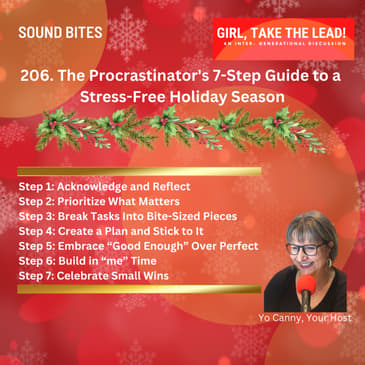
[00:08:16] So here's a little guide I put together for a stress-free holiday season.
[00:08:25] Step one, acknowledge and reflect.
[00:08:31] Accept that procrastination happens and explore the why behind it.
[00:08:37] Maybe journal to find out what's at the core of things.
[00:08:41] Some common reasons are like fear of imperfection, decision fatigue, or feeling overwhelmed.
[00:08:51] And here's a reflection exercise that might be helpful.
[00:08:56] What's the worst that could happen if I just start now?
[00:09:01] Step two, prioritize what matters.
[00:09:07] Identify what's truly important.
[00:09:10] Like family traditions, meaningful moments, or key events.
[00:09:16] And maybe if you're a fan of the movie Moonstruck, someone needs to just tell us a joke so we can have some fun and lighten up.
[00:09:28] You can also use a simple prioritization tool like the Eisenhower Matrix,
[00:09:33] which ranks tasks into four quadrants.
[00:09:39] Urgent and important, and those we do immediately.
[00:09:44] Not urgent, but important, and those we can schedule.
[00:09:50] Urgent, but not important, we can delegate those.
[00:09:56] And four, not urgent and not important.
[00:10:00] Delete them.
[00:10:02] Let them go.
[00:10:03] Don't even put them on the list.
[00:10:06] The Matrix was developed by President Dwight Eisenhower, who used it to prioritize tasks as a general, NATO commander, and president.
[00:10:17] The framework was popularized by Stephen Covey and the seven habits of highly effective people.
[00:10:24] The Eisenhower Matrix helped us avoid the urgency trap by focusing on what will make us more effective in the long run.
[00:10:32] It can help us improve our time management.
[00:10:36] It can help us improve our time management and distinguish between urgent and important tasks and those we can let go of.
[00:10:47] Step three, break tasks into bite-sized pieces.
[00:10:53] Step four, break tasks.
[00:10:54] Step four, break tasks into manageable chunks.
[00:10:56] Step four, break tasks into manageable chunks.
[00:11:00] Set daily or weekly goals to create momentum.
[00:11:05] And something we saw in our episode about habits.
[00:11:08] Step four, break tasks into manageable things.
[00:11:09] Just show up for 10 minutes of exercise instead of the one hour we think we should do.
[00:11:17] Step four, create a plan and stick to it.
[00:11:23] Use time blocking to allocate specific periods for tasks.
[00:11:28] Yep, just block them off in your calendar.
[00:11:33] Incorporate flexibility to account for unexpected delays.
[00:11:37] Now build in that extra time.
[00:11:40] Include examples like on Monday, I'll do card writing.
[00:11:45] Tuesday, gift wrapping.
[00:11:48] I can't tell you how many grouchy nights I spent gift wrapping at the midnight hour during my holidays.
[00:11:57] Don't do that anymore.
[00:11:59] Step five, embrace good enough over perfect.
[00:12:06] That releases the pressure to make everything flawless.
[00:12:11] Maybe share a story of how imperfection created a memorable holiday moment by putting something in the comments.
[00:12:20] Here's mine.
[00:12:22] Every year I tried to make the perfect Christmas morning waffles.
[00:12:28] I can't tell you how many years I have tried to get a Belgium waffle that is a bit crunchy and not soggy.
[00:12:37] I've tried mixes and recipes and have not succeeded as yet.
[00:12:43] Anyone out there got one that's nailed it?
[00:12:46] If so, send me your solution before I resort to the Eggo waffles this year.
[00:12:53] Step six, build in me time.
[00:12:57] Schedule time for rest, self-care, and connection with loved ones.
[00:13:02] It's incredibly important to say no to overcommitments.
[00:13:07] Yeah.
[00:13:08] Boundary setting.
[00:13:09] Check out episode 39 if you've got trouble with that like most of us.
[00:13:14] I know everything sounds fun and you quote should be social this time of year, but at what cost?
[00:13:23] Declining with grace and negotiating an alternative that doesn't overcommit us is a real possibility.
[00:13:32] Try it.
[00:13:34] Step seven, let's celebrate small wins.
[00:13:39] Let's all acknowledge our progress to stay motivated and avoid falling back into procrastination.
[00:13:46] Let's toot our own horn when this happens and say, look at me.
[00:13:51] I'm doing less and it's okay.
[00:13:58] And here's some mindset tips to help us stay on track.
[00:14:03] Practice self-compassion.
[00:14:06] Let's forgive ourselves for the delays and just move forward.
[00:14:11] And if it isn't a pretty picture, the picture we do see is good enough.
[00:14:18] And when we see the stress and even overwhelm sneaking up on us and we see our procrastination
[00:14:26] at its core, let's reframe it as an opportunity to rethink priorities and learn more about ourselves
[00:14:35] and what we need.
[00:14:38] And lastly, let's visualize the reward, the joy of a relaxed and meaningful holiday where
[00:14:49] we have fun and enjoy the moment.
[00:14:53] So again, I'll have the guide to these seven steps on our website blog with the link to
[00:14:59] it in our show notes if you print it out and have it nearby.
[00:15:05] Let's also make a promise right now to immediately implement one or two steps.
[00:15:11] My two things will be embracing good enough and visualizing the reward.
[00:15:20] I am reminded of something you might have heard before on one of our episodes.
[00:15:27] It doesn't need to be a work of art.
[00:15:30] It just needs to get done.
[00:15:33] An engineer I used to work with gave me that early on in my career and I've never forgotten
[00:15:41] it.
[00:15:43] I'd like to end today's episode with the following poem I was inspired to write for you called
[00:15:51] A Moment of Gratitude.
[00:15:56] As the year winds down and the holiday lights flicker softly, let us pause.
[00:16:04] Let us breathe in the crisp air of this season, heavy with both joy and expectation, and exhale
[00:16:15] the weight of what we thought it all should be.
[00:16:21] Gratitude isn't found in the grand gestures or the perfect plans.
[00:16:28] It resides in the quiet moments.
[00:16:32] A laugh shared over a cup of tea.
[00:16:36] The warmth of a loved one's embrace.
[00:16:40] Or even the peace of sitting still amidst the rush.
[00:16:48] This season, may we remember that it's okay to let some things go undone.
[00:16:56] To embrace good enough instead of perfect.
[00:17:02] To find beauty in the messiness of life.
[00:17:08] May we give ourselves the gift of presence.
[00:17:13] May we delight in small wins.
[00:17:17] Celebrate even the tiniest step forward.
[00:17:20] And marvel at the light we carry.
[00:17:25] Even when the days grow.
[00:17:31] And as we reflect, may we know this.
[00:17:35] We are enough.
[00:17:38] Just as we are.
[00:17:40] Right here.
[00:17:41] Right now.
[00:17:44] And for that,
[00:17:46] let's celebrate this moment with gratitude.
[00:17:59] Thank you for listening today.
[00:18:01] And we sure hope you enjoyed this episode.
[00:18:02] If you did,
[00:18:04] please leave us a comment wherever you listen to your podcasts.
[00:18:08] Tell a friend about us.
[00:18:09] Join our public Facebook group,
[00:18:11] Girl Take the Lead,
[00:18:12] or visit our website,
[00:18:15] girltaketheleadpod.com.
[00:18:16] We also have a YouTube channel where your subscription would be appreciated.
[00:18:21] Once you're on YouTube,
[00:18:22] search at Girl Take the Lead.
[00:18:24] And we're on YouTube Music,
[00:18:26] where you can find a video of this episode
[00:18:28] and you can find a video on Spotify.
[00:18:33] Our next episode will feature our guest,
[00:18:36] Zim Neubert,
[00:18:38] where we'll explore the topic of loneliness,
[00:18:41] a place we can sometimes go this time of year.
[00:18:45] Zim is Executive Director for Project Cornerstone
[00:18:48] of the YMCA of Silicon Valley
[00:18:51] and is passionate about serving youth and families to foster positive skills,
[00:18:57] experiences,
[00:18:58] and honest conversations to create safe,
[00:19:01] caring,
[00:19:02] and equitable communities
[00:19:03] in the Silicon Valley and beyond.
[00:19:06] I had the honor of working on a panel with Zim
[00:19:10] for a Girl Scout Giving Circle event
[00:19:12] where I saw her in action
[00:19:14] and her listening skills are amazing.
[00:19:18] And she has incredible insights into the topic of loneliness.
[00:19:22] So please join us again.
[00:19:26] Talk to you soon.
[00:19:27] Bye.