
So we like to cover books and have guests on the show to talk about emotions so we can be better leaders and based on the number of listens, you like to explore those topics with us. And there’s one emotion we realized was suspiciously absent from our list. And that emotion was grief.
As some of you know we recently lost the dog we’ve had the pleasure of loving and caring for, over the last 7 years, Caitlin. She was a very spicy 13 yo Frenchie and we are so grateful to her breeder who thought it would be great for her to live her later years with us.
There were several things that the event of losing Cait, as we liked to call her, brought to the forefront as I went through the process of grieving.
Here’s what we’ll cover in the episode so you can choose to listen or not and it’s okay if it’s not – grief is a complex and difficult topic, particularly if you’re going through something right now.
Topics Covered:
What is grief? And we’ll reference Brené Brown’s Atlas of the Heart for that.
Is the grief of losing a pet different from losing a person we love?
Can grief bring other losses to the forefront?
Is the experience of grief different if it’s sudden rather than having the time to prepare?
How do emotions around grief like guilt manifest themselves?
What does the author, David Kessler, have to say about the Sixth Stage of Grief of finding meaning?
What does the author, Victor Frankel, say about grief?
Here are 3 takeaways from our episode:
1. Grief is deeply personal and complex:
Grief isn't limited to the death of a loved one and can manifest through a wide range of emotions, often involving sadness, guilt, or anger.
2. Grieving a pet can bring up layered losses: The loss of a pet can trigger cumulative grief, where past
losses reemerge and intensify the current experience. While society may not always acknowledge the depth of pet grief, it can be just as profound as grieving a loved one. Pets provide emotional support and companionship, making their absence felt in everyday life.
3. Finding meaning is a crucial part of healing: David Kessler's "Sixth Stage of Grief" teaches that healing goes beyond accepting loss; it's about discovering meaning in the aftermath. This process helps us honor the memory of what we've lost and find purpose in life again. Meaning is personal and can come from ongoing connections with loved ones, rituals, or reflecting on the lessons their lives offered.
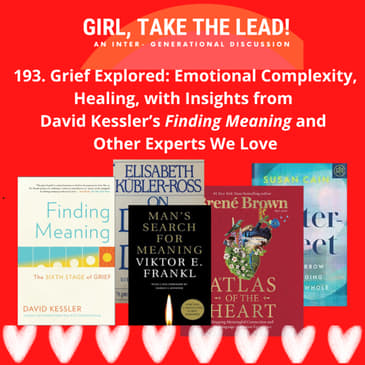
Mentioned in the Episode:
Atlas of the Heart by Brené Brown
Finding Meaning: The Sixth Stage of Grief by David Kessler
On Death and Dying Elisabeth Kubler-Ross
Motherless Daughters and The AfterGrief by Hope Edelmann
Man’s Search for Meaning by Victor Frankel
Bittersweet by Susan Cain
Ep 23 Part 1 of 2 – Bittersweet (Susan Cain): How do Sorrow and Longing Help Us Lead?
https://spotifyanchor-web.app.link/e/znsJe8hFlNb
Ep 24 Part 2 of 2 – Bittersweet (Susan Cain): How do the Arts Play a Role in Seeing Our Whole Selves?
https://spotifyanchor-web.app.link/e/xtihY7hFlNb
Ep 111 – More About Daniel Pink’s ‘Power of Regret’ – From Regrets to Resilience
https://spotifyanchor-web.app.link/e/JIv88ffFlNb
How to reach Yo Canny:
Our Store: www.girltaketheleadpod.com/store
Our Website: www.girltaketheleadpod.com
You can send a message or voicemail there. We’d love to hear from you!
email: yo@yocanny.com
FB group: Girl, Take the Lead
https://www.facebook.com/groups/272025931481748/?ref=share
IG: yocanny (Yo)
LinkedIn: https://www.linkedin.com/in/yocanny/
[00:00:06] [SPEAKER_00]: Episode 93 of Girl Take The Lead, for each week, Quicksplored womanhood and leadership in
[00:00:12] [SPEAKER_00]: I'm your host, Yolanda Canny. So we'd like to cover books and have guests on the show to talk
[00:00:18] [SPEAKER_00]: about emotions. So we can better be leaders and based on the number of lessons you like
[00:00:25] [SPEAKER_00]: to explore these topics too. And there's one emotion I recently realized was suspiciously
[00:00:31] [SPEAKER_00]: absent from our list. And that emotion was grief.
[00:00:36] [SPEAKER_00]: As some of you know, we recently lost the dog we've had the pleasure of loving and caring
[00:00:41] [SPEAKER_00]: for over the past seven years, Caitlin. She was a very spacey 13 year old and we are so
[00:00:49] [SPEAKER_00]: grateful to her breeder who thought it would be great for her to live her last years with us.
[00:00:54] [SPEAKER_00]: And just so you know, the average lifespan of a French is 10 to 12 years. So a such an
[00:01:02] [SPEAKER_00]: honor to have her with us in our life and to have her 10 year old pup Tino still living with us.
[00:01:11] [SPEAKER_00]: There were several things that the event of losing Kate as we like to call her brought to the
[00:01:17] [SPEAKER_00]: forefront. As I went through my own process of grieving, here's what we'll cover in the episode
[00:01:24] [SPEAKER_00]: so you can choose to listen or not and it's okay if it's a knot. Grief is a complex and difficult
[00:01:31] [SPEAKER_00]: topic, particularly if you're going through something right now. I totally get having those raw
[00:01:39] [SPEAKER_00]: feelings at vulnerability and needing the time and this space to be able to handle a topic like this one.
[00:01:48] [SPEAKER_00]: Leave me, I get you and it's important that you take care of you. I'm not doing this
[00:01:54] [SPEAKER_00]: episode to make anyone feel bad or exploit anyone's feelings. I'm offering this episode as a
[00:02:01] [SPEAKER_00]: way for us to understand more about grief so we don't feel so alone when we experience it
[00:02:08] [SPEAKER_00]: or that we can validate our own process. So the questions will explore are these.
[00:02:16] [SPEAKER_00]: First one will be grief, what is it? And we'll reference Bernabews' alicithart because you
[00:02:23] [SPEAKER_00]: know that's where I love to go. And then we'll look at the grief of losing a pet and is it different
[00:02:30] [SPEAKER_00]: from losing a person we love and can grief bring other losses to the forefront.
[00:02:38] [SPEAKER_00]: And is the experience of grief different if it's sudden rather than having the time to prepare?
[00:02:45] [SPEAKER_00]: And how do emotions around grief like guilt manifest themselves? And we'll talk about some
[00:02:52] [SPEAKER_00]: authors like David Kessler and what he has to say about the sixth stage of grief which is about
[00:02:59] [SPEAKER_00]: finding meaning. And what Victor Franco says about grief, I hope that with this episode
[00:03:09] [SPEAKER_00]: that there'll be some new insights you have about grief. So here you go.
[00:03:18] [SPEAKER_00]: So let's start with Bernabews. She addresses grief in Atlas of the Heart within the broader
[00:03:24] [SPEAKER_00]: exploration of emotions and human experiences. In the book she dedicates a section to grief as part
[00:03:32] [SPEAKER_00]: the discussion on places we go when things don't go as planned and places we go when we're hurting.
[00:03:41] [SPEAKER_00]: Here are some of the key points she makes. One, grief is a reaction to loss.
[00:03:49] [SPEAKER_00]: Bernabews explains that grief is not limited to the death of a loved one. It can occur with any
[00:03:56] [SPEAKER_00]: significant loss including relationships, jobs, involved in their or dreams.
[00:04:05] [SPEAKER_00]: She emphasizes that grief is a normal response to loss and reflects the depth of our connections
[00:04:12] [SPEAKER_00]: and emotional investment. Two, grief is complex. Bernabews grieve as multilayered involving
[00:04:23] [SPEAKER_00]: a wide range of emotions that can include sadness, anger, confusion and even relief.
[00:04:32] [SPEAKER_00]: This complexity mirrors her broader thesis that human emotions are rarely simple or one
[00:04:41] [SPEAKER_00]: and it's not an emotional. Three, grief needs to be processed. One of the recurring themes in
[00:04:49] [SPEAKER_00]: Bernabews' work is vulnerability and she emphasizes that grief requires us to allow ourselves
[00:04:57] [SPEAKER_00]: to be vulnerable. She advocates for giving oneself the space to experience grief fully,
[00:05:06] [SPEAKER_00]: rather than suppressing or avoiding it. Because Kate died on the way to the vet
[00:05:15] [SPEAKER_00]: and she was unresponsive in the vet's office, I felt very exposed.
[00:05:22] [SPEAKER_00]: My grief wasn't a private matter. The whole office knew and that added some layers I needed to process.
[00:05:32] [SPEAKER_00]: Four, grief is intertwined with the need for connection. She points out that grief itself can
[00:05:41] [SPEAKER_00]: feel isolating but sharing our grief with others helps us heal but only when those connections
[00:05:50] [SPEAKER_00]: are compassionate and validating. So you guys a big shout out to all of you who commented
[00:05:58] [SPEAKER_00]: on our Facebook group page and sent hugs. They were so welcome and very appreciated.
[00:06:08] [SPEAKER_00]: Lastly, Bernabews' grief as a natural, though challenging part of our emotional landscape that requires
[00:06:18] [SPEAKER_00]: acknowledgement, compassion and support from ourselves and others.
[00:06:25] [SPEAKER_00]: That gives us a nice framework from which to start. As I was going through my own process,
[00:06:32] [SPEAKER_00]: I was struck by the following and we'll use these questions to guide us in the episode.
[00:06:40] [SPEAKER_00]: First, I found myself grieving more than just Kate Lynn and wondered what was that about.
[00:06:47] [SPEAKER_00]: It was like I felt every loss in my life.
[00:06:52] [SPEAKER_00]: Then, I wondered if I should feel so sad about a pet. It wasn't a person after all.
[00:07:02] [SPEAKER_00]: The surprise nature of Kate Lynn's passing, I think I was in shock really.
[00:07:09] [SPEAKER_00]: Would that experience have been different if I had time to plan? I felt sad and a big guilty,
[00:07:19] [SPEAKER_00]: helping others if that's a hoffest wouldn't judge me. I was definitely ugly crying.
[00:07:28] [SPEAKER_00]: I felt helpless and definitely not in control. I know, crazy, right?
[00:07:37] [SPEAKER_00]: But I suspected there were some underlying beliefs. I could feel but I couldn't quite see
[00:07:45] [SPEAKER_00]: and with these emotions normal, so I did some research. You know me, looking for the research
[00:07:55] [SPEAKER_00]: and here's what I learned. Let's look at the first one where I felt I was grieving every loss in my life.
[00:08:04] [SPEAKER_00]: Turns out this phenomenon is known as cumulative grief or grief layering
[00:08:11] [SPEAKER_00]: where the loss of the pet re-awaken the pain of previous losses. Whether those are the death
[00:08:18] [SPEAKER_00]: of a loved one, other paths or significant life changes. This can magnify the emotional response,
[00:08:26] [SPEAKER_00]: making the current grief feel even more overwhelming and I sure felt that.
[00:08:32] [SPEAKER_00]: To manage this compound grief, it's important to allow space for both the present and past
[00:08:39] [SPEAKER_00]: emotions to be expressed. Recognizing that the loss of the pet can evoke much more than it seems
[00:08:49] [SPEAKER_00]: on the surface can be a first step toward acknowledging and processing the depth of one's feelings.
[00:08:59] [SPEAKER_00]: So in my case, it was feeling the loss of my father, which had just been a couple years ago
[00:09:07] [SPEAKER_00]: and it seemed like also every pet I ever had was top of mind for me. Looking at number two,
[00:09:18] [SPEAKER_00]: grieving the loss of a pet can feel different from grieving the loss of a person in several ways.
[00:09:25] [SPEAKER_00]: The both are can be deeply painful. Here are some key distinctions. Pets often provide unconditional
[00:09:34] [SPEAKER_00]: love companionship and non-verbal emotional support. The grief might center around the loss
[00:09:42] [SPEAKER_00]: of their constant presence and the daily routines built around them. While the loss of a person
[00:09:50] [SPEAKER_00]: is more complex, emotionally and influenced by the depth of the relationship and shared history
[00:09:58] [SPEAKER_00]: and the roles they played in our lives, all of this can be brought up. It can also stir
[00:10:05] [SPEAKER_00]: memories, unresolved issues or guilt, making the grieving process more layered.
[00:10:15] [SPEAKER_00]: Society sometimes undervalues the grief associated with losing a pet. This can make pet grief
[00:10:22] [SPEAKER_00]: feel more isolating. As people may not always understand or acknowledge the depth of the loss.
[00:10:30] [SPEAKER_00]: But I think in my case, there were so many of you that understood the pet grief I had.
[00:10:39] [SPEAKER_00]: While the societal recognition and support for grieving the loss of a person,
[00:10:44] [SPEAKER_00]: whether through ceremonies like funerals or communal expressions of sympathy,
[00:10:51] [SPEAKER_00]: the grief of losing a pet can also be intense. It is more straightforward and focused on sadness
[00:11:00] [SPEAKER_00]: from losing our companion, and some find that while the grief from losing a pet is intense,
[00:11:08] [SPEAKER_00]: it may not last as long as you and grief, though this varies greatly. And the depth of a pet may
[00:11:16] [SPEAKER_00]: affect daily routines, but it might not create significant life changes beyond that.
[00:11:23] [SPEAKER_00]: While losing a loved one often has larger practical implications, such as the need to settle
[00:11:31] [SPEAKER_00]: a state, a dad, family dynamics or deal with shared responsibilities, all of that is huge.
[00:11:39] [SPEAKER_00]: Ultimately both types of loss are valid and meaningful. Grief is personal
[00:11:45] [SPEAKER_00]: and may be influenced by the unique bond memories and roles that either the pet or the person
[00:11:53] [SPEAKER_00]: played in our life. The number three question was about a sudden versus a prior knowledge
[00:12:01] [SPEAKER_00]: of one step, so that it could be planned. As I stated, I felt surprised and not at all prepared
[00:12:10] [SPEAKER_00]: for Kate's passing. I really felt like I was in shock. There is significant research that
[00:12:19] [SPEAKER_00]: explores the difference between the emotional, psychological and social impacts of a sudden death
[00:12:26] [SPEAKER_00]: versus a prolonged passing. These two types of loss tend to affect the grieving process and
[00:12:33] [SPEAKER_00]: distinct ways, but both can present unique challenges for the bereaved.
[00:12:40] [SPEAKER_00]: Settendeths that occur without warning leave no time for mental or emotional preparation,
[00:12:47] [SPEAKER_00]: which can lead to intense shock and trauma, which is why I felt
[00:12:53] [SPEAKER_00]: studies indicate that the lack of closure or chance to say goodbye can lead to prolonged or
[00:13:00] [SPEAKER_00]: complicated grief, where emotions such as anger, guilt and regret may be amplified.
[00:13:08] [SPEAKER_00]: These kinds of deaths often leave the bereaved searching for meaning and trying to understand why
[00:13:15] [SPEAKER_00]: the loss occurred. Research also shows that people dealing with prolonged passing
[00:13:22] [SPEAKER_00]: often experience anticipatory grief, where they begin grieving the loss before it actually occurs.
[00:13:31] [SPEAKER_00]: This allows some level of emotional preparation and may reduce the initial shock
[00:13:36] [SPEAKER_00]: when the death happens. This kind of death provides more time for meaning making,
[00:13:44] [SPEAKER_00]: which can help some individuals cope better. They may be able to find closure by reconciling
[00:13:51] [SPEAKER_00]: with the inevitability of death, saying their gubys and even reflecting on the life-lived.
[00:13:59] [SPEAKER_00]: And number four, perhaps by looking at how grief is manifested, we can look at different
[00:14:07] [SPEAKER_00]: emotional manifestations like my guilt. All overwhelming feelings of sadness are the most recognized
[00:14:16] [SPEAKER_00]: form of grief. This may come in waves or be constant. Grief can also trigger anger towards the
[00:14:25] [SPEAKER_00]: situation, the deceased oneself or even others. Some may feel anger over the unfairness of loss
[00:14:33] [SPEAKER_00]: or unresolved issues. Many people experience guilt over things left unsaid or actions taken
[00:14:41] [SPEAKER_00]: or not taken before the loss. guilt may also come from a sense of relief, especially in the case
[00:14:50] [SPEAKER_00]: of prolonged illness. My guilt was kind of like, hmm, could I have done something that I didn't
[00:14:59] [SPEAKER_00]: to save little Kate's life? And I realized, nope, it was exactly as it was supposed to be.
[00:15:09] [SPEAKER_00]: My peek could, to review the stages of grief, authored by Elizabeth Cooper Ross, and know that
[00:15:17] [SPEAKER_00]: not everyone experiences grief in a linear progression. But these five stages of grief can help us
[00:15:24] [SPEAKER_00]: frame our common emotional response. First, there's denial, refusing to accept the reality of the
[00:15:37] [SPEAKER_00]: death. I was not believing the dog was dead. There was no warning at the time.
[00:15:44] [SPEAKER_00]: Second, anger. Dealing anger at the situation at the deceased or even at one self,
[00:15:52] [SPEAKER_00]: I did feel a bit of anger toward the vet office staff. My perception said they all seem to be staring at me.
[00:15:58] [SPEAKER_00]: It's like cried my eyes out, then bargaining. And I know that that was misplaced. There was
[00:16:06] [SPEAKER_00]: not about the staff. I was definitely my perception, then bargaining.
[00:16:13] [SPEAKER_00]: Trying to negotiate or make deals with a higher power to reverse or less in the loss,
[00:16:19] [SPEAKER_00]: I needed to know it was not my fault. I followed my depression. Deep sadness and despair over
[00:16:27] [SPEAKER_00]: the loss often accompanied by withdrawal from others. Yeah, definitely did that. And then acceptance.
[00:16:37] [SPEAKER_00]: Coming to terms with reality of the loss though, not necessarily feeling okay about it.
[00:16:45] [SPEAKER_00]: For me, I could see myself moving into acceptance after Kiki, my Gen Z daughter,
[00:16:51] [SPEAKER_00]: who was on the show from time to time with my other daughter Emma.
[00:16:56] [SPEAKER_00]: And I attended a sound bath with her, which I found very healing. I sound bath for those who don't know
[00:17:04] [SPEAKER_00]: isn't immersive experience for participants, bath in the sounds and vibrations of instruments,
[00:17:12] [SPEAKER_00]: like Tibetan singing bulbs. I know some of you listening, saying, oh those kind of burdens.
[00:17:21] [SPEAKER_00]: But who knows how things happen or loosen up or how we heal? But after the sound bath,
[00:17:29] [SPEAKER_00]: I was able to see the beliefs I was holding on. And one, in particular, was something like
[00:17:38] [SPEAKER_00]: I wasn't a good dog mom or Caitlyn when dev died. And then layered on that was something like,
[00:17:48] [SPEAKER_00]: others have negatively judged me because I haven't grieved correctly.
[00:17:56] [SPEAKER_00]: And once I saw those, I could see they were not true. Do a little by Rinkady work on them
[00:18:03] [SPEAKER_00]: and let them go and then move on. Not feeling so bad. I also wanted to share what I learned
[00:18:13] [SPEAKER_00]: in the book, Finding Meaning. The sixth stage of grief, where David Kessler expands on the
[00:18:21] [SPEAKER_00]: original five stages we just went through. Kessler who worked with Kubla Ross introduces
[00:18:28] [SPEAKER_00]: quote, Finding Meaning. As the sixth stage, emphasizing that healing through grief involves
[00:18:38] [SPEAKER_00]: more than just acceptance. It's about discovering a deeper meaning in the loss.
[00:18:45] [SPEAKER_00]: You're some key points that David Kessler's book makes. While acceptance helps us come to terms
[00:18:54] [SPEAKER_00]: with reality of loss, Meaning allows us to make sense of it and find purpose in life again.
[00:19:03] [SPEAKER_00]: And that's why he's added a sixth stage of grief. Meaning is not about understanding why
[00:19:13] [SPEAKER_00]: the loss happened. But about how we choose to live after the loss. It's an active process of
[00:19:21] [SPEAKER_00]: creating meaning in the aftermath of pain. So for me, you can probably get other. I found myself
[00:19:30] [SPEAKER_00]: with questions that I wanted to research and then share with you. Katelyn not only impacted our
[00:19:38] [SPEAKER_00]: family, but by listening today, our loss is touching you too, which gives it meaning.
[00:19:47] [SPEAKER_00]: She is giving us much to learn from her time here. Kessler emphasizes that there's no set time frame
[00:20:01] [SPEAKER_00]: for when someone should quote, move on from their grief. Grief is unique to each person and can
[00:20:11] [SPEAKER_00]: last a lifetime. I found a few more of his insights out for. Kessler explains that finding
[00:20:21] [SPEAKER_00]: meaning isn't about getting over the loss. But instead about redefining life without the deceased
[00:20:31] [SPEAKER_00]: and discovering how to honor their memory through actions or purpose.
[00:20:39] [SPEAKER_00]: He stresses that meaning is deeply personal and varies for everyone. But gives one person
[00:20:47] [SPEAKER_00]: meaning may be different for another, and that's okay. It's about what resonates for the individual.
[00:20:57] [SPEAKER_00]: For some, meaning might come from keeping the deceased's memory alive, such as through rituals,
[00:21:04] [SPEAKER_00]: creating a legacy or making life changes inspired by the loss. A kind of honor for the love held
[00:21:13] [SPEAKER_00]: for the deceased. It is in this way Kessler reframes grief as a reflection of love.
[00:21:24] [SPEAKER_00]: The depth of grief often corresponds to the depth of that connection.
[00:21:31] [SPEAKER_00]: By focusing on that love rather than solely on the pain, meaning can emerge.
[00:21:42] [SPEAKER_00]: He often reminds us that grief is a form of love that has nowhere to go after a loss
[00:21:48] [SPEAKER_00]: and through that love people can find meaning. My interpretation for the quote nowhere to go
[00:21:59] [SPEAKER_00]: is the finality of death. I felt helpless. It couldn't make it different. It couldn't control
[00:22:07] [SPEAKER_00]: the outcome. It was that helplessness that brought the grief. I also liked when Kessler says about
[00:22:18] [SPEAKER_00]: the importance of community in finding meaning. Connecting with others who have experienced
[00:22:24] [SPEAKER_00]: similar losses can provide comfort, validation and help in the meaning making process.
[00:22:34] [SPEAKER_00]: So a special shout out to Katelyn's mom, Cindy, who helped me every step along the way
[00:22:43] [SPEAKER_00]: right after her loss. She was grieving at the same time and creating space for us.
[00:22:54] [SPEAKER_00]: Thank you. Thank you. Again, a shout out to all of those of you who are listening,
[00:23:00] [SPEAKER_00]: who sent hugs in love on our Facebook group page. You all should join us there if you're not.
[00:23:07] [SPEAKER_00]: I felt very supported and definitely connected to all of you. Thank you so much.
[00:23:13] [SPEAKER_00]: In several of our episodes, we've talked about resilience and Kessler promotes the idea
[00:23:20] [SPEAKER_00]: of continuing bonds with the deceased, which he says can be a source of resilience.
[00:23:28] [SPEAKER_00]: These bonds don't require letting go of the deceased, but instead involve finding ways to keep them
[00:23:35] [SPEAKER_00]: in your life. He suggests that finding meaning in grief often comes from the ongoing
[00:23:42] [SPEAKER_00]: relationship with the memory of the lost loved one. I know for me, I am always talking to my dad
[00:23:51] [SPEAKER_00]: and all of those in our family who have gone before me, I feel their presence all the time.
[00:23:59] [SPEAKER_00]: And I think you probably feel those, the presence of those you've lost to.
[00:24:07] [SPEAKER_00]: I've heard it said that relationships can actually improve after someone passes.
[00:24:14] [SPEAKER_00]: Hope Edelman, another expert on grief, particularly focused on the loss of mothers
[00:24:22] [SPEAKER_00]: and how that impacts daughters throughout their lives. Her books, motherless daughters and the
[00:24:29] [SPEAKER_00]: aftergrew, examine how relationships with the deceased continue to change and evolve
[00:24:36] [SPEAKER_00]: even decades after the loss. She explores how grief can lead to a deepening connection
[00:24:43] [SPEAKER_00]: with the deceased as individuals grow older and reflect on their lives.
[00:24:50] [SPEAKER_00]: And believe me, this is going to be a topic probably in the future because I'm someone who
[00:24:56] [SPEAKER_00]: anticipating the loss of my mother who was 95 and with whom I have a very strange relationship
[00:25:04] [SPEAKER_00]: right now. And I hope that our relationship will improve.
[00:25:12] [SPEAKER_00]: Kessler suggests that relationships can evolve after one's death.
[00:25:18] [SPEAKER_00]: As we find new ways to honor their legacy, learn from their lives and integrate their memory
[00:25:24] [SPEAKER_00]: into our own personal growth. I can see that definitely with my mother.
[00:25:31] [SPEAKER_00]: Victor Frankles, core idea and that's another author who's really an expert in this field.
[00:25:39] [SPEAKER_00]: States of suffering, including grief, is an inevitable part of life
[00:25:45] [SPEAKER_00]: and what matters most is how individuals respond to it. He argues that even in the worst circumstances
[00:25:54] [SPEAKER_00]: such as the loss of the loved one, we have the freedom to choose how we interpret and respond
[00:26:01] [SPEAKER_00]: to our suffering. Meaning can be found in grief by connecting with the love and memory of
[00:26:08] [SPEAKER_00]: the person or pat who has died very similar to what Kessler says.
[00:26:14] [SPEAKER_00]: Frankles suggests that while we cannot always control our circumstances, we can control our
[00:26:20] [SPEAKER_00]: attitude toward them. He also writes about the tragic triad, pain, guilt and death,
[00:26:30] [SPEAKER_00]: which are inscapable realities of life. He argues that humans have the capacity to transcend
[00:26:39] [SPEAKER_00]: these realities by finding meaning in them. In the context of grief, Frankles would suggest that
[00:26:48] [SPEAKER_00]: millions of loss can be a catalyst for personal growth and a deeper understanding of one's purpose.
[00:26:58] [SPEAKER_00]: And he writes about the continuing bonds with the deceased when he says this.
[00:27:05] [SPEAKER_00]: Our relationship with those who have passed away don't end with their death.
[00:27:11] [SPEAKER_00]: The love and meaning we derive from these relationships can continue to guide and inspire us.
[00:27:19] [SPEAKER_00]: In grief, one can find solace in the idea that the deceased influence remains present in our lives.
[00:27:31] [SPEAKER_00]: Frankles also emphasizes that grief is a natural and necessary reaction to the loss of someone
[00:27:37] [SPEAKER_00]: or something we deeply love. Grief itself is a testament to the love we held for the
[00:27:45] [SPEAKER_00]: person or the pet who has died. Rather than seeing grief as something to get over,
[00:27:51] [SPEAKER_00]: Frankle would argue that it is part of the profound human experience of love and connection.
[00:27:59] [SPEAKER_00]: For Frankle, grief is not just about mourning the loss but also about discovering
[00:28:07] [SPEAKER_00]: what the loss can teach us about life, love and resilience. I'd like to end today's episode
[00:28:18] [SPEAKER_00]: with a passage from Susan Cain's book, Bitter Sweet, a book we've covered previously as an episode.
[00:28:26] [SPEAKER_00]: I found myself referencing this passage as an automatic response about my own loss.
[00:28:38] [SPEAKER_00]: Quote, Bitter Sweetness is a tendency to states of longing,
[00:28:46] [SPEAKER_00]: poignancy and sorrow, and acute awareness passing time, and a curiously piercing joy at the beauty
[00:28:57] [SPEAKER_00]: of the world. The Bitter Sweetness also about the recognition that light and dark,
[00:29:07] [SPEAKER_00]: per and death, bitter and sweet are forever paired. Thank you for listening today and we
[00:29:23] [SPEAKER_00]: sure hope you enjoyed this episode and learned something new about grief. If you did, please leave
[00:29:30] [SPEAKER_00]: comment wherever you listen to your podcast. Tell a friend about us or join our public Facebook
[00:29:36] [SPEAKER_00]: group, Girl Take the Lead. We also have a YouTube channel where your subscription would be appreciated.
[00:29:44] [SPEAKER_00]: Once you're on YouTube search at Girl Take the Lead and we've recently expanded to YouTube
[00:29:49] [SPEAKER_00]: music where you can find a video of this episode. You can also check out our new store on our website
[00:29:57] [SPEAKER_00]: Girl Take the Lead pod.com slash shop and plan to return to it as we'll keep updating
[00:30:05] [SPEAKER_00]: products on an annoying basis. Here are three takeaways from our episode. One,
[00:30:14] [SPEAKER_00]: grief is deeply personal and complex. Grief isn't limited to the death of a loved one and can
[00:30:21] [SPEAKER_00]: manifest through a wide range of emotions, often involving sadness, guilt or anger.
[00:30:30] [SPEAKER_00]: And David Kessler's work on the sixth stage of grief emphasizes that finding meaning in loss
[00:30:37] [SPEAKER_00]: can aid in the healing process, allowing us to redefine our lives while continuing bonds with the
[00:30:52] [SPEAKER_00]: layered losses. The loss of a pet can trigger cumulative grief, where past losses you re-emerge
[00:31:00] [SPEAKER_00]: and intensify the current experience. While society may not always acknowledge the death of a
[00:31:07] [SPEAKER_00]: pet grief, it can be profound as much as grieving a loved one. Pads provide emotional support
[00:31:16] [SPEAKER_00]: and companionship making their absence felt in everyday life. And three,
[00:31:25] [SPEAKER_00]: finding meaning is a crucial part of healing. David Kessler teaches that healing goes beyond
[00:31:34] [SPEAKER_00]: accepting the loss. It's about discovering the meaning in the aftermath. This process helps us
[00:31:43] [SPEAKER_00]: honor the memory of what we've lost and find purpose in life again. Meaning is personal
[00:31:50] [SPEAKER_00]: and can come from ongoing connections with loved ones, rituals are reflecting on the lessons
[00:31:58] [SPEAKER_00]: their lives offered us. Our next episode will feature Ellen Katherine Shumlaff, a quantum healer
[00:32:09] [SPEAKER_00]: enlightenment mentor and best-selling co-author and an international speaker.
[00:32:17] [SPEAKER_00]: She is amazing, you guys! And we'll cover some very cool topics like manifestations,
[00:32:26] [SPEAKER_00]: the seven life lessons and the quantum enlightenment system. So please join us again.
[00:32:35] [SPEAKER_00]: And I'll talk to you soon. Bye!