
This month we’re all about Abundance and this episode continues the conversation by doing two things:
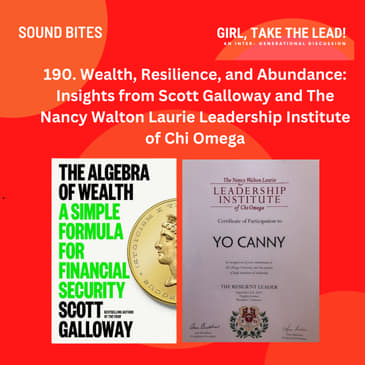
The first is covering the book, The Algebra of Wealth, A Simple Formula for Financial Security, by Scott Galloway. I had seen several posts by Galloway on LinkedIn and thought he had a lot to say about wealth, both from the functional and higher vibrational level.
And the second thing will be to share some recent learnings about Resilience I’ve had over the weekend when I attended the Nancy Walton Laurie Leadership Institute of Chi Omega in Memphis, TN.
Topics Covered:
- Key economic statistics
- “True advice” research findings
- Galloway’s wealth algebraic equation
- Emotional security
- Deep dive into resilience
Here are 3 takeaways from our episode:
1. Despite the challenges we face, the future holds incredible opportunities for those who remain focused, adaptable, and willing to invest in themselves.
2. Economic security isn’t just about how much you earn, but about what you keep and how you use it.
3. By embracing a mindset of resilience and long-term thinking, we can redefine success and build lives of abundance, free from the anxieties that have weighed down previous generations. Remember, wealth is not just about money—it’s about choices. And when you take control of your financial future, you gain the freedom to live on your own terms.”
Mentioned in the Episode:
The Algebra of Wealth, A Simple Formula For Financial Security, Scott Galloway
Ep. 163, Rethinking Grit: Embracing Quit with Nicole Trick Steinbach (Annie Duke’s book)
https://spotifyanchor-web.app.link/e/ZKkPRCHFOMb
Nicole Trick Steinbach Podcast: Build Your Brave Career
https://tricksteinbach.com/bravepodcast/
Galloway’s Prof G Podcast
https://podcasts.apple.com/us/podcast/the-prof-g-pod-with-scott-galloway/id1498802610
Ep. 20, Sheryl Crow, Leading with Vulnerability
https://spotifyanchor-web.app.link/e/89vpHlyFOMb
Ep. 108, Unlocking Happiness : Arthur Brooks and Oprah’s “Build the Life You Want”.
https://spotifyanchor-web.app.link/e/2S3OZIEFOMb
Ep. 39, Be a terri Cole Boundary Boss in Training, Too!
https://spotifyanchor-web.app.link/e/bp2kLFBFOMb
Voluspa Goji Tarocco Orange Candle (Yo's fav):
How to reach Yo Canny:
Our Store:
https://www.girltaketheleadpod.com/store
Our Website:
You can send a message or voicemail there. We’d love to hear from you!
email:
FB group: Girl, Take the Lead
https://www.facebook.com/groups/272025931481748/?ref=share
IG:
yocanny (Yo)
LinkedIn:
[00:00:05] Welcome to episode 190, which is a girl tick the lead sound bite, which is a shorter episode that may be a bit more about a theme.
[00:00:14] We're covering like our episode today or quick inspiration and I'm your host, YoCanny.
[00:00:21] This month we're all about Abundance and this episode continues the conversation by doing two things.
[00:00:28] The first is covering the book, The Algebra of Wealth, a simple formula for financial security by Scott Galloway.
[00:00:38] I had seen several posts by Galloway on LinkedIn and thought he had a lot to say about wealth, both from a functional and vibrational level.
[00:00:48] Annie Duke, who we've covered in this podcast before with the bravest Nicole Chicksteinbach, who hosts the Bill Gerbrave Career Podcast, said this about Galloway's book.
[00:01:02] The decisions you make at the beginning of your professional life have a compounding impact on your chances of success.
[00:01:13] And this invaluable guide will steer you toward an optimal outcome.
[00:01:20] Sounded really good to me and it seemed like a great place to start.
[00:01:25] A little bit about Galloway. He's an NYU Stern professor of marketing and co-host the Prof. G pod and pivot podcasts.
[00:01:38] He is served on the boards of directors of the New York Times Company, Urban Outfitters and Berkeley High School of Business.
[00:01:47] And the second thing we'll do is I'll share some recent learnings about resilience I've had over the weekend when I attended the Nancy Walton Lawary Leadership Institute of Kaya Mega in Memphis, Tennessee.
[00:02:03] And as always my resources and references are all in the show notes. Enjoy the listen and here you go.
[00:02:15] You probably know by now that I always love sharing statistics with you and hold on.
[00:02:24] Galloway offers the following ones which might be a bit hard hitting, but they might also confirm why you're feeling a little stressed.
[00:02:35] The median home price in the US is six times the median annual income.
[00:02:46] It's a year ago it was two times and the share of first time buyers is barely half the historical average and the lowest on record medical debt is the leading cause of consumer bankruptcy.
[00:03:04] Half of American adults would not be able to cover a $500 medical bill without taking on debt.
[00:03:14] Marriage rates among all but the wealthiest cohort are down 15% since 1980 as people can't afford to tie the knot much less have kids.
[00:03:29] Despite record growth in our broader prosperity just 50% of Americans born in the 1980s are making more than their parents did at the same age.
[00:03:43] The lowest share ever and 25% of gen Z years don't believe they'll ever be able to retire.
[00:03:53] But he adds this that today's workers have more opportunities and mobility than any generation before.
[00:04:02] They also face unprecedented challenges we just covered including inflation, labor and housing shortages and climate volatility.
[00:04:14] Even the notion of retirement is undergoing a profound rethink as our lifespan's extent and our relationship with work evolves.
[00:04:25] In this environment the tried and true financial advice our parents and I had followed no longer applies it's time for a new playbook he says.
[00:04:39] As reference that tried and true advice took something like one get a good education this was seen as a crucial foundation for securing a stable and well-paying job leading to financial security and it certainly was in my time.
[00:04:58] To find a stable job the goal was to find employment with a reliable company that offered long term security benefits and a pension.
[00:05:08] This provided a steady income over a lifetime okay so I never felt that myself.
[00:05:16] And I chose instead to craft my own way by increasing my earning potential by advancing in each job change I made.
[00:05:27] 3 by a home.
[00:05:29] A home was viewed as an essential investment offering both a place to live and a way to build equity over time.
[00:05:40] And yes we were very fortunate to have gotten into our home and we've seen it appreciate.
[00:05:47] Save consistently regularly saving a portion of ones income often through employer sponsored retirement plans like a 401k or similar.
[00:05:59] What's considered crucial for building wealth and ensuring a comfortable retirement right and I probably couldn't get to that until kids were out of college.
[00:06:09] But we got there and the last is to avoid debt being cautious about taking on debt especially high interest debt like credit cards was emphasized as a way to maintain financial stability.
[00:06:25] And I think once I got to my 30s I was able to do that more.
[00:06:29] These principles were based on the economic realities of the time where long term employment and the value of home ownership were more predictable and secure compared to today.
[00:06:43] So I ran this idea by three millennials and three gen Z years I know and asked them if they agree with Holloway's assessment.
[00:06:53] And here's what they had to say.
[00:06:57] Regarding more opportunities and mobility, all said yes and noted that some careers like in the arts are viewed now with more possibilities.
[00:07:06] And all indicated that remote work has opened the door to more opportunities regarding facing unprecedented challenges.
[00:07:19] Yes, they all agreed that inflation and climate changes were challenges and buying a house was just out of reach.
[00:07:28] Something that they hoped they could do but weren't confident that they could.
[00:07:37] About rethinking the notion of retirement.
[00:07:41] Galois states that our parents generation typically viewed retirement as a finish line or goal to be reached after decades work.
[00:07:50] The idea was to work hard saved diligently and then enjoy a period of rest in the future in the final years of life.
[00:07:59] This view was shaped by a more predictable economy longer term job stability and pension plans that supported this kind of retirement model.
[00:08:11] He contrasts this traditional view with the modern perspective where retirement is less of a definitive endpoint and more of a flexible base.
[00:08:23] He suggests that the current generation should consider retirement as a stage that could involve continued work.
[00:08:32] Perhaps in a different capacity rather than completely stopping work altogether.
[00:08:38] The evolving economic landscape.
[00:08:41] Longer life expectancy and changing job dynamics have made this new approach to retirement more relevant.
[00:08:51] All six of the people I interviewed felt that the more modern view was what they thought was happening and added that they wanted.
[00:09:03] If they did find themselves working into their 70s, they would be doing work they found fun and had passion for.
[00:09:11] I hope that's the case for them.
[00:09:15] And then lastly the financial advice of previous generations.
[00:09:19] That's the one that's about got a good education, find a stable job by a home safe consistently and avoid that.
[00:09:26] So four of the six were all in that a new approach is warranted.
[00:09:33] A good education however brought debt which makes it hard to buy a house or safe and a stable job not to be counted on if you're in tech like those I interviewed.
[00:09:48] One gen here was helping that advice would still hold and one millennial was totally in.
[00:09:55] And was moving along the same path as their parents.
[00:10:01] So what does Galois say about this that would be helpful?
[00:10:06] It's his algebra for wealth and it goes something like this.
[00:10:11] Well equals focus plus and then in perenn.
[00:10:18] Stokes is a times time times diversification.
[00:10:26] So one more time.
[00:10:28] Well equals focus plus and in perenn.
[00:10:33] Stokes is a times time times diversification.
[00:10:40] I know that might get you like what?
[00:10:44] And I'll go into a bit more detail about that.
[00:10:47] But he sees wealth as a means to an end to gain economic security.
[00:10:54] Our better said the absence of economic anxiety.
[00:10:59] And if we're freed of the pressure to earn, we can choose how to live.
[00:11:05] Okay so here's a deeper look at each of those elements.
[00:11:10] One focus.
[00:11:12] Focus represents the need for concentration and clarity on your financial goals.
[00:11:18] It implies a disciplined approach to managing your money, avoiding distractions and staying committed
[00:11:25] to the actions that will grow your wealth.
[00:11:28] This could involve focusing on career growth, business development or smart investing.
[00:11:35] This matters because without focus it's easy to insight your act by short term gains.
[00:11:43] Our impulse of spending, yes, queues to that in the past, preventing sustainable financial growth.
[00:11:52] Two, stokesism.
[00:11:54] Stokesism here refers to emotional resilience and the ability to stay calm and rational in the face of financial
[00:12:03] volatility, market fluctuations or personal setbacks.
[00:12:11] It encourages detachment from external pressures or emotional reactions that could lead to bad financial decisions.
[00:12:22] This matters because emotional discipline is crucial in investing and wealth building.
[00:12:28] Being stoic helps us avoid panic selling during market downturns or making rush decisions based on fear or greed.
[00:12:41] Three, time.
[00:12:44] Time is one of the most powerful factors in building wealth he says.
[00:12:48] It refers to the length of time you allow your investments to grow and compound.
[00:12:54] The earlier you start, the more time your money has to work for you through compound interest and market appreciation.
[00:13:05] This matters because wealth is in built overnight.
[00:13:08] The principle of compounding means that small consistent investments over time can lead to significant wealth in the long term.
[00:13:17] And for diversification.
[00:13:22] diversification involves spreading investments across different asset classes like stocks, bonds, real estate, etc. to reduce risk.
[00:13:33] By not putting all your financial eggs in one basket, you protect your wealth from being wiped out by downturns in any single market.
[00:13:43] This matters because diversification ensures that your wealth isn't overly reliant on any one source of income or investment, making you or financial future more secure.
[00:13:57] So let's bring it all together one more time.
[00:13:59] Once more, the equation is wealth equals focus plus in perenn.
[00:14:07] Stoicism times time times diversification.
[00:14:14] This equation suggests that wealth creation is a combination of concentrated effort and attention which is focus resilience, which is being very stoic.
[00:14:29] Allowing your investments to grow over the long haul, which is time, and minimizing risk by spreading investments, which is diversification.
[00:14:42] The equation reflects that while focus is crucial, it is multiplied by the other three factors, being stoic, time and diversification, which compound to significantly impact your financial success.
[00:14:59] In essence, Galois formula emphasizes that wealth building is not just about earning money, but about maintaining discipline, patience and the balance approach to risk over time.
[00:15:17] One concept that really captured me was his notion of emotional security, which is embedded in the stoic mindset and the discipline of focus.
[00:15:30] It helps build resilience, maintain clear head in this during tough times, and ultimately supports the long term strategic thinking that wealth creation demands.
[00:15:44] In essence, emotional security forms the foundation that allows each element of his equation to work effectively.
[00:15:57] He also states that economic security isn't a function of what you earn, but what you keep and knowing how much is enough for you.
[00:16:10] He quotes the great philosopher Cheryl Crow, one of my faves, and someone we've covered previously in episode 20 with my friend Sheila, where she said, it's wanting what you've got from the song, so up this.
[00:16:31] There is so much in Galois book, and I've only touched a few of the points he makes.
[00:16:37] Might want to follow him on LinkedIn or get his book, it's a great resource for those just beginning their wealth journey or anyone who wants to learn more.
[00:16:48] As many of you know, I stopped getting a paycheck September 2021 and at the age of 67.
[00:16:59] And what was my wealth strategy?
[00:17:02] Number one, as I mentioned before, was earned as much as I could, but don't count on social security being there.
[00:17:11] Number two, don't count on our house appreciation.
[00:17:16] So that meant we had to save, save, save.
[00:17:21] As a result of this, I felt poor all the time, it still do.
[00:17:26] We deferred home improvements and unfortunate enough to spend on the things that really mattered like our kids education.
[00:17:35] I am so interested to see how things evolve for the generations following us boomers, but I have confidence in our ability to be resilient.
[00:17:48] So this past weekend, I was a certified participant at the Nancy Walton Lori Leadership Institute of Kaya Mega in the resilient leader flagship session in Memphis, Tennessee.
[00:18:02] With about 75 other women, also from the Kaya Mega fraternity, some still in college and others of us long graduated, we explored resilience together.
[00:18:17] I'll be forever grateful for being selected to attend this weekend.
[00:18:22] And for the opportunity to connect and learn from such inspiring women, the energy took me back to my U.S. college days and especially when I had to imitate Elvis.
[00:18:38] That's a story for another time.
[00:18:42] And in addition to resilience, we also talked about our strengths, which will also be a topic.
[00:18:49] I'm sure we'll cover in another episode. Now I know Galaway talks a little about resilience, but after doing my recent deep dive this weekend, I realize it's a key skill.
[00:19:04] We all need to deal with so much uncertainty, particularly the economic stressors we all have that Galaway talks about.
[00:19:16] Let's start with the question. What is resilience really?
[00:19:22] The equation we came up in our flagship was that resilience equals acknowledging plus responding, which helps us learn from our failures, emerge stronger, align our emotions and mind and remain calm.
[00:19:42] While this episode talks about building our economic vitality, resilience can serve us during the big and small things like during job transitions and life changes we can't control.
[00:19:58] We can cope in ways with these stressors that can be non-productive.
[00:20:05] And many of you know that food was my go to sooner than I thought stressed, but we can also cope productively that can include like time management asking for support, establishing healthy boundaries.
[00:20:25] Another topic we've covered previously, and develop some strategies that aim to address the feelings.
[00:20:35] So we manage our emotions and actually change our perception of the stressor, especially when those stressors are outside our control.
[00:20:44] Some of the coping strategies aimed at our feelings that we talked about over the weekend can be centered around our five senses.
[00:20:53] Taste, smell, touch, sight and hearing.
[00:20:58] Blocking one of these out or enhancing one is key.
[00:21:03] For example, we might lay in a dark room, use the senses candle, my favorite making cards.
[00:21:14] Taking a walk, which I try and do every day, find myself flowers, volunteering, and doing random acts of kindness.
[00:21:26] We can also build our own sense of community.
[00:21:29] So we really get we're not alone and we can find support and guidance to provide new and different perspectives on the challenges we face.
[00:21:39] Just like I did this weekend, in our course it was called a personal board of directors and they could be someone in your field, like your profession or industry.
[00:21:53] Someone who is in or has been in your circumstances, like if you're a single parent, if you're changing careers.
[00:22:02] Someone who is one of your greatest cheerleaders and you can call on me for that if you're in need of that person on your board.
[00:22:11] Someone who is a leader in the area you aspire to grow professionally, personally or spiritually.
[00:22:20] Someone of another generation and you got me if you're looking for someone older.
[00:22:27] Someone who can introduce you to others in your profession or community.
[00:22:34] And maybe after knowing a bit more about the algebra of well, you'd want someone who knows about diversification and expert in that field would be very helpful.
[00:22:47] So think about it for a moment.
[00:22:50] Okay, who's on your personal board.
[00:22:54] Who are the people that hold you up and where do you have some gaps all in this episode today with a bit of hope.
[00:23:08] Despite the challenges we face, the future holds incredible opportunities for those who remain focused, adaptable and resilient.
[00:23:22] And remember that economic security isn't just about how much you earn, but about what you keep and how you use it.
[00:23:36] By embracing resilience and long-term thinking, we can redefine success and build lives of abundance free from the anxieties that weighed down previous generations.
[00:23:57] Thank you for listening today and we sure hope you enjoyed this episode.
[00:24:01] If you did, please leave a comment wherever you listen to your podcasts, tell a friend about us or join our public Facebook group Girl Take Lead.
[00:24:12] We also have a YouTube channel where your subscription would be appreciated once you're on YouTube search at Girl Take Lead.
[00:24:18] And we're on YouTube music where you can see a video of this episode.
[00:24:24] You can also check out our news store on our website, Girl Take Lead.com slash shop.
[00:24:33] And we've just added birthday cards, not in cards.
[00:24:39] So plan to return to it as we'll update our products on an ongoing basis.
[00:24:45] Here are three takeaways from our episode one.
[00:24:49] Despite the challenges we face, the future holds incredible opportunities for those who remain focused, adaptable and willing to invest in themselves.
[00:25:01] To economic security isn't just about how much you earn, but about what you keep and how you use it.
[00:25:15] And three, by embracing a mindset of resilience and long-term thinking, we can redefine success and build lives of abundance.
[00:25:26] Free from the anxieties that have weighed down previous generations.
[00:25:33] Remember, wealth is not just about money, it's about choices.
[00:25:40] And when you take control of your financial future, you gain the freedom to live on your own terms.
[00:25:53] Our next episode will continue our abundance theme with our guest, Andrea Samson, who is co-founder of Talk Booteek and an expert in the transformative power of storytelling.
[00:26:09] She is a speaker coach and helps leaders share their communication skills.
[00:26:16] She specializes in equipping TEDx speakers and executives with the tools to create impactful storytelling.
[00:26:26] I'm boy, did we have fun talking about storytelling and personal branding?
[00:26:32] So please join us again and talk to you soon. Bye!