
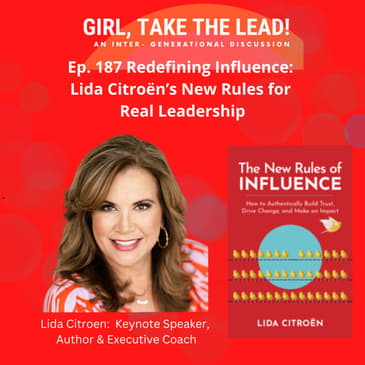
Lida Citroën, Boomer, joins us to talk about her new book, The New Rules of Influence – How to Authentically Build Trust, Drive Change, and Make an Impact.
Lida is a keynote speaker, author and executive coach empowering global executives, entrepreneurs, and thought leaders to manage how they’re perceived and drive them towards ideal opportunities. She has helped thousands of individuals gain a fresh perspective on crafting a personal narrative that tells the right story to the right people about who they are. Her personal mission isn't just about perception—it's about profound transformation, guiding others to leave an indelible mark on the tapestry of human achievement.
Topics covered in the Episode:
- We matter
- Executive Presence and Influence
- Groups of Rules (why, who, how, where)
- Misalignment of values
- Brand and Influence
- Influencers & Social Media
Here are three takeaways from the episode:
1. Executive presence is about: Gravitas but that can’t
be well-defined, Image which is about how to dress the part, and Communication that are usually scripted messages. That doesn’t necessarily lead to influence which is not manipulation or persuasion. This is why we need new rules.
2. Lida divides the 10 rules into 4 groups. Courage is our “Why” and it’s about being real. Credibility means being clear what we stand for. “Who” is now global and includes rules of being of service and inclusive. “How” is not about perfection but being consistent and that builds trust. “Where” is about visibility.
3. Misalignment of our values can
be part of the journey and gets us to where we are (Rule 3) We’ve all experienced this and we learn from them.
Mentioned in the episode:
Lida’s Book: The New Rules of Influence – How to Authentically build Trust, Drive Change and Make an Impact
Release Date: August 27. Publisher is Berrett-Koehler. Order here.
Ep 52 Personal Branding: Can’t Leave Home Without One – Let’s Craft Yours!
https://spotifyanchor-web.app.link/e/U9U0POfvfMb
Special Offer From Lida:
Drop Lida a note, let her know you read the book, and she’ll send you a special gift!
More About Lida:
Lida offers veterans and service members tools for transitioning into the civilian workplace and collaborate with employers to provide resources for hiring, training, and engaging military veteran employees. You can find the books she’s authored for service members here: https://lida360.com/store/
How to reach Lida:
Email:
Lida@LIDA360.com
Website:
https://lida360.com/the-new-rules-of-influence/
FB:
https://www.facebook.com/LIDAthreesixty
IG:
https://www.instagram.com/lida_citroen/
How to reach Yo Canny:
Our website:
You can send a message or voicemail there. We’d love to hear from you!
email:
FB group: Girl, Take the Lead
https://www.facebook.com/groups/272025931481748/?ref=share
IG:
yocanny
LinkedIn:
https://www.linkedin.com/in/yocanny/
[00:00:06] Welcome to episode 187 of Girl, Take the Lead, where each week we explore womanhood and leadership. And I'm your host, Yolanda Canny.
[00:00:16] Lida Citroën Boomer joins us to talk about her book, The New Rules of Influence, How to Authentically Build Trust, Drive Change, and Make an Impact.
[00:00:28] This month, we've been covering fearless leadership and Lida talked with us about topics related to being influential, an important element of being fearless.
[00:00:41] Lida is a keynote speaker, author, and executive coach empowering global executives, entrepreneurs, and thought leaders to manage how they're perceived and drive them more towards ideal opportunities.
[00:00:57] Lida Citroën Boomer, she has helped thousands of individuals gain a fresh perspective on crafting a personal narrative that tells the right story to the right people about who they are.
[00:01:11] Lida Citroën Boomer, Her personal mission isn't just about perception.
[00:01:15] Lida Citroën Boomer, it's about profound transformation, guiding others to leave an indelible mark on the tapestry of human achievement.
[00:01:25] at. These are the topics we covered in the episode. One, we matter. Two, executive presence
[00:01:35] versus influence. Three, the four rule groupings she put together based on why, who, how, and where.
[00:01:48] Four, when our values can become misaligned. And five, brand and influence.
[00:01:58] Please enjoy the listen. And here you go. So welcome leader to girl, take the lead.
[00:02:07] Love having you here. Thanks for being here and welcome. Thank you so much. I'm so excited to have
[00:02:14] this conversation. Yeah. Well, I think our listeners are going to be happy to hear us talk a little bit
[00:02:21] about marketing, other things too. At least I know I will be. So this is great conversation. So thank
[00:02:28] you for coming. Let's start, if you would, to just sort of tell our listeners a little bit about your
[00:02:33] background. Yeah, sure. So I spent 20 years in corporate marketing, brand development, business
[00:02:41] development, all of that. Did everything that was expected of me, brought home a lot of results.
[00:02:47] And in 2008, as the economy in our country was falling apart, decided to become an entrepreneur.
[00:02:53] Had never wanted to have my own business, had never occurred to me. And I didn't want to do what I had
[00:02:59] done before. And this concept of personal branding was not known, but I knew how to stand up and position
[00:03:07] a company, a product or a service. And I now wanted to do it for people. So because of the state of the
[00:03:13] economy and what was happening with everybody losing their jobs and, you know, trying to keep their jobs,
[00:03:18] personal branding was the right opportunity and offer at the right time. And I started a personal
[00:03:24] branding firm. And 16 years later, I work in over 30 countries, individuals at all different layers of
[00:03:31] the organization. And I'm that person who wakes up every morning, excited to do what I do.
[00:03:38] That's so great. You have to tell them about your book. And I think it is just going to be so
[00:03:45] terrific. I know it's launching soon. So you might want to tell them a little bit about that. And
[00:03:49] yeah, let's hear about the book.
[00:03:51] You know, I've written seven books and they always say, if you ask a mother, which one is their favorite
[00:03:56] child, you're never supposed to say there is a favorite. And if my kids are listening,
[00:04:02] but this one is a special place in my heart because I've written business books, even though
[00:04:07] three of my books have been geared towards a military audience, which is a community I'm
[00:04:12] deeply passionate about serving. They've been business books, right? They've the formulas,
[00:04:18] the how to's, this is the prescription. These are the case studies. And this book is, is a little
[00:04:24] more like a love letter. And I know that sounds really weird to say, but I feel like there are so
[00:04:29] many women and people from underrepresented groups and marginalized communities who have felt what I
[00:04:36] felt and needed something like this. And I, this is my, my gift to that community. It's a book of power.
[00:04:43] That's a book of, you know, finding our voice, being confident and clear in who we are,
[00:04:49] and then using that to make the world a better place. So that's why I, it sounds corny, but I kind of
[00:04:55] describe it a little bit like a love letter. Um, I poured my heart into this book.
[00:05:00] You did. And so many of your examples, um, Oh my gosh, they're so heartfelt and, um, you know,
[00:05:08] we can relate to them. I know I related to several of your stories and we'll get into that a little bit,
[00:05:14] but, um, I'll have in the show notes for our listeners, like where they can get it. And,
[00:05:20] you know, cause I know that you are going to be launching towards the end of the month.
[00:05:23] So this is, this is nice. So tell them a little bit about it. Um, I got to read the dedication
[00:05:31] because the dedication, I don't know, just grabbed me. It's for all of us who want to know that by the
[00:05:38] end of this crazy and wonderful journey called life, we mattered, we made a difference and we left
[00:05:46] the world a better place. I love that too. You know, it's funny how that came about because I,
[00:05:53] I, I, sometimes in my books, I've included a dedication. If there's a particular person
[00:05:58] that I want to say, you know, thank you to. Um, and my, my publisher kept saying,
[00:06:04] do you need, do you have a dedication? And I said, well, I didn't include it in the manuscript. So I
[00:06:08] think we're good. And it was weird because usually they would just be good with that and,
[00:06:13] and put the format of the book together, but they kept coming back saying, are you sure there's no
[00:06:18] dedication? I thought, okay, something's telling me I need to say something. And I just pulled that
[00:06:23] together and sent it over. And they're like, this is perfect. So I feel like it came after the book was
[00:06:29] done. And, and that really speaks to, I think why I wrote it is I think all of us want to know that
[00:06:35] we matter that, that, that we're here for a reason. And, and that reason is so perfect and so
[00:06:41] amazing. And it's our opportunity to lean into that and, and do something good, do something positive
[00:06:48] with it. Yeah. And your voice comes through so clear. And I guess all of us, right. We have our
[00:06:54] journeys and your previous books and your, um, passion for the military and support of those
[00:07:01] people in service. I mean, it's just all fits that this would be the next thing for you.
[00:07:08] And, and if you had told me that a year ago, well, actually a year and a half ago, I would have no
[00:07:12] idea what you're talking about. I thought I was writing a book for women. Um, and my publisher
[00:07:18] said, yeah, there's a lot of books for women. I went, okay. So then I, they really said, you know,
[00:07:23] what is it that, that the world needs now? And I thought back to my own experience of all those 20
[00:07:29] years in corporate, right. Trying to play by the rules, whatever those were, um, they weren't written
[00:07:35] anywhere, trying to conform and assimilate and be what everybody around me was knowing that that
[00:07:42] didn't feel genuine, but not knowing what it meant to be me and looking at these models that were held
[00:07:48] out of this is what an executive looks like. This is what it takes to climb the corporate ladder and
[00:07:54] shatter the glass ceiling and all these messages, which really didn't have a playbook attached to
[00:08:00] them. And that's when I decided maybe this is the book the world needs now is that if we don't have
[00:08:07] to look like someone else, we don't have to sound like someone else. We can be the best version of
[00:08:11] ourselves and do it in the right place in the right way. And, and we can make a real difference.
[00:08:18] Well, I love you make a distinction between executive presence and influence and your whole
[00:08:25] theme about influence is just so terrific. And, and cause I can remember being in a room with people
[00:08:33] and, you know, didn't have the highest position in the room, but if someone went to speak,
[00:08:43] everyone would be silent and want to hear what that person had to say. They had the influence of the room.
[00:08:49] Right. And, and people took them seriously, or at least considered. And really that's what we're
[00:08:55] trying to do with influence. It's not persuasion. It's not manipulation. It's to say that if I've got
[00:09:02] a vision, if I've got an idea, if I want to call something out, maybe point out something isn't right,
[00:09:07] that I have earned the credibility. I have the confidence and the clarity. I know my audience.
[00:09:13] I know my delivery and I know how to present that. It can be just raising your hand in a meeting. It
[00:09:19] can be starting a movement, anything in between. And the problem I had with executive presence and
[00:09:25] candidly, I have taught executive presence for years. The problem I've always had is it fell on
[00:09:32] three traditional pillars, gravitas, image, and communication. Well, image, we kind of know
[00:09:40] means dress the part, look the part, you know, which typically was the picture of a middle-aged
[00:09:45] white man in a black suit with a red power tie. Right. That was the image. The communication was
[00:09:52] scripted and eloquent and polished and thespian like, right. But gravitas was the one that tripped
[00:09:59] everybody up because when I was doing the research for the book, there were so many studies that said
[00:10:04] it's important to have gravitas, but people can't define what it really is. And then we
[00:10:09] really can't teach people how to get it. So I'm going, wait a minute, if I don't want to look a
[00:10:14] certain way, because that's not me and scripting my messages, like that's not the world we live in.
[00:10:20] And whatever this gravitas thing is, doesn't fit me. Then how do I do it? How do I do it? And that's
[00:10:26] where I came up with the new rules of influence that there's a whole different playbook now.
[00:10:31] I love the rules. I totally love the rules. And I love the way that you organize them.
[00:10:38] You have them like in four groups, why, who, how, and where. Yeah.
[00:10:47] You got it. You got to talk a little bit about how you came to these groupings and these rules,
[00:10:53] because like you said, you know, the old rules didn't work anymore. And so these,
[00:10:59] these are awesome. I'm going to say. Thank you. I think so too. And, you know,
[00:11:04] it's tough because I could have come up with 50 rules, but no one's going to remember that. So
[00:11:09] the 10 was already a mouthful and then grouping them just allows us to understand how they work
[00:11:17] together. So the first category is discover your why. So you want to have influence. Why,
[00:11:23] why do you want to have influence? You know, just because you can, doesn't mean you should or want to.
[00:11:28] Right. So it's, it's starting with the first rule, which is courage. And that doesn't mean the absence
[00:11:34] of fear. It means working through fear, but the people I've studied, the people I've worked with,
[00:11:39] who have been real leaders and real people of influence, they're unwavering about their
[00:11:45] commitment to see this through. They are so deeply passionate. It is non-negotiable and their
[00:11:52] courage carries them, you know, into interactions with the naysayers and through the times when it,
[00:11:59] it doesn't work and, and all of that. So courage is really where it starts.
[00:12:03] And then is the rule about being real. And I had a lot of people ask me, well,
[00:12:08] why wouldn't you say authentic? You know, everybody talks about being authentic. I said,
[00:12:13] well, that's kind of the problem, right? We say, you know, Oh, be authentic with me.
[00:12:17] Well, I thought I was, but if you say, be real with me or let's have a real conversation, it,
[00:12:24] it tends to be easier to digest. So I went with the rule of being real and then credibility is the
[00:12:31] name of the game. I mean, it's the first, it's the first foundation to any type of positioning,
[00:12:36] any type of influence is to be really clear on what you stand for and who you are and then walk the talk,
[00:12:43] you know, putting your actions consistent with your values and, and all of those baked together
[00:12:48] creates your why and helps you understand. Okay. Now I have clarity. Now let's build some confidence.
[00:12:56] And so the second one is finding your who, and that's been an interesting one, given what we went
[00:13:02] through as a world in 2020 and 2021. Um, a lot of our who's changed. It wasn't just our direct reports
[00:13:10] and our teams. It was global communities. And all of a sudden we were wanting to represent or stand up
[00:13:17] or advocate for groups that we didn't come from, or we didn't look like, and how do you do that?
[00:13:24] And a lot of people made mistakes. You know, they tried to assume that they understood the plight or the,
[00:13:30] the challenges of that community because they've read about it. So that's really where the,
[00:13:35] the two rules of being of service and being inclusive, put together a mindset that says you
[00:13:42] may not have all the answers and that's okay. Be really good at asking questions and then listen to
[00:13:48] learn not to judge. And that's that step moving forward, you know, is how are you going to influence?
[00:13:57] Um, what I love about branding and all the work that I do, and I know you've got a background in this
[00:14:02] as well as it's not about perfection because we can't be perfect, but we absolutely have to be consistent.
[00:14:08] The same person online as in-person as what somebody tells me that consistency is when I start to trust you,
[00:14:16] right? When you speak in a meeting and in the past, you've offered good ideas, that consistency
[00:14:22] starts to create, you know, some muscle memory. Um, agility is powerful because it is,
[00:14:29] it's how we navigated 2020. It's what we see leaders do today when market shift or, you know,
[00:14:36] world shift, uh, geopolitical shifts. And all of a sudden things look different and we got to go,
[00:14:41] Hmm, okay. Am I going to be rigid? This is how we've always done it. Or am I going to flex and adapt
[00:14:48] and learn and listen? And then the last one in that category is the power of storytelling.
[00:14:54] And you're a master at this, right? You use story to share all these messages with your listeners
[00:15:01] and people remember stories, whatever country, whatever culture I'm working in. If I tell a story
[00:15:08] and it's culturally relevant because it can't just be an American story. Um, people get it,
[00:15:14] people take it and they realize it. And then we wrap it all up with two rules around visibility and brand.
[00:15:21] If I don't see you, I can't, I can't be influenced by you. And you have to know who you are and how you
[00:15:27] want the world to see you and receive you. And in a nutshell, those are the rules.
[00:15:33] Yeah. Well, I think you also, um, and I think it's rule three where you talk about actions and values
[00:15:43] and having alignment around those. You brought up this wonderful story about how you had to ease someone
[00:15:51] out of the organization. And I know I went to the place with my experience too, where I went,
[00:15:56] oh yeah, I remember, you know, this PR event and, um, I knew there was cheating going on and,
[00:16:06] you know, it was hard, you know, like you, you, you do have these values and,
[00:16:11] you know, I was leaving the organization anyway, so I didn't have to stick around for very much longer,
[00:16:15] like maybe a day or two after I found all that out. But it, it is hard on us when those values don't
[00:16:24] match. It, it pulls at a part of our heart and our gut and our head that sometimes we don't even
[00:16:31] realize until the years later. And it's not to say that if you haven't done the values work first,
[00:16:37] you don't feel that discontent. I knew, and that was a really painful story to share. And I even
[00:16:44] discussed with my husband, like, do you really think I should go there? And he's like, well,
[00:16:48] you're kind of asking your reader to get real. You kind of have to get real. Um, but it wasn't
[00:16:54] flattering. I mean, I went against everything I believed because that's what I was told. And that's
[00:17:01] what I thought was expected. And I thought everybody else was doing it. And I made somebody
[00:17:06] very unhappy. And to this day, I, I still regret that. Uh, it was not one of my finer moments,
[00:17:12] but I'll tell you, I've never done it since. Yeah. And I know, and I don't know, and maybe it's
[00:17:21] something that just happens to us over time after being in corporate life for so long,
[00:17:27] you've seen it happen more and more, and you can feel it happening when it's coming for you
[00:17:31] several times. I felt, Oh, okay. They're lining this up. They're documenting this event. You know,
[00:17:42] it's cause you learn as, especially as a leader, you know, what the steps are within HR so that you're,
[00:17:48] you quote followed, you know, the correct path to dismiss somebody legally. Um,
[00:17:57] it's funny you say that because it did not even occur to me until this moment that yes,
[00:18:02] you're absolutely right. And I absolutely saw it coming for me. Um, and I remember telling my son
[00:18:08] once, and I don't know, it's something I have to keep remembering, but there's this, that phrase that
[00:18:14] says, when somebody shows you who they are, believe them the first time, like that was the beginning of
[00:18:21] my career with that organization and they showed me who they were. And yet I was surprised later
[00:18:26] to see it happening again. Um, so yeah, till this moment, you know, I mean, I know putting it out
[00:18:36] there, it's almost like when you're doing a podcast and you're telling your people, you know, like,
[00:18:40] this is really what happened. Um, there's this vulnerability that happens, but so many of us have
[00:18:48] been there and for you to just sort of say, yeah, this happens. Y'all go, yeah, we know we've been
[00:18:56] there, we've experienced it, or I've seen it happen or whatever. So thank you for, for doing that and
[00:19:01] for putting that out there because there are things in our lives that we have to live with when we're in
[00:19:07] those situations. You don't know the right thing, quote, right thing to do. You just continued along the
[00:19:14] path and you learn. Yeah. Like you said, never going to do that again. And I said to myself,
[00:19:20] well, I'm never going to do that one again, believe me. Um, but it's, it's part of our journey,
[00:19:27] right? It is. And it gets us here. And if we don't have those experiences, who's to say we'd end up in the
[00:19:33] same place. So I don't regret the experiences that I've had. I wish sometimes I had made different
[00:19:40] choices, but I didn't know then what I know now. Yeah, exactly. Is there one group or rule that stood
[00:19:50] out for you? Cause I kind of mentioned rule three, cause I love that and that group, you know, but it,
[00:19:56] what about you? You know, asking you to choose a favorite child. I know exactly. Right. And I should
[00:20:04] say the last group, because that has branding in it, um, which a lot of people have asked me. So now
[00:20:09] that I'm talking about influence, does that mean I'm moving away from branding? And I reconciled
[00:20:14] that because it's a really good question. Um, you don't think we build a brand for a company or for a
[00:20:21] person to get to an, that's not the end state, right? You don't have a brand, put it on a shelf
[00:20:26] and go done. Um, you build a brand to have influence, to be able to walk into a room and know why you're
[00:20:32] there and have people respect you and take you seriously and, and to have the opportunities that you want.
[00:20:38] So I love that one, but probably fundamentally, I love the first one because it's why and everything
[00:20:46] boils down to why, you know, and we are so perfectly designed for everything that we're doing. Um, being
[00:20:54] conscious of that and leaning into that and saying, how cool is it like that? I'm here, that you're here,
[00:21:01] that we're having this conversation, that your listeners are hearing this message now,
[00:21:05] and they may go do something really good with it. Yeah. That's a really cool thing.
[00:21:12] I love, well, you know, the heart of every marketer and their skill is differentiation.
[00:21:20] And the fact that you bring that up and in the why, you know, that you understand what makes you,
[00:21:27] you and why you're doing something, you know, what's your point of difference in terms of why you're
[00:21:33] doing it. I loved all of the marketing lingo. We've had, you know, well, personal branding is how I got
[00:21:48] into doing podcasting because I didn't know very much about it. And I decided to take a class with
[00:21:55] Kathy Heller and learn about podcasting. Cause someone said to me, you know, that's a really good
[00:22:01] example of personal branding. You would learn a lot. And I thought, okay, I'll go. And I had no idea
[00:22:06] that I would be a podcaster. You know, I can't even tell you, I hadn't barely listened to any podcast
[00:22:12] before I took the class and then I come out of it and I go, you know what? I'm going to do this.
[00:22:17] This is just really great. And it has been really an experience of personal branding and influence,
[00:22:26] you know, that's challenging. It's not, you know, like pick up the microphone and start talking.
[00:22:32] Oh, and, and you're good at it. So there are a lot of people who do just pick up the microphone
[00:22:37] and start talking, but to be good at it, to have it be organized. And so that your listeners getting
[00:22:42] something of value as well as it being entertaining. That's not easy. I applaud you for that.
[00:22:48] Well, I like when we give them things to think about and you have certainly helped us under,
[00:22:54] I mean, just the distinction there between executive presence and influence. I think that's
[00:23:00] very generational in the perspective of, um, especially for our Gen Z and millennial listeners
[00:23:09] and viewers that they're all about influence. They're, they're almost got the masterclass in it
[00:23:17] with all the social media that they go through. Don't you think?
[00:23:21] Well, because influence gives them opportunity. It gives them lifestyle. It gives them choice.
[00:23:26] It gives them freedom. It gives them dependence, whatever it is that they're seeking. And yeah,
[00:23:31] I mean, one of the examples I use in the book of influence is Greta Thunberg age 15 sits down in
[00:23:38] front of Swedish parliament and delivers a message about, you know, climate change, which captivated the
[00:23:44] world. She didn't look the part. She didn't sound the part, but her passion, her realness, her
[00:23:51] inclusivity and how she brought different voices together to be part of that conversation with her
[00:23:56] and what she's done with it in terms of service. Yeah. I mean, that's 15 year old. And we see that in
[00:24:02] organizations now where you might have a CEO who carries less influence over decision-making and
[00:24:10] visibility and advancement than somebody who's new to the company or someone who sits in the back.
[00:24:16] But to your point, when that person speaks, everybody listens, not the CEO all the time.
[00:24:22] So it doesn't come with rank and authority and job title, which is what I've been taught. I don't know
[00:24:28] about you, but I was always taught when, when you get there, you know, then people will listen.
[00:24:32] Yeah.
[00:24:32] It's like, well, nobody to find there. I just knew I wasn't there.
[00:24:38] Well, and I think what also came with that was you had to be driven to keep excelling and moving to
[00:24:45] the next thing to get more quote power and authority so that your executive presence increased. And
[00:24:53] because organizations have gotten a lot flatter, less hierarchical, there aren't that many spots.
[00:24:59] Right. So you have, you know, what is it that you want? What is that? Why for you? Is it about
[00:25:06] influence? Is it about knowing your field is, you know, what is it that you want out of what you're
[00:25:12] doing? Because the old paradigm does not work anymore. It really doesn't. And I think that's a good
[00:25:19] thing. I think that's a good thing. Um, and I say, you know, in the book straight up, if somebody
[00:25:24] is reading this book, because you're looking to accumulate more, more power, more wealth,
[00:25:30] more status, it's probably not the book for you. Um, you know, there are so many get rich quick books
[00:25:36] out there that I'm sure would be better served because I'm, I'm going to make the reader uncomfortable
[00:25:41] with some of the questions to get to the essence of why this matters and what you want to do with
[00:25:47] this. And are you really willing to have those hard conversations and listen so that you can better
[00:25:53] serve and advocate for the people that you want to serve. We can all make a difference,
[00:25:57] but it doesn't all have to be in the same way. Yeah. Oh, that's so beautifully said.
[00:26:02] I love that you said that. Well, I definitely think every business school should have a copy of your book.
[00:26:08] Okay. Let's make that happen. I'm fine with that.
[00:26:11] For every student, because it, I think you've done an excellent job of helping us see
[00:26:18] how to navigate so differently. And it's so important. And thank you for your fearlessness
[00:26:24] in doing this and leading us in this way. Cause it's really, I know it wasn't, there's so much
[00:26:31] of you in this book, as you said, um, and you're, you just got it out there. So thank you. Thank you
[00:26:38] for doing that. You know, it's funny. My, my older son read the book and he said, I know you said
[00:26:43] this book was really personal and you shared all these things. He goes, I didn't learn anything new.
[00:26:48] I said, okay. So that means you've listened when I've told you all that stuff in real time.
[00:26:53] And we had a very interesting conversation. Um, but yeah, I, I, I feel like I had to, um,
[00:27:01] I still am not a fan of transparency, so I didn't go that far. Um, but I feel like I, I had to share
[00:27:07] what I had to share so that the reader knows that they're not the only one, you know, who's going
[00:27:12] through this and wondering and feeling and curious about the same things. Cause I was too.
[00:27:17] We all were. So is there anything else you'd like for us to cover? We want them to go out and get
[00:27:23] the books, definitely get the books. Um, you know, and it's the start of a conversation. You know,
[00:27:29] one thing we're, we're hoping is that people will read the book maybe with someone and have
[00:27:34] conversations together, small groups within companies, or I don't think, I don't know that
[00:27:39] it's a book club type book, but you know, find a friend and read it together and then sort of bounce
[00:27:44] ideas off of each other because that's the sense of community. I would love to see come out of this.
[00:27:50] Oh, it's a very small place. So.
[00:27:53] I remember putting a book club together for, um, when Sheryl Sandberg did lean in,
[00:27:59] you know, and got a bunch of, I don't know, there must've been an eight of us or so reading
[00:28:03] it together. It's such a wonderful experience. So yes, listeners go and do that. That's so cool.
[00:28:08] Yes. And then let me know how it goes.
[00:28:10] I want to hear. Yeah. So the last question I always ask our guests, what advice would you
[00:28:16] give your 20 something self today?
[00:28:20] Oh, and I'm grateful you said 20 and not other ages because that does make it a little easier.
[00:28:25] I was in college and, um, I, I, I wish someone had had conversations with me at that age.
[00:28:33] Like I have conversations with the reader, um, just to, I was pre-law. I was supposed to go to
[00:28:39] law school. That was the path I was on. Everything was designed for that. I didn't want to be a lawyer,
[00:28:45] but I didn't know enough to say time out. Like, let me take a beat and figure out what I want to be.
[00:28:51] I didn't have really good role models. So I would love for that 20 year old version of myself to just
[00:28:57] know that you're not going to make mistakes because everything's going to get you where you're supposed
[00:29:01] to end up a little later in life, but you'll get there. Um, and the world's going to be a better
[00:29:07] place because you're in it. And let's give that message to young people. Cause wouldn't that be a
[00:29:13] confidence boost no matter where you are to hear that?
[00:29:16] Absolutely. Absolutely. Such good advice. I would say, give everybody your book.
[00:29:22] I have put you on the payroll. Um, yeah, it is definitely a book for young people. Um,
[00:29:28] I thought it was going to skew very young and then several, uh, business leaders that I gave it to
[00:29:34] said, Oh gosh, no, I think to your point, business schools and corporate folks need to read this
[00:29:40] because you're going to pick something up. You're going to, you're going to get one message that says,
[00:29:44] I could probably do a little bit more of that thing. Maybe I haven't been thinking about that
[00:29:48] part. Um, so there's something for everyone. I didn't write this to be a hard business book,
[00:29:54] you know, there's enough of those out there and they all have a place in the world. This is an easy
[00:29:58] read and it's a conversation with a friend who cares about you. There you go. Oh, love it.
[00:30:04] Thanks for joining us Lita today. Appreciate you being here. I appreciate you. Thank you.
[00:30:12] Thank you for listening today. And for this episode with Lita, I was reminded of one of my cards
[00:30:18] you'll find on our website, girl, take the lead pod.com slash shop. And it's called
[00:30:28] snarky cat. And it reads at the bottom, trust your gut. You know what to do. And I hope you'll
[00:30:37] check it out. Snarky cat is one of my favorite little pieces that I put into my cards.
[00:30:46] If you like this episode, please leave a comment, wherever you listen to your podcasts,
[00:30:51] tell a friend about us or join our public Facebook group girl, take the lead. We also have a YouTube
[00:30:58] channel where your subscription would be appreciated. Once you're on YouTube search at girl, take the lead.
[00:31:04] And you can also find us on YouTube music and you can see a video of this episode. Here are three
[00:31:15] takeaways. One executive presence is about gravitas, but that can't be well-defined image, which is about
[00:31:26] how to dress the part and communication. And that's usually very scripted and that doesn't necessarily
[00:31:34] lead to influence, which isn't about manipulation or persuasion. This is why we need new rules.
[00:31:45] Two. Lita divided the 10 rules into four groups. Courage is our why, and it's about being real.
[00:31:55] Credibility means being clear what we stand for. Who is now global and includes rules of being of service
[00:32:06] and inclusive. How is not about perfection, but being consistent about what builds trust and where
[00:32:17] is about visibility. And three, misalignment of our values can be part of the journey.
[00:32:25] And gets us to where we are now. We've all experienced this and we learn from them. Our next episode
[00:32:36] will be a soundbite about the women athletes of the 2024 Olympics. I know I just couldn't resist.
[00:32:45] My hope is that you'll be as inspired as I was by the women who are truly fearless.
[00:32:54] Talk to you soon. Bye.