
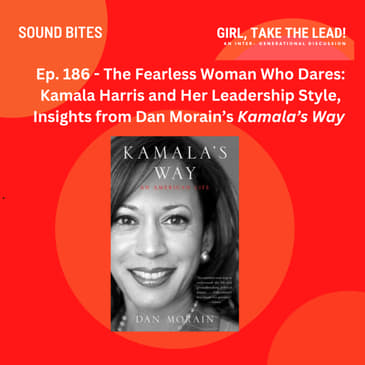
This month we’ve been covering stories about fearless leadership and perhaps like you have been intrigued by the political landscape this month and seeing Kamala Harris emerge as what one can only describe as fearless. So I dug in and found some sources that can help us elements of her leadership that we’ve been covering on the show.
Topics Covered:
Early inspirations Competition Determination Resilience Networking Empathy
Here are three takeaways from the episode:
1. Kamala Harris is breaking the mold for women when it comes to leadership. Her early foundation (mother-inspired, Berkeley in the 60s) set her on a course to be an advocate, empathy, and insights into politics.
2. Kamala has designed her own way (blended family, Presidential run in 2020) and is an example of learning from failure and demonstrating resilience.
3. One of Kamala’s greatest strengths are her people skills: networking, building influence and creating alliances.
Mentioned in the Episode:
Ep 48, A discussion with Andrea Mein DeWitt about her book: Name Claim Reframe, Your Path to a Well-Lived Life.
https://spotifyanchor-web.app.link/e/cfTURe31gMb
Book: Kamala’s Way, An American Life, Dan Morain
Ep. 60, Let’s Celebrate Women’s History Month with the book: Women and Leadership by Julia Gillard & Ngozi Okonjo-Iweala
https://spotifyanchor-web.app.link/e/T20W9Za2gMb
Ep. 15, Part 1 of 3, Atlas of the Heart: How do the emotions, Empathy and Compassion, relate to leadership?
https://spotifyanchor-web.app.link/e/DZ0O7Q71gMb
The 'blended' family behind Kamala Harris, August 16, 2023
https://www.bbc.com/news/articles/clylqv3g4rwo
Inside Kamala Harris' close bond with rarely seen sister Maya Harris
https://www.hellomagazine.com/celebrities/711649/meet-kamala-harris-sister-maya-harris/
Economic shocks are wiping out progress on gender equality: Global Gender Gap Report 2023, June, 2023
https://www.weforum.org/agenda/2023/06/economics-shocks-gender-equality-linkedin/
How to reach Yo Canny:
Our website:
You can send a message or voicemail there. We’d love to hear from you!
email:
FB group: Girl, Take the Lead
https://www.facebook.com/groups/272025931481748/?ref=share
IG:
yocanny (Yo)
LinkedIn:
https://www.linkedin.com/in/yocanny/
[00:00:06] Welcome to episode 186, which is a Girl Take the Lead soundbite. And that's a shorter episode, which may be a bit more about a topic we've covered like our episode today or quick inspiration. And I'm your host, Yolanda Canny. We've been covering stories about fearless leadership this whole month. And perhaps like you, I have been intrigued by the political landscape.
[00:00:31] Seeing Kamala Harris take charge of her presidential campaign in a way one can only describe as fearless. So I dug in and found us some sources like the book, Kamala's Way by Dan Morain that can help us identify elements we've been covering in this podcast to understand her leadership style. Elements like her early inspirations,
[00:01:01] and then masculine skills like competition, determination, and then feminine skills like resilience, empathy, inclusivity. I want to give a shout out to our previous guest, Andrea Main DeWitt, who outlined these traits for us in her book. And I'll have a link to that episode if you'd like to listen to it. Here you go. Enjoy the listen.
[00:01:26] So let's just say you were given a job description for the position of the president of the United States. Would you want to interview? It's a pretty crazy time, right? To want to be president? There's just a few challenges like continuing U.S. economic recovery, managing inflation, a mental health crisis, a global climate crisis, racial and gender inequality,
[00:01:57] immigration reform, immigration reform, political polarizations, U.S.-China rivalry, Ukraine-Russia tensions, the Middle East hotbed, cybersecurity and national security, North Korea's nuclear ambitions, Europe's energy crisis and political stability, and oh yeah, the African military conflicts.
[00:02:24] And your life will be under scrutiny 24-7 on a global level. Would you take the job? I know I wouldn't, but thank God someone is willing. You have to be one fearless lady to do so. So who is this daring woman? Kamala?
[00:02:47] Kamala. Point one, I think. She was groomed from birth. Kamala's mom was 26-year-old Indian immigrant when she was born at Kaiser in Oakland in 1964. As a little girl, she grew up to be tough, sharp-witted, exacting, hardworking, smart, multilayered, and multicultural.
[00:03:15] Maureen's book was written in 2021. So Kamala would have just become VP after Joe Biden won the 2020 presidential election. She is the United States' first female vice president, the highest ranking female elected official in U.S. history, and the first African-American and the first Asian-American vice president.
[00:03:41] She is described as her mother. She is described as her mother's daughter. Her mother, Shyamala Goblin Harris, died in 2009 and was the greatest inspiration in her life.
[00:03:58] And Kamala often shares inspirational quotes from her, one being, quote,
[00:04:03] You may be the first to do things, but make sure you are not the last.
[00:04:09] One post on Instagram Kamala made during Women's History Month in 2020 was,
[00:04:16] She taught my sister Maya and me the importance of hard work and to believe in our power to right what is wrong.
[00:04:25] I was struck by the fact that Kamala was inspired by her mother.
[00:04:29] In her episode 60, we looked at the book, Woman and Leadership, by Julia Gillard, former PM of Australia,
[00:04:39] and Ngozi Okonjo-Iwala, Nigeria's finance minister, and is now director general of the World Health Organization.
[00:04:50] In their book, they spoke to eight of the world's most powerful women,
[00:04:54] one including Hillary Clinton, and most indicated a strong tie to their fathers.
[00:05:01] So what did Kamala's mom do to lay a foundation for her that she was so inspirational?
[00:05:09] Here's a little about her mom.
[00:05:11] Her mom stood a little taller than five feet.
[00:05:15] She was the eldest of four children of a senior civil servant in a family of high achievers
[00:05:21] in a nation that gained its independence from Britain in 1947, nine years before she was born.
[00:05:30] She was raised in a household where political activism and civic leadership came naturally.
[00:05:36] She had a keen political consciousness and was conscious of history, conscious of struggle,
[00:05:44] and conscious of inequities.
[00:05:47] Kamala said this about her mom.
[00:05:49] She was born with a sense of justice imprinted on her soul.
[00:05:55] In 1958, she was 19 when she graduated with a degree in home science in New Delhi and then went to Berkeley
[00:06:04] in search of a higher and more meaningful education.
[00:06:08] She studied nutrition and endocrinology and received her PhD.
[00:06:13] She was recognized for her research in breast cancer and published over 100 research papers.
[00:06:21] In 1962, Shyamala attended a gathering of black students where the speaker was a young graduate student
[00:06:29] from Jamaica, Donald Jasper Harris, who was studying economics.
[00:06:35] He immigrated from Jamaica in 1961, also arriving at Berkeley for an education.
[00:06:42] He was a bit of a radical and Shyamala came up to him after his lecture, charmed him.
[00:06:50] They spoke and they met a few more times and became married in 1963.
[00:06:56] Kamala Devi was born in 1964 and her sister Maya Lakshmi two years later.
[00:07:04] Debbie is the Hindu mother goddess and Lakshmi is the lotus goddess of wealth, beauty, and good fortune.
[00:07:14] Shyamala told the LA Times she gave her daughters names derived from Indian mythology
[00:07:21] to help preserve their cultural identity and said,
[00:07:25] quote,
[00:07:26] a culture that worships goddesses produces strong women.
[00:07:32] In the mid to late 1960s, both parents were active in the civil rights movement
[00:07:38] with Kamala wheeled to demonstrations initial in the stroller.
[00:07:44] She tells the family tale that on one occasion, as she was fussing in the stroller,
[00:07:50] her mother asked Kamala what she wanted.
[00:07:53] And she replied,
[00:07:55] feed them.
[00:07:58] And for those of you who don't know the San Francisco Bay area in the 60s and 70s,
[00:08:04] Berkeley was a hub of political activism, intellectual fermentation, and cultural revolution.
[00:08:14] And it was playing a pivotal role in shaping the broader countercultural and social movements
[00:08:21] of the time.
[00:08:23] During that time, Berkeley was defined by the free speech movement,
[00:08:29] anti-Vietnam War protests, civil rights, and social justice.
[00:08:35] And Berkeley was one of the first cities to integrate its schools.
[00:08:38] And the broader fight for racial justice was a significant part of the political consciousness.
[00:08:46] Organizations like the Black Panther Party, which was founded in nearby Oakland,
[00:08:51] also had a significant influence.
[00:08:54] And then there was the countercultural and hippie movement.
[00:08:58] The city is near San Francisco's Haight-Ashbury,
[00:09:02] the epic center of the summer of love, especially in 1967.
[00:09:07] And Berkeley shared in the cultural shift towards peace,
[00:09:10] love, communal living, experimentation with drugs like LSD.
[00:09:16] The university, Telegraph Avenue, and People's Park became gathering places for those involved
[00:09:23] in the countercultural.
[00:09:25] So what about her dad?
[00:09:29] Donald Harris's career was in academia.
[00:09:32] He spent time at Berkeley, the University of Illinois,
[00:09:36] at Urbana, Champaign, Northwestern University, the University of Wisconsin.
[00:09:43] And then in 1972 at Stanford, he was the first Black economist to achieve tenure
[00:09:51] in the Stanford Economics Department.
[00:09:54] And he stayed there until 1998 when he retired from teaching.
[00:10:00] Shyamala and David separated in 1969 when Kamala was five.
[00:10:06] They filed for divorce in 1972.
[00:10:12] Shyamala gained physical custody.
[00:10:16] Kamala said this in 2003,
[00:10:19] My father is a good guy, but we are not close.
[00:10:24] He was not included in the official biography on the California Attorney General's website
[00:10:30] while her mother was.
[00:10:34] So what foundation did mom lay?
[00:10:39] Mom had a keen sense she was raising a Black daughter and took her to a rainbow sign,
[00:10:46] a Black cultural center in Berkeley,
[00:10:49] where she met the likes of Shirley Chisholm,
[00:10:53] the New York congresswoman and first Black presidential candidate,
[00:10:57] jazz singer,
[00:10:59] and civil rights leader,
[00:11:01] Nina Simone,
[00:11:03] and poet,
[00:11:04] Maya Angelou.
[00:11:06] Can you imagine being with these amazing women?
[00:11:10] How inspiring could that have been?
[00:11:13] During her teenage years,
[00:11:15] you've probably heard about her friend Wanda Kagan,
[00:11:18] who inspired Kamala to become a prosecutor,
[00:11:21] largely because of what happened to Wanda.
[00:11:24] She lived with the Harris family
[00:11:26] and was welcomed as a member of the family
[00:11:29] to escape abuse that was occurring in Wanda's home.
[00:11:33] Running for president this year is not Kamala's first rodeo.
[00:11:37] In 2019,
[00:11:40] you may remember,
[00:11:42] she was on stage with Joe Biden
[00:11:43] and was quoted to have said,
[00:11:46] I would like to speak on the issue of race.
[00:11:50] At the time,
[00:11:51] she was a first term senator from California.
[00:11:55] And as they were discussing block busing
[00:11:58] to desegregated public schools,
[00:12:02] Harris called that hurtful
[00:12:03] and said this,
[00:12:05] You know,
[00:12:07] there was a little girl in California
[00:12:09] who was part of the second class
[00:12:12] to integrate her public schools.
[00:12:15] And she was bused to school every day.
[00:12:18] And that little girl was me.
[00:12:22] Oh,
[00:12:22] oh yeah.
[00:12:24] Moraine says this in his book.
[00:12:26] Harris entered the presidential race
[00:12:28] fully intending to win.
[00:12:30] To do that,
[00:12:31] she had to defeat the front runner,
[00:12:33] Biden.
[00:12:35] That she fell short
[00:12:36] can be attributed to missteps
[00:12:38] by her
[00:12:39] and by factors beyond her control.
[00:12:42] But though her campaign sputtered
[00:12:44] and haltered
[00:12:44] before the first votes were cast,
[00:12:47] Harris left a big impression.
[00:12:50] Something about her
[00:12:51] always cuts through.
[00:12:52] And he calls that
[00:12:54] Kamala Harris way.
[00:12:58] At Howard University,
[00:13:00] she fit in.
[00:13:01] Having grown up in Berkeley and Oakland,
[00:13:03] here's a great passage from her book,
[00:13:06] The Truths We Hold.
[00:13:09] On any given day,
[00:13:11] you could stand in the middle of the yard
[00:13:13] at Howard
[00:13:13] and see on her right
[00:13:15] young dancers
[00:13:17] practicing their steps
[00:13:18] or musicians playing instruments.
[00:13:20] You could look to your left
[00:13:22] and there were briefcase
[00:13:24] toting students
[00:13:25] strolling out of the business school
[00:13:27] and medical students
[00:13:29] in their white coats
[00:13:30] heading back to the lab.
[00:13:33] Groups of students
[00:13:34] might be
[00:13:35] in a circle of laughter
[00:13:36] or locked in deep discussion.
[00:13:39] That was the beauty of Howard.
[00:13:42] Every signal
[00:13:43] told students
[00:13:44] that we could be anything.
[00:13:48] That we were young,
[00:13:50] gifted,
[00:13:50] and black.
[00:13:52] And we shouldn't let
[00:13:53] anything get in the way
[00:13:55] of our success.
[00:13:57] Huh.
[00:13:58] Can we get another
[00:13:59] whoa?
[00:14:00] Oh yeah.
[00:14:01] Okay,
[00:14:02] there's more.
[00:14:04] There's a chapter
[00:14:05] about the comparison
[00:14:06] of Harris
[00:14:07] and Obama.
[00:14:08] Both were described
[00:14:09] as biracial,
[00:14:11] smart,
[00:14:12] and attractive.
[00:14:12] Both accomplished attorneys
[00:14:15] and both reflective
[00:14:16] of the new face
[00:14:18] of the Democratic Party,
[00:14:19] if not the nation itself.
[00:14:21] When Harris ran
[00:14:23] for president,
[00:14:24] a Politico
[00:14:25] reporter asked her
[00:14:27] about carrying on
[00:14:28] Obama's legacy
[00:14:29] and she told the reporter,
[00:14:32] I have my own legacy.
[00:14:35] Oh yeah.
[00:14:36] Harris recounted
[00:14:38] in 2018
[00:14:38] New York Times op-ed
[00:14:40] an incident
[00:14:42] about her mother
[00:14:43] being hospitalized
[00:14:44] near the end
[00:14:45] of her life.
[00:14:47] Quote,
[00:14:49] For as long
[00:14:49] as I could remember,
[00:14:52] my mother loved
[00:14:53] to watch the news
[00:14:54] and read the newspapers.
[00:14:55] When Maya
[00:14:56] and I were kids,
[00:14:58] she'd insist
[00:14:58] we'd sit down
[00:14:59] in front of
[00:15:00] Walter Cronkite
[00:15:01] each night
[00:15:01] before dinner.
[00:15:03] But suddenly,
[00:15:04] she had no interest.
[00:15:06] Her mighty brain
[00:15:07] decided
[00:15:08] it had had enough.
[00:15:10] She still had room
[00:15:11] for us though.
[00:15:13] I remember
[00:15:14] that I had just
[00:15:15] entered the race
[00:15:16] for California
[00:15:17] Attorney General
[00:15:18] and she asked me
[00:15:20] how it was going.
[00:15:22] And she said,
[00:15:23] Mommy,
[00:15:25] these guys are saying
[00:15:27] they're gonna kick
[00:15:28] my ass.
[00:15:29] I told her.
[00:15:32] She rolled over
[00:15:33] and looked at me
[00:15:34] and unveiled
[00:15:35] the biggest smile.
[00:15:38] She knew
[00:15:39] what she'd raised.
[00:15:41] She knew
[00:15:42] her fighting spirit
[00:15:43] was alive
[00:15:44] and well
[00:15:45] inside me.
[00:15:48] As I've read
[00:15:49] Moraine's book,
[00:15:50] it's filled
[00:15:51] with her ability
[00:15:52] in a network.
[00:15:53] It reads
[00:15:54] like a dream team
[00:15:55] you'd want to have
[00:15:56] in your corner
[00:15:57] like former Speaker
[00:15:59] of the House
[00:15:59] Nancy Pelosi
[00:16:00] and then there's
[00:16:01] Willie Brown
[00:16:02] and Senator
[00:16:03] Dianne Feinstein
[00:16:04] and Governor
[00:16:05] Gavin Newsom
[00:16:06] and former
[00:16:08] Senator
[00:16:09] Barbara Boxer.
[00:16:11] And there was
[00:16:12] the fundraiser
[00:16:12] she sponsored
[00:16:13] as San Francisco
[00:16:14] District Attorney
[00:16:15] for Barack Obama
[00:16:17] when he ran
[00:16:18] against Bill Clinton.
[00:16:20] Kamala served
[00:16:21] as Obama's
[00:16:22] surrogate
[00:16:22] delivering
[00:16:23] the San Francisco
[00:16:25] vote
[00:16:25] while Clinton
[00:16:26] won
[00:16:27] all of California.
[00:16:28] Now,
[00:16:29] that's one
[00:16:30] powerful alliance.
[00:16:32] We often say
[00:16:33] on our podcast
[00:16:34] that failure
[00:16:35] leads us
[00:16:36] to resilience
[00:16:36] and that has
[00:16:38] been the case
[00:16:39] for Kamala too.
[00:16:41] Here are three
[00:16:42] of her notables.
[00:16:43] One,
[00:16:45] her run
[00:16:45] for the presidency
[00:16:46] in 2020
[00:16:47] is a major
[00:16:49] example of
[00:16:49] public failure.
[00:16:51] She launched
[00:16:52] her campaign
[00:16:52] with high hopes
[00:16:53] and gained
[00:16:54] early momentum
[00:16:55] but by the
[00:16:56] end of 2019
[00:16:57] her campaign
[00:16:58] faced financial
[00:16:59] struggles,
[00:17:00] internal conflicts
[00:17:01] and difficulty
[00:17:03] maintaining support.
[00:17:05] Can you imagine
[00:17:06] learning from
[00:17:07] something like that?
[00:17:08] No wonder
[00:17:09] she could hit
[00:17:10] the deck
[00:17:10] running this time.
[00:17:12] Two,
[00:17:14] as San Francisco's
[00:17:16] District Attorney,
[00:17:17] Harris faced
[00:17:18] challenges
[00:17:18] and setbacks.
[00:17:19] Her office
[00:17:20] faced criticism
[00:17:21] over issues
[00:17:23] such as low
[00:17:24] conviction rates
[00:17:25] for certain
[00:17:25] types of crimes
[00:17:26] and allegations
[00:17:28] of misconduct
[00:17:29] in her handling
[00:17:31] of police
[00:17:31] investigations.
[00:17:33] Additionally,
[00:17:35] her refusal
[00:17:36] to seek
[00:17:37] the death penalty
[00:17:38] for the killer
[00:17:39] of a police officer
[00:17:40] in 2004
[00:17:42] caused
[00:17:43] significant
[00:17:44] backlash.
[00:17:45] But I also
[00:17:46] think it has
[00:17:47] something to say
[00:17:47] about her
[00:17:48] decision making.
[00:17:49] You may not
[00:17:50] agree with her
[00:17:51] decision,
[00:17:51] which at that
[00:17:52] time was super
[00:17:53] unpopular,
[00:17:54] not seeking
[00:17:55] the death penalty,
[00:17:57] but she did it.
[00:17:59] And I think
[00:18:00] that says a lot
[00:18:01] about her
[00:18:02] ability to make
[00:18:03] decisions,
[00:18:04] even unpopular
[00:18:05] ones.
[00:18:06] Three,
[00:18:08] as a U.S.
[00:18:10] Harris proposed
[00:18:11] several legislative
[00:18:13] measures that
[00:18:14] failed to pass.
[00:18:15] For instance,
[00:18:17] her efforts
[00:18:18] on criminal
[00:18:18] justice reform,
[00:18:20] particularly
[00:18:20] pushing the
[00:18:21] police reform
[00:18:22] in the aftermath
[00:18:24] of George Floyd's
[00:18:25] murder.
[00:18:26] That faced
[00:18:27] significant opposition
[00:18:28] and ultimately
[00:18:30] did not achieve
[00:18:31] her desired
[00:18:32] results.
[00:18:34] We've also
[00:18:35] talked a lot
[00:18:36] about empathy
[00:18:37] on our show
[00:18:37] as a key
[00:18:38] component of
[00:18:39] leadership.
[00:18:40] And Kamala
[00:18:41] has been
[00:18:41] characterized
[00:18:42] as cold
[00:18:42] and even
[00:18:43] mean.
[00:18:45] In Moraine's
[00:18:46] book,
[00:18:46] he recounts
[00:18:47] the story
[00:18:48] that Matthew
[00:18:49] D. Davis
[00:18:50] tells about
[00:18:51] his neighbor,
[00:18:53] Naomi Gray,
[00:18:54] an elderly
[00:18:55] black woman
[00:18:56] who long
[00:18:57] had been
[00:18:57] involved in
[00:18:58] city politics
[00:18:59] and was
[00:19:00] a Harris
[00:19:01] supporter
[00:19:01] when she
[00:19:02] was elected
[00:19:02] district
[00:19:03] attorney
[00:19:03] in 2003.
[00:19:06] Naomi had
[00:19:07] a stroke
[00:19:07] and was
[00:19:08] hospitalized
[00:19:09] and Davis
[00:19:10] called
[00:19:11] Harris
[00:19:11] and told
[00:19:12] her it
[00:19:12] would mean
[00:19:13] the world
[00:19:13] to Naomi
[00:19:14] if she
[00:19:15] would send
[00:19:15] a card.
[00:19:16] Harris
[00:19:17] asked,
[00:19:19] where are
[00:19:19] you right
[00:19:20] now?
[00:19:21] And they
[00:19:22] made arrangements
[00:19:22] to meet
[00:19:23] at Naomi's
[00:19:24] room.
[00:19:25] Harris
[00:19:25] sat beside
[00:19:26] her and
[00:19:27] held her
[00:19:27] hand for
[00:19:27] 20 minutes.
[00:19:29] There were
[00:19:30] no crowds
[00:19:30] potential
[00:19:31] voters
[00:19:32] or even
[00:19:33] the press
[00:19:34] just a
[00:19:35] quiet
[00:19:35] hallway.
[00:19:37] Davis
[00:19:37] felt
[00:19:38] compelled
[00:19:38] to reveal
[00:19:39] the story
[00:19:39] in a
[00:19:40] Facebook
[00:19:40] essay.
[00:19:42] And there's
[00:19:43] got to be
[00:19:44] a lot
[00:19:44] of empathy
[00:19:45] and compassion
[00:19:45] when your
[00:19:46] stepchildren
[00:19:47] call you
[00:19:47] Mamala
[00:19:48] or even
[00:19:49] your
[00:19:50] husband's
[00:19:50] ex
[00:19:51] campaigns
[00:19:52] for you.
[00:19:54] And there's
[00:19:55] her sister
[00:19:55] Maya
[00:19:56] who was
[00:19:57] also an
[00:19:57] American
[00:19:58] lawyer,
[00:19:59] public
[00:19:59] policy
[00:20:00] advocate
[00:20:00] and writer.
[00:20:02] Maya
[00:20:02] was one
[00:20:03] of the
[00:20:03] three
[00:20:03] senior
[00:20:04] policy
[00:20:04] advisors
[00:20:05] for
[00:20:05] Hillary
[00:20:05] Clinton's
[00:20:06] 2016
[00:20:07] presidential
[00:20:08] campaign's
[00:20:09] policy
[00:20:10] agenda.
[00:20:11] And she
[00:20:11] also served
[00:20:12] as chair
[00:20:13] of the
[00:20:14] 2020
[00:20:14] presidential
[00:20:15] campaign
[00:20:16] of her
[00:20:16] sister,
[00:20:17] Kamala.
[00:20:19] According
[00:20:20] to Kamala,
[00:20:20] the duo
[00:20:21] have a
[00:20:22] bond
[00:20:22] that is
[00:20:23] unbreakable.
[00:20:24] As she
[00:20:25] told the
[00:20:25] Washington
[00:20:26] Post
[00:20:26] that
[00:20:27] all of
[00:20:28] the joyous
[00:20:29] moments
[00:20:29] in our
[00:20:29] lives,
[00:20:30] all of
[00:20:31] the
[00:20:31] challenging
[00:20:31] moments,
[00:20:32] all of
[00:20:33] the
[00:20:33] moments
[00:20:34] of
[00:20:34] transition,
[00:20:35] we
[00:20:36] have
[00:20:36] always
[00:20:37] been
[00:20:37] together.
[00:20:39] When
[00:20:40] Kamala
[00:20:40] married
[00:20:40] Doug
[00:20:41] Emhoff
[00:20:41] in
[00:20:42] 2014,
[00:20:44] Maya
[00:20:45] officiated
[00:20:46] the
[00:20:46] ceremony
[00:20:46] at a
[00:20:47] courthouse
[00:20:48] in
[00:20:48] Santa
[00:20:48] Barbara,
[00:20:49] California.
[00:20:50] Her
[00:20:51] daughter
[00:20:51] would
[00:20:52] read
[00:20:52] Maya
[00:20:52] Angelou's
[00:20:53] Touched
[00:20:54] by an
[00:20:54] Angel
[00:20:55] at the
[00:20:56] ceremony.
[00:20:58] One
[00:20:58] last thing
[00:20:59] before we
[00:20:59] close our
[00:21:00] episode
[00:21:00] today,
[00:21:01] if you
[00:21:01] haven't
[00:21:02] checked
[00:21:02] out our
[00:21:03] new
[00:21:03] store
[00:21:03] on our
[00:21:04] website,
[00:21:05] girltaketheleadpod.com
[00:21:07] shop,
[00:21:09] please do
[00:21:09] so.
[00:21:10] I've made a
[00:21:11] card there
[00:21:12] with brave
[00:21:13] wings,
[00:21:14] she flies.
[00:21:17] And it
[00:21:18] just seems
[00:21:18] like the
[00:21:19] perfect message
[00:21:19] for yourself
[00:21:20] or others
[00:21:21] in your
[00:21:21] life after
[00:21:22] listening to
[00:21:22] this episode.
[00:21:24] I think
[00:21:24] Kamala
[00:21:25] reminds us
[00:21:25] to be
[00:21:26] brave and
[00:21:26] courageous,
[00:21:27] like the
[00:21:28] butterfly on
[00:21:29] this card.
[00:21:31] I'll end
[00:21:32] this episode
[00:21:33] today with
[00:21:33] this last
[00:21:34] paragraph of
[00:21:35] the Moraine's
[00:21:36] book in
[00:21:37] the epilogue.
[00:21:38] He wrote,
[00:21:39] two days
[00:21:40] before the
[00:21:41] 2020 election,
[00:21:42] Harris posted
[00:21:43] a video on
[00:21:44] her Twitter
[00:21:44] page that
[00:21:46] opened with
[00:21:46] one of her
[00:21:47] famous go-to
[00:21:48] lines.
[00:21:49] Quote,
[00:21:50] I have
[00:21:52] in my
[00:21:52] career been
[00:21:53] told many
[00:21:53] times,
[00:21:55] it's not
[00:21:56] your time,
[00:21:57] it's not
[00:21:58] your turn.
[00:22:00] But let
[00:22:01] me tell
[00:22:01] you,
[00:22:02] I eat
[00:22:04] no for
[00:22:06] breakfast.
[00:22:08] Oh,
[00:22:08] yeah.
[00:22:10] Oh,
[00:22:12] thank you
[00:22:12] for listening
[00:22:13] today and
[00:22:14] taking a
[00:22:16] look at
[00:22:16] brave wings.
[00:22:18] We sure
[00:22:19] hope you
[00:22:19] enjoyed this
[00:22:20] episode.
[00:22:21] And if you
[00:22:21] did,
[00:22:21] please leave
[00:22:22] a comment
[00:22:22] wherever you
[00:22:23] listen to
[00:22:23] your podcast,
[00:22:24] tell a friend
[00:22:25] about us,
[00:22:25] or join our
[00:22:26] public Facebook
[00:22:27] group,
[00:22:27] Girl Take
[00:22:28] the Lead.
[00:22:29] We also have
[00:22:30] a YouTube
[00:22:30] channel where
[00:22:31] your subscription
[00:22:31] would be
[00:22:32] appreciated.
[00:22:33] Once you're
[00:22:33] on YouTube,
[00:22:34] search at
[00:22:35] Girl Take
[00:22:35] the Lead.
[00:22:36] And we've
[00:22:37] recently gone
[00:22:38] to YouTube
[00:22:38] Music,
[00:22:39] where you
[00:22:39] can find a
[00:22:40] video of
[00:22:41] this episode.
[00:22:43] Here are
[00:22:44] three takeaways
[00:22:45] from our
[00:22:46] episode today.
[00:22:47] One,
[00:22:48] Kamala Harris
[00:22:49] is breaking
[00:22:50] the mold
[00:22:51] for women
[00:22:51] when it
[00:22:52] comes to
[00:22:53] leadership.
[00:22:54] Her early
[00:22:55] foundation,
[00:22:56] being mother
[00:22:57] inspired,
[00:22:58] Berkeley in
[00:22:59] the 60s,
[00:23:00] set her on
[00:23:01] a course to
[00:23:03] be an
[00:23:03] advocate,
[00:23:04] to be
[00:23:05] empathetic,
[00:23:06] and have
[00:23:07] tremendous
[00:23:08] insights into
[00:23:09] politics.
[00:23:11] Two,
[00:23:12] Kamala has
[00:23:13] designed her
[00:23:14] own way.
[00:23:14] She has
[00:23:15] a blended
[00:23:16] family,
[00:23:17] presidential
[00:23:17] run in
[00:23:18] 2020,
[00:23:19] and is
[00:23:20] an example
[00:23:21] of learning
[00:23:22] from failure
[00:23:23] and demonstrating
[00:23:24] resilience.
[00:23:26] And three,
[00:23:28] one of
[00:23:29] Kamala's
[00:23:30] greatest
[00:23:30] strengths
[00:23:31] are her
[00:23:32] people skills.
[00:23:33] She can
[00:23:34] network,
[00:23:35] build influence,
[00:23:36] she's a
[00:23:37] charmer,
[00:23:38] and she's
[00:23:39] great at
[00:23:40] creating
[00:23:40] alliances.
[00:23:42] For our
[00:23:42] next episode,
[00:23:43] we'll have
[00:23:44] a guest,
[00:23:46] Lydia
[00:23:46] Citrion,
[00:23:48] author of
[00:23:49] the book,
[00:23:50] The New
[00:23:50] Rules of
[00:23:51] Influence,
[00:23:52] How to
[00:23:53] Authentically
[00:23:54] Build Trust,
[00:23:56] Drive Change,
[00:23:57] and Make an
[00:23:58] Impact.
[00:23:59] The dedication
[00:24:00] of her book
[00:24:01] instantly
[00:24:02] grabbed me.
[00:24:03] It read,
[00:24:04] To all of
[00:24:05] us who want
[00:24:06] to know
[00:24:07] that by the
[00:24:08] end of this
[00:24:09] crazy and
[00:24:09] wonderful
[00:24:10] journey called
[00:24:11] life,
[00:24:11] we mattered,
[00:24:13] we made
[00:24:14] a difference,
[00:24:15] and we
[00:24:16] left the
[00:24:16] world a
[00:24:17] better place.
[00:24:19] And who
[00:24:19] doesn't want
[00:24:20] that, right?
[00:24:22] So please
[00:24:23] join us again
[00:24:24] and talk to
[00:24:25] you soon.
[00:24:26] Bye!
[00:24:27] Bye!
[00:24:28] Bye!
[00:24:28] Bye!
[00:24:28] Bye!