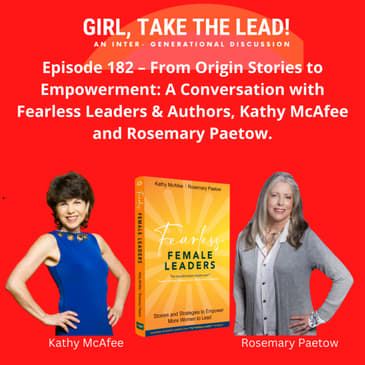
Kathy McAfee returns to the show! Yay! She was in Ep 13 where we discussed fearless leadership. She is an accomplished author and speaker, creative entrepreneur, business coach, and CEO of Kmc Brand Innovation, LLC. Kathy is joined by Rosemary Paetow, CEO of Think inStrategy who works with executives and their teams to become better, bigger, bold leaders of industry. Kathy and Rosemary have co-authored the book, Fearless Female Leaders, Stories and Strategies to Empower more Women to Lead.
Recently their book just made the Amazon Best Seller Rank in three top categories:
During this episode we explore the following questions with the two authors:
· What drew Kathy & Rosemary to team up to write the book?
· What is the word “Shero” about?
· How did you connect to our episodes about Susan Cain’s book, Bittersweet?
· What are their leadership origin stories and why are they important?
· Who are some of the featured women in the book and why did they impress you?
Enjoy this episode!
Mentioned on the episode:
Ep 13 What is fearless leadership?
https://spotifyanchor-web.app.link/e/kqvqLp1eFLb
Eps 23 – 25 Bittersweet (Susan Cain): How do sorrow and longing help us lead?
https://spotifyanchor-web.app.link/e/ywC6ed1eFLb
Special Offers:
Listeners can sign up to gain access to an 8 book bonuses at https://www.fearlessleaderbooks.com/bonuses and you can connect with other fearless leaders and access more fearless resources at Fearless Leader Community on Mighty Networks (learn more at https://www.thefearlessleader.com/mighty-networks).
Special Request:
The authors would be so grateful if you get the book to post a review or even take a picture of you with the book. Get creative!
Here's a list of places you can post a review:
More about Kathy:
She thrives on helping professional women advance their careers and influence, and partners with organizations and communities to cultivate leadership diversity. Known as America’s Marketing Motivator, Kathy is the founder of The Fearless Leader™ program and coauthor of the new book, Fearless Female Leaders: Stories and Strategies to Empower More Women to Lead. Learn more at www.TheFearlessLeader.com
More about Rosemary:
Rosemary helps create high performing teams, predictable, profitable growth & work-life balance and her results include:
* Clients grow on average 160% within 18 months
* Clients profitability increases by at least
40% in 18 months
* Clients have happier staff, more money and
more time to enjoy life
As a past owner of a VAR Accounting Software Consulting Firm to top tier companies in SD and internationally, Rosemary has the unique ability to understand business models to determine whether they are scalable & sustainable & to streamline systems for companies. Her CPA experience from KPMG-one of the Top Four Accounting firms in the world helps her find the areas of business risk for clients & to understand all of the financial aspects of operating a company successfully.
Ways you can contact Kathy:
Website:
Subscribe to her YouTube channel:
https://www.youtube.com/@thefearlessleader
IG:
https://www.instagram.com/kathymcafeemarketingmotivatort/
LinkedIn:
https://www.linkedin.com/in/kathymcafee/
Linktree:
https://linktr.ee/AmericasMarketingMotivator
Mighty Network:
https://www.thefearlessleader.com/mighty-networks
Ways you can contact Rosemary:
Website:
FB: Think inStrategy
LinkedIn:
https://www.linkedin.com/in/rosemarypaetow/
Ways to reach Yo:
Public FB group: Girl, Take the Lead!
https://www.facebook.com/groups/272025931481748/?ref=share
IG:
https://www.instagram.com/yocanny
LinkedIn:
https://www.linkedin.com/in/yocanny/
[00:00:07] Welcome to Episode 182 of Girl, Take the Lead where each week we explore womanhood and leadership and I'm your host, Yolanda Canny. Kathy McAfee returns to the show. She was in Episode 13 where she discussed fearless leadership with us and is an accomplished author and speaker, creative entrepreneur and business coach. She's also the founder of the Fearless Leader Program.
[00:00:35] She is joined by Rosemary Paetow, CEO of Think in Strategy who works with executives and their teams to become better, bigger and bolder leaders of industry. Kathy and Rosemary have co-authored the book Fearless Female Leaders, Stories and Strategies to Empower More Women to Lead.
[00:01:01] Recently, they received the excellent news that their book just made the Amazon Best Seller Rank in three top categories. Business Motivation and Self-Improvement, Women and Business and Business Leadership. Congratulations to both of our guests for this great accomplishment.
[00:01:29] In our episode today, you'll want to check out what they have to say about the word Shiro, what their origin stories are, why they're important for all of us to know ours, and the attribute of boldness. My personal fave. Enjoy the listen. Here we go.
[00:01:55] Kathy and Rosemary, welcome to Girl Take the Lead. We are so excited to have you back, Kathy. I mean, you came to us on Episode 13, and now we're way beyond that. So thank you for coming back.
[00:02:09] My pleasure.
[00:02:13] Kathy and Rosemary, welcome to Girl Take the Lead.
[00:02:40] Yeah. Well, this book arose out of the pandemic and all the craziness that was happening before and during and after. And it was an opportunity to really put a spotlight on the barriers that women face when advancing into leadership, whether that's corporate leadership, small business leadership, civic leadership, or just even leadership of your life.
[00:03:09] There are things that get in our way, both externally and internally. And we wanted to empower more women to not only, you know, ascend and get a seat at the leadership table, metaphorically there, but also to know themselves as leaders.
[00:03:27] To feel and to feel and to see themselves as the leaders of their life, the leaders of their careers.
[00:03:34] And should they choose the leaders of big business and governments and communities, because we believe and the research shows that when we have more women represented in leadership across all facets of society, the world improves, lives improves, communities are stronger.
[00:03:53] And we are underrepresented.
[00:03:56] And we are underrepresented at this point.
[00:03:57] So that's kind of the why this book is necessary.
[00:04:00] And I'd love to hear Rosemary's view of why she felt compelled to write this book.
[00:04:07] Thanks, Kathy.
[00:04:08] You know, there's a couple things about that.
[00:04:11] I'm a baby boomer.
[00:04:13] And when I started in the work arena, I couldn't buy a house without a man signing, co-signing.
[00:04:24] I couldn't have my own credit.
[00:04:27] And for me, going into business and being a business person, I felt like the whole world was opening up to me.
[00:04:36] And I kept just pumping into walls all the time.
[00:04:41] And I noticed later on in my life, the younger women coming in.
[00:04:46] First of all, they didn't understand any of that.
[00:04:48] Like, why were we talking about this weird thing called a glass ceiling?
[00:04:52] You know, they don't have that experience.
[00:04:54] But what I noticed is that they were having similar problems that I experienced.
[00:05:01] And I just said, I've got to write something about women's leadership.
[00:05:07] And as I started to talk about that whole concept, somebody said, hey, I know somebody else that you should meet.
[00:05:13] And they introduced us to Kathy.
[00:05:17] And Kathy is so extraordinary.
[00:05:19] And when you read the book and you read her origin story, you begin to understand just the powerful lady that she is and how she has always embodied leadership.
[00:05:32] And I think that she had a similar experience in that we just took it for granted that, of course, we were going to have these problems.
[00:05:40] Of course, there were going to be these walls.
[00:05:42] We're going to break through them.
[00:05:43] But that was going to be there.
[00:05:44] And we don't want those walls to exist for women anymore.
[00:05:47] We're done with that.
[00:05:48] Women deserve the right to front and center, you know, take the leadership roles.
[00:05:53] So that was why I wanted to do it and with Kathy.
[00:05:57] Yeah.
[00:05:58] Well, the two of you are just amazing women.
[00:06:01] Kathy, I've known you for a long time.
[00:06:03] But you've always been somebody who gets things done and moves it and makes it happen.
[00:06:10] And so congratulations again on such a terrific book.
[00:06:16] So one of the things I loved about the book was the way that you organized it.
[00:06:23] It was really, really well done.
[00:06:25] And I'm wondering if you can talk a little bit about your thoughts there and tell our listeners a little bit about how you organized the book.
[00:06:37] That's a wonderful compliment.
[00:06:39] It's like telling a person you're a good listener.
[00:06:42] It's like, really?
[00:06:43] I am?
[00:06:43] Oh, that's great.
[00:06:45] Gosh, organization.
[00:06:47] It, I do attribute a lot of the structural, organizational, strategic brilliance of this book to Rosemary.
[00:06:54] Because when I brought it to her, it was a compilation of some amazing stories.
[00:07:00] I had been interviewing people through the summer of 2021.
[00:07:05] And I had stepped into the shoes of all these remarkable people who had almost fiction-like lives.
[00:07:11] Like, how could that happen?
[00:07:13] If you read the story of Dr. Opal Lee, you're like, no way.
[00:07:17] There's no way someone could have lived that life.
[00:07:21] And so, not only by the end of summer was I emotionally exhausted having curated all their stories.
[00:07:28] But I kind of lost my way in terms of what do I do with this and where does it take me?
[00:07:34] And how do we structure, back to your point, structure this?
[00:07:37] So, Rosemary's arrival on the scene to help organize.
[00:07:43] I think she really should answer this one because it was her brilliance that put it into a logical order structure.
[00:07:53] Thanks, Kathy.
[00:07:55] One of the things that I'll start with Kathy is that she's brilliant around his storytelling.
[00:08:00] And her whole emphasis is always, you got to have the right story to tell if you want to make the point.
[00:08:09] And I'm this person that goes, no, no, no, you don't understand.
[00:08:13] Here's the logic.
[00:08:13] Here's the point.
[00:08:14] You know, and people start yawning.
[00:08:17] And they're going, can you tell a story?
[00:08:19] So, for me, it was, all right, here are all these brilliant stories.
[00:08:25] And now how do we create something compelling that's going to allow people not only to connect to the story, but do something next?
[00:08:36] I think that the thing with Kathy and I that's so important is that we want women to be in action.
[00:08:46] We want the movement.
[00:08:48] And so it's great to tell a story, but if you just go rah, rah and don't do anything, then we failed.
[00:08:55] And so the whole design of this book was to inspire and then to cause action and then to inspire and then to cause some more action.
[00:09:07] And I don't think I could have done half as good a book without Kathy at all because she is a brilliant storyteller.
[00:09:16] And she took many of the things that I brought to the table and said, okay, here's how we create a story out of it.
[00:09:23] So it was the two of us.
[00:09:24] But I think you also have some very cool, like you have your QR code, you know, that someone can take a look at and go to.
[00:09:33] And you kind of divided the book into parts, which I thought was really good as well.
[00:09:39] I felt like I was doing a workbook while I was going through the thing.
[00:09:44] We did pull structurally.
[00:09:47] We pulled some critical content from the Fearless Leader Group Mentoring Leadership Program.
[00:09:53] In fact, the Fearless Leader Manifesto is one of the big transformative exercises.
[00:09:58] So that's in Chapter 3.
[00:10:01] And then we, through all these stories, we looked at the attributes that these eight women embodied and got them through their challenges and hurdles.
[00:10:13] And so we came up with the then the eight attributes of fearless leadership.
[00:10:18] And then how do you cultivate those and how do men and women express them differently?
[00:10:21] So now we're getting into kind of actionable strategies.
[00:10:26] We also did a proprietary survey, you know, and we interviewed women and we had a survey that tried to find out what was stopping them from achieving their goals, both in the past, past five years in this case, and currently and more recently.
[00:10:43] And then looking at those.
[00:10:44] And so the four barriers, if you might, if you want to ask us, well, you'll dive into that, are also key.
[00:10:52] Because if you can remove a barrier, then you can advance.
[00:10:55] So we want to really practically help.
[00:10:57] And then the last one I want to just call out is the takeaways, which are in Chapter 1.
[00:11:05] At the end of Chapter 1.
[00:11:07] And 2.
[00:11:08] Yeah, and 2.
[00:11:08] They're in a gray box.
[00:11:10] Take a picture of it.
[00:11:12] But those are how we organize the stories.
[00:11:15] And in fact, let me just jump to one of those.
[00:11:19] So, and some of these are very near and dear to my heart.
[00:11:23] Start focusing on what's most important.
[00:11:27] Stop complaining about what's unfair.
[00:11:30] That came out of my origin story.
[00:11:32] Because I spent, aka wasted, at least two years of my life in college trying to right a wrong that was never going to change.
[00:11:42] To complain about mistreatment.
[00:11:45] And it wasn't until I'm sitting on a park bench at the end of my junior year that a stranger sit next to me.
[00:11:52] And suddenly my first business is born.
[00:11:55] Because I let go of what I was fighting.
[00:11:59] And I embraced a new way to lead.
[00:12:02] And every time even just saying that part, I'm truncating the story.
[00:12:05] But it brings tears to my eyes.
[00:12:09] To stop butting my head against a wall that was never going to move.
[00:12:14] Because there are so many other opportunities for women of any age.
[00:12:19] Of any age.
[00:12:21] To create things that we enjoy.
[00:12:25] Things that we can thrive in.
[00:12:26] Not just misery according to someone else's structure.
[00:12:32] So, it's four takeaways.
[00:12:33] Page 12.
[00:12:34] Take a picture of that.
[00:12:35] That will serve you well.
[00:12:38] I'd like to jump in on what Kathy's talking about.
[00:12:41] Because this has a little bit to do with my background.
[00:12:45] I was a Vistage chair for nine years.
[00:12:48] And that's a CEO membership group.
[00:12:52] Okay.
[00:12:53] And I am passionate about women's leadership.
[00:12:57] And so, I approached women CEOs.
[00:12:59] And I say, hey, come and join the group.
[00:13:02] And they would say, no, no, it's okay.
[00:13:04] I can do this on my own.
[00:13:08] Now, I got all kinds of men going, I'm in.
[00:13:11] Sign me up.
[00:13:12] And I'm going, why are the men a yes?
[00:13:15] And the women are going, I got this.
[00:13:19] And it came out in the book in that when Kathy's telling her origin story, I say, oh, this is what you said.
[00:13:29] And she would go, wow.
[00:13:30] I would tell her my origin story.
[00:13:33] And she would say, oh, this is what you got.
[00:13:36] This is what I got out of your origin story.
[00:13:38] And I'd go, really?
[00:13:39] Unless we are collaborating.
[00:13:43] And particularly, I think it has to do with women collaboration.
[00:14:15] And you're not going to get as much.
[00:14:18] Yeah.
[00:14:19] So, Rosemary, we heard a little bit of Kathy's origin story.
[00:14:22] What about yours?
[00:14:24] Oh, mine.
[00:14:25] So, my dad, my dad is an avid tennis player.
[00:14:30] In fact, what's not in my origin story is that, so he's an immigrant.
[00:14:38] And he came over, actually, to Canada first.
[00:14:41] And he said, you know, I've got to find some activity to do outside of my work, work, work, work, work.
[00:14:47] And so, he was up in Vancouver, Canada.
[00:14:49] He goes to Stanley Park.
[00:14:50] And he sees all these people playing tennis.
[00:14:52] And he goes, I can do that.
[00:14:54] Now, if you know anything about tennis, it takes about five years to get any kind of playability in there.
[00:15:02] And so, he goes out and he starts doing that.
[00:15:03] He gets the whole family involved.
[00:15:04] He teaches me how to play tennis and then tells me, you know, I have a tennis shop.
[00:15:12] And, Rosemary, you're going to run the tennis shop when I'm working.
[00:15:16] So, after school, you know, I'm running this tennis shop.
[00:15:19] So, I learned how to be an entrepreneur, how to assess people's skills and talents,
[00:15:25] all because my dad said he wanted to have some kind of family activity.
[00:15:30] Like, who knew, right?
[00:15:32] And weren't you young?
[00:15:34] Oh, I was, let's see.
[00:15:36] I was 11 and 12 when I started playing tennis.
[00:15:39] And I was 13 when I started running the tennis shop.
[00:15:41] Yeah.
[00:15:42] That's pretty.
[00:15:43] I'm a senior store manager.
[00:15:45] How about that?
[00:15:46] It was so interesting, yo, when she was telling me the story.
[00:15:51] The first time I got her origin story, it was dry as toast.
[00:15:57] Okay.
[00:15:57] Okay.
[00:15:58] And then I did an interview with her and we really started to dig in.
[00:16:01] When was the first time you knew you were a leader?
[00:16:04] Who taught you these things?
[00:16:06] And then we got this written richness.
[00:16:08] And even for her to go, oh yeah, it was like 12 and 13.
[00:16:12] I was running a store.
[00:16:14] I didn't even recognize that was leadership.
[00:16:19] That's the way it is.
[00:16:21] Oh, that's pretty amazing.
[00:16:23] Having some collaboration and help where people can help you see what you, what is so ordinary for you, which is just what you did.
[00:16:31] It's part of your story and it needs, it needs a spotlight because then you can find out where your, your, your leadership gift came from.
[00:16:44] Yeah.
[00:16:45] Way back when.
[00:16:45] It wasn't last week.
[00:16:46] It wasn't on that project when you, you know, we're 30.
[00:16:49] It was probably, you know, when you were young.
[00:16:54] So Rosemary, why do you think it's so important for us to explore origin stories?
[00:17:00] One of the things that Kathy pointed to is that the things that we are naturally really good at come from our early lessons in life.
[00:17:11] And we don't understand the gift that it is.
[00:17:15] And so when we explore where it came from, we begin to get the extraordinariness of, of the event.
[00:17:24] You know, Kathy talks about being a song leader and she, she just sort of casually tosses out that they, they got invited to the song leader national association.
[00:17:38] And then they started teaching everybody.
[00:17:41] And you were in high school at that time, right?
[00:17:44] I mean, she's over there on a national stage teaching something and it's no big deal, but it is, but it is.
[00:17:56] And, you know, um, one of the things that my mom taught me.
[00:18:01] So English as a second language, she, when I went to school, she said, Hey, you got to go learn for me, come home and teach me.
[00:18:09] At the age of six, I started learning how to teach somebody something.
[00:18:14] You got to get that that many years of training.
[00:18:17] I'm pretty darn good at it.
[00:18:19] Malcolm Gladwell talks about, you know, the 10,000 hours that has you become an expert.
[00:18:25] Got that one.
[00:18:26] All right.
[00:18:27] And that's part of it.
[00:18:29] But I would say, you know, that the origin story, exploring it, discovering it or rediscovering it.
[00:18:36] It's a source of your power.
[00:18:39] It is your authenticity, the beginnings of it.
[00:18:43] And it also, as Rosemary said, it's the gift that you have.
[00:18:47] And one of the things we say in the book is your gifts and your talents are wanted and needed.
[00:18:53] And it's really easy to go, Oh, I'm just one of many.
[00:18:58] Anyone can do that.
[00:18:59] That's no big deal.
[00:19:01] We discount ourselves.
[00:19:03] And guess what?
[00:19:03] The world discounts us.
[00:19:05] You have to kind of, you have, you listener have to appreciate the source of your power and your leadership origin.
[00:19:13] And it does just that empowers you to do more.
[00:19:18] So it's an exciting process.
[00:19:20] Well, I think it, the, the superpower, like I used to always call those our superpowers, like whatever we could do that we were really exceptional at.
[00:19:32] That's so good.
[00:19:33] Very good.
[00:19:35] It also has, you get really excited about who you are as a human being.
[00:19:41] So let's put you on the spot today.
[00:19:45] We'll just ask a couple prompts.
[00:19:47] And the first thing to mind.
[00:19:48] So when did you know?
[00:19:50] Well, actually, when was the first time you knew you were a leader or thought you might be a leader or did some leadership thing?
[00:19:57] When, when was that?
[00:19:59] Okay.
[00:20:00] Second grade.
[00:20:03] Mother Tarchesia.
[00:20:05] Okay.
[00:20:05] What a name.
[00:20:08] Called me out as a ringleader for making the merry-go-round go a little too fast.
[00:20:14] And she blamed me.
[00:20:16] And she blamed me.
[00:20:16] And I was like, what?
[00:20:19] We were just all on the merry-go-round.
[00:20:21] But that was the first time that the word leader had been assigned to me.
[00:20:26] Ring leader.
[00:20:29] There you go.
[00:20:30] Wasn't using my leadership skills or my superpower to the best of my benefit.
[00:20:37] Benefit, but it was okay.
[00:20:39] I think that was my first time really recognizing that.
[00:20:42] It was a fun story to flesh out.
[00:20:44] And yet, when you were penalized, you were criticized, you were said, this is bad, which then would cause us to not do it again or want to do it more.
[00:20:54] I think I didn't do it again.
[00:20:56] And the Tarchesia was quite bad.
[00:20:58] People following you.
[00:20:58] You made something go faster.
[00:21:00] And you broke the rules a little bit, which is sometimes what leadership's about, right?
[00:21:06] Innovation.
[00:21:07] Yeah.
[00:21:07] I think it was fun.
[00:21:08] I mean, I think I was on a track early, early on.
[00:21:15] I was, you know, when I was reading the intro, I think Teresa talks about being a Girl Scout.
[00:21:22] You know, I was a campfire girl from Bluebird all the way up to Horizon Club and, you know, just always achieving, always leading and being a counselor and everything.
[00:21:33] I just loved it.
[00:21:35] And, but I've also discovered parts of me that aren't so out there, you know, like reading more about being an introvert.
[00:21:48] So it's like, you know, we, we do definitely have layers of who we are.
[00:21:53] And I think, you know, we, we shift and we change.
[00:21:58] And I think a lot of your questions are so good to help us see where we are in the process.
[00:22:04] Because it isn't like one thing happens and then we're always that.
[00:22:09] It's a journey.
[00:22:10] It totally is a journey.
[00:22:12] We call it a sheroes journey in the book.
[00:22:16] And talk some more about that.
[00:22:17] It is a, it's a process.
[00:22:20] So you've heard, well, maybe you've heard and readers have heard of the term a hero's journey.
[00:22:28] Coined probably even before Joseph Campbell, but made very wealthy man, Joseph Campbell, to study the, if you will, the roadmap of how traditionally the hero, traditionally men, will leave the community, go on a quest, tackle a big problem.
[00:22:47] You know, face their inner demons.
[00:22:50] You know, face their inner demons.
[00:22:50] Be successful.
[00:22:51] Come home and be celebrated.
[00:22:52] And so there's, that's a very kind of a glossy overview.
[00:22:57] And so that has been, we've seen that in movies all the time.
[00:23:01] It's just a classic script for a young emerging leader to come home as a celebrated hero.
[00:23:13] And there's a wonderful author by the name of Maureen Murdoch, who was a student of Joseph Campbell, but she also challenged his thinking because she interviewed him at one point and said, well, how does, I don't get how this works for women.
[00:23:27] And it was some paraphrasing here in her book, The Heroine's Journey.
[00:23:32] He said something like, well, women don't need to do the hero's journey because they've got it all figured out.
[00:23:38] They can't get a line of credit.
[00:23:41] Some countries, they can't leave the house unescorted.
[00:23:43] They're underpaid.
[00:23:45] They, you know, it's like, no, women don't have, women are being held down.
[00:23:49] So she kind of said, no, this is, that's a bad answer.
[00:23:52] And she went on and developed The Heroine's Journey.
[00:23:56] And so we took a look at her model and we looked at the things that we are seeing and learning.
[00:24:01] And we just renamed it The Shiro's Journey, which actually we believe is for all people, not just women.
[00:24:09] So for eons, for 5,000 years, The Hero's Journey has been the name of the leadership model.
[00:24:17] Right?
[00:24:18] We're just changing the name to The Shiro's Journey.
[00:24:20] So you can be a man and still have a Shiro's Journey.
[00:24:23] And you'll see a model in the book, which will show you the traditional male version of how you face an external dilemma.
[00:24:31] And you face your feelings, you wrestle with your feelings, and you do strategies, and you win your victor.
[00:24:38] But we think that only leads to one dimensional leader.
[00:24:41] The real work, the real treasure is when you face the internal impasses.
[00:24:49] I'm going through a divorce.
[00:24:51] I've just turned 60.
[00:24:53] I've just had a cancer diagnosis.
[00:24:55] I just lost my position.
[00:24:56] And that's all I've ever known.
[00:24:58] The stuff that can really set you back, but it's the inner work that has to be done.
[00:25:04] And so we have a model that shows you how to go through that with confidence, with safety, with insight, and that you can emerge a thriving, balanced, holistic leader who is fearless.
[00:25:22] And then you're able to do whatever kind of challenge, whether it's internal or external.
[00:25:28] This idea of balance, I love this one.
[00:25:30] Everyone's searching balance, balance, work-life balance.
[00:25:33] We think it's an inside job, not an external solution.
[00:25:37] I'm sure there's things that can help externally, but we have to balance ourselves.
[00:25:42] And we don't just want to survive.
[00:25:44] We want women, men, all people to thrive in their careers, in their lives, in their work.
[00:25:52] We want it to be joyful and a source of success and meaning.
[00:25:59] And so how you go through that journey, which we're calling the Shiro's Journey, can help you evolve.
[00:26:07] I hope that wasn't too complicated.
[00:26:09] And there's a map in the book, and we have a guidebook as one of our books.
[00:26:15] Yeah, that's kind of like, what is she talking about?
[00:26:18] We have a guidebook called the Shiro's Journey Guidebook that you can walk through, self-guiding.
[00:26:24] Well, I found myself using the term more and more after reading the book.
[00:26:29] It was like, of course, heroin isn't quite the right thing.
[00:26:32] It should be a Shiro.
[00:26:34] She should have her own.
[00:26:35] If he's got a hero, I can be a Shiro.
[00:26:39] So it was like, I've been noticing myself change and bring that in more.
[00:26:43] So I think that's great.
[00:26:45] Great contribution, you guys, to our thinking and challenging us.
[00:26:49] One of the things that why we wanted to call it a Shiro's Journey and incorporate everybody
[00:26:55] and not just women is, well, one is because the hero's journey only incorporated men.
[00:27:03] And, you know, that's patently unfair.
[00:27:05] Let's have, and we said, well, we could do that too.
[00:27:08] But why don't we just go up to the next level?
[00:27:11] And the other part of it is, again, with the pandemic and so many people staying home,
[00:27:17] for the first time, for the first time, really, a majority of men started getting involved
[00:27:25] in their young children's lives because now they were home, the kids were home, mom was
[00:27:30] home, everybody, right?
[00:27:32] And I can't tell you how many young men that I know said, I don't want to go back to the
[00:27:39] office.
[00:27:40] I just realized how much I'm losing out on a day-to-day basis with my children, and I'm
[00:27:46] not doing that anymore.
[00:27:47] And so they need a whole different way of operating as well from a balanced perspective.
[00:27:54] And so that's what this model does, is it gives everybody the opportunity to incorporate
[00:28:00] all sides and really own one's inner self.
[00:28:04] Yeah.
[00:28:06] Yeah.
[00:28:06] Well, I'm assuming if there's anything you want to add about how we got here in the first
[00:28:11] place?
[00:28:12] I mean, we've kind of talked about a few of the things that I know were great insights
[00:28:17] in the book.
[00:28:19] Is there anything that we're missing that you want to cover?
[00:28:23] I do want to just circle back on the She Rose journey and chapter three, which is the eight
[00:28:32] great attributes of fearless leadership, because we intentionally chose these eight to pick
[00:28:42] up on the traditional masculine attributes, like confidence and boldness and humor with the
[00:28:50] classic female attributes like compassion and resilience and wisdom and intuition.
[00:28:57] And so that was a lot of work for us to go.
[00:29:01] We wanted to pull it from the women's stories, but we also wanted to say, we want a whole leader.
[00:29:06] We have to blend the masculine with the feminine and then show both men and women and others
[00:29:15] how to develop that holistic blend.
[00:29:19] And that's where we want to thank you for one of your earlier episodes on bittersweetness,
[00:29:25] the attribute of bittersweet, which I always thought was just chocolate, right?
[00:29:30] It's melancholy.
[00:29:31] It's these sadder emotions.
[00:29:34] It's guess what?
[00:29:36] Crying.
[00:29:37] All these things are not allowed in the workplace.
[00:29:39] Don't bring your downer self here.
[00:29:41] Don't cry.
[00:29:42] You know, we can't handle it.
[00:29:44] You can be angry.
[00:29:45] That's cool, right?
[00:29:47] Try not to break glass or hurt anybody, but be angry all you want because that looks strong.
[00:29:51] But for goodness sakes, don't cry.
[00:29:53] And when I heard your episode and I bought Susan Cain's book, Bittersweet, and absolutely
[00:29:59] loved it, two things I got out of that.
[00:30:01] One was the learning.
[00:30:03] Did you know that Susan Cain has a book club kit in her book?
[00:30:08] She's one of very few authors.
[00:30:11] Very few authors do that work.
[00:30:13] We used hers as our model.
[00:30:16] So we have a book club kit.
[00:30:17] It's one of the QR codes because we want your readers to actually lead book club discussions.
[00:30:24] That's a leadership role.
[00:30:25] Learn how to facilitate a book club discussion.
[00:30:28] And we'd love our book to be the book you choose.
[00:30:31] So we've created this tool for you.
[00:30:34] But you had an influence on one of those attributes.
[00:30:39] And that was compassion.
[00:30:42] And allowing for the full spectrum of emotion and humanity to be okay in the workplace.
[00:30:49] Yeah, you know, I got to tell you, when I went to retire and people were sending me, you know,
[00:30:57] congratulatory notes and emails, the thing that I was hearing, which I had no idea, was that
[00:31:05] I cared so much and that I cared.
[00:31:09] I was one of the most caring executives that they had worked with.
[00:31:14] And I went, wow, isn't that interesting?
[00:31:17] I had no idea that that attribute would show up so high.
[00:31:23] Because it never showed up on a performance evaluation.
[00:31:27] It never, you know, these, some of these attributes that you guys have outlined,
[00:31:31] I would love to see the day when those kinds of attributes are on the performance evaluation
[00:31:36] and they're encouraged.
[00:31:38] Wouldn't that be great?
[00:31:39] I mean, to really see that.
[00:31:41] The one attribute I loved reading about in your book was boldness.
[00:31:48] I guess second grade had something to do with that.
[00:31:51] Yeah.
[00:31:55] But I'm just going, right on, bold.
[00:31:57] We've got to be bold.
[00:31:59] Shake things up.
[00:32:00] Do it differently.
[00:32:02] Get those other executives mad at you because you are doing it differently.
[00:32:08] Anyway, I can remember being taken aside a few times and being told, you know, like,
[00:32:13] could you get a little too bold?
[00:32:15] Tone down that boldness.
[00:32:16] Could you conform a little bit more?
[00:32:18] Can I put two stories in?
[00:32:22] One is about Joe Biden and one is about Diane von Furstenberg.
[00:32:27] Okay.
[00:32:27] So Joe Biden emphasizes compassion and he's a very empathetic human being.
[00:32:35] And so his detractors automatically say what a weak man he is.
[00:32:41] And that's one of the things we want to change.
[00:32:44] Empathy and compassion is not a weakness.
[00:32:47] It's a strength.
[00:32:48] And when more men can start on center stage, showing that this world will be a better place,
[00:32:56] regardless of your politics around all of that.
[00:32:59] The other is I recently saw on Hulu the story of Diane von Furstenberg.
[00:33:07] Now she, you know, she had her own clothing line and all of that.
[00:33:12] And your first wrap dress from her?
[00:33:14] I can remember.
[00:33:17] Millions.
[00:33:18] She made millions off of that.
[00:33:20] And if you go and look at her story, it's everything about boldness.
[00:33:28] Her mother was a Holocaust survivor.
[00:33:33] She came from nothing.
[00:33:37] You know, they can say, you can say she had a lucky break.
[00:33:41] She married a prince, you know, from Germany.
[00:33:43] And at the same time, she had a passion and she followed through and she did the work.
[00:33:52] And she didn't let her detractors stop her.
[00:33:55] And that's what we're talking about.
[00:33:57] That's that boldness that women have that we love so much and we want more of in the world.
[00:34:04] And when we do a cohort, a fearless leader program, it is so awe inspiring to see.
[00:34:15] Sometimes we have really young women in there who are just starting their career.
[00:34:20] Get a hold of, oh, my gosh.
[00:34:24] You mean this is something special that I'm doing?
[00:34:28] Like when they actually own that.
[00:34:31] Like Anaya, for example.
[00:34:33] It's extraordinary to see how what they can do and what's available.
[00:34:38] And and that's a gift for the future, because that's a 21 or 22 year old that gets to make a huge difference in the world.
[00:34:48] Hey, you can just read a little section on boldness for your listeners.
[00:34:52] I'm going to read the last paragraph in that section.
[00:34:54] By the way, with each of the attributes, we give some synonyms.
[00:34:59] So attribute number one, boldness, fearlessness, courageousness, gutsy, audacious.
[00:35:05] So last section.
[00:35:08] What can women do to develop this keener sense of boldness?
[00:35:12] It's simple.
[00:35:13] Stop seeking agreement.
[00:35:16] Stop needing to be liked.
[00:35:18] Be okay with rejection.
[00:35:20] It won't kill us.
[00:35:22] Speak up.
[00:35:23] Speak out.
[00:35:24] And ask for what you want and need.
[00:35:26] And support others who need our advocacy.
[00:35:31] Start with that.
[00:35:34] And boldness will start to cultivate inside of you.
[00:35:37] Yeah.
[00:35:38] We all know that when you start.
[00:35:40] People start telling you a little.
[00:35:42] That's pretty bold on your end.
[00:35:45] That's really.
[00:35:46] You can look at that.
[00:35:47] That's my superpower.
[00:35:48] That's what I bring to it.
[00:35:50] So.
[00:35:52] That's my favorite part.
[00:35:52] So, you guys.
[00:35:53] I mean, we started to talk a little bit about some of the people you have showcased in the book.
[00:35:59] And put the spotlight on.
[00:36:01] You talk a little bit about them.
[00:36:03] And we're going to have a lot of them join us in the month ahead.
[00:36:08] So, looking forward to hearing from them directly.
[00:36:12] But you did a great job of finding these fearless leaders.
[00:36:18] How did you find them?
[00:36:19] And what were some of the ones that stood out for you?
[00:36:23] I think we found them through fearless networking.
[00:36:28] Just reaching out.
[00:36:29] Some of them were people that we knew.
[00:36:32] Others, we had no idea that even existed.
[00:36:36] But through connections and connections.
[00:36:38] And then they're agreeing to tell the story.
[00:36:41] For example, in Chapter 6, we have Sylvia Whitlock.
[00:36:44] And we have Jane Dyer, who's going to be on your show.
[00:36:48] So, I knew Jane Dyer from Rotary.
[00:36:50] And I had heard pieces of her story.
[00:36:52] And your listeners are going to love her story.
[00:36:55] It's so powerful.
[00:36:57] And in the book as well.
[00:36:58] But Sylvia Whitlock is now 88 years old.
[00:37:02] 87.
[00:37:03] She might not like to be called 88 yet.
[00:37:05] She's in California.
[00:37:06] And she was also in Rotary.
[00:37:08] Kind of interesting how many Rotarians are in the book.
[00:37:11] And she was the very first.
[00:37:14] She was Jamaican-American woman.
[00:37:17] Her story starts when she comes back from Jamaica.
[00:37:20] She was born in the United States.
[00:37:21] But she was educated in Jamaica.
[00:37:22] Because of the Jim Crow pressures.
[00:37:25] Her mom said, I can't have you stay here.
[00:37:27] I need you to go be with your grandmother.
[00:37:29] So, she comes back and she goes to college.
[00:37:31] And the very first experience in college.
[00:37:33] Is someone doesn't believe that she did the assignment.
[00:37:36] Someone accuses her of cheating.
[00:37:38] Why?
[00:37:38] Because she's a black girl.
[00:37:41] How could you possibly have that much intelligence to write that paper?
[00:37:45] And that begins some of her struggles.
[00:37:47] But she keeps persevering.
[00:37:48] And she becomes a PhD in education.
[00:37:53] So, she also has a huge spirit for public service.
[00:37:57] And so, she became a Rotarian.
[00:38:00] And then people said, you'd make a great president.
[00:38:02] So, she gets elected president of her local Rotary club.
[00:38:06] And serves.
[00:38:07] Until she gets the letter from Rotary International.
[00:38:11] It says, not only can you not be president.
[00:38:13] But you can't be a Rotarian.
[00:38:15] Because we don't allow women in our club.
[00:38:18] So, what does she do?
[00:38:20] This is a big shocker for the whole club.
[00:38:22] What?
[00:38:23] They do Rotary X.
[00:38:25] So, they say, ringleader.
[00:38:27] We're just going to do our own thing.
[00:38:28] Because we believe in the mission of public service.
[00:38:30] But then things heat up.
[00:38:33] And she ends up, she and her team have to hire attorneys.
[00:38:35] And they take the case to the Supreme Court over a period of 11 or 12 years.
[00:38:40] And they prevail.
[00:38:42] Because of Sylvia Woodlock and her team, women can join public service organizations like Kiwanis and Rotary.
[00:38:53] Women can serve in leadership.
[00:38:56] Women are no longer locked out of that special boys club.
[00:39:00] And Rotary has changed and thrived ever since.
[00:39:04] So, you know, not only that was kind of her shining moment.
[00:39:07] But if you look at her whole story, she's just not only just a vessel of love and service.
[00:39:19] But nothing stops her.
[00:39:21] And she's still going strong at 88.
[00:39:24] So, how could you not put that?
[00:39:26] She was the very first person to be interviewed.
[00:39:28] So, she got position one.
[00:39:32] And I adore her.
[00:39:33] I adore her.
[00:39:34] It sounds like we all will.
[00:39:36] Definitely.
[00:39:37] How about you, Rosemary?
[00:39:38] What were some of the, or what was a particular story that grabbed you from the book?
[00:39:46] So, when we were looking at the book, what we were going to put in the book in general, there, I think there were probably 15 stories.
[00:39:55] And my job was to, yeah, right, decide who was staying and who was going.
[00:40:04] Going in the sense of, they can go into another, the next book, but, you know, not this one.
[00:40:11] Jane Dyer is one of the big ones that really stood out to me because she kind of did sort of the same thing that I did.
[00:40:22] It is, she decided that she wasn't going to go into a woman's career like nursing.
[00:40:27] Because, you know, being a nurse is okay.
[00:40:29] Because, you know, most nurses are females.
[00:40:33] At least they started out that way.
[00:40:36] And now, and instead she decides she's going to be an Air Force pilot.
[00:40:42] It's a man's world and, you know, and there she goes.
[00:40:48] And you'd like to think that they would have a little bit of courtesy with her and kind of, or at least one of them, be nice to her.
[00:40:59] Nah, not a one of them.
[00:41:00] They actually voted a rule that one of their goals for the candidates, you know, that were going to be graduated is that no women were going to be able to be graduated from that cadet group.
[00:41:18] Meaning none of them wanted Jane.
[00:41:21] They voted her off the island before she even got on the island, right?
[00:41:27] And so she had to deal with herself.
[00:41:30] And, you know, and she had to question her origin story.
[00:41:36] Because it's in there.
[00:41:37] You can see it.
[00:41:38] It's just, it's right there.
[00:41:40] But she, she had to go back to it in order to persevere and push out.
[00:41:51] And the paving the road for all women to be able to either be in the armed forces or to do what is traditionally a man's job is extraordinary.
[00:42:05] And I don't know about you, but I didn't hear about, I didn't know about her before this.
[00:42:12] I didn't know about Sylvia Whitlock before this book.
[00:42:17] I didn't know about Miss Opal Lee before this book.
[00:42:23] And, you know, Opal Lee is the one who got Juneteenth a national holiday.
[00:42:30] I mean, these are extraordinary women and we just don't talk about them.
[00:42:34] And they started out all ordinary.
[00:42:37] They were all just, they, they were not special or privileged.
[00:42:41] They were, they were not handed a golden spoon.
[00:42:45] They, and, and so, yeah, all of them.
[00:42:48] And so.
[00:42:49] Nothing actually drives me more crazy than to pick up a book and read another story about Steve Jobs or the Wright brothers.
[00:42:56] Or it's like, I got, you know, they've had their spotlight and there are other human beings who we can be inspired from.
[00:43:03] So we wanted to introduce you and your listeners and readers to more interesting people who are potentially kind of like us, right?
[00:43:12] We can relate to them and you don't have to be famous to make a difference.
[00:43:20] There's room, there is room for all of us at the leadership table and on this planet.
[00:43:26] Um, so we wanted to really.
[00:43:30] To share that stage and that, uh, that book, that the page with people who had done fearless things.
[00:43:38] And, you know, it's funny, you know, many of them don't think of themselves as fearless or as leaders.
[00:43:43] Like Eva, Eva Hausman.
[00:43:46] You got right.
[00:43:46] Co-founder of the Mother's Day movement.
[00:43:48] The woman who starts a movement based on her friends and reading a book and it's now raised millions of dollars for women around the world.
[00:43:56] She's still like, she doesn't really like until she had her origin story curated for her.
[00:44:02] She's like, I know where I got it from.
[00:44:04] I knew where I came from.
[00:44:06] Yeah.
[00:44:07] And that, that, that was very special feedback.
[00:44:10] And so I know you've, you've showcased the Mother's Day movement.
[00:44:13] I have every, every year.
[00:44:16] I just think they're so amazing in what they're doing.
[00:44:20] Um, so I'm wondering, is there any, I mean, we've talked a lot about some of the takeaways from the book, but is there anything we're missing there?
[00:44:30] Like, is there a particular message you want to make sure our listener and viewer see or hears about?
[00:44:40] Chapter 10.
[00:44:42] Change everything.
[00:44:45] Chapter 10 is what you can do to make a difference in your right here, right now.
[00:44:51] And it doesn't have to be big.
[00:44:52] And if you want it to be big, it's in there too.
[00:44:58] What about you?
[00:44:59] I think that's true.
[00:45:01] There's tons of, of, of resources in there, but we want all of our readers, not just to read this and feel good, but to read this and do something.
[00:45:10] Do something for themselves.
[00:45:12] Yeah.
[00:45:13] And their careers, but also to do this, something for someone else to lift someone else up.
[00:45:18] Because if we all do that, you know, boats will rise.
[00:45:23] And so we have the power, we call it the pay it forward philosophy.
[00:45:27] So, and this is what's unique about women, I think, and I'm just going to do a little opinion here.
[00:45:32] Um, when you, when you educate women and give women resources, the whole community improves.
[00:45:43] The family improves, the family economies.
[00:45:46] Um, in fact, women's education is the solution to poverty and violence around the world.
[00:45:52] According to research, according to the book, Half the Sky.
[00:45:55] Um, so, but when you do that for men, not all men, but most men, they take what they get and they use it for themselves.
[00:46:05] And that's done.
[00:46:06] There's no paying it forward.
[00:46:08] There's no sharing.
[00:46:09] There's no making the world a better place.
[00:46:12] And please forgive me guys.
[00:46:13] I I'm speaking very generally.
[00:46:15] Um, but I've even seen it in the fearless leader program.
[00:46:18] It's the women that keep coming back.
[00:46:20] It's the women that refer the program.
[00:46:22] It's the women, women that call for advice.
[00:46:25] My wonderful female male leaders.
[00:46:28] Um, I don't see them again.
[00:46:29] Now that could be me, but it's like, where'd you go?
[00:46:33] Where'd you go?
[00:46:34] I gave you this gift.
[00:46:35] I gave, I, you know, I helped build you up.
[00:46:37] And now what are you doing to make the world a better place for other people?
[00:46:41] That's what chapter 10 is about.
[00:46:43] And if we all could commit to that, doing little things, um, we could transform the world.
[00:46:51] Very good.
[00:46:53] What Kathy's talking about that is so incredible.
[00:46:56] I, you know, I don't know if you guys remember about the micro credit, um, uh, loan thing that
[00:47:03] happened, uh, several years ago at this point.
[00:47:06] Um, they decided to give $250.
[00:47:11] That's it.
[00:47:11] $250 to women in poverty stricken countries.
[00:47:18] And the bank said that's money flushed down the toilet.
[00:47:23] They had a 98% payback.
[00:47:28] And what happened is, is that these women took that money and changed their entire community,
[00:47:38] brought water to the community, you know, fix the, you know, the, the, the food situation,
[00:47:45] whatever it was.
[00:47:47] And, and that's the power that we're talking about.
[00:47:50] You get, you give women just a tiny little bit.
[00:47:53] They'll run with it and make a difference in the world.
[00:47:55] And that's what we're looking for more of that.
[00:47:58] And you'll see that in Jolly Lux's story.
[00:48:01] And she runs a nonprofit in Uganda.
[00:48:06] She's a Ugandan American and she's been able to make that kind of difference.
[00:48:10] Yeah.
[00:48:10] Just a little bit.
[00:48:11] And what was her name again?
[00:48:13] Jolly Lux.
[00:48:15] Yes.
[00:48:20] So I'm just wondering, you guys, what you would tell your 20 something self today.
[00:48:28] How about you start Rosemary?
[00:48:30] What would you say?
[00:48:37] You had the right idea.
[00:48:39] Keep going.
[00:48:41] And don't listen to the detractors because you had it.
[00:48:48] Great.
[00:48:49] Goosebumps, goosebumps.
[00:48:51] And tears.
[00:48:53] I would tell her, first of all, you are fabulous and fearless.
[00:48:57] And I like it.
[00:49:01] Yeah, that's it.
[00:49:03] Catherine, Kathy, just rejection will not kill you.
[00:49:07] It is not your enemy.
[00:49:09] It will help you grow.
[00:49:11] It exists.
[00:49:12] Don't take it personally and become resilient against rejection.
[00:49:18] Keep going.
[00:49:19] Yeah.
[00:49:21] And that is still something I have to coach myself on today.
[00:49:24] So it's okay.
[00:49:25] Rejection.
[00:49:27] Next.
[00:49:28] Right.
[00:49:28] Next.
[00:49:29] We just got to keep going.
[00:49:31] So you guys will end, but why don't you tell our listener viewer who, how to reach you
[00:49:39] and how they can learn more and where they can get your great book and stuff like that.
[00:49:44] Kathy, you want to?
[00:49:46] Well, you can reach me at my website, thefearlessleader.com.
[00:49:52] It's important to hear the word thefearlessleader.com.
[00:49:55] And my email is kathy, K-A-T-H-Y, at thefearlessleader.com.
[00:50:00] I'm active on LinkedIn.
[00:50:02] I'm actually pulling myself off of Facebook, kind of weaning back.
[00:50:06] And I'm also starting to run the fearless leader community, not on Facebook, but on Mighty
[00:50:13] Networks, which is a private network.
[00:50:16] So if any of your viewers are interested in being part of the fearless leader community,
[00:50:21] networking with other fearless leaders, getting resources, invited to events, you can find
[00:50:27] that on my website.
[00:50:28] But it's under the Mighty Networks tab on thefearlessleader.com.
[00:50:32] That's me.
[00:50:35] Yeah, for the book, go to the fearless leader website.
[00:50:40] Or you can go to Amazon, I suppose, too.
[00:50:44] If you want to reach me, it's rpato, P-A-E-T-O-W, at thinkinstrategy.com.
[00:50:53] That's my company.
[00:50:55] And the website is www.thinkinstrategy.com.
[00:51:02] And we do a lot of corporate programs.
[00:51:07] And I'm working a lot with Kathy on doing the fearless leader program.
[00:51:11] So I would suggest going there and looking for that.
[00:51:16] Great.
[00:51:17] Okay, ladies.
[00:51:19] Anything else before we...
[00:51:21] Well, we just want to thank you so much for shining a spotlight on this book and also
[00:51:25] interviewing a number of our featured women in the book.
[00:51:28] I can't wait to hear their interviews.
[00:51:30] You have Paula Stone-Williams, Kim Deshane, and Jane Dyer.
[00:51:35] So all fantastic leaders in different sectors.
[00:51:40] I know your listeners will enjoy those programs, too.
[00:51:43] Yeah.
[00:51:43] We always want to kind of inspire more women as...
[00:51:50] I mean, our missions are aligned, you guys, like on what you're trying to achieve and what
[00:51:54] I'd love to achieve with my podcast.
[00:51:56] So it just totally resonated.
[00:51:58] When I...
[00:52:00] You did your book launch and I was participating a little bit in your party.
[00:52:05] And I was thinking, you know, I think we should just do the whole month.
[00:52:11] Aw.
[00:52:14] Because fearlessness and courage and all the attributes you've laid out.
[00:52:19] I mean, I'm like, this is right up our alley.
[00:52:22] So I'm glad we're going to be able to do that.
[00:52:24] And yeah.
[00:52:27] So thank you again for joining and sharing your courage with all of our listeners.
[00:52:36] So thanks.
[00:52:37] Thanks for the honor.
[00:52:41] Thank you for listening today.
[00:52:43] And we sure hope you enjoyed this episode.
[00:52:45] If you did, please leave a comment wherever you listen to your podcasts, tell a friend about
[00:52:51] us, or join our public Facebook group, Girl Take the Lead.
[00:52:55] We also have a YouTube channel where your subscription would be appreciated.
[00:53:00] Once you're on YouTube, search at Girl Take the Lead.
[00:53:03] And we're on YouTube music where you can see a video of this episode.
[00:53:09] You can also check out our new store on our website, girltaketheleadpod.com slash shop.
[00:53:18] And plan to return to it as we'll update our products monthly.
[00:53:23] Here are three takeaways from this episode.
[00:53:28] One, women facing barriers in leadership exist, and we need to see ourselves as leader in our
[00:53:37] own lives.
[00:53:38] When we do this, lives improve and communities improve.
[00:53:44] Two, origin stories can help us see the source of our talents and power.
[00:53:51] Once we see that, and particularly if we collaborate with other women, we can spotlight where our
[00:54:00] leadership gift came from.
[00:54:03] And three, there are eight great attributes of fearless leadership outlined in the book,
[00:54:11] which integrate both masculine and feminine leadership styles.
[00:54:17] Let this be the way we cultivate future leaders.
[00:54:24] Our next episode will continue this conversation with our guest, Jane Dyer.
[00:54:31] Jane was one of the fearless female leaders mentioned in Kathy and Rosemary's book.
[00:54:37] Jane shares her She-Ro journey as an Air Force pilot and talks about when she had to go back to her
[00:54:45] origin story so that she could build her confidence and then pave the way for other female pilots to follow.
[00:54:55] Please join us again and talk to you soon.
[00:54:58] Bye.
[00:54:59] Bye.