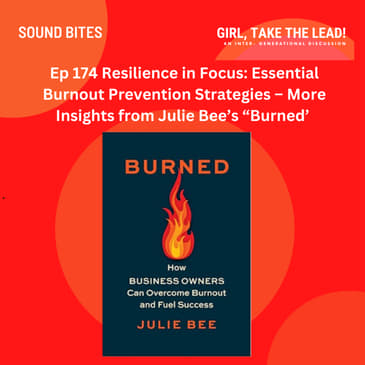
Julie Bee, Millennial, joined Yo in Ep. 173 to discuss her new book: Burned, How Business Owners Can Overcome burnout and Fuel Success. There so much more we could have covered I wanted to share some more insights from the book in this Ep 174.
3 Topics covered in this Episode:
Step 1: Identify two red flags
The “I’m resilient” folder
3 Groups of resources to prevent burnout
Here are 3 takeaways from the episode:
1. It takes work to find our red flags that can lead to burnout – we need to think of our past burnouts and look for patterns – actions we’re taking or not taking and document them as a future reference tool.
2. Julie calls the collection of our stories of our past experiences the “I’m Resilient” folder. Try a failure resume as a starting place.
3. The 3 groups of resources to help prevent burnout are: health and well-being, entertainment, and help from others. We can’t do it all ourselves!
Mentioned in the Episode:
Ep. 173 Conquering Burnout: From Recognition to Recovery - Meet the Author, Julie Bee
https://spotifyanchor-web.app.link/e/KMpebpCX5Kb
Burned, How Business Owners Can Overcome Burnout and Fuel Success by Julie Bee
Workbook to track red flags:
https://www.thejuliebee.com/burned
Ep 112, Ewww: Failure Resume
https://spotifyanchor-web.app.link/e/TiEQdTVqAKb
Ep. 16, Part 2 of 3 – Atlas of the Heart (Brené Brown) How do the Emotions, Stress, Overwhelm, Comparison (Envy, Jealousy, Resentment), Relate to Leadership?
https://spotifyanchor-web.app.link/e/es41gDe80Kb
Ep. 40, Book Discussion with Toni Morris: Burnout, The Secret to Unlocking the Stress Cycle by Emily and Amelia Nagoski
https://spotifyanchor-web.app.link/e/4iH7irh80Kb
How to reach Yo Canny:
Our website:
You can send a message or voicemail there. We’d love to hear from you!
email:
yo@yocanny.com (Yo)
FB group: Girl, Take the Lead
https://www.facebook.com/groups/272025931481748/?ref=share
IG:
yocanny (Yo)
LinkedIn:
https://www.linkedin.com/in/yocanny/
[00:00:06] Episode 174, Girl, Take the Lead, Sound Bite That's a shorter episode, which may be a bit more about a topic we've covered like our episode today or a quick inspiration. I'm your host, Yolanda Canny. In our episode with Julie, we talked about
[00:00:23] red flags and she writes this in her book about that. Red flags tend to be repetitive behaviors, thoughts, or things we say during times of stress. They can also include stopping regular self-care behaviors like we stop exercising or doing things that are good for us. And the first
[00:00:46] thing we need to do is identify our personal red flags by looking at our personal history. It takes work to find these. We need to think of our past burnouts and look for patterns, actions we're taking or not taking. She suggests looking at our sleep, social withdrawal,
[00:01:08] our words we're using, or thoughts we're having because we just don't go from everything is fine to burnout overnight. By the way, she has a workbook you can download to keep track of
[00:01:24] this work. You can check out on her website and I'll have that in the show notes. This work gives us a baseline and then we can recognize more quickly when we're going towards that danger zone,
[00:01:37] towards burnout. Good to know these red flags can change and it's good to review so that we can course correct if needed. For me, I feel stress in my body right away
[00:01:52] and it shows up as discomfort in my stomach. If I find that I need to reach for a tummy or an alka-salsa, I need to stop and assess what's going on. I also find that weather can play a huge factor
[00:02:08] in my stress. Like many of you, we have had weather here in the 90s and 100s in California and I find I need to do a lot less. My body needs more electrolytes and rest,
[00:02:24] time to do less and be okay with it. Do you ever find on social media you get served up posts that seem to be just there at the right time? I saw this this morning from Rewild2.
[00:02:43] Women who feel uncomfortable resting were once the little girls who were taught productivity and achievement were directly tied to their worthiness. That what they could accomplish was the only thing that mattered. If you have a hard time resting, you probably grew up in an environment
[00:03:04] where chaos, uncertainty and there was a lot of stress. Your nervous system literally doesn't know how to respond when things are calmer. Your body doesn't know how it's safe but now is the time
[00:03:20] to remind her. So my friends, if you find you need the rest, let's take it without shame or guilt and if you want to binge watch, bridge your tent, do it. We need to take care of ourselves.
[00:03:40] So the second sticky said this, Yolanda, every professional needs an I'm resilient folder. Jylt calls the collection of our stories of our past experience the I'm resilient folder. They're the stories we've overcome, the challenges that life brings us and moved on from
[00:04:03] and grew from. And Julie offers us the following questions when considering what information to include in our folder. When did the experience begin and end? What and who were the precipitating factors? What types of burnout did you experience and what were your signs of it?
[00:04:26] What did the experience cost you and how did you recover from the experience and what did you learn? As I read this part of her book, I was reminded of our episode where I wrote a failure resume
[00:04:41] and I can see a lot of the patterns of burnout I had in different jobs. And if you haven't done one, I'm telling you it's an amazing way to celebrate your own resiliency. Check it out in the show notes for more about that episode.
[00:05:01] Julie's last sticky said there are three groups of resources to help burn out. And they fall into health and well-being, entertainment and help from others. And she suggests having two or three resources for each group. Examples are for the health and
[00:05:21] well-being group, monthly therapy, weekly exercise and daily meditation. I'm going to tell you guys for me, it's bi-weekly therapy, daily exercise and daily meditation. Entertainment, watching a favorite TV show, hanging out with a friend, reading a book and working on your hobby.
[00:05:48] I do all of those. I got to. And then help from others. Hire a monthly house cleaning service. Amen. Having your significant other takeover dinner duty, which is in our case going out
[00:06:05] and asking your leadership team at work to hold you accountable for leaving the office at a certain time each day. So I don't have a leadership team anymore, but I have you and often I ask you
[00:06:17] to hold me accountable for things just so that I can set up a boundary and ask for help. I've got to love it. I'm telling you, there is so much good in this book. And her last chapter
[00:06:30] talks about the gift of burnout because it helps us become a master at prioritizing. We know we can't do it all and we need to listen to ourselves to prevent the burnout manifesting physically. It's a much kinder way to treat ourselves.
[00:06:49] I'll end today with a passage from one of my favorite authors, Donna Ashworth, a jacket acknowledgement about her book, Wild Hope Reads. Soul nurturing permission to relax, connect and be kinder to ourselves. The passage is titled, A Day Is Not Lost. And here it goes.
[00:07:12] A day is not lost if you fail to tick off a list or a diet was broken. A day is only lost if we forgot to save something kind to yourself or another. If you forgot to pause to search for a tiny spark of beauty amongst the drudgery,
[00:07:38] glimmering like gold in the mud. A day is only lost if you forgot that life, even in the worst of times, is still a gift, a gift you so very much deserve to live through
[00:08:04] and not just survive. Thank you for listening today and we sure hope you enjoyed this episode. If you did, please leave a comment wherever you listen to your podcast. Tell a friend about us. Join our public Facebook group, Girl Take the Lead. Visit our website, girltaketheleadpod.com.
[00:08:38] We also have a YouTube channel where your subscription would be appreciated. Once you're on YouTube, search at girltakethelead.com and we've recently expanded to YouTube music where you can find a video of this episode. Here are three takeaways. One, it takes work
[00:08:59] to find our red flags that can lead to burnout. We need to think of our past burnouts and look for patterns, actions we're taking or not taking and document them as a future reference tool. Two, Julie calls the collection of her stories of our past
[00:09:17] experiences that I'm resilient folder. And three, the three groups of resources to help prevent burnout are health and well-being, entertainment and help from others. We can't do it all ourselves. Our next episode will continue our conversation
[00:09:39] about self-care with some inspiration and feature our guest, Alicia Burrich. Alicia is a passionate motivation and manifestation coach and she wants to help women unleash their true potential to become who they are meant to be. In our episode together, she offers us terrific insights and
[00:10:02] ideas to take care of ourselves. Please join us again and talk to you soon. Bye.