Suparna Vashisht joins us to talk about her passions: driving social change in the areas of sustainability, conservation, gender equality, and mental wellbeing. She's a founder of Women Back to Work, an initiative that helps create systemic pathways for women wanting to re-enter the workforce. For the last 20 years she has worked for conservation nonprofits in the areas of strategy, communications, and development.
Suparna helps us learn about some fabulous nonprofits that are doing great acts of kindness to sustain the planet and the animals in it.
Topics covered in the Episode:
- Advocacy for social change.
- One person making a big difference
- Marine Institute Maui Ocean Center
- Maui Nui Marine Resource Council
- Project Coyote
- One Reef Micronesia
- Women Back to Work
Here are three takeaways from the episode:
1. Everyone has their own way of being persuaded to take action – one message does not fit everyone. Find the one that can persuade someone to make a change for the greater good.
2. There are so many different ways to take action – like eating organically, composting, reducing our use of plastic, or supporting not-for-profit groups. It’s all of us individually having a positive impact through our choices and actions.
3. Women trying to return to work after a break face challenges and barriers – a system for diversity
hiring needs to include these women!
Mentioned in the Episode:
https://www.un.org/en/actnow/facts-and-figures
https://www.sierraclub.org/volunteer
https://www.biologicaldiversity.org/
https://www.plasticpollutioncoalition.org/takeaction/guides
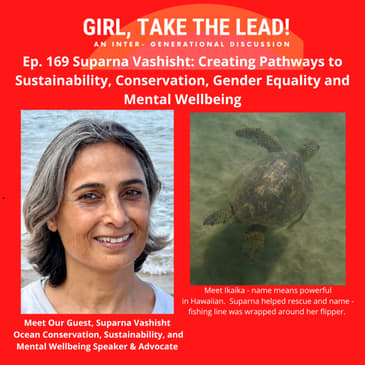
Video of one of the turtles Suparna spotted that the team from Marine Institute was able to rescue and release (after 6 weeks of treatment!). She got to name her when they found her and chose the name Ikaika, meaning powerful (in Hawaiian).
https://www.instagram.com/p/C6IRQVMr93J/?igsh=a3ZubWkyY3BraGl0
More Resources From Suparna:
Personal Choices/Action
1. According to the UN, our lifestyles are responsible for an estimated two thirds of global emissions and our individual choices have the power to reduce total global emissions by up to 70% by the year 2050. https://www.un.org/en/actnow/facts-and-figures
2. UN Environment Programme has free 3 hour online course on sustainable lifestyle
Plastic Pollution -Info and Action
1. https://www.plasticpollutioncoalition.org
2. https://www.technologyreview.com/2023/10/12/1081129/plastic-recycling-climate-change-microplastics/
Hawaii - Turtles and Whales
1. Land based pollution affects turtles (tumors)
2. Climate change affects turtles - wiped out island where turtles nest
3. Climate change will make 30-67% of humpback whale breeding grounds too warm
More About Suparna:
Suparna would like people to become more engaged in conservation in whatever way is feasible for them. For example, join the local chapter of Sierra Club, incorporate a few sustainability practices in their daily life, take action to protect the ocean or other natural environment, buy from companies that follow sustainable practices, etc.
Suparna gives talks on ocean conservation, sustainability, and mental wellbeing. She also runs workshops for Women Back to Work through the San Jose Public library. Ping her if you would like to host a talk or workshop.
How to reach Suparna:
How to reach Yo Canny:
Our website:
You can send a message or voicemail there. We’d love to hear from you!
email:
FB group: Girl, Take the Lead
IG: yocanny (Yo)
LinkedIn:
https://www.linkedin.com/in/yocanny/
[00:00:00] Welcome to episode 169 of Girl, Take the Lead, where each week we explore womanhood and leadership. And I'm your host, Yolanda Canny. Today, Suparna Vashisht joins us to talk about her passions which are driving social change in the areas of sustainability, conservation, gender equality
[00:00:31] and mental well-being. She's the co-founder of Women Back to Work, an initiative that helps create systemic pathways for women wanting to re-enter the workforce. For the last 20 years, she has worked for conservation nonprofits in the areas of strategy, communication and
[00:00:50] development. Suparna helps us learn about some fabulous nonprofits that are doing great works of kindness to sustain the planet and the animals in it. Enjoy the listen. Here you go. Welcome, Suparna. I'm so excited to have you on Girl, Take the Lead. We were just
[00:01:13] talking and it's been like 24 years. We work together at LifeScan in the marketing department, global marketing. And here we are recovered from corporate wounds and continue down with our lives. So welcome. Thank you so much. I'm so honored to be on this podcast and yes, like you
[00:01:37] said it's a long way away from what we were doing before. Absolutely. And I think for our listeners, I had seen a lot of your posts on LinkedIn about your efforts in conservation and your care
[00:01:57] for the planet. And we try and give the spotlight to organizations on the podcast that are doing the kinds of work that you're pointing out. So I think it's also interesting for us to see where
[00:02:14] we are in our lives today versus when we were so corporate. Right. I do believe though that what I learned in corporate America was immensely useful to me personally and then professionally in what I gravitated towards doing in conservation and sustainability because
[00:02:40] the rigor and discipline that you learn in corporate, in the corporate environment where you're looking at things with the profitability angle. If we do this, does it move the needle or
[00:02:55] if we have this much money and we have to choose from how do you prioritize? I found those things would be immensely useful in the nonprofit world. Yeah, definitely. Good filters to kind of take a
[00:03:10] look at and then assess how things are going. And but why don't we start if you would just sort of tell our listeners a bit about your background and what you've been doing over the 24 years?
[00:03:24] So I'm Soparna. I believe if something has always been done a certain way, now is usually a very good time to do it better. And I believe one person can make a difference
[00:03:38] and that individual actions add up to a sea change. And I think leaving life scan started me on this journey of individual actions and trying to bring about a sea change. And I found myself
[00:03:56] first moving into the freelance world, still continuing to do what I was doing, but then transitioning into the nonprofit world of conservation and sustainability and finding that I had a lot of strengths and knowledge from the corporate world that were immensely useful,
[00:04:14] like I was saying in the nonprofit world. So that's what I've been doing for 24 years. Like in the transition, I would say it took me about five or six years to transition over to the nonprofit world. So your advocacy for social change, I don't remember too much of
[00:04:41] you talking about that when we worked together, but how did it get a hold on you? Like how did you find that passion or had it always been there and it wasn't really, I didn't really know it?
[00:04:53] It was a journey for sure. And it was an evolution. When I look back, I can see how it was gradual. It was in sudden. So like, as I spent over a decade in corporate brand management and
[00:05:06] profit and loss responsibility roles. And then when I left life scan, I had young children. So I was looking to do something freelance so that I had more flexibility. And during a lull
[00:05:22] in between two of these freelance projects, I got to know of Sierra Club and I volunteered for the local chapter. And I became the chair of the Sustainable Land Use Committee. And I told them,
[00:05:37] I said, I don't know nothing about sustainable land use. And they said, that's okay, you learn we're all volunteers. And that's what we do. And sure enough, I did. I mean, I learned
[00:05:45] a lot very quickly. And then that gradually and over a period of a few years, steered my career in the direction that I realized I was most passionate about was sustainability and conservation. And secondarily, you know, further down the line, women empowerment and more recently,
[00:06:06] mental well being. But you know, one of the reasons why I left life scan, and I didn't join another company is because I was already at that, that juncture where I was not sure that I
[00:06:20] wanted to stay in corporate America. Because I was starting to question, why am I spending, you know, eight, 10 hours a day working for something that I find myself no longer believing in. And, oh, like the routine annual price increases, and then the focus on
[00:06:41] waterly growth and year on year, year on your growth. And I was just getting increasingly uncomfortable about it. So I had interviewed with other companies, and I decided not to take go back into a company setting and do freelance instead where I could control what I was
[00:06:58] doing and so I could do what I was that I was that I liked. So I think I was already there. But it just crystallized when in projects, I started doing this work with Sierra Club.
[00:07:16] And then while I was with Sierra Club, I learned about the factory farming. So I didn't did not grow up in the US, but I was born and brought up in India, but I was raised in omnivore. Unlike, this is unusual because actually more than 60% of India's vegetarian,
[00:07:39] but anyway, I was raised omnivore. But as I worked for Sierra Club, I learned about factory farming. And honestly, I was horrified. I had no idea that's where where our meat and dairy comes
[00:07:55] from because it was not like that growing up in India. And so then I, you know, I stopped eating all kinds of meat except for organic free range chicken and, you know, organic dairy products and
[00:08:11] eggs. But then gradually, then I find and people would ask me what happened to you? People who knew me for a long time why are you not eating all this stuff and I would tell them.
[00:08:23] So my advocacy started accidentally. And when people I also found that I had to articulate my reasons so that I could talk in an informed manner because people would push back, which was great. Because then I could use the information I had learned and share my concern
[00:08:49] about the negative impact in an informed way, negative impact on the environment and the negative impact on animals. I mean, I didn't want my food to come with a side of suffering and pain and torture and cramped living conditions. I was pretty honest about that when
[00:09:13] people asked me and I know it made some people uncomfortable. But I also noticed that a lot of people actually appreciate the information I shared because a lot of them were like me
[00:09:24] and they did not realize the impact. And then it became a puzzle for me to solve, one that I was used to solving as a marketer. You know, why were people persuaded by what I was saying but other
[00:09:37] people were not? Is there something else that I could share that would be more persuasive? And so, you know, I found that some people are motivated to make changes because of the inhumane aspect of animal consumption. But some of them didn't care about that,
[00:09:52] but they cared about the impact on the environment. And others didn't care about either of that, but they cared about the safety and health of their kids. Because, you know, milk from cows that have been injected with hormones have these effects and so on and so forth. So,
[00:10:10] I really didn't care what the reasons were as long as I was able to find the one that would persuade someone to make a change for the greater good. And I started using this approach in my personal interactions and my work. And it just...
[00:10:27] Well, I think you're giving us a great example of how one person can shift others. Yes, absolutely. And make a difference. And so, are there other examples that you have that are kind of like
[00:10:43] that? Yeah, absolutely. So, I myself was influenced by someone, right? Like the people that I was working with. And so, from the start, I really believed that one person can make a difference. And so, some other examples are... I started eating organic. And, you know, most people
[00:11:09] were doing it at that time. This was many years ago because it's better for your health, because you don't ingest the chemicals from fertilizers and pesticides. But actually, my prime motive was that organic foods are better for soil health and water quality.
[00:11:23] And honestly, I don't know where I get that from. But I think even as a child, I felt very connected to just nature. And I thought a lot about how trees grow and, you know, like whether
[00:11:37] animals are suffering or thriving. And so, for me, buying organic was because it's better for soil health. It's better for water quality. Fertilizers and pesticides degrade the soil by killing beneficial bacteria, makes it harder to grow food. It also reduces the nutrient value of food.
[00:11:59] And in addition to that, they also pollute water bodies. You know, it goes, gets sucked down into the aquifers, lakes, rivers, oceans. And that damages marine ecosystems and its inhabitants. And my, this journey was influenced by, like I said, by a friend.
[00:12:20] And also by a lot of news reports, you know, when the seed was planted in my head, then I became curious and I started looking, you know, seeking information on this. And then I shared the information. Many of my friends have been influenced by what I've
[00:12:38] shared and have switched part your entirely to organic. I still remember, I think about 10 or 12 years ago a friend of mine said, you know, I have you to blame because, because my grocery
[00:12:49] bill now is, you know, 15% more expensive than it used to be because now I'm buying organic. I was thrilled. I'm sure they weren't. To that point, when I first started down this path, organic foods were, I think about 30% more expensive than conventional. But today,
[00:13:08] it's a much smaller premium and so affordable, affordable by many more. And it's only because of the early adopters who supported organic and advocated for it, which made it more economical for farmers and consumers to go organic. So again, this is the power of,
[00:13:25] you know, one person influencing 10 people influencing another 100 people and so on. The other thing I started doing again, like now this a lot of this is not that uncommon. But when I first started doing it 10 12 years ago, it was quite uncommon is composting.
[00:13:44] And you I mean, I was astonished at what an amazing ripple effect it had through one of my engine sustainability jobs. I've learned that if you compost, you can reduce your trash by 75 to 90%. I mean, I actually, I can't remember now whether I was
[00:14:03] curious about whether that was really true at an individual level as well. Or I just wanted to reduce trash. But I started doing that I had to train my husband and kids who protested. But actually, you know, it didn't take very long. And even though I knew the
[00:14:19] numbers, I was astonished by how little we were sending to landfill. And then I realized that I didn't need a plastic liner for our trash can because there was everything going in there was
[00:14:29] dry. Nothing was wet, everything that was wet and biodegradable and stinky was going into compost. So I got rid of our plastic bags from trash. And I also found out that, you know, there was a time
[00:14:43] when an actual person was emptying your trash bin that you put out on the road. But now you have these, these big robotic arms from the truck that come in empty. The same reason to use plastic
[00:14:56] bags, even the trash sorting facilities actually tear up on the trash bags before for sorting before they send things out to landfill. So in one new habit, we reduced what we sent to landfill, we
[00:15:08] enriched the soil for the fruits and flowers in a yard and we reduced our use of plastic. Yeah. We also lowered our trash fill because it was a lot of... I'm always surprised when I travel and there, there isn't system set up, you know, for,
[00:15:26] for recycling like even LA, even when you go down to LA, there's no system for how to to do this. And I always in my head, I'm so well trained, like let's, you know, separate things. Let's put compost here and, you know, just, it doesn't happen everywhere. So,
[00:15:47] some of our listeners, maybe you can be a person who advocates this for your, your town, your city. That would be great. And talking about recycling, I found out that less than 9% of the plastic
[00:16:03] ever produced has been recycled. And 50% of all plastic produces for single use. We use it once and you throw it. You know, you think of shampoo containers, water bottles, a lot of things. And all of that goes somewhere. In fact, the estimate is that every minute we're dumping
[00:16:26] a garbage truck of plastic into the ocean. So reducing plastic became another thing that I did. You know, again, this was 15 years ago and people would still look at me weirdly when I, you know, insisted on not buying the single use plastic water bottles and taking my,
[00:16:45] my reusable bags everywhere. And I used to take them to drug stores and, you know, through the mall and everywhere. And I stopped using those plastic produced bags in the stores, the grocery stores. I got rid of plastic food wrap and plastic ziplock bags. I started using,
[00:17:04] you know, either wax paper that can be composted or aluminum foil. And then I think my next big step was my car always has little reusable boxes, steel boxes or glass boxes. And when I go to a
[00:17:18] restaurant, I take them in with me so that I can never finish the food. So instead of asking them for a box, I just put it in my box and I take it. It's perfect. Why not? That's something
[00:17:31] that people like on neighboring tables have said, Oh my God, that's such an obvious idea. I never thought of it and I'm going to start doing it. And I get, I get so happy.
[00:17:42] Yeah, well, it's you making the example for others. And let's talk about some of the organizations I know that you're involved with and especially those in that have to do with the ocean because I can hear the passion and the care for the
[00:17:59] planet and your voice and the things you care about. And I think the Marine Institute, the Maui Center there, Ocean Center is one, right? Yes, it is. The Marine Institute,
[00:18:14] MOC, it started out as part of Maui Ocean Center but no longer is, but they still call it Marine Institute MOC. That works for the survival of coral reefs and sea turtles in Hawaii. The coral reefs in Hawaii have gone through a lot of damage. So it's really,
[00:18:35] I've been diving, I'm a diver, I've been diving there for about 20 years. And I have seen firsthand the degradation. All species of sea turtles are endangered or highly endangered and the green sea turtles in Hawaii are no exception. So I found out about Marine Institute when
[00:18:58] I started visiting Maui really frequently. About seven years ago, we started going every year and we would go for weeks at a time. And I spend a few hours a day in the ocean, snorkeling, diving, kayaking and seeing the Hawaiian's green sea turtles in the water
[00:19:15] is my favorite experience for a variety of reasons. I can go on and on about it. It's a whole other podcast, so I won't, I won't. One time I came across a turtle with a fishing hook
[00:19:29] and the line was all around its shoulders and front flippers and it was heartbreaking. It was, it could barely move. So when I got out of the water, I wondered how I could help. And so I
[00:19:41] found out that among other things, the Marine Institute rescues sea caninger turtles and then, you know, rehabs them, brings them back to good health and releases them. So I called them
[00:19:56] and they sent out a team to find the turtles so they could take it in for treatment. And since then, I've just become a regular with them. You know, I call in turtles that need help and
[00:20:06] I join in the search efforts whenever it's possible so I can show them where I had seen it. And what I also found out is that this is the only turtle hospital in all of Hawaii.
[00:20:19] So the injured and sick turtles from all the other Hawaiian islands also get sent here. And it's a really small organization, you know, they need financial support for medical supplies and to pay staff to locate, transport, treat the turtles. Nearly all of the sea turtles,
[00:20:38] like I said, are endangered. So this makes the Marine Institute's work even more significant. And you know, the baffling fact to ponder on is that even though the ocean covers more than 70%
[00:20:52] of our planet and we depend on it for clean air, water and so much more, less than 1% of all global charitable giving goes to protect the ocean and its inhabitants. And so for me, you know, trying to support organizations that are doing good work to protect
[00:21:14] the ocean and its inhabitants is really important. And the Marine Institute has an Instagram account so you can see the turtle rehab in videos. It's very uplifting. And for our listeners, I'll have all the links in the show notes for you on how you can
[00:21:34] help the organization and where you can donate. And so I'll take, I'll have that for everybody. And we're going to talk about a couple others too. The Maui Nui Marine Resource Council. Yes. So as I said, you know, I spent a lot of time
[00:21:52] in Maui and in the ocean snorkeling and diving. I honestly, it's a spiritual experience for me. And about 15, 20 years ago, when I left the next day, I started learning about the declining health
[00:22:11] of corals and other marine life. And I've been diving for 27 years. So I've been seeing this firsthand. It's not just reading about it. In fact, I started reading about it because I started
[00:22:24] seeing it firsthand. And as I started visiting Maui frequently, I just wondered how I could give back and help improve the health of the ocean around Maui. Because like I said, you know, the reef, the coral in Maui in Hawaii has gone through a lot of degradation.
[00:22:43] So I found out about Maui Nui Marine Resource Council through somebody who lives in Maui. And what I like about it is that it works with its community to create culturally appropriate solutions, which are also science based, to combat the threats faced by the local reefs.
[00:23:03] So for example, to improve the declining reef health, MNMRC takes a systemic or holistic approach by working MOKA to Makai, which is the Hawaiian concept of how all living things are interconnected from the mountain to the sea. So MOKA means mountain and Makai means sea.
[00:23:27] And you know, the local Hawaiians have, to them it was a very important part of the culture to actually care for the ocean. And they understood that to care for the ocean,
[00:23:43] they had to care also for the mountain top because making flows from there down into the ocean. So MNMRC really works with that. So for example, last year, they prevented the equivalent of 63 school buses worth of sediment pollution from entering the ocean water, you know, from
[00:24:03] mountain top to the ocean. They've launched Hawaii's first reef friendly landscaping program to help properties reduce the use of harmful chemicals, which inevitably end up in the ocean harming coral reefs, fish, turtles and other marine life. So you know, you go to Hawaii
[00:24:19] and you see these beautiful hotel resorts with landscaped manicured lawns and golf courses. And a lot of them are using really strong fertilizers and pesticides. And the runoff pollutes the ocean, kills the coral. And I have observed many turtles with tumors
[00:24:42] and scientists believe that this runoff is a major cause of these tumors. And so reef friendly landscaping and agriculture is critical. And that's what MNMRC is really advocating and pushing for.
[00:24:58] They also were one of the first groups to start testing water quality in the burn zone after the Lahaina fires last year. And they took a test for water quality at 39 sites in West Maui, where
[00:25:11] all the which had, you know, the brunt of the fires took place. Again, it's a very small team, but it accomplishes a lot. They need more funding. And it would also be helpful if visitors to Maui
[00:25:24] were to ask their hotels and condo complexes, if they have reef friendly landscaping, because this is again, you know, the power of the individual, if people ask their hotel, do you have reef friendly landscaping? Then the hotel will say, Oh, you know, this matters to the people who
[00:25:40] are paying for our services. So we should do something about it. As for me, I help out on ad hoc basis with specific needs, but also more general things like, you know, giving input on marketing
[00:25:54] and communications, because as you know, that's my training and my experience. But people can support MNMRC by donating on their website, MauiReefs.org. And they can learn more by following them on social media. And like I said, I think one of the most powerful
[00:26:10] things would be to ask their hotels to contact MNMRC for reef safe landscaping. Yeah, I think you're turning us all into advocates. Yeah, doesn't take much does it? I mean, really like when you're saying it's a
[00:26:30] one person can make a big difference. Now what about Project Hyody that has a very provocative name? Us. And I think, as you know, from a marketing standpoint, sometimes you need to be provocative
[00:26:48] to get people engaged. Again, you know, this is another one of those very interesting things to think about environmental nonprofits receive less than 3% of all charitable donations. So from the start, our family tried to overcompensate by focusing almost exclusively
[00:27:12] on the environment. Our support started with protecting wild forests, rivers, animals, all over the world. And a lot of it was focused on Africa actually, because there's so much biodiversity there. And there are also so many endangered species there. But then I came
[00:27:32] across Project Coyote and I was intrigued why protect the coyote? It's an animal most people love to hate. But the more I learned, the more sense it made. And I also liked that Project Coyote
[00:27:47] focuses on protecting wildlife in the US. And you know, it made me realize we've lost so much wildlife in America ever since people from Europe and other parts discovered it. I mean, this land used to be rich in biodiversity with pumas, wolves, bison, bears, foxes, coyotes.
[00:28:06] Most of us now don't get to see any of that. But Project Coyote promotes compassionate coexistence and it works to protect the wild carnivores that are key to biodiverse thriving ecosystems. Through Project Coyote, you can learn more about why the coyote is provocative. But also,
[00:28:32] they do provide very important ecosystem services. So there is that reason too. But through them, I just learned so much about the wildlife here in our backyard. And one of the things I learned about was this program called Wildlife Services,
[00:28:54] which is a program of the US Department of Agriculture. But it's a total misnomer because this wildlife services is essentially an extermination program targeting a long list of wild creatures, some of which are endangered and this is done on behalf of agricultural
[00:29:12] and ranching interests in a whole bunch of states in, you know, all over the US. The Wildlife Services program has no oversight and no requirement to disclose its activities to the public. In 2023, under this program, 1.4 million, million native animals were killed.
[00:29:35] Animals such as gray wolves which are endangered, coyotes which perform ecological services, black bears, mountain lions, bobcats, foxes, beavers and the way they're killed, there is immense suffering involved because any and all means are allowed. Stangulation snares which
[00:29:56] leads to slow death, aerial gunning, chasing and shooting with hounds and ATVs where the animal gets wounded badly but is not killed. So it's a very slow death. Killing contests, I had no idea. Killing contests and Project IOT works to stop all of this. So it just
[00:30:22] sounds like a good one for us all to check out. Yeah. Yeah, it is. I'd, you know, like I said, our support went to protecting wildlife all over the world but
[00:30:38] I hadn't found one that was so focused on the US and I wanted, I'm living here. I want to make an impact, positive impact here. So I started donating to them like more than 10 years ago and then about two years ago, I started supporting them for marketing strategy
[00:30:56] and communication and now I'm on the advisory board. So yeah, I encourage everyone to look into them apart from donating. They have a lot of opportunities where you can really make a difference by doing, you know, whatever your time allows, you can write a letter to your
[00:31:14] representative about these killing contests and other things or you can educate your neighbors about how to coexist compassionately with the local wildlife like mountain lions and coyotes and all of that. So there's a number of ways you can get involved. That sounds like great.
[00:31:34] I think the last one we were going to talk about is One Reef, Micronesia. Yeah, or and women back to work. I thought you're- Oh okay, yeah, that's right. We'll talk about that one too because
[00:31:46] that's the one you started. Yeah, so women back to work. I would love to talk about One Reef by the way because it's ocean conservation and I learned a lot about ocean conservation with them but let's
[00:32:00] talk about women back to work, the organization I started. So this is again one of those things where, you know, I've always had these questions about like I said, why are we doing
[00:32:13] things this way just because it's always been done this way is not a good enough reason. So over the years my husband and I have provided advice and guidance to many of our women friends
[00:32:24] on how to get back into the workforce after taking a break. Sometime in late 2014, just coincidentally I was coaching three different women friends and acquaintances to help them get back into the workforce and I realized it is so challenging and
[00:32:43] onerous for women who are trying to get a job after a break. Their odds of even getting their resume from the application pile onto the interview pile is dismal. So as my husband that,
[00:32:59] you know, it seemed to me that there needs to be a formal system that allows and enables women to enter and exit the workplace easily. You know, we've established systems for diversity hiring but that does not include women who have taken a break. It's really very odd.
[00:33:18] Yeah, my husband thought that was a worthy idea. He was on the executive team of a large tech company and he immediately said you should do this and I can introduce you to heads
[00:33:30] of HR at several companies so you can explore and hopefully execute that idea. And I was sitting there thinking, wait what? I know the feeling. I realized yeah he's right and so a few weeks later
[00:33:45] I had a meeting with an acquaintance who owns a recruiting company to see if he could collaborate on this initiative because I knew very little about the HR and recruiting side of things. You
[00:33:54] know if I'm going to go meet with HR heads, I need to know how recruiting is done. So she agreed and that's how women back to work came about. I started thinking about all the different ways we could
[00:34:07] present this idea as a specific program to HR leaders and again this is you know the marketing training coming in play. And I did research and I discovered just the previous year 2013 Goldman Sachs started what they called a return ship which is like a summer internship for college
[00:34:23] kids but this is targeted at women who want to return to the workforce. So I created this modified version of that and this acquaintance of mine with the recruiting company and I started
[00:34:35] meeting with HR leaders and proposing return ship programs and short-term contract work as a low risk way for companies in the Bay Area to hire women who had taken a break. So that's how it came
[00:34:47] about. That was I think I believe it was 2015, it was when we started approaching companies. Now I am no longer on the you know involved in selling to the HR and hiring managers. I instead
[00:35:03] focus on the women by offering a series of year-round free workshops through the San Jose public library that supports women returners through their job search process because that's what I was doing originally right like helping women get more confident about speaking
[00:35:19] about themselves and interviewing and we're doing the resume. We just finished our series in April so it's a six workshop series and we'll be resuming in July and people. So for those local people
[00:35:33] who are listening I'll have that in the show notes for you in case you want to check it out. Yeah and actually it's online you know we used to do in-person workshops and during COVID we moved
[00:35:44] to online and we found that more women were able to attend that way. So we've continued to do it online. There are other websites as well where women who are looking to get back to work can
[00:35:57] find really good resources. There's a website called pathforward.org there's a website called inhersite.com and where women work.com and both of these have a section for women returners pathforward.org is oriented specifically for women returners. Great so before did you want
[00:36:23] to just quickly say anything about one reef? Yes a reef I worked for many years as I think the NGO I worked for the longest and what I liked about them is that we were working with small
[00:36:38] Kosovo communities in small island countries in Micronesia so there's a country called Palau there's a country called Federated States of Micronesia and the reason why we were working with them is because it's a very integral part of the culture to look after the ocean
[00:36:58] and the land very much like Hawaii but they don't have the resources for it. They don't have the technology, the science, the money but they have the passion, they have the motivation
[00:37:11] and in the nonprofit world that is more than half the battle. In places like Africa and Asia nonprofits spend a lot of money doing education and outreach with the local population trying to convince them to protect their forests instead of logging them or to protect the animals
[00:37:30] instead of poaching them and in places like Micronesia you don't have to do that. They they're already very motivated and eagerly they actually own the coral reefs that are in their coastline and so they are able to take action directly on the ground because they own it but
[00:37:50] they need money for rangers and for patrol boats, they need the science so we you know one reef had a collaboration with Scripps Institute and where they come in and they
[00:38:06] take this imagery of the coral reefs and then we do it every two years to monitor the health and see if what we are doing is helping improve the health or not and how we can tweak what
[00:38:16] we are doing and all kinds of technology and science and really just you know equipping the local people to do what they already want to do and and you know it was just very very satisfying and gratifying and I stopped working for them
[00:38:38] about two years ago but I still have very strong relationships with the people that we're working with that I worked with in fact I was there just last month I was there diving and
[00:38:47] hanging out with my with the people I've now called friends but I worked with them. That's so nice what you've been like everywhere so this is so good you have and you have shared community
[00:39:02] you have shared interests and compassion for certain things so I can see that them must bring a lot of joy to you. Yeah it does absolutely and it's very satisfying to see you
[00:39:14] know now over the years I've seen some of those seeds I planted bloom and fruit and that's really gratifying. So before we close what advice would you give to younger generations? You know my favorite advice is that don't don't let anybody tell you you cannot do something
[00:39:39] because no one knows yourself as well as you do and this is advice I give the women as well who are trying to get back to work and they have lost their confidence and I always tell them
[00:39:52] you know don't let people tell you oh you know I don't think you can do this no let people tell you what you can do but do not listen to them and they say what you can't do so
[00:40:00] that's what I would tell young girls is to really listen to that inner voice and to support it and not be afraid sometimes you will fail but I honestly believe you learn a lot more from your
[00:40:17] failures than you learn from your successes take the time to reflect and then those failures become a really strong foundation for you to go ahead and succeed. Tell your 20-something self today. Well that's an interesting question I I think I would just tell my 20-something self to
[00:40:40] just follow your inner voice because I always did follow my inner voice but I did have people telling me that you know sometimes following my inner voice made other people very uncomfortable
[00:40:56] you know like I was talking about advocacy and when people would ask me why have you stopped eating meat and I would tell them in pretty graphic terms and it made a lot of people uncomfortable
[00:41:09] I gradually found better ways of saying it so that I got the results I wanted in I guess a less disruptive way as well but I would tell my 20-something self to not to not be afraid and to just
[00:41:28] you know be disruptive because that's how you bring about change but learn to do it in a way that wins friends and influences people instead of you know just ruffling the feathers so much that
[00:41:46] they can't see a way to be your ally. That sounds like really great advice for all of us so sharing that anything else before we go? No I think that's about it I think
[00:42:05] I'm like like I said I was very delighted to see you have this podcast it's very different from what you were doing back. Absolutely. This is fantastic it's quite interesting but it is very
[00:42:23] similar to you know the women back to work you know your focus on having women find their voice and encouraging them to do that so it's interesting that both of us are doing something
[00:42:39] that's quite similar and yet very different from what we were doing. Exactly, exactly thank you so much for joining us and for educating us about all these organizations I knew that when I saw your
[00:42:53] posts especially the ones with the turtles I'm like we got to do this because we got to hear about these different things that you're involved in and just thank you for taking care of the
[00:43:05] planet and standing your ground and making it good for all of us so thanks for your efforts. Thank you thank you and I hope that with your help we can get more people to join in. Yeah definitely so thanks again Dr. Singh. Bye.
[00:43:27] Thank you for listening today and we sure hope you enjoyed this episode and if you did please leave a comment wherever you listen to your podcast tell a friend about us join our public Facebook group Girl Take the Lead or visit our website girltaketheleadpod.com
[00:43:45] we also have a YouTube channel where your subscription would be appreciated once you're on YouTube search at girl take the lead and you can see a video version of this episode on YouTube music. Here are three takeaways from our episode one
[00:44:04] everyone has their own way of being persuaded to take action one message just not fit everyone find the one that can persuade someone to make a change for the greater good and two there are so many different ways to take action like eating organically composting reducing our use
[00:44:29] of plastic like I'm trying to do all the time and supporting not for profit groups it's all of us individually having a positive impact through our choices and actions and three women trying
[00:44:46] to return to work after a break face challenges and barriers a system for diversity hiring needs to include these women our next episode will be a soundbite building on our episode today with Soparna I found a book our wild calling how connecting with animals can transform our lives
[00:45:13] and save theirs by Richard Louvre a book that offers hope after hearing Sopranas talk about sea turtles and guide buddies I knew I wanted to learn a bit more about how we connect with these animals
[00:45:28] I feel like my heart is always there with them besides the book had this most amazing front cover picture of a wolf and it just pulled me right in similar to the different causes Soparna mentioned this book makes a case for protecting promoting and creating
[00:45:47] a sustainable and shared habitat for all creatures not out of fear but out of love please join us again and talk to you soon bye