
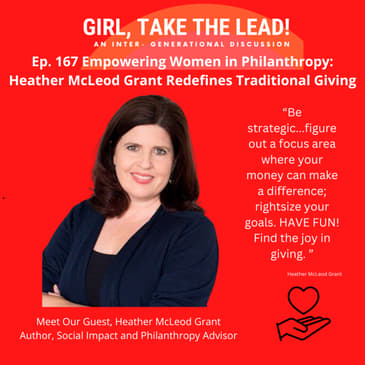
Heather McLeod Grant (GenX), social impact and philanthropy advisor, thought leader, and social entrepreneur with 30+ years expertise in strategy, leadership, governance, networks, and leadership for social change joins Yo to talk about women and philanthropy.
Did you know that there will be a massive asset-transfer of $30T over the next decade?
And some estimate women will control 60-70% of the giving and control 85% of purchasing decisions?
Heather lets us know that philanthropy doesn’t look like the balding, white guy with a top hat. It looks like us! Women are going to be a significant story when it comes to giving in 10-20 years.
Topics covered in the Episode:
Trends in philanthropy
Key statistics related to women’s giving
Giving Circles: what are they and how do they work
Women making a big splash in philanthropy
Key questions we should ask ourselves when it comes to our philanthropic journey
Here are three takeaways from the episode:
1. Women are stepping up and getting more involved – it’s not just men – and other trends include that donors are giving while living and tend to be younger.
2. Women give differently than men - they are more community centric, more diversified in their giving, and less interested in having their name on a building.
3. Giving circles are massively growing with more than 2500 nationwide. They serve as way to amplify
the gift and democratize philanthropy. You can contact Yo to learn more.
Mentioned in the Episode:
Authored by Heather:
And a few additional sources & resources on giving circles/ women in philanthropy:
Philanthropy Together (research and resources related to giving circles)
Women's Philanthropy Institute at Indiana University
More About Heather:
She is currently passionate about working with women donors and leaders, with a DEI and gender-equity lens. Co-founder of Open Impact, Irvine New Leadership Network, Who Cares Magazine; Author of Forces for Good, The Giving Code, The Giving Journey, Pioneers in Justice, Leading Systems Change, & many other articles.
How to reach Heather:
LinkedIn You can also contact her at the firm she co-founded, Open Impact.
How to reach Yo Canny:
Our website:
You can send a message or voicemail there. We’d love to hear from you!
email:
yo@yocanny.com (Yo)
FB group: Girl, Take the Lead
https://www.facebook.com/groups/272025931481748/?ref=share
IG:
yocanny
LinkedIn:
https://www.linkedin.com/in/yocanny/
[00:00:04] Welcome to episode 167 of Girl, Take the Lead, where each week we explore womanhood and leadership. And I'm your host, Yolanda Canny. Today, Heather McLeod Grant, social impact and philanthropy advisor, thought leader, and social entrepreneur with 30 plus years experience in strategy, leadership, governance, networks,
[00:00:29] and leadership for social change joins us to talk about women and philanthropy. Did you know that there will be a massive asset transfer of $30 trillion over the next decade? And some estimate women will control 60 to 70% of the giving and control 85% of purchasing decisions.
[00:00:58] Heather lets us know that philanthropy doesn't look like the balding white guy with the top hat in the monopoly board game. It looks like us. Women are going to be a significant story when it comes to giving in the next 10 to 20 years. Enjoy the listen. Here you go.
[00:01:19] Heather, welcome to Girl, Take the Lead. We are so excited to have you with us. And when I heard you at our giving circle and listeners, you're going to hear more about giving circles.
[00:01:33] I was just so impressed with your message and your mission and your passion about women in philanthropy. So I'm so excited that you're here and that you're going to help all the women who listen to this see themselves as strong and powerful. I love it. So thank you.
[00:01:55] Thank you, Yo, for having me. It's a real delight and I'm so excited to get to meet you and learn more about your work and your podcast. Yeah, thanks. So why don't we start first by telling our listeners a little bit about your background
[00:02:08] and how you've come to this field of expertise. It's just so amazing. Yeah. Well, I'll try and keep it relatively brief. I didn't have a career plan. For all the listeners out there who are trying to find their way in this world, I feel like
[00:02:27] I've made it up as I went along and I've sort of thought of my life in more or less five year chapters. I grew up in the Central Valley of California. I had the great fortune and privilege to go back east to an Ivy League college for undergrad.
[00:02:40] However, I was in much culture shock from that experience and I think it led me to be deeply curious about gender and race and class and how all of those issues show up in our lives.
[00:02:52] I thought I would go into politics or journalism, which were my two passions as an undergrad, but I ended up being an accidental social entrepreneur and starting a magazine with a friend from college right out of college in the early 1990s. So we were only 22, 23 at the time.
[00:03:07] We got an Echoing Green Fellowship, which was a social entrepreneurship fellowship very new at that time. And we started a magazine focused on youth activism. So that was really the first big chapter of my career. I then woke up at 27, 28 and was like, wow, this is great.
[00:03:23] I love working in the nonprofit sector. I love being part of this mission around social change, but I was making almost no money and literally living on the verge of poverty. So I decided to go back to business school, which a lot of social entrepreneurs in my
[00:03:36] generation did. I was like, okay, I've got to go figure out this business thing. And long and short of it is I then spent about a decade working for consulting firms, but on the nonprofit side of the house.
[00:03:45] So I wrote a book called Forces for Good about how you scale social impact that came out about 15 years ago really launched my career. And then I spent a decade at McKinsey and monitor and working with social entrepreneurs
[00:04:00] on how they could build their own organizations and have significant impact as leaders in the sector. And then the last chapter of this last decade, I've been really focused on philanthropy. So I then co-founded and ran a firm called Open Impact, which does philanthropic advising in Silicon Valley.
[00:04:16] So I went from being on the side of the nonprofits and the entrepreneurs building and running organizations to being on the side of the funders and the capital supporting those organizations very much like VCs and entrepreneurs in Silicon Valley. And that has been wonderful.
[00:04:31] And then my most recent pivot has been really over the last year and a half I took a sabbatical and spent some time reflecting on my career and what I really deeply cared about how I want to spend the next 10 years or so before I retire.
[00:04:45] And what kept coming up for me was women helping women get activated to make a difference in their communities with whatever resources they have that could be time that could be talent, could be treasure in the case of philanthropists.
[00:04:57] So that's really what ignited this interest and passion around women and giving for me. It's sort of been a through line my whole career, but I decided to really make that my focus. So juicy. I know there's a lot in there.
[00:05:14] So and I have been, you know, I know you asked something about publications as well, but I have been because of my interest in journalism, thought leadership and writing, I have tried to write a pretty significant piece every two to three years.
[00:05:29] I mean, I had my book, which was a big effort took several years and then I've written a number of other shorter workbooks and publications, including a book called Leading Systems Change focused on how leaders and communities can change the systems around
[00:05:43] them. And then when I was at Open Impact, we wrote a couple reports on philanthropy called The Giving Code and The Giving Journey. So that has also been part of getting this message out in the world.
[00:05:55] And I'll have links to those in the show notes for our listeners in case they want to dig in and study that a bit more. So what are some of the trends that you see going on right now in philanthropy?
[00:06:09] Yeah, well, it's a really interesting time in the philanthropic sector. First of all, I think we're going through a lot of disruption. There's a lot of new money and new wealth coming into the philanthropy sector.
[00:06:22] It's not going to surprise any of your listeners to hear that we're going through a time of great, you know, economic inequality in the United States. So the richer, getting richer, the poorer, getting poorer, the middle classes being squeezed.
[00:06:37] But the one silver lining to that is that there is a significant amount of capital coming into the philanthropic space. Now, the real question is some of that is sitting in donor advise funds. Some of that is sitting in foundations and not really being activated.
[00:06:50] So myself and a whole lot of other leaders in this sector are really focused on how do we get that money into communities and into nonprofit organizations, not just sitting in bank accounts, earmarked for philanthropy 10 or 20 or 50 years from now.
[00:07:05] But how do we get that money moving now? Because, you know, again, I don't need to tell you that our world faces a lot of challenges, right? We're facing a climate crisis globally. We've got rising income inequality. We've got issues around democracy and the rise of authoritarianism globally
[00:07:22] and in the US political polarization, the likes of which we haven't seen since the Civil War, our K-12 education systems could do better. So there's no host of issues which fill and profit capital can address if put to use. So those are some of the big trends.
[00:07:40] I would say a couple of other things we're seeing is that many of these new philanthropists are really thinking of their giving much more globally. So because of globalization and the internet and the world being so much
[00:07:51] more interconnected, people in the United States, it's getting easier and easy or to give money to a nonprofit in Africa or in India or in Latin America and the global south. Many of the donors I work with are also using multiple vehicles
[00:08:05] that gets a little bit technical for the average listener, but they might have a donor advised fund, they might have an LLC like Chan Zuckerberg has done, which gives them more flexibility. They might set up a foundation or they might choose to not set up a foundation.
[00:08:19] I think we're seeing increasingly donors don't want to build a big Rockefeller Gates Foundation or Packard Foundation. They want to stay more nimble and not have a big staff. So that's all leading to the rise as well of lots of intermediaries,
[00:08:33] pooled funds, donor collaboratives, basically an explosion of different vehicles and opportunities for donors to get engaged, the likes of which I have not seen in my career over the last 30, 40 years. So are those just the donor look different than what we've thought of typically like that?
[00:08:52] Yeah, very typical. You had us do an exercise. I know like what does that what does a donor look like right age and yeah. Well, I always say like picture when I when I speak to groups of women,
[00:09:03] I'm like picture what you know, what comes to mind when I say the word philanthropist and people pause for a moment and almost always the answer comes out like an old white man, you know, sort of the monolithic guy with a top hat, right?
[00:09:15] The Rockefellers, the Carnegie's or even frankly, Bill Gates is kind of the newer version of that. And what's changing as well is that we're seeing much greater diversification in terms of who gets to be a philanthropist. There are giving circles for donors of color, Latino community foundation.
[00:09:35] There's a network of grant makers for donors of color. And we're seeing a lot of women getting much more involved. So I think the face of philanthropy is changing significantly. And that is also one of the most interesting trends.
[00:09:49] So maybe we should explain what a giving circle is because that's how I got to know you. But maybe can you tell our listeners what they are and what are some of the things going on around that? Yeah, for sure.
[00:10:04] I mean, I would say the most simple definition is giving circle is a group of people. It doesn't have to necessarily be women, although many of them are women led who come together to pool their resources so that they can have more impact collectively than they could individually.
[00:10:21] So for example, let's just take the Girl Scouts giving circle that you're a part of, right? And I would love to hear more about your experience, but it's a great opportunity and I love it because I was a Girl Scout troop leader with my
[00:10:31] daughter when she was younger. She's now in college. You can put in $100 or $1,000 or even five or $10,000 for folks who have a little more extra income that they want to give back. And that if you just granted that to a nonprofit, $1,000 doesn't make a huge significant difference.
[00:10:50] I mean, it helps because nonprofits need support and they get it from community members, but by pooling those resources, then you can make grants that are 10 or 100 X that amount. So you could then give a grant to a nonprofit of 50,000 or 100,000.
[00:11:06] So it's a way for donors to have outsized impact by creating a method for collective giving. I'd say that's the simplest. There's an organization. I will flag this and I'll put it in the link called philanthropy together, which has done surveys of giving circles.
[00:11:21] They are on the rise. I think there's now more than 3,000 in the United States. So this is a growing trend. I think the average commitment for year is about $1,000 or $1,200. So we're seeing, you know, a real increase in giving circles as a vehicle for getting folks engaged.
[00:11:40] Yeah, for me, it was a way to. Take. A passion and an interest and influence. So that. And then there's been these other amazing things that have happened as a result of it, like meeting the great people that are in this.
[00:12:01] Giving circle that share that same passion, that same concern, that same issue and getting to know each other, working with each other. Towards this event so that, that community feel. Yeah. That you have when you're doing that.
[00:12:19] And if any of our listeners are interested in finding out more about how to do a giving circle, I'll put in, you know, some interesting information about that because I do think you can. You're banding together for your local interest. Correct. Yeah. Right. Well, it could be local.
[00:12:45] It can also be global. Right. I know some giving circles that have a global focus. I know there's a whole network called social venture partners that's been around the last 20 years and I was a member of their local version in Silicon Valley.
[00:12:57] Initially they started out giving to nonprofits that were scaling and those nonprofits could be US based. They could be global. Now they've really pivoted to focus on the local community because they realized there are a lot of unmet needs in Silicon Valley.
[00:13:10] In our own backyard, even though we are a hub of all this wealth creation in the Bay Area, there are many families struggling to make ends meet, right? To pay their rent, to put food on the table for their families.
[00:13:24] Some of them holding down two or three jobs. It's an expensive place to live, right? So SV2 is pivoted to focus locally. There are also giving circles that focus on specific issues. So there might be, for example, a climate giving circle or a democracy giving circle.
[00:13:38] So there are many ways you could pick in almost any area of focus you could think of. It could be an issue focus. It could be a geographic focus. It could even be a population focus or it could be say we want to
[00:13:51] be a group of women who support one another in our giving. So I think the Girl Scout circle that you're part of is just such a fantastic example. Yeah. Yeah. So what are some statistics you think about women and philanthropy?
[00:14:06] Because that monopoly player that you described is not current. Yeah, exactly. So what's amazing is I do think, you know, I think there have been some headlines that many of your readers will probably be familiar with, right around Mackenzie Scott and Melinda Gates and so on.
[00:14:24] And I can talk more about them in a minute. But but I think beneath that, beneath the headlines, there is a really interesting story of women's growing economic power in this country. And women, I think are increasingly becoming the face of philanthropy
[00:14:40] and the leaders in their families that are getting their husbands engaged, that are getting their kids engaged, that are maybe even getting multiple generations engaged. So, you know, first of all, the biggest statistic is there is going
[00:14:52] to be an enormous economic transfer of wealth over the next decade, decade and a half. This is well known data that others in the industry would cite. It comes from Women's Philanthropy Institute and and at Indiana University and some other institutions.
[00:15:08] But there is an estimate about 70 trillion up to 70 trillion dollars will transfer to the next generation over the next 10 to 15 years as the baby boomer generation dies off and leaves their wealth to their heirs. So what's really interesting about that is about 70 percent of that
[00:15:25] is estimated to end up in the hands of women. So we're talking about, you know, depending on how you do the math and depending whose numbers you use, anywhere from a 30 to a 50 trillion dollar opportunity, women are going to be controlling this
[00:15:39] wealth because they inherit from parents, but they also outlive their spouses. So they tend to inherit twice. And in addition, women are now 60, 65 percent of the workforce and make 85 percent of purchasing decisions. So women are increasingly becoming critical economic players in their families in purchasing decisions.
[00:15:59] And that is going to start to show up in philanthropy over the next decade, which is why I'm so excited about the friend, because I think it's like, wow, this is really an area where women can make a huge difference if they choose to get involved.
[00:16:13] And you've said that there's a real difference in the kind of giving that women do versus men. Yeah. So also again, going back to the Women's Philanthropy Institute, which is really the only academic institution that focuses on research specific to women in giving.
[00:16:29] There's a lot of good data to show that women do give differently. First of all, they give more collectively. So your point about the giving circle, like I don't want to be alone. This is about building community. Women tend to be much more relational in their giving
[00:16:42] and they seek out others to give more collaboratively. So that shows up in terms of women driving the giving circles trend, but it also shows up in terms of women wanting to be more involved with their grantees. So often if they give money to an organization,
[00:16:56] they may want to serve on the board or be an advisor or give some time and some talent, not just treasure. So so they give more collaboratively, more relationally, they're more hands-on. They tend to give more broadly.
[00:17:09] So they do tend to give slightly smaller amounts across more organizations than men. I think the typical again, it's a bit of a stereotype, but there's truth in it. The typical male donor gives, you know, a $10 million or a hundred million
[00:17:24] dollar grant. Their alma mater puts their name on a building. It's much more individualistic. It's a larger sum, but it's going to more of an institution. Whereas what we see is the women tend to give much more to causes that they care deeply about to give smaller amounts,
[00:17:38] but to more organizations and to be much more involved in hands-on in their giving. Yeah, I definitely can see that the name on the building is a little difference from what we're doing, for example, in the giving circle.
[00:17:56] Somebody called somebody I heard, you know, I don't remember where I first heard this, but they called it an edifice complex. So, you know, and I think there's some truth to that, right? I think men tend to see wealth and money because that shows up in women
[00:18:08] at wealth too, right? Women tend to see money as a yardstick by which they measure their ego and their accomplishments. Women tend to see it as a vehicle for what can I get done with this? This is a means to an end. It's not about my ego.
[00:18:23] It's about, can I put more food on the table for my kids? Can I help feed children in my community? Can I give this to my kids' school and make that school more effective or fund programs that wouldn't otherwise be supported?
[00:18:35] In international development, just as an aside, there's a lot of great data over the last 20, 30 years that the UN and others have highlighted about the role of women and girls in international development. When you give money to women, they put it right back into the community.
[00:18:48] They send kids to school. They build a better house. They feed people. They take care of the community. Heather, what are some of the big splashes that are happening out there that women are making? And how do you see them shifting the giving? Yeah. Yeah.
[00:19:06] So, you know, we talked a little bit about how women generally give differently. I think, you know, I say this is, you know, I really do think women are going to be the big story in philanthropy over the next 10 to 15 years. We're starting to see leading indicators.
[00:19:21] So it's showing up in terms of the big names, right? So we've been reading about Mackenzie Scott. She's given away more than $14 billion in just the last three or four years. Now, she did that rather than set up a foundation and have an endowment
[00:19:36] and given perpetuity and put her name all over lots of buildings. She actually hired a consulting firm, Bridge Span, which is well known in the nonprofit sector in philanthropy world, to help staff her and to identify organizations that were really meeting local and community needs.
[00:19:52] So boys and girls clubs, a lot of them have a racial justice and equity focus. A lot of them have a gender equity focus. A lot of them are bedrock institutions in our communities that historically are doing incredible work but are always resource constrained.
[00:20:08] And so she was making five and $10 million gifts to boys and girls clubs, food banks, YMCA's, afterschool tutoring programs for low income kids. I mean, she has given money to literally more than a thousand organizations and there's lots of good data published on all of this.
[00:20:26] But I do think that that is in a way she's kind of signaling she hasn't been very public in terms of being out speaking about it. She's actually quite private, but her actions speak much louder than her words. She has really set a model for what's possible.
[00:20:40] And I only wish that her ex-husband, Jeff Bezos and some of the other men were giving it the same amount that she is because truthfully, if you look at the list of, you know, there's 2700 billionaires worldwide, you know, the vast majority of those are men.
[00:20:55] There are some women like Oprah or Sheryl Sandberg and others, you know, Mackenzie Scott on that list, but many of them are men. I think she's showing the boys how it can be done. I mean, I think that's, you know,
[00:21:04] she's kind of throwing down the gauntlet and saying, look what you can do if you actually put your money to work at communities. You can change millions of lives and with not a huge amount of effort. The other one, of course, is Melinda Gates.
[00:21:16] And just the last week, there was big announcements on that front where she decided to step down from being a co-trustee of the Bill and Melinda Gates Foundation, which is now just the Gates Foundation. She for, you know, they've gone through a divorce
[00:21:31] and she for the last five, seven years has been running Pivotal, which is her philanthropic and investment arm. I think it was another big statement reading between the lines. I think she was saying, I want to go out on my own
[00:21:43] and I don't want to be beholden to this big institution, which now has lots of, you know, layers of bureaucracy and ways of giving. And I think she wanted to create her own identity separate from Bill. And so what's been interesting to see after the divorce,
[00:21:56] you know, she wrote the book, The Big Lift. She set up Pivotal and she's now got $12 billion that she's planning to move out the door in the next decade. So I think that's another one. And then the third, I would say, is Lorraine Pelt Jobs,
[00:22:08] who after Steve Jobs' death, of course, inherited significant wealth and set up the Emerson Collective and started out very anonymously. And much of her giving was quiet and behind the scenes. But she has become a real force
[00:22:22] and much more of a public voice in philanthropy over the last decade. You know, she's giving to everything from criminal justice reform to democracy to education. So these three women, interestingly, all of them divorced or widowed, untethered, let's just say, for male influence
[00:22:42] are really paving the way and setting the example. But I also want to say you don't have to be a billionaire to make a difference. Right? I said that's why I say I think those are the headlines
[00:22:51] and that's kind of the splashy news that the media focuses on. But beneath the surface, there are so many women, hundreds of women, thousands of women getting involved and leading their family foundations. I've had the great privilege in my work over the last decade to work with
[00:23:08] just some local examples, Lisa Sobrato-Sanzini, who kind of took over running the Sobrato family foundation, stepped into the shoes of her father. So she's kind of that next gen. She's really been leading that foundation. There's a woman named Kathy Kwan locally,
[00:23:24] whose divorce, who's done great things with her philanthropy, supporting scholarships at many of the UC systems and schools, doing a lot of ed reform work. Another woman named Allie Carlson, who's been a real leader on taking on environmental pollution and plastics
[00:23:40] because it's had huge impact on women's reproductive health. So I could go on and on. There are many, many stories of women who don't necessarily have billions who may have millions but are really becoming leaders in this sector and in this field.
[00:23:58] I know that you, I mean, you asked this very provocative, provocative question when we had our session with you. And I think you brought up some of the questions we should ask ourselves as women in philanthropy in our own philanthropic strategy. And would you would you share those?
[00:24:25] I think there were like five Ys and one. Yeah, well, yeah, exactly. Well, going back to my days as a journalist, I still think that, you know, who, what, when, where, how and why framework is really a simple way of thinking about strategy
[00:24:40] without making it overly intellectualized and overly complicated. So yeah, so I do think the first question is really to start with your Y. Right? I mean, there was a book by Simon Sinek that had that as the title, but I think it's about starting with
[00:24:54] what really drives you? What are you really passionate about looking inside your heart? You can certainly use your head to be strategic and thoughtful about how you deploy your money. But I think really getting clear on your wife first, what issues matter to you?
[00:25:09] I mean, for me, when I took a year sabbatical after COVID and we were talking about this before you started recording about, you know, having aging parents and teenage kids and all the things women had in running a firm and dealing with clients during a pandemic,
[00:25:23] I was super burned out and I took a year off and I spent a lot of that time doing some introspection around what really motivates me and what am I most passionate about? And for me, that answer was women and girls.
[00:25:35] And when I looked back over the course of my career, it was working with other women. It was starting organizations with other women leaders. It was supporting women social entrepreneurs or women nonprofit leaders supporting women philanthropists that really got me excited.
[00:25:50] So that answer could be different for everyone, but really looking inside yourself and starting with your why. Then I think there's a whole lot of other things. So let's say you care deeply about the climate or you care about, you know, environment or conservation
[00:26:04] or you care about fixing democracy or you care about schools, you care about health care. So then I think there's a little bit of narrowing to what is the issue you want to focus on? I mean, you can do multiple issues. However, I typically advise clients,
[00:26:18] especially when they're just getting started up, pick an issue for a couple of years and learn. Because if you get spread to then too fast, it can be kind of overwhelming. It's almost like learning to be a good investor, which I'll be candid.
[00:26:31] I'm not really on the for-profit side, but I'm starting to get more involved in impact investing and angel investing. So I'm on my own learning curve there. Start a little smaller, start focused. What issues do you care about? And then where can you have the biggest impact?
[00:26:49] So, you know, there's a whole effective altruism movement. That's kind of an extreme and I think it's a little too extreme in some cases where it was like literally like an ROI of like, where can your $1 have the most impact?
[00:27:00] And the answer is almost always buying bed nets in Africa to prevent malaria. I think it's perfectly valid to say, I want to give locally because I want to be involved in my community. And this is a way of giving my time and my talent
[00:27:14] and being in relationship with these organizations and the proximate leaders on the ground doing the work. It is more expensive to give in the United States than to give in Africa, but you need to then make some decisions about your geographic focus and where you want to give.
[00:27:28] There's a who question in there as well. Who do you want to involve in your philanthropy? Do you want to do this as an individual? Do you want to be in a giving circle? There are so many communities out there. There are groups like Women Moving Millions,
[00:27:40] the Maverick Collective, there are more and more organizations specifically targeting women donors, Women's Foundation of California, Women Donors Network. So I'll give you lots of links to put on your site so your listeners can access those. But I think this question of who?
[00:27:55] Who do you want to be involved with? Do you want to involve your kids? I mean Girl Scouts is a great example. My daughter and I did Girl Scouts together. You know, I was a troop leader, but for six, seven years we were going
[00:28:06] on all kinds of outings and having experiences as a group and we formed some really amazingly deep friendships and relationships. We were giving back to the local community, doing community service projects. So who you want to involve and then when? What's your timeframe?
[00:28:22] You know, I think we're seeing more and more people are giving while living and not just waiting to pass on their money to their heirs to make decisions. I think that's been a big trend over the last 20, 30 years. But we're also seeing an interesting trend
[00:28:34] of people who are spending down and choosing to spend their money in 20 or 30 years rather than have a foundation again exist in perpetuity. So if you have extra wealth and you're in that privileged position, you might want to think about the timeframe. You know, how long do you,
[00:28:49] how active do you want to be in your philanthropy? How long do you want this wealth to last? You know, there's lots of decisions about how much you leave to your heirs and so on. For the average woman, that's probably less of an issue,
[00:29:00] but I do think there's a question about what your timeframe and your giving. So... Well like I know after listening to you and having that question pop in my head of, you know, what am I passionate about? And, you know, I made some decisions
[00:29:18] like I decided that I was going to expand my offering using the podcast kind of as the base of it, but that I would begin to sell my homemade cards with sentiments that were consistent with the messaging I like on the podcast. And out of that, those sales,
[00:29:39] that's what I would contribute to these areas that I care about. And one of the big ones was, you know, I felt that every student going into college should be able to afford their books. And I had done some work with San Jose State
[00:29:57] and I went, I had like kids that were working so hard and couldn't afford their books. And it was just like this little thing, you know? A little thing, right. But I think that there's just so many things that we could just do like you're saying,
[00:30:12] it can be a little contribution. It doesn't matter. Yeah, and it can make you, I love that story. Thank you for sharing that story. I'm curious like were there other decisions that you've made about your own giving or your own philanthropy? Definitely, I thought, you know,
[00:30:28] that sometimes you wanna do something and the organization or the nonprofit has a different kind of strategy in mind than what you would like to do. Right. And I think you brought up some distinctions for us when we met with you, which were about, you know,
[00:30:50] how much and how you want to put on the organization that you're working with. And so something that shifted in me after hearing you was trusting more, not holding on to the organization. If they have a different strategy than me, then what I wanna get to, it's okay
[00:31:17] that maybe I can trust that they're gonna get there. But still give them the money to do that and not expect the ROI to come back as, okay, we impacted, you know, 12 girls and this is what happened. This is what happened. Right, yeah.
[00:31:34] Giving could be done a little bit differently than the way that I had been thinking about it. Yeah, I love that, yo. That's such a great story because I mean, I mentioned Mackenzie Scott, but I didn't talk about another trend that we're seeing right now in philanthropy,
[00:31:50] which is trust-based giving. So when I look back over the kind of grand sweep of philanthropy, you know, 100 years ago, you had the Gilded Age and you had the Rockefellers and Carnegie's and all of that, right? They sort of set the model.
[00:32:02] And then in the 80s, 90s, 2000s, there was a big movement towards strategic philanthropy, which was being really rational and scientific and using MBA language and MBA frameworks. And I was part of that movement, right? And I think there are a lot of people, you know,
[00:32:18] and to some extent it was correction against earlier eras of charity where you would just give, you know, alms to the poor, put money in the collection plate at your church or your temple. And you didn't really think about the impact you were having.
[00:32:32] So strategic philanthropy was a correction to that, right? And saying, let's be more intentional. Let's measure our outputs and outcomes. Let's be really thoughtful about what we're doing. The challenges and effective altruism then took that to the insta-grade, right?
[00:32:45] It was literally an ROI calculus of like, bang for the buck. The challenges, it went too far in that direction and it became too much about measurement and too much about donors holding the power and telling nonprofits what to do because they thought they knew best, right?
[00:33:05] And forcing them to do hundreds of hours of complicated evaluation without paying for it so that they can report back to the donors. So what we're seeing now I think is a healthy and natural correction back to the middle, which is saying, look, you can be somewhat strategic
[00:33:21] but you should also trust the people on the ground who are addressing these problems every day. So this whole idea of proximity and lived experience, whom I as a wealthy white woman to go into East Palo Alto and tell Latino families or Black families
[00:33:38] how to solve their problems. That's not my place. What I should do is give them the money and give them my support. And if they want my advice or help, bringing friends to fundraisers or whatnot, great. But really they are the closest to the problems
[00:33:52] and they know what the solutions need to be and what works in their community and in their context. So I think it's, you know, over the last decade, this has been a much needed correction and I think really the truth is somewhere in the middle. Yeah.
[00:34:08] Well thank you so much. I mean, I think we've covered so much but I wonder if there's any advice that you would give to your own daughter or other Gen Zers who are just starting to think about this.
[00:34:25] Yeah, well I would say first of all it's so funny because my daughter is like, oh mom politics and non-providence that's your thing. Like she's really into theater, she's really into the arts, she's really into psychology, she's really into youth mental health but she does it differently, right?
[00:34:39] So I think first of all different generations are gonna approach philanthropy differently put their own stamp on it, that's totally fine. But what I would say is you're never too young to start like if you look at like Greta Thunberg and the impact that she has had
[00:34:54] by being a voice for her generation on climate change and speaking truth to power, you know, at the UN and at Davos and in these kind of, you know, hallowed halls with like billionaires and government world leaders. You know, I started in my 20s running a nonprofit,
[00:35:11] getting a fellowship and I learned so much from that experience, I sat on boards in my 20s. So you're not too young. I mean, I look at teenage kids getting involved in community service programs through Girl Scouts, you know or through programs that they're schools.
[00:35:26] So you can start at any age and life stage. You're never too young and you're never too old to get involved. I think then some of the questions we talked about what do you want to focus on? Who do you want to involve?
[00:35:38] You know, how do you want to get engaged? Reach out to people in your community. If you have an interest in an area what I love about the nonprofit sector and philanthropy sector it's highly collaborative. People are almost always willing to give their time to talk to you.
[00:35:51] So reach out to a local nonprofit and say, I'm interested in what you're doing. I would love to learn more. How can I support? How can I get involved? I'm seeing a whole rise in, you know a lot of organizations have youth chapters, youth advisory boards, youth committees.
[00:36:06] So that's a great way to get started and you don't need a ton of money. You can say I'm gonna give $100 a month out of my income. I was just talking to a young woman last night who is herself an entrepreneur from Canada.
[00:36:19] She's in her early 30s and she's saying, you know look I think of myself as a philanthropist and I've always set aside a small portion of my income to give back even though she's not where she wants to be in terms of her own wealth creation ultimately
[00:36:33] she's still giving so you can do it. You can do it with a little amount. You can do it with your time. You can do it with your talent. There's lots of ways to get engaged. I'm on a lot of different ways.
[00:36:43] And then what would you tell your 20 something self? Wow, this is a hard one. I would say, you know I think when I look back on my career again there was no clear career path. And certainly when I started in this sector
[00:37:01] you know I joke with somebody if you told me at 21 or 22 that I was gonna grow up to be a philanthropy advisor I'd be like what is that? Like it wasn't even a job description 30 years ago. So I feel like I'm very much made up my career
[00:37:14] as I went along and I had to kind of you know walk the path while making it as it were. So I would say don't freak out, don't get so anxious or worried. Take it one step at a time. I think for me it really has been thinking
[00:37:28] of my career in these five year increments and figuring out okay what's the next chapter? What's the next chapter? And over time that starts to add up to impact but I didn't have a clearly defined path from the outset.
[00:37:43] I did what I was passionate about at that moment in time at that life stage and it's led to all kinds of great things. What a great way to end the episode. Thank you Heather so much. Well thank you Yo, this was so delightful.
[00:37:57] I mean it's just like for me an episode where I feel like we've really lifted women up to see a vision for themselves that maybe they're not thinking of so. Yeah exactly, yeah. Thank you, thank you for doing that. Thank you for listening today
[00:38:16] and we sure hope you enjoyed this episode. If you did please leave a comment wherever you listen to your podcasts, tell a friend about us, join our public Facebook group Girl Take the Lead or visit our website girltakethelidpod.com. We also have a YouTube channel
[00:38:36] where your subscription would be appreciated. Once you're on YouTube search at Girl Take the Lead and we're also on YouTube music where you can find a video of this episode. Here are three takeaways from today. One, women are stepping up and getting more involved. It's not just men.
[00:39:03] And other trends include that donors are giving while living and tend to be younger too. Women give differently than men. They are community centric, more diversified in their giving and less interested in having their name on a building. And three, giving circles are massively growing
[00:39:27] with more than 2,500 nationwide. They serve as a way to amplify the gift and democratize philanthropy. Our next episode will be a sound bite building on our episode today with Heather called Women, Love and Kindness, the History, Science and Strategy of Giving. After this episode with Heather
[00:39:53] I thought you might like a bit more about the topic. I also thought we could build on our episode 56, which was about love and kindness because perhaps at the heart of philanthropy is kindness and love. Please join us again and talk to you soon. Bye.