
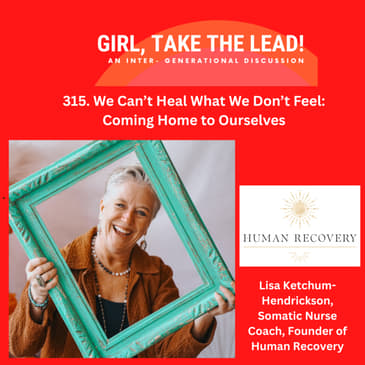
What if recovery isn’t about getting around our pain—but learning how to be with what we feel?
In this episode of Girl, Take the Lead!, Yo welcomes Lisa Ketcham-Hendrickson, somatic nurse coach and founder of Human Recovery.
Drawing on more than 30 years in emergency and trauma nursing—as well as her own journey through profound loss—Lisa integrates nervous-system regulation, yoga, breathwork, somatic practices, grief work, and wellness coaching.
Her work is rooted in the belief that healing is a process of coming home to ourselves—remembering the innate wholeness that has always existed beneath our conditioning, protective patterns, and the roles we have learned to carry.
Five years ago, Lisa’s understanding of trauma and grief became deeply personal when she lost her two oldest sons eight months apart to suicide and addiction. What followed was a healing journey that transformed not only how she understood grief, but how she understood recovery itself.
At the center of Lisa’s work is a simple but powerful idea:
We can’t heal what we don’t feel.
Together, Yo and Lisa explore what it means to come home to ourselves—to notice what is happening in our bodies, sit with discomfort rather than automatically avoid it, and learn to trust ourselves as a safe place again.
They also explore grief beyond the loss of someone we love. Grief can accompany transitions, changing identities, ancestral wounds, letting go of old coping mechanisms, and even experiences we consider joyful.
And perhaps surprisingly, making room for grief may actually expand our capacity for joy.
In This Episode, We Explore:
- Why trauma and addiction can be connected through our desire to numb discomfort
- What it means to “come home” to ourselves
- Why we can’t heal what we don’t allow ourselves to feel
- The grief involved in letting go of coping mechanisms that once helped us survive
- How we can honor what once protected us even when it no longer serves us
- Why grief can accompany transitions—including joyful ones
- How making room for grief may deepen our capacity for joy
- The importance of community in healing and recovery
- Ancestral grief and the many forms grief can take
- Becoming a safe space for our inner child
- How our bodies can help us recognize a nervous-system response
- Lisa’s sensory-journaling practice and the grounding question: “Am I safe?”
- Breathwork and somatic practices that can help us reconnect with our bodies
- Why healing and recovery are ongoing practices rather than destinations
About Lisa Ketcham-Hendrickson
Lisa Ketcham-Hendrickson is a somatic nurse coach and founder of Human Recovery.
Through Human Recovery, Lisa hopes to build community and create greater awareness of grief as a powerful and necessary part of healing. Her integrative coaching program is designed for people who are ready to come home to themselves beneath the conditioning, roles, and protective patterns they have learned to carry.
Connect with Lisa
Human Recovery: www.humanrecovery.life
Email: lisa@humanrecovery.life
Instagram: @human.recovery.llc
Facebook: Lisa Ketcham-Hendrickson
Upcoming Opportunities to Connect with Lisa
September 11–13: Keynote speaker at the Denver Yoga Summit
Beginning September 22: The Wild Edge of Sorrow — Embodied Book Club
November 12: New group cohort of the Human Recovery coaching program
Resource Mentioned
Francis Weller — The Wild Edge of Sorrow
Connect With Girl, Take the Lead!
🌐 Website:
www.girltaketheleadpod.com
🎧 Listen to Girl, Take the Lead!
www.girltaketheleadpod.com/listen
▶️ YouTube:
@GirlTaketheLead
📘 Facebook Group:
Girl, Take the Lead!
📸 Instagram:
@yocanny
💼 LinkedIn:
Yo Canny
💌 Email:
yo@yocanny.com
If this conversation resonated with you, share the episode with someone who might need the reminder that healing can begin when we give ourselves permission to feel.
[00:00:07] Welcome back to Girl, Take the Lead!. I'm your host, Yolanda Canny. Today we're talking about something every one of us experience in some form, grief, healing, and what it means to come home to ourselves. My guest is Lisa Ketcham-Hendrickson, a somatic nurse coach and founder of Human Recovery. Lisa brings more than 30 years of emergency and trauma nursing to her work, along with something deeply personal.
[00:00:37] her own journey through profound loss. Her approach integrates nervous system regulation, yoga, breath work, somatic practices, grief work, and wellness coaching. And at the end of it is a belief that really stayed with me. We can't heal what we don't feel. Our conversation challenged me to think about grief differently. Not only as something we experience when we're in our lives, but we don't feel.
[00:01:07] when someone dies. But as something that can accompany change, transitions, the letting go of old ways of coping, and even moments of joy. So what might happen if instead of trying to move around what hurts, we allowed ourselves to become curious about what we were feeling? Let's get into it. Here you go.
[00:01:33] Lisa, welcome to Girl Take the Lead. How fun that you're going to be with us. Thank you for joining. Thank you for having me. I'm so excited to be here. Why don't we start first if you would introduce yourself to the audience and tell them a little bit about the work that you're doing. Sure. So my name is Lisa Ketcham-Hendrickson, and I'm the founder of a coaching program called Human Recovery.
[00:01:57] Kind of my story is, by history, I'm a somatic nurse coach. I've stepped into that field just over the last four years. My history is in trauma and emergency nursing. I've been a nurse for over 30 years, and over 25 of those years working in level one trauma centers and flight nursing, and really helping guide people in that realm in some of their worst moments.
[00:02:26] But then five years ago, tragedy struck me as well. And I lost my two oldest sons eight months apart to suicide and addiction.
[00:02:37] And that really brought me on this healing journey of really diving in and just discovering who I am through all of this and understanding what healing really looks like.
[00:02:56] And it's been a long five-year journey, but I'm honestly, and this may sound really weird to say, but I'm really grateful for this journey. I've learned so much about who I am and our existence in this realm. And honestly, my connection with my boys is ever present in my life, even more so than it was in this realm.
[00:03:25] Well, tell us a little bit more about the Human Recovery Program and what that's about. Yeah. So Human Recovery is a 16-week coaching program rooted in yogic philosophy and theory, polyvagal theory, science-backed. It involves breath work, journaling, smart goals. And we meet once a week. We go over the book, The Yamas and Niyamas.
[00:03:53] And we also touch base on Francis Weller's book, The Wild Edge of Sorrow. So we kind of do a book that involves a bit of a book club on both of those, really diving into those concepts. And then it involves a lot of Kriya yoga. Kriya yoga is, Kriya stands for evolutionary action. And it involves a lot of breath work, mantra, and mudras that really just bring us back to ourselves.
[00:04:24] And is that something that people have to do in person? Or is it something that they can do virtually and sign up for? Yeah, it's in person or virtually. I'm starting a new cohort, a group in this fall, probably in October. I don't have the exact date yet. So they can do it in a group format or individually, whichever feels more comfortable to them.
[00:04:50] And yeah, I'm currently also teaching it at Serenity for Life, which is a residential trauma treatment center for women. And the coaching program spans residential to outpatient treatment. So as we know, that bridge between residential and outpatient is very precarious.
[00:05:12] And for people in recovery, whether from substance use or trauma, a lot of times that is where they fall off the practices that they learned in residential treatment. And so this keeps them in the work, keeps them connected, not only in the program, but with other like-minded individuals who are traveling the same journey. So do you see that a strong connection then between trauma and addiction?
[00:05:42] Absolutely. I mean, if we're talking about addiction in relation to substance use or really anything, you know, we can be addicted to overworking or gambling, sex. There's so many forms of addiction, but usually all of those addiction comes back to numbing, right? We're numbing from something, some sort of trauma that has occurred in our lives.
[00:06:12] And we don't feel quite comfortable or maybe have the tools quite yet to be able to sit with that. Yeah, see it. And does it just, it sort of seems like the neuropathway for trauma is never goes away, but you can find other pathways around it. Is that kind of what you try and do with your? Yeah.
[00:06:38] You know, I think the biggest thing is really guiding individuals to come home to self. I think, you know, our, whatever we're coming from was a path of moving around the trauma and human recovery and serenity where I work is about bringing you back to yourself. We can't heal what we don't feel.
[00:07:04] And so these practices bring us back to be able to have the tools to be able to sit in our discomfort and be able to work with our grief because grief is a big part of trauma, right? And a big part of recovery.
[00:07:20] I think one of the big things in recovery is we talk about this transition and letting go of these tools that help that, or maybe not tools, these things that helped get us from one point to the other. But we honor the grief in that because while those things may have been dysfunctional, they also got us to where we are right now.
[00:07:47] And so I think it's important not just to recognize that we have to let those things go. I think it's also important to honor those things because they did serve a part of our life to get us to where we are now. And if we just cut those things off without honoring the piece that they, the part that they provided in our life, then we're also doing a disservice to that transition.
[00:08:12] Is that kind of what you wish everybody knew a little bit more about trauma? Yeah, absolutely. I think trauma and just living in general, you know, we are a society that really is avoidant of discomfort. And I think especially grief, grief is ever present in our lives in so many different realms and in so many different aspects. And we avoid grief.
[00:08:42] Other cultures really lean into grief and see it as a natural process in this human experience. And we as a culture typically avoid grief. And I think really being able to talk about grief and the part that it plays in all parts of our lives, even in joy. There's grief in marriage that never gets talked about.
[00:09:08] You know, you're you're marrying somebody and that you're losing a piece of your your independence. Another it's a transition into a different part of your life. And we don't talk about the grief in that transition of joy. And honestly, I think when we learn to sit with our grief, it really expands every other emotion and especially joy.
[00:09:38] You talked a little bit about the Francis Weller book, and that's how you and I connected because I had never read that book. And gosh, was so asleep around grief. Yeah, definitely. Like you were saying, something to avoid, something not to talk about. Um, what's your favorite part of that book? Oh, wow. Um, it's hard for me to really distinguish one thing, but I will tell you my favorite quote from the book. Okay.
[00:10:07] Is I mean, there's so many pieces of this book that I think are so relevant. But my favorite quote is, there is some strange intimacy between grief and aliveness, some sacred exchange between what seems unbearable and what is most exquisitely alive. Boy. Boy. That's so good. We don't get one without the other. Yeah. Yeah, absolutely.
[00:10:37] And, you know, I remember when my, my therapist brought me this book, because you can see it's still a very much loved book in my thing. And, you know, I was like, Oh, I don't know if I'm ready to read this. But when I read it, it was just, it's just like, yes, this is, you know, it talks about the five pillars of grief.
[00:11:00] And that grief isn't just about the loss of a loved one, that grief encompasses so many different things in our life and enriches so many things in our life when we truly just honor grief for what it is, which is truly just, you know, love of something. I, I, I, the part that really opened my eyes was what you've just said about the five pillars.
[00:11:30] You know, cause I had always thought of grief as only the loss of a loved one. But I think the one that got me the most was the ancestral grief. Yes. Oh, I still get chills on that one. It was like, you know, being part Mexican, it was like the whole journey. Yeah. Yeah.
[00:11:55] And from that, and then I could just embrace that and go, Oh my gosh, this was, this was so eyeopening to me and that I could inherit the grief that my mother inherited from her mother, that she inherited from her mother. And it has come down the line. Yes. And just, I had just never seen it that way before. And it was so good to kind of have my eyes opened to that.
[00:12:25] You know, I've mentioned to you that I have a food addiction and have been in recovery for 25 years, 26 years. I never realized how much grief was involved in that kind of recovery.
[00:12:41] And I'm sure you see it day in and day out, but that was really kind of, yeah, you put the food down, but there's still all of the other feelings and inheritance that you've gotten to, to really work through. And that's the part that never stops. I don't think, I don't think you've ever really recovered because you've just always seen a new layer, right?
[00:13:11] Really? I have to tell you one story. I just had a birthday last week and I had lived in, I was clear that I had lived in this trauma of never having a birthday party as a child. Never. And I would feel lonely and birthdays would come and I would be in touch with that again.
[00:13:34] And so I was going through some slides that I had inherited from my parents and I found a slide of my five-year-old birthday in the backyard playing pin the tail on the donkey. Remember? I mean, that used to be like what we would do at birthday parties. Now we do these bouncy things and all that, you know, major events. But at the time it was just pin the tail on the donkey.
[00:14:04] And I, that little girl in me went, oh my God, you can let that one go now. Yeah. Wow. I mean, it was just really amazing. And I think sometimes when we're just get another layer that we're willing to look at and to really, you know, dive into. Absolutely. And I think, you know, that's such a big piece of it.
[00:14:33] I think that's one thing that the coaching program also guides individuals through is understanding that as adults, being able to come home to being a safe space for our inner child to be able to live. Right.
[00:14:58] And so understanding where we are in our lives right now as adults and being able to provide that healing for our inner child, I think is so huge. And that's what human recovery is. You know, it's this whole person trauma informed coaching program built around understanding that recovery is truly touches every aspect of our life.
[00:15:25] And it is for everyone, whether you're recovering from grief or antiquated social norms, ancestral grief. It's all there and we're all seeking it. And such a big piece of that, too, is not just grief, but it's community. You know, I think in our society often, you know, we're just supposed to, you know, have big shoulders and bear all of it alone.
[00:15:51] And, oh, you're so strong because you're just plowing through life by yourself. And that's such a fallacy. You know, we just do ourselves such a disservice to not be talking about these difficult transitions in life and sharing with one another how we, the tools that we learn from one another, how to heal and come together and support one another. So that's what also human recovery is about, is building this community of like-minded individuals.
[00:16:20] You know, we have monthly groups and connect other individuals with each other who are on a similar journey. So cool. I think that's one of the things that Weller says, too, in the book, that grief is a community. Yes. Yes. Not activity, but a community wound, not just a personal one that we all feel each other as humans.
[00:16:49] Oh, I think that's so good. Are there other tools? You mentioned some breath work, vagus nerve. You know, I always feel like when I take my nighttime shower and I'm in there and I'm like, okay, vagus nerve. That's good. Let's give you a moment to just chill. I don't know. Is that crazy? No, no. Oh my God. It's not crazy at all. Yeah. Several tools. So yeah, we dive a lot into breath work. Kriya yoga.
[00:17:19] One of the funnest, not necessarily fun, but one of the tools that I also give my clients pretty early on is called a sensory journal. And it's this small little journal that they can carry around with them so that they can start tuning into their interoception, what's really happening on the inside. And instead of just labeling things like anxiety or depression or the technical term, tuning into what's actually happening in the body.
[00:17:47] So when you start to notice those first signs of anxiety coming on, noticing what's happening in your body, do you have a pit in your stomach? Do you feel your heart rate starting to kind of increase? Maybe your respiratory rate. Maybe you have a knot in your throat or as a starting to notice those very subtle signs before they really compile up on each other.
[00:18:12] And so the sensory journal, when they first kind of start to notice a tick in their nervous system, the sensory journal was created to create an intentional pause. So they start to notice those first reactions. They take out the journal. Of course, the first thing I want them to do is notice, am I safe?
[00:18:35] Right. Because these responses are from some past trauma response in which our bodies were trying to keep us safe. So the first thing to notice is, am I safe? OK, yes. Ground, locate. I'm in a safe space. And then what is the sensation that's happening within?
[00:18:52] And then just to make a quick note of that and then put that away to look at further later, because as they start to use that, then they can start to connect the dots between what situations are really elevating their nervous system.
[00:19:09] So then once they jot those down, then they do a grounding exercise, you know, ground and locate, really move our feet where we have so many sensory endings connecting us, grounding us to the earth. Maybe do a three part breath, one hand over your stomach, one hand over your heart and just really breathing in, expanding that belly, bringing that breath all the way up into their lungs, all the way up to the top.
[00:19:34] And then slowly exhaling, activating that vagus nerve in the parasympathetic nervous system, taking three breaths like that. And then just a moment to come back to your body and out of this nervous system response. I just did the breath breathing with you. So it's like a good goodness and going. It's amazing. It's like one of the first things that I teach in human recovery, because, you know, as we go through our day to day lives,
[00:20:04] we're just breathing with our chest cavity, with our lungs. And we don't really think about what taking a full yogic three part breath looks like and truly how stimulating that is to our vagus nerve and how it really does help to settle our nervous system. We have covered so much. I I'm just wondering, is there anything else there for you that you'd love to leave our audience with?
[00:20:31] You've given us such great insights into so many things. Just that, you know, remembering that coming home to self, that everything is right here. And this is where healing really occurs. And, you know, we have we can't heal what we don't feel.
[00:20:54] And so that's what these practices are for is to come home to ourselves and learn to trust ourselves as a safe space again. Yeah. So, Lisa, how can our audience get in touch with you? And I can keep if you keep me informed around your October cohort, I can can let them know about that. But what about them just reaching out to you and getting to know you a little bit? Yeah, absolutely.
[00:21:21] So my website is human recovery dot life. And then, of course, I'm on Instagram, which is human dot recovery dot LLC. And yeah, I think those are the best places to get in touch with me. We will be also having a keynote speech at the Denver Yoga Summit in September. So that's the weekend of the 11th, 12th and 13th.
[00:21:49] I'm partnering with Serenity for Life on that. And so we'll really be talking about really this new ecosystem of recovery that we're building together, which we're super excited about. And I think that's about it. I have a if you go to my website, I have a retreat coming up in September called the Sacred Spa, Sacred Pause, which is especially for those working through grief in between those very major holidays.
[00:22:17] So those are kind of the things coming up. Also have another book club starting the end of September on The Wild Edge of Sorrow. Everyone, that book club is amazing. And I was in it and really encourage you all to check that out. It'll open up all kinds of things you didn't even know you were going to open up. So such a good, good book club. I ask all my guests this question.
[00:22:47] What would you tell your 20 something self today, Lisa? I would tell her to trust in herself. To. Know that this journey was meant just for her. And.
[00:23:13] To love and to feel every aspect of it. I think. That's the biggest thing is to really invite feeling back into our bodies. To. Not try to skirt around the pain, but to sit in it and. Acknowledge it as part of our existence is part of our life. And seeing that as a sacred. Piece of our journey.
[00:23:46] And. That. There will be some really, really difficult times. But to trust in her community. Trust in herself. And remember that this is always home. I have to give that a moment.
[00:24:16] Well, I know you had a chance to go to our online store. And I know something spoke to you. Yeah. And it's going to be my pleasure to send it to you. That. Lotus. That lotus flower is definitely you. Yeah. Yeah. I talk about that a lot with. The women of serenity. And it's really just a. A big piece of it. You know, the lotus flower is. Such a good representation. Of a healing journey. You know, it rises through the muck. Every morning.
[00:24:46] To greet the sun. At the beginning of a new day. And it comes back at the end. And. Every day. It. Takes that step forward. And it. Continues that practice. And that's what healing is. And that's what these practices are. Is a practice. You know. A practice in living. And moving forward every day. Thank you for sharing your heart with us.
[00:25:15] Thank you for having me. This has been. It's been a blessing. And I'm so grateful. For me too. And for our audience. Yeah. Thanks. All right. Thank you so much. Lisa. Thank you again. For sharing your wisdom. Your experience. And your heart with us. There was so much in this conversation. Right. But here are three things to take away. One. We can't heal what we don't feel.
[00:25:44] Avoiding discomfort may protect us for a time. But healing asks us to come back. To our bodies. To our feelings. And ultimately to ourselves. And as Lisa reminded us. Part of that is learning to trust ourselves. As a safe place again. Two. We can honor what helped us survive. Without needing to carry it forever. Forever. I love Lisa's perspective on the behaviors and patterns.
[00:26:14] We sometimes want to get rid of. Maybe before we judge them. We can recognize that they served a purpose. They helped us get here. And perhaps we can thank them before deciding whether to kick them to the curb. And three. Grief is much bigger than we may think. It isn't only about death. Grief can live inside transitions. Changing identities.
[00:26:43] Ancestral experiences. Things we never received. Things we're leaving behind. And even joyful moments. And maybe one of the most surprising ideas Lisa offered us is this. When we allow ourselves to experience grief. We may also expand our capacity to experience joy. That one has stayed with me. And I hope it stays with you.
[00:27:13] And here's where we'll go next. In our next soundbite. I'm going to stay with grief. I know. Some of you are going. Do we have to? But we'll explore some of what Lisa and I touched on today. Along with ideas from Francis Weller's book. The Wild Edge of Sorrow. It's my textbook when it comes to grief. Because I'm beginning to wonder.
[00:27:42] How much of what we carry might actually be grief. We've never named. And this book really helps with that. Until then. Thank you for being here. For listening. And for being willing to lead with curiosity. And remember. Sometimes coming home to ourselves begins simply. By allowing ourselves to feel what's already there.
[00:28:10] See you next time on Girl Take the Lead. Bye.