
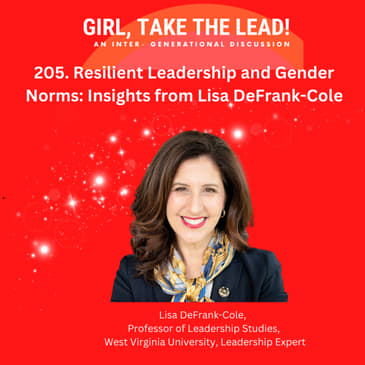
Lisa DeFrank-Cole, Gen X, joins Yo who talks with us about resiliency and other important traits for women leaders. Lisa is Director and F Duke Perry Endowed Professor of Leadership Studies at West Virginia University, and is widely known for her academic and practical expertise in women’s leadership.
She is a leadership coach and has been coauthor/coeditor of the following three academic books about women and leadership including an award-winning textbook:.
Women and Leadership: Journey Toward Equity
A Research Agenda for Gender and Leadership
Women’s Leadership Journeys: Stories, Research, and Novel Perspectives
Lisa overcame many stereotypes as a first-generation college graduate from Appalachia to reach where she is today. WV Living magazine named her a “Wonder Woman” in 2019, celebrating her for defying barriers and working towards uplifting West Virginia.
Topics Covered:
Why resiliency is an important leadership trait What other skills/traits women offer What are gender norms & alignment Likeability vs competence Masculine and feminine traits What are different strategies to promote equity What is a leader identity (claiming vs granting)
3 Episode Takeaways
1. Hardiness is needed for women to be leaders. Resilience is the ability to get back up after being knocked down and trying again. Women face challenges that are different than men when it comes to leadership.
2. There’s a flexibility and empathy women bring to leadership situations. Because we are scanners women can assess where people are coming from. Research states women bring a transformational approach into organizations. Women can be the “glue” that holds things together which can be unrewarded and
overlooked.
3. Gender norms are changing but not equable yet. It is going in both directions for men and women. Leaders are seen in their ability to make decisions or be agents of change, and how society perceives these differently for men and women is the real challenge.
Card or Gift Items Lisa Liked from Our Store
https://girltaketheleadpod.com/shop Snarky Cat, Trust Your Gut Card Enjoy the Journey Bookmark
More About Lisa:
Lisa has 15+ years as a speaker at the International Leadership Association Global Conferences presenting on Women and Leadership. She has been recognized with awards for dedication to women and leadership, including the Mary Catherine Buswell Award, the West Virginia Wonder Woman Award, and the Harriet E. Lyon Endowed Professorship in Women’s and Gender Studies. She is a Fulbright Specialist Scholar and taught leadership to women in the Middle East.
How to reach Lisa:
LinkedIn account:
https://www.linkedin.com/in/lisa-defrank-cole-7b32286b/
eMail: L.DeFrank.Cole@gmail.com
Website: lisadefrankcole.com
How to reach Yo Canny:
Our website:
You can send a message or voicemail there. We’d love to hear from you! And you can check out our Heartfelt Cards & Gift Shop.
email:
FB group: Girl, Take the Lead
https://www.facebook.com/groups/272025931481748/?ref=share
IG:
yocanny
LinkedIn:
https://www.linkedin.com/in/yocanny/
[00:00:06] Welcome to episode 205 of Girl, Take the Lead, where each week we explore womanhood and leadership. And I'm your host, Yolanda Canny. Lisa DeFrank-Cole, Gen X, joins me to discuss two very important topics when it comes to leadership, resiliency and gender norms. Lisa is director and F. Duke Perry Endowed Professor of Leadership Studies at West Virginia University and is widely known for her
[00:00:36] academic and practical expertise in women's leadership. She is a leadership coach and has been co-author or co-editor of three academic books about women and leadership, including an award-winning textbook. Topics we covered together were why resiliency is an important leadership trait for women, what other skills and traits women offer when it comes to leadership,
[00:01:06] What are gender norms and what their alignment is about when it comes to leadership, likeability versus competence, masculine and feminine traits, and different strategies women can take to promote equity. Enjoy the listen. Here you go. Lisa, welcome to Girl, Take the Lead. We are so excited to have you here and to, gosh, this great
[00:01:38] conversation we're going to have a great conversation we're going to have about leadership and women and can't wait to get into it, but thanks for coming. Oh, thanks, Yolanda. I'm so excited to be here with you. Yeah. So why don't we start if you would just sort of introduce yourself to our viewers and listeners so they get to know you a little bit about you. Sure. I am a professor of leadership at West Virginia University and I was born and raised in Appalachia. So I grew up in Southwestern Pennsylvania.
[00:02:08] I'm a first-generation low-income college graduate. I'm a first-generation low-income college graduate. And what that means, if I unpack it a bit, it means neither of my parents had gone to college before I attended college. And that's first-generation college graduate. And low-income means that I received free lunch at school, had hand-me-down clothes, but I had a lot of love and support in my family.
[00:02:36] And so they encouraged me to go to college, especially my mother. And I'm excited to teach at West Virginia University. And my research area is women and leadership. So that's a little bit about me.
[00:02:52] And how did you come to that path for yourself?
[00:02:57] It was a circuitous path. I'll tell you the truth. I started an undergrad in landscape architecture. I spent a lot of time outdoors growing up, running around through the woods and strip mine that was behind my house.
[00:03:15] It's also called a surface mine for coal mining, was big in my area. And so I grew up in this coal mining community, spent a lot of time outdoors.
[00:03:24] And I never met a landscape architect before I went to college. And I realized that it's just as possible to create beauty in the natural world, in the world, outside world, as it is degradation.
[00:03:40] And so I think I wanted to have some part in making the landscape beautiful. I recognized that that was not going to be my path. I finished the degree. I have a degree in landscape architecture, but it didn't speak to my heart.
[00:03:55] I realized that I loved higher education. I loved being in college. And I tried to find a path to work in a higher education institution and just, again, bopped around like a master's in higher education administration and then realized, yeah, I do like this path.
[00:04:14] But I think to really advance in my work at a university, I needed a doctoral degree. And so I eventually got my doctoral degree and was lucky enough to come back to my alma mater at West Virginia.
[00:04:30] I went to undergrad at WVU and did my graduate work elsewhere, but was happy when I was able to come back home, as it were, to West Virginia.
[00:04:40] Yeah. Well, I think one of the aspects of leadership that we've talked about is resilience.
[00:04:49] And I think you have some thoughts there about that as an aspect of leadership, especially for women. Can you talk a little bit about that?
[00:05:01] Yeah, I think all leaders have to have some hardiness in that I use that not H-E-A-R-T, but H-A-R-D-I hardiness.
[00:05:12] But both, I think, could go hand in glove. Hardiness like a plant that lives through the winter, evergreen.
[00:05:19] Hardiness like a plant that lives through the winter, but it's hardiness.
[00:05:22] Hardiness like a plant that lives through the winter, but it's hard to have some of the elements that are exposed to it.
[00:05:27] So I think women generally have to be hardy to be leaders because the way society expects a woman to act can be different than the definition we see for leader.
[00:05:44] And so it's a delicate, tightrope walk. And I think in my mind, resilience is having the ability, when knocked down, to get back up again and keep trying.
[00:05:57] And so I would think that women have certain challenges. Literature has shown, research has shown that women face challenges that are different than some of the challenges men face in leadership.
[00:06:11] And so being able to keep going, keep forging ahead.
[00:06:15] Well, on that thought, what are some of the things that you think women bring to the party that are different than men?
[00:06:23] Yeah, I think because women have had to try, you know, continuously to kind of learn to negotiate and navigate things, there's a flexibility that women can bring.
[00:06:38] There's something MIT researchers talk about reading the mind in the eye test, and it's largely seen as a test of empathy.
[00:06:46] And I think women bring that to bear in situations because we have to watch out.
[00:06:56] I mean, I think from the time we're young, we're told, you know, safety in numbers and be cautious about where you're walking, you know, be aware of your surroundings.
[00:07:06] So as women, I think we are scanning.
[00:07:10] And I think that carries not only into a safety aspect, but also into looking and trying to understand people.
[00:07:19] And so reading the eye in the mind test, a test of empathy is trying to understand where people are coming from.
[00:07:27] And I think that's, I think that's helpful.
[00:07:29] Women are also seen to score higher on aspects of tests, if you will, about leadership, and they're seen to be more transformational.
[00:07:40] And transformational leaders enable their followers to reach goals higher than the ones they had expected that they would reach.
[00:07:49] And treats people as individuals and allows them to kind of participate in the leadership process.
[00:07:58] It's not just about the leader.
[00:08:00] It's also about the nourishment of the follower.
[00:08:03] And so there have been research studies showing that women bring that transformational approach a little bit more than men do into organizations.
[00:08:14] I think you also have mentioned before to me that they're the glue that can hold things together.
[00:08:21] Yeah, yeah, I would say so.
[00:08:25] I think, yeah, it's like laying bricks in the mortar.
[00:08:29] Sometimes we think about meeting at the water cooler or sharing a cup of coffee together in an organization.
[00:08:36] And that strikes creativity and conversation when people come together.
[00:08:43] Again, women have always had to struggle for their kind of position as leaders.
[00:08:50] And I think they're willing to be flexible and try to negotiate things a little bit more.
[00:08:57] That helps smooth an organization and move it forward.
[00:09:02] You know, oftentimes when I say glue, it could be something as like who's going to celebrate the birthdays.
[00:09:08] And sometimes it's women who, you know, think to get the cake or, you know, we expect them to.
[00:09:14] And so that can be glue.
[00:09:16] But it's the thing that is sometimes unrewarded.
[00:09:22] It's not the thing that gets a woman promoted.
[00:09:25] So even though she realizes that it's like the oil and well-oiled machine, it's the oil, it's the glue, the thing that kind of holds things together in a community.
[00:09:37] It's not always recognized and not always rewarded.
[00:09:42] But I still think women, you know, want to do it because of the communal mindsets that society has kind of put on women to say that, well, they are the nurturers.
[00:09:53] They are the community builders.
[00:09:56] Right.
[00:09:57] Well, I remember I was in graduate school.
[00:09:59] And so that would have been like 1976 or so.
[00:10:07] And I was asked by the member or actually not asked.
[00:10:13] I was kind of told by some team members that I should do all the typing.
[00:10:23] And, you know, I and I went, what?
[00:10:29] I was like, what?
[00:10:32] And I said, no, I don't think so.
[00:10:35] I think we should all share this.
[00:10:36] And they went to the TA and the TA said, called me in and said, you know, if you have a skill, you give that to the team.
[00:10:50] And it's the team.
[00:10:54] Benefits from that.
[00:10:55] And I remember thinking to myself.
[00:10:59] Oh, so he doesn't have my back on this.
[00:11:02] I have to figure out how to navigate this now.
[00:11:08] And I do think I ended up typing everything up, you know, quote for the sake of the team.
[00:11:15] But I remember that being such a, obviously, I'm talking about it as a very memorable moment of when you don't go get the coffee anymore.
[00:11:29] Or you, you know, you've moved.
[00:11:32] Your identity has moved beyond.
[00:11:35] Where people expect you to be.
[00:11:41] Well, I was asked to type notes, too, in the early 2000s.
[00:11:45] In my first, well, it wasn't even my first job.
[00:11:48] It was like my third job.
[00:11:49] And, you know, master's degree, ABD from my doctoral program.
[00:11:54] And, yeah, it's the idea that women are supposed to take care of the men, regardless of their educational background.
[00:12:04] And it's a double bind.
[00:12:06] Women, it's hard for women to be seen as both likable and competent at the same time.
[00:12:10] And so you were demonstrating likability.
[00:12:14] Well, for the team, they'll like you better if you type the notes.
[00:12:18] But that wasn't demonstrating your competence in the subject matter in graduate school.
[00:12:25] Yeah.
[00:12:26] So, yeah, we put that on women.
[00:12:29] And we want to be liked, but we also want to be seen as competent.
[00:12:33] But sometimes it's hard to be seen as both at the same time.
[00:12:36] Well, and I think we go to the place of it's demeaning when we're not, when our competence isn't recognized.
[00:12:47] And we're marginalized when our competence isn't recognized.
[00:12:51] Is that kind of what you see there?
[00:12:54] Yes, absolutely.
[00:12:55] Yeah, these are things that should be shared among the team, that it shouldn't be the woman's job.
[00:13:03] And they were equating you to secretarial work.
[00:13:05] Because in the 70s, what most of us saw were secretarial staff being women.
[00:13:13] And so you being in alignment with your gender meant that you should do the typing.
[00:13:18] But you, you know, being in alignment with leadership and education and getting a master's degree meant you should be demonstrating your competence in your field of study, which went against, yeah, the gender norms that most people saw at that time.
[00:13:36] So it doesn't surprise me at all that you had that experience.
[00:13:39] It's so cool, because I wish you had told me that in 1977, right?
[00:13:46] Because that would have helped a great deal.
[00:13:48] To understand the tension.
[00:13:50] Like, not having the ability to articulate that in the moment, you know, wouldn't have been great if I could be able to say, you know, what I think is going on here is, you know, competence isn't being recognized.
[00:14:07] And I think we can all share this particular task, even if it takes you longer.
[00:14:16] I don't know, but great.
[00:14:17] I mean, it's just so.
[00:14:19] Do you think that gender norms have changed?
[00:14:23] Like, where are they now?
[00:14:25] Like, how do they change?
[00:14:26] They are changing, but it's not equitable yet.
[00:14:32] I wouldn't say that we have the same expectations out of men as we do out of women and vice versa.
[00:14:39] We definitely still see gender norms in society about what we expect of people.
[00:14:47] But we do see people other than women in secretarial pools, as it were, right?
[00:14:54] We see men as office administrators and secretary types now.
[00:15:00] So it's not just women coming into professional fields.
[00:15:05] It's also men doing secretarial type work, too.
[00:15:09] And in all manner of speaking, I would say that, you know, seeing men as nurses, as well as seeing women as doctors, right?
[00:15:18] When we hope for gender and strive for gender equity, it's going in both directions for men and for women such that men can go to their kids' soccer game or go to the school play and be able to take time off work for taking the kids to the dentist appointments or what have you and not be seen as somehow incompetent at his job or somehow less masculine in his presentation.
[00:15:48] Because he does things like that.
[00:16:20] For us to look for us to look at ourselves, not just as one dimension and gives us more men and women, like you were saying, an opportunity to move so that, you know, a male who takes off to take the kids to the dentist isn't perceived as any less of a person.
[00:16:49] Mm-hmm.
[00:16:50] Mm-hmm.
[00:16:50] Because they're a total person, right?
[00:16:54] They're a total.
[00:16:55] They're, you know, they have caretaking feminine traits as well as the masculine traits.
[00:17:01] And we do too as women.
[00:17:03] Mm-hmm.
[00:17:04] I think that opens us up a little bit more so that there isn't this pressure on women leaders that they have to be a certain way, like a certain masculine trait, I guess.
[00:17:24] I don't know.
[00:17:24] Does that make sense?
[00:17:25] A hundred percent.
[00:17:27] Yes.
[00:17:27] It makes sense in that, you know, when we talk about gender equity, it's just as much trying to, as you say, open up these masculine and feminine opportunities for men and women, not just women.
[00:17:42] And you're right, we all hold masculine and feminine abilities or attributes.
[00:17:51] And men can be kind and nurturing and communal.
[00:17:56] And women can be agentic, agents of change, decisive in their approach.
[00:18:01] And it's just how society views those behaviors that is the challenge, where there's a rub.
[00:18:12] Mm-hmm.
[00:18:13] Because I think we need to talk about masculinity more than just toxic masculinity.
[00:18:19] We need to talk about the wide range of ways that men can show up.
[00:18:25] And the same is true for women, but often men are penalized if they show up in ways that are too feminine.
[00:18:36] And women are penalized when they act in ways that are seen as more masculine, such as being decisive and agents of action or having agentic qualities.
[00:18:50] And that's the challenge because we align leadership, the word leadership, with decision-making and being agents of change and being able to, you know, quickly make a decision on something.
[00:19:03] But when a woman does that, she's seen as somehow acting against her gender norm in society.
[00:19:13] And so that's where the challenge comes in.
[00:19:18] Men and women don't lead all that differently.
[00:19:21] As I said earlier, the transformational approach, it's just a slight advantage there.
[00:19:27] But generally, men and women lead largely similarly, but it's just how society perceives them that is the challenge.
[00:19:38] Wow.
[00:19:40] That is so interesting.
[00:19:42] I mean, again, we were talking earlier about seeing things through our perceptions and through our filters.
[00:19:54] And those norms are there and they're deep.
[00:19:59] And a lot of us don't even recognize that we have them.
[00:20:04] Yes.
[00:20:05] They're just so automatic.
[00:20:07] Yes.
[00:20:09] I mean, without talking politics, but we could watch any news broadcast and things and see things on television and pop culture about this idea that women need to be taken care of in some way.
[00:20:24] That masculinity in our country means a certain thing, that you have to take care of your women people in your family, whether it's a spouse or children.
[00:20:37] And women should be nurturers and somehow, you know, in some relationships subservient to the head of the household.
[00:20:47] And it's just being these are really ingrained in our society about what does it mean to be a good woman or a good man?
[00:20:56] And in some ways, how do we see a good man as being a stay at home dad taking care of the kids while his partner is working outside of the home?
[00:21:10] Those are very different.
[00:21:11] And so I advocate for a wide acceptance of a wide range, whatever works for the individual people, rather than saying it should be, you know, specifically one way or another.
[00:21:25] It's just what works.
[00:21:28] Right.
[00:21:29] Right.
[00:21:29] What are some strategies that you think both men and women can take when it comes to leadership?
[00:21:38] I think sometimes in organizations where there are men and women in a meeting, for example, and a woman vocalizes an idea about something and it's kind of not really addressed or heard, so to speak.
[00:21:57] And then five minutes later, a man reiterates the same point, claims it as his own.
[00:22:02] Oh, I think we should do X.
[00:22:03] And in a case like that, I think having allies in the room that can say, Bob, that's a great idea.
[00:22:10] And I really liked it when Sally said it five minutes ago.
[00:22:14] I think you two could maybe, you know, work together on that idea, on working out that approach.
[00:22:21] So recognizing women for the accomplishments that they make.
[00:22:27] I think men can be allies for women and mentors and sponsors because they are the ones always represented in all sectors as senior leaders.
[00:22:41] There is no sector where there are more women as senior leaders than men, even in our more women heavy type fields.
[00:22:54] You know, I think nursing or even in education.
[00:22:59] In college, for example, there are only a third of college and university presidents are female, despite education being a largely female enterprise.
[00:23:10] Sixty percent of college graduates are women these days.
[00:23:13] Women have been earning more bachelor's degrees than men since the 1980s.
[00:23:18] So even it's not a pipeline issue.
[00:23:21] It's not that women haven't earned the right credential to be the leaders, but they're just not represented as such.
[00:23:28] So I think having advocates and allies, sponsors, people who can mentor women into these more senior positions and policies and procedures of organizations.
[00:23:42] Those cultures matter.
[00:23:45] Can a man take paternity leave?
[00:23:49] Not just can he take it?
[00:23:50] Is it just on the books?
[00:23:51] Is it just a policy?
[00:23:53] But will he truly be allowed to take that leave and not be looked down upon as somehow less of a man if he takes off the full, you know, six weeks or eight weeks, whatever might be available?
[00:24:08] Because in some organizations, it's on the books, but the men know that they really can't take all of that time because they'll be looked down on.
[00:24:20] So I think in those a few examples, I kind of mixed and mingled them together, being advocates and allies, having mentors and sponsors who are men for women leaders and looking at policies and procedures and not just do they have them on the books, but can they be actualized?
[00:24:38] Yeah.
[00:24:40] Yeah, I love that.
[00:24:42] So you've talked a little bit too about leader identity.
[00:24:49] And so how do they develop?
[00:24:53] Yeah, researchers have looked at leader identity and there's a variety of studies out there.
[00:24:59] And one that I like to talk about is claiming and granting.
[00:25:04] And so not my original idea, but others have looked at this idea that women to claim a leader identity might mean something like how she dresses, how she presenting herself in the organization.
[00:25:20] Does she, quote unquote, dress like a leader?
[00:25:24] Does she help set the agenda for a meeting, putting items on the agenda that will be addressed?
[00:25:32] And so that is claiming leadership.
[00:25:37] Granting is done by others in an organization.
[00:25:41] Do they defer to her?
[00:25:44] Do they listen when she's speaking?
[00:25:49] So it is very much a back and forth kind of process to develop one's leader identity.
[00:25:56] It's not just a woman saying, I want to be a leader and I'm going to go buy a suit and wear a suit every day.
[00:26:05] You can claim it, but it also has to be granted by others around her.
[00:26:11] And so how can we grant leadership if you're thinking, well, how might we do that more for other women by listening to women when she is speaking, not interrupting her, reiterating her points.
[00:26:27] As Mary said earlier, as Sally said earlier, giving her credit for things that she contributes.
[00:26:37] So women can do that for other women.
[00:26:40] Men can do it too.
[00:26:42] So I think it's doing those things.
[00:26:46] We can help grant women leadership as well as her claiming it too.
[00:26:52] Well, you talked a little bit about what we expect from leaders.
[00:26:56] So you talked a little bit about decision making.
[00:27:00] What do you think about being able to mobilize other people, like getting people into action?
[00:27:10] Yeah, I think at its core, leadership is a process of influence.
[00:27:16] Leadership is not a position.
[00:27:18] And that opens up a wide range of possibilities for anybody to be a leader.
[00:27:27] And if we're going to speak about women in particular.
[00:27:31] It doesn't mean she has to hold the corner office and have a big title.
[00:27:37] It means, is she willing to do the work?
[00:27:40] Is she willing to organize with other people to get the job done?
[00:27:45] How do we influence people?
[00:27:48] And, you know, we have this whole social media enterprise, TikTok, and we have people that are influencers.
[00:27:58] These people have no formal position, but yet they're influencing millions of people in some cases.
[00:28:04] So it's how, how can we influence other people?
[00:28:11] And so, yeah.
[00:28:12] So leadership is a process of influence.
[00:28:15] Absolutely.
[00:28:16] And in TikTok, social media influencers have learned how to do it for sure.
[00:28:22] Oh, and get people mobilized so that we're trying the recipes, doing all the things that they tell us.
[00:28:28] Yeah.
[00:28:30] So interesting.
[00:28:33] Well, is there anything else that we didn't cover that you would like to mention?
[00:28:42] I'm excited for the future, right?
[00:28:44] I am an optimist and I'm hopeful for the future.
[00:28:48] And I'm not a person that believes everything has to be 50-50 in order to be fair.
[00:28:55] So I'm an advocate for gender equity.
[00:29:01] I don't say equality, but I say equity in that I think we can do a good job in trying to hire the best people for the best jobs where they fit.
[00:29:12] And everything doesn't have to always be 50-50, but recognizing fairness.
[00:29:18] That's what I'm standing for.
[00:29:20] That sounds so good.
[00:29:24] So, Lisa, what would you tell your 20-something self?
[00:29:30] I would tell her to stick it out because at age 20, I was looking at my degree and realizing it was going to take me six years to finish my bachelor's degree.
[00:29:42] And I would say that you're going to get there.
[00:29:45] You'll not only finish your undergrad, but you'll get a doctorate, which never occurred to me at that time.
[00:29:52] So just tell her she's going to make it and it's going to be better than she ever imagined.
[00:29:58] Sounds lovely.
[00:30:01] And one last question.
[00:30:03] Did you happen to pick out a card from our website that you liked?
[00:30:07] I did.
[00:30:08] I liked Snarky Cat, but I also like Embrace the Journey bookmark.
[00:30:14] So, yeah, I think of cards sometimes as things I'll give other people, but I think bookmarks are something that I use myself.
[00:30:23] Oh, that's so good.
[00:30:24] Now, Snarky Cat, there were two.
[00:30:26] There's one like Trust Your Gut.
[00:30:33] Yeah, that was it.
[00:30:34] And it's all tied up.
[00:30:36] And then the other one, I think, was that the one that you liked?
[00:30:40] Trust Your Gut?
[00:30:41] Okay.
[00:30:41] Yeah.
[00:30:42] Yeah.
[00:30:43] Sometimes we don't always trust ourselves, especially younger people.
[00:30:48] But as we get older, we've realized we've been on this planet for as long as we have.
[00:30:53] And we've made some good decisions and it's okay to trust ourselves.
[00:30:58] And so that's what spoke to me when I saw the cat.
[00:31:00] Yeah, definitely.
[00:31:02] Thank you for sharing that.
[00:31:05] And I guess on that note, I think we've covered our list.
[00:31:11] And well, I'm going to ask you one other question because you're so into this field.
[00:31:16] Who are the women leaders that you see right now that inspire you?
[00:31:28] Well, as we're speaking, we're at the end of the campaign cycle, if you will, for a presidential election.
[00:31:40] And I'm inspired by Kamala Harris running for the highest office in the land.
[00:31:48] Again, I don't want to get into the political side of that equation.
[00:31:53] But just seeing a woman's name at the top of a ticket in our nearly 250-year history of the United States, we've never had a woman hold that job.
[00:32:05] And when children are little and they're in school, sometimes teachers tell them, you can be anything you want to be.
[00:32:13] But that's not true, right?
[00:32:15] There are still positions out there that women have never held.
[00:32:20] And so I get excited by thinking of someone like that.
[00:32:27] I also think of people without position, people like my mom, right, who's 88 years old and went to college.
[00:32:36] Literally, I was a first-generation college graduate.
[00:32:40] So she started college when she was 59 and then pursued one class at a time until she was 69 and got a two-year degree.
[00:32:51] So over the course of 10 years, she eventually got her associate's degree about the same time that I had just gotten my doctoral degree.
[00:33:02] And so it was a dream of hers.
[00:33:07] And so even though my mom didn't pursue education after high school and raised four kids in Appalachia in low-income situation, education changed her life.
[00:33:22] Like she really wanted it.
[00:33:23] She wanted her kids to have it and made sure that we all got it.
[00:33:26] And then at age 59, she started.
[00:33:31] And so I think that's leadership.
[00:33:34] Yeah, yeah.
[00:33:35] So again, I can think of leaders well-known and I can think of leaders little-known.
[00:33:42] And there's so many throughout history that I think had been unrecognized because they just weren't written about in the history books that I had anyway.
[00:33:52] So yeah, plenty to be excited about.
[00:33:55] Well, I think that would be another episode.
[00:33:57] So to come back when you write your book.
[00:34:01] Yeah, right?
[00:34:02] Yeah, exactly.
[00:34:03] Thanks.
[00:34:03] Thanks again, Lisa, so much for coming.
[00:34:06] It was, I just felt like we had a really good flow and it was a great conversation.
[00:34:11] So thank you so much.
[00:34:13] Well, you're welcome.
[00:34:14] It was a pleasure to be with you today.
[00:34:17] Thank you for listening today.
[00:34:19] And we sure hope you enjoyed this episode.
[00:34:21] If you did, please leave a comment wherever you listen to your podcasts.
[00:34:25] Tell a friend about us.
[00:34:27] Join our public Facebook group, Girl Take the Lead, or visit our website, girltaketheleadpod.com.
[00:34:34] We also have a YouTube channel where your subscription would be appreciated.
[00:34:38] Once you're on YouTube, search at Girl Take the Lead.
[00:34:41] And we've recently expanded to YouTube music where you can find a video of this episode and
[00:34:47] you can find a video on Spotify.
[00:34:52] Here are three episode takeaways.
[00:34:55] One, hardiness is needed for women to be leaders.
[00:35:00] Resilience is the ability to get back up after being knocked down and try again.
[00:35:07] One, women face challenges that are different from men when it comes to leadership.
[00:35:13] And two, there's a flexibility and empathy women bring to leadership situations.
[00:35:20] Because we are scanners, women can assess where people are coming from.
[00:35:26] Research states that women bring a transformational approach into organizations.
[00:35:32] And they can be the glue that holds things together, which can be unrewarded and overlooked.
[00:35:41] Three, gender norms are changing, but it's not equitable yet.
[00:35:48] It is going in both directions for men and women.
[00:35:53] Leaders are seen in their ability to make decisions or be agents of change.
[00:35:58] And how society perceives these differently for men and women is the real challenge.
[00:36:06] We've been asking our guests to go to our card and gift store and our website,
[00:36:13] girltakethelidpod.com slash shop.
[00:36:17] And tell us which items spoke most to them.
[00:36:20] And Lisa picked Snarky Cat.
[00:36:23] Trust your gut and enjoy the journey bookmark.
[00:36:28] So check out Lisa's choices and see our newest collection of holiday cards there.
[00:36:33] Our next episode will be a soundbite, which is a shorter episode about overdoing,
[00:36:40] which can raise its ugly head around this time of year.
[00:36:45] And we'll also look at procrastination and what that has to do with being overwhelmed.
[00:36:52] We're hoping it'll be a super helpful episode as we get into this busyness of the holiday season.
[00:37:01] Talk to you soon.
[00:37:03] Bye.