
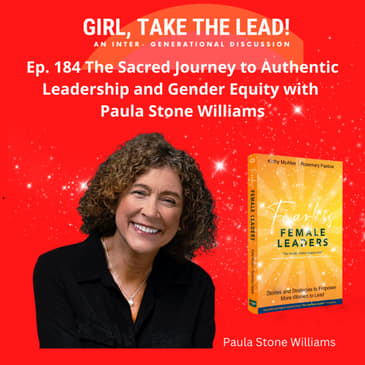
Paula Stone Williams, Boomer, joins us to talk about the fearless face of authenticity as part 3 of our 4-part series about the book Fearless Female Leaders by Kathy McAfee and Rosemary Paetow (Eps, 182, 183).
Paula is a Pastoral Counselor and internationally known speaker on gender equity and religious tolerance. As Kathy and Rosemary wrote this in their book after interviewing Paula: “She who had been born into a boy’s body and was given the name Paul by her parents knew she was meant to be a girl… After leading a double life he made the fearless decision to move forward with her gender transition... for the first time in her years on earth she was feeling seen, heard, loved and valued for who she truly was. A woman.”
Topics covered in the Episode:
Transition journey
Male & woman leadership insights
Gender equity
Authenticity
Mary Oliver’s The Journey
Actions to take the deep inner journey
What keeps us from leading
Rejection
Types of gifts
Women apologizing
Here are three takeaways from the episode:
1. Women can have very strong leadership tendencies and tend to have great confidence coupled with great humility.
2. The call toward authenticity is sacred, is holy, and for the greater good and it’s terrifying and never easy.
3. What stops us from leading is
not what we fear but what gave birth to the fear. It’s something that comes from thinking we’re unworthy of deep human connection as we are. You cannot
lead from a place of strength until you deal with this dragon.
Mentioned in the episode:
Paula’s Ted Talks
https://www.youtube.com/results?search_query=paula+stone+williams+ted+talk
Mary Oliver’s The Journey
https://margaretmcgoverne.com/2019/01/08/poem-of-the-month-the-journey-by-mary-oliver/
Ep. 182 From Origin Story to Empowerment: A Conversation w Fearless Leaders, Kathy McAfee and Rosemary Paetow
https://spotifyanchor-web.app.link/e/CcYH6G3ZYLb
Ep. 183 Flying High: Jane Dyer’s Journey of Fearlessness in the Face of Sexism
https://spotifyanchor-web.app.link/e/VAjC3kby5Lb
Ep. 177, Worthy: Self-Confidence, Self-Worth, and Insights from Jamie Kern Lima’s Book
https://spotifyanchor-web.app.link/e/qqParJ3ZYLb
58. Sorry? Apology help from the Book: Sorry, Sorry, Sorry
https://spotifyanchor-web.app.link/e/Lz5OiP0eFLb
More About Paula:
She lives in Lyons, Colorado, where she serves as Mayor Pro Tem. Paula has been featured in the New York Times, Washington Post, TED, NPR, PBS, and many other media outlets. Her TED talks have had over nine million views. Paula’s memoir, As A Woman, What I Learned About Power, Sex, and the Patriarchy After I Transitioned, was published by Simon & Schuster in 2021.
How to reach Paula:
Website:
How to reach Yo Canny:
Our website:
You can send a message or voicemail there. We’d love to hear from you!
Our store:
www.girltaketheleadpod.com/shop
email:
FB group: Girl, Take the Lead
https://www.facebook.com/groups/272025931481748/?ref=share
IG:
yocanny
LinkedIn:
[00:00:06] Welcome to episode 185, which is a Girl, Take the Lead soundbite. And that's a shorter episode, which may be a bit more about a topic we've covered like our episode today or quick inspiration. And I'm your host, Yolanda Canny. This episode is building on our previous episode with Kathy and Rosemary, where we've talked about their book, Fearless Female Leaders in episode 182.
[00:00:31] We then followed up with part two of the four-part series with Jane Dyer, who was featured in their book, as well as our guest today, Paula Stone Williams. Paula is a pastoral counselor and internationally known speaker on gender equity and religious tolerance.
[00:00:53] Kathy and Rosemary wrote this in their book after interviewing Paula, quote,
[00:00:59] She who was born into a boy's body and was given the name Paul by her parents knew she was meant to be a girl.
[00:01:08] And after leading a double life, he made the fearless decision to move forward with her gender transition.
[00:01:17] For the first time in her years on earth, she was feeling seen, heard, loved, and valued for who she truly was, a woman.
[00:01:30] Paula and I talked about a lot of things, including her transition journey, her insights about leadership, gender equity,
[00:01:38] and authenticity, and authenticity.
[00:01:40] I'm sure you'll be mesmerized as I was when you listened to this episode.
[00:01:46] Enjoy the listen.
[00:01:48] Here you go.
[00:01:55] Well, Paula, welcome to Girl Take the Lead.
[00:01:58] We are very excited to have you and your story and continue the conversation that we started with Kathy and Rosemary about the book,
[00:02:06] Fearless Female Leaders.
[00:02:08] And you are definitely one of those people.
[00:02:10] So thanks for being here.
[00:02:12] Well, it's a pleasure to be with you.
[00:02:14] Great.
[00:02:14] Can you tell our listeners a little bit about your background so they kind of hear some of your story?
[00:02:22] Sure.
[00:02:23] I was the CEO of a large nonprofit.
[00:02:26] I was the host of a national television show.
[00:02:28] I was the editor at large of a national magazine.
[00:02:31] I was a successful, well-educated, quite American male.
[00:02:35] But Thomas Merton said it's a tough thing to climb to the top of the ladder of success only to realize when you get there that your ladder has been leaning against the wrong wall.
[00:02:46] So I knew from the time I was maybe five or so that I was transgender.
[00:02:51] And in my night, it tastes on how I thought I got to choose.
[00:02:54] That a gender fairy would arrive and say, okay, what's it going to be?
[00:02:57] But alas, no gender fairy arrived.
[00:03:00] So I just lived my life.
[00:03:02] I didn't hate being a boy.
[00:03:04] I just knew I wasn't supposed to be one.
[00:03:06] Went to college, got married, had kids, built a career.
[00:03:09] But, you know, the call toward authenticity has all the subtlety of a smoke alarm.
[00:03:14] And eventually decisions have to be made.
[00:03:17] And so I came out as transgender 11 years ago and promptly lost every single one of my jobs.
[00:03:24] I had never had a bad review.
[00:03:26] I lost every single job.
[00:03:28] In all 50 states of the United States, you cannot be fired for being transgender.
[00:03:32] But in all 50, you can be fired if you are transgender and you work for a religious corporation.
[00:03:40] Good to know.
[00:03:41] So I lost all of my friends, all of my work, lost my pension worth about a million dollars.
[00:03:47] I had loaned a nonprofit that I ran about a half a million of my own money.
[00:03:51] I had to threaten a lawsuit to get that back, which was a good thing because over my first
[00:03:57] four years as Paula, I earned a total of $23,000, so less than $6,000 a year.
[00:04:03] Now, since that time, my life has gone quite well.
[00:04:06] I've done three TED Talks that have had about 10 million views.
[00:04:09] I speak all over the world on issues related to gender equity.
[00:04:13] I'm an elected official here in Colorado, a member of the Board of Trustees, Lions, Colorado,
[00:04:18] also the mayor pro tem.
[00:04:20] I helped start a church, pastored that church for six years, and continue as a pastoral
[00:04:26] counselor, which is what my doctorate is in, what I was doing at the time that I transitioned.
[00:04:31] But yeah, it was not an easy journey.
[00:04:34] No.
[00:04:35] And your family was in the church business, right?
[00:04:39] I mean, they were...
[00:04:40] Mm-hmm.
[00:04:41] Yeah.
[00:04:41] ...that made it difficult, I'm sure.
[00:04:43] Yeah, both sides, many generations.
[00:04:46] And my son was in ministry at the time.
[00:04:49] And we've done a TED Talk together, and he's written the book, She's My Dad, that is a best
[00:04:55] lover on what it's like when a family member transitions.
[00:04:58] I think it's probably the best book out there on that subject.
[00:05:02] I wrote responses to five of the chapters.
[00:05:06] And we're probably going to end up doing a TED Talk together again next year.
[00:05:10] We're working on a book proposal together right now.
[00:05:12] Oh, great.
[00:05:13] That does sound very good.
[00:05:15] Yeah.
[00:05:15] What made you get involved with Kathy and Rosemary's book?
[00:05:19] You know, to be completely honest, I do not remember at all.
[00:05:28] Well, I remember Kathy reaching out to me because of my first TED Talk and having a long conversation
[00:05:35] and then somewhere between that and now I ended up in the book.
[00:05:40] Yeah.
[00:05:41] No, it's definitely...
[00:05:43] Well, I'm sure she's done TED Talks too, so I'm sure that's kind of the overlap between
[00:05:48] you two.
[00:05:50] I think you bring a very unique view that's mentioned in the book about leadership from
[00:05:57] both a white male and a woman's point of view.
[00:06:05] What were some of your insights?
[00:06:07] What are some things that you saw there?
[00:06:09] You know, one of the things I think I was interested in pursuing, I mean, my own memoir
[00:06:13] is, as a woman, what I learned about power, sex, and the patriarchy after I transitioned.
[00:06:19] It was published by Simon & Schuster three years ago.
[00:06:23] And I really was interested in not furthering the cause of the patriarchy.
[00:06:31] And in fact, my third TED Talk is about that.
[00:06:36] Interestingly, it's had about a million views, whereas my TED Talk on gender equity has had
[00:06:41] about seven million.
[00:06:43] That's because in that third TED Talk, I suggest to men that maybe they need to make room for
[00:06:50] women in leadership, which might include them stepping down before they're intending to do
[00:06:54] so.
[00:06:55] So that particular talk ended up being not particularly popular among men.
[00:07:01] But it's interesting because I was very interested in pursuing flat leadership models and non-hierarchical,
[00:07:11] non-vertical models.
[00:07:13] And did, in fact, pursue that in one realm of nonprofit work that, in fact, had been my
[00:07:18] specialty for 35 years.
[00:07:20] And after six years of that, I actually have come to the conclusion that there's nothing wrong
[00:07:25] with a vertical leadership.
[00:07:27] It's mostly how it's handled, how it's done.
[00:07:31] And I've probably given, I don't know, 10,000 disk tests over the years, which is a very reliable
[00:07:39] psychological test that focuses on how we function in our work environment.
[00:07:44] And what I have discovered is that those who are very, very good at leadership, particularly
[00:07:53] in entrepreneurial leadership, do, in fact, have certain personality types.
[00:07:59] But that, measurably, women with those types are far better as CEOs than men with those types.
[00:08:08] And one of the things I've discovered is that women will have very strong leadership abilities.
[00:08:13] What's on that test called dominance and influencing, which means that they are, in fact,
[00:08:19] dominant and are interested in influencing large groups of people.
[00:08:23] So, but that women tend to do it a little bit more often, particularly in the Western world.
[00:08:28] And I can't speak outside of that.
[00:08:30] But in the Western world, they are much more inclined to have the dual and paradoxical strengths
[00:08:36] of great confidence coupled with great humility.
[00:08:40] And that, you know, if you would think about that from a male perspective, very easy to think
[00:08:44] about, think the difference between Bush 41 and Bush 43.
[00:08:48] You see it very, very clearly in male leaders.
[00:08:53] But you also see it in female leaders and see it far more often in female leaders.
[00:08:59] It's almost the norm to see that confidence coupled with humility.
[00:09:04] You see it in, you know, take a look at six countries that did extremely well in the first
[00:09:09] year of the coronavirus.
[00:09:10] There is Finland, Norway, Germany, Iceland, Taiwan, and New Zealand.
[00:09:18] All six had a female head of state at the time.
[00:09:21] And all six had a female head of state who saw her health department not as subordinates,
[00:09:28] but as co-workers in this important area where they were listening to them.
[00:09:34] They also did not have a lot of ego in the game.
[00:09:37] They were not looking for the ego satisfying solution.
[00:09:41] They were looking for the best solution under the circumstances.
[00:09:44] And the one thing that all six had in common that you did not see in three countries that
[00:09:49] did spectacularly poorly in the first year, Brazil, the United States, and Great Britain.
[00:09:54] But one thing you see in all six of those is these women were all willing to admit when
[00:09:59] they were wrong and very quickly pivot and move in another direction.
[00:10:03] Jacinda Ardern was probably the best example of that in New Zealand.
[00:10:06] And of course, you did not see that in any of those three other nations that did horribly,
[00:10:14] because in all three, you had men with very great ego need and very little ego strength,
[00:10:20] which is never a good combination.
[00:10:23] Yeah.
[00:10:23] Well, I think from being an observer and being the person that you are now today and having
[00:10:34] the insights of both sides of the coin.
[00:10:38] I mean, it's, I think we all have our filters in the way that we see things.
[00:10:46] It's so difficult to understand the other genders so that we can get along and we can communicate
[00:10:56] and we can, you know, love each other and embrace the differences as well as the commonalities.
[00:11:04] And I think it's so great when you talk about it because not everybody can do that.
[00:11:10] Yeah.
[00:11:11] Yeah.
[00:11:11] I speak all over the world on issues related to gender equity, which is the subject of my
[00:11:16] first TED Talk.
[00:11:17] Yeah.
[00:11:18] Because I have seen it from both sides.
[00:11:20] I often say that I come from a liminal space between genders, from the borderlands between
[00:11:24] genders.
[00:11:26] I will not live long enough to lose my white male entitlement.
[00:11:29] I know what privilege is.
[00:11:32] And I also now know what it is like to constantly be questioned and to apparently have become quite
[00:11:40] stupid over the last 11 years.
[00:11:42] If I am to listen to those who seem to think that I cannot have the kinds of expertise I
[00:11:49] actually have in a number of broad areas.
[00:11:52] Yeah.
[00:11:53] There's a wonderful quote in the book.
[00:11:55] I just want to quote something from the book that I think you had in perhaps your other
[00:12:02] book.
[00:12:03] We can either spend our lives searching for comfort or we can spend our lives searching
[00:12:09] for meaning.
[00:12:10] Rarely will the two lead to the same conclusion.
[00:12:15] I thought that was.
[00:12:17] Yeah, that's actually not in my first book.
[00:12:21] And I believe I picked that up, not the exact language, but the concept of it up from James
[00:12:29] Hollis, a union analyst in his book, Swamp Lands of the Soul, which has been very, very instructive
[00:12:36] to me over the last several years.
[00:12:39] If you are, in fact, searching for meaning, and of course, that is the basic search of
[00:12:45] mankind.
[00:12:45] I mean, Viktor Frankl had it right.
[00:12:48] We want our lives to make a difference.
[00:12:52] And when you do that, it will always take you down the road less traveled by and will
[00:12:58] always lead to suffering because suffering is, in fact, the path of service.
[00:13:06] Always has been, always will be.
[00:13:13] Let that sit in for a minute.
[00:13:14] I also think what you point to a lot is our sense of, especially with that quote, the sense
[00:13:26] of authenticity that is living your life, not perhaps with comfort, but taking that harder
[00:13:34] road that you described.
[00:13:40] And I know that it costs you, but it also seemed to open you up to new things.
[00:13:47] Oh, absolutely.
[00:13:49] I think, you know, when I was working on my first TED Talk, my coach was the head coach
[00:13:54] for TED, and we've become good friends.
[00:13:56] And I kept losing a connection.
[00:14:01] You have to memorize TED Talks.
[00:14:03] I coach TED speakers now, and they're always think they can't memorize their talks.
[00:14:09] Everybody can.
[00:14:11] I memorize a talk every single week.
[00:14:13] But I kept losing the connection between two paragraphs.
[00:14:18] And finally, she said just the day before, which is way late in the process, she said,
[00:14:24] yeah, you're lacking a transition sentence.
[00:14:27] So came to me about two in the morning and ended up being the most quoted line from that
[00:14:33] talk.
[00:14:34] Also, the dedication line from my own book, which is the call toward authenticity is sacred
[00:14:40] and holy and for the greater good.
[00:14:45] And I believe that's true.
[00:14:48] I say the call toward authenticity, because there's no such thing as authenticity.
[00:14:52] We're always on the journey to get there.
[00:14:55] We are always trying to live authentically.
[00:14:59] But the call to it, the call toward trying to live authentically is sacred.
[00:15:05] It is holy.
[00:15:08] And it is for the greater good.
[00:15:11] It's also terrifying.
[00:15:13] And it is never easy.
[00:15:17] Yeah.
[00:15:18] Well, I know I feel like I don't have a net under me.
[00:15:22] Like I'm walking and I'm just like, okay, where am I supposed to go?
[00:15:31] Well, I'll just do the next, take the next step or just do the next indicated thing.
[00:15:36] And there's no script.
[00:15:39] There's no map.
[00:15:45] No.
[00:15:47] No.
[00:15:48] I mean, that brings to mind, you know, Mary Oliver's wonderful poem, The Journey, said,
[00:15:56] One day you knew what you had to do and began.
[00:15:58] Though the voices around you kept shouting their bad advice, the whole house began to tremble
[00:16:02] and you felt the old tug at your ankles.
[00:16:05] Mend my life.
[00:16:06] Each one of those voices cried.
[00:16:09] Mend my life.
[00:16:10] But you did not stop.
[00:16:12] You knew what you had to do.
[00:16:14] Though the wind pried with its fingers at the very foundations.
[00:16:18] Though their melancholy was terrible.
[00:16:20] But it was already late enough.
[00:16:25] And a wild night.
[00:16:27] And the road full of fallen branches and stones.
[00:16:31] But little by little, as you left their voices behind.
[00:16:35] I love that.
[00:16:36] But little by little, as you left their voices behind, the stars began to burn through the
[00:16:41] sheets of clouds.
[00:16:42] And there was a new voice, a new voice, a new voice, which you slowly recognized as
[00:16:48] your own that kept you company as you strode deeper and deeper into the world.
[00:16:55] Determined to do the only thing you could do.
[00:16:59] Determined to save the only life you could save.
[00:17:02] I love the end of that.
[00:17:05] Stars began to burn through the sheets of clouds.
[00:17:07] There was a new voice, which you slowly recognized as your own that kept you company as you strode
[00:17:13] deeper and deeper into the world.
[00:17:14] And determined to do the only thing you could do.
[00:17:17] Determined to save the only life you could save.
[00:17:21] That's Mary Oliver, the journey.
[00:17:23] And of course, she lived her own life very much.
[00:17:26] Following that.
[00:17:28] I will.
[00:17:29] North Star.
[00:17:30] It always happens on this.
[00:17:32] When I'm, my heart can be so touched by a guest and what they're saying.
[00:17:37] And I'm like weeping over here.
[00:17:39] Because I'm like, oh, it's.
[00:17:40] Well, it's.
[00:17:41] I mean, it is a powerful, powerful poem.
[00:17:44] I have several of hers memorized, but I probably quote that one most often.
[00:17:49] Beautiful.
[00:17:51] So one of the things, I guess, in chapter 10 of Kathy and Rosemary's book,
[00:17:57] they outline actions that readers can take, you know, to lift themselves up more as, as leaders.
[00:18:07] And when you think about that, what are some actions that our listeners and our viewers can take
[00:18:15] that would be helpful?
[00:18:19] I don't know that you can lead if you have not taken the deep inner journey.
[00:18:24] And by deep inner journey, I'm a therapist by trade.
[00:18:28] That's what my doctorate is in, pastoral counseling.
[00:18:31] I find places for cognitive behavioral therapy.
[00:18:34] It helps a lot in many different circumstances.
[00:18:37] But I'm talking more about depth psychology, psychodynamic therapy, where we begin to take a hard look at why we do what we do.
[00:18:47] Because until we understand that, we are doomed to continue to repeat the patterns.
[00:18:54] And often, I find the thing that stops us from leadership is not the thing we fear.
[00:19:00] It's that which gave birth to the thing we fear.
[00:19:04] I mean, that's the first lesson of the old English story, Beowulf.
[00:19:10] You know, Beowulf slays the horrible monster, Grendel.
[00:19:14] But then an even more hideous monster arrives and devours the king's men.
[00:19:20] And who is this more hideous monster?
[00:19:22] It's the mother of Grendel.
[00:19:24] And Beowulf has to lay her.
[00:19:27] And often, I discover that what stops us from leading adequately is not the things we fear,
[00:19:35] but it's that which gave birth to the thing we fear.
[00:19:38] For instance, one of the things I discover a lot in my counseling practice,
[00:19:42] is I've worked with a lot of Fortune 500 C-suite people, so very top-level leaders.
[00:19:49] And they desperately fear failure.
[00:19:52] And particularly if they're male, more so, they fear failure.
[00:19:57] And that's never actually the thing they fear.
[00:20:00] What is behind it is that every last one of us,
[00:20:04] it is wired into our DNA to want deep human connection.
[00:20:08] We are neurobiologically wired for deep human connection.
[00:20:13] And yet, it is almost a ubiquitous human experience
[00:20:17] to believe that there's something about us
[00:20:20] that makes us unworthy of deep human connection.
[00:20:24] The fundamentalist forms of the desert religions have fed this for a few thousand years.
[00:20:29] Only in their fundamentalist forms, I will add.
[00:20:32] But whether it's Christianity, Judaism, or Islam,
[00:20:35] all three at that level teach us that we are not worthy as we are.
[00:20:41] And I find that actually to be the bigger problem for people.
[00:20:47] It's not that they fear failure.
[00:20:49] It's that they fear that there's something about them
[00:20:52] that makes them unworthy of deep human connection.
[00:20:56] And usually that comes from our family of origin,
[00:20:59] or it comes from generational trauma.
[00:21:01] And it is a dragon not easily slain,
[00:21:06] because often it's pretty complex.
[00:21:09] And then you add with those who were raised as females,
[00:21:14] cis females, identified female at birth,
[00:21:17] have a much, much higher incidence of sexual abuse in their background,
[00:21:21] and complex trauma related to sexual abuse,
[00:21:27] that it just ends up building on itself and building on itself.
[00:21:31] And I don't think you ever really can lead from a place of strength
[00:21:35] until you deal with those deepest of fears.
[00:21:42] So when you came out, did you have a sense,
[00:21:48] or were you fearful of how the family and friends reacted,
[00:21:55] would react to this?
[00:21:56] Oh, no.
[00:21:57] No, I think my male entitlement knew no bounds.
[00:22:02] I thought, well, you know, all these friends,
[00:22:05] I've known these thousands of people for years,
[00:22:08] I was a national leader in my denomination.
[00:22:11] And, you know, they have one or two options here.
[00:22:13] Either they have to think to themselves,
[00:22:16] oh, I was wrong about what it means to be transgender.
[00:22:19] Or they could think I was wrong about Paul.
[00:22:22] And what shocked me is that they pretty much all to a person
[00:22:27] decided they had been wrong about Paul,
[00:22:29] wrong about my character.
[00:22:31] So that rejection was not something I expected.
[00:22:35] With my family, I think there was an eye to say
[00:22:38] that you see often, particularly with trans women,
[00:22:41] and to get the nomenclature right,
[00:22:44] I am a trans woman.
[00:22:45] Somebody identified male at birth who then transitions genders.
[00:22:48] With trans women, because they have had so much male entitlement,
[00:22:53] they don't understand how difficult it's going to be
[00:22:57] for their family and friends.
[00:22:59] And, you know, I protested, as most trans women do,
[00:23:02] in the first year.
[00:23:03] So I'm the same person.
[00:23:05] Well, the truth is, you're not.
[00:23:07] If you remove testosterone and add estrogen,
[00:23:10] you become fundamentally a different person.
[00:23:14] And we are a gendered culture.
[00:23:16] And so it was extremely difficult for my family.
[00:23:21] I think I naively thought it'd take about five years
[00:23:24] for everybody to adjust.
[00:23:27] And then within, yeah, two or three years,
[00:23:30] I thought, no, more likely 10.
[00:23:32] And now I realize, yeah, no, not,
[00:23:35] it actually never happens.
[00:23:36] That we will always all be adjusting
[00:23:39] because it's not ever easy,
[00:23:41] particularly for my son and my wife,
[00:23:43] my former wife.
[00:23:44] Mm-hmm, mm-hmm, yeah.
[00:23:48] Yeah, because I think sometimes
[00:23:49] we have to take certain actions
[00:23:54] and have certain commitments.
[00:23:57] And you kind of know it's going to hurt a little bit,
[00:24:01] but you're compelled to do it.
[00:24:06] It's, you walk through it.
[00:24:09] You have to go through it.
[00:24:10] And that's what bravery encourages.
[00:24:13] And I so appreciate that in your story.
[00:24:17] Yeah, the truth will set you free,
[00:24:19] but it's pretty much always going to make you miserable first.
[00:24:26] Oh, and Paula,
[00:24:28] you just must be the most amazing counselor
[00:24:30] that working with.
[00:24:32] Oh, you know what?
[00:24:34] Probably.
[00:24:36] You know, I think we all have
[00:24:37] what I call abilities,
[00:24:40] gifts, and pinnacle gifts.
[00:24:42] And ability is,
[00:24:43] arbitrarily use the language,
[00:24:45] but ability is something you're good at
[00:24:46] that you don't like,
[00:24:47] you don't enjoy,
[00:24:48] but you're good at it.
[00:24:49] People want you to do it.
[00:24:51] And then we have gifts.
[00:24:52] And gifts are things we're good at
[00:24:54] that we enjoy so much
[00:24:55] we lose track of time doing them.
[00:24:57] And then there are pinnacle gifts.
[00:24:59] And a pinnacle gift is our sweet spot,
[00:25:02] that place where others say,
[00:25:04] oh, this, this is what you were made for.
[00:25:07] I would say my work as a therapist
[00:25:10] is a gift,
[00:25:11] not my pinnacle gift.
[00:25:15] I think my former wife,
[00:25:16] who I still work with,
[00:25:17] I think for her,
[00:25:18] it's a pinnacle gift.
[00:25:19] I think my own therapist,
[00:25:21] who I've had in New York for 31 years,
[00:25:24] for her,
[00:25:25] it's clearly a pinnacle gift.
[00:25:28] I know my limitations with it,
[00:25:30] which is a good thing
[00:25:31] to know.
[00:25:33] I also know that
[00:25:34] most of my clients
[00:25:35] have very positive feelings
[00:25:38] about the work we do together.
[00:25:40] But yeah,
[00:25:41] I,
[00:25:42] I
[00:25:43] would
[00:25:44] wish
[00:25:45] I were maybe a little stronger at it
[00:25:47] than I am.
[00:25:48] Well,
[00:25:49] what is your pinnacle gift?
[00:25:51] I think for me,
[00:25:53] it's,
[00:25:53] it's speaking
[00:25:55] and,
[00:25:57] and coaching other speakers.
[00:25:58] I mean,
[00:25:59] I,
[00:26:00] I think you always have to be open
[00:26:02] to new gifts.
[00:26:04] And too many people,
[00:26:05] once they hit retirement age,
[00:26:06] are not.
[00:26:07] And I'm older than Dirk.
[00:26:08] I'm way past retirement age.
[00:26:11] And I think you always have to be looking
[00:26:13] for new gifts.
[00:26:14] And since I started coaching
[00:26:15] with the largest TEDx in North America,
[00:26:18] which is here in Denver,
[00:26:19] and serving as a speakers ambassador
[00:26:21] with TED,
[00:26:23] which is kind of coaching light
[00:26:24] with TED,
[00:26:26] I've discovered that,
[00:26:28] that I have a very strong gift
[00:26:30] as a speakers coach.
[00:26:31] And at this point in my life,
[00:26:32] I probably would
[00:26:34] rather coach speakers
[00:26:35] than I would speak.
[00:26:36] So I love working
[00:26:37] with our TED speakers
[00:26:38] because you're taking
[00:26:39] the smartest human beings
[00:26:41] from the face of the earth.
[00:26:42] And most of them
[00:26:44] are not particularly
[00:26:45] good speakers.
[00:26:47] So,
[00:26:48] Chris Anderson at TED
[00:26:49] always says that
[00:26:50] a speakers coach
[00:26:51] is the job
[00:26:52] to take
[00:26:52] scientific nerds
[00:26:54] and give him his hands.
[00:26:58] Which is kind of what it is,
[00:27:00] I guess.
[00:27:00] Well, you're,
[00:27:00] you're mesmerizing.
[00:27:02] Like,
[00:27:02] I'm just like listening to you
[00:27:04] and feeling very peaceful
[00:27:05] and very calm
[00:27:07] and
[00:27:08] your voice
[00:27:09] and just the way
[00:27:10] that you articulate yourself.
[00:27:12] I mean,
[00:27:12] I can definitely see
[00:27:14] that that's a
[00:27:16] major
[00:27:17] skill for you.
[00:27:19] And it's your superpower.
[00:27:21] Yeah, definitely.
[00:27:22] Yeah.
[00:27:22] I mean,
[00:27:23] that's the area
[00:27:24] where
[00:27:24] where people
[00:27:26] I
[00:27:27] emcee
[00:27:28] every other
[00:27:30] TEDx Mile High event,
[00:27:32] which is
[00:27:32] in a
[00:27:33] wonderful,
[00:27:34] huge theater
[00:27:34] about 3,000 seats.
[00:27:36] And
[00:27:38] I was there
[00:27:39] last night
[00:27:40] for a Broadway show
[00:27:42] Wicked
[00:27:42] and
[00:27:43] just,
[00:27:44] you know,
[00:27:45] looking
[00:27:45] at the
[00:27:46] middle of that
[00:27:47] very large stage
[00:27:48] and thinking,
[00:27:50] yeah,
[00:27:50] I am really
[00:27:51] comfortable there.
[00:27:53] and,
[00:27:54] you know,
[00:27:55] not everyone
[00:27:55] feels that way
[00:27:56] for me.
[00:27:59] Yeah,
[00:28:00] I do.
[00:28:01] I do.
[00:28:02] I think also
[00:28:03] there's
[00:28:03] a wisdom
[00:28:05] that comes
[00:28:05] with age
[00:28:06] where
[00:28:06] you know
[00:28:07] you're really
[00:28:08] not all that.
[00:28:09] You know,
[00:28:09] you know
[00:28:10] that there are
[00:28:10] plenty of people
[00:28:11] who are far better
[00:28:12] than you
[00:28:12] in any area.
[00:28:14] but you
[00:28:15] also begin
[00:28:16] to stop
[00:28:16] apologizing
[00:28:17] for what
[00:28:17] you are
[00:28:19] good at.
[00:28:20] Though I'm
[00:28:20] not sure
[00:28:21] women ever
[00:28:21] stop
[00:28:22] apologizing
[00:28:23] for who
[00:28:24] they are.
[00:28:25] I can't
[00:28:26] believe how
[00:28:26] often I do
[00:28:27] it now.
[00:28:28] Kathy,
[00:28:29] my former
[00:28:29] wife,
[00:28:29] was saying
[00:28:30] it just
[00:28:30] the other
[00:28:30] day.
[00:28:31] She said,
[00:28:31] oh my
[00:28:31] God,
[00:28:32] you just
[00:28:33] apologize
[00:28:33] for yourself
[00:28:35] so much
[00:28:36] now,
[00:28:36] and you
[00:28:37] virtually
[00:28:37] never did
[00:28:38] when you
[00:28:38] were both.
[00:28:41] Which I
[00:28:42] don't think
[00:28:43] was a
[00:28:43] compliment.
[00:28:44] I'm
[00:28:44] relatively
[00:28:45] sure.
[00:28:45] to womanhood.
[00:28:47] It's in
[00:28:48] the water.
[00:28:49] I know
[00:28:50] it's in
[00:28:50] the water
[00:28:50] we drink
[00:28:51] all the
[00:28:52] time.
[00:28:52] I'm so
[00:28:53] sorry.
[00:28:57] I have
[00:28:57] noticed
[00:28:58] Kamala Harris
[00:28:58] does not
[00:28:59] do that.
[00:29:00] Oh,
[00:29:00] man.
[00:29:02] Yeah.
[00:29:03] So
[00:29:04] amazing.
[00:29:07] I
[00:29:07] every time
[00:29:09] I hear
[00:29:09] her energy
[00:29:10] and I'm
[00:29:11] watching her
[00:29:11] I'm like,
[00:29:14] You know,
[00:29:15] I spoke
[00:29:15] as a
[00:29:16] surrogate
[00:29:16] for one
[00:29:17] of her
[00:29:17] events
[00:29:17] on,
[00:29:20] well,
[00:29:21] a few
[00:29:21] days ago.
[00:29:22] It's the
[00:29:23] first day
[00:29:23] that she
[00:29:25] and Tim
[00:29:25] Wells
[00:29:25] were together
[00:29:27] in Philadelphia
[00:29:27] and that
[00:29:28] same evening
[00:29:28] the head
[00:29:30] of her
[00:29:33] campaign
[00:29:34] and then
[00:29:35] three other
[00:29:36] people,
[00:29:36] all of us,
[00:29:37] all four
[00:29:38] of us
[00:29:39] spoke
[00:29:40] to
[00:29:42] LGBTQ
[00:29:42] plus
[00:29:43] leaders
[00:29:43] all over
[00:29:44] the
[00:29:44] nation.
[00:29:44] I don't
[00:29:45] know,
[00:29:45] I think
[00:29:45] about
[00:29:46] 300
[00:29:46] of them
[00:29:48] and I
[00:29:48] noticed
[00:29:49] every last
[00:29:49] one of us,
[00:29:50] all four
[00:29:50] of us,
[00:29:50] apologize
[00:29:51] for
[00:29:51] ourselves.
[00:29:52] It's
[00:29:53] like,
[00:29:53] you know,
[00:29:53] here we
[00:29:54] are national
[00:29:54] speakers.
[00:29:55] I mean,
[00:29:55] one is
[00:29:55] running
[00:29:56] her whole
[00:29:56] campaign
[00:29:57] and yet
[00:29:58] somewhere
[00:29:58] in the
[00:29:58] matter
[00:29:59] of five
[00:29:59] minutes
[00:30:00] we can
[00:30:00] say,
[00:30:00] I'm
[00:30:00] sorry
[00:30:01] about
[00:30:01] something.
[00:30:02] Yeah.
[00:30:03] I did
[00:30:03] a couple
[00:30:04] episodes
[00:30:04] on that
[00:30:05] because there's
[00:30:05] been some
[00:30:06] great books
[00:30:06] written about
[00:30:07] that and
[00:30:07] I love
[00:30:08] talking about
[00:30:10] you know,
[00:30:11] just things
[00:30:11] that we're
[00:30:12] kind of
[00:30:13] unaware
[00:30:14] of
[00:30:16] that we
[00:30:17] do
[00:30:17] because
[00:30:17] we just
[00:30:18] don't
[00:30:18] observe
[00:30:19] everything
[00:30:19] about
[00:30:19] that.
[00:30:21] And there
[00:30:21] is so
[00:30:22] much.
[00:30:23] Yeah,
[00:30:24] I have
[00:30:24] heard from
[00:30:25] women on
[00:30:25] all seven
[00:30:26] continents
[00:30:27] and somebody
[00:30:28] always asks
[00:30:29] yes,
[00:30:29] including
[00:30:30] Antarctica,
[00:30:31] two women
[00:30:32] from
[00:30:32] Antarctica,
[00:30:33] just thanking
[00:30:34] you for
[00:30:35] validating your
[00:30:35] experience as a
[00:30:36] woman because
[00:30:37] you don't
[00:30:37] know when
[00:30:38] that's the
[00:30:39] only water
[00:30:39] you swim
[00:30:40] in.
[00:30:40] Yeah,
[00:30:41] yeah.
[00:30:41] That it is
[00:30:42] so different
[00:30:42] for men,
[00:30:44] but oh my
[00:30:45] God,
[00:30:45] it is so
[00:30:46] different
[00:30:47] for men.
[00:30:50] Well,
[00:30:51] I always
[00:30:52] ask my
[00:30:52] guests this
[00:30:53] one question
[00:30:53] and I'm
[00:30:54] sure you'll
[00:30:54] have an
[00:30:55] interesting
[00:30:55] way to
[00:30:56] answer it,
[00:30:57] but what
[00:30:57] would you
[00:30:58] tell your
[00:30:58] 20-something
[00:30:59] self
[00:31:00] today?
[00:31:08] I would
[00:31:09] say you
[00:31:10] can wait
[00:31:12] because
[00:31:12] there's
[00:31:13] a lot
[00:31:13] more rich
[00:31:14] life much
[00:31:16] later in
[00:31:17] your decades
[00:31:18] than you
[00:31:19] were aware
[00:31:19] of.
[00:31:20] You know,
[00:31:20] I read a
[00:31:20] study not
[00:31:21] long ago
[00:31:21] that said
[00:31:22] our happiest
[00:31:23] decade is
[00:31:24] our 60s,
[00:31:25] our second
[00:31:25] happiest is
[00:31:26] our 70s,
[00:31:27] our third
[00:31:28] is our 50s,
[00:31:29] and the
[00:31:29] worst is
[00:31:31] our 40s.
[00:31:32] And I
[00:31:33] think I
[00:31:34] thought back
[00:31:35] then I
[00:31:35] had to
[00:31:35] accomplish
[00:31:35] everything
[00:31:36] right then.
[00:31:37] And now
[00:31:38] that I'm
[00:31:39] living a
[00:31:39] second
[00:31:40] life,
[00:31:41] a completely
[00:31:42] different
[00:31:43] life,
[00:31:45] and I'm
[00:31:45] 11 years
[00:31:46] into that,
[00:31:47] I realize,
[00:31:47] oh,
[00:31:48] there's
[00:31:48] plenty of
[00:31:49] time,
[00:31:50] and it's
[00:31:51] all right
[00:31:51] to grow
[00:31:53] and mature
[00:31:53] and develop
[00:31:54] in your
[00:31:55] own way.
[00:31:56] I also
[00:31:57] would have
[00:31:57] said,
[00:31:58] spend the
[00:31:59] time with
[00:31:59] your kids
[00:32:00] that you're
[00:32:00] going to
[00:32:00] spend with
[00:32:01] them.
[00:32:02] Do not
[00:32:02] put them
[00:32:03] second,
[00:32:03] put them
[00:32:04] first,
[00:32:05] because that
[00:32:06] pays off
[00:32:06] like nothing
[00:32:07] else.
[00:32:07] And I
[00:32:08] would say
[00:32:08] that to
[00:32:08] every father
[00:32:09] everywhere,
[00:32:09] mothers do
[00:32:10] it anyway.
[00:32:11] But I
[00:32:12] think most
[00:32:12] fathers think
[00:32:13] that they're
[00:32:13] providing,
[00:32:14] that they're
[00:32:14] doing what
[00:32:14] they're supposed
[00:32:15] to do,
[00:32:15] and I
[00:32:16] was never
[00:32:17] one of
[00:32:17] those fathers
[00:32:18] and I'm
[00:32:18] very glad
[00:32:19] that I
[00:32:19] was not.
[00:32:21] It's a
[00:32:22] beautiful way
[00:32:22] for us to
[00:32:23] end our
[00:32:23] episode today.
[00:32:25] Thank you,
[00:32:26] Paula,
[00:32:26] for joining
[00:32:26] us.
[00:32:27] Really,
[00:32:27] really love
[00:32:28] listening to
[00:32:29] you and
[00:32:29] talking with
[00:32:30] you,
[00:32:30] so thank
[00:32:31] you.
[00:32:31] Oh,
[00:32:32] it's been
[00:32:32] a pleasure
[00:32:32] being with
[00:32:33] you.
[00:32:38] Thank you
[00:32:39] for listening
[00:32:39] today and
[00:32:40] we sure
[00:32:40] hope you
[00:32:40] enjoyed
[00:32:41] this episode.
[00:32:42] If you
[00:32:42] did,
[00:32:43] please leave
[00:32:43] a comment
[00:32:43] wherever you
[00:32:44] listen to
[00:32:45] your podcasts,
[00:32:46] tell a friend
[00:32:46] about us,
[00:32:47] or join our
[00:32:48] public Facebook
[00:32:49] group,
[00:32:49] Girl Take
[00:32:50] the Lead.
[00:32:51] We also
[00:32:51] have a
[00:32:52] YouTube
[00:32:52] channel
[00:32:53] where your
[00:32:54] subscription
[00:32:54] would be
[00:32:55] appreciated.
[00:32:56] Once you're
[00:32:56] on YouTube,
[00:32:57] just search
[00:32:57] at Girl
[00:32:58] Take the
[00:32:58] Lead.
[00:33:00] And we're
[00:33:01] on YouTube
[00:33:01] Music
[00:33:02] where you
[00:33:02] can see
[00:33:03] a video
[00:33:04] of this
[00:33:04] episode.
[00:33:05] You can
[00:33:06] also check
[00:33:06] out our
[00:33:07] new store
[00:33:08] on our
[00:33:08] website,
[00:33:10] girltaketheleadpod.com
[00:33:12] slash shop
[00:33:13] and plan to
[00:33:14] return to it
[00:33:15] as we'll
[00:33:16] update our
[00:33:16] products monthly.
[00:33:20] Here are
[00:33:21] three takeaways
[00:33:22] from our
[00:33:22] episode.
[00:33:24] One,
[00:33:25] women can
[00:33:26] have very
[00:33:27] strong leadership
[00:33:28] tendencies
[00:33:29] and tend
[00:33:30] to have great
[00:33:31] confidence coupled
[00:33:32] with great
[00:33:33] humility.
[00:33:33] two,
[00:33:35] the call
[00:33:36] toward
[00:33:37] authenticity
[00:33:37] is sacred,
[00:33:39] is holy,
[00:33:40] and for the
[00:33:41] greater good,
[00:33:42] and it's
[00:33:43] terrifying
[00:33:44] and never
[00:33:45] easy.
[00:33:46] Three,
[00:33:48] what stops
[00:33:49] us from
[00:33:49] leading is
[00:33:50] not what
[00:33:51] we fear,
[00:33:52] but what
[00:33:53] gave birth
[00:33:54] to the
[00:33:54] fear.
[00:33:55] It's
[00:33:56] something that
[00:33:57] comes from
[00:33:58] thinking we're
[00:33:59] unworthy
[00:33:59] of deep
[00:34:01] human connection
[00:34:02] as we
[00:34:03] are.
[00:34:04] You can't
[00:34:05] lead from
[00:34:06] a place
[00:34:06] of strength
[00:34:07] until you
[00:34:08] deal with
[00:34:09] this dragon.
[00:34:11] I know,
[00:34:12] I only ever
[00:34:13] put three
[00:34:14] takeaways,
[00:34:15] but if I
[00:34:15] were to
[00:34:16] have a
[00:34:16] fourth,
[00:34:17] it would
[00:34:17] be my
[00:34:18] favorite
[00:34:18] Paula
[00:34:19] quote.
[00:34:21] We can
[00:34:22] either spend
[00:34:23] our lives
[00:34:23] searching for
[00:34:24] comfort,
[00:34:24] or we can
[00:34:26] spend our
[00:34:26] lives searching
[00:34:27] for meaning.
[00:34:28] Rarely will
[00:34:29] the two lead
[00:34:30] to the same
[00:34:31] conclusion.
[00:34:32] Our next
[00:34:34] episode will
[00:34:34] conclude our
[00:34:35] four-part
[00:34:36] series with
[00:34:37] our guest,
[00:34:37] Kim Deshane,
[00:34:39] who shares
[00:34:39] another fearless
[00:34:40] story with us,
[00:34:42] and hers is
[00:34:43] about fearless
[00:34:44] in the face
[00:34:45] of depression.
[00:34:47] Please join
[00:34:48] us again.
[00:34:49] Thanks for
[00:34:50] being here,
[00:34:51] and talk to
[00:34:51] you soon.
[00:34:52] Bye.
[00:34:53] Bye.