
What if resentment isn't the problem...
What if it's the invitation?
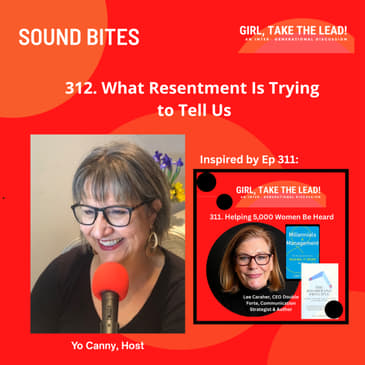
Inspired by my recent conversation with communication strategist and CEO Lee Caraher, this Sound Bite explores what often lies beneath resentment—and how a simple pause can help us move from assumptions and "shoulds" toward greater understanding.
Resentment can begin with something as ordinary as a disappointment that never gets talked about or something much deeper that continues to replay in our minds. Either way, it asks us to pay attention.
Drawing on insights from Lee Caraher, Brené Brown, and Byron Katie, I reflect on how resentment often begins with hurt, grows through the stories we tell ourselves, and quietly keeps us stuck in the past.
Together, we'll explore how pausing, journaling, and asking a few simple questions can help us move toward greater clarity, understanding, and perhaps even forgiveness.
In this Sound Bite:
• Why resentment often begins with hurt
• How "should" and assumptions fuel resentment
• Brené Brown's question:
"What do I need that I'm afraid to ask for?"
• Byron Katie's invitation:
"Is it true?"
• How journaling helps separate facts from the stories we create
• Why pausing creates space for understanding
• How requests and offers can replace assumptions
Questions for Reflection
- Where do I notice resentment in my body?
- What story am I telling myself?
- Is it true?
- What do I need that I haven't asked for?
- What part of this belongs to me?
Sometimes the most important conversation isn't the one we have with someone else.
It's the one we have with ourselves.
If you enjoyed this reflection, be sure to listen to Episode 311: Helping 5,000 Women Be Heard with Lee Caraher, where we explore communication, leadership, and why every woman deserves to be heard.
Connect with Girl, Take the Lead!
🌐 https://girltaketheleadpod.com
🎧 Listen wherever you enjoy podcasts.
[00:00:06] Welcome to Soundbite, a short reflection inspired by a recent conversation on Girl, Take the Lead. I'm your host, Yolanda Canny. Each soundbite is an opportunity to pause, reflect, and explore one idea a little more deeply, and perhaps discover something about ourselves we hadn't noticed before. Today's reflection was inspired by my conversation with communication
[00:00:32] strategist and CEO, Lee Caraher. Let's get started. During my conversation with Lee, she shared two words she believes often get us into trouble. Should and I assumed. At first I thought she was talking about communication, but the more I sat with those words, the more I realized she was
[00:00:57] talking about something much deeper. Resentment. Resentment can show up in different ways. Sometimes it grows from everyday disappointments that never get talked about. Sometimes it follows much deeper hurts. Either way, it asks us to pay attention. Have you ever noticed how resentment
[00:01:20] feels in your body? For me, it's a tightening in my stomach. Then my mind starts replaying the same story over and over again. Like they should have known. They should have remembered. They should have asked. And every time I replay it, I gather more evidence that I'm right. I build a stronger case.
[00:01:45] Before long, I've convinced myself I've been wronged. And the other person doesn't even know they're on trial. The more I paid attention to my own resentment, the more I realized it wasn't the first feeling.
[00:02:04] It followed a sequence. First, I feel hurt. Then I look for an explanation. I create a story about what happened. That story then becomes they should have. Then I replay the evidence until resentment begins to grow. Researcher Brené Brown describes resentment as a feeling that often appears when we've
[00:02:33] haven't asked for what we need or haven't set clear boundaries. One question she asks herself whenever resentment shows up is, what do I need that I'm afraid to ask for? Wow, right? That question changes everything because suddenly I'm no longer focused on what someone else should have done.
[00:02:59] I'm asking what part of this belongs to me. And I found something else that helps. When I can't figure out what I'm feeling. I write it just open my journal and let the thoughts spill onto the page kind of automatically. It helps me slow down enough to separate the facts from the story I've
[00:03:25] created about them. Sometimes I discover what I called resentment was really hurt or disappointment or an expectation I never expressed or simply a story I hadn't questioned. The next time you notice the knot in your
[00:03:45] stomach or hear yourself saying they should have, pause. Notice what's happening inside you. Become curious about the story you're telling yourself. If writing helps. Pick up the journal. Then ask yourself, is it true? A little Byron
[00:04:11] Katie worked there. And then ask, what do I need that I haven't asked for? A la Brené Brown. And what part of this belongs to me? When you're ready? Lee reminds us we don't have to stay stuck. We can communicate more clearly.
[00:04:34] We can make a request. We can make an offer. And sometimes those conversations lead to something resentment never can. Understanding. And understanding can become the first step toward forgiveness.
[00:04:53] Not because what happened was okay. But because carrying resentment forever keeps us tied to the story we've been replaying. And it's good to let it go. Until next time. Be well. And let's continue to learn together. Thank you for spending these few moments with me. I hope today's reflection encourages you to notice
[00:05:23] resentment a little differently. Not as something to fear or ignore, but as an invitation to pause, become curious, and perhaps discover what it's really trying to tell you. If this episode resonated with you, I'd love it if you'd share it with someone who might need to hear it today. And join me next time on Girl, Take the Lead!, when I'll be talking with Dr. Darby Banami,
[00:05:51] a sport and performance psychologist who helps high-achieving women quiet self-criticism, overcome the expectations that hold them back, and perform with greater confidence and freedom. I think you'll find our conversation both practical and very inspiring. Until then, be well. Let's continue to learn together. Bye!