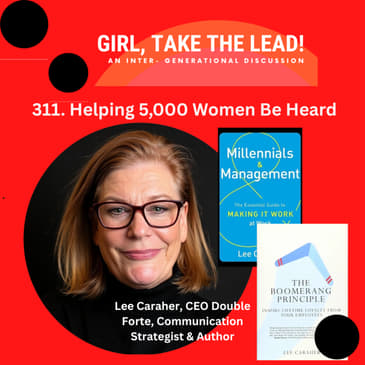
What if one conversation could change the way you lead?
Communication strategist, CEO, and author Lee Caraher believes it can.
As CEO of Double Forte, Lee has spent decades helping organizations communicate more clearly, build stronger teams, and navigate difficult conversations. Along the way, she noticed something troubling: too many women's voices were missing from important conversations.
Rather than simply point out the problem, Lee set an ambitious goal—to help 5,000 women be heard as confident spokespersons and recognized experts in their fields. She's now remarkably close to reaching that milestone.
In this conversation, Lee shares practical strategies for communicating with clarity, resolving conflict before it grows, and building trust through honest conversations. We also explore why assumptions create unnecessary misunderstandings, how emotions can become valuable information instead of obstacles, and why great leadership begins with saying what you actually mean.
Whether you're leading a team, your family, a volunteer organization, your community, or simply yourself through your next chapter, this episode offers practical ideas you can begin using today.
In this episode, you'll learn:
- Why Lee set a goal to help 5,000 women be heard
- How clear communication strengthens relationships and leadership
- Why assumptions and "they should know" often create unnecessary conflict
- A simple framework for turning difficult conversations into productive ones
- How emotions can become valuable information instead of something to suppress
- Why your personal brand is really your reputation
- Why great leaders communicate with clarity, curiosity, and compassion
One of my favorite reminders from our conversation:
"You cannot overcommunicate."
When leaders communicate with clarity and curiosity, everyone has a better opportunity to succeed.
Connect with Lee Caraher
📘 LinkedIn: https://www.linkedin.com/in/leecaraher/
📸 Instagram: https://www.instagram.com/leecaraher/
📘 Facebook: https://www.facebook.com/LeeCaraher1
▶️ YouTube: https://www.youtube.com/@leecaraher4222
🎙️ Podcast: Everything Speaks
An Invitation from LeeConnect with Girl, Take the Lead!
Lee is inviting professional organizations, companies, nonprofits, and women's groups to participate in her communication and spokesperson training as she works toward her goal of helping 5,000 women be heard.
If you're part of an organization looking to help women communicate with greater confidence and impact, I encourage you to connect with Lee through her website to learn more. It's a wonderful opportunity to strengthen both individual voices and the organizations they serve.
🌐 https://girltaketheleadpod.com
🎧 Listen wherever you enjoy podcasts.
And be sure to join me for the next Sound Bite, where I'll reflect on one idea from this conversation that stayed with me long after we stopped recording: What Resentment Is Trying to Tell Us.
[00:00:06] Welcome back to Girl, Take the Lead. I'm your host, Yolanda Canny. Today, I'm delighted to welcome communication strategist, CEO, and author, Lee Caraher. Lee believes something that immediately resonated with me. Work doesn't have to suck. As the CEO of Double Forte, she's spent decades helping organizations communicate more clearly, build stronger teams, and navigate difficult
[00:00:36] conversations. Along the way, she noticed something really important. Too many women's voices were missing from the conversations that shaped businesses, industries, and communities. So she set a goal for herself to help 5,000 women be heard as confident spokespersons and recognized experts. And she's
[00:01:01] now remarkably close to reaching that milestone. And we can help her. So listen in. She'll give us the idea on how to help make this happen. In our conversation, we explore why assumptions create unnecessary conflict, how clear communication builds trust, why our emotions can actually help us lead
[00:01:25] better. And the simple shifts that can transform the way to communicate both at work and in life. So let's meet Lee. Here you go. Lee, welcome to Girl, Take the Lead. We're going to have this great conversation. Appreciate you being here. Can't hardly wait for it. Thank you so much for having me. So let's start. If you would introduce yourself to our audience, that would be great.
[00:01:50] Sure. I'm Lee Caraher. I am a mom friend, participant in the world, and I own Double Forte, which is a nationally recognized public relations stratcom firm. And I've written a couple of books about how to create great teams that cross boundaries of all different kinds of boundaries in terms of
[00:02:14] benefit of age and background and gender. Because I think we can all do better. And work doesn't have to suck. And basically, that's how I live my life. Work doesn't have to suck. I love that. So I know you have a very ambitious goal. In my role as Double Forte's PR firm, we work with big and small companies all over the country.
[00:02:39] And part of that job is to get our clients in the media, in television, in radio, in podcasts, and in print. And there was a stat that came out in 2020 that at that time, 75% of all quotes, experts quoted in the media
[00:03:02] were men. But over 50% of the workforce is women. And there was some peeling of the onion on that. And I am of that age. I'm the last year of Boomer. Sort of have been fighting that my whole career. And I realized that the only way really to change the media, no matter how much we don't like it,
[00:03:29] the media sets the agenda. Because it's a third party. And they get credence for being that third party. You, Yolanda, as a podcaster, you set the agenda. Like, who do you have on your podcast? What is the message you carry? But the mainstream media, they prefer men. And it's actually, they don't prefer men. Actually, they are get served up men
[00:03:54] as experts. And too many times, and we work with lots of big companies with, you know, big muckety mucks. And in my experience on this, most women say, I don't have time for that. Have Joe do it. And the, the consequence of that is, is that men's voices are the ones we hear more. And men's voices are the ones that are setting agendas. And, and we're frustrated then women in
[00:04:22] general, then we're frustrated on the other side of like, where'd that come from? Well, it comes from the fact that we're not putting ourselves out there to be contributing voices to how the agenda is getting set. So, um, in 2020 coming into COVID and then all the things, um, when this was the realization, um, and we just, I decided to myself, I was like, you know what, I just have to, one,
[00:04:50] I looked at the member of people we had trained as spokespeople at the company. And it was about 80% of the people we had trained were men. I go, we can change that. We can say every time you give us a man, give us a woman. And therefore we at least have two people. Cause we always want a bench. And in general, it was the women tapping out cause they're so busy. Cause it is extra time. I have to go to a speaking up. I have to learn how to do that. I have to take this out of my day.
[00:05:19] I'm so busy. But, um, we just, our whole goal was to build a bench that were women in our client base who were ready to speak to. And if we could offer, have a woman also, we would start chipping away. And then I was like, you know what? I can actually make a difference on this myself. Cause this is what I do. And I can, what if I, um, helped 5,000 business people, business women be comfortable
[00:05:46] and understand the importance of being speakers and known experts in their field. Wow. So that was my goal. I'm almost there. It's 20, 26. It's, you know, sort of done it like 20 people here, a hundred people there. It takes a long time to get to five. I sort of like pulled 5,000 sort of out of nowhere. It sounds like a good number. When I get there, I'm going to have to big bottle of champagne because
[00:06:11] it's a lot of work to get there. But, um, I'm really excited to say, you know, many more the number now, six years later is around 60%. But if we are more than 50% of the workforce, we should be more than 50% of the experts. So we still have work to do, but that's the goal. And then I have created a, like a tour, depending on the format, two, three, uh, it's really six hours,
[00:06:38] um, program that I can drop into other people's curriculum as a guest. And that's what I have done. Cool. So you see differences between men and women. What about generations? Are you seeing differences about that? Um, in terms of their willingness to speak? Yeah. And what the barriers are for them? Well, I think that two things are probably on that. One is usually when we're looking for expert voices
[00:07:08] in, in the media, they're usually older because they've earned their chops and they have titles that the media wants vice president of this chief of that kind of stuff. And you sort of have to have some years on you actually in big companies to earn that. But, um, that's number one. Number two is, um, having the expectation. So that has been a generational issue. Younger people, younger women
[00:07:36] are more apt to, um, serve themselves up, particularly given social media, um, how they do that personally versus how they do that professionally is very different. Um, you know, I have, I have an Instagram following people know me. They don't know you as a professional. They know you as Yolanda the shopper or whatever it is. Right. So, uh, the sensibility of that is different, but there's definitely a more
[00:08:06] willingness, a bigger willingness. Um, and sometimes, um, how you put someone forward credibly as a credible voice. That's half the battle too. So what makes a credible voice, how you talk about yourself is your bio interesting. You know, what do you have to offer? That's different. Are you, you know, why should I listen to you? And that's the job of my agency is helping people figure out why they
[00:08:31] should listen to you. Yeah. And younger people, younger women and men are more well, they're more out there anyway. So I think that's breaking down, but the credibility part doesn't go away. So what do you think are some mistakes then that we make? Being boring. I remember getting media trained and going in front of the camera and stuff like that,
[00:08:57] but, um, there's gotta be things that you can see now. Oh yeah. Well, I think one, how we talk about ourselves, um, and I think a few things on that. So there is that, um, statistic that if there's a job description and there's 10 items, you need to do this, this, this, this, you know, these are the minimum requirements in general, a man will see it and go, yeah, pretty much got that. Even if they
[00:09:27] don't I'll apply. And the women will see those 10 things and go, I don't have three of them. So I better not apply. So that is something we have to get over, right? We just have to go for it because most job descriptions are, should actually include the words and walks on water on them because they're ridiculous. Right. So, but in general men are like, yeah, that sounds like me. And women are like, oh my God, I can't possibly do that job with those requirements.
[00:09:56] It is just crap. So we have to put ourselves into other situations. That is true also as being an expert. So, um, and so how do you put yourself in that, into that situation? I, what am I an expert in? Why would you want to listen to me? And how do I talk about myself in a way that is compelling? And there is a, you know, go to any large company's website and find their bios. And, you know,
[00:10:24] frankly, I don't understand how to get out of bed because they're so boring. So how do you talk about yourself and how you put yourself into a bio or whatever it is in a way that it's interesting and tells people actually why they should listen to you versus your, your CV, which is I went to this school and I had this job at this title. And then I did the, you know, boring, boring, boring, boring, boring. But if you talk about yourself as,
[00:10:48] um, bring those things that you offer up as differentiators, um, we're not as good as that. Frankly, in my experience, we're not as good as that, as men are finding compelling ways to talk about ourselves and being comfortable with it. Yeah. It's hard, right? Part of that program I give is the first part is how to do your bio. So someone actually wants to listen to it.
[00:11:12] And it's always a challenge. Do you help them with, um, finding their personal brand? All the things. Because I would think that would be really helpful. Yeah. Oh my gosh. Like, so who, who are you? Right. So they say, well, I am a professional, you know, I want to be this, this, this, and this, and they're, they're looking at me frumpy as all crap and you know, their hair
[00:11:35] up in a bun and it's, or whatever the things, you know, everything looks, you gotta line it up, sweetie. Let's line it up. Now, if you want to be the eccentric bohemian, you'll look awesome. But if you want to be, you have to match, it has to match. Right. Right. And we have a hard, I mean, I have a hard time with myself, like matching it all up. So, um, it's hard to do for yourself. It's easier to do for somebody else, but you have, it all has to match up. What is your personal
[00:12:04] brand? What do you want? And what is, what is that? Your personal brand is your reputation. Your personal brand is things that people say about you when you're not in the room. Exactly. So what are those things that you want people to say when you're not in the room? Yeah. If you do not care that they say she's frumpy. Okay. You got also it's going to limit your opportunity. That's just how it works. So, um, like the first thing I say for some women,
[00:12:30] even if they don't wear glasses, get some glasses, get some funky glasses. Like you have funky glasses on. I have multiple pairs here. Yours are great. These. And then I just got these, you know, I don't wear those very often. As you can see, but they say something about you. Right. And there's so many options and you don't have to have lenses in them. Yeah. But what is,
[00:12:56] what does it say about you? Right. Um, or, um, metal, do the metal on Albright, put a, put a brooch on, you know, or something because, um, particularly it's same thing with networking. Like you want to be rememberable when you go into a room for networking. Well, if you always wear a brooch, um, you could say when you, hi, hi everyone that, Hey, it's Lee. I had that funky brooch on. Oh yeah. That's who it was. You have to give people easy ways to remember you. So maybe it's
[00:13:26] your cool glasses. Maybe it's your hair curling. Maybe it's a brooch. Maybe it's that you're, I was a teeny person or, you know, for me when, um, I wear a lot, I don't work. It's hard to see now. Cause we're not, we're more virtual, but, um, I wear shiny shoes. I wear sparkly shoes, like flats, tennis shoes. Yeah. Because in a room, particularly in like San Francisco and New York, where I had my offices and I have office here in Wisconsin, but when I was meeting people out in
[00:13:53] the world, crowded places, I'm five, six, what the heck look down and find my shiny shoes. People could find me in a heartbeat. So that was the signature, right? So what's your signature? So one, what is the thing? The visual signature to the work that you put into the world? Like, what do you, if you have social media on LinkedIn focus, what do you want people to say when you're
[00:14:18] not in the room? Focus on those three or four things. So just do that because we all are different people. Yeah. Right. Like I have three Instagram accounts. I don't keep up and track on all of them at all, but one's for professional ones for my sister-in-law. Cause she wants to know what the heck I bought and one's for my family or my friends. Yeah. And they can see all the, you know, wackiness or the, Oh my gosh, do you want to believe what happened this week? But I don't put that on my
[00:14:47] professional one. Right. So you have to be thoughtful about that. So one of the things you mentioned that I really liked was when you talked about clarity, that that can be a mistake. And I know Brene Brown talks about being unclear is really being unkind.
[00:15:08] Absolutely. So what do you see there as, you know, when it comes to us speaking our voice and presenting who we are? Yeah. Well, I like the, I mean, I think those are two related points of Renee Brown's being unclear is being unkind. And I think what she's really talking about there is giving feedback. And when you give feedback, we don't like to, we don't want to hurt people's feelings.
[00:15:39] So we avoid it by saying you can improve, but you're okay. And people hear that you're okay. They don't hear that you're going to improve. Right. And then we don't put enough intention into giving that feedback that would actually help someone improve. You could say, Oh, you did better this time and you can do some other things, but you're on a good track. What can anybody do with that?
[00:16:03] Nothing. Right. You could say, you know, Lee to me, you want, you could say Lee, it would really help if you were more prepared when you like, you know, lined up on a zoom, because you look discombobulated. I didn't know if I could trust you to be on point. Um, in the future, um, you have so much to offer Lee, but it would be really helpful if you actually showed up all together at the same time. Now that is, Oh my God. One, you're reinforcing that as something to offer.
[00:16:30] And two, you're telling me you didn't, you fell down on the job. You did not show up the way I should have when we turned on the zoom. And, uh, if you want to be who you want to be, you got to fix that. That is clear and helpful and therefore kind because you were helping me be better. Right. Yes. Yes. That's one thing on the, I think that's what she's talking about in terms of being clear. We're so worried about hurting someone's feelings that we don't actually tell them
[00:16:58] the clear point that they would be able to use to improve. The other thing on clarity is, uh, sort of, uh, unintentional fuzziness. We think we're clear. Uh, and I'll give you probably the best example of this is sort of around deadlines. And that's where a lot of so much of conflict in the workplace comes through deadlines. We think we're clear. We think I need it by the end
[00:17:25] of day. And I mean, Lee care her. I live in Wisconsin. I spend half my time, a lot of time in San Francisco and a lot of time in New York, but for me, that means end of day, 6 PM central time zone, uh, in the United States. And, uh, if it needs to be a certain format, I'll put the format by Slack, by email in the Google links. I mean, whatever if, but that's what I mean when I say end of day.
[00:17:55] Mm-hmm. Someone could hear me say end of day and go great. I have 11 till 11 59, 59 PM in Hawaii. Cause that's where I live. And, uh, I'm 24 and that's the, that is the deadline that I got the last 10 years of my life. So I don't know any better. So my end of day is my end of day for the last 10 years. So that's 10, you know, 11 59, 59 PM. And where am I? I am in Hawaii. Okay. In Hawaii.
[00:18:21] So I think I've been very clear. Yeah. They think they heard something very clear. Uh, we're both wrong. And because I'm the boss, that person's wrong, but because I'm the boss, I screwed up because I let them be wrong, even though I thought I was clear. Yeah. So the more we can drive specificity into where there can be obfuscation in, and that's really in those terms
[00:18:50] that could use something, you know, like end of day, like later, like tomorrow, like, um, it's good enough. Like, you know, just send me the document. Well, the client needs it in SharePoint in, in, and please know SharePoint, but in SharePoint in the specific folder, as a word document with draft
[00:19:11] in the background, if you send it any other way, it doesn't count. Yeah. If I don't tell someone that that's, if I don't tell somebody new, or I don't have a policy for it, or, you know, for this client always do this, I let someone do all the work and still fail. That's on me. Yeah. Right. Um, so on the clarity piece, we can do so much to close the gap between what we intend
[00:19:41] and what we actually deliver and what people hear and actually deliver on their end. So I know you have some ideas on feelings. Ah, yeah. That can help us resolve issues and not necessarily get us into trouble because it's got me into trouble. Oh my gosh. Right. Hold on a second. I'm going to
[00:20:04] pull a book off my desk here. Oh, particularly as women, we are told not, you know, don't, don't cry out in the office, you know, leave your feelings at the door. All those things. It's such crap, Yolanda. Oh my God. As if we're not humans who actually run on emotion and feelings. So I am
[00:20:29] always looking for, uh, and you know, what's the most inefficient worker, the one who's confused, the one who's pissed off, the one who doesn't know what to do, but doesn't want to ask the one who's at risk, you know, who feels like they're nervous because they can't ask any questions. And why are they the most inefficient? Because they are grinding away at the fact that they don't know,
[00:20:55] they can't ask, um, uh, they're nervous instead of getting the clarity they need to actually deliver something on time. And the more, and this is when you talk about a lot of time we talk about psychological safety in the office around big issues around race and gender and, um, discrimination, which are
[00:21:19] really real, but more psychological safety comes around being able to, uh, be human. Um, and from that one conflict all comes from emotion, uh, because you are, you only know you have a conflict because you're feeling it. It's an emotion. I'm pissed. I'm angry. I'm mad. I'm upset. I'm, I'm,
[00:21:42] I'm, and then that just grinds you, grinds you, grinds you. So what if you actually used that feeling? I'm mad, right? Right. Say, why am I mad? I'm mad because this, you know, Yolanda doesn't respect me. And how do I know Yolanda doesn't respect me? Because she has been late 19 times in a
[00:22:06] row, uh, giving me a document and she doesn't respect me. And I'm pissed because why am I pissed? Because now I have to like, go back to her. I'm the one who has to ask her all the things. I'm the one who has to like add more work to my plate. Cause she doesn't do anything on time. I'm just pissed. And then all you, that's just boom. Right. But what if I, when, as soon as I have a feeling, as soon as I have a feeling upset, anger, whatever it is, I identify it and I backtrack it, excuse me.
[00:22:35] And I backtrack it to, I'm mad. Why am I mad? Cause Yolanda's late again. She doesn't respect me. What if I talked to you about it and said, Hey, now I know what I'm pissed about. I'm a pissed about the fact that you're late. That's what I'm pissed about. Yeah. Or anything else. And I could say, Hey, Yolanda, can we talk please? Um, listen, the fact is for the last 19 times in a row,
[00:23:03] which you would never let it get to 19, but this is where real big feelings happens. Cause you've avoided it. Right. Um, you've been late in giving me my, what I'm required to have to, for me to do my job. And so, you know, it just seems like you do not respect me at all. And I'm pissed. And my request to you is that you deliver things on time to me so I can do my job on time.
[00:23:29] And my offer to you is to remind you when things are due now that's the circle of conflict. Yes. Through it. Yes. Usually the assessment is wrong. 95% of the time that assessment is wrong. You don't respect me. It was my assessment. You don't respect me. Lee. Oh my God. I told what I have only respect for you, Lee. What are you? Oh my God. I feel so terrible. What do you mean? I was late.
[00:23:57] I thought it was early. I thought it was on time. What are you talking about? No, my gosh. Right. And the late thing that I said, you were late 19 times. That's actually subjective. I should have said, Yolanda, for the last 19 times, um, the deadline was eight 30 in the morning and you gave it to me at 10 AM in the morning, which is also late, but it's still subjective. I'm you obviously
[00:24:21] don't respect me and I'm mad. Lee. Oh my God. I totally have respect for you. I thought the deadline was 10 30. I thought it was giving to you something early because I'm actually in the East coast and you're on the West coast. So I thought I was doing things, whatever it is, or the wet were reversed and it's all miscon it's all miscommunication. Right. But I was so, I just let it go, let it go, let it go. Got madder, madder, madder, madder. Yeah. Until it erupted as opposed
[00:24:49] to the first time I feel a niggle, go back and say, Yolanda, um, the deadline for this is actually eight 30. I got it at 10 30. Uh, next what's going on. And the first thing you would say is, Oh my God, I got my time zones mixed up. Sorry. Right. Right. That happens all the time. So harnessing your feelings under tapping into them and then figuring out what they can lead
[00:25:14] back from. Yeah. So useful. So useful. This book, um, have you, have you read this book? No hard feelings. No, I haven't. Highly recommend, highly recommend it's from, um, Liz Fosline and Molly, Molly West Duffy, no hard feelings, the secret powers of embracing emotions at work. Um, I read this after I had that, I mean, I have a circle of conflict, how to get rid of conflict. It's all about
[00:25:41] understanding your feelings. This, I read after that totally reinforces it with a lot of more, a lot more eloquently than I am. Yeah. But if we don't acknowledge that we're human, we cannot be efficient. I'm all about efficiency. Efficiency is profit. And anytime you're not being efficient, you were dropping profit off the bottom line. And so much inefficiency for the human person comes from grinding on something that they shouldn't need to grind them.
[00:26:08] Yeah. So you mentioned the conflict wheel, is that the same as the communication wheel? Same thing. Ah, so why don't you, if you wouldn't mind telling us a little bit more about that communication wheel? Yeah. So this is work. Where's my other book? This is work, the communication wheel or the conflict where you can talk about it either way is work that was started in George, Georgetown. And then a coach of mine shared it with me. And then I've adopted it, continue to adopt it.
[00:26:38] And I detail it in my books because it's just so useful because we need a process and we need a process to get to the other side of the conflict. Right? So if you and I have a conflict, you might not know you have a conflict with me. Well, actually you would about me, but that's just me. Right? Yeah. I remember at camp one year I was told I was in a fight with somebody. I had no idea I was in a
[00:27:05] fight. Exactly. Right. What are you talking about? I love that girl. She's awesome. Right? So many times. I think her name was Donna. Donna. Donna. What the hell, Donna? I'm like, oh, here it is. Okay. It actually is the page it opens up on right here. Page 126. So basically when you have
[00:27:30] a conflict and how do you know you have a conflict? You're pissed or you're angry, you're mad, you're disappointed, all, whatever that feeling is. And it's about a person or a process or whatever. Um, what I, and it's basically a circle and I can provide it to as a download for your listeners, if you like, um, which is a document and you want to, as soon as you know, you're like,
[00:27:57] what are my feelings? It's actually it's at six o'clock. What are my feelings? I'm like, I just said, I'm mad. Why am I mad? Well, she's late. That's the fact. The fact is up top. Right? But the fact late is subjective. I'm just going to use that deadline one. What is the actual time? The deadline was eight 30 and I keep getting it at 10 30. What's the assessment? Cause I'm getting
[00:28:23] to the feelings, not because it's the time, the assessment of the time of the assessment of the fact is what's giving me the feeling. Right. Right. Um, and I get to disrespect totally disrespects me, trying to undermine me, whatever it is. That's my assessment. You're trying to undermine me. Uh, we recognize that we're in teams and that we have to be part of the solution. If we just go and say, get away, it's not going to work. Right. So being the person who's going to work this wheel,
[00:28:52] right. We come up with a request. Uh, my request to you, um, Yolanda is to deliver it at eight 30 every morning, not 10 30 in the time zone, my time zone. Right. Which is what the original thing was. And then how do we help that person succeed? So my offer to you is to either help you set up reminders. I can send you an automatic email the night before or whatever it is so that you have
[00:29:19] this as a tickler in your system. So in the commute, in the relationship, it's not just do it. Like I said, cause now that doesn't work anymore. Unless someone's, you know, you're in a fire that works, but command and control has got no place, you know, outside of real conflict in real crisis. So in a relationship, you're in a relationship with work. You don't have to like them, but you got to
[00:29:47] respect them. And, and frankly, you'll get further in your career, the more you are helping people succeed and helping people help you and calling them on and making sure everyone's on the same page on actually what's happening. So many times, like that person doesn't respect me. They're undermining me when actually they had the wrong time zone. Yeah. Or they didn't know. I don't need you to help. Thank you so much, Lee, but I can remember to do that now that I know what the real time
[00:30:14] is. Yeah. Yeah. You know, and I can, uh, and then as soon as, if you don't, if you do it again, so once you have an agreement, you have an agreement, right? Yes, Lee, I will make sure that that comes in by eight 30 every morning in your time zone. I apologize. I have only respect for you. I'll make this work. Now, if you break that agreement, now you've done something totally different. Yeah. You can't, if there's no agreement, there's no, if you haven't done this step
[00:30:42] and made a request and offered something to help make ameliorate the problem, you really are going nuclear with, without any evidence. Right. Yeah, definitely. I can just, and, and not taking ownership really of the communication and what could else. One of the things I always found very frustrating was a lack of understanding of the larger picture. This gives you an opportunity to
[00:31:06] understand with almost compassionate curiosity, what the other person is perhaps coming from. And then you making the offer is so empathetic for them to be able to change. Right. And the other thing that someone might say in that scenario is, uh, I thought you didn't care because you never said it 19 times in a row. You didn't say anything. So I had no idea that you actually cared. I thought this was getting to you in time. Actually, I have to work two hours ahead of
[00:31:35] this eight to deliver what I need to deliver to you requires two hours of work, which means I'm up at six 30. Cause I'm in a different times on than you. So, but I didn't think you cared because 19 times you let it go. Yeah. That's not me. Right. Yeah. Um, and if I don't understand it takes two hours. Oh my gosh. Had I known that it took two hours for you to generate your part of the program? Well, let's get, let's straighten that out. Yeah. What can we rearrange so that we both can meet our
[00:32:03] deadlines, but it sounds just rational, but it's, we're not set up for it and we're not trained on it. We are not trained. We don't want drop into a team and go, here's how we handle things. Yeah. No one does that. Right. Yeah. Well, we do it, but still you have to reinforce it all the time. But if you understand, you know, that's why it's so important to understand roles and responsibilities
[00:32:28] on a team, regardless of your title, because you might be on five projects with the same group of people and have a different role in each of them. Yeah. What if you're project lead on one and do her on the other? Yeah. Right. So, um, the one, as soon as there's a miss, you got to bring it up. Yeah. And how do you do it in a way that is respectful of the team and, and gets to, and helps
[00:32:57] a makes the rational request and B makes the offer to help them succeed. Yeah. You're only going to win. Cause what if you didn't know it took two hours or what if she didn't, she thought it was okay. Cause it was, you didn't say anything. So 19 times in a row, I thought it was okay. One time in this book, the millennials in management, my first book, I tell the story about this woman who I was working with, she, and she's so frustrated with one of her employees. She goes, yeah, I'm going to
[00:33:23] have to fire that woman. I'm just going to have to fire her. I'm like, why? I thought her work was great. Her work is awesome. And this was a late thing. She shows up late every single day. I'm like, how long has this been going on? Six months. Have you talked to her? Well, no, she should know. Okay. So that's the first, as soon as you say should, Yolanda, you know, you're in trouble,
[00:33:49] you know, you're in trouble, right? Totally. So, um, and this woman, the woman she was talking about was probably 23, 24. And I said, well, she's going to quit on you. You're going to talk to her. She's going to quit before you can fire her. Oh, no, she's not going to quit. She's in the wrong. I said, no, not really. How do you know she knows? Well, she should know we open at eight. She shows up at nine 30 quarter at 10. She has no idea that you got here at eight. She may think you just got
[00:34:19] here a minute before you her, whatever. Yeah. Right. Cause you've never six months. Uh, and she, and she called me the next week in a panic. Lee, she just quit on me. You're right. I'm like, I don't care to be right. I care to help you to succeed on this. I said, did you run after her? Yeah. But she kept running faster than me.
[00:34:45] And basically, you know, she ended up, I said, here's the deal, right? Remember anybody who's been wrong for. So Yolanda, you'd be pissed at me if I let you go 19 times without talking to you, because you know that I'm talking about you 19 times to somebody else. Yeah. Right. So this woman clearly was talking about this poor, not poor, but this young person who had no clue. She was late,
[00:35:11] no clue that she was wrong. And then she finds out for six months, she hasn't been corrected. And all she knows that she's been talked about for six months as a slacker. Nothing's worse. Well, there are a lot of things worse, but that's pretty bad. It's the surprise element that I have found in my career to just be so unfair, like just pulling it on me. Well, it's the policy. Well,
[00:35:39] did she sign the policy? Well, I'm not sure. We better be sure before you talk to her. And it turns out she hadn't signed the policy because whoever was supposed to do the onboarding was out that week and it was totally missed. I mean, and felt so terrible. Yeah. She ended up hiring, you know, she ended up keeping the woman, but she, uh, she had to cave on a lot of things.
[00:36:04] Well, she just felt, she felt stupid. And again, it was the whole thing, right? She didn't know, like she didn't, you, you assume things, you know, assumption. I, if you say, I assume, and if you say they should, you're in trouble. Yeah. Because something is missed. Yeah. That's a great quote, you know, something is, if you say I assumed, and if you say they should, you're probably
[00:36:30] wrong. And I sound so terrible. And the only way that I can say it with a laugh is because of course I've done that a million times in my own career. I know that's why I almost deep six, my own career with my own company. When I hired millennials, I didn't have any hired six. They were all gone. We hired six within eight weeks. They were all gone in three months. And in my career, never had that churn rate ever in my career. I was known for keeping people for a long time. And here,
[00:37:00] a whole cohort left within three months. And I think if they had dribbled out, like not, I maybe would have noticed, frankly, I maybe wouldn't have noticed, but I noticed six people gone in three months and I had to dig in and I was like, Oh my gosh, wow. I got some work to do. Yeah. So that's where that is. That before your book? Oh no. Well, that's before my book. Right. And actually I figured in, I've talked to my clients. This was back in 20,
[00:37:30] well, this happened in 2012. So it was a long time ago, but that was right when millennials were coming into the workforce. Right. And pretty much in the, and my clients were having the same problem. Clients have the same problem. So as I was with my employees and okay. And I was sort of, this happened to the sixth person walked out within like the week or whatever. I was like, something is wrong. Cause we're awesome. We are great at hiring. Fantastic. So something's wrong. And in the end it was us.
[00:38:03] And I started reading about it. And at that time you read, you know, I call my friend. I'm like, you won't believe what just happened. Oh, these millennials, they're the worst. And I'm like, what's a millennial? I had no idea. And I started, of course you Google and I'm like, everything was negative. Everything was there entitled. They're negative. Everything. I was like, it is really impossible for 80 million people to all be entitled, you know, generational.
[00:38:30] You know, they're not all the same. It's not a monolithic. Right. So I started digging into myself because everything I read was horrific. They're all terrible people. They're not all terrible people. They have terrible parents. They have a lot of helicopter parents who have screwed them up for life, but that's another thing. So I started reading about it. Right. And then I happened to be, this is how this book came. And then I started working with my clients on the same topic by accident. Cause I happened to be at a client and they were so frustrated. Same reason. Like,
[00:38:58] look at this person. She's on her phone and she's got an iPad on and she's got a computer and she's got an earphones. Like, how could she be working? And I had to like pull the CEO away. Cause I thought he was going to erupt on her. I said, you know, her job is social media manager. So let's talk about what's required for that job. A phone, a video that you listen, she's editing and she's seeing how it's
[00:39:27] working on her phone at the same time. And then she's got to monitor what's going on in customer service. Cause she's in customer service liaison for social media and her iPad is showing her, you know, the tick at that time, the Twitter feed. Cause that was super important. I had no ideally. I thought she wasn't working. I thought she was blowing everything else. I'm like, no, she's your biggest producer. She's your biggest producer. What are you talking about? Right.
[00:39:54] And that's what I realized. I wasn't the only idiot in the room that there was such a big gap. Right. Yeah. And I happened to be talking to my employee was about to publish a book and her, her, um, publisher wanted, she was joining my company. She, I, she had, I was hiring her from another company that company had promised to support the book. So the publisher wanted to meet, meet me about supporting the book. I did. And the same sort of thing happened in the room with the publisher.
[00:40:24] She was, she ended up complaining about something in her office. And I was like, well, tell me about that. And then I did the same thing. Like I did with Anne. She goes, I will publish that book. I'm like, well, what book are you talking about? I don't know what you're talking about. That book about millennials you have. I'm like, I don't have a book about millennials. Yeah, you do. And I wrote it in four months and it was published within the year. Yeah. So it was totally serendipitous that that happened, but it was sort of like the moment,
[00:40:49] right? It was just the moment. Anyway, I need to do an update now though. We're in 2006 and it's like, you know, my next book different. There's a lot of things. Well, here's the thing about generations. Every generation complains about the next generation. Every generation complains about the generations before them. This is not new, but this book starts with a quote from Socrates,
[00:41:16] which is 495 before Christ on the same topic, right? So this is not a new phenomenon. We just think it's new because we're living through it. Yeah. So my next book is actually more about, well, I should do an update and I have a better idea for good teams talk and how teams talk. And then what I just described, good teams talk. We know this, if it's a sports team, a music group,
[00:41:42] a theater group, a work team, whatever it is, if you're not talking, you got nothing. So that's my next book is good team stock. I love that. You have to make sure you tell me when you, I will, when I get it done, you can come back on. Well, Lee, we could go on forever. I just think you have such a depth of knowledge here, but is there anything else you want to cover before we
[00:42:07] end our episode? Well, unless you have, I mean, as you can tell, I can go on for days. So whatever is most useful for your audience, I'm ready to answer. I think you've given us some really great insights. Totally. I think you've helped our listeners break down. Cause I think some people fall into that. Well, I'm not a good communicator and they give up and it's just like they're resigned,
[00:42:32] but no one's born a good communicator. Right. Well, actually that's probably not true. Probably everyone's born a good communicator and then gets sort of you age out of being a good communicator cause you're told to be quiet. So, and then women and men are very different regardless of the age, regardless of the generation. And we have to learn as, as women, men and women have to learn how to
[00:42:58] get rid of, they should, they should. And I assume. Yeah. Cause all that says is that you didn't communicate. Yeah. That's on you. Yeah. If you're the one giving the instruction or you're the one leading, it is on you to make sure that everybody understands what you meant. And one and done does not work. You cannot count on, we used to use the number of marketing seven, the seven times the right person to see the right message, the right time to get it. We use the number 39 today.
[00:43:26] Now I'm not suggesting you have to send 39 emails exactly the same, but you want to then you have to repeat yourself and repeat yourself. You're only done. You'll wonder when someone can finish your sentence. Yeah. Then you can go on to the next and we get bored as entrepreneurs, as leaders, as busy people, we get bored. I'm like, I got that. Right. And we just can't get bored with the communication. It's a challenge, but we're never really done. You cannot over communicate. And no one tells us that until it's
[00:43:53] too late. Yeah. So where can people find you, follow you and get your books and you can get my books anywhere online, anywhere. I'll put them in really easy to find. If you just Google Lee Carrier, more than you want to know comes up, but my website is Lee Carrier.com or double dash forte.com is my agency. And on social media, I'm Lee Carrier everywhere. Great. And I ask all my guests this,
[00:44:22] this question, what would you tell your 20 something self today? I would tell her that she can define her own success at 20 and she doesn't have to wait till she's 45 to figure that out. I love it. Excellent. And how do you think she would define that?
[00:44:45] Well, I can tell you how at 45 year old, when I was 20, it was other people's definitions. When I started my own company, which I'm an accidental entrepreneur because my mother got sick, long story, needs a cocktail. It was, if I have to be an entrepreneur, what am I going to measure? So I'm not miserable because I know a lot of miserable entrepreneurs and I know a lot of bit, you know, I didn't,
[00:45:14] I hated the company I'd come. I hated the situation I was in. The company was actually very generous to me, but I hated the situation I was in. So I'm going to be in an agency. How do I make sure that it's good for me? And so I made four different roles on that. And so we don't work with assholes. I'm never alone, except when I'm talking to people like you. And I only work, my whole team only works
[00:45:42] for things we're interested in because life's too short and you do better work when you're interested. And you have to pay us because we like to eat. And having been in Silicon Valley for 25 years, no, thank you very much for your equity that you can give it to us extra, but you have to pay us to work because we're not working on a promise. Yeah. Good for you. Love it. Clear. Very clear.
[00:46:08] Well, it really helps make decisions. No, we won't work for you. No, we won't hire you. Yes, we will work for you. Yes, we'll work for you. But at a, you know, yeah, when you're the clearer you are, and it's so hard when you're 20, right? You know, what do you really know? Not a lot. But the more, you know, the more time you spend on what are your values and what do you value and how do you
[00:46:32] want to be generative in your life? Cause we spend more time working than we do anything else. Yeah. So how do you use it as a projector? How does he use us as a, as a springboard to being better as opposed to, Oh my God, thank God I'm out of there. Yeah. Life's too short. Work does not have to suck period. Um, and most everyone listened to this podcast has much more opportunity than they
[00:46:58] think they have. So make your own rules on what you will tolerate and what you want to, what you want to put into the world and it will happen. I love it. Thank you, Lee, so much for this and for passing along all your thoughts and wisdom. And we want to cheer you on for your 5,000 goal. Yes. I'm almost there. Actually, here's what your listeners, if you have a group listeners of 20
[00:47:25] people to a hundred people, if you have a group of women who would, um, like to go through our, it's probably four hours, a minimum four hours in two sessions, let me know. And I will see what I can do to schedule you. So, cause I want to cross this 5,000 mark this year. So I have a couple hundred more to go. So if you, if your listeners have groups of women, professional women who would like
[00:47:49] to go through this project, I'm, I would love to hear from them. Well, I will definitely keep that in mind and share that with a few groups that I think might qualify. Thank you, Lee. Thank you so much, Yolanda. So good to see you. Thank you. So grateful to Lee for joining us today and for sharing her wisdom, practical tools, and passion for helping more women be heard. As we wrap up
[00:48:17] today's conversation, here are three takeaways I'll be carrying with me. First assumptions and shoulds often create unnecessary conflict. Clear communication begins with curiosity, not mind reading to our emotions. Our emotions aren't something to ignore. They can point us towards the conversations we need
[00:48:42] to have and the clarity we need to create. And three, every one of us has a voice that can make a difference. Whether you're leading a team, a family, your community, or simply yourself, your perspective matters. If you'd like to learn more about Lee, her books, her communication workshops, or her podcast, everything speaks, you'll find all the links in today's show notes. Be sure to join me
[00:49:10] next time for a new soundbite where I'll reflect on one idea from today's conversation that stayed with me long after we stopped recording. We'll explore what resentment is trying to tell us and how a simple pause can help us move from hurt and assumptions toward understanding and perhaps even forgiveness.
[00:49:35] Until then, be well and remember, you have a voice worth hearing. Thanks for listening to Girl Take the Lead. Bye!