
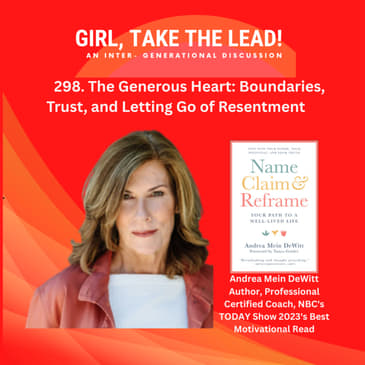
What happens when giving begins to feel heavy?
In this thoughtful return to Girl, Take the Lead!, Professional Certified Coach and author Andrea Mein DeWitt joins Yo Canny to explore a question many caring people wrestle with:
How do we remain generous without becoming resentful?
Drawing from her essays, The Generous Heart and Open Hands, Andrea shares why generosity without integrity often leads to resentment, how healthy boundaries make love sustainable, and why trust becomes increasingly important as our relationships evolve.
Together they discuss:
• Why acknowledgment matters—and why we can't always depend on it
• The connection between generosity, integrity, and resentment
• Moving from reacting to responding
• Trusting adult children without trying to fix their lives
• How Andrea's Name, Claim & Reframe® methodology helps people navigate difficult moments
Throughout the conversation, Andrea offers practical wisdom for anyone navigating family relationships, leadership challenges, life transitions, or the difficult balance between caring deeply and caring for themselves.
One question sits at the center of it all:
Who do I want to be in this situation?
About Andrea Mein DeWitt
Andrea Mein DeWitt is a Professional Certified Coach (PCC), author, and creator of the federally trademarked Name, Claim & Reframe® methodology. Her book Name, Claim & Reframe: Your Path to a Well-Lived Life was featured on NBC's TODAY Show as 2023's Best Motivational Read. The companion workbook and audiobook followed, with the audiobook released on Audible in December 2025.
Andrea publishes the Beyond the Reframe newsletter and a monthly Reframing Wellness column with GetFitNow. She helps high-achieving women navigate challenging relationships and life transitions—teaching them to lead from authenticity rather than armor.
Work with Andrea
andreadewittadvisors.com
• The Generous Heart
andreadewittadvisors.com/blog/generous-heart
• Open Hands
andreadewittadvisors.com/blog/open-hands
• Beyond the Reframe Blog
andreadewittadvisors.com/blog
• Leadership Quiz
andreadewittadvisors.com/leadership-quiz
• NCR Toolkit
andreadewittadvisors.com/ncr-toolkit
Book:
Name, Claim & Reframe®: Your Path to a Well-Lived Life
Beyond the Reframe Newsletter:
https://www.linkedin.com/newsletters/beyond-the-reframe-7275538370468966400/
Previous Conversations with Andrea Mein DeWitt
• Ep. 48 – A Discussion with Andrea Mein DeWitt About Her Book, Name, Claim & Reframe: Your Path to a Well-Lived Life
• Ep. 72 – Andrea Mein DeWitt Returns: Using Name, Claim & Reframe® to Address Female Bullying
• Ep. 153 & 154 – Be Confident. Be Resourceful. Be Graceful. Insights from the Name, Claim & Reframe Workbook
• Ep. 266 – Reframing the “Good Daughter” Story with Andrea Mein DeWitt
Browse all Andrea Mein DeWitt episodes here or wherever you listen to your podcasts:
Connect with Girl, Take the Lead!
Website:
girltaketheleadpod.com
Listen:
Available on Apple Podcasts, Spotify, YouTube Music, and wherever you enjoy podcasts.
Join the Conversation:
Follow Girl, Take the Lead! on LinkedIn, Facebook, Instagram, Pinterest, and YouTube for leadership insights, guest highlights, and weekly reflections.
Explore the Shop:
Visit the Heartfelt Cards & Gifts collection at girltaketheleadpod.com/shop
Subscribe:
Never miss an episode by subscribing to Girl, Take the Lead! and sharing your favorite conversations with friends and colleagues.
Reflection Question
What relationship in your life might benefit from a little more generosity, integrity, or trust?
What would Andrea tell her 20-something self?
"Stop looking for permission.
You are so much smarter than you think. You are way more resourceful than you give yourself credit for. Take the risk because it's worth it. The worst thing that can happen is that you learn something.
Start claiming who you are now and trust that your people, if you live in integrity with yourself, are going to find you."
[00:00:06] Welcome back to Girl, Take the Lead, the podcast where we challenge the status quo, share meaningful conversations, and explore what it really means to find our voice and lead with intention. And I'm your host, Yolanda Canny. Have you ever given your time, energy, support, or love to someone and then felt hurt when it wasn't acknowledged? Or found yourself wondering why generosity sometimes turns into resentment?
[00:00:34] My guest today is returning favorite Andrea Mein DeWitt, whose previous appearances on Girl, Take the Lead have sparked conversations about everything from female bullying and caregiving to confidence, grace, and personal reframing. Andrea is a professional certified coach, author, and creator of the name, claim, and reframe methodology. In this conversation, we explore generosity, boundaries,
[00:01:03] trust, trust, feedback, adult children, the challenges of staying true to ourselves while navigating life's changing relationships. Most importantly, Andrea reminds us to pause and ask a simple but profound question. Who do I want to be in this situation? It's a conversation filled with wisdom, practical insight, and a few reframes that may stay with you.
[00:01:33] Long after you finish listening. Let's jump in. Here you go. Andrea, welcome back to Girl, Take the Lead. Oh, I'm excited to be here, Leo. We have had the best topics. It's like you and I are traveling along the same path with our families and life and things going on. So we always have good things to talk about.
[00:02:01] We do. And it's, it's, it's, it's, you are such a fun dance partner to co-conspire with. We definitely are co-conspiring on this one. Let's, for those folks who haven't caught our past episodes, which we'll have all links to in the show notes, but would you mind introducing yourself? Thank you. I'm Andrea Mein DeWitt, and I am a professional certified coach and the author of Name, Claim, and Reframe Your Path to a Well-Lived Life.
[00:02:31] I still am surfing on this wave, you know, because we were the Today Show's best motivational read for 2023. And that is just so fun. I keep pinching myself. We had a workbook that came out two years later in 24 and an audiobook that just was released this last December.
[00:02:53] I work primarily with high achieving women who are navigating challenging relationships, both at work and in their personal lives. And they're also, this also really dovetails with life, life transitions. I always say that I'm a self-proclaimed warrior in recovery, having learned that it's much softer to lead with authenticity than with armor.
[00:03:20] And so I have to catch, sometimes my warrior shows up and I have to say, oh, there's another way to do this. I get that one. I write a bi-monthly blog, both on LinkedIn and through my website called Beyond the Reframe, where I think out loud about some of the things we're talking about today,
[00:03:43] including, you know, things where I find that I'm inspired by my friends, my colleagues and my clients to write about things. And I also write kind of with my heart in my hand because I'm still making mistakes and trying to be more graceful in the way I lead my life. Well, I definitely can relate to a warrior in recovery.
[00:04:11] Thank God we're in recovery about that for the people around us, I think more than for ourselves. But what drew me this conversation that we're going to have today was the writing you did about the generous heart.
[00:04:29] And I think it was because I had just come off a major event and received no acknowledgement, public acknowledgement for all the work I had done for this major event. And your writing about the generous heart just hit me.
[00:04:52] Like, let's do you mind summarizing it for our listeners and viewers so that they get a gist of what you've proposed in your writing with that article? Well, I mean, may I, I'm going to mirror back to you because I listened to your episode. And it resonated with me. I think I wrote you and said, Oh, gosh, I just wrote this piece. We must be on the same frequency.
[00:05:22] Yes. Yes. Um, I think anyone who works to be consciously aware, um, you know, interprets and I'm going to say interprets boundaries, you know, with withholding love, you know, and it feels like, like a betrayal of who we are. And as generous people were trained, you know, when we are hurt, you think, Oh, gosh, I haven't been seen.
[00:05:50] But the truth is that generosity without integrity becomes resentment. And you were talking really about that. Um, and resentment is corrosive. So we really, you know, if, if we are generous and then it's not, we're not seen for that generosity, then it resentment bubbles up. And so we need to, to, to look at that and be aware of that. And so when I talk about the boundaries, it's really about boundaries for ourselves to be realistic about that.
[00:06:20] Um, and I think boundaries really aren't a withdrawal of love. Boundaries are actually the architecture that makes love sustainable. Hence the episode that you did about feeling like you didn't get acknowledgement. And hence the thing, the piece that I wrote about generosity. I'm going to say it again. And I think we talked about this, this quote, but generosity without integrity becomes resentment.
[00:06:44] And so we need to watch that in ourselves and boundaries around that generosity is how we make love sustainable. Well, let's look at integrity. What we mean by integrity. Cause I think integrity for me means. I have a value and I'm going to live to that. Yes. And be consistent in my life with that.
[00:07:09] So if I'm, if I'm caring, if I say that I'm, I have the value of caring or the value of giving, I'm going to do that no matter what, even if I get the acknowledgement or no acknowledgement, it's not possible for me to be any other way. And that's going to be what you're saying for me or for all of us to look at in terms of integrity. Exactly.
[00:07:36] And, and I, I, can I talk a little bit about core values? Sure. Because I think that core values are steeped in integrity. They are our truth. And a lot of my work, especially, you know, we have name claim and refrain. The claim step is, is about core values. It's about core values decisions. And so your core values are the personal, intimate and internal barometers of what's important to you and what's not.
[00:08:06] And so when you are out of integrity with yourself, that means that somebody tromped on a core value. And that's, you know, core values are truth. So when you talk about being caring, a way that you can reframe, like I'm going to, I'm going to, you know, I would have done all the things I did for that event that I planned for someone I love in my family, regardless, because I, that's how I show love.
[00:08:32] And so I'm just going to sit in that integrity of the core value of caring. That's just how I care. And I'm going to just have to be with that, even whether I'm acknowledged or not. And that's the reframe that I, I just, I, I'm going to do it anyway. I'm going to use this example, if I may. The other day, someone in my, I had somebody in my family that has a birthday in June and it's a sibling. They never remember my birthday.
[00:09:00] They don't even acknowledge his birthday came up and I thought, well, it's birthday today. Of course I'm going to send him a nice text. And the reason I'm doing it is because I'm nice, not because he is, but because I am. And that's who I, I'm choosing to be. You were kind and doing all those things because that is who you are and who you were choosing to be. Right. And that's, and that's how we, that's how we hold the integrity of it.
[00:09:29] So whether the person acknowledges or not, that's just who you are. Yeah. It's, it's not an easy stance sometimes. And you have to really, you know, hold, you know, name that resentment that is bubbling up. But then the, the, the claim is, well, I'm a caring person. Yeah. Yeah. Well, also in your article, you mentioned that, you know, we don't always know how these things land.
[00:10:01] And you said that it was an example of faith. Talk a little bit more about that. Cause I thought that was so good because I think we assume when we don't get the answer or the validation or the response that is, and we only hear crickets, nothing else. They didn't care or they didn't. It's like a violation of that value we had, but we don't know.
[00:10:31] We don't know. And someone like you, you know, who is a verbal articulate person. I mean, you are out, you're an extroverted person. You're out. You're going to say it, you know, words of affirmation. That's just who you are. You're, you're also have a very generous heart. I know because I'm your friend, but I've received that generosity. Yes. It's the faith that it did land. The person got it.
[00:10:58] I mean, I know that I've sent wedding gifts or baby gifts and you think, gosh, I wonder if I get lost in the mail. I don't know. And you think, well, again, we go back to what I said in the last prompt, but, you know, you did it. You sent it. You hope it landed. And, you know, only you and God know for sure. Yeah. God saw it too.
[00:11:24] And we have to trust that, that we, that, you know, what we're in integrity because we did what we felt in our heart was the right thing to do because we wanted to. And it's the faith that it did land. And you never know. I mean, sometimes you are lucky and you hear back. Yeah. But most times you don't. Yeah. And I, I think that, um, the, the days of thank you notes and acknowledgements are over. It's not the norm these days.
[00:11:54] It just isn't. Yeah. Yeah. Well, I definitely can see when I do get like, um, I put a post up yesterday on LinkedIn. And every time I do a post and my, my listeners know I'm very active on all these social media platforms.
[00:12:18] And when I get a reply, someone taking the time to actually write something back that's that hit them at their core, it, it makes it all worthwhile, even if it's just the one person,
[00:12:42] because I know for, for marketing, one person represents a lot more people. It's not just the one person. There are usually, you know, multiples of people behind that one response that you're not seeing. And I know that it just delighted me. And I immediately said, Oh, thank you for responding and letting me know how you, how this hit you because it hit them strong.
[00:13:09] Um, so I guess I would say to all my listeners, Hey, if you feel inclined to give feedback on something, you got a thank you note or something to it because it makes their day. It does. It does make, it does make people stay. And when, even when you stop and say, um, even if you're a witness to something, gosh,
[00:13:32] um, even if you're say, you know, with a colleague, you could say on the side, gosh, I watched how you handled that tricky situation. And I really admired how you handled that. I mean, I've had people say that to me and I've said that to people and you think, wow, okay, thanks. Thanks for noticing that. Yeah. I mean, those kinds of things go a long way.
[00:13:56] Um, and people remember that you remembered, you know, for the one post when someone is kind enough to stop in their day and write something. I mean, it's, it's huge, but even, even the verbal acknowledgements that we make, you know, um, I think, I think it's important. I don't know if there's enough that I think we're all, we're, we're all kind of rushed. Yo, aren't we? Yeah. We're rushing through. And that human interaction sadly gets dropped.
[00:14:25] And I think it's, it's just a reminder that we do have the power and it doesn't take very long. Yeah. Just, just, just one thing. Gosh, this was this, this podcast really resonated for me. Yeah. Yeah. Thank you so much for putting it out there. Yeah. Yeah. Yeah. Yeah. I also think, um, that you talked a little bit about boundaries, right?
[00:14:50] Because we kind of have, like you said, we kind of have to hold both, you know, the giving part and the boundary part can be together so that we don't get resentment in the process. Yeah. Yeah. Um, what do you see there? I know, um, going a little deeper into boundaries, you know, we, I'm afraid I'm going to hurt somebody's feelings or they won't appreciate me.
[00:15:18] I'll say it in a way that's, uh, that doesn't land well for them. Um, you know, and practicing putting a boundary down. Um, even I caught myself, Andrea, I went out for dinner. I got the worst chicken breast I have ever gotten. It was really not edible. It was so dry and awful.
[00:15:47] And I did not send it back. I've never sent a meal back. I've never done that. But the next day I thought, why didn't you send that back and just communicate to the, to someone in, you know, um, in the kitchen that, Hey guys, this is not good. I cook better than this.
[00:16:15] Um, but I find that sometimes putting that boundary down for myself is difficult. Well, and it's, there's, I mean, Brene Brown talks about the, the, the two second uncomfortableness of, uh, bringing something up. And, and I also smell people pleasing a little bit in there. Sure. Was it there? Was it present? I mean, everyone needs to have a good time. I'm going to pull out the third thing. I mean, you paid for it.
[00:16:45] I mean, you know, I mean, you're actually, if you think about it, you're actually doing them a favor, you know, and, and it can be said in, in a very gracious way, you know, as you're leaving, walking out the door or saying to the waiter, you know, you, you could agree that, you know, I'm going to pay for it, but you could say, you know, I just need to let you know, because this is just feedback for the future that this particular meal, you know, was lacking in these areas.
[00:17:12] And I just want you to know for the next person that comes and maybe your chef would want to know that. So it's, you're, you're, you're, you're packaging it in a very graceful way, but you're also putting a boundary saying, you know, Hey, yeah. But you're, but, but there's grace in it because you're still paying for the meal. I mean, you could also say, I'm not going to pay for it. And there's the uncomfortable piece. I mean, some people would. Yeah. Some, some, some would definitely. I guess it's that part of us, right.
[00:17:43] Where we have to practice. Yes. You don't just jump out with your graceful response the way that you did. Right. I mean, we have, we have to learn how to let go of the emotion so that we're at a point where we can discuss it without the tinge of resentment sneaking in there.
[00:18:09] And I mean, really what you're talking about is name claiming, refrain. Yes. I mean, and, and, I mean, if you go to an, you live in an expensive area, just like I do. And so meals, you know, the price of going out is elevated because it's expensive. It's kind of a foodie area that we live in. And so you shouldn't have to pay. There's a boundary for a crummy chicken breast. Right. So there's that.
[00:18:39] So you're triggered right there. So you may be, oh, I'm, I'm really irritated and I'm, you know, feeling a little resentment. I'm paying, you know, $35 for this, you know, crummy chicken breast. So then I'm going to claim maybe a graceful way because it's, you know, the boundaries are value. This is not a value for me. And so I'm going to just, you know, that maybe I'm going to land on that and, you know,
[00:19:06] and I'm going to catch myself and who do I want to be in this situation? So then I'm going to reframe it by saying, I'm going to give them some feedback. And this is, this is in the form of feedback. That's the reframe. I'm giving them feedback that will help the next customer, the next, you know, diner. You know, I mean, but again, if you are starving and you're, you know, and you're, and you're not feeling particularly more reactive, I mean, you're not going to catch yourself.
[00:19:35] And I think what you said about practice, yo, is huge because it is a practice. I live this stuff. So I do practice. Am I always graceful? No, not at all. Not at all. Not at all. But, but because I'm thinking about it sometimes I can be, but we're not always. So it's, it's, you know, give yourself permission to practice and try it next time you have a
[00:20:04] crummy chicken breast. I am definitely going to try that one because I, I'll, I, I even will preface things by saying, okay, I'm going to practice here. And then the person is kind of clued into, I'm not good at this, but I'm going to try to communicate something from, you know? And so I find that people are pretty gracious when you do that. They give you lots of space.
[00:20:30] It's like being the signs that you see on cars that say, you know, student driver, be patient. But I mean, right there, you've put up a boundary. Yeah. You, you, you, you've, you've teed yourself up. Right. I mean, even if you come up with, you know, I, I, I can't leave, I can't leave this meal without giving you this feedback for your next customer. Yeah.
[00:21:00] And, and so then you package it as, as a gift. Yeah. Now feedback, feedback is your choice. You can either take the feedback or you can throw it out. They can choose to take it and say, gosh, that was really great. Thank you so much for letting us know. We appreciate it. Or they can say, I don't care what she says. We got her, we got our $35. I don't care. Yeah. So, I mean, it's that, but that in, in that sense, yo, you are integrity with yourself
[00:21:30] because you spoke your truth. You know, in a nutshell, integrity is about your truth. When you're out of integrity, you're not being truthful with yourself. You're, you're not aligning with your core beliefs. Yes. So if you give the feedback about the crummy chicken breasts, you, you, you've put the boundary out there. You let them know. Yeah. You know, and if they are an integrity, they're going to take it off the bill, but they may not. Yeah.
[00:21:59] I, and there were other environmental things going on at the same time, but I think that's just so good to, to understand next time I'm sending the, I'm sending the chicken back. But it goes for anything, any sort of service. I mean, if you've hired somebody, you know, to help you with your website or you've helped you, you know, any service that you've hired somebody to do something, you hired somebody to help you with your daughter's wedding and something didn't go right.
[00:22:29] You need to give feedback because you're paying for something. Yeah. I think what also too, Andrea, what you're helping us see is that on the other side of this, when a feedback or is trust, right? Not just trust in the other person that they will take our comment or our feedback, but trust
[00:22:55] in ourselves that we can handle whatever that option is that they choose to respond to. Oh, I mean, when we give or receive feedback, especially, you know, when we give feedback, if you're giving feedback about your chicken breast, that's about you. I mean, it's, it's about what you value. I value good food if I'm paying for it.
[00:23:24] The person that's receiving the feedback from you, that feedback's about you, your, how, how it landed on you and having them having respect about, you know, I can either take it or not. They don't have to own it because it's about you, how you receive that chicken breast, but feedback, when you receive feedback, it's, it's about the person giving the feedback and you get to choose how you receive it or don't receive it.
[00:23:52] And you who's giving the feedback. Yeah. You've given it. You're in your truth. You gave the feedback and then you wrote it out. You've given it and then you have to be done with it. You've given them. That's where you're open hands. Exactly. Another article you wrote about shows up because I think that the trust, when you open your hands
[00:24:17] and, and your article spoke mostly about trusting ourselves as mothers, when our adult children make certain decisions or we have certain conversations with them, we can show up with open hands. That's right. That's right.
[00:24:43] I mean, the, the open hands piece came out of my own ache to, um, to not be attached to my children's outcomes. My children are in their, in their mid, well, middle thirties. So they're cooked. It's none. It's really not my circus or my monkeys and not my business. Um, and so I needed boundaries for myself.
[00:25:11] And so, um, you know, when you, when you think about when they're little, your hands are full, you're wiping noses and you're the fixer and the note, you know, you know, then you know stuff and they trust you, but when they become adults, your hands need to be open because it's their journey. And even if they make, um, an error or they have a hard time, that's, that's on them. And, and, and we all had hard, hard stuff happen.
[00:25:41] And that's, that's where the magic happens. That's where you learn. And it's hard to watch your children suffer, but you know, we're here, we love you, but it's, this is your journey. And that is really hard. I mean, our kids are older. I think it's harder, you know, from the transition from, you know, when they, when they leave the nest, you know, I mean, that's when it's, that's when it, that's when we need to start working on it. Now, you know, we should be better at it than we are, but we're still working on it. It's tricky. It really is.
[00:26:11] Well, I think you say, um, caught, not taught in that article. Well, my favorite thing, and this came from my mom and she's 92 more is caught than taught. Um, lessons that stick are usually absorbed through proximity. And I remind myself that my actions, the way I handle things, um, my job is to be worth watching.
[00:26:40] And so when something happens, you know, especially with adult children, I think, okay, who do I want to be in this situation? And I want to be worth watching because I want to handle this well. Um, and I think it's like, what, what's the long game here? Cause it's not about me really. It's about our relationship, you know, and, you know, you go from the, in motherhood, you go from the verb of doing when they're little to the verb of trusting that they have everything they need.
[00:27:10] Unless you're asked, you need to trust that they've got it. Yeah. Again, the open hands and that's, you know, simple, but not easy, simple, but not easy. Yeah. And, um, you know, I mean, we, we, I, I think too, you know, if something isn't okay, if something has happened in the relationship with you being the adult parent and your child being
[00:27:38] an adult child, you apps and something, you know, somebody stepped on a core value, you absolutely have to have that tricky conversation. You do. And there are ways to do that too. Simple, not easy. Well, I remember the first time I got the back off mom.
[00:27:58] This is my decision when Emma went to college and she wanted to hang her robe, um, tucked away in her closet. And I thought she should hang it behind her door so that it was easy to get to. And I remember being in a way told, this is my room. I will do it as I see fit.
[00:28:26] And my, I mean, it was like being kicked to the curb in that moment. And I remember taking a long walk after, cause I had to kind of process that. Yeah. She's on her own now. And they, they have their own way and trusting that they, that their path will be their path. And hopefully they will be safe and secure on that path.
[00:28:56] Well, and it's, and it, and bottom line, it's where we separate. I mean, the back off does feel like rejection, but it actually in the reframe is, is an invitation for us. How to do it differently. Absolutely. It's, it's, it's your invitation to that. Your roles have shifted. Yeah. They have shifted and, and it's, it is jarring. It is very, and we've all gotten the back off and some of them are kind of aggressive.
[00:29:25] You know, what they're, you know, what they're, what they're saying is I want a different relationship now, mom. Yeah. You know, it doesn't, it doesn't mean I don't need you. I just need you differently. And bless your heart. You heard her. You heard her. Yo, not everybody hears their children. Not everybody hears their children. You heard her.
[00:29:50] You know, I mean, I really believe that Gen Z and Gen and millennials grew up with more language around boundaries and mental health and autonomy. I think that they have way more fluency than, than the baby boomers, which you and I are. We didn't, you know, we didn't, you didn't push back on your parents like that, but our kids, I mean, I think it's good when they say things like that. I think it's, you know, I think it's important.
[00:30:18] I mean, when they ask for space, that's, that's their integrity. And we need to, to work to give them that space. I think that it's, you're also saying, I'm trusting that you have all the tools. Yeah. I know you, you can handle this. And, and I think when we give them space, then they're more likely to come and ask our opinion.
[00:30:42] I mean, when my children, you know, call and I get the, you know, you get the phone call, I'll say, um, do you want me just to witness and receive, or do you want to know what I think? I have one that just wants me to listen. Yeah. And I have one that wants to know what I think. So it's important because again, you've created a boundary. Do you want me just to receive this? Or do you want me to tell you what I think? And so then you, that's an invitation for them.
[00:31:11] Do they, you know, you have to be invited in. Yeah. Again, it sounds really simple, but it is not easy. It's a, it's a complete role change. You are not the fixer of their life anymore. No, they are. Or the partners or however they're doing things. But also there, you know, it's an opportunity to build the architecture of trust.
[00:31:41] I love trust. And that architecture, you know, it's, it's, you know, that's how you build the trust. And that's how it grows is that you create the space for you to explore that. I mean, again, you know, you know, my, that's my, my column is called beyond the reframe because reframing really the idea of reframing is when we separate our ego and step around it and see it from a different point of view, because with our adulthood, it's not about us anymore.
[00:32:11] It's really not about you, you know, their, their reaction or their back off mom is about them really trying to find autonomy. They're trying to figure it out. And we're, you know, it's, it's not our agenda. It's theirs. And so how can I be supportive? You know, I'm, I'm, I'm only invited in if they, you know, I only get to have an opinion if they invite me in. I just get to, I'm, my job is to witness. And I, our parents did not witness.
[00:32:41] Bless their hearts. They did not witness. But, but we are in this moment, we are cycle breakers. We are, I mean, we get to be the cycle breakers. We get to have the conversations that you and I are having about how to be better parents, better in-laws. You know, I think about a better mother-in-law. You know, I want to be a, a good mother-in-law.
[00:33:08] I want to be, you know, a good, a better friend. I want to be a better partner. I mean, all of those things we get to be, we get to choose to stop. The cycle. Because people are more self-aware now, I think. There is a realization that our kids and the world they're in is so different than the world we had.
[00:33:36] And to, to think that I know their world is really something to give away and not hang on to because it's just not the case. I think that is, that's the biggest reframe of all, isn't it? Yeah. That's the biggest reframe of all. It's much, it's, it's much different now.
[00:34:03] And we, you know, we didn't have, um, if things move a lot quicker. Oh, fast. So fast. And I watch my own kids and just how they interact on the, on their phones. I'm typing with my index finger and they're typing with, and I'm going, wait a minute, hold on. I mean, it's just, you know, um, you know, and I, that's true.
[00:34:27] And I, you know, again, I go back to the naming step of just taking a deep breath and, um, responding from the scar, not the wound. And, you know, I mean, it's, it's different for them. Yes. And I mean, I'll even say, you know, honey, it's really hard for me to understand that. Um, and I, I, I can't even imagine, but let me just say, you know, this is how I see it. Is this correct?
[00:34:56] Or this is what I'm seeing and what would be helpful right now for you? What can I do to be helpful to you? Yeah. There's no, there's, you know, there's, there's, there's, there's no right way. No, there's no perfect way, but there are thousands of good ways. You know, and I think taking a deep breath and asking yourself the question, you know,
[00:35:24] who do I want to be right now? You know, and who do I admire that, you know, how, who have I watched navigate things like this? And what would they do? We all have somebody. Do you have somebody that you admired, you know, maybe an auntie or a colleague or somebody that just had, was grace under fire? I was going to say you. No, really.
[00:35:53] I mean, if I were to think about in the moment, if I had to reframe something, I would go, how would Andrea do this? So that, yeah, I would, I would put you in that. Well, that's, I, thank you. I'm going to say thank you because part of, of being gracious is accepting compliments and catching them and saying thank you and letting it land.
[00:36:20] But I want to say to your listeners that, yes, I, I can be, you know, gracious, but I'm not always gracious. My goodness. You know, when, when you're under fire in the airport and you're going to miss your flight and, you know, there's a line to get through customs, you know, no. No, no, no, no, no, no, no, no, no, no, no, no, no, no, no. We're all humans. We're all humans.
[00:36:44] So I think the big thing to say that is that, you know, we do our, it's a practice and we, you know, I always, when I'm feeling challenged and something is getting to me emotionally, I, I, I go to the name step. I say, okay, I'm triggered. I'm, I'm triggered. How am I feeling right now? I need to catch myself. Okay. you're feeling anxious or you're feeling not valued or whatever. So now I'm going to go into
[00:37:13] the claim step and I'm going to claim a core belief that I have, how I want to embody. I want to embody curiosity. I want to ask a question because I don't understand why this person is doing this or why they're asking me or they're not seeing. I'm going to ask a question. Curiosity isn't that. I feel like the value of curiosity, if I can just go in with a question that often people feel seen when you ask them a question and it also buys you time. And then you get,
[00:37:43] then when you get the answer, you have understanding of where they're coming from, which takes you right into that reframe step. Then I can see where it is. I mean, this isn't perfect. You know, and I mean, every situation, I mean, if you, if you give me a situation, we could, we could, you know, go through name claim and reframe. But I think that, you know, the big
[00:38:08] thing is to bias time so that you can respond instead of react. When you react, you are back on your heels. You're out of power. When you respond, you are calmer. You've taken a breath and you're in power. You're not out of power. Reaction is, you think about your reaction, you know, you're angry or you're defensive or you're, you're the worst, the worst possible
[00:38:34] thing, passive aggressive, which is the worst possible reaction, I think. So when we can take a breath, receive ourselves in that, in that we, and catch ourselves before we reacted, then we can respond in a graceful way. So Andrew, how can people work with you? I mean, I just think that they're going to want to work with you and take some of these issues that we, we just kind of
[00:39:03] scratched the surface about, but, and also how they get to your newsletter and articles and things like that. So how can they follow you? Well, thank you. Um, they can find me at my website, Andrea DeWitt advisors.com. Um, and, but they can also read my work, read, read my, um, my newsletters,
[00:39:28] because that's really where I do the work. And I think that those really touch people. Um, I write for lots of different, um, platforms, but I write for myself, which is the most fun. And I think those are the things that, where people can see themselves. Um, and you talked about hearing back, um, from, from people. I do hear back from people who said, Ooh, that, that really resonated.
[00:39:52] Um, I, I think, um, the other pieces, you know, I've, I've got books, I've got workbooks and I've got audio books and things like that. Um, reach out to me, send me an email, follow me on LinkedIn. Um, can I, I want to add one more thing. Um, if I could leave your listeners with one thing
[00:40:14] for them to use, um, I would say when one mantra, when you get stuck in a moment, ask yourself, who do I want to be in this situation? Because you're naming, you know, right there, am I reacting or am I responding? And then you can claim an intention that you can ground in. And then you
[00:40:39] can reframe the outcome that will serve you going forward. Cause it's really often not about you and it's about modeling what good leaders do. And, you know, more is caught than taught. And years from now, you know, what you did and how you responded so gracefully is what matters most
[00:41:04] act on that answer. I think we should also leave them with your quote about resentment, generosity, integrity becomes resent, resentment. Okay. I mean, that's, that's really NCR in a nutshell. Got it. Love it. So entry, I asked my guests this question and I know you've answered it before,
[00:41:31] but it changes over time. What would you tell your 20 something self today? Oh, I would say, stop looking for permission. You are so much smarter than you think you are way more resourceful than you give yourself credit for take the risk because it's worth it. The worst thing that can happen is that you learn something and the people that you're trying to earn respect for,
[00:41:58] you know, all the opinions that you think matter so much are not going to be the ones when you're 64 years old, you know, start claiming who you are now and trust that your people, if you live in integrity with yourself are going to find you. Beautiful. And I know the last thing I am, you and I are designing a card together, which I love. Um, and when this is, um, when we go to post this,
[00:42:28] I'll have that in, um, our recording, but we're going to take your, one of your quotes, um, which I think we'll take this one. Generosity without integrity becomes resentment. And we're going to quote you on the card and I'll send that along to you and we'll add it to our
[00:42:52] website so others can see it and get it if they want it. Can I, can I, here's something to back to you, yo? Yeah. I mean, when I received, you generously showed me a picture of this card and listeners, you have to see this card, the cards that she makes are so beautiful. And she generously asked me what quote to put on it, which I thought was so generous of her. Um, and I talk about
[00:43:21] generosity, you know, with integrity. I mean, I, I, I, I just feel so held. So thank you. You are, you do have a generous heart and, um, I am so lucky to be in your orbit really. And me and yours definitely that we can kind of go through these things and see things and kind of, I, I feel like we just sort of unpack a lot of it so we can do, uh, there's the,
[00:43:49] I can name this now and I can look at my values. I can claim something there. And then also then just reframe it so that for the future, I'm taking a different path. Well, I mean, what I love about the reframe step is there's always learning. There's always a new perspective, even in, well, especially in the hard things, there's always a reason why something happened and you always can
[00:44:16] claim and harvest that learning always, especially in the hard things. And that's the ultimate reframe. That's, that's an optimistic view about life, but my goodness, optimistic people live fuller lives. Don't they? Yeah. I think you're also pointing us towards the faith we talked about and the trust. Yes. Hmm. So thank you for joining us today. Andrea, thank you for coming back and playing and dancing
[00:44:44] with me on this. I just love it. Thanks. My sincere thanks to Andrea for joining us once again and for sharing her wisdom so generously. One idea that stayed with me from the conversation is that generosity and boundaries are not opposites. In fact, as Andrea reminded us, boundaries are the
[00:45:09] architecture that makes love sustainable. Here are three reflections to carry with you. One, generosity without integrity can quietly become resentment. Two, trust grows when we stop trying to control outcomes and allow others their own journey. And three, leadership isn't only about what we say.
[00:45:38] It's about how we show up because more is caught than taught. If you'd like to learn more about Andrea and her name claim and reframe methodology, check our show notes. We've got all her links there. And one more thing towards the end of the conversation, Andrea and I talked about a card we've been designing together, inspired by one of her insights from today's episode. The one about generosity without
[00:46:06] integrity becomes resentment. It's a beautiful reminder about the relationship between generosity, integrity, integrity, and boundaries. One that I suspect many of us need from time to time. We'll be sharing the finished card in our Monday social media posts next week. And I'd love for you to go and see how it turned out. Next on Girl Take the Lead, we'll continue this conversation with a special
[00:46:36] soundbite inspired by today's episode. We'll take a closer look at trust, trust in ourselves, trust in others, and why trust may be one of the most important leadership practices we can develop as our relationships, roles, and lives continue to evolve. I hope you'll join me again. As always, thank you for
[00:46:59] listening and for being part of this community. Until next time, listen inward, lead outward, and remember, sometimes the greatest act of leadership isn't what you teach. It's what others catch from watching how you live. Talk soon. Bye.